Mission: Oceanographic and Biological Monitoring of Davidson Seamount Geographic Area of Cruise: Monterey Bay National Marine Sanctuary Departure Port: Alameda, CA Arrival Port: Alameda, CA
Date: July 9, 2025
Yes, I am back for a second chance! Last year, after a wonderful orientation at the Coral Lab in Galveston, I unexpectedly came down with Covid just days before my cruise on Thomas Jefferson. Thanks to the Teacher at Sea Program and specifically the support of Emily Susko, I was placed on a new cruise on Reuben Lasker in the Monterey Bay National Marine Sanctuary. I am so grateful for this chance to sail and learn in my local marine sanctuary. Easier yet, the port of departure- Alameda- is just a 20 minute drive from my home in Berkeley!
In this cruise, the Monterey Bay National Marine Sanctuary (MBNMS) will be working with Point Blue Conservation Science and the Monterey Bay Aquarium Research Institute to study the Davidson Seamount. The Davidson Seamount is an undersea mountain that rises 8,000 feet above the sea floor and hosts a unique ecosystem due to the nutrient rich waters that are pushed to the surface. It is located 50 miles offshore of central California. I am very excited to learn more about seamounts!
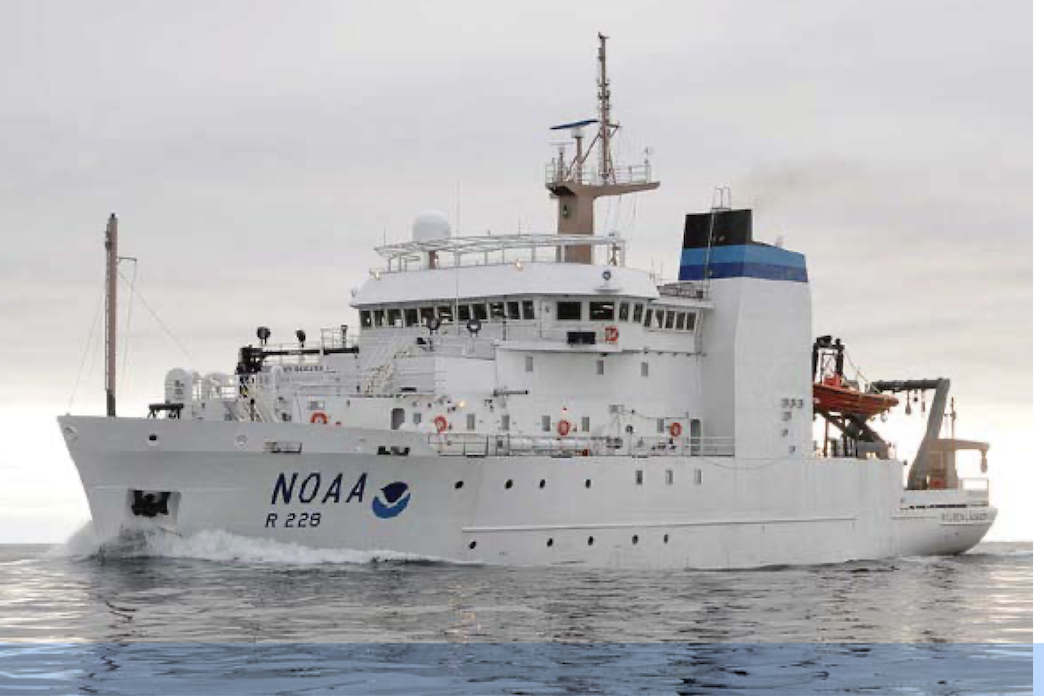
In our survey, we will sample the water above and adjacent to the seamount. We will also be surveying marine mammals and seabirds and their prey and collecting environmental DNA (eDNA) to understand animals that we are not able to observe. This data will help give a more complete picture of oceanography and biology of the entire seamount from its base to the ocean surface and help us to understand connections between climate, ocean conditions and marine life. One goal is to use this data to inform the shipping industry so that ships crossing the Davidson Seamount lower their speed to avoid hitting whales. This work is of great importance to me as I have been saddened by the many whale strikes in the Bay over the recent months. All of our work will be done on board Reuben Lasker, a 208 ft research vessel equipped for both fishery and oceanographic research.
NOAA Ship Reuben Lasker, Photo courtesy of NOAA
While I shared my background in my introductory blog last summer, there have been some new developments. First is the great news that after 9 years of leading student activism to end single use plastics in school meals, we began reusable dishware for school lunch. The change is not just for my school, but will be rolled out in all schools across the district, impacting 9,000 students daily and vastly reducing the plastic waste our schools generate. I am really happy that students will be able to experience more sustainable meals at school — since lunch is school too.
Traditional single-use disposable materialsNew reusable lunch dishes
This school year, I also had the opportunity to travel for 12 days to Antarctica as a Grosvenor Teacher Fellow with National Geographic on the polar expedition ship Endurance. This life-changing experience of exploring the Southern Ocean deeply impacted both myself and my class. We spent the school year diving into a study of Antarctica, interacting with polar scientists and learning of the critical role Antarctica has for the health of our water planet. We discovered how our local actions impact the environment and affect places as far away as Antarctica.
Though I couldn’t take my students on the voyage with me, I did instill in them the curiosity and joy I experienced exploring. Thus, my class became explorers of our local environment — the Berkeley Marina and the San Francisco Bay. In a series of 10 field trips, we learned to identify local birds, trawled and studied plankton and charted and sailed a course on the schooner Pegasus, engaged in multiple beach clean-ups (with data sheets) and camped on the cliffs in Marin overlooking the Pacific Ocean. I hope that through these joyful experiences of learning in nature, my students will be inspired to continue to grow their connection, curiosity and sense of caring for our planet — and especially for our ocean.
The following photos are included courtesy of Oxford Elementary.
Bay scientist studies Trawling as Bay Scientists Beach Clean / Waste Audit Birding at the Berkeley Marina
Sailing on Pegasus (a youth sailing project)
Charting a course to Angel IslandSailing our course to Angel Island
Finally, I am especially excited for my Teacher at Sea experience because Monterey Bay is close to my heart. In 2019, my students and I participated in the Monterey Bay Aquarium’s Ocean Plastic Pollution Summit; it was a life changing 2-day experience where we explored the aquarium at night, slept next to the tanks, listened to inspirational youth ocean activists and connected with students from all over California who were also working to solve the plastic pollution crisis. Many of the students pictured below are still active in working to protect our ocean by volunteering at the Marine Mammal Rescue Center or serving as youth representatives on our city’s Climate Commission.
Ocean Plastic Pollution Youth Summit. Photo courtesy of Monterey Bay Aquarium
As I embark on this voyage of discovery, learning and adventure, these words of the great oceanographer and ocean activist Sylvia Earle, whom I deeply admire, come to mind:
“The ocean is the cornerstone of Earth’s life support system, it shapes climate and weather. It holds most of life on Earth. 97% of Earth’s water is there. It’s the blue heart of the planet — we should take care of our heart. It’s what makes life possible for us.”
With Sylvia Earle and my students (not pictured) in Alameda, CA
Thank you to the scientists and crew of Reuben Lasker for the opportunity to join you in this most important work!
Great for getting the kids involved with the ocean and it’s health. The more people understand the environment the better they will treat it I think.
A suggestion for working on the pier/docks – please wear a life-jacket – when reaching over the edge it is easy to fall in, much safer if a life-jacket is worn.
Sorry but I am laughing with the great leap forward in getting rid of single use plastic food serving items, full circle and reinventing history. When I went to school some 60+ years back there was NO single use plastic inn the cafeteria! The ONLY single use items were the paper napkins, paper straws and the waxed milk carton! The plates, trays and such were all washed and reused. (By the way the only single use anything at the local Coast Guard Galley are the paper napkins)




Great for getting the kids involved with the ocean and it’s health. The more people understand the environment the better they will treat it I think.
A suggestion for working on the pier/docks – please wear a life-jacket – when reaching over the edge it is easy to fall in, much safer if a life-jacket is worn.
Sorry but I am laughing with the great leap forward in getting rid of single use plastic food serving items, full circle and reinventing history. When I went to school some 60+ years back there was NO single use plastic inn the cafeteria! The ONLY single use items were the paper napkins, paper straws and the waxed milk carton! The plates, trays and such were all washed and reused. (By the way the only single use anything at the local Coast Guard Galley are the paper napkins)
But keep up the good work!!