Jacqueline Omania: First Mola Mola and First Days Afloat!

Jacqueline, wearing a Teacher at Sea beanie, sits in an observer's chair anchored to the deck of the flying bridge. She holds a pair of binoculars with both hands. She turns her head from the binoculars to pose for a photo. Beyond, over the railing, we see that the sky is fairly cloudy and the seas are mild.

NOAA Teacher at Sea

Jacqueline Omania

Aboard NOAA Ship Reuben Lasker

July 14 – July 24, 2025

Mission: Oceanographic and Biological Monitoring of Davidson Seamount

Geographic Area: Davidson Seamount/Monterey Bay National Marine Sanctuary

Date: July 16, 2025

Weather Data from the Bridge

Latitude: 35° 42.48’ N

Longitude: 122°  22.29’ W

Wind Speed: 3.1 knots

Wave Height: 3-4 ft.

Air Temperature: 16.2°C/ 61°F

Sky:  Overcast

Science and Technology Log: 

After a day of transit, we reached our location in Monterey Bay National Marine Sanctuary, the Davidson Seamount, an undersea mountain habitat 80 miles southwest of Monterey. At 7,480 feet tall and with its summit still 4,101 feet below the ocean surface, Davidson Seamount is one of the largest known seamounts in U.S. waters. It hosts a large number of deep-sea species-like coral forests, sponge fields, crabs, shrimps and deep-sea fish-as well as a great diversity of marine mammals and sea birds. While the deep-sea habitat of the seamount has been well studied, the area above the top of the seamount has not. Thus, this environment is the focus of our research. We are working to observe marine mammal and bird life and to measure water conductivity (salinity), temperature, and depth (also known as CTD), and to collect environmental DNA (or eDNA, the genetic material shed by organisms in the water) data to give a more complete picture of the rich and interdependent food web above the seamount.

At the moment, we have completed our first day of observations and collections. The scientists work in two groups. One group is on the flying bridge (highest deck) and is observing and recording birds and mammals over a set distance with the ship traveling at the same speed (10 knots) each time.. The other group, in the wet lab, is managing the CTD data and eDNA collection. The chart below shows our CTD data collection stops on the transects over the seamount. We started at 24W and progressed to 24E on day one. Now as I write on day two, we are on 20M.

bathymetric map of the ocean around Davidson seamount, overlaid with straight magenta-colored transect lines. symbols along the transect lines reflect different types of planned sampling: a red circle is CTD only, a yellow circle is CTD and shallow eDNA sampling, and blue square (appearing directly above the seamount) is for CTD, shallow, and deep eDNA sampling. the title of the map is "Davidson Seamount, 50 miles offshore of central California." There's a small inset map in the corner showing the location of the seamount off the coast of California, south and offshore of Monterey.
Map of planned transects around Davidson Seamount.
Image Credit: Chad King/MBNMS

What is a CTD?

A CTD rosette is an instrument used to measure conductivity, temperature and depth. Conductivity readings tell us how  salty the water is because salinity affects how electricity moves through water. The device is a large cylindrical instrument, with a circle of 12 Niskin bottles, that is lifted by a very large winch and pulley system into the ocean. The caps to the bottles are open as the CTD rosette descends into the ocean. The device itself electronically collects CTD data along the round trip to 1000 meters and will do so at every location on the transect both in the day and in the night. For the water samples which capture the eDNA, the scientists close the caps on the bottles remotely to capture water at the depth of choice. For our eDNA samples at the yellow dots, we are collecting at 500 meters and the surface (0 meters) as the CTD rosette travels up. For the blue dots, we will collect eDNA at 0m, 500m and 1500-1700m. We are working hard to collect as much data as we can above the Davidson Seamount to better understand the relationship between oceanographic variables and the lives of marine organisms.

two crewmembers wearing white hard hats, life vests, and gloves work to pull the suspended CTD back over the railing and lower it safely onto the deck.
Landing the CTD on deck

Science in the Wet Lab:

Once the CTD rosette returns, the scientists collect sterile samples in small vials. First (image 1), 500ml of water is slowly run through a tube that forces the water through a very fine filter (imagine something like a disk shaped coffee filter). The filter (image 2), captures the eDNA which is then put into a small 2 ml vial with a preservative. This vial (image 3) will be processed by MBARI (Monterey Bay Aquarium Research Institute) which is dedicated to the study of our ever-changing ocean. The eDNA samples will allow scientists to identify species which have been in the area, although we have not physically seen them, by analyzing the genetic materials the organisms have shed. Thus, when combined with the actual physical observations, we will have a more complete picture of the ecosystem at Davidson Seamount.

  • water filtration system set up near a large metal sink. in the sink are two bottles of water, each with a thin tubes extending up through a black filtration apparatus attached to a piece of plywood.
  • close up view of two purple latex-gloved hands preserving a water filter; the right hand uses tweezers to stick a round filter (about the size of a quarter) into the sample bottle the left hand is holding. on the metal table below we see a green tray for holding small vials and a blue tray for holding larger ones.
  • close up view of a hand holding a roll of printed labels with QR codes. in the background, on a table surface, are datasheets and notebooks.

Science on the Flying Bridge: 

The flying bridge, the highest deck on the ship (about 50 ft. above sea level), is where the mammal and bird scientists work. They divide the areas of observation into two 90 degree quadrants facing the direction of travel. Observations are recorded at specific time intervals from 7:30 am to 5 pm and only happen when the ship is traveling. As the observers call out, a recorder enters the data. There is a special order in which behaviors and details are entered. For birds the order of details recorded is: species, number, distance from ship (100m, 200m etc.), behavior (sitting on water, eating etc.) and direction of flight. For marine mammals, the order is: how first seen, what method (eye, binoculars), direction from ship, reticule (distance taken from binocular lines), animal’s activity, age/sex, species, number and any other comments. Since there are 4 observers calling out, taking turns is necessary. Also spotting a mammal takes precedence over birds- so mammal observers are allowed to interrupt and share their observations. All of this data is compiled daily. On our first day, we noted 331 sightings of which 284 were birds and 47 mammals. Today, Wednesday, we had 303 observations with 274 birds and 29 mammals. Most of the birds today were Red-necked Phalaropes and the mammals were fur seals. Red-necked Phalaropes, of which we saw 107 individuals, breed in the Arctic and then migrate to winter in South America.

view of an upper deck with a shade covering. nine people are visible along the railing; two tit on higher chairs while the rest stand. they all face away from the camera. the sky and the sea are gray.
The Flying Bridge
Mammal and bird scientists

All of this research is possible through excellent teamwork. Just as in our school, Oxford Elementary, we have a team of the principal, a secretary, teachers, instructional assistants, specialists, afterschool staff, maintenance and food service, our work on Rueben Lasker requires a team of the scientists, the ship crew and the NOAA Corps officers. I am part of the science team which is led by chief scientist Chad King from Monterey Bay National Marine Sanctuary and has four scientists from the sanctuary and four from Point Blue, a conservation organization that works both on land and sea. In future blogs, I will be spotlighting members of both the science team and the ship team to share their work.

Personal Log:

My first days on the ship have been wonderful. The entire community is so welcoming and are always checking in and willing to share their work. I have learned a great deal of new vocabulary that is important to get around the ship. My room is called “a stateroom,” the bathroom “a head,” and each floor is a “deck.” We eat in the dining room called the “ mess” and the food is made in the “galley” (kitchen). The front of the ship is “bow” and the back “stern,” while the right side is “starboard” and the left is “port.” I am learning my way around the ship- it is a bit of a maze of doors and levels. The first day, I spent an hour going up and down and around trying to find the acoustic lab to join the card games without luck. Now my orientation is better, and I know where the acoustic lab is; each day, though, I continue to notice more special doors or sections of the ship that I have never seen before. 

I feel incredibly safe at sea due to the great teamwork. Chad, our chief scientist, meets with NOAA Corps and the crew twice a day- at sunrise and sunset- to discuss operations and gain feedback on the day. Our science team also meets at 8 pm daily to discuss both science and general well-being. On our second day at sea, the entire ship had both a fire drill and an abandon ship drill. For the fire drill, we had to go to our muster station- indicated on our bunk card – and wait for the ship crew to do their practice. This experience is much like fire drills at school where we make sure everyone is accounted for. For the abandoned ship drill, we had to put on the red survival suit. We were lucky we got to practice in the mess. It is a bit like struggling into the most awkward Elmo costume. Once you get your hands in, you lose dexterity and yet you still need to zip up your suit and pull up the head covering all on your own. With coaching by NOAA Corps officer, Lt. Mike Fuller, I made it! This suit will give you insulation and buoyancy to prevent hypothermia and drowning in case of the need to abandon ship.

close-up view of a card attached by a magnet to a metal door. It reads: TAS Omania, Jacqueline. and then lists three sets of muster locations for Fire & Emergency, Abandon Ship, and Mariner Overboard. The three scenarios also include depictions of the corresponding morse code, shown as boxes or rectangles
Emergency Bunk Card

Life aboard Rueben Lasker is quite comfortable. I share a stateroom with Amity Wood, who works with Monterey Bay National Marine Sanctuary in education and communication. She kindly let me have the bottom bunk. We have our own bathroom and shower and lockers to store our clothes in. Now, a few nights in, I am getting used to sleeping with the constant rocking. Overall, life aboard the ship is like being forever in a fun house. Everything moves- the hallways, the doors, the decks and the ladder like stairs. As you walk, you learn to keep your steadiness and constantly adjust despite it all. Metaphorically, this skill of always adjusting and adapting yourself to stay balanced no matter what happens is a great life skill.

The highlight of my experience so far is being able to spend my day 50 ft above sea level on the flying bridge surrounded by the deep blues to silver greys of the ever-changing Pacific Ocean. We began with amazing views of the Bay Bridge and the Golden Gate Bridge after we left our port of Alameda. Though I know the San Francisco Bay well, the chance to see it with the birds’ eye view was a special gift. I could see details I’d never seen before- such as the inside of a container loader’s cabin and the underside of both bridges. 

view of a large bridge from underneath. the sky is blue with some haze. the water is mostly still - only a fine ripple - and we can see the shadow of the bridge on the water's surface. at the far end of the bridge is a city skyline with high rises; beyond that, a distant mountain range.
Oakland Bay Bridge
view of Golden Gate Bridge as the ship approaches from the east; we see the hills of Marin beyond the span. the top of the bridge is obscured by fog.
Golden Gate Bridge
view of the Golden Gate Bridge as seen from directly underneath: a long black span stretching above our heads. at the far end of the bridge we can see the hills of Marin partially obscured by fog. the sky is gray and cloudy, another vessel motors toward this, leaving a wake.
Golden Gate Bridge
ten people pose for a group photo on an upper deck of NOAA Ship Bell M Shimada; they have timed it so that the Golden Gate Bridge (shrouded in fog) is centered behind them. Most people wear jackets, hats, and sunglasses.
Science Team

Once we left the Bay, heading toward Monterey Bay National Marine Sanctuary, we sailed past several humpback whales, brown pelicans and cormorants. Each day, I learn more about scientific animal observation. I now know how to first spot an animal with your eye and then bring your binocular up to your face at the line of vision. You must not look down ever in the process or you will lose the animal you are focusing on. I am fairly new to birding- even though I started birding with my class this year. We gave ourselves the challenge to learn 6 local Berkeley birds and experienced birding at the Berkeley Marina, where most children saw their first ‘lifer’ – the Great Blue Heron. I’d love my students to see me now– as I am seeing ‘lifers’ every hour of the day! (A ‘lifer’ is the first time a bird species is seen by an observer.)

Jacqueline, wearing a Teacher at Sea beanie, sits in an observer's chair anchored to the deck of the flying bridge. She holds a pair of binoculars with both hands. She turns her head from the binoculars to pose for a photo. Beyond, over the railing, we see that the sky is fairly cloudy and the seas are mild.
Observing on the Flying Bridge

Animal observation takes time and patience and precision. At first, every time I spotted an animal, by the time I lifted the binoculars, it was gone. With practice, I’ve gotten better and each day is filled with wonder. I have a goal to personally see at least one new species a day. On Monday it was a Black-footed Albatross. On Tuesday, after missing out time after time…. I actually saw -– a Mola mola!

Did you know?

The Mola mola, also known as Ocean Sunfish, is the heaviest bony fish in the world. They can be up to 14 feet long and weigh 4,400 pounds. They average at 550-2200 pounds. Mola mola are silvery grey with a tiny mouth, big eyes, a flattened body and no tail. Because they spend much of their time near the surface, they are very sensitive to entanglement and plastic pollution. In my sighting, I saw the dorsal fin first and then the giant body through the water. You can see Mola mola at the Monterey Bay Aquarium.

top down view of a mola mola swimming at the ocean surface
Mola mola in the ocean. Photo Credit: NOAA
A vivid view of a mola mola swimming underwater, possibly in a tank
Mola mola. Credit: The Nature Conservancy.

Jacqueline Omania: A Second Chance! July 9, 2025

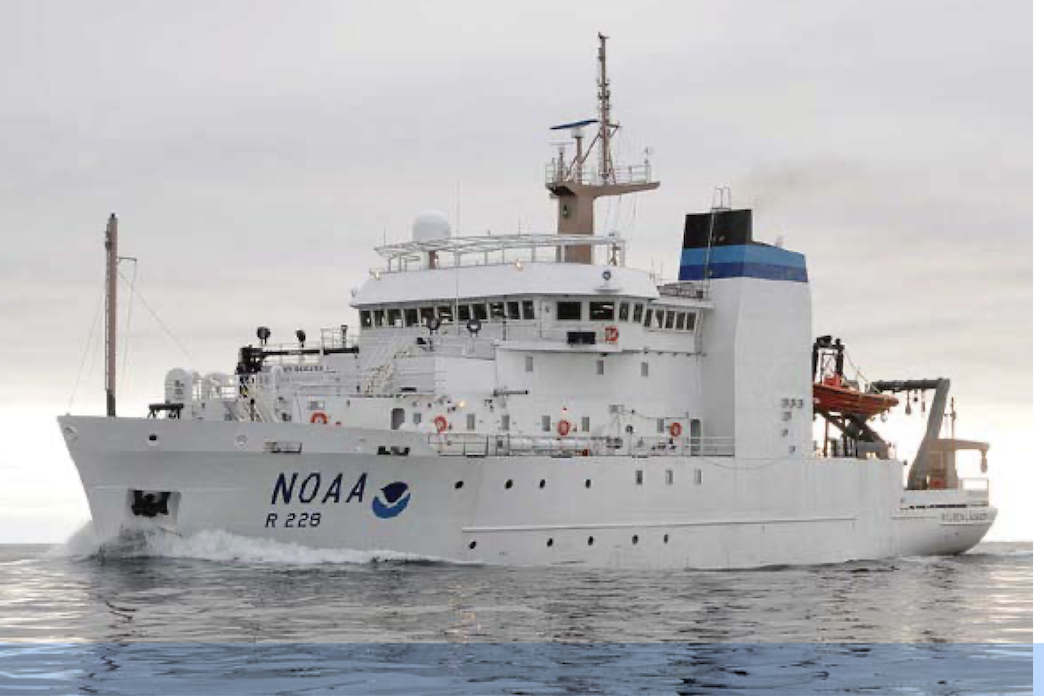
view of NOAA Ship Reuben Lasker underway, as seen from an adjacent vessel. The ship is painted white, and we can see the NOAA logo, the acronym NOAA, and the hull number R 228 painted on the hull.

NOAA Teacher at Sea

Jacqueline Omania

Aboard NOAA Ship Reuben Lasker

July 14- July 24, 2025

Mission: Oceanographic and Biological Monitoring of Davidson Seamount
Geographic Area of Cruise: Monterey Bay National Marine Sanctuary
Departure Port: Alameda, CA
Arrival Port: Alameda, CA

Date: July 9, 2025

Yes, I am back for a second chance! Last year, after a wonderful orientation at the Coral Lab in Galveston, I unexpectedly came down with Covid just days before my cruise on Thomas Jefferson. Thanks to the Teacher at Sea Program and specifically the support of Emily Susko, I was placed on a new cruise on Reuben Lasker in the Monterey Bay National Marine Sanctuary. I am so grateful for this chance to sail and learn in my local marine sanctuary. Easier yet, the port of departure- Alameda- is just a 20 minute drive from my home in Berkeley!

In this cruise, the Monterey Bay National Marine Sanctuary (MBNMS) will be working with Point Blue Conservation Science and the Monterey Bay Aquarium Research Institute to study the Davidson Seamount. The Davidson Seamount is an undersea mountain that rises 8,000 feet above the sea floor and hosts a unique ecosystem due to the nutrient rich waters that are pushed to the surface. It is located 50 miles offshore of central California. I am very excited to learn more about seamounts!

In our survey, we will sample the water above and adjacent to the seamount. We will also be surveying marine mammals and seabirds and their prey and collecting environmental DNA (eDNA) to understand animals that we are not able to observe. This data will help give a more complete picture of oceanography and biology of the entire seamount from its base to the ocean surface and help us to understand connections between climate, ocean conditions and marine life. One goal is to use this data to inform the shipping industry so that ships crossing the Davidson Seamount lower their speed to avoid hitting whales. This work is of great importance to me as I have been saddened by the many whale strikes in the Bay over the recent months. All of our work will be done on board Reuben Lasker, a 208 ft research vessel equipped for both fishery and oceanographic research.

view of NOAA Ship Reuben Lasker underway, as seen from an adjacent vessel. The ship is painted white, and we can see the NOAA logo, the acronym NOAA, and the hull number R 228 painted on the hull.

NOAA Ship Reuben Lasker, Photo courtesy of NOAA

While I shared my background in my introductory blog last summer, there have been some new developments. First is the great news that after 9 years of leading student activism to end single use plastics in school meals, we began reusable dishware for school lunch. The change is not just for my school, but will be rolled out in all schools across the district, impacting 9,000 students daily and vastly reducing the plastic waste our schools generate. I am really happy that students will be able to experience more sustainable meals at school — since lunch is school too.

This school year, I also had the opportunity to travel for 12 days to Antarctica as a Grosvenor Teacher Fellow with National Geographic on the polar expedition ship Endurance. This life-changing experience of exploring the Southern Ocean deeply impacted both myself and my class. We spent the school year diving into a study of Antarctica, interacting with polar scientists and learning of the critical role Antarctica has for the health of our water planet. We discovered how our local actions impact the environment and affect places as far away as Antarctica.

Though I couldn’t take my students on the voyage with me, I did instill in them the curiosity and joy I experienced exploring. Thus, my class became explorers of our local environment — the Berkeley Marina and the San Francisco Bay. In a series of 10 field trips, we learned to identify local birds, trawled and studied plankton and charted and sailed a course on the schooner Pegasus, engaged in multiple beach clean-ups (with data sheets) and camped on the cliffs in Marin overlooking the Pacific Ocean. I hope that through these joyful experiences of learning in nature, my students will be inspired to continue to grow their connection, curiosity and sense of caring for our planet — and especially for our ocean.

The following photos are included courtesy of Oxford Elementary.

Sailing on Pegasus (a youth sailing project)

Finally, I am especially excited for my Teacher at Sea experience because Monterey Bay is close to my heart. In 2019, my students and I participated in the Monterey Bay Aquarium’s Ocean Plastic Pollution Summit; it was a life changing 2-day experience where we explored the aquarium at night, slept next to the tanks, listened to inspirational youth ocean activists and connected with students from all over California who were also working to solve the plastic pollution crisis. Many of the students pictured below are still active in working to protect our ocean by volunteering at the Marine Mammal Rescue Center or serving as youth representatives on our city’s Climate Commission.

a group photo of seven students and Jacqueline, in matching black shirts, in front of a backdrop that is printed with a school of fish and the words Monterey Bay Aquarium Ocean Plastic Pollution Summit
Ocean Plastic Pollution Youth Summit. Photo courtesy of Monterey Bay Aquarium

As I embark on this voyage of discovery, learning and adventure, these words of the great oceanographer and ocean activist Sylvia Earle, whom I deeply admire, come to mind:

“The ocean is the cornerstone of Earth’s life support system, it shapes climate and weather. It holds most of life on Earth. 97% of Earth’s water is there. It’s the blue heart of the planet — we should take care of our heart. It’s what makes life possible for us.”

a photo of two women leaning toward each other and smiling for the camera. Jacqueline, on the right, holds up a handwritten note that reads: "To the Zero Waste Class - Bravo! With admiration and thanks for all you are doing to make a difference. Sylvia Earle.  December 2017."
With Sylvia Earle and my students (not pictured) in Alameda, CA

Thank you to the scientists and crew of Reuben Lasker for the opportunity to join you in this most important work!

Kimberly Godfrey: Night time..Day time! June 10, 2018

NOAA Teacher at Sea

Kimberly Godfrey

Aboard NOAA Ship Reuben Lasker

May 31 – June 11, 2018


Mission: Rockfish recruitment and ecosystem assessment survey

Geographic Range: California Coast

Date: June 10, 2018

Data from the Bridge

Latitude: 36° 39.980′ N

Longitude: 122° 33.640′ W

Wind: 30.87 Knots from the SE

Air Temperature: 12° C

Waves: 2-3 feet with 6-8 foot swells

Science Log

As you may have gathered from my previous blogs, I spent my time working with the night scientists. However, there was a lot happening during the daylight hours that I would like to highlight. There was a separate team assigned to the day shift. Some of their tasks included analyzing water samples, fishing, and surveying marine mammals and seabirds.

Catching fish during the day allowed them to see what prey were available to diurnal predators, and they could also compare their daytime catch to the evening catches. They used a different net called a MIK Net, which is a smaller net used for catching smaller and younger fish.

MIK Net
The MIK net used by the day time scientists to catch juvenile fish.

The day shift is also the best time for spotting seabirds and marine mammals. Some of the bird species spotted included brown pelican, common murre, terns, black-footed albatross, shearwaters, and at least 1 brown booby. The marine mammals we spotted included humpback whales, fin whales, blue whales, common dolphins, and sea lions.

I had an opportunity to speak with Whitney Friedman, a postdoctoral researcher with NOAA, and she explained to me some of the goals of their marine mammal survey. Many may recall that there was a time when whale populations, especially humpback whales, were in significant decline. Today, humpback whales are considered a success story because of rebounded populations. The concern now is monitoring the success of their food sources. Humpback whales feed on krill and fish like anchovies. However, it is possible that when these sources are less available or as competition increases, they may feed on something else. The question is, what is that something else? During this survey, one goal was to collect whale scat for analysis. Studies have found that some seabirds feed on juvenile salmon incidentally when their preferred local prey is limited, and they move inshore to feed on anchovy. Is it possible that whales might do the same? What else might they be foraging on? Unfortunately, we did not have much luck catching whale scat this time around, but they will try again in the future, and hopefully will find the answers they are looking for.

As previously mentioned, we also did water quality tests and took water samples using the Conductivity, Temperature, and Depth (CTD) Rosette. This instrument has multiple functions. As the initials suggest, it detects conductivity (the measure of how well a solution conducts electricity) and temperature at any given depth. Salinity (the amount of dissolved salts and other minerals) and conductivity are directly related. By knowing the salinity and temperature, one can determine the density. Density is one of the key factors that drives the ocean currents. Many species depend on the ocean currents to bring in nutrients and food. It all comes full circle.

CTD
CTD Rosette used to capture conductivity, temperature, and depth. We also used this to take water samples at specified depths.

CTD
The CTD is lowered into the water by a winch with the assistance of the deck crew.

When we lowered the CTD we could also take water samples at any given depth. This allowed scientist to test for various parameters. For example, we filtered various water samples to determine the amount of chlorophyll at certain depths. This can help scientists estimate the growth rates of algae, which in the open ocean are called phytoplankton. One of the scientists collected water to analyze for environmental DNA (eDNA). This is DNA that might be left in the air, soil, or water from feces, mucus, or even shed skin of an organism. In her case, she was trying to find a way to analyze the water samples for sea turtle DNA.

I’ve heard of eDNA, but I have never actually understood how they collected and analyzed samples for this information. My understanding is that it can be used to detect at least the presence of an extant species. However, when collecting these samples, it is likely to find more than one species. Scientists can use previously determined DNA libraries to compare to the DNA found in their samples.

Personal Log

We started trawling again on the evening of June 7th. By then we settled ourselves into the protection of the Monterey Bay due to the weather getting bad. While we still had some off-shore stations, we tried our best to stay close to the bay because of the wind and swells. We had some interesting and challenging trawls in this area: lots of jellyfish. Some of the trawls were so full we had to actually drop the catch and abort the trawl. If not, we risked tearing the net. We tried to mitigate the overwhelming presence of jellies by reducing our trawls to 5 minutes instead of 15 minutes, and we still had similar results. One night, we had to cancel the final trawl to sew up the net. I’ve been told that sewing a fish net is an art form. Our deck hands and lead fisherman knew exactly what to do.

Let me tell you my experience with jellyfish during the survey. As you may recall, someone must be on watch for marine mammals on the bridge. This is the ship’s control room that sits on the 5th level above water.

Reuben Lasker
The Bridge of the Reuben Lasker is where we do inside Marine Mammal Watch. This is where the main controls of the ship are located.

From here you can see the surface of the water quite well, which makes it a great spot for the marine mammal watch. It was also great for watching hundreds of moon jellies and sea nettles float right by. It was one of the coolest things to watch. It was somewhat peaceful, especially hanging your head out of the window, the cool air blowing against your face, and the occasional mist of sea spray as the ship’s hull crashes against some of the larger swells. However, that same peaceful state disappears the moment you realize, “I’m gonna have to lift, count, and sort all those jellies!” I wasn’t too concerned about being stung; we had gloves for the sea nettles and the moon jellies were no real threat. However, the sea nettles (Chrysaora fuscenscens) smelled AWFUL, and the moon jellies (Aurelia spp.) are quite large and heavy. I’m honestly not sure how much they weighed; we did measure up to 20 per haul, some of them measuring over 400 mm. Even if they weighed about 5 pounds, lifting 50-60 of them consecutively until the count is complete is enough to get the muscles burning and the heart rate elevated. It was a workout to say the least. I was literally elbows deep in jellyfish. I also wore my hair in a ponytail most of the time. Anyone that knows me knows well enough that my hair is long, and definitely spent some time dipping into the gelatinous goop. I smelled so bad! HAHAHAHA! Nonetheless, it was still one of the most intriguing experiences I’ve had. Even though the jelly hauls proved to be hard work, I enjoyed it.

In those last few days, I felt like I became integrated into the team of scientists, and I felt comfortable with living out at sea. I had a few moments of nausea, but never really got sea sick. I still couldn’t walk straight when the ship rocked, but even the experts wobbled when the ship hit the big swells. Then, that was it for me. By the time I got the hang of it all, it was time to leave. I wish there were more hours in the day, so I could have experienced more of the day time activities, but I still got to see more than I thought I would, and for that I am grateful.

Did you know…

NOAA offers many career options. As a scientist, here are some things one might study:

  • track and forecast severe storms like hurricanes and tornadoes; monitor global weather and climatic patterns
  • Research coastal ecosystems to determine their health, to monitor fish populations, and to create policies that promote sustainable fisheries
  • Charting coastal regions and gathering navigational data to protect the ship from entering unsafe waters

NOAA Corps allows one to serve as a uniformed officer, commanding a ship or piloting aircraft. On NOAA Ships, they need engineers, technicians, IT specialists, deck hands, fishermen, and even cooks (The Reuben Lasker had two of the best, Kathy (Chief Steward) and Susan (second cook)). There are many opportunities available through NOAA, and there is a longer list of amazing experiences one can have working for this organization. If you want to explore in more detail, visit http://www.careers.noaa.gov/index.html