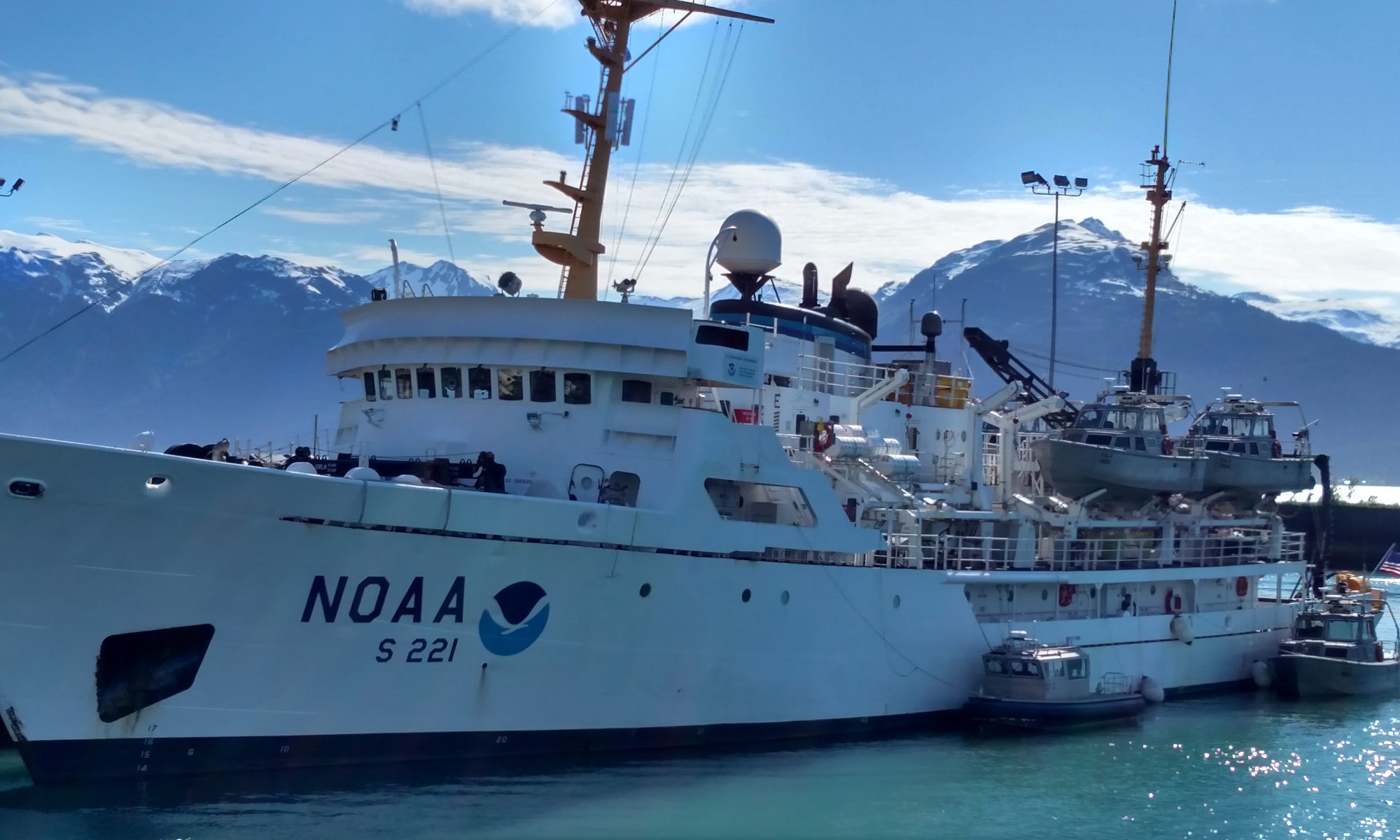
Shelley Gordon: A Day on the Back Deck, July 20, 2019

NOAA Teacher at Sea

Shelley Gordon

Aboard R/V Fulmar

July 19-27, 2019


Mission:  Applied California Current Ecosystem Studies Survey (ACCESS)

Geographic Area of Cruise:  Pacific Ocean, Northern and Central California Coast

Date:  July 20, 2019

Weather data: Wind – variable 5 knots or less, wind wave ~1’, Swell – NW 7’@ 10sec / S 1’ @ 11sec, Patchy fog


Science Log

7:39am – We are about to pass under the Golden Gate Bridge, heading west toward the Farallon Islands.  Several small fishing boats race out in a line off our port side, hulls bouncing against the waves and fishing nets flying in the wind.  I am aboard R/V Fulmar in transit toward data collection point 4E, the eastern most point along ACCESS Transect 4.  The TTG (“time to go,” or the time we expect to arrive at 4E) is estimated at 1h53’ (1 hour, 53 minutes), a figure that fluctuates as the boat changes course, speeds up, or slows down.  

This is my second day on an ACCESS research cruise.  Yesterday I got my boots wet in the data collection methods used on the back deck.  The ACCESS research project collects various types of data at specific points along transects (invisible horizontal lines in the ocean). Today we will be collecting samples at 6 different points along Transect 4.  With one day under my belt and a little better idea of what to expect, today I will aim to capture some of the action on the back deck of the boat throughout the day. 

9:41am – Almost to Station 4E. “5 minutes to station.”  This is the call across the radio from First Mate Rayon Carruthers, and also my signal to come down from the top deck and get ready for action.  I put on my rain pants, rubber boots, a float jacket, and a hard hat.  Once I have my gear on, I am ready to step onto the back deck just as the boat slows down for sample collection to commence.  At this first station, 4E, we will collect multiple samples and data.  Most of the sampling methods will be repeated multiple times through the course of the day at different locations and depths (most are described below). 

deploying hoop net
Dani Lipski and Shelley Gordon deploy the hoop net. Photo: Rachel Pound

10:53am – Station 4EX. We finished cleaning the hoop net after collecting a sample at a maximum depth of 33m.  The hoop net is a tool used to collect a sample of small living things in deep water.  This apparatus consists of an ~1m diameter metal ring that has multiple weights attached along the outside.  A 3m, tapered fine mesh net with a cod end (small plastic container with mesh vents) hangs from the hoop.  Attached to the net there is also a flow meter (to measure the amount of water that flowed through the net during the sample collection) and a depth sensor (to measure the depth profile of the tow).  To deploy the net, we used a crane and winch to hoist the hoop out over the surface of the water and drop the net down into the water. Once the net was let out 100m using the winch, we brought it back in and pulled it back up onto the boat deck.  Using a hose, we sprayed down the final 1m of the net, pushing anything clinging to the side toward the cod end.  The organisms caught in the container were collected and stored for analysis back at a lab.  On this haul the net caught a bunch of copepods (plankton) and ctenophores (jellyfish).

Kate Davis preps samples
Kate Davis fills a small bottle with deep water collected by the Niskin bottle.

11:10am – Station 4ME. Dani Lipski just deployed the messenger, a small bronze-colored weight, sending it down the metal cable to the Niskin sampling bottle.  This messenger will travel down the cable until it makes contact with a trigger, causing the two caps on the end of the Niskin bottle to close and capturing a few liters of deep water that we can then retrieve back up at the surface.  Once the water arrives on the back deck, Kate Davis will fill three small vials to take back to the lab for a project that is looking at ocean acidification.  The Niskin bottle is attached to the cable just above the CTD, a device that measures the conductivity (salinity), temperature, and depth of the water.  In this case, we sent the Niskin bottle and CTD down to a depth of 95m. 

deploying the CTD
Dani Lipski and Shelley Gordon deploy the CTD. Photo: Rachel Pound

12:16pm – Station 4M. Rachel Pound just threw a small plastic bucket tied to a rope over the side of the boat.  Using the rope, she hauls the bucket in toward the ship and up over the railing, and then dumps it out.  This process is repeated three times, and on the third throw the water that is hauled up is collected as a sample.  Some of the surface water is collected for monitoring nutrients at the ocean surface, while another sample is collected for the ocean acidification project.

surface water sample
Rachel Pound throws a plastic bucket over the side railing to collect a surface water sample.

1:36pm – Station 4W. Using a small hoop net attached to a rope, Rachel Pound collected a small sample of the phytoplankton near the surface.  She dropped the net down 30ft off the side of the boat and then towed it back up toward the boat.  She repeated this procedure 3 times and then collected the sample from the cod end.  This sample will be sent to the California Department of Public Health to be used to monitor the presence of harmful algal blooms that produce domoic acid, which can lead to paralytic shellfish poisoning.

Tucker trawl net
Shelley Gordon, Dru Devlin, Jamie Jahncke, and Kirsten Lindquist prepare the Tucker trawl net. Photo: Kate Davis

2:54pm – The final sample collection of the day is underway.  Jaime Jahncke just deployed the first messenger on the Tucker trawl net.  This apparatus consists of three different nets.  These nets are similar to the hoop net, with fine mesh and cod ends to collect small organisms in the water.  The first net was open to collect a sample while the net descended toward ocean floor.  The messenger was sent down to trigger the device to close the first net and open a second net.  The second net was towed at a depth between 175-225m for ~10 minutes.  After the deep tow, a second messenger will be sent down the cable to close the second net and open a third net, which will collect a sample from the water as the net is hauled back to the boat.  The Tucker trawl aims to collect a sample of krill that live near the edge of the continental shelf and the deep ocean.

3:46pm – After a full day of action, the boat is turning back toward shore and heading toward the Bodega Bay Marina. 

5:42pm – The boat is pulling in to the marina at Bodega Bay.  Once the crew secures the boat along a dock, our day will be “done.”  We will eat aboard the boat this evening, and then likely hit the bunks pretty early so that we can rise bright and early again tomorrow morning, ready to do it all again along a different transect line!


Did You Know?

The word copepod means “oar-legged.” The name comes from the Greek word cope meaning oar or paddle, and pod meaning leg. Copepods are found in fresh and salt water all over the world and are an important part of aquatic food chains. They eat algae, bacteria, and other dead matter, and are food for fish, birds, and other animals. There are over 10,000 identified species of copepods on Earth, making them the most numerous animal on the planet.

David Knight: Summer Adventures, June 26, 2018

NOAA Teacher at Sea

David Knight

Aboard NOAA Ship Pisces

July 10-23, 2018


Mission: Southeast Fishery-Independent Survey

Geographic Area: Southeastern U.S. coast

Date: June 26, 2018


Weather Data from my patio in Mission Viejo, California

Latitude: 33.64
Longitude: -117.62
Sea wave height: 0 m
Wind speed: 13 mph
Wind direction: East
Visibility: 8.6 nm
Air temperature: 24 C
Barometric pressure: 1014 mb
Sky: Clear

Personal Log and Introduction

What a summer I am having! I just got back from an eight-day adventure to Belize with sixteen of this year’s AP Biology students. During our trip we hiked in the rainforest both during the day and at night, snorkeled the meso-American reef at South Water Caye, went tubing in a limestone cave, visited the Mayan site of Xunantunich, hiked into the Actun Tunichil Muknal cave system to see Mayan artifacts and remains, and zip-lined above the rainforest in the Mayflower Bocawina National Park. Now I begin preparations for my Teacher at Sea adventure aboard NOAA Ship Pisces. What a life I lead… I sometimes feel as though I am living in a mashup episode of “Dora the Explorer”, “Where in the World is Carmen Sandiego”, and “The Secret Life of Walter Mitty”.

TAS David Knight in Belize
El Castillo temple at Xunantunich. Behind me is Belize and Guatemala. (photo by David Knight)

I have been teaching at University High School in Irvine, California since 1990. UNI was my first and will be my only teaching position—I’ve found a great place and intend to teach there my entire career. The teachers in my department are not only my colleagues, they are my friends. I have so much respect for the staff at UNI because we all work hard to teach and serve the students and share a passion for investing in the lives of kids. The students at the school are motivated to learn, are respectful and encouraging of one another, and are supported by parents that value education. I frequently tell people, “when I got hired at UNI 28 years ago, I won the lottery!”

Throughout my career I have taught all levels of life science, from remedial biology to AP Biology and everything in between. My current teaching schedule includes Marine Science and AP Biology. I began teaching Marine Science four years ago and love the class. In Marine Science we get to study Oceanography and Marine Biology throughout the year so I get a chance to practice some of my physical science skills along with my love of biology. Teaching this class has reinvigorated me and has given me a chance to teach a diverse range of students. I know that my experience as a Teacher at Sea will benefit both Marine Science and AP Biology, but I also hope it will benefit my colleagues at UHS and in the Irvine Unified School District.

As previously mentioned, I just got back from a trip to Belize with my AP Biology students. For the past fifteen years I have been taking groups of AP Biology students outside the United States to see and experience the natural world first-hand. On our trips we have learned about tropical rainforest and coral reef systems, plants and animal diversity, and geology as well as many different cultures and customs in countries like Belize, Costa Rica, Peru, Ecuador, Honduras, Guatemala, and Iceland. My former students tell me that these trips have played an integral part of their high school experience and have given them opportunities to challenge themselves physically and mentally as well as a great appreciation for the world in which we live.

Me and my students
Me and my students on South Water Caye, Belize. (photo by David Knight)

As a Teacher at Sea I will be working with Dr. Nate Bacheler of the NOAA Southeast Fisheries Science Center aboard NOAA Ship Pisces.  The NOAA Ship Pisces is a 208 ft. ship that was designed specifically for fisheries studies. The ship is designed to sail quietly through the water in order to better collect samples using a variety of collection methods including hook and line, traps, and video systems.  During my cruise on NOAA Ship Pisces I will be helping scientists survey snapper and grouper to better understand their distribution and abundance for better management of these economically important species. Additionally, we will be collecting bathymetric and water quality data at various sample sites.


Kimberly Godfrey: Trawl Away! June 6, 2018

NOAA Teacher at Sea

Kimberly Godfrey

Aboard NOAA Ship Reuben Lasker

June 6, 2018


Mission: Rockfish Recruitment and Ecosystem Assessment Survey

Geographic Area of Cruise: Pacific Ocean along the California Coast

Date: June 6, 2018

Data from the Bridge

Latitude: 36° 59.462 N

Longitude: 122° 31.056 W

Wind Speed: 12.77 knots

Wind Direction: Northwest winds

Wave height: 2 to 3 feet with 4-6 foot swells

Air temperature: 12.76° C

Science and Technology Log

Our first official night on the Job was Sunday, June 4th. My shift is technically 6:00 pm to 6:00 am, but we could not begin trawling until the evening when skies were dark. If fish can see the net, they can avoid it. The method we use to catch fish is a midwater trawl, also known as a pelagic trawl, because the net fishes in the water column. It’s called a modified Cobb midwater trawl net. It has a cod end, the narrow end of a tapered trawl net where the catch is collected during the trawl.

Trawl Net
Diagram of a Trawl net used on NOAA Ships

Before we lower the net, the water around the ship must be clear of marine mammals. Thirty minutes prior to each trawl, someone stands the marine mammal watch on the bridge. Once the net is deployed, someone must be watching for marine mammals outside the entire time. If any marine mammals are spotted (this includes dolphins, porpoises, seals, and sea lions), we report it to the officer on the bridge. The rule is that if we spot a marine mammal, the net must be hauled back in and we sail a mile away from the sighting. Marine mammals are protected and we do not want any caught in the net.

When the net is in the water, we trawl for 15 minutes at 30 m deep. Optimal speed is about 2 knots, but that is weather dependent. During this time, our deck crew, and Survey Technician monitor each step of the haul, reporting back to the officer on the bridge. As they haul the net in, the deck hands and Survey Technician work together to make sure the catch goes into the bins for sorting.

Winch
The winch used to deploy and haul in the trawl net on the Reuben Lasker

Trawl net with Cod end
Survey Technician Jaclyn Mazzella, Deck Hands Ethan Skelton and Raymond Castillo, and NOAA Fisheries Intern Thomas Adams dropping the cod end of the net into a bin to collect our catch.

Pyrosomes and salps
First catch of the first trawl. Some fish and squid are present, but this catch was dominated by salps and pyrosomes.

I didn’t know what to expect from our first catch. Maybe we would have some fish, crabs, squid…However the first catch brought something I never saw before. Lots of Thetys!

Thetys
Thetys

Thetys are a type of salp. Salps are planktonic, colonial tunicates from the phylum Chordata. We also had pyrosomes, another type of colonial tunicate. They are efficient feeders, filtering particles of plankton from the water. It is expected that in areas where salps are prevalent, one can expect to find less of other species from the same trophic level.  For this catch, that happened to be the case.

Pyrosomes
Pyrosomes, another type of planktonic, colonial tunicate.

As of today, I officially completed 3 shifts on the job, which included 12 trawls in total. It seems that each catch was dominated by 1 or 2 species. There were other species present, but we had to sort through the catch to find them.

We had a catch that was loaded with anchovies, another with krill, and one full of pelagic red crabs. I find this to be one of the most interesting parts of the work, anticipating what we will find. There are many variables that can impact the productivity of an ecosystem, and therefore can determine what we find. Things like salinity, sea surface temperatures, upwelling, proximity to land or open ocean, and human impact, can all influence an ecosystem.

Anchovies
This is me with Fisheries Intern Thomas Adams, stunned by the amount of anchovies we had in this catch. Photo by Keith Sakuma

Krill
This catch consisted predominantly of krill species. Some catches will have 3 to 4 different species of krill

So, what do we do with our catches once we have them? We count them, and there is a method to the count. Depending on the size of the catch, we may measure out 1,000 ml, 2,000 ml, or 5,000 ml. We start with that first bucket and count every individual (species like krill or salps are measured by volume). The numbers are reported to Keith Sakuma, our chief scientist, and recorded in a handwritten data sheet, then transferred to an excel document. After the first bucket, we may focus on sorting for all other species except the predominant species. For example, for our large anchovy catch, we sorted through approximately 60 liters of fish. We didn’t count every single anchovy, but based on our primary count, we can use the total volume to estimate. However, we sort through looking for all other species and record the findings.

Sorting and Counting
Here we are counting the first 5,000 ml bucket of anchovies. Here you can see we separated out the other species and count them as well.

Leg 2 Team Rockfish Recruitment and Assessment Survey
Here is the team starting clockwise from the left: Melissa Monk, Stephanie Oakes, Thomas Adams, Becky Miller, and Kimberly Godfrey. Photo taken by Keith Sakuma

We will record each species we find, and then we have a list of specified species that need to be measured.  We take the first twenty specimens of each so we have a record of the average size fish caught in that specific location and time. We focus on measuring the species of fish that have the most ecological and economic importance. These are the prey and those that are consumed by us. Therefore, they are also likely to suffer from human impact. Learning about these species are important to the understanding of what makes them successful, and how to mitigate the things that negatively impact their productivity.

Measuring specimens
This is me, measuring species of focus for this survey. Afterward, we bag and freeze those needed for further analysis back on land, and the rest get washed back to sea.

Caliper
Electronic caliper used to measure the specimens. It has a USB cable that connects to the computer and immediately records data into a spreadsheet.

Data Sheet
This data sheet is a record of all the measured species from our catches.

So far this is our routine. Tonight, we had a break from trawling as we transit up to Davenport, just North of Santa Cruz.  The current conditions are not favorable for trawling, so we will get back to work tomorrow evening. While we take it easy, our NOAA officers navigate the ship up the coast. I had the opportunity to speak to our Executive Officer (XO), Lieutenant Commander Emily Rose.

How did you come to work for NOAA?

I went to the University of Hawaii and got my degree in Meteorology. From there, my friend referred me to someone who currently worked in the NOAA Corps. The things she told me about the job piqued my interests, so I applied. I was selected in 2008. There was a 5-month training period, and then I was stationed in Hawaii on the Ka’imimoana, a ship that has since been decommissioned. I was sent to Santa Rosa, CA to work for National Marine Fisheries Service (NMFS) during my first land assignment, then I became the Operations Officer aboard the Okeanos Explorer. Before I joined the Reuben Lasker, I was stationed at the National Centers for Environmental Information (NCEI) in Boulder, CO for 2 years.

Since you have a degree in Meteorology, do you get to use what you’ve learned for your current position?

Every time I’ve been on a ship, I’ve been the defacto weather officer. On the Reuben Lasker, I haven’t had to do too much with weather so far, but on other assignments I’ve done weather presentations and helped others like the CO (commanding officer) interpret weather patterns, and just to provide information to those who are interested in learning. It’s is not a career in Meteorology, but having a degree in a science that relates to what NOAA is beneficial. You use critical thinking skills throughout the job. If there is a challenge, you can come up with a solution. You also have math and physics, and a basic understanding of how things work. All these things help make operations successful.

What is the most important part of your job now?

The most important part of my job is to manage the ship’s crew. I make sure they are put first. I manage their time and attendance, their pay, their leave time, any personnel issues, etc. Anything they need, I am there for them. They are the reason we (the ship) are successful.

What is your favorite part of your job?

All of it! The variety. My job changes from day to day; there are new challenges each day. The variety makes it interesting.

What tool is the most important for you to do your job?

For me I would not be able to do a good job if I did not have a positive attitude. Sometimes we are faced with challenges that are not easy to fix without support and understanding. Having a positive attitude helps me get through it and helps others around me.

I also think it is important to be open-minded and be willing to try new things. There is a lot that we deal with that some have never dealt with before. Having an inquisitive mind and ability to be ready for anything are important.

When you applied for NOAA, did you know this is what you wanted to do?

Yes. Once I applied, I thought it would be pretty cool. I was also thinking about being a math teacher, or to pursue weather in the air force. I’m glad I didn’t because I get to do a whole lot more here than I would if I were in an air force weather center. Once the application process got rolling, and then I got an interview, I thought “Yeah, this is what I want to do.”

Was there something you found surprising about your job when you started?

There were a lot of surprises! You always have an idea of what you expect, but once we all got together for training, we learned something new every day. Some of us had never been on a ship before, some have never driven a small boat, some have never done any charting. And I still feel like I learn something new each day. Everybody that I’m around has a different background and experience, so it’s fun to learn from them.

If you weren’t working for NOAA, what would you be doing now?

I don’t think I would be doing something else. I don’t feel like I’ve missed out on something. In fact, I tell people all the time about what they are missing! I’ve got to do more in this job than I ever thought I would. I’ve been all over the world, included places like Western Samoa, The French Marquesas, and the Marshall Islands.

If you were give advice to a young person considering a NOAA career, what would you recommend?

Anyone who is interested in going into NOAA as a scientist, crew member, or Corps Officer, one important piece would be to study hard and work hard, but keep in mind, grades are not the end-all be-all. Try hard and learn the material, and learn how to problem solve. Don’t be afraid of a challenge, and be ready to give 110% because that will help get you to the next level. For NOAA Corps specifically, having some experience working on a ship and understanding of nautical operations is beneficial. And don’t be afraid to reach out to someone from the NOAA Corps because they are willing to offer guidance.

What are your hobbies?

Sports! I play any sport that you ask me to, but I play on teams for soccer, softball, ice hockey, tennis, and a basketball league not too long ago. When I’m on land, I join as many teams as I can. I love riding my bike. On my last land assignment I went two years riding my bike to work and didn’t drive at all. My husband even bought me snow tires. You name it I’m game!

Did You Know…

  • Before you can set out, you must have multiple permits. Depending on where trawling occurs, one may need a permit for state waters and federal waters. Those conducting research may receive permits to trawl in both state and federal protected areas.
  • We keep some of the specimens for further analysis in the lab (back on land). There are various reasons scientists want to study further, including learning about their genetics, development, and reproduction. One group includes all the juvenile rockfish we find. Please stay tuned for the next blog to learn more about this part of the research.

Kimberly Godfrey: Preparing for the Adventure! May 25, 2018

NOAA Teacher at Sea

Kimberly Godfrey

Aboard NOAA Ship Reuben Lasker

May 31 – June 11, 2018

Mission: Rockfish Recruitment and Ecosystem Assessment Survey

Geographic Area of Cruise: Pacific Ocean along the California Coast

Date: May 25, 2018

Introductory Personal Log

One time, I had the chance to visit California for a conference, and I got to dip my feet into the Pacific Ocean. It was so cold! In less than a week I will be surrounded by Pacific waters as I set sail on NOAA Ship Reuben Lasker for 12 days. The anticipation has been building since I learned of my assignment, and now the time has finally come.

My name is Kimberly Godfrey, and I am the Coordinator of the Women In Natural Sciences (WINS) Program at the Academy of Natural Sciences of Drexel University (yes, that it a mouthful). The Academy (1812) is the oldest natural history research institution in the Western Hemisphere, and WINS just celebrated 35 years. WINS is a science enrichment, after-school program for high school girls in public and charter schools in Philadelphia. Our goal is to provide opportunities for exposure to the natural sciences in ways the students cannot find in the classroom. Our long-term goal is that they take what they learn and turn it into a career.  Most of our participants have had little to no real-world, hands-on science in the classroom, and they share many first-time experiences with the WINS staff and other participants.

WINS Participants peforming stream studies
WINS participants collecting macroinvertebrates to determine the health of a stream in Avondale, PA

WINS 2018 Seniors
2018 WINS Senior Farewell. Of our 15 graduates, 12 are pursuing STEM majors and careers!

That’s my favorite part of being a WINS girl. I can share my experiences and my knowledge with them. I have a degree in Marine Biology, and had the opportunity to participate in marine mammal research for 2 years. I taught about environmental science and wildlife conservation for 10 years prior to working at the Academy.  And, something that is important to me, I am a Philadelphia native who, like these young ladies,  knew little about my urban ecosystem while growing up in the city (the only eagles I ever saw growing up were the Philadelphia Eagles, you know, the 2018 Superbowl LII Champions! You may have heard it a time or two). It wasn’t until I returned from college that I began to explore the world right under my nose. Now I help them explore the wildlife in their backyard, and then push them to branch out of the city, the state, and even across the globe.

Over the past few weeks, I found it difficult to refrain from talking about my upcoming trip. I shared the information I’ve learned so far with some of my girls, and each time I share something new, they become equally excited to follow my adventure at sea. I met with one of the Academy’s fisheries scientists, Paul Overbeck, to learn how to remove an otolith.  Some of my preparation stories have led to a lot of joking and humor. For example, trying on every pair of waders, boots, and waterproof gear that we have, all of which are too big for my size 5 shoe and my 5’0” height; how my freshly caught blue fish dinner turned into a dissection in my kitchen as I practiced removing the otoliths; or how I randomly had the opportunity to meet Sian Proctor, 2017 TAS participant and face of the 2018 TAS application (she happens to be friends with one of my co-workers)! All of this leads to one very anxious and excited woman ready to set sail.

Blue fish otolith
Practicing how to remove an otolith on what was supposed to be my dinner.

Blue fish
Beginning the process of removing a blue fish otolith.

TAS Participants K. Godfrey S. Proctor
Small world indeed! I had the chance to randomly meet Sian Proctor, 2017 TAS Participant.

Quite a few of our girls wish to explore Marine Science as a career, so my plan is to absorb everything I can and bring it back to them. I want them to know the importance of this research, and that this career is truly an option for any one of them. One day, I would love to see a WINS girl aboard a NOAA research vessel, dedicating their careers to the understanding and stewardship of the environment. That’s what NOAA’s mission is all about!

Did you know?

Scientists working with NOAA and the Southwest Fisheries Science Center have been conducting surveys along the California Coast since 1983. Along with rockfish (Sebastes spp.), they’ve been collecting abundance data and size information on other species including Pacific Whiting (Merluccius productus), juvenile lingcod (Ophiodon elongatus), northern anchovy (Engraulis mordax),  Pacific sardine (Sardinops sagax) market squid (Loligo opalescens), and krill (Euphausiacea). The information gathered from these studies is used to examine recruitment strength of these species because of their economic and ecological importance.

Visit NOAA”s website to learn more here https://swfsc.noaa.gov/textblock.aspx?Division=FED&ParentMenuId=54&id=19340


David Amidon: Science @ Sea, June 8, 2017

NOAA Teacher at Sea

David Amidon

Aboard NOAA Ship Reuben Lasker

June 2 – 13, 2017

Mission: Pelagic Juvenile Rockfish Recruitment and Ecosystem Assessment Survey

Geographic Area of Cruise: Pacific Ocean off the California Coast

Date: June 8, 2017


Science and Technology Log

The main scientific research being completed on the Reuben Lasker during this voyage is the Pelagic Juvenile Rockfish Recruitment and Ecosystem Assessment Survey and it drives the overall research on the ship during this voyage. Rockfish are an important commercial fishery for the West Coast. Maintaining healthy populations are critical to maintaining the fish as a sustainable resource. The samples harvested by the crew play an important role in establishing fishery regulations. However, there is more happening than simply counting rockfish here on the ship.

How does it work? Let me try to explain it a bit.


First, the ship will transfer to a specific location at sea they call a “Station.”

IMG_1590
Collection stations off the California Coast that the Reuben Lasker trawls annually.

For a half hour prior to arrival, a science crew member will have been observing for Marine Mammals from the bridge area. When the station is reached, a new observer from the science crew will take over the watch outside on the deck. The fishermen on the boat crew will then unwind the net and launch it behind the boat. It must be monitored from the deck in order to ensure it is located 30 m below the surface. Once everything is set, then the ship trawls with the net at approximately 2 knots. Everything must be consistent from station to station, year to year in order to follow the standardized methods and allow the data recorded to be comparable. After the 15 minutes, then the crew pulls the net in and collects the sample from the net. This process is potentially dangerous, so safety is a priority. Science crew members can not go on the deck as they have not received the proper training.


Timelapse video of the fishermen bringing in a catch. 6/7/17 (No sound)


Once the sample is hauled in, the science personnel decide which method will be used to establish a representative sample. They pull out a sample that would most likely represent the whole catch in a smaller volume. Then we sort the catch by species. After completing the representative samples, they will eventually stop taking counts of the more abundant organisms, like krill. They will measure the volume of those creatures collected and extrapolate the total population collected by counting a smaller representative sample. Finally, we counted out all of the less abundant organisms, such as squid, lanternfish and, of course, rockfish. After the sample is collected and separated, Chief Scientist Sakuma collects all of the rockfish and prepares them for future investigations on shore.  


A selection of species caught off the coast of San Clemente. These include Market Squid, Anchovies, Red Crab, King-of-Salmon (the long ribbonfish), and Butterfish, among others.

NOAA has used this platform as an opportunity. Having a ship like the Reuben Lasker, and the David Starr Jordan before that, collecting the samples as it does, creates a resource for furtAher investigations. During the trawls we have catalogued many other species. Some of the species we analyzed include Sanddab, Salp, Pyrosoma, Market Squid, Pacific Hake, Octopus, Blue Lanternfish, California Headlightfish and Blacktip Squid, among others. By plotting the biodiversity and comparing the levels we recorded with the historic values from the stations, we gain information about the overall health of the ecosystem.

What happens to the organisms we collect? Not all of the catch is dumped overboard. Often, we are placing select organisms in bags as specimens that will be delivered to various labs up and down the coast.

IMG_1519
Collecting subsets for classification

This is a tremendous resource for researchers, as there is really no way for many of these groups to retrieve samples on their own. Rachel Zuercher joined the crew during this survey in part to collect samples to aid in her research for her PhD.

Along with the general species analysis, the team specifically analyzes the abundance of specific krill species. Krill forms the base of the marine ecosystems in the pelagic zone. They are a major food source for many species, from fish to whales. However, different krill species are favored by different consumers. Therefore, an extension of the Ecosystem Assessment involves determining the abundance of specific krill species. Thomas Adams has been responsible for further analyzing the krill collected. He counts out the representative sample and use microscopes to identify the species collected based on their physical characteristics.  

Additionally, at most stations a Conductivity, Temperature and Depth cast (CTD) is conducted. Basically, bottles are sent overboard and are opened at a specified depth.

IMG_1589
The apparatus for collecting water during CTD casts

Then they are collected and the contents are analyzed. Often these happen during the day prior to the Night Shift taking over, with final analysis taking place after the cruise is complete. This data is then connected with the catch numbers to further the analysis. Ken Baltz, an oceanographer on the ship, uses this information to determine the production of the phytoplankton based on the amounts of chlorophyll detected at depth. This is an important part of the food web and by adding in this component, it makes the picture below the surface clearer.


img_1488.jpg
NOAA Corps’ Ryan Belcher completing the CTD collection for a station.

Finally, there are two more scientific investigations running as we cruise the open seas during the daylight hours. Michael Pierce is a birdwatcher from the Farallon Institute for Advanced Ecosystem Research who is conducting a transect survey of Seabirds and Marine Mammals. He is based on the Flying Bridge and catalogs any birds or marine mammals that pass within 300 meters of the ship’s bow. Although difficult, this study attempts to create a standardized method for data collection of this nature. As he explained, birds are more perceptive than we are – what looks like open ocean really varies in terms of temperature, salinity and diversity below the surface. Therefore, birds tend to favor certain areas over others. These are also important components of the food web as they represent upper level predators that are not collected in the trawl net. Also, on the bottom of the ship transducers are installed that are able to gather information through the EK60 Echosounder. This sonar can accurately identify krill populations and schools of fish underwater. Again, adding the data collected from these surveys help create a much more complete understanding of the food web we are analyzing out on the open sea.


IMG_1591
Sonar data from the EK60

Personal Log


Sunday, June 4

The waves were very active all day. Boy am I glad I’m wearing the patch. There was so much wind and the waves were so high, there was a question if we were even going to send the net out. High wind and waves obviously add an element of concern, especially for the safety of the boat crew working the net.

I spent some of the day up on the Bridge- the section of the boat with all of the navigation equipment. The Executive Officer (XO) gave me an impromptu lesson about using the map for navigation. They have state-of-the-art navigation equipment, but they also run a backup completed by hand and using a compass and straightedge just like you would in math class. Of note – the Dungeness Crab season is wrapping up and many fishermen leave traps in the water to catch them. When the boat is passing through one of these areas, someone will act like a spotter so the boat can avoid getting tangled up. When I was looking with him, we saw some whale plumes in the distance.

We did launch the net twice Sunday night, collecting a TON of krill each time. In the first batch, we also caught some squid and other small prey species. The second trawl was very surprising. Despite cutting it down to a 5 minute trawl, we caught about the same amount of krill. We also caught more squid and a lot of young salmon who were probably feeding on the krill.  

IMG_1493
That is a ton of krill!


Monday, June 5

I am getting used to the hours now – and do not feel as guilty sleeping past 2PM considering we are up past 6 in the morning. It will make for a tricky transition back to “the real world” when I go home to NY!

During the day, spent some time just talking with the science folks and learning about the various tasks being completed. I also spent some time up on the Flying Bridge as they said they had seen some Mola, or Giant Ocean Sunfish (although I did not see them). I did have a chance to make a few videos to send to my son Aiden’s 3rd grade teacher back in NY. It did not work out as well as I had hoped, but considering we are out in the middle of the ocean, I really can’t complain about spotty wi-fi.

Once we started the night shift, we really had a good night. We completed work at 5 stations – which takes a lot of time. We saw a LOT of biodiversity last night – easily doubling if not tripling  our juvenile rockfish count. We also saw a huge variety of other juvenile fish and invertebrates over the course of the night. We finally wrapped up at 6:30 AM, what a night!

Tuesday, June 6th

We found out today that we will need to dock the ship prematurely. There is a mechanical issue that needs attention. We are en route straight through to San Diego, so no fishing tonight. However, our timing will not allow us to reach port during the day, so we will get a chance to sample the southernmost stations Wednesday night. Thus is life at sea. The science crew is staying on schedule as we, hopefully, will be back on the water this weekend.

Wednesday, June 7th

After a day travelling to San Diego, we stopped at the stations near San Clemente to collect samples. Being much farther south than before, we saw some new species – red crabs, sardines and A LOT of anchovies. Closer to shore, these counts dropped significantly and krill showed up in numbers not seen in the deeper trawl. Again, I am amazed by the differences we see in only a short distance.


More from our anchovy haul- the bucket contains the entire catch from our second trawl, the tray shows how we analyzed a subset. Also on the tray you find Red Crab, Salps, Mexican Lanternfish and Krill.