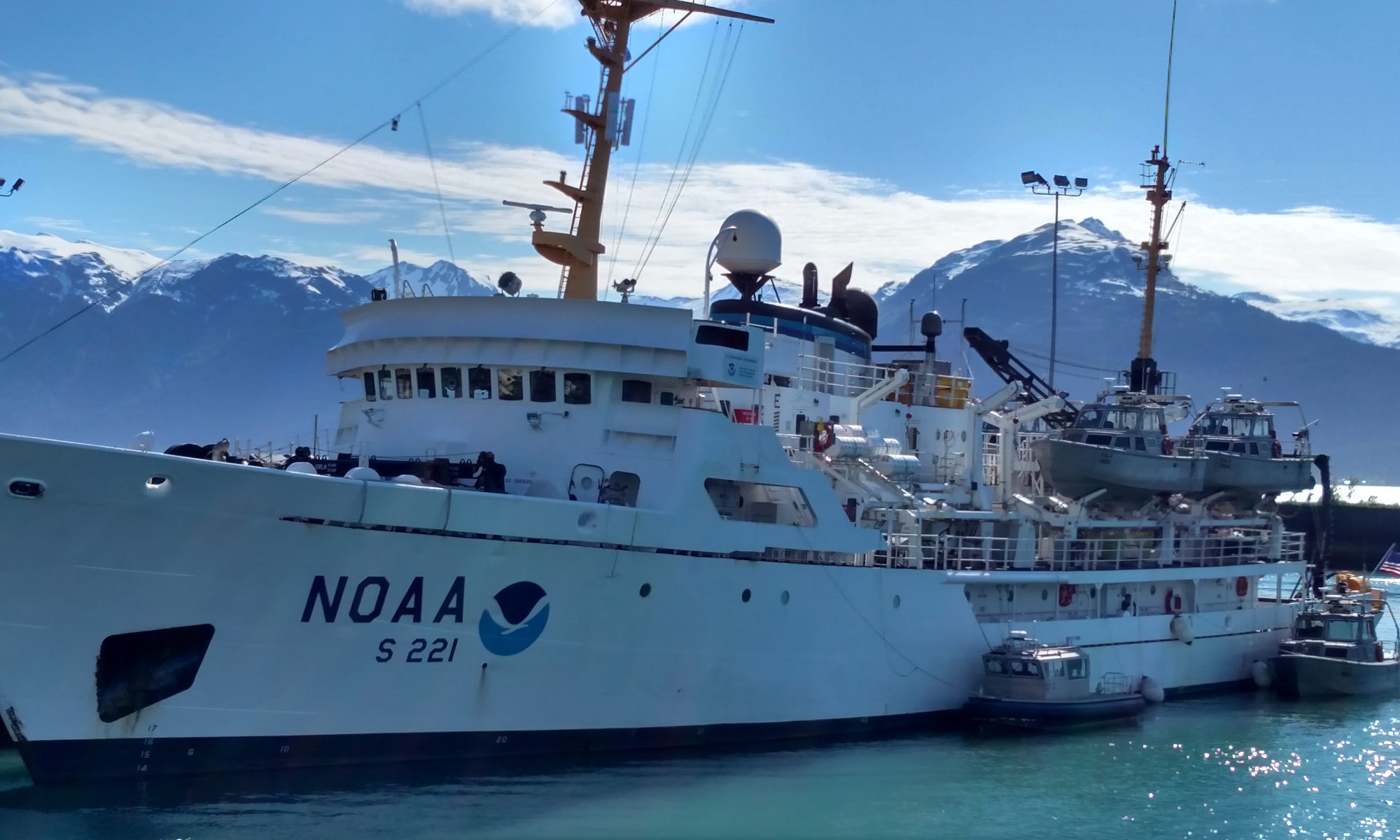

NOAA Teacher at Sea
Cheryl Milliken
Aboard NOAA Ship Oregon II
July 25 – August 10, 2025
Mission: Bottom Longline Survey, Leg 1
Geographic Area of Cruise: Atlantic Coast of Florida
Date: August 1, 2025 (11:00 AM)
Weather Data from the Bridge
Latitude: 30° 30.1’N
Longitude: 081° 12.6′ W
Wind speed: 10 kts.
Wave height: 0-1 ft.
Air temp.: 31.5° C (89° F)
Sky: Clear
Science and Technology Log
“Fish on!” is what is called out whenever we have a fish on a hook. Everyone springs into action to collect data on the fish as efficiently as possible so it has a better chance of surviving. Their success is evidenced by the number of shark tags that have been returned after this release. Wednesday we caught a large female tiger shark that had been tagged by scientists out of the Apex Predators Program out of the NOAA Fisheries Narragansett lab. Here is a link to the work they conduct in that lab: https://www.fisheries.noaa.gov/new-england-mid-atlantic/atlantic-highly-migratory-species/northeast-shark-research. We are awaiting information about the tagged individual (where and when it was tagged, how much it has grown since she was tagged) from scientists in Narragansett.
NOAA Fisheries has been conducting the Southeast Bottom Longline Survey for 30 years! Scientists and crew participating in the survey have vital scientific data on sharks and finfish in U.S. waters from Cape Hatteras, North Carolina, to the Florida Keys and through the Gulf of America.
Each year, survey stations—randomly selected before each cruise—are sampled in both shallow and deep waters. Scientists and crew use standardized fishing protocols to collect data on abundance, distribution, size, sex, and maturity of captured species. For bony fish, they also remove otoliths—tiny calcareous structures in the ear—to count growth rings and estimate age, similar to how one might age a tree.
This long-term, standardized dataset is an invaluable resource. It provides critical baseline information about marine ecosystems, which is especially important when natural disasters strike. Managers can refer to this historical data to understand pre-disaster conditions and guide recovery efforts.
Best of all, the entire database is public. Researchers, policymakers, and curious minds alike can access this wealth of information to support science-based decision-making. Learn more about the Southeast fishery-independent surveys: NOAA Fisheries Southeast Surveys.
Teamwork in Action: Skilled Crew and Augmenters Keep the Survey Moving
This leg of the Southeast Bottom Longline Survey includes several augmenters—crew members temporarily reassigned from other NOAA ships or roles to help out where they’re most needed. Their skills and experience are a welcome asset on board, especially during a time when a federal hiring freeze has led staff to pitch in across vessels.
Among the augmenters are NOAA Corps officers either in training or assisting with training, the ship’s chief steward, and members of the deck crew. Their flexibility and teamwork ensure the survey continues smoothly and safely.


Left to right: Josh with a barracuda he trolled off the stern deck; Chuck Godwin in the best hat; Sean reeling in the line at sunset.
Fishing operations on this leg are led by a capable and experienced Deck Department:
- Josh Cooper, Chief Boatswain, has served on board for 3 ½ years.
- Chuck Godwin, the lead fisherman, brings years of experience working aboard NOAA Ship Oregon II.
- Sean Gronquist, a skilled fisherman, just celebrated his one-year anniversary on board this week.
- Aaron Walton, a seasoned Lead Fisherman from NOAA Ship Bigelow out of Rhode Island, is augmenting the night watch team.
- Malachi Olson, a contractor, is also supporting night operations as an augmenter.
During fishing operations, this team handles critical tasks: setting longlines, hauling them back in after one hour, and moving a specialized mesh cradle into place when large sharks are brought aboard. Their coordination and expertise are essential to ensuring the data collection is efficient, humane, and safe for both crew and animals.
Interview with Sean Gronquist
This interview is with skilled fisherman Sean Gronquist. He has been around the Atlantic Ocean his whole life, but on NOAA Ship Oregon II for a year. Growing up, Sean and his friends used to take all kinds of watercraft out into the Intracoastal Waterway around St. Augustine, FL, from a dock behind his house. He learned some basic mechanics from his friend, Jordan, who was able to fix 2-stroke engines on the fly when they were out on the water together.
Sean graduated from the University of North Florida with a degree in anthropology and a dream to be an underwater “Indiana Jones.” He earned his captain’s license and worked as a charter fishing captain for 15 years, where the focus for him was locating the target species of his clients to catch whatever they requested, if possible. Sean literally helped customers check items off their bucket list (he runs Uno Mas Fishing Charters out of Stuart, FL). He could return to this profession if he ever needed to, but for now he finds joy in working toward the important goal of figuring out how many fish are off the southeastern coast of the US.
Why is your work important?
“We collect data that is used by multiple groups to set quotas or limits on fisheries. We’re one of the longest running surveys.”
What do you enjoy most about your work?
“Even during transits, no two days are the same. Straight up, I fish for the government. The fact that I found a job that pays me to do what I’m passionate about, you can’t beat it. I learn something new every day. “
What is the most important tool that you use for your job?
“My answer is simple: a sharp pocket knife comes in handy all the time. You can cut something, open things, all sorts of uses. “
If you could invent any tool to make your work more efficient and cost were no object, what would it be and why?
“It would have to be something to keep weeds off the line, a weedless spring to remove the sargassum weed from the trolling line. We fish off the stern when we have finished all that we need to do, and it’s a pain to have to pull in the lures all the time because they’re fouled with sargassum.”
When did you know you wanted to pursue an ocean career?
“I’ve always known I wanted that. I grew up on the water, so I just needed to figure out how to make a career out of it. I did marine mechanics on Yamaha engines at a guy’s shop but realized that the owner of the shop would always make a lot more money than I would. I did finish carpentry, too, but ultimately I decided to put down a hammer and picked up a wrench.
“My great grandfather was a merchant marine, and my grandfather was a See Bee in the Navy in Okinawa in World War II. It ran in my family, so I always figured I’d end up on a ship.”
Personal Log
I am having so much fun and learning so much on this trip. It’s always nice to interact with people who are like-minded about the wonder of the ocean. We have a range of people on this leg of the cruise (it takes 4 legs to sample all of the stations and regions). Here are the people on the day watch with me:
- Trey Driggers, primary investigator for the project
- Gretchen Kruizenga, survey technician (Ms. Fix-It!)
- Tera Winters, survey scientist (and former veterinarian)
- Evan Winters, volunteer entering college at West Florida University when we return
Everyone is pulling their weight (I always feel like I need to step up a little more, but I am trying to keep up at these new tasks) and getting along well. I will try to write more about these new friends in the future.
New Animals Seen
- Spotted dolphins
- Cannonball jellyfish
- Lion’s mane jellyfish
- Tiger sharks (large and small)
- Sandbar sharks
- Leech on the sandbar shark
- Nurse shark
- Bull shark
- Sharpnose shark
- Great hammerhead shark! (the other watch actually saw this shark, but they showed me the pictures! We are in competition now to see who catches the next hammerhead.)
- Two large red snappers!


Photos clockwise, from top left: Spotted dolphins swimming in the wake for fun; Lila holding a baby tiger shark, a favorite!; great hammerhead shark on the longline, prior to hauling up; great hammerhead in the mesh cradle being measured, sexed, and tagged; leech (size approximately 2 cm) in my glove, removed from a large sandbar shark); Tera measuring a red snapper prior to removing otoliths (estimated to be around 15 years old).
Did You Know?
Otoliths, or fish ear stones, are the densest part of a finfish’s body and are made of calcium carbonate, the same material as seashells. They are suspended in a liquid to help the fish to know which end is up and to sense vibrations.


Left: Otoliths from six species aligned at the core and ready to be sectioned. Photo: Sandy Sutherland, NOAA Fisheries. Right: Otoliths removed by Tera from the red snapper in the previous photos.