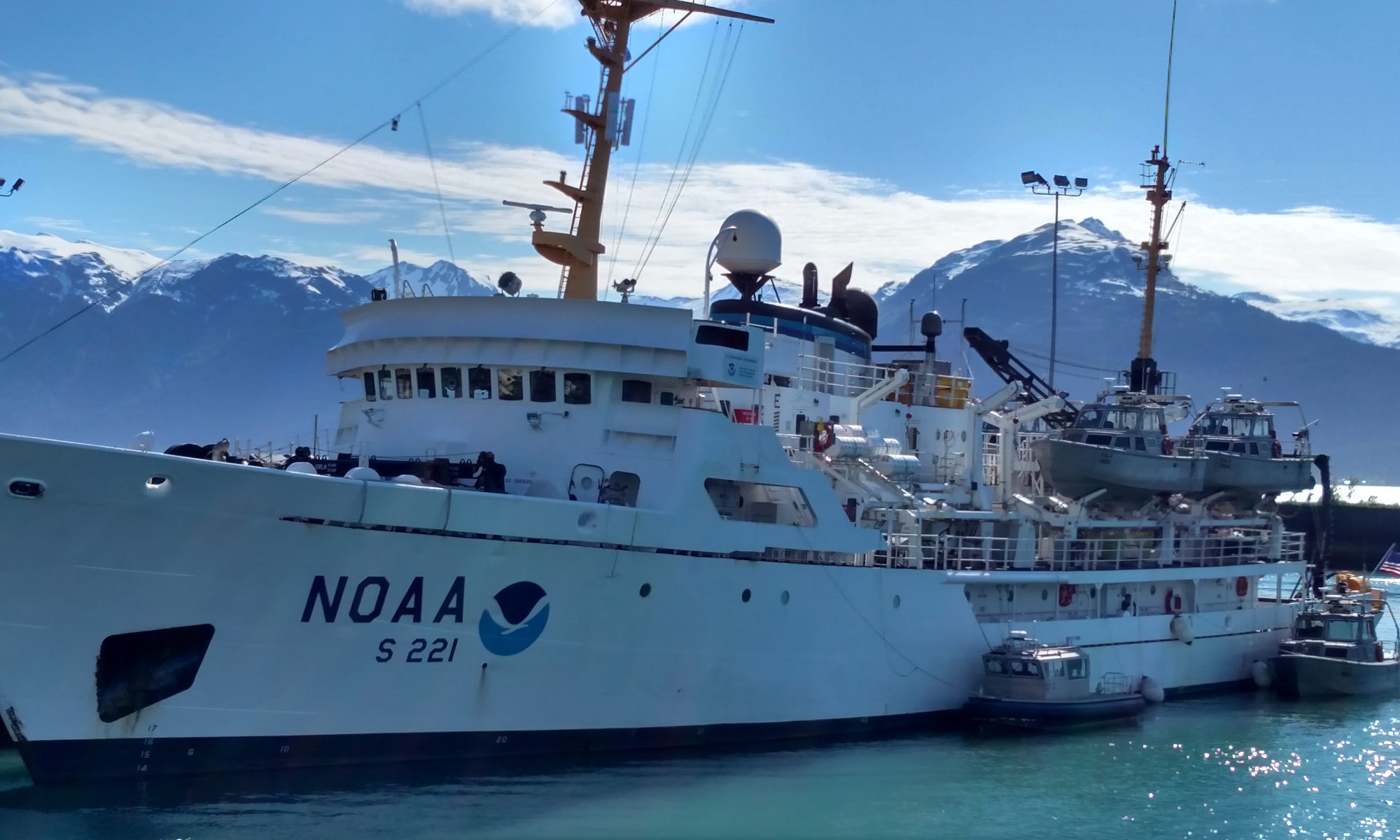
Robert Markuske: Land to Sea, Early Days, August 17, 2025

Robert Markuske 

Aboard NOAA Ship Oregon II

August 13 – 29, 2025

Mission: Long Shark and Snapper Survey

Geographic Area of Cruise: Gulf of America

Date: August 17, 2025

Weather Data from the Bridge:

Greenwich mean Time: 23:51

Latitude: 25 22.739′ N
Longitude: 82 24.980′ W
Relative Wind speed: 2 Knots
Wind Direction: North – Northwest
Air Temperature: 32.8 Celsius
Sea Surface Temperature: 30.8 Celsius

Hello from the Gulf of America. Hereafter, it will be referred to as the Gulf.

We departed the Port of Miami at 14:20pm EST on August 13th. Below are my early experiences leaving port and getting a crash course before our survey starts. It’s been lots of info quickly; from living at sea on the Oregon II, how we fish, why we fish, what we use to fish, and all the different roles NOAA corps, Steward Crew, Deck Crew, Engineer Crew, and Science team do function on the water.

From the Galley; Port Holes Land to SEA

First and foremost, I have better service and internet at sea than I do at homeโ€”definitely better than at New York Harbor School. Maybe itโ€™s time we really bring marine and maritime tech beyond the decorative portholes on our classroom doors. ๐Ÿ˜‰

Although funny, it makes sense. At sea, doing scientific research on fisheries, things need to be a certain wayโ€”for the sake of quality science directives, the life of the organisms studied, and the quality of life for those walking the corridors and decks of the ship. While transiting from port to our first station in the Gulf, itโ€™s been overwhelmingโ€”in a good wayโ€”but exciting, learning all thatโ€™s needed to truly be a part of the crew.

Why does the Oregon II even go to sea?

An assignment given to my students – albeit over the summer – comment on the blogs. Maybe they were hoping Iโ€™d have no internet connection. They were wrong. Letโ€™s get those comments going.

Mission Objectives:

a wide landscape view of NOAA Ship Oregon II in port; Rob, standing on the dock near the ship, is visible at a distance. We can see the NOAA logo, the letters N O A A, and the number R 332 painted on the hull.
Ready to learn and assist in Oregon 2’s objectives
  1. Conduct a study to assess the distribution, abundance trends, life history (age structure, growth, and reproduction), movement patterns, and habitat of coastal sharks and red snapper (Lutjanus campechanus).
  2. Collect biological and environmental data at survey sites (including water quality parameters).
  3. Tag and release sharks.

For some context on fisheries scientific surveys:

Iโ€™m currently on Leg 2. This survey has four legs. A leg is a separate time at sea within the overall survey. In each leg, different stations are worked to reach objectives. This survey runs down the Atlantic Coast from North Carolina to West Palm Beach, FL, then transits back around past the Florida Keys, and into the Gulf to begin sampling again north of the Dry Tortugas. The legs in the Gulf , data is collected at three different depth strata: shallowest and closer to the coast (9-55 m), midway (55-183 m), and farther out on the continental shelf (183-366 m)โ€”bouncing back and forth along shelf as we move up the western coast of Florida..

The gear used on this survey is bottom longline. But firstโ€”safety. Iโ€™ll get to the science and tech in a bit.

Safety Training & Protocol

Before the ship got underway, we went over a lot of safety procedures in case something were to occur while at sea. We went over what emergency signals are: fire is a 10-second alarm, man overboard is three long blasts, and abandon ship is six short blasts and one long. We were given cards that list our locations for where to muster in the event something occurred. We went over protocol and procedures if any of these events happen. While underway, we did some drills.

While on the ship, we did some drills. I would have to say, practicing for an event where I have to abandon ship was a little fun and emotional. Putting on the immersion suit to save my lifeโ€”keeping you warm, afloat, illuminated, and with your head above waterโ€”in the event I need to abandon ship, is an iconic โ€œteacher at seaโ€ shot, I am told. I should have known; we have them at Harbor School. I’ve seen lots of selfies of kids and VIPs in them, but never had the chance. Itโ€™s an exciting and necessary drill aboard a working vessel.

Parachute Flare Training

We were demoed and practiced two types of flares to be used in different emergency situations. It was the best birthday candle I’ve witnessed to date. I got to set off the parachute flare, and some folks lit off other flares with a birthday serenade. It goes without saying, the reusable Grateful Dead birthday candle from Claraโ€”my partnerโ€”is out of the league of candle celebrations. But the flare demo came close.

While underway, I’ve noticed and learned little things I would normally take for granted and that we don’t need on land.

photo of two kinds of work gloves, a white hard hat, and a life vest with the NOAA logo lying in a pile on a metal table that also contains a measuring board.
Not unfamiliar PPE

Red lights at night help preserve night vision and are just being kind to our shipmates. Watch for the red light blinking on top of the engine roomโ€”that means someoneโ€™s coming up the stairs. The office chairs donโ€™t have wheels. The computers and equipment are cantilevered to the wall. Hard hats go on when things are overhead, and a PFD (personal flotation device) goes on when working close to the edge or near the stern. And when handling animals or fishing gear, weโ€™ve got different gloves for different jobs.

a travel mug in a bright pink cone that stops it from rolling, on a wooden table.
BK Roasters doesn’t go rolling

My coffee cup really needs a stabilizer for this table. Honestly, I might bring one of these into the classroomโ€”Iโ€™m forever spilling or misplacing my coffee.

And of course, the big reminder out here: follow directions. Listen, read, communicate. Feels like Iโ€™ve heard that a million timesโ€”pretty much every teacher, whether at sea or on land, says it.

coffee maker
You smell it through the galley.

Life at sea has its own lessons. Out here, everything needs backups, and things have to work a certain way. Weโ€™re living, working, and doing science on a ship that never stops moving and is always a long way from shore.

Shout out to BK Roasters for supplying a critical piece of material for this mission, good smelling, roasted coffee from the Brooklyn Navy Yard in NYC. My shipmates are saying it’s super smooth!

Science and Technology Log

In order to conduct the data collection and research on sharks, lots of scientific protocols and technology, both computer-based and mechanical, go into the survey. First and foremost, we are fishing. The techniques are similar to those of commercial fishermen. On the longline shark and snapper survey, we use bottom longline.

Graphic design illustration bottom longline fishing gear lying on the sea floor with fish swimming nearby. The bottom long line is connected to a blue fishing vessel in the background.
Bottom longline fishing

Bottom longlines have a mainline weighted to the seafloor with buoy lines marked by flags on either end, called high flyers.

Typically, per watch from 12 p.m.โ€“12 a.m. and/or 12 a.m.โ€“12 p.m., there are 3โ€“4 sets, depending on how far away the stations are and conditions in the Gulf. An orchestrated ballroom dance across the Gulf, except the dance floor is wet, moving, with predictable and sudden changes in environmental conditions. Oh right, and sharks. Brings โ€œthe floor is lavaโ€ to a new level.

Gangionsโ€”short lines clipped to the mainline with hooksโ€”are baited and attached to the mainline (4 mm thick). We bait 100 gangions (3 mm thick) with Atlantic mackerel and circle hooks. This one-nautical-mile line is then deployed off the stern. Note: we use a data collection system on a Toughbook to mark, map, and catalog the numbered hooks that are baited to use later on when hauling.

The most interesting thing I learned, or rather donโ€™t emphasize when I teach about fishing gear types, is that longlines are detached from the vessel. There is a winch (like a big reel) that trails the line from the bow to the stern to set the gear and haul the gear. Upon set, it is released from the ship. Upon hauling it in, we reconnect to the harvesting system.

  • a spool of fishing line bolted to a pallet sitting on the deck of NOAA Ship Oregon II, as seen from the side
  • a spool of fishing line bolted to a pallet sitting on the deck of NOAA Ship Oregon II, as seen from the front; there is a sticker with the NOAA logo that reads HARVESTING SYSTEMS
  • view of the fishing line extended across the breezeway, a narrow side walkway
  • view of the fishing line extended down the breezeway
  • view of the fishing line looping around a pulley mounted at the edge of the wall of the breezeway
  • view of the stern, with a barrel lined with gangions and two high flyers lying on deck

To set the longline, itโ€™s deployed in this order:

As things go into the water, data is collected on the gearโ€”quantity and location.

This all happens from the stern (back of the ship) of the Oregon II:

  • Buoy, High-flyer (high visibility, designed and lit) โ€“ tossed out at the station coordinates.
  • Weights โ€“ connected after some slack from the high-flyer to keep the line on the bottom.
  • 50 gangions with bait, numbered 1โ€“50 โ€“ spaced out along half a nautical mile of mainline.
  • Weights โ€“ to keep the middle section on the bottom.
  • 50 gangions with bait, numbered 51โ€“100 โ€“ spaced out along another half nautical mile of mainline.
  • Weights โ€“ attached at the opposite end to keep the line on the bottom.
  • High-flyer, Buoy (high visibility, designed and lit) โ€“ with some slack given after the weight to keep things accurately placed.

During the soak of the 100 gangions, we are also completing water quality data via a CTD Device ( Conductivity, Temperature and Depth) that measures conductivity, depth, temperature, dissolved oxygen, and Ph. I will describe this in more detail in a later post.

CTD water quality monitoring device; Watching data on descent and ascent

After being deployed its time to let the longline soak for an hour. Then we flip it and reverse it with some twists.

A big twist through the whole process is that you will have live animals on the ship that need to be returned to sea. The idea is to study these animals.

Lastly, as you are hauling up the line, you are simultaneously thinking of the next set. For example, keeping numbered gangions in order and placing hooks correctly in the barrel. If not careful, things can get squirrely quickly.

Note: as things come out of the water, data is collected on the gearโ€”quantity, location, and status of the hook. Howโ€™s the bait looking? Is there a fish on!?!?!

Happens from the bow (front of the ship) of the Oregon II:

  • Buoy โ€“ High-flyer (high visibility, designed and lit) โ€“ A grappling hook is tossed to nab the mainline and pull it toward the vessel. The buoy and high-flyer are pulled onto the vessel, detached from the mainline, the mainline is reconnected to the harvesting winch, and the highflyer brought back to the stern.
  • Weights โ€“ Pulled onto the vessel.
  • 50 gangions with bait โ€“ Status of the hook. Howโ€™s the bait looking? Is there a fish on!?!?
  • Weights โ€“ Pulled onto the vessel.
  • 50 gangions with bait โ€“ Status of the hook. Howโ€™s the bait looking? Is there a fish on!?!?
  • Weights โ€“ Pulled onto the vessel.
  • High-flyer (high visibility, designed and lit), buoy

During the hauls, data is collected on the animals; fin clips taken for genetics, sexed, measured, and weighed. Some animals are tagged.


Fish Hauled in the early days of this mission

Silky Shark – Carcharhinus falciformis

Sandbar Shark – Carcharhinus plumbeus

Barracuda – Sphyraena barracuda

Speckled hind – Epinephelus drummondhayi

Yellowedge grouper – Hyporthodus flavolimbatus

Red Porgy – Pagrus pagrus

Tiger Shark – Galeocerdo cuvier

Sharpnose – Rhizoprionodon terraenovae

Gulf Smoothhound – Mustelus sinusmexicanus

Snake Fish – Trachinocephalus myops

Click Common Name for for more info

Personal Log 

I would say writing a personal log is probably the hardest. I’ve been so engaged in learning what we are doing, I haven’t really been thinking about anything other than being a student.

But after some reflection, some workout routines in the corner of the bow, listening to some music, and working off all the great food I’ve been eatingโ€”I am a dessert-after-every-meal type of personโ€”the Chief Steward has won my heart. It’s hard walking past the galley and not grabbing the cooking of the day on a 12-hour shift, in between set and haul.

In the early days of taking this journey, it reminded me of my first year of teaching. With eight hours of doing it, the learning curve is steep and continues to climb. You kind of have no choice, especially when you aren’t getting off the vessel for 17 days.

All in all, I am so grateful for this experience. It’s made me realize how much I underestimate the appreciation I have for both the people who do the work to study our marine life and for those who fish the marine life as a wild food source. It’s a massive world out here on the Gulfโ€”in some distances it’s 800 miles from Texas to Floridaโ€”and on the open ocean. It takes special people both to do the work of studying these animals and to fish them for money.

Instantly, stepping on this ship, it’s place-based learning in stakeholder engagement. It’s a wild world out there. Living and working on a vessel is both a good way and a crash course in stakeholder engagement and cooperation. You kinda have no choice. We could learn a few things on land from the folks that work on the water for research and/or their economic income, specifically when it’s in the realm of fisheries.

Moreover, from the shark wranglers that are my current shipmates.

Animal Sighting:

a brown bird with a long bill rests on a railing of an upper deck of NOAA Ship Oregon II at night
Brown Noddy Chilling

Brown Noddy ( Anous stolidus)

The brown noddy forages over the water and dipping down to catch small squid, other mollusks, aquatic insects and super small fish, like sardines and snatching insects in air too.

AKA -Tuna Bird – Fishermen see it as a sign that tuna are near.

Did you know? 

Sharks are fish.

They live in water, and use their gills to filter oxygen from the water. They don’t have bones. These are a special type of fish known as chondrichthyans because their body is made out of cartilage instead of bones. The further classification of sharks, rays, and skates are known as “elasmobranchs.”

Cheryl Milliken: Sharks off South Carolina, August 3, 2025

NOAA Teacher at Sea

Cheryl Milliken

Aboard NOAA Ship Oregon II

July 25 – August 10, 2025

Mission: Bottom Longline Survey, Leg 1

Geographic Area of Cruise: Atlantic Coast of Florida

Date: August 3, 2025

Weather Data from the Bridge (3:00 PM)

Latitude:     32ยฐ 54.4โ€™ N

Longitude:  079ยฐ 00.3โ€™ W

Wind speed:  18 kts.

Wave height:  1-2โ€™

Air temp.: 28.1 C

Sky:   Clouds

Science and Technology Log

To date, we have caught, tagged, and fin-clipped silky, sharpnose, sandbar, tiger, great hammerhead, blacknose, nurse, and scalloped hammerhead sharks. We have also brought up red snappers, a pale spotted eel, and a blunt-nose lizardfish. I have never seen any of these fishes before, so it has opened a whole new world of sea creatures for me. I am grateful to have this opportunity to explore a region of the ocean with which I am unfamiliar. 

Top row: Scallloped hammerhead shark in mesh cradle; Large tiger shark being hoisted by crane and cradle to be processed alongside the ship (photo courtesy NOAA Corps officer on the bridge); Field Party Chief and PI Trey Driggers lifting red snapper onto cutting table to remove otoliths and eye lenses. Bottom row: Face of scalloped hammerhead shark prior to removal of circle hook; I am holding a sharpnose shark after measuring and fin-clipping it. (Photo by Gretchen Kruizenga).

Personal Log

Living on a ship is much different than living on land. Obviously, weโ€™re on a moving vessel, so the scenery and location are different every time we wake up. As soon as the mooring lines were cast off, we had no access to shopping for anything that we might have forgottenโ€ฆ 

One major change from when I was last aboard a ship 25 years ago is the internet. Thanks to a satellite connection through Starlink, I can now stream movies, call my husband, and scroll through Facebook โ€” even miles from shore. It’s strange but comforting to feel connected to the outside world while being so physically remote.

Our living quarters are compact and communal. On the main deck where we fish, thereโ€™s a toilet and sink, while the lower deck โ€” where we sleep โ€” has two water closets with an adjacent sink. Each stateroom also has a small sink, which makes washing up and brushing teeth a bit easier. For showers, we have two shared ones for the entire crew, so we limit ourselves to ten-minute showers to make sure everyone gets a turn and can get to bed soon after their shift.

Before leaving port, the crew was split into two watches: day watch (12 noon to midnight) and night watch (midnight to noon). Most staterooms house two people on opposite watches, so the person off duty has the room to themselves while the other works. Unfortunately, our bunks are located just below the deck where the fishing line is hauled in, so it gets quite noisy. Sleep is something we grab when we can, knowing it may be disrupted by the sound of the winch or the motion of high seas. I’m on day watch, so my schedule feels more natural โ€” but for those on night watch, sleeping during daylight and staying alert all night is a real challenge.

Yesterday we also launched the second drifter. This one had Falmouth High School stickers, of course, but also the crew of NOAA Ship Oregon II wrote their names, drew, or wrote favorite quotes. It was fun to get everyone on the ship involved in this project! The track of Drifter #1 appears to be keeping up with the ship!

Interview with Trey Driggers

Trey, wearing a life vest and work gloves, stands on deck with his right hand on the rail of the ship and his left resting on a white barrel lined with circle hooks. Behind him, the sky is blue with many gray clouds, and the water is blue-gray with some chop.
Dr. Trey Driggers hauling in hooks during our longline survey.

Trey Driggers is the PI, or principal investigator, of the Southeast Fisheries Science Center Bottom Longline (BLL) Survey. He originally wanted to be a musician playing guitar, but his father said that if he went to military school first, he would pay for college. That seemed like a good deal, so he completed an associateโ€™s degree at Valley Forge Military Academy in Wayne, PA, then continued for a BA in History from Clemson University. 

Trey imagined being a lawyer, but he was always interested in sharks. His fascination with large predators was driven after his childhood dog was eaten by an alligator in his grandparentsโ€™ yard in Florida. He was 8 years old when the movie Jaws came out, and although he was too young to see it, he was intrigued by all the shark-related merchandise that was on the shelves at that time. During his senior year in college, scientists from the Smithsonian Institutionโ€™s National Museum of Natural History released a book entitled, Sharks in Question: The Smithsonian Answer Book. The last section was entitled, โ€œHow Do I Become a Shark Specialist?โ€ He read that and thought, โ€œThat’s a job?โ€ His career goals dramatically changed; now he realized that he could be a shark biologist. After graduating from Clemson, he enrolled in the courses needed to earn another degree in Marine Science. Once Trey had this focus, he became a straight A student. He finished that program in two years.

After finishing his coursework in marine science, Trey applied for graduate school and was accepted into Dr. John Deanโ€™s lab at the University of South Carolina. Dr. Dean was very supportive of his students and is considered one of the godfathers of otoliths, studying ear stones of finfish to determine their age. Treyโ€™s masterโ€™s thesis was on the age and growth of yellowfin tuna. Dr. Dean convinced him to stay in that lab to complete his PhD, as well. Part of his research on blacknose sharks required him to collect fin clips from sharks for a genetic study which was done in part on the Southeast Fisheries Science Center’s Bottom Longline Survey, which solidified his desire to work for the National Marine Fisheries Service. He has been participating in this survey since 1999. The rest is history!

Tell me about your family:

โ€œWe live in Ocean Springs, MS. My wife is a biology teacher in middle school. We met at USC and are both Clemson Tigers. Weโ€™ve been married for 26 years and have three children: Amelia is a biomedical engineer; Boyd is a junior at Ole Miss; and Max is a senior in high school. We have a malinois dog named Lilah and a chihuahua named Oliver.โ€

How did you get your position at NOAA Fisheries?

โ€œIn 2002 I was still a post-doc, but I went to the Resource Surveys Branch Chief at the Pascagoula lab three separate times to ask for a job. I think I finally wore him down and was hired in 2003. In 2012, I became the Shark Unit Leader. Kristin Hannan is my right-hand partner, and Will Tilley complements us both to make a solid team.โ€

What is the most fun part of your job?

โ€œThere are many fun parts of my job. My coworkers and I are very close, and itโ€™s great being around people who have the same interests. I get to see things very few people get to see and I feel very fortunate to have access to the resources that allow me to conduct broad scale research. When I retire, I will know I did exactly what I set out to do and will have achieved my professional goals.โ€

What is the most difficult part of your job?

โ€œI miss important family events such as birthdays, first days of school, etc. The good definitely outweighs the bad, though. Our work helps conservation and fishermen. I feel it’s critical to have boots on the ground when conducting research and in my field there is only one place to do that and that is on the water.โ€

What part of your job with NOAA did you least expect to be doing?

โ€œI least expected the Deepwater Horizon disaster. When that happened, we were told, โ€˜Youโ€™re now forensic biologists,’ and our jobs changed significantly for a time. It was a big adjustment, and a massive effort by many, many people.”

What would you be doing if you didnโ€™t work for NOAA?

“Iโ€™ve thought about that a lot and donโ€™t have a good answer. I do play my guitar 3-4 hours per day, though, and would try to do something with that.”

Did You Know?

Scientists have identified ten different species of hammerhead sharks. We are fortunate to have caught two different species so far!

New Animals Seen:

  • Scalloped hammerhead shark
  • Pale spotted eel
  • Decorator crab
  • Semipalmated plover
out of focus view of a small shorebird walking on a gray surface
Semipalmated plover
(courtesy of Lila Xenakis)
a decorated crab photographed splayed out against a blue surface; we can see some seaweed stuck to it
Decorator crab

Cheryl Milliken: Fish On! August 1, 2025

NOAA Teacher at Sea

Cheryl Milliken

Aboard NOAA Ship Oregon II

July 25 – August 10, 2025

Mission: Bottom Longline Survey, Leg 1

Geographic Area of Cruise: Atlantic Coast of Florida

Date: August 1, 2025 (11:00 AM)

Weather Data from the Bridge

Latitude: 30ยฐ 30.1’N

Longitude: 081ยฐ 12.6′ W

Wind speed: 10 kts.

Wave height: 0-1 ft.

Air temp.: 31.5ยฐ C (89ยฐ F)

Sky: Clear

Science and Technology Log

โ€œFish on!โ€ is what is called out whenever we have a fish on a hook. Everyone springs into action to collect data on the fish as efficiently as possible so it has a better chance of surviving. Their success is evidenced by the number of shark tags that have been returned after this release. Wednesday we caught a large female tiger shark that had been tagged by scientists out of the Apex Predators Program out of the NOAA Fisheries Narragansett lab. Here is a link to the work they conduct in that lab: https://www.fisheries.noaa.gov/new-england-mid-atlantic/atlantic-highly-migratory-species/northeast-shark-research. We are awaiting information about the tagged individual (where and when it was tagged, how much it has grown since she was tagged) from scientists in Narragansett. 

NOAA Fisheries has been conducting the Southeast Bottom Longline Survey for 30 years! Scientists and crew participating in the survey have vital scientific data on sharks and finfish in U.S. waters from Cape Hatteras, North Carolina, to the Florida Keys and through the Gulf of America.

Each year, survey stationsโ€”randomly selected before each cruiseโ€”are sampled in both shallow and deep waters. Scientists and crew use standardized fishing protocols to collect data on abundance, distribution, size, sex, and maturity of captured species. For bony fish, they also remove otolithsโ€”tiny calcareous structures in the earโ€”to count growth rings and estimate age, similar to how one might age a tree.

This long-term, standardized dataset is an invaluable resource. It provides critical baseline information about marine ecosystems, which is especially important when natural disasters strike. Managers can refer to this historical data to understand pre-disaster conditions and guide recovery efforts.

Best of all, the entire database is public. Researchers, policymakers, and curious minds alike can access this wealth of information to support science-based decision-making. Learn more about the Southeast fishery-independent surveys: NOAA Fisheries Southeast Surveys. 

Teamwork in Action: Skilled Crew and Augmenters Keep the Survey Moving

This leg of the Southeast Bottom Longline Survey includes several augmentersโ€”crew members temporarily reassigned from other NOAA ships or roles to help out where theyโ€™re most needed. Their skills and experience are a welcome asset on board, especially during a time when a federal hiring freeze has led staff to pitch in across vessels.

Among the augmenters are NOAA Corps officers either in training or assisting with training, the ship’s chief steward, and members of the deck crew. Their flexibility and teamwork ensure the survey continues smoothly and safely.

Left to right: Josh with a barracuda he trolled off the stern deck; Chuck Godwin in the best hat; Sean reeling in the line at sunset.

Fishing operations on this leg are led by a capable and experienced Deck Department:

  • Josh Cooper, Chief Boatswain, has served on board for 3 ยฝ years.
  • Chuck Godwin, the lead fisherman, brings years of experience working aboard NOAA Ship Oregon II.
  • Sean Gronquist, a skilled fisherman, just celebrated his one-year anniversary on board this week.
  • Aaron Walton, a seasoned Lead Fisherman from NOAA Ship Bigelow out of Rhode Island, is augmenting the night watch team.
  • Malachi Olson, a contractor, is also supporting night operations as an augmenter.

During fishing operations, this team handles critical tasks: setting longlines, hauling them back in after one hour, and moving a specialized mesh cradle into place when large sharks are brought aboard. Their coordination and expertise are essential to ensuring the data collection is efficient, humane, and safe for both crew and animals.

Interview with Sean Gronquist

This interview is with skilled fisherman Sean Gronquist. He has been around the Atlantic Ocean his whole life, but on NOAA Ship Oregon II for a year. Growing up, Sean and his friends used to take all kinds of watercraft out into the Intracoastal Waterway around St. Augustine, FL, from a dock behind his house. He learned some basic mechanics from his friend, Jordan, who was able to fix 2-stroke engines on the fly when they were out on the water together. 

Sean graduated from the University of North Florida with a degree in anthropology and a dream to be an underwater โ€œIndiana Jones.โ€ He earned his captainโ€™s license and worked as a charter fishing captain for 15 years, where the focus for him was locating the target species of his clients to catch whatever they requested, if possible. Sean literally helped customers check items off their bucket list (he runs Uno Mas Fishing Charters out of Stuart, FL). He could return to this profession if he ever needed to, but for now he finds joy in working toward the important goal of figuring out how many fish are off the southeastern coast of the US.

Why is your work important?

“We collect data that is used by multiple groups to set quotas or limits on fisheries. Weโ€™re one of the longest running surveys.”

What do you enjoy most about your work?

“Even during transits, no two days are the same. Straight up, I fish for the government. The fact that I found a job that pays me to do what Iโ€™m passionate about, you canโ€™t beat it. I learn something new every day. “

What is the most important tool that you use for your job?

“My answer is simple: a sharp pocket knife comes in handy all the time. You can cut something, open things, all sorts of uses. “

If you could invent any tool to make your work more efficient and cost were no object, what would it be and why?

“It would have to be something to keep weeds off the line, a weedless spring to remove the sargassum weed from the trolling line. We fish off the stern when we have finished all that we need to do, and itโ€™s a pain to have to pull in the lures all the time because theyโ€™re fouled with sargassum.”

When did you know you wanted to pursue an ocean career?

“Iโ€™ve always known I wanted that. I grew up on the water, so I just needed to figure out how to make a career out of it. I did marine mechanics on Yamaha engines at a guyโ€™s shop but realized that the owner of the shop would always make a lot more money than I would. I did finish carpentry, too, but ultimately I decided to put down a hammer and picked up a wrench.

“My great grandfather was a merchant marine, and my grandfather was a See Bee in the Navy in Okinawa in World War II. It ran in my family, so I always figured Iโ€™d end up on a ship.”

Personal Log

I am having so much fun and learning so much on this trip. Itโ€™s always nice to interact with people who are like-minded about the wonder of the ocean. We have a range of people on this leg of the cruise (it takes 4 legs to sample all of the stations and regions). Here are the people on the day watch with me:

  • Trey Driggers, primary investigator for the project
  • Gretchen Kruizenga, survey technician (Ms. Fix-It!)
  • Tera Winters, survey scientist (and former veterinarian)
  • Evan Winters, volunteer entering college at West Florida University when we return

Everyone is pulling their weight (I always feel like I need to step up a little more, but I am trying to keep up at these new tasks) and getting along well. I will try to write more about these new friends in the future.

New Animals Seen

  • Spotted dolphins
  • Cannonball jellyfish
  • Lionโ€™s mane jellyfish
  • Tiger sharks (large and small)
  • Sandbar sharks
  • Leech on the sandbar shark
  • Nurse shark
  • Bull shark
  • Sharpnose shark
  • Great hammerhead shark! (the other watch actually saw this shark, but they showed me the pictures! We are in competition now to see who catches the next hammerhead.)
  • Two large red snappers!

Photos clockwise, from top left: Spotted dolphins swimming in the wake for fun; Lila holding a baby tiger shark, a favorite!; great hammerhead shark on the longline, prior to hauling up; great hammerhead in the mesh cradle being measured, sexed, and tagged; leech (size approximately 2 cm) in my glove, removed from a large sandbar shark); Tera measuring a red snapper prior to removing otoliths (estimated to be around 15 years old).

Did You Know?

Otoliths, or fish ear stones, are the densest part of a finfishโ€™s body and are made of calcium carbonate, the same material as seashells. They are suspended in a liquid to help the fish to know which end is up and to sense vibrations.

Left: Otoliths from six species aligned at the core and ready to be sectioned. Photo: Sandy Sutherland, NOAA Fisheries. Right: Otoliths removed by Tera from the red snapper in the previous photos.

Cheryl Milliken: Drifting and Setting, July 30, 2025

NOAA Teacher at Sea

Cheryl Milliken

Aboard NOAA Ship Oregon II

July 25 – August 10, 2025

Mission: Bottom Longline Survey, Leg 1

Geographic Area of Cruise: Atlantic Coast of Florida

Date: July 30, 2025

Weather Data from the Bridge

Latitude: 28ยฐ 35.1โ€™ N

Longitude: 080ยฐ 14.9โ€™ W

Wind speed: 9 knots

Wave height: 0-1 ft.

Air temp.: 31.3ยฐ C (88ยฐ F)

Sky: Few clouds

Science and Technology Log

Before I begin, my friend asked if we have a streaming presence. Although we do not, NOAA supports a website that tells where NOAA Ship Oregon II (and the rest of the fleet) is located at this link: https://coastwatch.noaa.gov/cwn/apps/noaa-shipwatch.html. This week we are completing many stations off the Florida coast and have made it as far north as Cape Canaveral.

On Tuesday we launched our first drifter, from NOAA’s Adopt-a-Drifter (ADP) program. The deployment went off without a hitch. Soon we will be able to view its movements using the following link: https://adp.noaa.gov/trackadrifter/falmouth-high-school/. Oceanographers from NOAA’s Atlantic Oceanographic and Meteorological Laboratory (AOML) in Miami, Florida, set up this dashboard to eventually see all three drifters in the ocean.

Images: (1) Drifter #1 in wet lab; (2) Cheryl and drifter #1 prior to deployment; (3) Cheryl and Josh (chief bosun) deploying Drifter #1; (4) Cheryl and Josh preparing to launch; (5) Drifter #1 in the Gulf Stream!

Tuesday night at 2030 (military time for 8:30 PM), we began preparing the first longline of the trip! This process looked daunting the first time we did it, but I’m sure we will settle into a groove soon.

A longline is a series of baited hooks stretched out for a long distance (ours stretches for a mile!). The line is weighted down at the beginning, middle, and end and marked by flanking high flyers, or buoys with long poles and a flashing beacon on top of a reflective panel so the ship’s captain can return to retrieve the gear.

We set out 100 gangions clipped to the mile-long longline. The ship steams forward, and the bridge calls out every 1/10 of a mile (10, 20, etc.) to help the bosun pace the number of gangions along the mile-long line. A gangion is a fishing unit consisting of a metal number to keep track of the hook, a clip, a length of monofilament with a circle hook at the end, and a piece of bait (we used mackerel cut into thirds). A circle hook is used because the curve of the hook reduces the chances that a fish or sea turtle will swallow the hook (an event that often mortally wounds the fish because it is very difficult to remove, or it can hold a sea turtle underwater and may drown them ). The bait has to be double-hooked (pierce it twice with the hook) to secure it.

Once the 100th gangion is attached to the monofilament, the bosun secures a weight, the second high-flyer, and a separate floating buoy to mark the end of the longline. Then the timer begins: the longline soaks, or stays in the water, for an hour from the time the second high flyer hits the water to the time we retrieve the first high-flyer. Here is an infographic made by Stephen Kade, former Teacher at Sea from 2018:

an illustration titled Long Line Fishing on the NOAA Ship Oregon II. The ship is depicted at the (completely flat) surface of the ocean. in the foreground, the ocean surface is cutaway to reveal a view of a deployed longline both above and beneath the surface. two buoys with tall fins ("high flyer buoys") are tied to each end of a line that is weighted at the ends and middle to stay on the ocean bottom. short lines extending off the longline in two directions are labeled baited gangions. there are silhouettes of sharks all around. at the top, there are 10 lines of text explaining the steps for deploying and retrieving the long line.

Infographic of longline survey aboard NOAA Ship Oregon II, created by Stephen Kade, NOAA TAS 2018.

We did not land any fish at our first station, but we have a long way to go! The night watch caught two sharks: one silky shark and one dusky shark. I can’t wait to see some on our watch!

I am enjoying being on the ship and meeting new people. I will be interviewing some of them for this blog, so you can see for yourself the diversity of careers needed to support a survey cruise.

Interview with LT Luke Petzy

portrait of a man in a navy blue t-shirt, a blue NOAA Corps baseball cap, and an orange life vest. he stands at a railing on the deck of the ship. the sky and the ocean are bright blue.

LT Luke Petzy of NOAA Corps on NOAA Ship Oregon II.

LT Luke Petzy was one of the first members of NOAA Corps (National Oceanic and Atmospheric Administration Commissioned Officer Corps) we met, as he led the โ€œWelcome Aboard” meeting for all new volunteers and crew. From the outset, it was clear that safety is a top priority on this vessel.

The meeting covered essential safety procedures and introduced us to the impressive array of equipment installed to ensure our well-being at sea. Located at the top of the ship is an EPIRB (Emergency Position-Indicating Radio Beacon), which is triggered to call for help via satellite if the ship is in distress. In addition, SARTs (Search and Rescue Transponders) emit radar signals to aid in locating the ship during an emergency. 

Each person aboard is assigned to a specific life raft and issued an EEBD (emergency escape breathing device) for use in smoke-filled or low-oxygen situations. Hard hats and work vests are mandatory when working on deck. It is reassuring to know that we are in capable and well-practiced hands, as they perform drills at the start of each leg of the survey. Hereโ€™s a closer look at LT Petzyโ€™s background and how he came to serve in the NOAA Corps.

How did you become a part of the NOAA Corps?

I grew up in Methuen, MA, and graduated with a degree in Natural Resource Studies and Fisheries Conservation from UMass Amherst. I took a SCUBA course that culminated in a trip to Key Largo, FL, which really hooked my interest in fish and the ocean. After college, I moved to St. John, US Virgin Islands to work at an eco-resort, where I met my wife, Corie. We moved back to MA when I got a job as a fisheries observer out of Woods Hole to go out on different types of fishing boats. It was the coolest job, but also the most dangerous. The job had a very unpredictable schedule and no way to call home for a couple of weeks while I was at sea observing. It was a really great experience but also a tough lifestyle.

In 2015 I moved back to St. John with my wife. I got my captainโ€™s license and taught scuba. In 2019 I got a job in Newburyport, MA, as a tow boat captain.

Later that year, I applied and was accepted to NOAA Corps training. This job has given me the ability to drive boats and be a part of scientific operations and have adventures. I am a NOAA diver and have to dive a certain amount per year to maintain proficiency.

Why is your work important?

My job is to navigate the ship. I also work with the science crew to plan trips to complete the surveys. I like working for an agency that promotes science, scientific integrity, and an environmentally focused mindset. My job supports these efforts. I am responsible for the safety of the crew and safety of the ship, and I take pride in that.

What do you like most about your job?

I like seeing the ocean in a way that many others donโ€™t, in all its moods and forms. I get to see marine mammals and marine life during the surveys. It is a rewarding feeling after we complete a successful mission.

What is the most important piece of technology that you use in your job?

The radar and electronic chart display system are so important to know where we are, and to avoid other vessels. I have to add the depth sounder, too, to avoid shallow water. 

What do you think you would be doing if you werenโ€™t working at NOAA?

I would put my captainโ€™s license to use on ecotourism boats or work with schools to bring students out on the water.

Do you have any hobbies?

Scuba, woodworking, and playing guitar. I have my ukulele on this trip to practice.

Personal Log

Life aboard NOAA Ship Oregon II is comfortable and exciting. The scientific crew work twelve-hour shifts, so a lot of time is spent with four other people on my watch. Each person brings different strengths to the group and takes on a variety of roles and responsibilities when we are fishing. I will share more about that in my next blog.

Animals seen:

  • Flying fish (they don’t actually fly, but the ship’s movement definitely motivates them to scoot along or glide)
  • Brown booby (a seabird)
  • Barracuda! The fishermen troll behind the ship when their work is done, and this day they caught a barracuda. They did not keep it because the barracuda sometimes contains ciguatoxin, a toxin that causes ciguatera fish poisoning. We don’t want anyone to be poisoned on this trip!

L to R: Chief bosun Josh Cooper and skilled fisherman Sean Gronquist reel in the barracuda from the stern of the ship. Josh Cooper shows his barracuda catch to an excited group.

Did You Know?

Many sharks have only a few babies (called pups) at a time. Tiger sharks, however, can have up to a hundred! Their pups are often preyed upon by adult tiger sharks, including their mother!

Cheryl Milliken: Weโ€™re Steaming across the Gulf, July 26, 2025

view of NOAA Ship Oregon II in port in the evening. We can see the NOAA logo, the letters N O A A, and part of the hull number (R332)

NOAA Teacher at Sea

Cheryl Milliken

Aboard NOAA Ship Oregon II

July 26 – August 10, 2025

Mission: Bottom Longline Survey

Geographic Area of Cruise: Atlantic Coast of Florida

Date: July 26, 2025

Weather Data from the Bridge

Latitude: 29ยฐ 32.4โ€™ N

Longitude: 087ยฐ 53.2โ€™ W

Wind speed: 8 knots (peak 36 knots)

Wave height: 3โ€™ swell (wind waves 1-2โ€™)

Air temp.: 32.6ยฐ C

Sky: Cumulus and cirrus clouds, โ…œ cloud coverage

Science and Technology Log

Although we are going to spend a couple of days steaming before we reach our sampling stations on the Atlantic (east) side of Florida, crew and staff having been gearing up to prepare for the work ahead. 

Personal Log

After a stormy start that delayed our departure by a day, Iโ€™ve officially embarked on my journey aboard NOAA Ship Oregon II. Though the thunderstorms on Wednesday and Thursday scrambled flight plans, the extra day in Pascagoula turned out to be a gift โ€” a chance to explore this small but vibrant coastal city and ease into ship life.

I moved into my stateroom Thursday morning, a cozy space shared with Lila Xenakis, a grad student from Florida Tech researching sharks. The room is compact but comfortable, featuring a bunk bed, a personal sink, and a mini-split A/C unit thatโ€™s been a lifesaver in Mississippiโ€™s sweltering July heat. Although Lila and I are on different watch shifts (she will work from midnight until noon, while I will work from noon until midnight), we had a great time getting to know each other before departure.

Photos, L to R: Bunk bed and sink viewed from your door; our storage cabinets behind the door; cabinet in our room with emergency gear and a foldout desk.

Lila and I walked 6 miles (three each way) to see the beach. Top 5 things we saw there:

5.  Buffett Bridge โ€“ apparently, Jimmy Buffett lived here as a child, so they named this bridge in his honor. You can also see his house, but it was not along our route.

 4. The trains and bridge โ€“ many trains pass through Pascagoula, and they need to cross the Pascagoula River. The CSX Transportation railroad drawbridge, a bascule bridge (according to my research), is operated by a bridge tender in Mobile, AL. It was eye-opening to see such long trains coming through this city (I counted 44 cars on one train Thursday evening) and to think about all the industry going on in the southern states.

Photos, L to R: Buffett Bridge along Pascagoula coast; train coming over Pascagoula River; pogie boat passing under drawbridge.

3. Downtown Pascagoula – full of local color, murals, and culinary gems like โ€œJackโ€™s by the Tracks,โ€ where I chose shrimp and grits one night and mahi mahi tacos the next. The sushi might be the local favorite, but I have no regrets. We spent some time with other crew members, who have been very helpful and kind in welcoming us aboard.

2. Coastal nature – we walked past towering Southern Magnolias and graceful Coastal Live Oaks, plants that rarely survive back home on Cape Cod. The beach itself, rebuilt after Hurricane Katrina (2005) and restored postโ€“Deepwater Horizon oil spill (2010), stands as a testament to the Gulf’s resilience and the hard work of conservation teams.

Photos, L to R: live oak on our route; magnolia in bloom; beach.

1. NOAA Ship Oregon II – our home for the next couple of weeks! Built in 1967, this vessel has aged gracefully, with modern updates and full air conditioning throughout. Getting around her isnโ€™t always straightforward (still learning how to get from the stern to the flying bridge), but Iโ€™m eager to call her home as we head into the Gulf.

Photos, Clockwise from left: NOAA Ship Oregon II docked in Pascagoula; plaque on Oregon II acknowledging its origin at Ingalls Shipbuilding in Pascagoula, MS; view of forward deck from above.

Special thanks to my friend, Laura, for showing me around Ocean Springs, MS, on Thursday! We had a great time exploring such a charming place.

Did You Know?

The Gulf is home to more than 1,443 finfish species, 51 shark species, and at least 49 species of rays and skates. Source: sign hanging in the hallway of NOAA Fisheries building in Pascagoula, MS.

Animals Seen Today:

  • Many birds in port and on the way out to the middle of the Gulf:
    • Brown pelicans – they sit on every channel marker out of Pascagoula
    • Laughing gulls 
    • Black skimmer – striking black and white with distinct orange and black bill
    • Sandwich terns – identified by yellow-tipped bills like mustard smears
  • Bottlenose dolphins! (Tursiops truncatus) – right next to NOAA Ship Oregon II in the Pascagoula River!