Barbara Koch, September 28, 2010

NOAA Teacher at Sea Barbara Koch
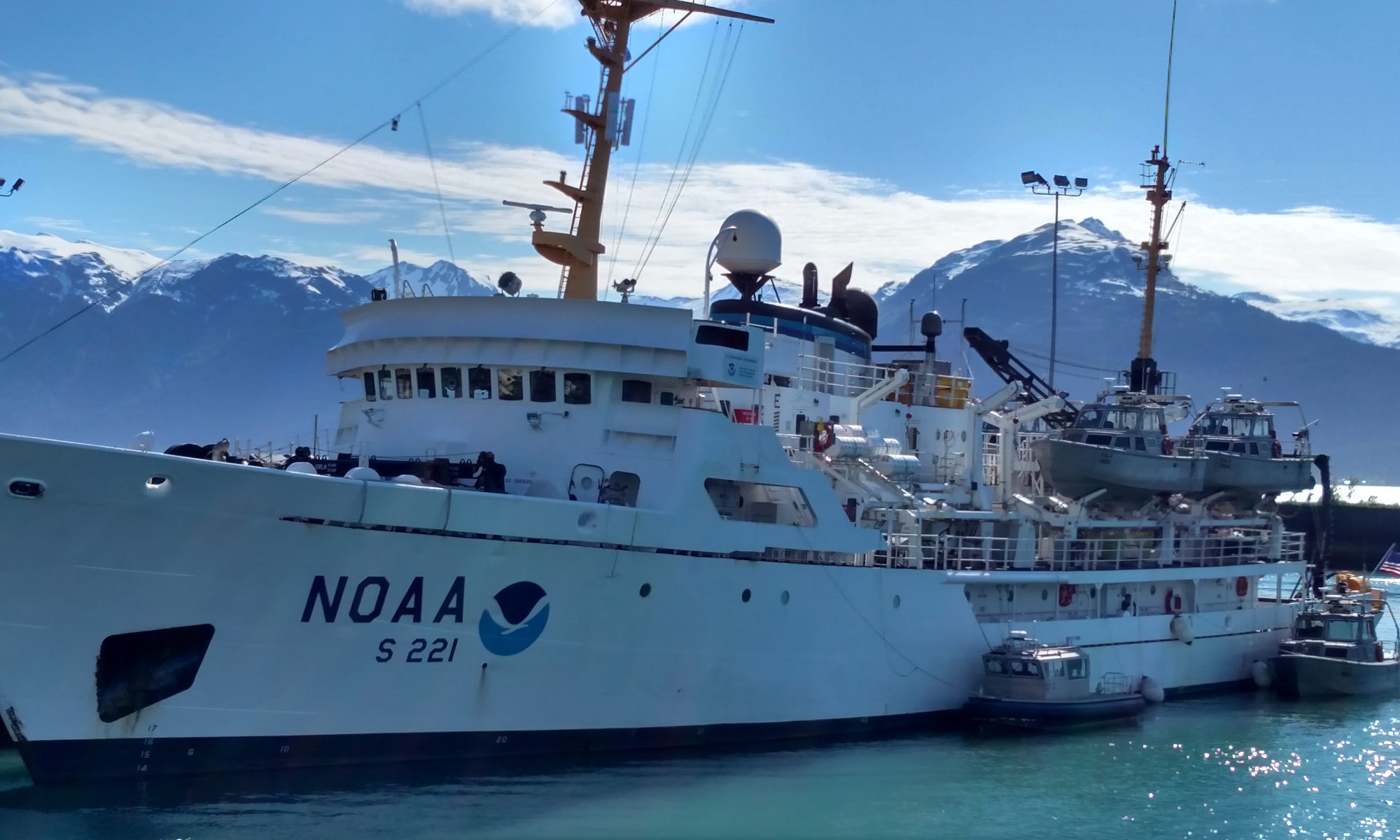
NOAA Ship Henry B. Bigelow
September 20-October 5, 2010

Mission: Autumn Bottom Trawl Survey Leg II
Geographical area of cruise: Southern New England
Date: Tuesday, September 28, 2010

Me in Front of the Henry Bigelow

Weather Data from the Bridge
Latitude 41.36
Longitude -70.95
Speed 10.00 kts
Course 72.00
Wind Speed 19.19 kts
Wind Dir. 152.91 º
Surf. Water Temp. 18.06 ºC
Surf. Water Sal. 31.91
PSU Air Temperature 19.80 ºC
Relative Humidity 91.00 %
Barometric Pres. 1012.45 mb
Water Depth 31.48 m
Cruise Start Date: 9/27/2010

Science and Technology Log

I have the privilege of working with the science team on Leg II of the Autumn Bottom Trawl Survey aboard the NOAA Ship Henry B. Bigelow from September 27 – October 7, 2010. We left port on Monday, September 27 and have been conducting the survey in the waters of Southern New England.

Processing Fish
Processing Fish

Fisheries surveys are conducted every spring and autumn in order to determine the numbers, ages, genders and locations of species that are commonly caught by the commercial fishing industry. The surveys are also carried out to monitor changes in the ecosystem and to collect data for other research. The scientists working on this leg of the survey are from Alaska, Korea, and New England. This ship works around the clock, therefore, we are divided into a day watch and a night watch, and we are all under the direction of the Chief Scientist, Stacy Rowe. I’m on the day watch, so my team processes fish from 12:00 noon until 12:00 midnight.

In order to collect a sample of fish, our ship drags a net for twenty minutes in areas that have been randomly selected before the cruise began. After the “tow,” the net is lifted onto the boat, and the fish are put in a large area to await sorting. The fish move down a conveyor belt, and we sort the fish by putting the different types into buckets and baskets. Once, the catch has been sorted, we move the buckets onto a conveyor belt, which moves them to stations for data collection.

Measuring fish
Measuring fish

Two people work at a station. One is a “Cutter” and the other is a “Recorder.” The cutter measures the length and weight of the selected species of fish on a “fishboard.” This data is automatically entered into the computer system. Depending on the species, the cutter might also be required to take an age sample or a stomach sample. Age is determined by collecting scales or an otolith (sometimes called an ear bone), depending on the species. The cutter removes these and the recorder puts them in a bar-coded envelope to send back to the lab for later study. The cutter also removes the stomach, cuts it open, and identifies what the fish has eaten, how much, and how digested it is. All of this information is entered into the computer for later analysis.

The information gathered during this cruise will give NOAA and other organizations valuable information about the health of the fish species and their ecosystem.

Personal Log

I arrived the night before we left port, and I was able to spend the night on the boat. My stateroom sleeps two people in bunk beds, and each person has a locker in which to stow our belongings. The stateroom also has a bathroom with a shower. Right across the hall is the scientist’s lounge. It has two computers, a television, many books, and games. This is where we sometimes spend our time while we are waiting for a tow to come in.

We spent much of the first day waiting to leave port. Once underway, some tests were conducted on the nets, and my Watch Chief showed me pictures of some of the common species we would see, explaining how to identify them. We began processing fish today. The first time the fish came down the conveyor belt, I was nervous that I wouldn’t know what to do with them. It worked out fine because I was at the end of the conveyor belt, so I only had to separate the two smallest fish, Scup and Butterfish, and Loligo Squid. After my first try at processing, I felt much more confident, and I even was able to tell the difference between Summer and Winter Flounders. One faces to the right and the other faces to the left!

Obed Fulcar, July 26, 2010

NOAA Teacher at Sea Obed Fulcar
NOAA Ship Oscar Dyson
July 27, 2010 – August 8, 2010

Mission:Summer Pollock survey III
Geograpical Area:Bering Sea, Alaska
Date:July 26, 2010

Weather from the Bridge: 

Time: 04:18 am
Latitude:60.02 N
Longitude:176.59 W
Wind Speed:15.2 knots
Wind Direction:180 degrees South
Sea Temperature:9.2 C (48.56 F)
Air Temperature:8.2 C (46.76 F)
Barometric Pressure: 1009.7 mb
Cloudy Skies

SCIENCE & TECHNOLOGY LOG:
The purpose of this mission aboard the Oscar Dyson is for a team of scientists to conduct a survey of the Bering Sea Walleye Pollock population, in oder to help the government establish sustainable commercial fishing quotas that will allow to manage a healthy population of this abundant, but yet fragile species. In order to carry the Pollock survey it is necessary to perform a combined Acoustic -Trawl Survey where acoustic data is collected along a line transect and then a Trawl (net) is used to catch a sample quantity of the fish observed in the acoustic data.

Acoustics Lab
Acoustics Lab

In the Acoustic Lab there are a number of video monitors displaying several screens. Taina Honkalehto, the Chief Scientist of the Oscar Dyson explained to us how the acoustic sonar operates. First the acoustic survey relies on Sonar technology where it sends an acoustic “ping” powerful enough to detect fish at any depths. It travel back and forth between the bottom and the surface of the ocean, and its signature then registered on a video screen, allowing us to “see” where the fish are and the precise location. One screen shows an actual graph, or “echogram”, displaying several layers at different depths in colors ranging from gray, blue, green, yellow, orange to red. The dark red color represented the ocean floor, and the green/blue dots represented the fish. The darker the color, the more dense were the objects. Another sceen showed the location of the ship on a Nautical Topographic Map, including a red line showing transects (line routes) followed by the ship., as well as icons showing the points where the fish has been detected along the way. Tainathen uses this constant information to decide how to instruct the bridge into when where to position the ship in order to launch thetrawl net.

transect lines
Transect Lines

The trawl net used is known as an Aleutian Wing Trawl (AWT). It is equipped with specialized sensors that show in the video monitor where the fish are in relation to the net. Once the trawl is finished the net is then hauled back and the contents spread on deck for sorting out and identification. Target species such as the Walleye Pollock will be separated to be measured and weight then released overboard. Some of the catch will be kept for dissection to determine the sex, and to determine the age by studying the Ear bone or Otholith,that registers the gowth of the fish by marking each year with a dark ring, just like the growth rings on a tree. The otolith, stomach contents, and sample fish are carefully placed in vials, mesh and ziploc bags to be sent to NOAA’s Alaska Fisheries Science Center in Seattle for laboratory analysis. all this information will tell us how healthy is the Pollock population o the Bering sea, and help determine commercial fishing quotas for next year’s fishing season.

Video Monitor
Video Monitor

PERSONAL LOG:

I could not help to think about the amount of technology involved in the Pollock survey. I am pretty sure that Mr.Sanchez, my school technology teacher would be excited to see all the servers, CPUs, monitors, and all the coputer harware and gear used around here onboard the Oscar Dyson. I believe that the middle school students of the Maria Teresa Mirabal school MS319 will be right at home, since they are accustomed to used technology as part their everyday school work. From getting their password to log on into the school website network, using Netbooks for interactive podcast lessons, to taking online reading comprehension quizzes, these are part of a technology rich learning environment. Technology literacy is basic for a 21st Century education. But technology alone is not enough if we don’t tech the kids how to apply it in the real world. One example of the importance of using mathematical skills in the real world is best demonstrated in the Acoustic survey when calculating the estimated size of the fish that appears as dots on the Acoustic radar screen. The sonar software allows to isolate the fish by scanning a selected area of the monitor display and calculating the average decibel (sound unit) value per dot representing a fish. Knowing this value we can replace it in a given formula and easily calculate the approximate size of the fish in order to start trawling.

VOCABULARY:
Aleutian (Alaska native group), Dissection, Decibel, Nautical Topographic Map (underwater map of the ocean floor), Otolith, Transect

Tecnologia en Alta Mar” El proposito de la Mision abordo del Oscar Dyson es la de tomar un muestreo del Pollock o Bacalao para poder determinar que tan robusta esta su poblacion, a fin de poder determinar las cuotas apropiadas a ser dictadas a las flotas de pesca comercial. Para poder hacer este muestreo es necesario el uso de tecnologia de Sonar Acustico en combinacion con el uso de la Red de Arrastre.Todo comienza en el Laboratorio Acustico donde un numero de pantallas de monitor muestran diferentes imagenes. Taina Honkalehto, la Cientifico en Jefe del Oscar Dyson, nos explico que la tecnologia de sonar consiste en enviar un “ping” acustico que es lo suficiente poderoso para viajar de la superficie al fondo del mar de ida y vuelta, penetrando las capas mas profundas. La onda acustica que es reflejada es pues registrada en las pantallas permitiendonos ver una imagen de la ubicacion de los peces, y la precisa profundidad. Una pantalla nos muestra una grafica en tiempo real con lineas de diferentes colores que van del gris, azul, verde, amarillo, hasta el rojo que representa el fondo del mar. Otra pantalla nos muestra un Mapa Topografico Nautico que incluye una linea roja mostrando la linea de transeccion o el curso que sigue la nave. Con toda esta informacion Taina puede instruir al puente sobre que ruta de navegacion debe tomar la nave a fin de hacer la pesca. La red de Arrastre Aleutina, empleada en el muestreo, esta equipada con sensores especiales que indican en la pantalla la ubicacion de los peces en todo tempo. Realmente tienen la pesca totalmente calculada a lo mas minimo! Tan pronto se termina la pesca, el contenido de la red es pues depositado en la cubierta donde los peces seran separados para ser medidos y disecados a fin de averiguar el sexo y la edad. Muestras del contenido del estomago, y especimenes seran recogidos a fin de enviarlos a los laboratorios de NOAA en Seattle para determinar si la poblacion estara optima para la peca de la proxima estacion.

Patricia Schromen, August 22, 2009

NOAA Teacher at Sea
Patricia Schromen
Onboard NOAA Ship Miller Freeman
August 19-24, 2009 

Mission: Hake Survey
Geographical Area: Northwest Pacific Coast
Date: Thursday, August 22, 2009

Bringing in the nets requires attention, strength and teamwork.
Bringing in the nets requires attention and teamwork.

Weather Data from the Bridge 
SW wind 10 knots
Wind waves 1 or 2 feet
17 degrees Celsius

Science and Technology Log 

In Science we learn that a system consists of many parts working together. This ship is a small integrated system-many teams working together. Each team is accountable for their part of the hake survey. Like any good science investigation there are independent, dependent and controlled variables. There are so many variables involved just to determine where and when to take a fish sample.

Matt directs the crane to move to the right. Looks like some extra squid ink in this haul.

The acoustic scientists constantly monitor sonar images in the acoustics lab. There are ten screens displaying different information in that one room. The skilled scientists decide when it is time to fish by analyzing the data.  Different species have different acoustical signatures. Some screens show echograms of marine organisms detected in the water column by the echo sounders. With these echograms, the scientists have become very accurate in predicting what will likely be caught in the net. The OOD (Officer of the Deck) is responsible for driving the ship and observes different data from the bridge. Some of the variables they monitor are weather related; for example: wind speed and direction or swell height and period. Other variables are observed on radar like the other ships in the area. The topography of the ocean floor is also critical when nets are lowered to collect bottom fish. There are numerous sophisticated instruments on the bridge collecting information twenty four hours a day. Well trained officers analyze this data constantly to keep the ship on a safe course.

Here come the hake!
Here come the hake!

When the decision to fish has been made more variables are involved. One person must watch for marine mammals for at least 10 minutes prior to fishing. If marine mammals are present in this area then they cannot be disturbed and the scientists will have to delay fishing until the marine mammals leave or find another location to fish. When the nets are deployed the speed of the boat, the tension on the winch, the amount of weight attached will determine how fast the nets reach their target fishing depth.  In the small trawl house facing the stern of the ship where the trawl nets are deployed, a variety of net monitoring instruments and the echo sounder are watched. The ship personnel are communicating with the bridge; the deck crew are controlling the winches and net reels and the acoustic scientist is determining exactly how deep and the duration of the trawl. Data is constantly being recorded. There are many decisions that must be made quickly involving numerous variables.

Working together to sort the squid from the hake.

The Hake Survey began in 1977 collecting every three years and then in 2001 it became a biannual survey. Like all experiments there are protocols that must be followed to ensure data quality. Protocols define survey operations from sunrise to sunset. Survey transect line design is also included in the protocols. The US portion of the Hake survey is from approximately 60 nautical miles south of Monterey, California to the US-Canada Border. The exact location of the fishing samples changes based on fish detected in the echograms although the distance between transects is fished at 10 nautical miles. Covering depths of 50-1500 m throughout the survey. Sampling one species to determine the health of fish populations and ocean trends is very dynamic.

Weighing and measuring the hake is easier with automated scales and length boards.
Weighing and measuring the hake.

Personal Log 

Science requires team work and accountability. Every crew member has an integral part in making this survey accurate.  A willing positive attitude and ability to perform your best is consistently evident on the Miller Freeman. In the past few days, I’ve had the amazing opportunity to assist in collecting the data of most of the parts of this survey, even launching the CTD at night from the “Hero Platform” an extended grate from the quarter deck.

Stomach samples need to be accurately labeled and handled carefully.

Before fishing, I’ve been on the bridge looking for marine mammals.  When the fish nets have been recovered and dumped on the sorting table, I’ve sorted, weighed and measured fish. For my first experience in the wet lab, I was pleased to be asked to scan numbers (a relatively clean task) and put otoliths (ear bones) into vials of alcohol. I used forceps instead of a scalpel. Ten stomachs are dissected, placed in cloth bags and preserved in formaldehyde. A label goes into each cloth bag so that the specimen can be cross referenced with the otoliths, weight, length and sex of that hake. With all the high tech equipment it’s surprising that a lowly pencil is the necessary tool but the paper is high tech since it looks regular but is water proof.  It was special to record the 100th catch of the survey.

Removing the otolith (ear bone) with one exact incision. An otolith reminds me of a squash seed or a little silver feather in jewelry.
Each barcoded vial is scanned so the otolith number is linked to the weight, length and sex data of the individual hake.

Questions for the Day 

How is a fish ear bone (otolith) similar to a tree trunk? (They both have rings that can be counted as a way to determine the age of the fish or the tree.)

The CTD (conductivity, temperature and depth) unit drops 60 meters per minute and the ocean is 425 meters deep at this location; how many minutes will it take the CTD to reach the 420 meter depth?

Think About This: The survey team directs the crane operator to stop the CTD drop within 5 meters of the bottom of the ocean.  Can you think of reasons why the delicate machinery is never dropped exactly to the ocean floor?  Some possible reasons are:

  • The swell in the ocean could make the ship higher at that moment;
  • An object that is not detected on the sonar could be on the ocean floor;
  • The rosetta or carousel holding the measurement tools might not be level.

Launching the CTD is a cooperative effort. The boom operator works from the deck above in visual contact. Everyone is in radio contact with the bridge since the ship slows down for this data collection.

Retrieving the CTD
Retrieving the CTD

Megan Woodward, July 16, 2009

NOAA Teacher at Sea
Megan Woodward 
Onboard NOAA Ship Oscar Dyson
July 1 – 18, 2009

Mission: Bering Sea Acoustic Trawl Survey
Geographical Area: Bering Sea/Dutch Harbor
Date: Tuesday, July 16, 2009

All bony fish have otoliths (ear bones) that can be used for calculating the age of the fish.

Weather and Location 
Position: N 58 13.617; W 171 25.832
Air Temp: 7.2 (deg C)
Water Temp: 6.54 (deg C)
Wind Speed: 15 knots
Weather: Overcast

Science and Technology Log 

One of the most interesting things I’ve learned while participating in the pollock survey is the importance of otoliths. Otoliths are small bony structures situated in the head of all bony fish, and are often referred to as “ear stones.”  For each haul we brought on board, 50 otoliths were taken from large fish (3+ years) and/or 5 from small fish (younger than 3 years old).  The otolith holds the key to accurately calculating the age of a fish (scales and vertebrates can also be used, but are not as reliable).  The average age of fish from the samples collected in the survey helps scientists estimate the strength of a year-class and size of the stock in the future.

Back in the lab, otolith samples are carefully catalogued.

The first step in taking an otolith is pictured above. An incision is made on the back of the pollock’s head, and an otolith is removed using tweezers.  Once the otolith is removed, it is rinsed with water and placed in a glass vial containing a small amount of 50% ethanol solution for preservation purposes.

The otoliths are taken back to NOAA’s aging lab where ages are determined by reading rings similar to those on a tree trunk. A crosscut is made through each otolith revealing a pattern of rings. Scientists then count the rings to determine the age of the fish.  Lightly burning or staining the otoliths makes the rings more visible.

Cod and sole otoliths

New material is deposited on the surface of the otolith creating the rings as the fish grows. The translucent/light zones indicate the main growth that takes place in the summer months.  The opaque/darker rings appear during the winter months when growth is slower. Because of the slower growth rate, new material is deposited on top of the old layers resulting in the dark ring. Each pair of light and dark zones marks one year. In fish younger than one year of age, rings can be identified for each day of life!

woodward_log6bPersonal Log 

I was surprised to discover otoliths have been used for aging fish since the early 1900’s.  While working in the fish lab I observed the scientist removing otoliths, however I did not remove any myself. The cracking sound heard when cutting the head open was like fingernails on a chalkboard to me.  I spent most of my time in sorting and measuring fish, as well as assisting with the stomach collection project.

For the next two days we will be heading back to Dutch Harbor, and the likelihood of trawling for more fish is minimal.  Our remaining work assignment is to give the fish lab a thorough cleaning. Everything in the lab is waterproof, so we’ll put on our Grunden’s (orange rubber coveralls) and boots and spray down the entire space. Working and living at sea for nearly 3 weeks has been an eye opening experience. My time aboard the Oscar Dyson has flown by. I have learned so much about fisheries research and life at sea. Dry land, however, will be warmly welcomed when we get back to Dutch Harbor.  Would I do it again? Absolutely.

Animal Sightings 

The whales have an incredible way of showing up when I don’t have my camera.  Yesterday I spotted two orcas, but did not get a photograph. The seabirds continue to circle. I like the murres most.  They look like small, flying penguins.

New Vocabulary 

Otoliths- Small bony structures situated in the head of all bony fish. Often referred to as “ear stones.”

Stock- Refers to the number of fish available, supply.

*** Much of the information used for this log entry was found on the Centre for Environment, Fisheries & Aquaculture Science (Cefas) web site.

Nicole Macias, June 20, 2009

NOAA Teacher at Sea
Nicole Macias
Onboard NOAA Vessel Oscar Elton Sette 
May 31-June 28, 2009 

Mission: Lobster Survey
Geographical area of cruise: Northwestern Hawaiian Islands
Date: June 20, 2009

Weather Data from the Bridge 
Location: 23° 37.7’N, 164° 43.005’W
Wind Speed: 11 kts.
Air Temp: 25.6° C

Here is a picture of an otolith that has been extracted from one of the fish we caught.

Science and Technology Log 

Even though the mission of this cruise is to conduct research on lobsters, we are helping out another scientist with his study on bottom fish. Three of the jobs on the rotation require bottom fishing at night. Every fish that is caught has to be “processed.” When processing a fish you have to indicate the type of species, its fork length, the gender and you have to collect its otoliths. The fork length is the distance from the fish’s upper lip to the end of the center of its tail.

To determine the fish’s gender and collect its otoliths you must dissect the fish. It is very messy business. First the scientist makes an incision from the fish’s anus all the way to the throat. From there you can open up the fish and locate its gonads, sex organs. By looking at the gonads you can determine whether it is a male or female. The female’s gonads are much larger and much more vascular, meaning they have more blood vessels in them. The scientist will then extract the gonads and place them in a jar with formaldehyde so that they can be taken back to the lab and further studied.

These are the females gonads of a fish. It is very important when cutting open the belly that you are very careful because the knife can easily cut into the gonads as it has in this picture. Notice all the blood vessels running through the gonads. This is characteristic of a female.

After removing the gonads, it’s time to extract the otoliths. Otoliths are the inner ear bone of a fish and are responsible for hearing and balance. There are two of them—one on each side of the spine at the base of the skull. They are very small, fragile bones so it takes a little finesse in removing them. The reason the otoliths are so important is because they can tell scientists a lot of important information on the life history of the fish. The otoliths have growth rings, kind of like a tree. The growth rings can tell scientists the age of fish as well as any environmental factors it encountered during that time period.

The purpose of the study is to re-estimate the life history for these important commercial fish species. The main species they are lacking data on is the opakapaka, Pristopomoides filamentosus. We have not caught very many of this species, but we have been catching quite a few ehu, Etelis carbunculus. This species is very similar to the red snappers we have in Florida and just the other day I caught a Butaguchi fish, which is related to the Jack family.

Here is a picture of me holding up the Butaguchi I caught. If you look in the background you can see the hydraulic bottom fishing rig that was used to catch the fish.
Here is a picture of me holding up the Butaguchi I caught. If you look in the background you can see the hydraulic bottom fishing rig that was used to catch the fish.

Personal Log 

We are now at our second and last location, Maro Reef. There is no land to be seen for miles. At least at Necker we had something to look at. We are heading in to the last week of the cruise and it is easy to see that 30 days is a long time for some people to be out to see. I am fortunate that I have made some really good friends or else I would be really ready to get home.

I have had the free time to read some really great books and watch some movies I haven’t seen and probably would never have watched if I weren’t out to sea. Anyway, I am looking forward to my last week on the ship and hope to report back many exciting things for you!

Here is a picture of me in the safety boat, about to be lowered down so that we can deliver fresh fish to the near by NOAA vessel.