Johanna Mendillo: Greetings from Alaska and the Bering Sea! July 27, 2012

NOAA Teacher at Sea
Johanna Mendillo
Aboard NOAA Ship Oscar Dyson
July 23 – August 10, 2012

Mission: Pollock Survey
Geographical area of the cruise: Bering Sea
Date: Friday, July 27, 2012

Location Data from the Bridge:
Latitude: 63 12’ N
Longitude: 177 47’ W
Ship speed: 11.7 knots (13.5 mph)

Weather Data from the Bridge:
Air temperature: 7.2C (44.9ºF)
Surface water temperature: 7.2C (44.9ºF)
Wind speed: 13.3 knots (15.3 mph)
Wind direction: 299T
Barometric pressure: 1001 millibar (0.99 atm)


Science and Technology Log:

Greeting from the Bering Sea!  It was a long journey to get here, complete with bad weather, aborted landings on the Aleutians, a return and overnight in Anchorage, and lost luggage, but it was a good introduction to the whims of nature and a good reminder that the best laid intentions can often go awry.  As O’Bryant students know, our motto is PRIDE and the “P” stands for perseverance, so I simply stayed the course and made it to Dutch Harbor and NOAA Ship Oscar Dyson… only 29hrs late!

In upcoming posts, you will learn a lot about the acoustic technology, statistics, and the engineering know-how behind the trawling process and how it is used to find, collect, and study Pollock populations.  But first, let’s start with splitting open some fish heads!

Now that I have your attention, let me explain.  There are many steps involved in “processing” a net full of Pollock, and I will show you each soon, step-by-step.  I think it would be more fun, though, to jump ahead and show you one little project I helped with that literally had me slicing open fish heads…

Hard at work...
Hard at work…

Here I am preparing and cutting away!  The objective: remove the two largest otoliths, structures in the inner ear that are used by fish for balance, orientation and sound detection.  These are called the sagittae and are located just behind the fish’s eyes.  These otoliths can be measured– like tree rings — to determine the age of the fish because they accrete layers of calcium carbonate and a gelatinous matrix throughout their lives. The accretion rate varies with growth of the fish– often less growth in winter and more in summer– which results in the appearance of rings that resemble tree rings!

Time to cut...
Time to cut…

From a small sampling of otoliths, along with length data, projections can be made about the growth rates and ages of the entire Pollock population.  Such knowledge is, in turn, important for designing appropriate fisheries management policies.  Fisheries biologists like to think of otoliths as information storage units; a sort of CD-ROM in which the life and times of the fish are recorded.  If we learn the code, we can learn about that fish!

Can you spot the otolith?

For each net of Pollock, we will collect 35 otoliths, which translates to approx. 1,500 otoliths from this cruise alone!  They will be sent back to Seattle and measured under the microscope this fall and winter.

Finished!
Finished!

Personal Log:

Wondering where I am at this very moment?  Check out NOAA Ship Oscar Dyson on NOAA Ship Tracker!

Small things become important when your daily life gets confined to a small space, right, students?  Perhaps some of you have been to sleepover camp and know firsthand?  In a few years, you will also experience communal living in close quarters— in college!  It only seems appropriate that I start by explaining to you (and showing you) my personal space aboard NOAA Ship Oscar Dyson!

First, my stateroom.  This picture shows you that I am in room 01-19-2.  I am on the 01-deck, and there are four other rooms on my hall that house most of the NOAA science team- Taina, Darin, Kresimir, Rick, and Allan.  Allan is my partner in crime- he is the other “Teacher at Sea” (TAS) onboard this cruise; he teaches high school science in Florida!  In addition to the NOAA team, Anatoli is a Russian scientist on board.  These NOAA scientists are based in Seattle in the Midwater Assessment & Conservation Engineering (MACE) group at the Alaska Fisheries Science Center and, depending on their schedules, come out to sea 1-4 times per year to collect data.  They are just one group of many NOAA teams conducting research in the Bering Sea; you will learn much more about the science team in later posts.

My door
My door

Originally, I was going to be bunking with the Chief Scientist, Taina!  However, one of the scientists was unable to join the trip, so Taina has her own quarters and I have mine!  This is quite the luxury, and it is very nice to know that I do not have to worry about waking up a roommate as I get ready for my shift.  Most roommates have opposite shifts, so each person gets at least a little bit of “alone time” in his/her room.  For example, Allan’s shift is 4am-4pm (0400-1600) and Kresimir’s shift is from 7pm-7am (1900-0700).

Here is my bunk!  I chose the bottom one, so if I fall out in rough seas, it is a shorter fall!  One trick- if the seas are rough, take the rubber survival suits and stuff them against the metal frames, so if I do smack against them, there will be some padding!  There is a reading light inside, and I also brought my trusty headlamp and pocket flashlight, so I should be pretty well set on any hasty exit I may have to make- such as for a safety drill!

My bunk!
My bunk!

I also have a desk and a locker, which is a closet for my clothes and other gear.  One thing ships excel at is maximizing small spaces with hooks- I have a row of hooks for my jackets, sweatshirts, hats, etc.  In the head (bathroom), there are many hooks as well.  The other neat trick—the use of bungee cords!  Here is one holding the head door open so it does not swing back and forth as the boat rolls.  They are also used throughout the ship to secure desk chairs, boxes, and any other object that could take flight during rough seas!

See the bungee cord?

Since it is summer here in the high northern latitudes, the days are very long—sunset does not occur until about 12am each night and sunrise occurs around 7am.  The ships provides shades on both the bunks and the port holes (windows) to help people sleep, but as you can see, the earlier tenant in my room even added a layer of cardboard!

My window...
My window…

There are a few other features that help define life at sea.  The shower curtain has magnets to help secure it to the walls.  As you can see, it is a pretty tiny shower, and that handle could become essential if I chose to take a shower and then the seas turn rough!   The medicine cabinet locks shut, and if you leave it open, the door can swing during a big wave and smack you in the face!  Lastly, the head includes special digesting bacteria, so you can only use a special cleaner that does not kill them by accident!  There is a very powerful FLUSH noise that takes a little bit of getting used to as well– it scared me the first time I heard it!

Spot the shower handle...
Spot the shower handle…

That about does it for our first tour.  Please post a comment below, students, with any questions at all.  In my next post, I will give you a tour of the second most important area in daily life— the mess, where I eat!

Lesley Urasky: Fish, fish, where are all the fish? June 18, 2012

 NOAA Teacher at Sea
Lesley Urasky
Aboard the NOAA ship Pisces
June 16 – June 29, 2012


Mission:  SEAMAP Caribbean Reef Fish Survey
Geographical area of cruise: St. Croix, U.S. Virgin Islands
Date: June 18, 2012

Location:
Latitude: 17.6568
Longitude: -64.9281

Weather Data from the Bridge:

Air Temperature: 28.5°C (83.3°F)
Wind Speed:  17.1 knots (19.7 mph), Beaufort scale: 5
Wind Direction: from SE
Relative Humidity: 75%
Barometric Pressure:   1,014.80 mb
Surface Water Temperature:28.97 °C (84.1°F)

Science and Technology Log

Alright, so I’ve promised to talk about the fish.  Throughout the science portions of the cruise, the scientists have not been catching the anticipated quantities of fish.  There are several lines of thought as to why: maybe the region has experienced overfishing; possibly the sampling sites are too shallow and deeper water fish may be more likely to bite; or they might not like the bait (North Atlantic mackerel) since it is not an endemic species/prey they would normally eat.

So far, the night shift has caught more fish than the day shift that I’m on.  Today, we have caught five and a half fish. The half fish was exactly that – we retrieved only the head and it looked like the rest of the body had been consumed by a barracuda!  These fish were in the grouper family and the snapper family.

Coney (Cephalopholis fulvus)
Blackfin snapper (Lutjanus buccanella). This little guy was wily enough to sneak into the camera array and steal some squid out of the bait bag! The contents of his stomach – cut up squid – can be seen to the left between the forceps and his head.

Once the fish have been caught, there are several measurements that must be made.  To begin, the fish is weighed to the nearest thousandth (three decimal places) of a kilogram. In order to make sure the weight of the fish is accurate, the scale must be periodically calibrated.

Then there are several length measurements that are made: standard length (SL), total length (TL) and depending on the type of fish, fork length (FL).  To make these measurements, the fish is laid so that it facing toward the left and placed on a fish board.  The board is simply a long plank with a tape measure running down the center.  It insures that the fish is laid out flat and allows for consistent measurement.

Standard length does not measure the caudal fin, or tail.  It is measured from the tip of the fish’s head and stops at the end of the last vertebra; in other words, if the fish is laying on its side, and you were to lift the tail up slightly, a crease will form at the base of the backbone.  This is where the standard length measurement would end.  Total length is just as it sounds – it is a measurement of the entire length (straight line)  of the fish.  Fork length is only measured if the type of fish caught has a forked tail.  If it does, the measurement begins at the fish’s snout and ends at the v-notch in the tail.

How to measure the three types of lengths: standard, fork, and total. (Source: Australian Government: Department of Sustainability, Environment, Water, Population, and Communities)
Red hind (Epinephelus guttatus) on the fish board being measured for standard length. Ariane’s thumb is on the crease marking the end of its backbone.

Once the physical measurements are made, the otoliths must be extracted and the fish sexed.  You’re probably anxious to learn if you selected the right answer on the previous post’s poll – “What do you think an otolith is?”  An otolith can be thought of as a fish’s “ear bone”.  It is actually a structure composed of calcium carbonate and located within the inner ear.  All vertebrates (organisms with backbones) have similar structures.  They function as gravity, balance, movement, and directional indicators.  Their presence helps a fish sense changes in horizontal motion and acceleration.

In order to extract the otoliths, the fish must be killed.  Once the fish has been killed, the brain case is exposed and peeled back.  The otoliths are in little slits located in the underside of the brain.  It takes a delicate touch to remove them with a pair of forceps (tweezers) because they can easily break or slip beyond the “point of no return” (drop into the brain cavity where they cannot be extracted).

Otoliths are important scientifically because they can tell many important things about a fish’s life.  Their age and growth throughout the first year of life can be determined.  Otoliths record this information just like tree ring record summer/winter cycles. More complex measurements can be used to determine the date of hatch, once there are a collected series of measurements, spawning times can be calculated.

A cross-section of an otolith under a microscope. The rings are used to determine age and other life events. Source: Otolith Research Laboratory, Bedford Institute of Oceanography, Dartmouth, Nova Scotia, Canada.

Because they are composed of calcium carbonate (CaCO3), the oxygen component of the chemical compound can be used to measure stable oxygen isotopes; this is useful for reconstructing temperatures of the waters the fish has lived in.  Scientists are also able to look at other trace elements and isotopes to determine various environmental factors.

Extracted otoliths. Often they are around 1 cm long, although the larger the fish, the slightly larger the otolith.

The final step we take in measurement/data collection is determining the sex and maturity of the fish.  To do this, the fish is slit open just as if you were going to clean the fish to filet and eat it.  The air bladder must be deflated if it isn’t already and the intestines moved out of the way.  Then we begin to search for the gonads (ovaries and testes).  Once the gonads are found, we know if it is female or male and the next step is to determine its stage or maturity.  This is quite a process, especially since groupers can be hermaphroditic.  The maturity can be classified with a series of codes:

  • U = undetermined
  •  1  = immature virgin (gonads are barely visible)
  •  2  = resting (empty gonads – in between reproductive events)
  •  3 = enlarging/developing (eggs/sperm are beginning to be produced)
  •  4 = running ripe (gonads are full of eggs/sperm and are ready to spawn)
  •  5 = spent (spawning has already occurred)
Ovaries of a coney (grouper family). These are the pair of flesh colored tubular structures running down the center of the fish.

Personal Log

Today is my birthday, and I can’t think of a better place to spend it!  What a treat to be having such an adventure in the Caribbean!  This morning, we were on our first bandit reel survey of the day, and the captain came on over the radio system, announced my birthday and sang Happy Birthday to me.  Unbeknownst to me, my husband, Dave, had emailed the CO of the Pisces asking him to wish me a happy birthday.

We’ve had a very successful day (compared to the past two days) and have caught many more fish – 5 1/2 to be exact.  The most exciting part was that I caught two fish on my bandit reel!  They were a red hind and blackfin snapper (see the photos above).  What a great birthday present!

Father’s Day surf and turf dinner
My birthday fish! The blackfin snapper is on the left and the red hind on the right.
I even got a birthday kiss from the red hind!

Last night (6/17) for Father’s Day, we had an amazing dinner: filet mignon, lobster, asparagus, sweet plantains, and sweet potato pie for dessert!  Since it was my birthday the following day (6/18), and one of the scientists doesn’t like lobster, I had two tails!  What a treat!

Our best catch of the day came on the last bandit reel cast.  Joey Salisbury (one of the scientists) caught 5 fish: 4 blackfin snapper and 1 almaco jack; while Ariane Frappier (another scientist) caught 3 – 2 blackfin and 1 almaco jack.  This happened right before dinner, so we developed a pretty good assembly line system to work them up in time to eat.

Dinner was a nice Chinese meal, but between the ship beginning to travel to the South coast of St. Thomas and working on the computer, I began to feel a touch seasick (not the best feeling after a large meal!).  I took a couple of meclazine (motion sickness medication) and still felt unwell (most likely because you’re supposed to take it before the motion begins). My roommate, Kelly Schill, the Operations Officer, made me go to bed (I’m in the top bunk – yikes!), gave me a plastic bag (just in case!), and some saltine crackers. After 10 hours of sleep, I felt much, much better!

I had some time in between running bandit reels, baiting the hooks, and entering data into the computers,to interview a member of the science team that joined us at the  last-minute from St. Croix.  Roy Pemberton, Jr. is the Director of Fish and Wildlife for the Department of Planning and Natural Resources of the U.S. Virgin Islands. The following is a snippet of our conversation:

LU: What are your job duties as the Director of Fish and Wildlife?

RP: I manage fisheries/wildlife resources and try to educate the population on how to better manage these resources to preserve them for future generations of the U.S. Virgin Islands.

LU: When did you first become interested in oceanography?

RP: I’m not really an oceanographer, but more of a marine scientist and wildlife biologist.  I got interested in this around 5-6 years old when I learned to swim and then snorkel for the first time.  I really enjoyed observing the marine environment and my interest prompted me to want to see and learn more about it.

LU: It’s such a broad field, how did you narrow your focus down to what you’re currently doing?

RP: I took a marine science class in high school and I enjoyed it tremendously.  It made me seek it out as a career by pursuing a degree in Marine Science at Hampton University.

LU:  If you were to go into another area of ocean research, what would it be?

RP: Oceanography – Marine Spatial Planning

Roy Pemberton holding a recently caught coney.

LU: What is the biggest challenge in your job?

RP: It is a challenge to manage fisheries and wildlife resources with respect to the socioeconomic and cultural nuances of the people.

LU: What do you think is the biggest issue of contention in your field, and how do you imagine it will resolve?

RP: Fisheries and coral reef management.  We need to have enough time to see if the federal management efforts work to ensure healthier ecosystems for future generations.

LU: What are some effects of climate change that you’ve witnessed in the reef systems of the U.S. Virgin Islands?

RP: Temperatures have become warmer and the prevalence of disease among corals has increased.

LU: In what areas of Marine Science do you foresee a lot of a career paths and job opportunities?

RP: Fisheries management, ecosystem management, coral reef diseases, and the study of coral reef restoration.

LU: Is there an area of Marine Science that you think is currently being overlooked, and why?

RP: Marine Science management that takes into account cultural and economic issues.

LU: What are some ideas a layperson could take from your work?

RP: One tries to balance resource protection and management with the cultural and heritage needs of the population in the territory of the U.S. Virgin Islands.

LU: If a high school student wanted to go into the fish/wildlife division of planning and natural resources, what kinds of courses would you recommend they take?

RP: Biology, Marine Science, History, Botany, and Math

LU: Do you recommend students interested in your field pursue original research as high school students or undergraduate students?  If so, what kind?

RP: I would suggest they study a variety of life sciences so they can see what they want to pursue.  Then they can do an internship in a particular life science they find interesting to determine if they would like to pursue it as a career.

Too many interesting people on the ship and so little time!  I’m going to interview scientists as we continue on to San Juan, Puerto Rico. Once they leave, I’m continuing on to Mayport, Florida with the ship.  During this time, I’ll explore other careers with NOAA.

Maureen Anderson: Status of Sharks, August 3, 2011 (Post #5)

NOAA Teacher at Sea
Maureen Anderson
Aboard NOAA Ship Oregon II
(NOAA Ship Tracker)
July 25 — August 9, 2011

Mission: Shark Longline Survey
Geographical Area: Southern Atlantic/Gulf of Mexico
Date: August 3, 2011

Weather Data from the Bridge
Latitude: 32.50 N
Longitude: -079.22 W
Wind Speed: 17.75 kts
Surface Water Temperature: 28.60 C
Air Temperature: 29.90 C
Relative Humidity: 71%
Barometric Pressure: 1009.06 mb

Science and Technology Log
One reason the shark longline survey exists is because the populations of many types of sharks are in decline. There are several reasons for this – finning is one reason. “Finning” is the process where the shark’s fin is removed from the rest of its body. Since usually only the fin is desired, the rest of the body is discarded. Shark fins are used for things like shark fin soup – a delicacy in Asian cultures. When the fin is cut off and the rest of the body stays in the water, the shark can not swim upright and eventually dies. While some regulations have been passed to prevent this, shark finning still occurs. Sharks are also overfished for their meat. As a result many shark species have become vulnerable, threatened or endangered. Large sharks can take longer to reproduce. Therefore, they are more likely to be threatened or decline in their numbers.

endangered species chart
There are different categories of extinction risk, from "least concern" to "extinct" (photo courtesy of IUCN)
marine food chain
Sharks are at the top of the food chain. They are apex predators. (photo courtesy of Encyclopaedia Britannica)

Sharks are at the top of the food chain. They keep prey populations in control, without which the marine ecosystem would be unstable.

This is why the mission of the shark longline survey is important. The identification tags and roto tags used during this survey along with the data collected will help scientists assess the abundance of species in this area. They can then provide recommendations for shark management.  On average, we are collecting data on 10 sharks per line (or 10%), although our catch rates are between 0% and around 50%.  With 50 stations in all, that would be data on approximately 500 sharks (on average).

There are more than 360 species of known sharks. Below is a list of some that we have seen and measured during our survey. The IUCN red list (International Union for Conservation of Nature and Natural Resources) classify these sharks with a status:

Atlantic Sharpnose Shark – Least Concern
Blacknose Shark – Near Threatened
Silky Shark – Near Threatened
Tiger Shark – Near Threatened
Lemon Shark – Near Threatened
Dusky Shark – Vulnerable
Sandbar Shark – Vulnerable
Scalloped Hammerhead – Endangered

During my shift, we sometimes catch things we do not intend to catch.  We might reel in fish or other sea creatures that get caught on the hooks. This is called “bycatch”. While everything is done to try to catch only the things we are interested in studying, bycatch occasionally happens. The fish are only on our line for 1 hour, so their survival rates are pretty good. Our bycatch data is a very important element and also contributes to management plans for a number of species like snappers and groupers.

longline gear
Our longline gear includes two high flyer buoys, and hooks that are weighted down so they reach the bottom.

Just the other day, we caught a remora (a suckerfish that attaches itself to a shark’s side). Remoras and sharks have a commensalism relationship – the remora gets leftover food bits after the shark eats, but the shark gets no benefit from the remora. We quickly took down its measurements in order to get it back into the water quickly. Other bycatch included an eel, and black sea bass.

sharksucker
This sharksucker is an example of bycatch.
moray eel
This moray eel accidentally found its way onto a hook.
black sea bass
Bycatch - a black sea bass.
otoliths
This otolith (tiny white bone in center) helps this red snapper with its sense of balance.

We also caught a red snapper. Our chief scientist, Mark, showed me the two small, tiny ear bones called “otoliths” in the snapper’s head. These bones provide the fish with a sense of balance – kind of like the way our inner ear provides us with information on where we are in space (am I upside down, right side up, left, right?). You can tell the age of a snapper by counting the annual growth rings on the otoliths just like counting growth rings on a tree.

Personal Log

My experience aboard the Oregon II has given me a better understanding of the vulnerability of some shark species. While many of us may think that sharks can be threatening to humans, it is more accurate the other way around. Sharks are more threatened by humans than humans are threatened by sharks. This is due to our human behaviors (mentioned above).

Today I saw dolphins following our boat off the bow.  There were about 6  or 7 of them all swimming together in a synchronized pattern (popping up for air all at the same time).  It was really quite a treat to watch.

I’m also amazed by the amount of stars in the sky.  With the lights off on the bow, you can really see a lot of stars.  I was also able to see the milky way.  There have been many storms off the horizon which are really cool to watch at night.  The whole sky lights up with lightning  in the distance, so I sat and watched for a while.  With tropical storm Emily coming upon us, we may have to return to port earlier than planned, but nothing is set in stone just yet.  I hope we don’t have to end the survey early.

Species Seen :

Tiger Shark
Atlantic Sharpnose
Nurse Shark
Barracuda
Remora
Black Sea Bass
Snowy Grouper
Atlantic Spotted Dolphins
Loggerhead Turtle
Homo Sapiens

Anne Mortimer: Fishing, July 7, 2011

NOAA Teacher at Sea
Anne Mortimer
Onboard NOAA Ship Oscar Dyson
July 4 — 22, 2011 

Mission: Pollock Survey
Geographical area of cruise: Gulf of Alaska
Date: July 7, 2011

Weather Data from the Bridge
Air temperature: 9.53 C, Foggy
Sea temperature: 8.19 C
Wind direction: 145
Wind Speed: 18.73 knots
Barometric pressure: 1013.22 mbar

Science and Technology Log

Last night, we attempted a bottom trawl for walleye pollock. The way scientists know that fish are present is by using acoustic sampling. The centerboard of the ship is set-up with sound emitting and recording devices. When a sound wave is emitted toward the bottom, it will eventually be returned when it hits a fish or the ocean bottom. This is called echo-sounding and has been used by sport & commercial fisherman and researchers for many decades. The sound waves are sent down in pulses every 1.35 seconds and each returned wave is recorded. Each data point shows up in one pixel of color that is dependent on the density of the object hit. So a tightly packed group of fish will show as a red or red & yellow blob on the screen. When scientists see this, they fish!

This echogram shows scientists where fish can be found.

The scientists use this acoustic technology to identify when to put the net in the water, so they can collect data from the fish that are caught. The researchers that I am working with are specifically looking at pollock, a mid-water fish. The entire catch will be weighed, and then each species will be weighed separately. The pollock will all be individually weighed, measured, sexed, and the otolith removed to determine the age of the fish. Similar to the rings on a tree, the otolith can show the age of a fish, as well as the species.

pollock otolith
A pollock otolith.
Pollock otolith in my hand

These scientists aren’t the only ones that rely on technology, the ships navigation systems is computerized and always monitored by the ship’s crew. For scientific survey’s like these, there are designated routes the ship must follow called transects.

globe chart
This chart shows the transects, or route, that the ship will follow.
This chart shows the route (white line) of the ship once fish were spotted. When scientists find a spot that they want to fish (green fish symbol), they call up to the bridge and the ship returns to that area. As the ship is returning, the deckhands are preparing the net and gear for a trawl.

Personal Log

I think that I must have good sea legs. So far, I haven’t felt sick at all, although it is very challenging to walk straight most times! I’ve enjoyed talking with lots of different folks working on the ship, of all ages and from all different places. Without all of the crew on board, the scientists couldn’t do their research. I’ve been working the night shift and although we’ve completed a bottom trawl and Methot trawl, we haven’t had a lot of fish to sort through. My biggest challenge is staying awake until 3 or 4 am!

Did you know?

That nautical charts show depths in fathoms.  A fathom is a unit of measurement that originated from the distance from tip to tip of a man’s outstretched arms. A fathom is 2 yards, or 6 feet.

Species list for today:

Humpback Whale

Northern Fulmar

Tufted Puffin

Stormy Petrel

petrel
Fish biologist Kresimir found this petrel in the fish lab; attracted to the lights it flew inside by accident. The petrel is in the group of birds called the tube-nosed sea birds. They have one or two "tubes" on their beak that helps them excrete the excess salt in their bodies that they accumulate from a life spent at sea.

In the Methot net:

Multiple crab species including tanner crabs

Multiple sea star species, including rose star

Sanddollars

Juvenile fish

Brittle stars

Sponge

Multiple shrimp species including candy striped shrimp

shrimp variety
These are some of the shrimp types that we found in our Methot net tow.

Jason Moeller: June 19-20, 2011

NOAA TEACHER AT SEA
JASON MOELLER
ONBOARD NOAA SHIP OSCAR DYSON
JUNE 11 – JUNE 30, 2011

NOAA Teacher at Sea: Jason Moeller
Ship: Oscar Dyson
Mission: Walleye Pollock Survey
Geographic Location: Gulf of Alaska
Dates: June 19-20, 2011

Ship Data
Latitude: 54.29 N
Longitude: -165.13 W
Wind: 12.31 knots
Surface Water Temperature: 5.5 degrees Celsius
Air Temperature: 6.1 degrees Celsius
Humidity: 97%
Depth: 140.99 meters

Personal Log

Welcome aboard, explorers!

To be honest, there is not a great deal to write about for the personal log. My daily schedule has settled in quite nicely! I get off work at 4 in the morning, shower, sleep until 2:30 in the afternoon, and then head down to the acoustics room where we track the fish. When we are processing a catch (see the science and technology section of this blog), I am in the fish lab wearing bright orange waterproof clothes that make me resemble a traffic cone.

fishing gear
Jason in fishing gear.

The rest of the time is down time, which is spent reading, working on the blog, learning about the ship, and dreaming up lesson plans that I can use to torment my students. I hope they are interested in a summer fishing trip, as that is the one I am currently planning.

Most of the blog work involves running around and taking photographs. My wife’s camera was soaked beyond repair during the prank that was pulled (see the previous post) as Sarah was holding the camera when the wave came over the railing. Fortunately, there was another camera on board.

Our survey is keeping us very close to the coast and islands of Alaska. As a result, I’ve gotten some gorgeous photos. This place is just beautiful.

An island shrouded by clouds.
waterfall
A waterfall falls off into the ocean.
Wind
Jason in front of an island. It was a bit windy, but at least it was sunny!
view
Mountaintops visible just above the island coast. Jake took this photo while I was in the fish lab.
sunset
Sunset over Alaskan waters.

Science and Technology Log

Pollock
Walleye Pollock waiting to be processed

We finally started fishing! As I mentioned in my very first blog, the Oscar Dyson is surveying walleye pollock, which is an important fish species here in Alaska. Walleye pollock make up 56.3% of the groundfish catch in Alaska, and is eaten in fast food restaurants around the world such as Wendy’s, McDonalds, and Burger King. It is also used to make imitation crabmeat.

Our first catch had a little over 300 walleye pollock, and we processed all of them. Three hundred is an ideal sample size for this species. If, for example, we had caught 2,000 pollock, we would only have processed 300 of the fish, and we would have released the rest of them back into the ocean.

The photo captions below will provide a tour of the fish lab as well as introduce blog readers to the data we wish to collect and how scientists aboard the Oscar Dyson collect it.

Conveyer belt
This is the conveyor belt. After the catch is pulled on board, it is loaded onto this conveyor belt and moved down the belt and into the lab. At this point, the scientists separate the pollock from the rest of the sea life that was accidentally in the net. Today, the majority of the "extra" sea life were brittle stars, sponges, and a few squid.
Gender Box
Once the pollock and other sea life are separated, they are moved to this box to be sexed. In order to do this, we would have to cut the fish open and look at the internal organs of the fish. Once this was done, females would go over the yellow sign on the right and into the box that was hidden behind it. The males went into the box on the left.
Length Station
Once we had determined the pollock's gender, we moved to the measuring station, which was on the other side of the last station. We laid each individual fish on the table on top of the ruler, and then measured the fish from the head to the fork of its tail. We recorded the length by tapping the table at the fork of the fish's tail with a sensor that we carried in our hand. A sensor in the table recorded the data and sent it to the computer monitor seen above the table.
measuring pollock
Jason measures a pollock on the board!

From this catch (we will do this for any following catch as well) we also took and preserved twenty stomachs from random fish. This was done in order to later analyze what the pollock had eaten before they died. We also took forty otoliths from random pollock as well. An otolith is the ear bone of the pollock, and it is incredibly important to researchers as they will tell the pollock’s age in a similar manner to the way a tree’s rings will.

This is a pollock otolith!
Stored Otoliths
After removing the otolith from the fish, they were put into these vials. Each pair of otoliths received their own vial.

While looking at pollock is the main focus of the survey, we did run into some other neat critters in this haul as well!

Atka Makerel
This is an Atka Mackerel. We also caught a salmon, but I didn't get a good look at it. Our kitchen grabbed it!
Basket Star
This is a basket starfish. We were trawling close to the bottom and pulled it up in the nets.
Lumpsucker
This is a lumpsucker! They spend their lives on the bottom where they eat slow-moving animals such as worms and mollusks.
Arrowtooth Flounder
This is an arrowtooth flounder. These are not very good eating fish, and are not the flounder found in the supermarket. Check out the nasty teeth in the photo below this one!
Flounder teeth
I wouldn't want to be bitten by this fish!
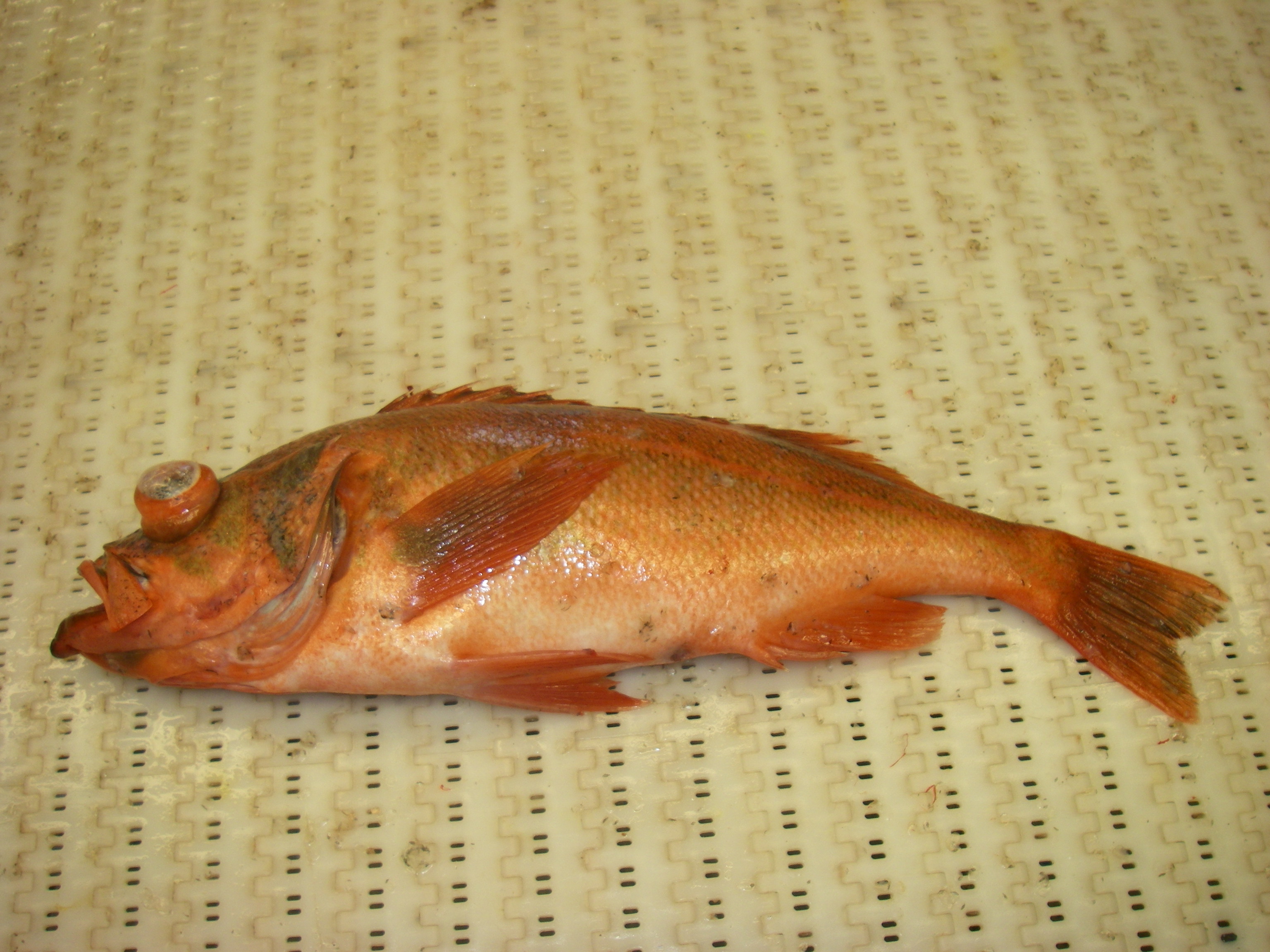
Rockfish
Finally, this is a rockfish! The red snapper that we see in the marketplace is often this fish instead.

Species Seen

Albatross
Northern Fulmar
Gulls
Rockfish
Walleye Pollock
Lumpsucker
Arrowtooth Flounder
Atka Mackerel
Salmon
Pacific Grenadier
Squid
Shrimp
Basket Starfish

Reader Question(s) of the Day!

Today’s question is actually a request. It comes from Tish Neilson, one of our homeschool parents.

Hey Jason –
I had a super favor to ask of you. There is a little girl from Jackson’s school that is a 5th grader and she was recently diagnosed with leukemia. There have been some bracelets created for her that say “Going Bananas for Anna” to show support and several moms and I have gotten together and are putting together a scrapbook for her and trying to get as many people as possible wearing her bracelets in really cool places. Then we are having them take pictures to send to us to put in her scrapbook so she can she how far her bracelets have traveled and how many people are pulling for her. If it’s possible to do so and you would be willing to do it I would LOVE to try and get you a bracelet to take some pictures and send to me from Alaska. Her nickname is Anna Banana and she is always asking for pictures and such so that is why we came up with this idea.
Tish Neilson

Unfortunately, I had left for Alaska before I received the email, and as a result I do not have a bracelet. Hopefully, a sign will work just as well.

For Anna
Hi Anna! This is Unimak Island! It is one of the Aleutian Islands off the coast of Alaska! Hang in there, we are rooting for you!