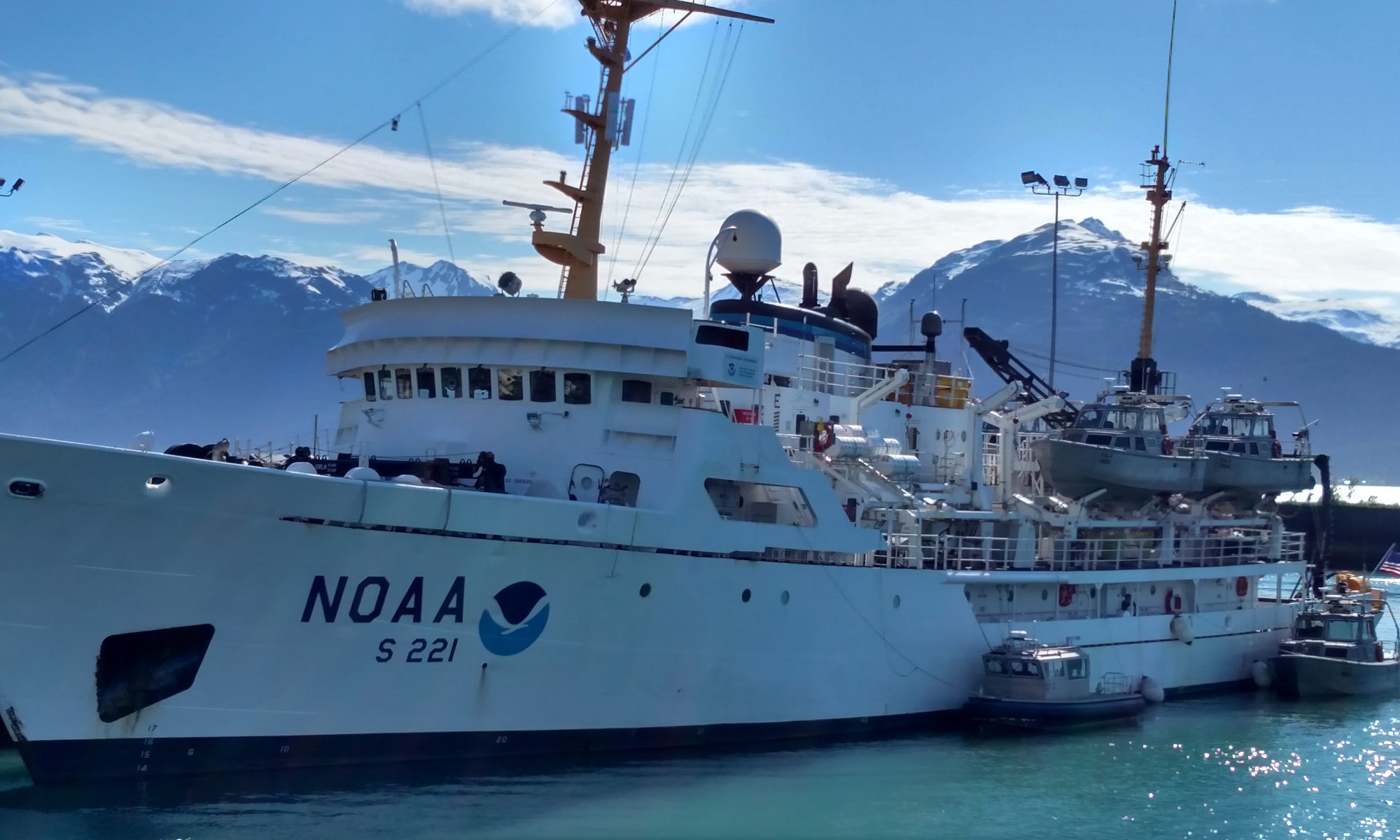
Latitude: 30° 30.2 N
Longitude: 80° 15.6 W
Sea wave height: 1-2 ft
Wind speed: 15 kts
Wind direction: 187°
Visibility: 10 nm
Air temperature: 30.1 °C
Barometric pressure: 1014.7 mB
Sky: Broken Clouds
Science and Technology Log
Warning!!! Great Science Ahead…
Part I.
Waiting to see what the traps have brought up this time… (photo by David Knight)
As fish traps begin to be brought up by the deck crew, scientist wait to see what may be in the trap. I’ve actually found that I am looking over the deck in anticipation of new fish that may have been caught, or to see how many fish will need to be “worked up.” Once the fish have been removed from the trap and emptied into a large bin, they are then sorted by species into 17-gallon bins to determine the total weight of all fish. Moving 17 gallons worth of fish up to the lab bench to the scale can be quite a “work out.” There have been a couple of hauls that have captured so many fish of a particular species that more than one bin has to be used. After the fish have been weighed, the total length of each fish is determined to get a length frequency of the entire catch. For species like Tomtate (Haemulon aurolineatum), every fish is measured and then returned to the ocean. For some species, a pre-determined percentage are kept for a more detailed work up that may include the extraction of otoliths, removal of gonads, or a collection of stomach contents. The data collected from each fish will then be used by scientists in a number of different agencies and in different states to better understand the growth and reproduction of the particular species. All of this data is then used to create management plans for economically and ecologically important fish as well as to gain a better understanding of its life history.
Work Up
Length.
Measuring the length of each, individual fish. (photo taken by Nate Bacheler)
One may assume that a very long fish is also very old, but that is not necessarily the case. The length of a fish is not a good way to determine the age of a fish because factors such as temperature and food availability may alter the growth rate. Many fish grow very rapidly early on, but then slow their growth, so it is possible that a fish that is twelve years old is the same size as a fish that is three years old. Because many fish demonstrate logistic growth rates in terms of length, it is important to use additional pieces of data to determine their age.
Otolith.
In the head of ray-finned fish, one can find small, bone-like structures called otoliths. These structures have a variety of sensory functions that include detection of sound vibrations in water, movement, and its orientation in the water. As fish age, calcium carbonate will be added to the otolith, forming ring-like structures that can be used to determine the age of a fish, much like a tree will add new tissue each season forming tree rings. Otoliths are the best way to determine the actual age of a fish.
Otoliths. [left to right: Black Sea Bass, Red Snapper, Jackknife fish] (photo by David KnightFor the fish that we were sampling, we remove the sagittal otoliths which are located beside the brain just about level with the eyes. To extract them, a cut is made on the dorsal side of the fish with a sharp knife to gain access to the skull case. To extract otoliths from some very “hard-headed” fish, a saw is used, while others take little effort. After a few hours of otolith extraction, I feel as though I am getting the hang of it, although I am nowhere near as fast as the biologist on board! I’ve been collecting otoliths from Black Sea Bass (Centropristis striata) and Vermillion Snapper (Rhomboplites aurorubens) to bring home with me to create a lab for my class and to post on the NOAA Teacher-at-Sea website.
Looking for a perfect extraction of otolith from Vermilion Snapper. (photo taken by Nate Bacheler)
Be sure to check back for Part II. Gonads, Diet and DNA
Personal Log
The motion of the ship has not been a problem so far and I stopped taking any motion sickness pills after the first day. As I have been removing otoliths from fish, I cannot help but think about the similarities in how both fish and humans perceive their spatial environment and maintain balance. In our vestibular system, we too have otoliths that help to sense acceleration in a vertical and horizontal direction. Of course my thoughts then go to a dark place…what if someone were removing my otoliths to determine my age?
Did You Know?
The longest known life span in vertebrates is found in the Greenland Shark (Somniosus microcephalus). It is estimated that the Greenland shark grows less than 1 cm per year. Since sharks do not have otoliths, scientist have to analyze proteins found in the lens of their eye. In 2016, scientist from the University of Copenhagen collected a 5 m shark that was estimated to be about 392 years old, but may be anywhere from 272 to 512 years old.
Reference: Eye lens radiocarbon reveals centuries of longevity in the Greenland shark (Somniosus microcephalus). Science 12 Aug 2016: Vol. 353, Issue 6300, pp. 702-704
Ship repairs are ongoing so I’m reporting from Biloxi, MS. Last week, I got the chance to visit the NOAA Southeast Fisheries Science Center, Pascagoula lab onshore to learn about what the scientists do when they are not at sea.
I got to see the variety of projects described on their website (https://www.sefsc.noaa.gov/labs/mississippi/surveys/index.htm) , from video reef fish surveys (https://www.sefsc.noaa.gov/labs/mississippi/surveys/reeffish.htm#video) to seafood inspection, sharks, and the effects the Gulf oil spill from Deepwater Horizon on plankton in addition to groundfish survey. Chrissy Stepongzi, another fisheries biologist, was willing to take me on an impromptu tour of the warehouses at the pier and then brought me over to the labs.
The Labs
This slideshow requires JavaScript.
Andre and Taniya holding the stingray.
Because we spent so much time at the pier (below) Andre Debose took over the tour. We got a sneak peek at the seafood inspection lab. You need a pretty high clearance to get in, but we ran into a researcher (I didn’t get his name) who was kind enough to take a few minutes to explain what they do:
The U.S. imports a lot of seafood from overseas as well. All ready-to-eat seafood that comes in is inspected by NOAA. A sample from every batch is tested for contaminants and pollutants to ensure it is safe for consumption. We happened to be at the lab that inspects menhaden, a fish typically ground into “fish meal” which is commonly used in pet foods. The lab also checks fish oil, a dietary supplement. Down the hall are labs that inspect Gulf seafood for petroleum oil. After speaking with him, I felt much more confident in my seafood dinners and my cats’ food.
We went down to the reef unit which Andre has worked on and was introduced to Kevin Rademacher who studies reef fish and was watching video data from their camera array. He showed me a few videos recorded from their past surveys. Today, they use an array of five video cameras to create a single, 360˚ field of view for accurate fish counts. Fisheries use these data to determine the health of a fishery, as in the population and sizes of commercially important fish. This information guides the quotas of how many fish people are allowed to take while maintaining resources for the future.
Up to a few years ago, they used four separate cameras—four different fields of view that had to be watched individually to count fish. The new setup also features two levels to create stereoscopic or 3-D images so scientists can digitally measure the lengths of the fish, which was not possible before. However, species identification is still done using good old-fashioned human eyeballs in an experienced scientist.
A hammerhead shark skull among shark jaws in Kristin Hannan’s office
I take a closer look at bull shark jaws
We stopped by the plankton lab. Plankton is a collective term for very small marine organisms—algae and animals that form the foundation of marine food chains. The very small animals are usually the larvae of larger animals, but I didn’t realize how many were vertebrates, i.e. baby fish. I had imagined that plankton were primarily invertebrates such as sea sponge, coral, crustacean and squid larvae.
Finally, Andre showed me his otolith samples. Otoliths are small bony disks in the ears of fish that allow them to sense gravity and speed, which maintains their balance. (Yes, fish have ears and earbones like humans.) A layer of calcium is added every year of a fish’s life so these give us data about the ages of fish.
Overall at NOAA’s Pascagoula labs, researchers are hard at work studying marine life in the Gulf of Mexico to learn where they are and when to find them, at every stage of life, from larval plankton, to juveniles, adults and to food for others such as sharks and dolphins. While “economic” species are the focus of fisheries industries, “ecological” species are deservedly monitored here as well. In such a vast ecosystem, every organism has hundreds or likely thousands of ecological ties to those around it, as predator, prey, competitors or symbiotic partners. Humans aren’t the only ones who enjoy crab legs and fish sticks for dinner. As biologist Alonzo Hamilton puts it, “fish are a product of the environment”, referring to the collective forces that create an ecosystem.
To top off the lab visit, I was presented with a fabulous goody bag! I have some great materials to use in class, and I’m particularly grateful for the coffee mug so I can stop using paper cups in the ship’s galley.
Goody bag from Pascagoula Lab
The Warehouse
So where does all this equipment for these different projects come from? Sadly, there isn’t a “science store” for weird and wonderful devices that seamlessly combine into “cutting edge technology”. I mentioned in the last post that scientists often have to build what they need. In fact, part of NOAA’s mission to support sustainable fishery practices is inventing the tools to fish sustainably! They may not have a store to go shopping in, but they have something much better: Captain James Barbour, master welder extraordinaire! (His actual title is something like Engineering Tech/Gear & Equipment Specialist.)
Chrissy took me to visit him in the warehouses and that was a fun place! We walked into his current project—a stainless steel work table for a scientist, but custom built to include clipboard hangers, blood sample holder, holes for hand sanitizer bottles…like a home renovation show but for research vessels.
The camera arrays for reef survey are his handiwork. He’s built traps with camera housing to record what’s going on under water. He has also modified smaller boats to create platforms for scientists to safely wrangle fish, and apparatuses to operate nets and other equipment. He is steeped in the design of TEDs-turtle excluder devices, and bycatch reducers. Bycatch are animal species that are caught with commercial ones, especially by nets. Often, these are not returned alive to the ocean. TEDs are metal, circular grids about three feet across that are attached to the end of fishing nets, forming a cone. When a turtle is caught, it hits the excluder and slides out of an escape chute. Fish pass through the excluder and into the blind end of the net.
A peek at one of the storage areas in a NOAA warehouse.
Custom trap built by Capt. James Barbour featuring camera housing on the left side.
Bycatch reduction devices
Bycatch reducers with nets
Turtle exclusion device attached to the end of nets. Turtles are stopped by the metal grid and slide out an escape chute to the right.
If you have ever heard or worried about sea turtles or wasted bycatch getting trapped in nets, rest assured that U.S. fisheries are using these devices to reduce their environmental impact. And chances are Capt. Barbour welded them!
Captain James Barbour and I with his many awards.
A recent award to James Barbour for his work with NOAA
This is just a small sample of what he’s accomplished in his long career at NOAA. He continues his research with other scientists to collect data and improve the design, for example, to screen out smaller turtles without sacrificing the fish catch.
As a scientist observing the decline in science literacy and confidence from the general public, I often come across the Strawman fallacy that “science has no place in politics”. This doesn’t make sense considering the various U.S. agencies that employ scientists to make discoveries about our world and outside of it, because objective knowledge is where sound policies should originate. Science has always has an important role in American politics. Another classic are the cries for “less government regulation and interference” but I’m certain those people have no idea what that means. In U.S. seafood industries, regulations require TEDs and bycatch reducers because ecological species support the health of economic ones. In U.S. markets, regulations require safety testing of seafood imports. In Gulf fisheries, regulations limit how many red snapper one can take and when shrimpers can open season because this ensures consumers can enjoy seafood next year and every year after. They ensure that fisherman have employment next year and every year after. Government, as well as university, scientists are third party to all companies and have no personal financial incentives besides their regular salaries. Scientists are public servants who work for everyone.
Captain Barbour is a modest man, but it’s clear that he takes pride in the devices he builds because he accepts the responsibility of humans to be stewards of this planet and the other creatures we share it with. Thus, he genuinely cares about the well-being of dolphins and turtles. He takes personal action for what he believes by coming to work everyday and engages with optimizing the design of scientific equipment by communicating with collaborators, analyzing data, and building with his own hands. While most of us don’t get to be so directly involved with our contributions to society there are two things to think about:
All of us together through our own strengths can make many small actions great: refuse those single use plastics, recycle always, VOTE (or don’t complain), and practice lifelong learning.
Personal Log
At about 1500 on the first day of the survey, I find out that I’m assigned to the day shift that runs from 1200 to 2400. Roommates are assigned with opposite shifts so that each person can have the stateroom while the other works. Typically, you have a backpack to carry anything you might need to avoid entering the room and disturbing a sleeping roommate. The operations of the vessel are 24 hours and other members of the crew work different shifts around the clock: engineers might be scheduled six hours on, six hours off, officers four hours on/off, etc.
“Someone is sleeping all the time on every deck.” –LT Ryan Belcher
So, on day one, my roommate tries to get some sleep and I’m out of the room. For the rest of the day, I experience something called “down time” with nothing really to do. I don’t know when the last time this happened was. Everyone is busy at work or sleeping before their shift and I find myself curiously alone. I find my way back to a higher deck that Chrissy had shown me earlier where a deck chair (no pun intended) has been stashed. The indoor lounge features a large collection of movies on loan from the Navy, including recent releases. After I come in from spending some time relaxing outside, I reenter the lounge to find some of the scientists starting Justice League. When that finishes, we put in Winchester which is inspired by the true story, whatever that means, of the famous haunted house built by Sarah Winchester of the family that developed rifles. Not too bad if you are a fan of ghost stories.
From the last blog we learned that NOAA is a Department of Commerce (DOC) agency that collects scientific data for economic purposes. On this cruise, and those of the past 40 years, Texas shrimp fisheries use NOAA data collected by Oregon II to determine when to open shrimping grounds every year to ensure a sustainable supply. NOAA Ship Oregon II also trawls during the summer for red snapper for fisheries around the entire Gulf to determine when fishing can begin.
We have made it to the most northern point on the survey.
Mission: Juvenile Pollock Fishery Survey
Geographic area of cruise:
Western Gulf of Alaska
Date: August 29, 2017
Weather Data: 10.2 C, rainy/stormy
Latitude: 59 20.0 N, Longitude: 152 02.5 W
Science and Technology Log
The main focus of this survey is to gather information about juvenile walleye pollock, Gadus chalcogrammus. Juvenile pollock less than 1 year of age are called young-of-the-year, or age-0 juveniles. Age-0 walleye pollock are ecologically important. Many species of birds, mammals and other fish rely on them as a food source. Adult pollock have a high economic value. Pollock is commercially fished and commonly used in fish sticks and fish and chips. This study is interested in learning more about the size of current juvenile pollock populations, where they occur, and how healthy they are.
An age 0 juvenile pollock is shown below an adult pollock.
In order to collect a sample, a trawl net is lowered into the water off of the back of the ship. The deck crew and bridge crew work together to release the right amount of wire and to drive the ship at the right speed in order to lower the net to the desired depth. The net is shaped like a sock, with the opening facing into the water current. In order to keep the mouth of the net from closing as it is pulled through the water, each side is connected to a large metal panel called a “door”. As the doors move through the water, they pull on the sides of the trawl net, keeping it open. When the doors are ready to be put in the water, the fishing officer will instruct the winch operator to “shoot the doors”!
The deck crew bring the trawl net back on deck. One of the metal “doors” can be seen hanging off of the back of the ship.
Sensors help monitor the depth of the upper and lower sides of the net and relay a signal to computers on the bridge, where the data can be monitored.
Sensors on the trawl net relay data to computers on the bridge which show the position of the net in the water.
Once the net is reeled in with a large winch, the catch is placed on a sorting table, in a room just off of the back deck called the fish lab. Here, the science team works to sort the different species of fish, jellyfish, and other kinds of marine animals that were caught.
Crew members stand below a winch and empty the catch from the trawl net into a large bin.The catch is then sorted on the sorting table in the fish lab.
Juvenile pollock are sorted into their own bin. If it is a small catch, we weigh, count, and measure the length of each one. However, if it is a large catch, we take a smaller sample, called a subsample, from the whole catch. We use the weight, lengths, and count of animals in the subsample to provide an estimate count and average size of the rest of the fish caught at that station, which are only weighed. This information is compiled on a computer system right in the fish lab.
Here I am measuring some fish.
Data from the catch is collected on computers in the fish lab.
The focus of this study is juvenile pollock, but we do catch several other species in the trawl net. The presence of other species can provide information about the habitats where juvenile pollock live. Therefore, data from all species collected are also recorded.
Here are some other interesting species we caught: 1. jellyfish (with a partially digested pollock inside it!) 2. lumpsucker 3. herring 4. spider crab
A small sample of juvenile pollock are frozen and saved for further study, once back on land. These fish will be analyzed to determine their lipid, or fat, content and calorie content. This data reveals information about how healthy these fish are and if they are getting enough food to survive through the cold Alaskan winters.
Other agencies within NOAA also conduct scientific surveys in this area. These studies might focus on different species or abiotic (non-living) properties of the Gulf of Alaska marine ecosystem. The data collected by each agency is shared across the larger NOAA organization to help scientists get a comprehensive look at how healthy marine ecosystems are in this area.
Personal Log
As we move from one station to the next, I have been spending time up on the bridge. This gives me a chance to scan the water for sea birds and marine mammals, or to just take in the scenery. Other members of the crew also like to come up to do this same thing. I have really enjoyed having this time every day to share in this activity (one of my favorite past-times) with other people and to learn from them how to identify different species.
Here I am outside of the bridge, posing with some glaciers!
Did You Know?
You can find the exact age of many fish species by looking at a bone in their ears! Fish have a special ear bone, called an otolith. Every year, a new layer will grow around the outside of this bone. As the fish ages, the otolith gets larger and larger. Scientists can find the exact age of the fish by cutting a cross section of this bone and counting the rings made from new layers being added each year.
A small otolith of an age 0 juvenile pollockLarger otoliths from an adult pollock
Geographic Area of Cruise: Pacific Ocean; U.S. West Coast
Date: 07/22/2017
Weather Data from the Bridge: (Pratt, Kansas)
Date: 08/02/2017 Wind Speed: SE at 5 mph
Time: 18:40 Latitude: 37.7o N
Temperature: 29o C Longitude: 98.75o W
Science and Technology Log:
During my last few days aboard the Reuben Lasker before steaming to Bodega Bay for a small boat transfer on July 30th, we were fishing off of the southern Oregon coast. The ship continued to run the longitudinal transect lines using acoustics and collecting data using the continuous underway fish egg sampler (CUFES) during the day and performing targeted trawls for coastal pelagic species (CPS) at night. The weather and the pyrosomes picked up as we moved down the Oregon coast to northern California, but on what would turn out to be the last trawl of my trip in the early morning hours of July 28th, we had our biggest catch of the trip with over 730 kg in the net. Once again we saw 3 of the 4 CPS fish species that are targeted for the survey including the Pacific sardine, Pacific mackerel, and jack mackerel, but no northern anchovies were to be found. The science crew worked efficiently to process the large haul and collect the data that will be used to provide the Southwest Fisheries Science Center (SWFSC) with information that can be used to help understand the dynamics of CPS in the California Current. The data collected from the CPS fish species includes length and weight, otoliths (used to age the fish), gender and reproductive stage, and DNA samples. The information from these different parameters will provide the biologists at SWFSC with information that can be used to understand the nature of the different populations of the CPS fish species that are being studied.
Jack mackerel to process (Photo Credit: Nina Rosen)
Sorted Pacific sardines to be processed
Tubs of pyrosomes
Kip checking reproductive maturity on jack mackerel (Photo Credit: Nina Rosen)
Kip and Sue record length/weight data (Photo Credit: Nina Rosen)
I am home now in southcentral Kansas, but as I am writing this, I can picture the science team beginning preparations for a night of trawling probably just north of Bodega Bay. By now (22:00) it is likely that a bongo tow and the conductivity, temperature and depth (CTD) probe samples have been collected providing data that will be used to calibrate and maximize the effectiveness of the acoustics for the area. Lanora and the rest of the team will have prepped the lab for a night of sampling, weather data will be recorded, and someone (maybe Nina or Austin) will be on mammal watch on the bridge. It all seems so familiar now; I hope the rest of the survey goes as well as the first half of the second leg. I will be thinking about and wondering how the science team of the Reuben Lasker is doing somewhere off the coast of California as I settle in for the night. One thing I am sure of, after spending two weeks aboard the ship, is that the entire crew on the Reuben Lasker is working together, diligently, as a team, using sound scientific practices to produce the best data possible to guide decisions about the fisheries resources in the California Current.
Video Transcription: (Narration by Kip Chambers)
(0:01) Ok, we’re preparing to remove otoliths from a jack mackerel. It’s for the Coastal Pelagic Species survey on the Reuben Lasker, July 27, 2017.
(0:22) We have Phil, from Washington Fish & Game, who’s going to walk us through the procedure.
(0:30) The otoliths are essentially the fish’s ear bones. They help with orientation and balance, and also have annual rings that be used to age the fish.
(0:48) And so the initial cut is – looks like it’s just in front of the operculum and about a blade-width deep.
(1:01) And the secondary cut is from the anterior, just above the eyes and kind of right level with the orbital of the eyes, back to the vertical cut.
(1:22) It’s a fairly large jack mackerel. And, once the skull cap has been removed, you can see the brain case, and you have the front brain and kind of the hind brain where it starts to narrow…
(1:42) … and just posterior to the hind brain, there are two small cavities, and that was the right side of the fish’s otolith,
(1:55) … and that is the left side. And that is very well done. Thank you Phil.
Phill collecting jack mackerel otoliths (Photo Credit: Nina Rosen)
Jack mackerel otoliths (Photo Credit: Nina Rosen)
I wanted to use a portion of this section of the blog to share some comments that were expressed to me from the members of the science team as I interviewed them before I left last week. The first “interview” was with Dave Griffith, the chief scientist for the survey. Dave was kind enough to provide me with a written response to my questions; his responses can be found below.
Chief Scientist Dave Griffith
Q1: Can you tell me a little bit about your background, including education and work history?
Q1: I was born and raised in a small suburb of Los Angeles county called Temple City. Located in the San Gabriel valley at the base of the San Gabriel mountains, it was the perfect place to exercise the love and curiosity of the animals I could find not only in my backyard but also in the local mountains. It wasn’t until I reached high school that I realized I had a knack for sciences especially biology. This interest and appeal was spurred on by my high school teacher, Al Shuey. With little concept of a career, I continued on to a junior college after high school still not sure of my direction. Here I dabbled in welding, art, music and literature but always rising to the surface was my love of sciences. My fate was sealed.
I entered San Diego State’s science program and was able to earn a bachelor’s degree and a master’s degree of science. For my dissertation I studied the re-colonization capabilities of meiofaunal harpacticoid copepods in response to disturbed or de-faunated sediments within Mission Bay. While studying for my masters, I was hired by Hubbs-Sea World Marine Laboratory as the initial group of researchers to begin the OREHAP project which is still operational today. The OREHAP project’s hypothesis was that releasing hatchery reared fish into the wild, in this case white seabass (Atractocion nobilis), would stimulate the natural population to increase recruitment and enhance the population. At the time the white seabass population numbers were at their all time low. During that time of employment at HSWML, I was also teaching zoology at SDSU as a teaching assistant in the graduate program. I was also the laboratory manager and in charge of field studies at Hubbs. My plate was pretty full at the time.
I heard about the opening at the SWFSC through a colleague of mine that I was working with while helping her conduct field work for her Ph.D. at Scripps. I applied and was hired on as the cruise leader in the Ship Operations/CalCOFI group for all field work conducted within CFRD (now FRD) working under Richard Charter. That was 1989. I have now been the supervisor of the Ship Operations/CalCOFI group since 2005.
My main objective on the Coastal Pelagic Fish survey as the cruise leader is to oversee all of the operations conducted by personnel from FRD during the survey. All scientific changes or decisions are made by the cruise leader using science knowledge, logic, common sense and a healthy input from all scientists aboard. I am the liaison between the scientific contingent and the ship’s workforce as well as the contact for the SWFSC laboratory. The expertise I bring out in the field is specific to fish egg identification, fish biology, field sampling techniques, knowledge of the California Current Large Ecosystem and sampling equipment.
Q2: What have you learned from your time on the Reuben Lasker during the 2nd leg of the Pelagic Species Survey?
Q2: First, that you never have preconceived ideas of what you expect to find. You always come out with knowledge of previous studies and a potential of what you might see, but the ocean always will show you and demonstrate just how little you know. When I was beginning in this career I was able to witness the complete dominance of a northern anchovy centric distribution change to a Pacific sardine centric distribution and now possibly back again. It’s mind boggling. I remember one of my colleagues, one of the pre-eminent fish biologists in the field, Paul Smith say to me during these transitions say, “Well, you take everything you’ve learned over the past 40 years, throw it out the window and start over again.” Yeah, the ocean environment will do that to you.
Q3: What advice would you give to a 1st year college student that was interested in pursuing a career in marine science?
Q3: Keep an open mind. Once you enter a four year university you will see areas of study that you never thought or believed existed. Have a concept of where you want to be but don’t ignore the various nuances that you see along the way. Go for the highest degree you feel capable of achieving and do it now because it becomes so much more difficult as you get older or the further away you get from academics if you begin working in a science position.
And last, and I feel most important. Read. Read everything. Journals, magazines, classics, modern novels, anything and everything and never stop. Communication is such an incredibly important part of science and you need to have a command of the language. Not only is reading enjoyable but it will make you a better writer, a better speaker and a better scientist.
Personal Log:
I am back home in Kansas now after wrapping up my assignment on the Reuben Lasker and I have started to contemplate my experiences over the last couple of weeks. There are so many facets related to what I have learned during my time on the ship; the technology and mechanics of such a large research vessel are both fascinating and daunting at the same time. There are so many moving parts that all have to come together and work in a very harsh environment in order for the ship to function; it is a testament to the men and women that operate the boat that things operate so smoothly. As impressive as the technology and research is on the Reuben Lasker, it is the people that have made the biggest impact on me.
You can see from Dave’s response above that there are some incredibly talented, dedicated individuals on the ship. I would like to share with you some of my observations about some of those people that I worked with including Dave Griffith. Dave is not only an outstanding scientist that has spent a lifetime making important contributions to fisheries science, he is also an incredibly well rounded person and an encyclopedia of knowledge. I would like to take this opportunity to personally thank Dave for his patience, and willingness to listen and provide insight and advice to me during my time on the ship. In my upcoming blog, I will provide more information about the other members of the science team that I had the pleasure to work with while on board. Until then please enjoy the pictures and video from my last week on the Reuben Lasker.
Latitude 4359.5N
Longitude 12412.6 W
Temperatue: 54 degrees
Sunny
No precipitation
Winds at 23.5 knots
Waves at 2-4 feet
Science and Technology Log
We are officially off! It has already been an amazing experience over the last couple of days.
One of the goals of this project is to collect data that will be used to inform the Pacific hake stock assessment. This falls in line with the Pacific Whiting Treaty that the US-Canadian governments enacted to jointly manage the hake stock. NOAA and Department of Fisheries and Oceans-Canada (DFO) jointly survey and provide the hake biomass to the stock assessment scientists. (Refer to the link in my last blog about additional information on this treaty.) Major goals of the survey are to determine the biomass, distribution, and biological composition of Pacific hake using data from an integrated acoustic and trawl survey. Additionally, we are collecting a suite of ecological and physical oceanographic data in order to better understand the California Current Large Marine Ecosystem (CCLME).
There is a very detailed process the scientists go through to collect samples and data on the hake caught and selected for sampling. They want to learn as much as possible about these fish to help with the ongoing research projects.
Here is a quick guide and understanding of how sampling works and what data is collected:
Determine the length and sex of the fish.
To determine the length, the fish is placed on a magnetic sensor measuring board. The magnet is placed at the fork of the tail fin; the length is recorded into the data table. (See figure A.)
Figure A. Determining the length of the fish.
To determine the sex, the fish is sliced open on the side. Scientist look to see if ovaries (for females) or testes (for males) are present. They also can determine the maturity of the fish by looking at the development of the reproductive organs. (See figure B.)
Figure B. Determining the sex of the fish.
Determine the mass.
The Hake are placed on a digital scale and then massed. The data also gets entered into the database. (See figure C.)
Figure C. Massing the fish on a digital scale.
Removing of the otoliths (ear bones).
Hake have two otoliths. How this is done is the scientist first cuts a slight incision on top of the fish’s head. (See figure D.)
Figure D. Making an incision on the fish’s head to remove otoliths.
The head is then carefully cracked open to expose the bones. (See figure E.)
The bones are removed with forceps and then placed in a vial. The vial is then barcode scanned into the database. The otoliths will then be sent to the lab for testing. Scientists can run test on the otoliths to determine the age of the selected fish. (See figures F and G.)
Figure E. Cracking head open to reveal otolith
Figure F. Removing otolith with forceps
Figure G. Storing otolith in vial
Removing a fin clip.
Fin clips are removed from the Hake for DNA sampling to be completed back on shore in the lab. This gives researchers even more information about the selected fish.
The fin clip is removed using scissors and forceps. (see figure H.)
Figure H. Removing a fin clip.
The clip is then placed on a numbered sheet. (see figure I.)
Figure I. Placing the fin clip on a numbered sheet.
The number is also entered into the database with all the other information collected on that particular fish.
All the information is collected in one database so it can be assessed by scientists for future research. (see figure J.)
Figure J. All information is stored in a database.
Personal Log
Even though this survey is just beginning this has been such an amazing experience already. I have learned a great deal about oceanography and marine research. I cannot wait to use my experiences back in my classroom to expose my students to careers and opportunities they could be a part of in their future.
Another great aspect of being a Teacher at Sea is the relationships I’m building with other scientists and the crew. It is amazing to hear how everyone became a part of this cruise and how passionate they are about their profession and the world around them.
Did You Know?
This is Leg 3 of 5 of this Summer Hake Survey. Two more legs will be completed this year to collect even more data on the fish population.
Fascinating Catch of the Day!
When we fish for Hake it is very common to collect some other organisms as well. Today’s fun catch was Pyrosomes or Sea Tongues!
These free-floating colonial tunicates are found in the upper part of the open ocean. Pyrosomes rely on the currents to move them around the ocean. They are typically cone shaped and are actually made up of hundreds of organisms known as zooids. The Zooids form a gelatinous tunic that links them together creating the cone shape. They are also bioluminescent and give off a glow in the ocean.
Fun with pyrosomes!
Check it Out!
If you want to learn more about what is happening on the Bell M. Shimada, check out The Main Deck blog for the ship: