Mission: Hydrographic Survey- Approaches to Houston
Geographic Area of Cruise: Gulf of Mexico
Date: July 1, 2018
Weather Data from the Bridge
Latitude: 29° 10.1’ N
Longitude: 093° 54.5’ W
Visibility: 10+ NM
Sky Condition: 3/8
Wind: 16 kts
Temperature:
Sea Water: 29.4° C
Air: 27° C
Science and Technology Log
At this point I have been able to understand more of the sonar technology taking place during the survey aboard the Thomas Jefferson. The ship uses two types of sonar: multibeam and side scan. Both work together transmitting and receiving sound pulses to and from the ocean floor. This provides a multispectral analysis.
Julia Wallace, a physical scientist, works at the sonar acquisition station. This requires a large amount of multitasking as she communicates with the bridge (ship steering deck), watches the safety cameras, and makes sure both sonar devices are working correctly.
Multibeam sonar is located underneath the hull of the ship. Multibeam is used to detect bathymetry (the depth of the ocean floor). Multibeam backscatter (reflected wave energy) gives a reading of the surface intensity. For example, a strong signal would mean a harder surface like rock or pipeline. With multibeam sonar, you can also adjust the sound wave frequency. For example, high frequency (primarily used during this survey in the Gulf of Mexico) is used for shallower waters allowing for higher resolution images. Images from multibeam have a color gradient to allow for clear vision of contours and depth differences. One way surveyors aboard the TJ may use backscatter images is to determine areas where bottom sampling might be applicable.
A NOAA ship using mulitbeam sonar. (Courtesy of NOAA)Bathymetry acquired using multibeam echosounder layered over a nautical chart. Blue and green wave lengths penetrate further in water, so the coloring corresponds to this observation. This poster is from a previous Thomas Jefferson hydrographic survey near Savannah, Georgia. (Prepared by CHST Allison Stone)3D bathymetry imagery from the Okeanos Explorer. (NOAA)A close-up view of multibeam data. The third window down shows multibeam backscatter.
The side scan sonar is used alongside multibeam to provide black and white scans of images. Like multibeam backscatter, side scan measures the intensity of the sound returning from the sea floor. For example, a side scan return with high intensity could indicate a difference in material like pipeline or a wreck. A low intensity value could mean that the side scan sonar waves have reached a muddy substrate. Julia used the analogy of a tennis ball being bounced against a wall of different materials. For example, the tennis ball hitting a concrete wall would bounce back with higher intensity than one being bounced against a soft wall. Side scan sonar is very effective at detecting features that protrude off the sea floor, and for shallow water surveys, typically can see farther and cover a greater area the sea floor than multibeam echosounders alone.
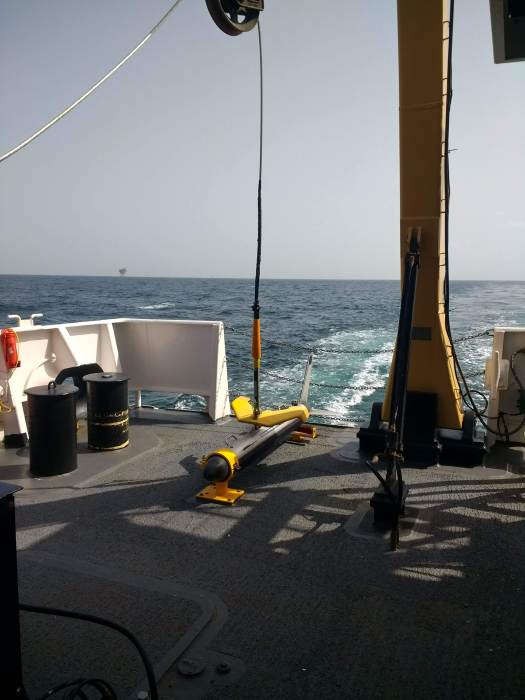
The side scan sonar sensor is located on a torpedo-shaped “towfish” and pulled behind the boat. When viewing side scan images, surveyors typically look for the acoustic shadow cast by a feature protruding off the sea floor. By measuring the length of the acoustic shadow, hydrographers can determine whether the feature requires additional investigation. For example, the outline of a shipwreck, bicycle, or pipeline. However, it can also detect mammals like dolphins or schools of fish.
Diagram of side scan sonar. (Courtesy of thunder bay 2001, Institute for Exploration, NOAA-OER)The Thomas Jefferson sidescan sonar on deck.In the early morning, the sidescan sonar picked up the image of an incorrectly charted shipwreck. Height is estimated using the “shadow” of the wreck.Sidescan sonar imagery layered on a nautical chart. It is important to remember that sidescan data does not account for depth, it is a measure of differences in sea floor substrate.Look closely and you can see arc lines in the sidescan imagery. Lt. Anthony Klemm explains that these arcs are from ships dragging anchor and stirring up the sea floor.
While this is happening, surveyors are also towing a MVP or Moving Vessel Profiler to capture information about the water column. This is important because multiple factors in the water column need to be corrected in order for accurate sonar calculations. For example, the speed of sound in salt water is roughly 1500 m/s but may change while the ship is traveling over different parts of the sea floor or passing through a thermocline (steep temperature gradient) or halocline (steep salinity gradient). The MVP is similar to the CTD used on the launch boat (see previous post), but the MVP allows the ship to continue moving at about 10 knots (average survey speed), while the CTD must be cast when the ship is stationary.
Information from the Moving Vessel Profiler. From left to right, the MVP tracks sound speed, temperature, and salinity in relation to depth.
For more information on multispectral analysis and sonar, see these resources:
One of my goals in the classroom is to teach students to be comfortable making and learning from mistakes. Making mistakes in math and science is common and welcome because they lead to great discussion and future change. Often, my sixth graders get discouraged or so caught up in failure that they become paralyzed in making further attempts. While aboard the Thomas Jefferson, I have witnessed several aspects not go according to plan. I think these experiences are important to share because they provide real-life examples of professionals coming together, learning from mistakes, and moving forward.
Around 4:00 am, the towfish side scan sonar became entangled with the MVP. This was a horrendous disaster. The crew spent about 16 hours contemplating the issue and collecting data using the multibeam only, which is less than ideal. One of XO LCDR McGovern’s many roles aboard the ship is to serve as the investigator. She reviewed tapes of the early morning, talked with the crew, and later held a debrief with all involved. When something like this happens, the ship must write a clear incident report to send to shore. There were many questions about why and how this happened as well how to best proceed. In the end, the towfish and MVP were untangled with no damage present to the sensor. Within the same day, both were cast out and back in use.
I find this to be an astounding example of perseverance and teamwork. Despite being disappointed and upset that a critical tool for collecting accurate data was in dire shape, the crew came up with a plan of action and executed. Part of the engineering and scientific processes include evaluation and redesign. Elements of the sea and a center drift of the side scan lead to a documented new plan and refiguring the process so that this is unlikely to happen again.
Lt. Charles Wisotzsky’s sketch of the complications with launching both the sidescan sonar (which tends to centerline) and MVP towfish with a current coming from port side.This camera image captures the entanglement of the sidescan sonar and MVP.
Peaks
+Saw a tuna eat a flying fish
Flying Fish. (www.ocean.si.edu)
+There is a large sense of purpose on the ship. Despite complex sleep schedules to enable 24 hour operations with a smaller crew, people are generally happy and working hard.
+ There seems to be an unlimited supply of ice cream in the ice cream freezer. Junior Officer, ENS Garrison Grant introduced me to a new desert- vanilla ice cream, a scoop of crunchy peanut butter, and chocolate syrup. I also found the rainbow sprinkles.
Geographic Area of Cruise: Pacific Ocean; U.S. West Coast
Date: June 29, 2017
Weather Data from the Bridge
Date: June 29, 2017 Wind Speed: 7.7 kts
Time: 6:15 p.m. Latitude: 4805.5N
Temperature: 12.7oC Longitude: 12520.07W
Science and Technology Log
The technology present on this ship is amazing and at the same time quite overwhelming. These systems allow for data to be collected on a wide range of variables both continuously and simultaneously. Below are a couple of photos of the acoustics room where multiple sensors are monitoring the feedback from sonar systems placed below the ship’s hull. One of the acoustic probes sends out sound waves in a cone-like formation directly below the ship. Another unit emits sound waves in a horizontal pattern. The ship was designed to run as quietly as possible so as to not disturb the marine life present in the waters as the ship passes by and also to reduce the interference of the ship’s sounds with the acoustics feedback.
Acoustics technician Dan Palance manages multiple computers
Acoustics technician Dan Palance manages multiple computers
Acoustics technician Dan Palance managing the multiple computers that are constantly collecting data.
Multiple programs help to eliminate the “noise” received by the probes until all that remains are images that represent schools of fish and their location relative to the ocean floor.
Diagram of Multibeam Sonar System
Diagram of Multi-frequency scientific sounder
The images above were taken from a poster on board the Reuben Lasker. They illustrate the range of the water column surveyed by the various acoustic systems.
The “soundings” are received by the ship, processed and “cleaned up” using a series of program algorithms. The image below shows the feedback received from one of the systems.
Displays of feedback from an acoustics system
Once the background “noise” has been eliminated, the resulting image will show locations of fish, school size, and the depth (y axis) at which they can be found.
Graph of acoustic feedback, with background “noise” eliminated, depicting depth and size of fish schools
Extension question for my students reading this: Approximately how deep are the schools of fish being picked up by the sonar at this location?
Acoustics aren’t the only tools used to try pinpoint the locations of the fish schools. As I wrote about on an earlier blog, the CUFES egg sampler is used to monitor the presence of fish eggs in the waters that the ship passes over. Water samples are analyzed every half hour. If egg samples appear in an area where there is also a strong acoustics signal, then that may be a location the ship will return to for the night’s trawl. The main focus of this trip is to monitor the anchovy and sardine populations, so extra attention is paid to the locations where those eggs appear in the samples.
Personal Log:
Each time we drop the net for an evening trawl it is always retrieved with a bit of suspense: What’s going to be in the net this time? How big is the haul? Will we capture any of the key species or haul in something completely different?
I can honestly say that while on board there were no two hauls exactly the same. We continued to capture large quantities of pyrosomes – unbelievable amounts. Check out the net-tearing load we encountered one night. We literally had to weigh them by the basketful!
Here I am getting ready to help unload this large catch.
TAS Dawn White prepares to help unload large catch
Net-tearing load of pyrosomes!
Above is the codend of the net filled with pyrosomes and fish. A 5-basket sample was pulled aside for analysis. The remainder was simply classified and massed.
While I was certainly don’t need to see another pyrosome any time soon, there were plenty of other times when some very unique species made an appearance!
Pacific Jack MackerelSolitary Common SalpTAS Dawn White holds a Blue SharkDogfish Shark
Did you know?
The dogfish shark (pictured above) was one of about 50 or so that were caught in the same haul. We had trawled through a school that was feeding on the small fish found at the ocean surface during the evening hours. This is the same species of shark that is commonly provided to students for dissection. Use the search terms “dogfish shark dissection” and see what you find!
Geographical area of cruise: Latitude: N 57˚50 Longitude: W 153˚20 (North Coast of Kodiak Island)
Date: June 23, 2016
Weather Data from the Bridge: Sky: Clear Visibility: 10 Nautical Miles Wind Direction: 268 Wind Speed: 14 Knots Sea Wave Height: 2-3 ft. on average Sea Water Temperature: 12.2° C (54° F) Dry Temperature: 16° C (60.8° F) Barometric (Air) Pressure: 1023 mb
Science and Technology Log
I’m continually searching for ways to connect what I am learning to what is relevant to my students back home in the Midwest. So, as we left Homer, AK for our survey mission in Kodiak Island’s Uganik Bay, I was already thinking of how I could relate our upcoming survey work to my students’ academic needs and personal interests. As soon as the Rainier moved away from Homer and more of the ocean came into view, I stood in awe of how much of our planet is covered with water. It’s fascinating to think of our world as having one big ocean with many basins, such as the North Pacific, South Pacific, North Atlantic, South Atlantic, Indian, Southern and Arctic. The study of ocean and its basins is one of the most relevant topics that I can teach when considering the following:
the ocean covers approximately 70% of our planet’s surface
the ocean is connected to all of our major watersheds
the ocean plays a significant part in our planet’s water cycle
the ocean has a large impact on our weather and climate
the majority of my students have not had any firsthand experience with the ocean
Earth’s One Big Ocean as seen from outside of Homer, AK
Each of the ocean basins is composed of the sea floor and all of its geological features which vary in size and shape. The Rainier will be mapping the features of the sea floor of the Uganik Bay in order to produce detailed charts for use by mariners. The last survey of Uganik Bay was completed in 1908 when surveyors simply deployed a lead weight on a string over the edge of a boat in order to measure the depth of the water. However, one of the problems with the charts made using the lead line method, is that the lead line was only deployed approximately every 100 meters or more which left large gaps in the data. Although not in the Uganik Bay, in the 1930s NOAA began using single beam sonar to measure the distance from a ship’s hull to the sea floor which made surveying faster but still left large gaps in the data. Fast forward from approximately 100 years ago when lead lines were being used for surveying to today and you will find the scientists on the Rainier using something called a multibeam sonar system. A multibeam sonar system sends out sound waves in a fan shape from the bottom of the ship’s hull. The amount of time it takes for the sound waves to bounce off the seabed and return to a receiver is used to determine water depth. The multibeam sonar will allow our team on the Rainier to map 100% of the ocean’s floor in the survey area that we have been assigned.
Evolution of Survey Techniques (Illustration Credit: NOAA)
NOAA Ship Rainier June 22, 2016 in Uganik Bay off of Kodiak Island
All Aboard!
NOAA Corps Junior Officer Shelley Devereaux
The folks I am working with are some of the most knowledgeable and fascinating people that I have met so far on this voyage and Shelley Devereaux from Virginia is one of those people. Shelley serves as a junior officer in the NOAA (National Oceanic and Atmospheric Administration) Corps and has been working aboard the Rainier for the past year. The NOAA Commissioned Officer Corps is one of the seven uniformed services of the United States and trains officers to operate ships, fly aircraft, help with research, conduct dive operations, and serve in other staff positions throughout NOAA.
Here is what Shelley shared with me when I interviewed her one afternoon.
Tell us a little about yourself: I’m originally from the rural mountains of Appalachia and moved to Washington DC after college. I lived in DC for about seven years before I joined the NOAA Corps and while in DC I really enjoyed cycling, hiking, cooking, baking and beer brewing.
How did you discover NOAA Corps and what do you love most about your job in the NOAA Corps?
I went to Washington DC after I received my undergraduate degree in math and worked a lot of different jobs in a lot of different fields. In time, I decided to change careers and went to graduate school for GIS (Geographic Information Systems) because I like the data management side of the degree and the versatility that the degree could offer me. I was working as a GIS analyst when my Uncle met an officer in the NOAA Corps who talked with my Uncle about the NOAA Corps. After that, my Uncle told me about NOAA Corps and the more I found out about NOAA Corps the more I liked it. Especially the hydro side! In the NOAA Corps each of your assignments really develops on your skill base and you get to be involved in a very hands on way. Just this morning I was out on a skiff literally looking to determine what level a rock was in the water. And, later in my career I can serve an operations officer. So I loved the fact that I could join the NOAA Corps, be out on ship collecting data while getting my hands dirty (or at least wet!), and then progress on to other interesting things. I love getting to be part of all the aspects of ship life and being a surveyor. It’s a wonderful feeling knowing that what we do here has a tangible effect on the community and the public because we are making the water safer for the people who use it.
NOAA Corps Junior Officer Shelley Devereaux manages her sheets during near shore work in Uganik Bay
What are your primary responsibilities when working on the ship?
I am an ensign junior officer on a survey ship. Survey ships operate differently than other ships in the NOAA fleet with half of my responsibilities falling on the junior officer side of ship operations which includes driving the ship when we are underway, working towards my officer of the deck certification, working as a medical officer, damage control officer and helping with emergency drills. The other half of what I get to do is the survey side. Right now I am in charge of a small section called a sheets and I am in charge of processing the data from the sheets in a descriptive report about the area surveyed. So, about half science and half ship operations is what I do and that’s a really good mix for me. As a junior officer we are very fortunate that we have the opportunity to and are expected to learn the entire science of hydrography.
Junior Officer Shelley Devereaux checks the ship’s radar
What kind of education do you need to have this job and what advice do you have for young people interested in a career like yours?
You need a college degree with a lot of credits in science and/or math. Knowing the science that is happening on the ship is important to help your understanding of the operations on the ship which helps you be a better ship operator. Realize that there are a lot of opportunities in the world that are not always obvious and you need to be aggressive in pursuing them.
Personal Log
You didn’t think I’d leave out the picture of Teacher at Sea in her “gumby suit” did you? The immersion suit would be worn if we had to abandon ship and wait to be rescued.
Teacher at Sea (TAS) Kurth Hi Mom!
Happy Solstice! Quirky but fun: For the past six years I have celebrated the solstice by taking a “hand picture” with the folks I am with on the solstice. I was thrilled to be aboard the Rainier for 2016’s summer solstice and include some of the folks that I’m with on the ship in my biannual solstice picture.
Winter Solstice 2015 with Sisu (family pet) and my husband JamesAll Hands on Deck! Summer Solstice 2016
Did You Know?
Glass floats or Japanese fishing floats are a popular collectors’ item. The floats were used on Japanese fishing nets and have traveled hundreds and possibly thousands of miles via ocean currents to reach the Alaskan shoreline. The floats come in many colors and sizes and if you’re not lucky enough to find one while beach combing, authentic floats and/or reproductions can be found in gift shops along the Alaskan coast.
NOAA Teacher at Sea Jeanne Muzi Aboard NOAA Ship Thomas Jefferson August 2 – 8, 2015
Mission: Hydrographic Survey Geographical area of cruise: North Atlantic Date: August 7, 2015
Weather Data From the Bridge: Temperature:79°F (26°C) Partly Cloudy
Humidity: 41%
Wind Speed: W 9 mph
Barometer: 29.89 in (1012.0 mb)
Dewpoint: 53°F (12°C)
Visibility: 10.00 mi
Heat Index: 79°F (26°C)
Science and Technology Log:
The Thomas Jefferson is in port at the naval base at Newport so the small launch boats are being used for hydrographic survey training.
Last minute instructions on deck.Lowering the Launch into the water!Onto the launch..…and we are off!
On my two trips out, I have absorbed an enormous amount of information about how to set up all the computer equipment so each part “talks” to the other, how to know if the underwater multi-beam sonar is set correctly, how to lengthen or shorten the swath of the beams so the “pings” travel the correct distance/speed and how to examine the survey data and discuss what is seen (for example, is that disturbance we see the wake from a passing ship? Are we running the lines too close to the jetty? Is that an underwater cable? Do you see that large school of fish moving?).
Coordinating all the tasks on all the screens is important.Learning about multi-beam sonarExamining data
Doug Wood, a senior hydrographic survey technician, explained how to start the generator on the launch, turn on all the surveying and charting technology and created different scenarios so that we could set various lines to survey. Once we had our location, the Coxswain (the person in charge of steering and navigating the boat) could guide the launch along that line and we could begin logging data. As the sonar began delivering data to the screen, we were able to see rocks, buoys and even large fish that appeared along with their shadows. The multi-beam sonar was capable of picking up lots of information about what was on the sea floor.
Gassing up the launch. Photo credit: Stephanie StabileReturning to the ship!
If you are interested in finding out more about how NOAA maps with sound, take a look at this article by clicking on this link:
Look at how detailed NOAA’s nautical charts must be:
Personal Log:
One of the most interesting parts of being on the Thomas Jefferson has been having conversations with everyone onboard. It seems that every officer, engineer, seaman or steward has a remarkable story about the path that brought him or her to serve on NOAA’s TJ.
Yesterday, I had a chance to ask three Junior Officers and a Lieutenant J.G. some questions about their work. Ensign Katie Seberger, Ensign Marybeth Head and Ensign Max Andersen were kind enough to let me chat with them as they worked in the chartroom updating checklists and working to improve safety routines. LTJG Matthew Forrest took a minute to talk with me in the mess. When I asked what the best thing about their job was, each answered that they really enjoyed their work.
Ensign Katie Seberger and Ensign Marybeth Head
Ensign Seberger explained that she had loved the ocean and wanted to study marine science her whole life and the best part of her job is being out on the water. Ensign Head said that doing something for the big picture is the best and it is easy to get really excited about her work. Ensign Andersen said the best part of his job has been getting a chance work with the Z boats; the newest surveying tool the crew of the TJ will begin using soon. LT.JG Forrest said that it was the opportunity to be a part of something much bigger than you, and contribute every day to something important. He also said an enjoyable part of his job is working with a great team.
Ensign Max Andersen
Each of the officers had to think about what the worst part of their job was. Ensign Seberger said that while it is exciting to travel, it is sometimes hard not knowing where you are going next. Ensign Head said that for her, it is difficult to be disconnected from the water, and that even though she is sailing on a ship, she grew up on small boats with the salt spray on her face, and she misses that. Ensign Andersen said the worst thing is the uncertainty of the ship’s schedule and not knowing where you will be next. LTJG Forrest said the worst thing is the lack of sleep because it is not unusual for them to be up working for 16 hours sometimes. He also said it was hard to be so far from his family and disconnected from everything going on at home.
LTJG Matthew Forrest
Each of the officers had great advice for young students who would like to one day do the type of work they do. Ensign Seberger suggested that its important to volunteer doing what you think you would like to work at so you can find out if it is for you. Ensign Head’s advice to students was to be “persistent and memorable.” She explained that you need to keep at whatever you are doing and not give up. The people that quit will be forgotten. The people that keep working will not. Ensign Andersen’s advice to young students is to make your own path and don’t settle for the status quo. He thinks you might have to work harder to make your way, but it’s worth it. LTJG Forrest felt that kids should understand that all the work done on the Thomas Jefferson is built on a foundation of the fundamentals of math and science so all kids should try to soak up as much math and science as they can. He also said to always be ready to work hard.
Each of the officers said they enjoy their work very much and could not imagine doing anything else!
In my last blog entry the Question of the Day was:
Why is surveying the ocean floor so important?
The ocean floor is covered with all sorts of things including natural things, like rocks, reefs, hills and valleys, and manmade objects, such as cables, docks, shipwrecks and debris. If ships don’t know where things are it can be very dangerous. Storms often change the position of things underwater so it is very important that charts are accurate and updated. Hydrographers capture the data from the seafloor using sonar, process the data and utilize the information to create precise and informative ocean charts.
In my last entry, The Picture of the Day showed an anchor ball. An anchor ball is a round, black shape that is hoisted in the forepart of a vessel to show that it is anchored. It must be taken down when the ship is underway.
Anchor Ball
Today’s Question of the Day is:
How was the ocean floor mapped before sonar was invented?
Today’s Picture of the Day: What is Ensign Gleichauf lowering into the water?
The last couple of days have been the best ever: beautiful weather, hard work, deep science. We acquired data along the continental shelf and found a cool sea floor canyon and then set benchmarks and tidal gauges.
In hydrography, we gather data in seven steps, by determining: our position on Earth, depth of water, sound speed, tides, attitude (what the boat is doing), imagery and features. Step 1 is to determine where we are.
In this picture you can see a GOES satellite antenna (square white one) that is used to transmit tide data ashore and a GPS antenna (the small white eggs shaped one) that provides the tide gauge with both position and UTC time. Photo by Barry JacksonIn this picture Brandy Geiger, Senior Survey Technician, uses GPS to record the positions of the benchmarks we have just set for the tide gauge. Photo by Barry JacksonWhere we are happens to be the most beautiful place on earth. Photo by Barry Jackson
In Step 2, we determine the depth of the water below us.
Bathymetry is a cool word that means the study of how deep the water is. Think “bath” water and metry “measure.” When your mom tells you to get out of the tub, tell her to wait because you’re doing bathymetry.
As I explained in my first blog, we measure depth by sending out a swath of sound, or “pings,” and count how long it takes for the pings to return to the sonar, which sits beneath the ship or smaller boat.
Yesterday we used the multi-beam sonar to scan the sea floor. Here is a screen shot of the data we collected. It looks like a deep canyon, because it is!
Here is the image of the sea floor canyon Starla Robinson, a Senior Survey Technician, and I discovered. We decided it should be named Denla Canyon, after the two scientists who discovered it.
Here I am, gathering pings.
While collecting data, I kept in contact with “the bridge,” the team responsible for navigating the ship, by radio to ensure the ship’s safety and maximum, quality data acquisition. Photo by Starla Robinson
Step 3, we take into consideration the tide’s effect on the depth of the water. Tides are one predictable influence on water depth. There are over 38 factors or “constituents” that influence the tides. The gravitational pull of the sun and the moon at various times of the day, the tilt of the earth, the topography, and many other factors cause water to predictably bulge in different places on earth at different times. The Rainier crew works 24 hours a day and 7 days a week, so they must find a way to measure depth throughout the days and month, by taking into account the tide. Arthur Doodson, who was profoundly deaf, invented the Doodson Numbers a system taking into account the factors influencing tide in 1921. Flash forward to the 21st century, our Commanding Officer, Commander Rick Brennan worked with a team of NOAA scientists to develop a software program called TCARI, as an alternate method to do tide adjustments, taking into account 38 factors, even the moon’s wobble. Inventions abound at NOAA.
The Rainier crew worked for 14 hours today to set up a tide gauge station, an in depth study of how the tide affects our survey area. On this map, there is a Red X for each tide gauge we will install. This process only happens at the beginning of the season, and I feel fortunate to have been here–the work we did was….amazing.
Each Red X is approximately where a tide gauge will be installed. The one we installed today in Driver Bay is in the north west corner of the sheet map.
You can see an animation here that shows the combined effect of two sine waves that produce a signal like our tide data. Just imagine what it looks like when you factor in 38 different variables.
The earth goes around the sun in 24 hours and moon goes around the earth in a little more than 12 hours, much like these two gray sine waves. Interestingly, when you add two different waves, you get the wonky blue sine wave, with ups and downs. This combined effect of the sun and the moon (two dots) causes the ups and downs of the tide (blue wave). Graph taken from Russell, D. Acoustics and Vibration Animation, PSU, http://www.acs.psu.edu/drussell/demos/superposition/superposition.html.
Low tide is the best time to see sea stars, mussels and barnacles, but it is also a more hazardous time in the tidal cycle for mariners to travel. Therefore, navigational charts use the mean lower low water level, low tide, for the soundings, or depth measurements on a chart. The black numbers seen on a nautical chart, or soundings, represent depth measurements relative to mean lower low tide. Driver Bay, the area on the chart where we installed the tide gauge today, is the crescent shaped bay at the northwest end of Raspberry Island.
This is a nautical chart used to help mariners navigate safely.
Installing Tide Gauge Stations
Before gathering sonar data, ground and boat crews install a tide gauge to measure changes in water level and to determine the mean lower low water level datum. A tide gauge is a neat device that has air pumped into it, and uses air pressure, to determine how deep the water is. The tide gauge uses a formula of (density of sea water)(gravity)(height) = pressure. The gauge measures pressure, and we apply factors for gravity and sea water. The only missing factor is height, which is what we learn as the gauge collects data. This formula and nuances for particular locations is a fascinating topic for a blog or master’s thesis. Scientists are looking for tidal fluctuations and other location specific variances. Then, by computer they determine the mean lower low tide depth, factoring in the tidal fluctuations.
There are permanent tide gauge stations all over the world. The nearest permanent tide gauge station to our study area is in Kodiak and Seldovia. These permanent gauges take into account many factors that affect tides over a 19 year period of time, not just the gravitational pull of the moon.
The tide gauge stays in place for at least 28 days (one full tidal cycle). During the month, data of the tides is collected and can be compared to the other tide gauges we install.
Installing the Tide Gauges and Benchmarks
Excitement built as the crew prepared for the “Tide Party,” packing suitcases full of gear and readying the launches. Installing Tide Gauges signals the beginning of the season and is one of the few times crew gets paid to go on shore.
Why Bench Mark?
There are three reasons I have figured out after many discussions with patient NOAA crew as to why we put in bench marks.
I installed this benchmark in Driver Cove by having a hole drilled in bedrock and affixing the benchmark with concrete if anyone ever returns and needs to know their exact location. Photo by Barry Jackson
The first reason we install benchmarks is to provide a reference framework to ensure both our tide staff and the tide gauge orifice are stable and not moving relative to land. The second reason is if we ever come back here again to gather or compare data to previous years, we will know the elevation of the tidal datum at this location relative to these benchmarks and can easily install a new tide gauge. The third reason is that the earth and ocean floor changes constantly. As scientists, we need to make sure the survey area is “geologically stable.” We acquire several hours of GPS measurements on the primary benchmark to measure both its horizontal and vertical position relative to the earth’s reference frame. Should there ever be an earthquake here, we can come back afterwards and measure that benchmark again and see how much the position of the Earth’s crust has changed. After the last big earthquake in Alaska, benchmarks were found to move in excess of a meter in some locations!
Teacher on Land Polishing Her Benchmark Photo by Brandy Geiger
Installing the Benchmark
Today, our beach party broke into two groups. We located stable places, at about 200 foot intervals along the coastline. We drilled 5 holes on land and filled them with concrete. A benchmark is a permanent marker you may have seen at landmarks such as a mountain peak or jetty that will remain in place for 100 years or more. We stamped the benchmark by hand with a hammer and letter stamps with our station identification. If we chose a good stable spot, the benchmark should remain in the same location as it is now.
Tide Gauge
As one group sets up benchmarks, another group installed the tide gauge.
Here, Chief Jim Jacobson, Lead Survey Technician, sets up a staff, or meter stick, I used to measure the change in water depth and others used for leveling. Photo by Barry Jackson
To install the tide gauge, you must have at least three approved divers who install the sensor in deep water so that it is always covered by water. Because there were only two crew on board trained to dive, Lieutenant Bart Buesseler, who is a dive master, was called in to assist the team. The dive team secured a sensor below the water. The sensor measures the water depth with an air pressure valve for at least 28 days. During this time there is a pump on shore that keeps the tube to the orifice pressurized and a pressure sensor in the gauge that records the pressure. The pressure is equal to the number of feet of sea water vertically above the gauge’s orifice. An on-board data logger records this data and will transmit the data to shore through a satellite antenna.
Divers install the tide gauge, and spent most of the day in the cold Alaska waters. Good thing they were wearing dive suits! Photo by Barry Jackson
Leveling Run
After the gauge and benchmarks are in place, a group does a leveling run to measure the benchmark’s height relative to the staff or meter stick. One person reads the height difference between 5 different benchmarks and the gauge. Then they go back and measure the height difference a second time to “close” the deal. They will do the same measurements again at the end of the survey in the fall to make sure the survey area has not changed geographically more than ½ a millimeter in height! Putting the bubble in the middle of the circle and holding it steady, leveling, was a highlight of my day.
Observation
Finally, a person–me– watches the staff (big meter stick above the sensor) and takes measurements of the water level with their eyes every six minutes for three hours. Meanwhile, the sensor, secured at the orifice to the ocean floor by divers, is also measuring the water level by pressure. The difference between these two numbers is used to determine how far below the water’s surface the orifice has been installed and to relate that distance to the benchmarks we have just leveled to. If the numbers are consistent, then we know we have reliable measurements. I won’t find out if they match until tomorrow, but hope they do. If they don’t match, I’ll have to go back to Driver Bay and try again.
As we finished up the observations, we had a very exciting sunset exit from Raspberry Island. I was sad to leave such a beautiful place, but glad to have the memories.
Last minute update: word just came back from my supervisor, Ensign J.C. Clark, that my tidal data matches the gauge’s tidal data, which he says is “proof of my awesomeness.” Anyone who can swim with a car battery in tow is pretty awesome in my book too.
The data Starla Robinson and I collected is represented by the red line and the data the gauge collected is represented by the blue line. The exact measurements we collected are on the table.
Spotlight on a Scientist
Lieutenant Bart Buesseler came to us straight from his family home in the Netherlands, and before that from his research vessel, Bay Hydro II. The main reason our CO asked him to leave his crew in Chesapeake Bay, Maryland, and join us on the Rainier is because he is a dive master, capable of installing our sensors under water, and gifted at training junior officers.
Lieutenant Beusseler knows he needs to be particularly nice to the amazing chefs aboard Rainier, including Floyd Pounds, who cooks food from every corner of our ocean planet with a hint of a southern accent.
During his few years of service, LTJG Buesseler adventured through the Panama Canal, along both coasts of North America, and has done everything from repairing gear to navigating the largest and smallest of NOAA vessels through very narrow straits. He loves the variety: “if I get tired of one task, I rotate on to another to keep engaged and keep my mind sharp.” He explains that on a ship, each person is trained to do most tasks. For example, he says, “during our fast rescue boat training today, Cal led several rotations. But what if he is gone? Everyone needs to be ready to help in a rescue.” Bart says at NOAA people educate each other, regardless of their assignments, “cultivating information” among themselves. Everyone is skilled at everything aboard Rainier.
In the end, he says that all the things the crew does are with an end goal of making a chart. His motto? Do what you love to do and that is what he’s doing.
Personal Log
Today was a special day for me for many reasons. It is majestic here: the stark Alaskan peninsula white against the changing color of the sky, Raspberry Island with its brown, golden, crimson and forest green vegetation, waterfalls and rocky outcroppings. I’m seeing whales, Puffins, Harlequin Ducks and got up close with the biggest red fox ever. Most importantly, I felt useful and simultaneously centered myself by doing tide observations, leveling and hiking. I almost dove through the surf to make it “home” to the ship just in time for a hot shower. Lieutenant Buesseler’s reference to “cultivating information” rings very true to me. In writing these blogs, there is virtually nothing I came up with independently. All that I have written is a product of the patient instruction of Rainier crew, especially Commander Brennan. Each day I feel more like I am a member of the NOAA crew here in Alaska.