NOAA Teacher at Sea
Elsa Stuber
Onboard NOAA Ship McArthur II June 4 – 9, 2007
Mission: Collecting Time Series of physical, chemical and biological data to document spatial and temporal pattern in the California Current System Geographical Area: U.S. West Coast Date: June 8, 2007
Weather from the Bridge
Visibility: clear
Wind direction 282 NW
Wind speed: 18.9 knots
Sea wave height: 3-5 feet
Sea temperature: 10.5 C
Air temperature: 13.5 C
Sea level pressure: 1013.36
Cloud cover: 100 % status clouds
Science and Technology Log
Wind woke me up at 06:00, boat rolling. Early morning 03:00—05:00 winds were 30 knots. Casts 31, 32, and 33 processed by other teams.
Cast 34 @ 09:24 Station H3 Latitude 36.44117 N Longitude 122.01108 W Cast depth 1000 meters CTD cylinders tripped at 1000, 200, 150, 100, 80, 60, 40, 30, 20, 10, 5, 0 meters Samples processed and stored. Data for cast is Table 16 at the end of the report. Worked on chlorophyll analysis with flurometer.
Cast 35 @ 11:47 Station C1 Latitude 36.478487N Longitude 121.508392 W Cast depth 225 meters CTD cylinders tripped at 225, 200,. 150, 100, 80, 60, 40, 30, 20, 10, 5, 0 meters Samples processed and stored. Data for cast is Table 17 at the end of the report. I worked on chlorophyll analysis off and on throughout the day.
The HyperPro instrument to measure light up to 40 meters depth in the water has been tested at mid-day each day. One tube is pointed down and opposite tube is pointed up sensing light levels. A third tube is strapped to the railing registering light levels at all times. Seechi was used during the daylight hours as well. MBARI staff gave us some Styrofoam cups, two sizes, to decorate as we wanted using different permanent colored markers. We put all of them in a mesh laundry bag and attached it to a 1000-meter depth cast. When they came back up they had shrunk to 1/6th of the original size. It demonstrates the amount of air in the Styrofoam, which should be a good illustration for my students.
Wildlife observations: humpback whales, dolphins, sea gulls, cormorants, sooty shearwaters, and albatross. Kathryn said the sooty shearwater cannot take off from the ground very well. This bird will climb up the trunk of a tree a ways and take off from there. They will wear the bark down going up a path on the tree. She hoped we would see a Yaeger bird, a bird that chases other birds that have been feeding, making them drop their food. That’s how the Yaeger feeds. It is very aggressive she said in pursuing other birds.
Moved to an area in Monterey Bay where whales had been sighted. Saw five at a distance of half a mile, sometimes a fin, but mostly the whale’s spout from the blowhole.
Packing up equipment so ready to unload early tomorrow in San Francisco.
Each day the plan of the day is posted by the FOO. I include an example at the end of the report.
We did extra stations as we are ahead of schedule. Cast 36 @23:58 nutrients only. Final station done by Troy, nutrients only at 03:00 June 9, 2007
NOAA Teacher at Sea
Tara Fogleman
Onboard NOAA Ship John N. Cobb June 1 – 14, 2007
Mission: Alaskan Harbor Seal Pupping Phenology and Site Monitoring Geographical Area: Southeast Alaska Date: June 4, 2007
We’ve been at sea now for nearly four days, and Dave Withrow, the Chief Scientist, and I have had a chance to visit several haulout sites to count harbor seals. Harbor seals tend to haul out on rocky islands or reefs that provide protection from predators or strong winds. Generally, the harbor seals “haul out”, or leave the water, at low tide, so all of our work is done around this time. We travel to these rocky sites via a small boat that is launched from the JOHN N. COBB, and because the sound of the boat can frighten the seals, we usually jump out at a nearby island, hike to a hidden viewpoint, and use binoculars to count them. When there is no viewpoint available, Dave must count the seals from the boat; however, this isn’t ideal, since using binoculars from a moving, bumpy boat can be quite difficult.
A female harbor seal and her pup haul out on a rocky reef covered in kelp during low tide. Photo by Chief Scientist Dave Withrow.
Don’t Forget the Equipment!
There are several pieces of equipment that are important for the study. Dave uses a GPS (Global Positioning System) unit to locate sites that he has visited previously—using this tool, he can identify the precise location of a seal haulout that he has visited in the past, or mark a new location for future reference. He also uses special gyrostabilized binoculars which maintain a stable image, even when his hands are unsteady or he is counting seals from a moving location, such as a boat. All of his data are recorded in a waterproof notebook. Dave brings camera equipment so that he can take photographs of the seals, which can be used later to recheck counts. He also carries a radio so that he can communicate with the driver of the small boat (for this cruise, a coxswain named Chris) and the Commanding Officer of the JOHN N. COBB. Safety equipment is also important, particularly when working in the unpredictable weather of southeastern Alaska. On each boat trip, Dave brings a satellite phone and a GPS-linked emergency transmitter called a PEPIRB (Personal Emergency Position Indication Radio Beacon) that can alert the US Coast Guard if Dave (or anyone else on the small skiff) is experiencing trouble and needs to be rescued. Other safety devices that are commonly used on small boats during field studies include a basic first aid kit, mini signal flares, a bright orange rescue streamer, fire-starting material, extra food and water supplies, and a pocketknife/hand tool such as a Leatherman.
Visiting the Haulout Sites
Tara Fogleman studied harbor seals in southeastern Alaska
Harbor seals haul out for several reasons, including temperature regulation and the conservation of energy. However, in June, the primary reason for hauling out is due to the pupping season, during which females give birth to their young on land and care for them. Dave will compare the number of seals hauling out during the pupping season to the number of seals that haul out during the molting season in August, when the seals shed their fur. We have visited several haulout sites during the past few days, and I have become much more adept at counting the seals and recognizing their shape and color from a distance. Harbor seals vary in color, including shades of white, gray, and brown-black. Often, the lighter-colored seals are older and larger individuals, while the pups are a darker color. At first glance, the seals appear defenseless, like large sausages washed up on to the rocks during a high tide. Their movements are awkward on land—they make their way across the jagged rocks by back-and-forth rocking of their bodies, and once situated, they rest in closely-packed groups, with the pups alongside their mothers. However, upon seeing the silhouette of a person or hearing an approaching boat, the seals smoothly enter the water and swim to safety, suddenly becoming graceful and quick.
Tide pools that form among the depressions in the rocky reefs provide a habitat for a variety of invertebrates, including sea anemones, sea stars, and bryozoans.
As mentioned earlier, harbor seals tend to haul out on rocky reefs that fringe small islands or the coastline. These rocky sites are only exposed at low tide, and become completely submerged by water during high tides. Because we visit the reefs at low tide, the rocks are partially covered in layers of slimy, light-green kelp and green algae that reek of a strong, ammonia-like odor and make for a slippery climbing surface. Small tide pools in the crevices between the rocks provide a close-up look at purple and orange sea stars, green sea anemones, small fish, and other tide pool organisms.
Humpback Up Ahead!
I finally had a chance to see my first humpback whale yesterday morning. From a distance, it was easy to spot the spray from the whale as it exhaled out of its blowhole. As the whale approached our boat and we turned the engine off, we could hear the exhale as well, and I was able to grasp the immense size of this marine mammal. The humpback whale can reach lengths of up to 45 feet and weigh up to 45 tons, and it is clearly recognizable by the small “hump-like” dorsal ridge that surfaces from time to time. To avoid injuries to the whale, Chris (our coxswain) kept the outboard motor running so that the whale would be able to identify our exact location. Dave attempted to take photos of the underside of the humpback whale’s flukes, or tail fin, so that the whale could be identified. Each whale has an individually unique pattern on its flukes, which acts like a “fingerprint” that can be matched for identification. Using these photos, researchers can track individual whale movements within and between seasons. The master north Pacific humpback database is maintained by NOAA’s National Marine Mammal Laboratory in Seattle where Dave works. We snapped a few photos as it maneuvered through the shallow waters and then headed back to the JOHN N. COBB for a late lunch. Scientists can use photographs of a humpback whale’s tail flukes to identify the organism because the pattern on each whale’s tail fin is unique.
Tara Fogleman, a NOAA Teacher-at-Sea participant, took this photograph of a humpback whale as it rose to the surface for another breath.
We are slowly making our way toward Wrangell, a small coastal town located south of Juneau. After making a pit stop there tomorrow night to purchase fuel and a fuel filter, we will proceed towards the tidewater glaciers at Tracy Arm and Endicott Arm and continue our study of haulout sites.
NOAA Teacher at Sea
Tara Fogleman
Onboard NOAA Ship John N. Cobb June 1 – 14, 2007
Mission: Alaskan Harbor Seal Pupping Phenology and Site Monitoring Geographical Area: Southeast Alaska Date: June 1, 2007
The boat set sail today as we headed for our first haulout sites. Because this first day was a traveling day, where no sampling would be conducted, I had a chance to explore the JOHN N. COBB, speak with the crew, and become better acquainted with life at sea.
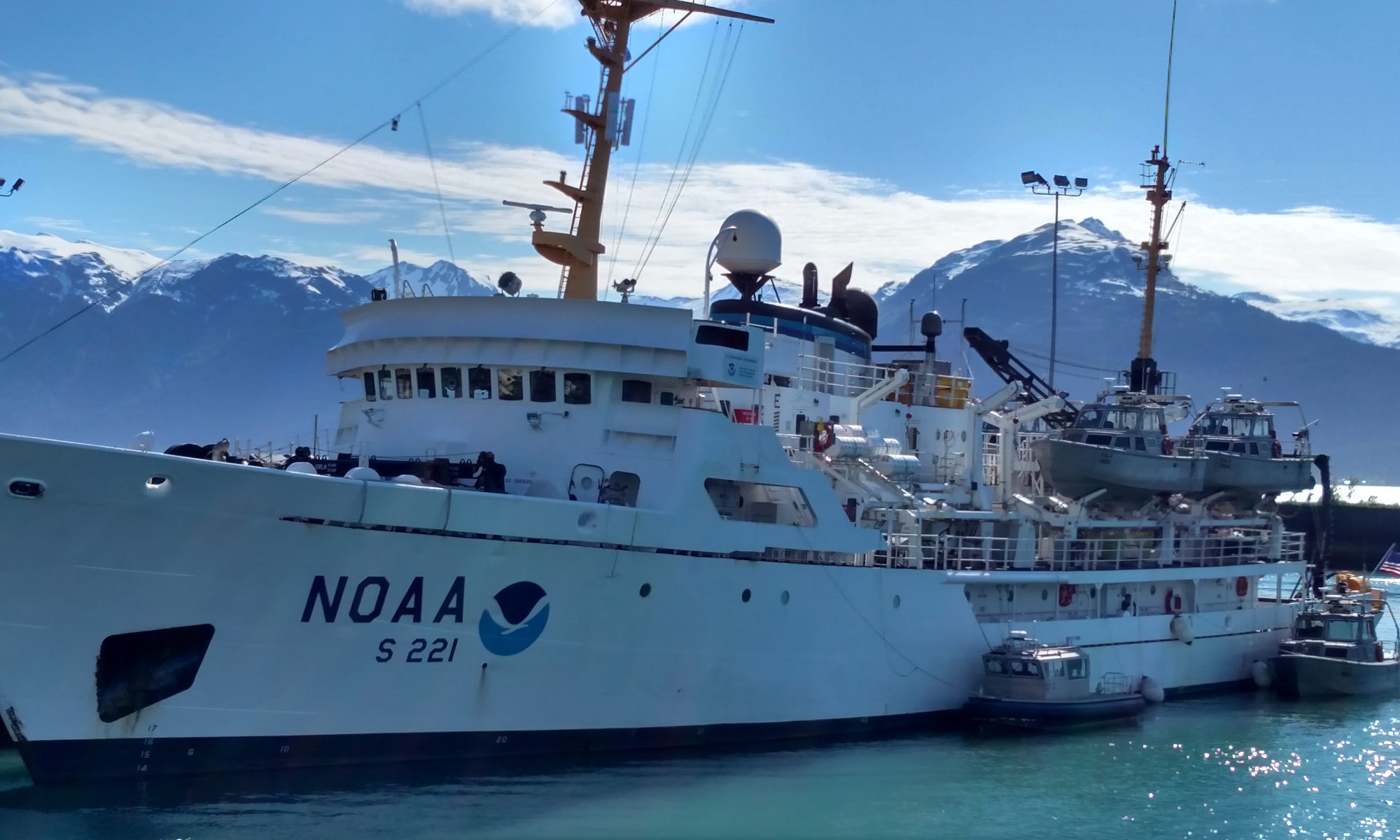
Our Boat, the JOHN N. COBB—
The JOHN N. COBB is the oldest vessel and the only wooden ship in NOAA’s research fleet. She was built in 1950 and named after John Nathan Cobb, the first dean of the University of Washington School of Fisheries. The boat is 93 feet long, has a beam of 26 feet, and a draft of 12 feet. The JOHN N. COBB typically cruises at speeds of around 10 knots, propelled by a 325 hp diesel engine. She has a crew of 8 and can carry up to 4 scientists.
The JOHN N. COBB spends most of her time in the waters of southeast Alaska, supporting the research of the National Marine Fisheries Service (NMFS). The ship can collect fish and crustacean specimens using a trawl and longline, or sample fish larvae, eggs, and plankton using plankton nets and surface or midwater larval nets. Marine mammal studies, such as the one that I will be part of, are conducted aboard or by the use of smaller boats stored on the JOHN N. COBB.
Daily Life on the JOHN N. COBB—
Life on board the JOHN N. COBB is exciting but intimate—the entire crew and scientists must work together to keep the ship clean and in working order so that the scientific research can be done. As mentioned earlier, the ship has several crew members, and each of the crew has important responsibilities that are integral to the proper working of the ship.
The Commanding Officer—Our Commanding Officer, Chad, has authority over all other crew members and ship personnel. He drives the ship on alternating 6-hour shifts and is responsible for medical care in the event that anyone were to get hurt.
The Executive Officer—Dan is the Executive Officer (also referred to as the XO) for the JOHN N. COBB on this cruise. He is the direct representative of the Commanding Officer, and is therefore responsible for executing the policies and orders issued by the Commanding Officer. He also drives the ship for 6-hour shifts, alternating with the Commanding Officer.
The Chief Marine Engineer—Del, or “Chief”, serves as our Chief Marine Engineer. Because his main responsibilities are to oversee the Engineering Department and fix any problems with the mechanical or electrical systems on the ship, he is usually down below in the engine room.
The Chief Steward—Bill, our Chief Steward, is in charge of the galley, or kitchen, of the ship. He provides the crew and scientists with three meals everyday, all cooked on a diesel stove. Because the galley on the JOHN N. COBB is very small, it is very important that those onboard the ship are clean and respect the requests made by the Chief Steward.
Bill, the Chief Steward of the JOHN N. COBB, cooks a delicious dinner for the crew.
There are also other crew members that are responsible for duties such as relieving the Chief Engineer, keeping the boat clean, and driving the skiffs stored on the JOHN N. COBB during scientific operations. The crew members and scientists sleep in various locations on the boat—though some have it better than others! Most of the crew members, with the exception of the Commanding Officer and Executive Officer, sleep in one large room at the front of the boat. Their room includes bunks, drawers and storage space for their clothing, a small sink, and a couple of benches that also serve as storage units. Because there is always someone sleeping aboard the ship, curtains can be pulled across each bunk to block light and provide privacy. The scientists are housed in staterooms located just behind the galley, and these rooms provide more space to allow the scientists to work. Each stateroom has two bunks, a small desk, a sink, and a couple of storage units for clothes and other personal belongings. The bathrooms, or heads, are located in the hallway and are shared by all on board, and there is one community shower for all crew and scientists to use. All of our meals are served in the galley at specific times of the day. Bill, the Chief Steward, rings a bell when a meal is served, and we each take a designated seat at the table. Meals are served family-style, where the dishes are placed on the table and we serve ourselves. The crew generally consists of some big guys, and so there’s a lot of eating at each meal! At the end of the meal, we clear our plates, thank the Steward, and head off to do our daily work.
However, life on the JOHN N. COBB isn’t always just about work—the crew enjoy their time off by fishing when the boat is anchored, reading magazines, watching movies, or playing games such as cribbage or solitaire. There is even a treadmill and rowing machine for those crew members that want to fit a workout into their busy schedule. Often, the scientists are busy with entering their data and preparing for the next day’s operations. Because there are always some crew members who are sleeping on the boat, it is important that noise is kept to a minimum at all times.
Safety First: Preparing for Emergencies at Sea—
Tara Fogleman hangs out in her bottom bunk.
It is standard practice for the crew and scientists to perform safety drills during the first 24 hours at sea, and this cruise was no exception. After lunch, we practiced the “Abandon Ship” drill and the “Fire” drill. During the “Abandon Ship” drill, everyone aboard was required to report to a life raft and bring (and put on) their survival suit, gloves, and hat. The survival suit is a bright orange outfit intended to cover nearly your entire body (excluding the face), provide insulation from the cold water, and provide floatation. It also has several safety features, including a strobe light and whistle. During the “Fire” drill, everyone aboard the ship plays a crucial role—many of the crew don protective fire gear and prepare the fire hose, while others assist as needed. Because everyone plays a role in these emergency situations, it is important that the scientists become familiar with their responsibilities before performing the drills.
Dolphins and Humpbacks and Bears, Oh My!—
Alaska is beautiful—rugged mountains topped with snow, extensive spruce forests, and dark-blue water that can be so calm in the bays that it appears we’re on a lake. There were two exciting finds on the way out of Gastineau Channel—we saw the spray of a humpback whale off in the distance (though I can’t truly say I’ve seen a humpback yet) and I saw a group of Dall’s porpoises riding the waves at the bow of the boat. The Dall’s porpoises are very different from the Atlantic bottlenose dolphins that I commonly see off the coast of Georgia—they are black and white in color (like an orca), they have a smaller dorsal fin, and they are nearly 8 feet in length—but their behavior is similar, as they travel in groups and enjoy riding the waves. We also spotted two brown bears, most likely a mother and her cub, and several bald eagles while we were anchored in a bay. Bald eagles are fairly common here, and they are easy to spot because their bright, white heads easily stand out among the dark green of the spruce trees and the grayish-black color of the rocks.
Tomorrow, we’ll begin traveling to haulout sites at low tide (which falls in the morning, between 8 AM and 10 AM) to count harbor seals and their pups. So with that in mind, I’m off to bed—we have a busy morning tomorrow and I need my rest!
This photo of two brown bears was captured by Chief Scientist Dave Withrow as the JOHN N. COBB anchored in Gut Bay, Alaska.
NOAA Teacher at Sea
Karen Meyers & Alexa Carey
Onboard NOAA Ship Albatross IV August 15 – September 1, 2006
Mission: Ecosystem Monitoring Geographical Area: Northeast U.S. Date: August 27, 2006
Weather Data from Bridge
Visibility: 12 nautical miles
Wind direction 36 o
Wind speed: 13 kts
Sea wave height: 1’
Swell wave height: 2’
Seawater temperature: 15.5 C
Sea Level Pressure: 1025.6 mb
Cloud cover: 7/8
Science and Technology Log
This morning we launched a drifter buoy that will transmit its position to a satellite so our students can monitor it via a website. Tamara Browning, the other teacher on board, wrote her school’s name on it and I wrote Garrison Forest School and drew a paw print for the GFS Grizzlies. The buoy consists of a small flotation device – about a foot in diameter or a little larger – which contains the electronics and is tethered to a part that looks like a wind sock but will be underwater where it will catch water currents as opposed to wind. Jerry picked a launching spot in the channel where the Labrador Current enters the Gulf of Maine. He says it may stay in the Gulf of Maine and circle around or it may exit with the outgoing current. It is designed to last for over 400 days. It will fun to have my students follow it and plot its course on a map.
JE Orlando Thompson gave us a tour of the engine room this morning. He took us into the air-conditioned booth which overlooks the room and contains the control panels. Orlando explained that the center part of the console controls the main engines (there are 2), the left portion controls the power supply for the ship, and the right side is for the trawl engine which is used when trawling or dredging. He said that the fuel for each day is first purified to remove sediments and then put into the day tank. The emergency generator, which is located behind the bridge, has its own fuel tank. The ship runs on diesel fuel. Down on the floor of the engine room, he showed us the transmission and the shaft that runs aft to the propeller. The ship moves forward when the blades of the propeller are adjusted to the right pitch. To stop the forward motion during sampling, the pitch is changed. Orlando, who was originally from Panama, learned his craft in the Navy where he served on aircraft carriers that he says make the ALBATROSS IV look like a toy.
Personal Log – Karen Myers
We finally saw whales today! Well, maybe not whole whales but we did see spouts, flukes, and tails. Ensign Chris Daniels identified them as Right Whales by their divided, v-shaped spouts. One reason that whalers called this species “Right” whales is that they are slow and sluggish and so were easier to catch up with and kill.
Personal Log – Alexa Carey
Tracy, Alicea and I all sleep through breakfast and lunch so we meet in the galley for cereal and toast around 12:00. Unfortunately, we missed the whales that showed up around 10 a.m. Apparently there were several pods swimming around the boat, one off the port side, one off the starboard side and one off the portside of the fantail. I’m still trying to understand the different terminology. Don Cobb stated that there were probably close to 40 whales total in the three different pods.
Karla is definitely a trooper. For her sampling, she has to be working for sixteen hours straight, however, there have been days when she’s been awake for over 24. It’s great to be in a group of close girls. Tracy and Alicea are very welcoming, friendly and personable. In such confined spaces, that’s a blessing to find two women who are so agreeable. There’s no pettiness, nor competition.
Life at sea is simpler than on land, I think, though you have to be able to find ways to keep yourself occupied and still find times to simply sit back and enjoy the frontier around you. I’ll spend time writing to home and my friends, talking to the various crew members, scientists and officers, reading, journaling my opinions and interpretations, and relaxing on the hurricane deck looking out to the sea. It’s very calm and laid back here. I think I like it here…
We’re having a cook-out tonight! Well, actually, it’s a pseudo-cookout because we left the propane tank at port. It’s basically an onboard barbeque which everyone gets together for (assuming that we’re not on station at the time). Tracy says, “Nothing beats eating dinner right on the ocean as the sun starts going beneath the clouds.” Following, Alicea said, “We takes a beating, but we keeps on eating.”
Ten minutes before we arrive at each station, the bridge sends an announcement over the intercom. Depending on the officer manning the bridge, a variety of calls can be decreed onboard. Ensign Chris Daniels (now nicknamed the Nascar driver), however, gave all the calls in one, “10 minutes to station, 10 minutes to CTD, 10 minutes to bongos, 10 minutes to bottom grab, 10 minutes to the longest station of the cruise.” Unbeknownst to the shift at the time, it was indeed the longest station and took over two hours on station due to problems with the CTD and bottom grab. As Alicea put it, “We should kindly ask the bridge to keep their comments to themselves [so they stop jinxing us]!”
ENS Meghan McGovern and ENS Olivia Hauser, Jr Officers, looking at unmarked buoy sighted on the bridge
Weather
Weather: Foggy, cloudy
Visibility: 1.5 nm
Wind direction: 130
Wind speed: 6 knots
Swell Waves direction: 260
Swell height: 1-2 ft
Seawater temperature: 11.7 degrees C
Sea level pressure: 1014,9 mb
Temperature dry bulb: 12.8 degrees C
Temperature wet bulb: 12.2 degrees C
Personal Log
I continue to work on activities that can be incorporated into my classes. The RAINIER is underway to Seward, Alaska. There is some excitement on the bridge after lunch, when an unmarked buoy is sighted on the port side of the ship. Several officers come to the bridge to observe and the buoy is marked on the chart. As it turns out, this is not a “find” and was updated on the Notice to Mariners put out by NOAA.
After dinner, fog moves in and the RAINIER sounds the fog horn. As a sailor, I don’t like fog. I am comforted by the fact that I am aboard a large ship with good radar system to detect approaching ships. The fog begins to lift a little and the last day of the cruise, like the first day, is marked by seeing humpback whales.
If this had truly been a “find”, the buoy would have been penciled in and added by NOAA.