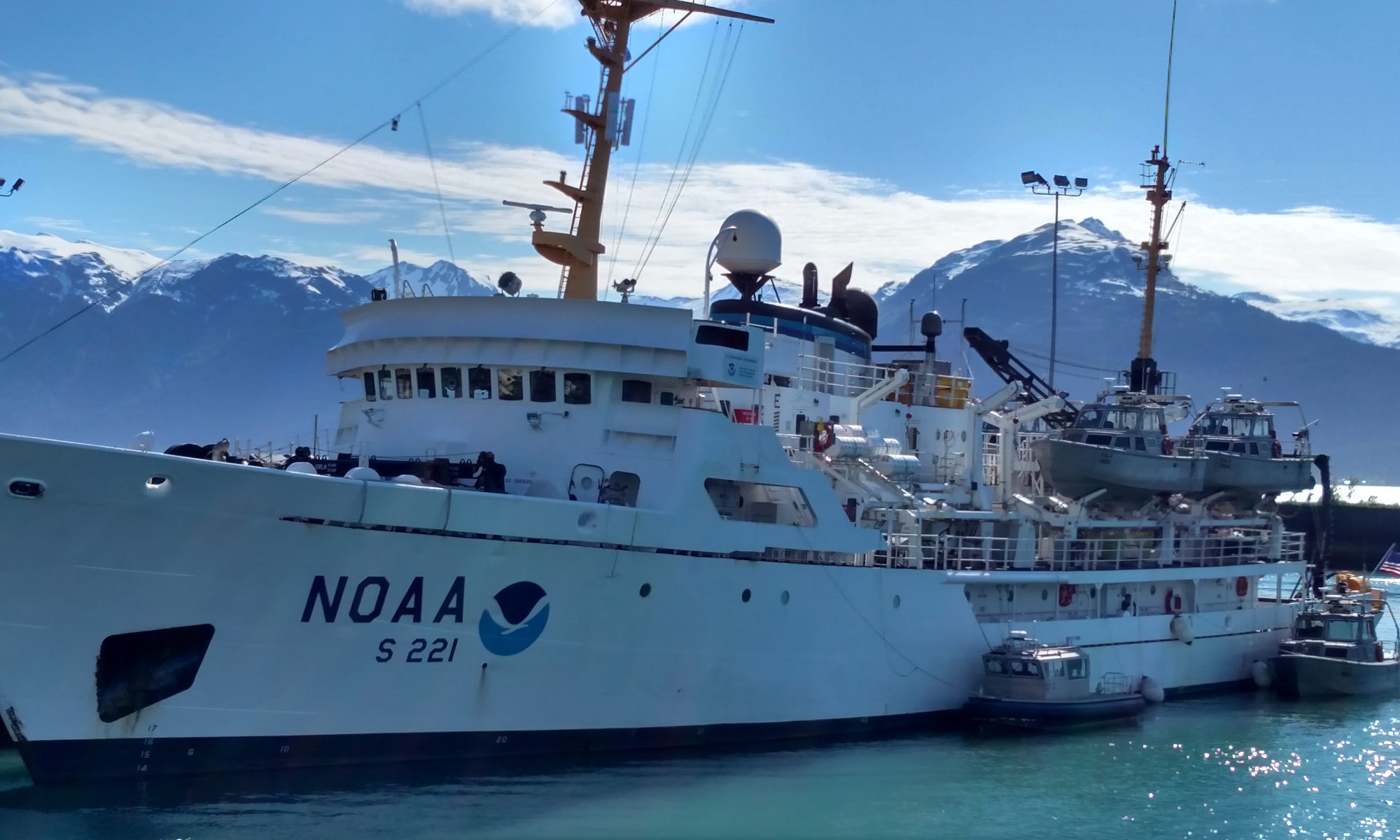
Roy Arezzo, July 19, 2007

NOAA Teacher at Sea
Roy Arezzo
Onboard NOAA Ship Oscar Dyson
July 11 – 29, 2007

Mission: Summer Pollock Survey
Geographical Area: North Pacific, Alaska
Date: July 19, 2007

Weather Data from Bridge 
Visibility: 10+ nm (nautical miles)
Wind direction: 270° (SW)
Wind speed: 11 knots
Sea wave height: 5 foot
Swell wave height: 5feet
Seawater temperature: 8.1°C
Sea level pressure: 1004.4 mb (millibars)
Air Temperature: 9.7°C
Cloud cover: 6/8, stratus

NOAA’s Lieutenant Commander D. ZezulaReading the chart of the North Bering Sea
NOAA Lieutenant Commander D. Zezula reading the chart of the North Bering Sea

Science and Technology Log

I would like to thank David J. Zezula, Lieutenant Commander for NOAA and Alaska Region’s Navigation Manager, who spent over an hour showing me charts and resources for my school. David is serving as a relief officer of the deck aboard the OSCAR DYSON. Around our second Transect this leg we needed to break off from our line momentarily to avoid some shallow pinnacles listed on the chart.  Of the three, one pinnacle is charted in deep water and the tall thin pinnacle seems an unlikely seafloor feature. I was surprised to learn that the information on the printed chart was different from the digital GLOBE program the scientists use to assess the bottom. It was indicated on the printed chart that these shallow regions were charted back before we started making seafloor maps using multi-beam sonar technology. The actual depth in that region is thus questionable and rather than sail over what seemed like deep enough water we cruised around it for safety precautions. Our draft is about 29 feet and all of sensors are located on the centerboard that extends down below the hull’s lowest point. As a research vessel we care very much about our sensors.

Long-tail Jaeger photographed off the bow of OSCAR DYSON by Tamara K. Mills

I asked David about this and he went to his files and was able to show me more information about the dates and background on that specific chart. Some of the archives he has access to were actually scanned from hand written charts created with lead lines back at the turn of the century. One of the main parts of his job back on land is to help prioritize what regions of Alaskan waters are to be updated with modern technology as part of NOAA’s Office of Coast Survey (the hydrographic and nautical charting division of NOAA). Obviously they focus on key ports and channels first but there is much water out there to chart and verify.

Bird of the Day: Today I was fortunate to see yet another “new to me” species. The Long-tail Jaeger (Stercorarius, longicaudus) is a pelagic seabird that rules the air. Although it probably eats some fish near the surface it is famous for its aerial piracy. It is a very muscular bird that is capable of upending flying birds forcing them to regurgitate their stomach contents to obtain a meal.  This is currently their breeding time so it is early in the season for them to be found this far out at sea but soon mature adults and their grown offspring will be out on the Bering looking for food before their winter migration to the south. I keep missing the albatross sightings and hope that it will be my next bird of the day. Information provided courtesy of Mark Rauzon, birder, author, educator and friend.

OSCAR DYSON’s centerboard

Personal Log

Land! It was very exciting to see land for many reasons. First, the sun was out, a rare treat on the Bering. Many of the weather entries above will list the cloud cover as 8/8, which means out of 8 parts of sky all of it is covered by clouds. Also the visibility was good and the seas, which turned up with some high winds last night, had calmed down considerably. Lastly we were looking at Russia, many of us for the first time, which made sense since we were in the north part of our third transect line in Russian waters. It was also the first time we have seen land since we left Dutch Harbor. Cape Otvesnyy, at 860 meters high was visible from about 63 miles away. We all went outside the bridge to take photos and celebrate.

Question of the Day 

Today’s question: Why do pollock rise in the water column at night?

Previous Question: How is the field of acoustics used in science? 

OSCAR DYSON’S deck crew attaches an acoustic device (yellow) to the fishing gear

Acoustics is a huge area of technology that ranges from how we design theaters to the use of sonograms to view unborn children. Much of the acoustic technology used in science has to do with creating alternative ways to observe different environments. Light does not travel through water as far as sound (vibrations). Sound waves are the key to looking deep into water. Marine mammals know this and can find prey with echolocation, reading reflected sound waves they send out to locate food and communicate.

On OSCAR DSYON we use several types of acoustic instruments

The Simrad EK60 is our main fish counting instrument and it uses about a 7º beam to send out sound waves of different frequencies and receive echoes from organisms and objects of different sizes. It is mounted on the centerboard and reads information from 5 frequencies ranging from 18 to 200 KHz. As we run along our transect line the data that is received is used to estimate the fish density. The scientists onboard spend a fair amount of time checking to see that the echoes actually represent pollock.

The ME70 Multi-beam is mounted to the ship’s hull and is a powerful tool in creating a wide swath three-dimensional image of what is below the ship. This is especially useful in hydrographic work that involves charting and mapping the seafloor bottom but it may be used for the fish survey in the future. The Acoustic Doppler Current Profiler  (ADCP) is also connected to the centerboard and uses the Doppler Effect (the change in frequency and wavelength of a sound pulse as perceived by an observer moving relative to the source of the sound) to estimate current and fish speed.

We place a Net Sounder (FS70, affectionately known as the turtle) on to our fishing n each time we trawl. Like scientists, commercial fishermen often use this instrument to monitor the shape of the net opening and the amount of fish entering the net.  It does this by sending a 200 kHz frequency beam across the opening of the net and transmits data along a cable for the team to see on our monitors. Along with the turtle we send down a Simrad ITI, which is smaller and wireless but a lower resolution net sounder that is used as backup in the event we have trouble with our cable.

The DIDSON (Dual Frequency Identification Sonar) is an instrument that has been developed for divers in low visibility water and has many industrial applications. It creates an image typical to the one seen on sonogram tests. It uses a high frequency beam (up to 1.8 MHz) to achieve a short-range image (up to 50 meters). It has been applied to salmon return rate studies and has well enough resolution to make out the shape of a moving fish. The pollock survey team has been experimenting with it as a way to monitor fish escapement from the net and how fish behave within the net.

In our survey work most of our mid-water trawls occur between 17 and 700 meters. The acoustic technology is vital to verify fish at these depths.

Roy Arezzo, July 16, 2007

NOAA Teacher at Sea
Roy Arezzo
Onboard NOAA Ship Oscar Dyson
July 11 – 29, 2007

Mission: Summer Pollock Survey
Geographical Area: North Pacific, Alaska
Date: July 16, 2007

We love Plankton
We love Plankton

Weather Data from Bridge 
Visibility: 8 nm (nautical miles)
Wind direction:   260° (SW)
Wind speed:   6 knots
Sea wave height: 1 foot
Swell wave height: 3 feet
Seawater temperature: 9°C
Sea level pressure: 1014.4 mb (millibars)
Air Temperature:   8°C
Cloud cover: 8/8, stratus

Science and Technology Log: Why fish pollock? What do pollock fish? Pelagic Food Webs of the Bering Sea 

Surveying pollock on the Bering shelf provides the data needed to set catch limits to manage the fishery. Catch limits for American fishing fleets are to be decided soon for next year. The pollock survey I am part of as Teacher at Sea is technically known as the Echo Integration Trawl Survey been an annual tradition of NOAA since 1971! The OSCAR DYSON, and before her the MILLER FREEMAN, use traditional trawling gear to achieve this goal. The fishing gear tends to be smaller then the larger fishing vessels since we don’t need to catch as many fish to estimate population trends. Like commercial operations we are interested in where the fish are in the water column and their geographic distribution. We also are concerned with their age composition. Although we primarily use acoustic sensors to detect fish, by trawling we can see how the technology used to locate fish in the water matches with what is being caught in the net. We also monitor by-catch organisms to observe what is mixed in with pollock when trawling.

Aleutian Islands
Aleutian Islands

Dutch Harbor, AK, according to the National Fisheries Service continues to be the No. 1 port by weight for seafood landings. In 2005, 877 million pounds of seafood passed through port, in 2006 it was more. In terms of seafood value only New Bedford, Mass., surpasses Dutch Harbor mostly due to the increase in the scallop market and decrease in crab populations. Dutch Harbor is known for its king crab industry in the winter and finfish year round, including hake, cod and salmon. Although shrimp is American’s most popular seafood item in terms of sales, finfish occupy much of the top five. Canned tuna is second highest for sales in the U.S., salmon is third and then pollock and tilapia; however if you factor in the global market, the amount of pollock being harvested and the sales for food products such as frozen whitefish foods, filets and surimi (Asian fish paste used in foods such as artificial crab) make it the largest seafood industry in the world (Anchorage Daily News). In addition Pollock are seasonally fished for roe. Commercially, fishing pollock is a good business venture due to its large schools and typically low by-catch. According to the National Marine Fisheries Service approximately 307 million dollars in pollock sales was made in the U.S in 2005. More than 3 million tons of Alaska pollock are caught each year in the North Pacific from Alaska to northern Japan. Of that the U.S. is responsible for about half. The population of Pollock in the Bering alone was estimated at 10 million metric tons early this decade and the catch limit was set around 10 –15% of the population size. Last year the survey team found a significant decline in populations and thus the catch limit was lowered but anecdotally there are preliminary signs of good recruitment with many young pollock being identified in this summer’s survey.

Assorted diatoms
Assorted diatoms

We are clearly at the top of the food web and consuming a large amount of pollock. The pollock are part of a very complex ecosystem. They are fragile fish and short lived but fast growing and quick to reproduce. The pollock population seems to be greater in number then most other harvestable finfish in the Bering, possibly due to a decline in Pacific Ocean perch, and shows interesting fluctuations in population density in response to global climate changes and sea current patterns. The Bering Sea lies between the Arctic Ocean to the north and the North Pacific to the south but remains a unique ecosystem exhibiting some characteristics of each of its neighbors.

Jellyfish found in the plankton net - large plankton!
Jellyfish found in the plankton net – large plankton!

The food web of the pelagic zone of open water in the cold Bering Sea is contingent on movement of nutrient rich waters. The main source of nutrients for the upper shelf region where one finds pollock seems to be influenced by the flow of the Alaskan Stream near shallower coastal waters which flows east across the Aleutian chain. Some of the water flows up through passes and becomes parts of currents like the Aleutian North Slope Current that feed the shelf. The Bering Sea is an extremely large and a relatively shallow body of water making it very different and it is this nutrient flow between shallow waters of the coast and shelf and deep basin/trenches to the west and south that account for its high biodiversity. In addition to currents ice melt and water temperature greatly affects nutrient flow and productivity. The nutrient rich water enables phytoplankton to flourish and reproduce in otherwise cold barren water. In turn zooplankton feed on the phytoplankton which transfers the organic carbon foods from producers to other levels of the food web. Invertebrates (ex. crabs, shrimp and jellyfish), small birds, small fish and baleen whales feed on the zooplankton. Seals, sea lions, skates, larger seabirds, porpoises and toothed whales feed on the fish and invertebrates. A substantial portion in the diet of larger pollock is made of plankton such as krill. This is the same food baleen whales filter out of the water when feeding.  Krill is the common name of shrimp-like marine invertebrates belonging to the order of crustaceans called the Euphausiids. Adult Pollock also dine on smaller pollock and this has been seen in our harvest as some pollock come up from the net with smaller fish in their mouth or stomach contents.

Pollock larvae
Pollock larvae

What is plankton? 

Plankton is a general word used to describe aquatic organisms that tend to drift with the current and are usually unable to swim against it. They are generally buoyant and found in the epipelagic zone (top of water receiving sun energy) although many species have serious vertical migration to feed and escape predators.  Most folks think of plankton as being tiny but large seaweeds and jellyfish are considered plankton. Phytoplankton refers to algae and photosynthetic organisms that make food with the sun’s energy. Diatoms are important phytoplankton in the Bering Sea ecosystem an have amazing silicon patterns. Zooplankton includes many groups of animal-like organisms, including microscopic protozoa and tiny crustaceans such as daphnia and copepods. The copepods population seems like an important link in understanding survivorship of young pollock. Many benthic crustaceans and mollusks (oysters and clams) start their life cycle as free-swimming larvae high in the water column. Young fish such as pollock also start their life cycle as plankton-like larvae.

Methot net, flow meter, and emptying the plankton net

Observing and Measuring Pollock Food: Last night we did a Methot Trawl. This involves dragging a net with a finer mesh than our fish trawl to pick up plankton. This is important in understanding what the fish we study are eating. When we dissect the belly of a pollock we often find it full of zooplankton with the occasional small fish, such as smelts or young pollock. We correlate the mass of the plankton caught in the net with the flow rate to estimate population density. We estimated 44,000 critters in the 35,000 cubic meters of water that passed through the net, much of which consisted of Euphausiids and Amphipods. This works out to approximately 1.3 plankton organisms per cubic meter of water.

Euphausiid pictured left and Amphipod pictured right

Personal Log

The Bering Sea has been relatively calm with good visibility. We have seen our first boats in over 36 hours, some fishing boats and a Coast Guard Cutter. There have been some marine mammal sightings but nothing close enough to make an ID. I am settling into a bit of a routine, waking around 10:30 AM for lunch and then relaxing and working out before checking in for my shift at 4 pm. I spend a fair amount of my off time in our spacious bridge discovering new technological toys and looking out for wildlife. Each day I spend some time out on the deck above the bridge for fresh air.

Mature Female Pollock with visible eggs

After dinner we usually begin fishing and I don my foulies and safety equipment and observe operations from the back deck. I then photo anything new that comes in and try to process any bycatch to make sure it is returned to the water quickly and in good shape. The science team then works together, processing the pollock and helping with the clean up. Sometimes the fish schools are large so we have to stay in our gear and work back to back trawls. After trawling we often look at the data collected or deploy various test equipment and water quality checks. Nighttime is not best for trawling so the few hours between sunset and sunrise is reserved for special project applications designed to modify our methods. In between fishing I work on my Teacher-At-Sea writings and interviewing folks on the boat.

Mature Male Pollock; testis visible above

Question of the Day 

Today’s question: How is the field of acoustics used in science?

Previous Question: How does one tell a male fish from a female fish in Pollock?  

Male and female Pollock look the same from their exterior anatomy. Although we weigh and catalog all the fish we pull in, we sex a 300 fish sample batch from each trawl. This involves dissecting the fish to identify their gonads. We make a cut on the ventral surface from the gills towards the anus. We open the body cavity and move the liver to the side to expose the other internal organs. Gravid females are relatively simple to ID since they have large egg sacks with whitish eggs. A mature female will have a large ovary that tends to be reddish and lined with blood vessels. Immature females are more difficult to identify and have a less pronounced ovary that varies in color.

Mature males will have developed white coiled testis. For undeveloped males one looks for pink globular organs where the white testis should be. Immature males are more difficult to identify but when no ovary is visible we search for a thin membranous tissue running from the Uro-genital opening up into the body cavity towards the backbone.

Interested in more about Alaskan fisheries?

NOAA Alaska Fisheries Science Center

Pacific State Marine Fisheries Commission 

Anchorage Daily News 

Roy Arezzo, July 13, 2007

NOAA Teacher at Sea
Roy Arezzo
Onboard NOAA Ship Oscar Dyson
July 11 – 29, 2007

Mission: Summer Pollock Survey
Geographical Area: North Pacific, Alaska
Date: July 13, 2007

arezzo_log1Weather Data from Bridge 
Visibility: 2 nm (nautical miles)
Wind direction:   227° (SW)
Wind speed:   4 knots
Sea wave height: <1 foot
Swell wave height: 4 feet
Seawater temperature: 8°C
Sea level pressure: 1010.3 mb (millibars)
Air Temperature:   5.8°C
Cloud cover: 8/8, stratus

Roy Arezzo, Teacher at Sea, on land before his sail, low visibility but great view.

Science and Technology Log: Introduction to the Pollock Survey 

Where does one start? Monday, July 9, 2007, I left my apartment in NYC at 6:30 AM and by the time I was making a descent to OSCAR DYSON Seattle I started to realize I Pictured to right was going far away. I was half way thereI then flew to Anchorage and finally took a small prop plane to Dutch Harbor. At 12 AM Eastern Standard time I was stepping out on the Tundra of Unalaska, my bag didn’t arrive until the next day. I had come a long way to fish, like many others, but this is the place to do it.  The global fish market seems to just keep increasing and someone needs to be looking at the fish populations. That is where NOAA comes in.  NOAA’s Teacher At Sea program sent me here and I ate some fresh salmon, some crab, hiked the tundra and soaked up the views in town before boarding for my expedition.

The OSCAR DYSON departed from the dock at 12 pm on Wednesday, July 11, 2007.  I remained outside, above the bridge, watching land disappear for most of our transit past the sea buoy and into the Bering. Within two hours the U.S. Fish & Wildlife Service folks were camped out in the bridge collecting bird data. Knowing it would be some time before we reached our study area to fish, I spent most of my first two days up in the bridge absorbing ship operations, navigation technology, sea bird names and searching for marine mammals. Two hours into our trip we had spotted over a dozen Humpbacks’, one breaching off the port beam about a half mile out. Some came a fair bit closer.

Acoustic Image of the trawl net from the Bridge:  The red line at bottom indicates the sea bottom. The circle represents the net and the specs inside the circle represent fish going in the net.
Acoustic Image of the trawl net from the Bridge: The red line at bottom indicates the sea bottom. The circle represents the net and the specs inside the circle represent fish going in the net.

Within 24 hours we had seen and recorded information on 5 different whale species, including, Humpback, Fin, Orca, Sei and a Beaked whale, the Fin whales being the largest. The pod of Orca’s moved with a mission. Dall’s Porpoises were cruising in our wake as Murres, Tufted Puffins, Northern Fulmar’s, Black-legged Kittiwakes, Fork tailed Storm Petrels and some immature gulls, that I could not ID, circled above. It was a spectacular show to start our trip. Although the Ship has many projects going on at the same time the primary mission is to monitor Pollock.

Nate, a fisherman, works the trawl net

Cruising at 12 knots for 2 days put us out on the first transect line. A transect line is a predetermined slice of ocean in a study area that we travel over in a straight line. Our mission is to spend 3 weeks monitoring the northern most region of a 9 week annual monitoring period (31 transects). We will travel northwest for most of the 3 weeks to cover all transects in this region. By 9 pm on Thursday we found ourselves on our first transect. When we pass over a transect line, which can be over a 200 miles long, we consistently send down sound waves from our center board several meters below any ship vibration. The reflection of sound waves from below can be interpreted as biomass data. Two science teams work 12 hour shifts to monitor the instruments and the data 24/7. The entire study covers the main area Pollock is found and fished in the Bering Sea. We can pick up small krill near the surface or schools hundreds of meters down depending on the frequency of the sound wave we use. On our monitors we get a visual image of the school of fish below us. When we find a significant fish footprint that resembles Pollock we put out trawl nets to catch an appropriate sample size. The ship has completed over 90 trawls in this study. When the nets come in we separate and record “by catch”, which I am happy to report there has been very little of (2 cod and some jellyfish). We then weigh all the fish, record size and sex on a sample size of 300. In addition we remove ear bones (the otolith)  from 50 fish each trawl to age them back at NOAA’s lab headquarters in Seattle, WA. We have fished three times today and landed 3.65 tons of fish. The day is not done.

Personal Log 

 Roy separates the boys from the girls.
Roy separates the boys from the girls.

I am excited at the opportunity to work along so many experienced and knowledgeable crew members from the science team to the deckhands and to observe how they work together to reach the objectives of the mission. Folks here have interesting backgrounds ranging from surfing to tall ships to commercial crab fishing. The Ship is very comfortable and quiet for her size and workload. I have yet to see the dark but I will be up late tonight as I switch over to the 4pm to 4am shift. Fortunately there is a proper cup of tea and left over clam chowder to keep me awake and warm. I would like to thank Rebecca Himschoot, Teacher at Sea participant on the previous sail, for showing me around and providing invaluable insight into preparing for my trip.  Thanks also to Amy and Forrest for a warm welcome to Alaska.

Question of the Day Today’s question: How does one tell a male fish from a female fish in Pollock?

The deck crew works a full net aboard NOAA Ship OSCAR DYSON.


Beth Carter, July 1, 2007

NOAA Teacher at Sea
Beth Carter
Onboard NOAA Ship Rainier
June 25 – July 7, 2007

Mission: Hydrographic Survey
Geographical Area: Gulf of Esquibel, Alaska
Date: July 1, 2007

Weather Data from Bridge
Visibility:  4 miles
Wind direction:  calm
Wind speed:  calm
Sea wave height: none
Swell water height: none…flat, flat, flat
Seawater temperature:  12.2 degrees C
Sea level pressure:  1016.6 mb
Dry bulb temperature: 12.2 degrees C; Wet bulb temperature:  11.7 degrees C
Cloud cover: Fog, cloudy, 8/8
Depth: 18 fathoms,
New anchorage: near Sonora Island, part of Maurelle Island group

This is a single beam transducer on the hull of launch #1. The small blue oval on the hull is a “fish finder” or depth sounder.
This is a single beam transducer. The small blue oval on the hull is a “fish finder” or depth sounder.

Science and Technology Log

On Friday, I went out on the RA-1 boat with Coxswain Leslie Abramson, Seaman Surveyor Corey Muzzey, and Survey Tech Marta Krynytzky. The #1 boat is a jet boat, which operates like a jet ski…it has a nozzle that shoots water out, and it only draws one foot of water. The RAINIER likes to use the #1 boat in very shallow water, as it is able to get into shallow places without running aground. #1 is also has a single beam sonar, which means it is sending out “pings” in a single direction directly underneath the boat. Thursday night, Marta drew a grid of lines for the RA-1 to survey.  The FOO (Field Operations Officer) asked her to develop a tight grid, with the lines being only 5 meters apart. If you have driven a boat, you know that this means that as you go up and down the parallel lines, your turning ratio is quite tight, and there will be wake and bubbles formed.  The problem with this is that bubbles throw off the single beam sonar, and it “scrambles” the feedback from the sea floor. 

This is the Echosounder machine that records the data from the single beam transducer.

We were operating in Warm Chuck Inlet, which has some freshwater creeks feeding it.  Marta taught me to do a little part of the recording on the Echosounder machine, which is called doing “paper control.”  She tracked our progress on her computer, and when we were over an area that needed to be mapped, she would say, “Start recording,” and I would hit a button that started the paper moving. The machine creates a line graph similar to that a seismograph might create during an earthquake, or in a medical scenario, it is similar to that of an EKG that graphs the activity of your heartbeat.  When we ran through our own bubbles, it created dense gray shaded areas that obscured the data. We had to slow down, and change our course several times to allow for which way the tide was flowing so that tidal movements would carry our bubbles away from the next line we wanted to drive.

The single beam technology is rather outdated, and NOAA prefers to use the multibeam, as it creates real-time, 3-D pictures of the ocean floor. However, the multibeam transducers are very expensive, and very vulnerable to damage caused by running aground, and so the RAINIER uses both technologies to get as much information as possible without damaging or destroying the multibeams. After we returned to the ship, the RAINIER weighed anchor and moved to a new anchorage near Sonora Island in the Maurelle Islands group.

This is a sample of the paper “picture” of the bottom recorded by Launch #1.
This is a sample of the paper “picture” of the bottom

Personal Log 

Friday was an interesting day, as most of the time, I was helping Marta with the recording. I goofed up a few times, as you have to stay so focused and attend to detail constantly. The survey techs have my true admiration…they go out day after day in cool to cold weather, rain or fog or drizzle, and collect intensely detailed data.  There are no days off on the ship, really.  Actually, everyone on the RAINIER is amazing with his/her ability to focus and stay on-task and get jobs done…from the cooks (who are great!) to the deck crew to the officers to the engineers. Last night (Saturday), Raul Quiros was fishing and caught a small shark…maybe 2 feet long. He cut him off the line, and had a bit of trouble picking him up to release him. The shark was gasping, so I tentatively grabbed his belly and threw him over the side.   Then, a few of us saw some whales playing off the starboard side of the ship.  I ran and got my videocam…finally!  I actually got some footage of a whale!  He was rolled over on his back, and slapping the water with both fins, over and over and over.  It was amazing.  Some people say whales breach and do these “slaps” to remove barnacles, but it looked to me as though he was just having fun!

Question of the Day 

  1. Go to the website and click on the “movie” on multibeam surveying.  What do you think would happen if the boat passed over a whale or a sunken ship?  What would NOAA do with information on sunken ships if they discovered some?
  2. For my first graders:  Look at a picture of a humpback whale and a jet plane.  Can you see any ways that they are alike? Also, try that website in #1…the movie is definitely something you will understand!

Beth Carter, June 29, 2007

NOAA Teacher at Sea
Beth Carter
Onboard NOAA Ship Rainier
June 25 – July 7, 2007

Mission: Hydrographic Survey
Geographical Area: Gulf of Esquibel, Alaska
Date: June 29, 2007

Weather Data from the Bridge
Visibility:  8 miles
Wind Direction:  Light
Wind Speed:  Aires
Sea Wave Height:  None
Swell Wave Height:  None
Seawater Temperature: 12.8 C
Dry bulb Temperature: 13.3 C, Wet Bulb Temperature:  12.2 C
Sea level Pressure:  1009.4 mb
Cloud Cover: Cloudy, light rain, 8/8
Depth: 31 fathoms

ENS Meghan McGovern and Elishau Dotson are recovering the CTD.  After recovery, Elishau connects the CTD to her computer and downloads the readings on temperature, conductivity (a function of salinity), and depth. NOAA uses Wilson’s Equation of Sound Velocity to convert the CTD information to something usable in the software
ENS Meghan McGovern and Elishau Dotson are recovering the CTD. After recovery, Elishau downloads the readings on temperature, conductivity (a function of salinity), and depth. NOAA uses Wilson’s Equation of Sound Velocity to convert the CTD information to something usable in the software

Personal Log (Just have to tell you about the whale first!) 

On Thursday, Aug. 28, I went out on the #4 launch from the RAINIER.  When the hydrographic team goes out, they go out for the whole day…8:15 until 4:30 p.m.  It was sunny and clear, our first sunny day! I went out with ENS Meghan McGovern, Elishau Dotson, Assistant Survey Tech, and our pilot, Jodie Edmond, Able Bodied Seaman – an all female boat crew! First, I have to focus on the wildlife that we saw – it was totally incredible!  We saw several sea otters floating on their backs, whiskery and cute!  We saw a doe leading her two fawns on the shore of an island. Eagles soared overhead all throughout the day, and one dove to catch a fish (missed), but later, he grabbed one in his talons.  We got a quick glimpse of a mother harbor porpoise and her calf feeding near the shore.

The highlight of the day, though, was seeing a humpback whale breaching near the boat – to say that I was totally enthralled is not adequate.  I don’t think the dictionary has any words that truly fit! First, I saw a silver/gray shape under the water near the stern, and thought it was a stingray, a common sight on the East Coast. Then, I heard a gasp/blow as the whale surfaced to breathe. The sound was like the “grunt” that Monica Seles makes as she serves up a tennis ball, only lower and longer.   We saw the whale surface a few more times, and then his great leap.  I was trying to videotape, and of course, I missed it.  But it will stay in my memory forever, if not on a memory card.

Science and Technology Log 

This is the multi-beam transducer mounted on the hull of the #4 launch of the RAINIER.  It can produce a broad band of sounds to “ping” off the bottom of the sea, and provide the data to create a 3-D picture of the ocean floor under and near the boat.
This is the multi-beam transducer on the hull of the #4 launch. It can produce a broad band of sounds to “ping” off the seafloor and provide the data to create a 3-D picture.

Now, to focus upon the hydrographic mission!  Before beginning the surveying, the crew lowers a CTD to the sea floor to collect a reading on the Conductivity, Temperature, and Depth of the water. The way that the sonar “pings” travel through water is affected by all three factors.  The higher the percentage of salinity, the greater is the ability of the water to conduct sound waves. Higher temperatures also increase sound conductivity in water, and deeper water also conducts sound waves better than shallow water. For example, if the launch is surveying the sea floor in an area near where a freshwater creek is flowing in, the conductivity of the water would decrease; therefore, the survey tech crew that does the night processing of the data would be able to correct the resulting data taking into account the lower conductivity. Number 4 launch has a multibeam sonar transducer mounted on the hull. The transducer produces a broad band of sound “pings” that bounce off the sea floor and return to the launch to be recorded by a sophisticated computer with four screens. The operator of the sonar equipment can see a digital display of the depth, and a real-time three-dimensional picture of the sea floor beneath and around the launch. The boat driver is constantly aware of the depth, so as not to run the launch aground on rock formations. 

Elishau is monitoring the real-time data streaming in from the transducer as Jodie drives the “lines” to create pictures of the ocean floor.

The driver steers the boat along a pre-set grid of lines that are programmed into the ship’s computer the night before.  Jodie said it is rather like “mowing the grass,” on the surface of the water. You “mow” the water in neat rows until you’ve mowed over every line on the chart established by the hydrographers. After all the lines were run, we returned to the ship, and then, other hydrographic scientists began to run a correction program on the data we gathered. In this way, they clean out errors that are caused by extraneous noises, kelp, echoes, and other obstacles. In the afternoon, we were “snagged” by a gigantic clump of kelp that got wrapped around the transducer. There was so much kelp, the launch could not maneuver effectively.  ENS McGovern stabbed the kelp with a boat hook, and Jodie reversed the engines until we shook the kelp loose.  Learn more about seafloor mapping here.

Questions of the Day

Later that night, Martha Hertzog, Physical Scientist, looks at the data from the #4 launch, and applies a correction program to the data to eliminate errors.  The night processors often work until 11:00 p.m. in order to process the day’s data collections from the 3-4 launches that were out that day.
Later that night, Martha Hertzog, Physical Scientist, looks at the data and applies a correction to eliminate errors. The night processors often work until 11:00 p.m. in order to process the day’s data collections.

These questions are particularly for Ms. Southgate’s oceanography students at Hoggard High School in Wilmington, N.C. (and any other curious people!)

  1. I’m learning that salinity affects conductivity of sound waves. Why does a high concentration of salt in water make sound travel faster? Does electricity travel faster or slower through fresh and salt water? Why?
  2. As we drove different lines yesterday, we took three different CTD readings?  Why do you think the hydrographers felt we should collect data three times?
  3. The islands here are very craggy and steep, and made up largely of granite and limestone rock.  Much of the sea floor is also rock.  Why is the coast of Alaska so vastly different to America’s Eastern coast?
  4. The islands here drop very sharply off into deep water.  For example, just 3-4 meters from shore, the depth can drop to 20 meters.  Why is this common here? How much is 20 meters measured in feet?  In fathoms?