NOAA Teacher at Sea Dave Grant Aboard NOAA Ship Ronald H. Brown February 15 – March 5, 2012
Mission: Western Boundary Time Series Geographical Area: Sub-Tropical Atlantic, off the Coast of the Bahamas Date: February 15, 2012
Weather Data from the Bridge
Position: Windspeed: 15 knots
Wind Direction: South/Southeast
Air Temperature: 23.9 deg C/75 deg F
Water Temperature: 24.5 deg C/76 deg F
Atm Pressure: 1016.23 mb
Water Depth: 4625 meters/15,174 feet
Cloud Cover: less than 20%
Cloud Type: Cumulus
Personal Log
Crew and scientists are reporting for duty and everyone is to be onboard by sunset for a scheduled departure tomorrow morning. There are many boxes of equipment to unload and sampling devices to assemble, so everyone is busy, even during meal times.
Tall ships had miles of rope and lines for handling enormous amounts of sail.
The Brown is also carrying miles of line and cable too, but not for sailing. This is coiled neatly on reels and will be used to anchor moorings of monitoring equipment that will record water temperatures and salinities for an entire year until they are recovered on the next cruise. These moorings are anchored with ship recycled chain and old railroad wheels and their long lines of sensors rising to the surface from 5,000 meters form the electronic “picket fence” spaced between Florida and Africa across the 26.5 degree North Latitude line we are sailing.
On our last night ashore we went downtown to enjoy dinner at one of the many nice restaurants in the historic district. It was a good time to update each other on different projects and make any last minute purchases. Everyone is anxious to get started. As captains like to say:
“Ships and sailors rot at port.”
(Horatio Nelson)
Day 3 We are leaving the dock on schedule and heading down river.
Old sailors’ superstitions say that a small bird or bee landing on the deck of a departing vessel foretells good luck on a voyage, and a tangled anchor line forecasts bad luck. Glancing around, I observe our noisy grackles preparing to depart neighboring ships at dock – so I hope they qualify as small birds. And huddled out of the wind on deck is a crane-fly – not a bee, but a harmless bug that looks like a giant mosquito. Perhaps no guarantee of good luck, but since all our lines and chain are neatly stowed, I am confident that an old “salt” – seeing how ship-shape the Brown is – would concur that we shouldn’t unnecessarily envision any bad luck on our cruise.
CraneflyDolphin "X"
Sailing down river we receive a great treat and are guided to the sea by small groups of dolphins surfing underwater in our bow wave. These are Tursiops – the bottle-nosed, the most common and well-known members of the dolphin family Delphinidae. Tursiops is Latin for “dolphin-like.” Their comradeship is another reassuring sign of good luck to suspicious sailors. It is a remarkable spectacle and entertainment to everyone, even the veteran crew members, who, like the ancient mariners, have reported it many times. Although they seem to be taking turns at the lead, one dolphin that keeps resurfacing has a small cross-shaped scar on the port side (Left) of the blowhole; proving that at least one member of the pod has kept pace with us for the entire time.
Ship mates. (Images on the Ron Brown by Dave Grant)
Curiously, they know to abandon us near the river mouth to join other “bow riders” that have caught the wave of a freighter that is entering the river and heading upstream. Noteworthy is the bulbous bow protruding in front of the freighter. Reminiscent of the bottle nose of a dolphin, the bulb modifies the way the water flows around the ship’s hull, reducing drag – which increases speed, range, fuel efficiency and stability – things dolphins were rewarded with through evolution. And what a show the dolphins make riding the steeper bow wave! Actually launching out of the vertical face of it like surfers.
Bow rider!
Passing historic Ft. Sumter we receive an impromptu lecture by some of the crew on Charleston’s rich history from the days of Blackbeard the pirate, up through the Civil War. There is an interesting mix of people on board, from several countries and with extraordinary backgrounds. There is also a great assortment of vessels using the bay – freighters, tankers, tugs, patrol boats, cranes, sailboats and a huge bright cruise ship. I am reminded of Walt Whitman’s Song for All Seas, All Ships:
Of ships sailing the seas, each with its special flag or ship-signal, Of unnamed heroes in the ships – of waves spreading and spreading As far as the eye can reach, Of dashing spray, and the winds piping and blowing, And out of these a chant for the sailors of all nations…
I note a transition here from the river to bay ecosystems reflected in the birdlife observed. Grebes and mergansers are replaced by pelicans and gulls.
The bay mouth is protected from wave action by low rip-rap jetties, and outside of them in a more oceanic environment are loons, scoters, and our first real seabirds – northern gannets. Loons spend the summer and nest on pristine northern lakes like those in New Hampshire (Reminding me of the movie On Golden Pond) but migrate out to saltwater to winter in ice-free coastal areas.
Scoters (Melanitta) are stocky, dark sea ducks that winter over hard bottoms like the harbor entrance, where they can dive down and scrape mussels and other invertebrates from the rocks and gravel.
Gannets are cousins of the pelicans but much more streamlined. They too dive for food but from much greater heights, sometimes over 100’. They also plunge below the surface like javelins to snare fishes. They are wide-ranging visitors along the East and Gulf coasts, wintering at sea, and returning to isolated cliff nesting colonies known as a “gannetry” in Maritime Canada
The ship was cheered, the harbor cleared, Merrily did we drop, Below the kirk, below the hill, Below the lighthouse top.
(Coleridge) Sullivan Island lighthouse
Latitude: 32.75794 Longitude: -79.84326
The odd triangular shaped tower of Sullivan Island lighthouse originally had installed the second brightest light in the Western Hemisphere. (Said to be so powerful that keepers needed to wear asbestos welding gear when servicing the light)
At 163 feet, its unusual flash pattern is tricky to catch on camera, but it is our last visual link to the mainland, and it will be the only land feature we will see until we are off the lighthouse at Abaco, Bahamas, after ten days at sea. A lighthouse keeper at the lens room, watching us sail away, could calculate at what distance (in miles) we will disappear over the horizon with a simple navigator’s formula:
The square root of 1.5 times your Elevation above se level. Try it out: √1.5E’ = _____ Miles
NOAA Teacher at Sea Elizabeth Bullock Aboard R/V Walton Smith December 11-15, 2011
Mission: South Florida Bimonthly Regional Survey Geographical Area: South Florida Coast and Gulf of Mexico Date: December 11, 2011
Weather Data from the Bridge
Time: 2:30pm
Air Temperature: 24.5 degrees C (76 degrees F)
Wind Direction: 65.9 degrees east northeast
Wind Speed: 15.8 knots
Relative Humidity: 78%
Science and Technology Log
Today is the first day of the research cruise. The R/V Walton Smith left its home port in Miami, FL this morning at about 7:30am. After a delicious breakfast, the crew and scientific party received a safety briefing from Dave, the Marine Tech. We learned about the importance of shipboard drills and we were shown the location of all the safety gear we might need in case of an emergency. This ship works like a self-contained community. The crew of the ship must also be the policemen and firemen (or policewomen and firewomen).
After our safety briefing, the science party went outside to our first station of the day. The first piece of equipment we put into the water was a CTD. The CTD is named after the three factors the equipment measures: conductivity, temperature, and depth. The CTD will be deployed at precise locations along our route. Since they conduct this research cruise twice a month, they can see if conditions are changing or staying the same over time.
Here I am, reading the data that came up from the CTD.This is the CTD, which measures conductivity, temperature, and depth.
Question for students: What is the relationship between salt and electrical conductivity? If the salt content in the water increases, will it conduct electricity better or worse?
The next piece of equipment we deployed was the Neuston Net. This net sits at the water line and skims organisms off the surface of the ocean. The net is in the water for 30 minutes at a time. After bringing the net onto the deck, the fun part starts – examining the contents! Our Neuston Net had two main species: moon jelly (Aurelia) and sargassum. The term sargassum actually describes many species, so the scientists on board will study it carefully in order to classify which kinds they caught in the net. Sargassum is an amazing thing! It is planktonic (which means that it floats with the current) and it serves as a habitat for bacteria and small organisms. Since it is such a thriving habitat, it is also a great feeding ground for many different species of fish.
Once we emptied the contents of the Neuston Net, Lindsey and Rachel, two of the scientists on board, began to measure the quantity of each species they caught. In order to measure the weight of the moon jellies, they used the displacement method. This is because we can’t use regular scales onboard. Here are the steps we took to measure the moon jellies:
1) We poured water into a graduated cylinder and recorded the water level. For example, let’s say that we poured in 100ml of water.
2) We put a moon jelly into the graduated cylinder and recorded the new water level. For example, let’s say that the new water level read 700ml.
3) We subtracted the old water level from the new, and we could tell the volume of the moon jelly we had caught. For example, based on the numbers above, we would have caught a 600ml moon jelly!
Lindsey examines what we caught in the Neuston Net.
Both the CTD and the Neuston Net will be deployed many times over the course of the cruise.
Personal Log
Despite a bit of seasickness, I am having a wonderful time! Everyone on board is very welcoming and happy to answer my questions. Everyone is so busy! It seems like they have all been working nonstop since we arrived on board yesterday.
Answers to your questions
First, let me just say that these are great questions! Good job, Green Acres. Here are some answers, below.
1) How do the currents make a difference in the water temp? The currents play a major role in water temperature. In the Northern Hemisphere, currents on the east coast of a continent bring water up from the equator. For example, the Gulf Stream (which is a very important current down here in Florida) brings warm water from the tropics up the east coast of the United States. This not only keeps the water temperature warm, but it also affects the air temperature as well.
2) How does the current affect the different algae populations? Currents regulate the flow of nutrients (which phytoplankton needs to survive). Strong currents can also create turbidity, which means that it stirs up the water and makes it harder for light to penetrate the water column. As you know, phytoplankton rely on sunlight to grow, so if less light is available, the phytoplankton will suffer. I’m told by Sharein (one of the phytoplankton researchers) that algae are hearty creatures. This means that as long as the turbid conditions are temporary, algae should be able to thrive.
NOAA Teacher at Sea
Staci DeSchryver Onboard NOAA Ship Oscar Dyson July 26 – August 12, 2011
Mission: Pollock Survey Geographical Area of Cruise: Gulf of Alaska
Location: 57.43287 N, 152.28867 W
Heading: 241.2 (Stationary)
Date: August 3, 2011
Weather Data From the Bridge Overall Weather: Clouds and fog
Science and Technology Log
One of the most serious emergencies that can take place onboard a ship is a fire. The NOAA Ship Oscar Dyson has many security measures in place in the event of a fire while underway. During our time in port, the crew of the Dyson planned a ‘’Safety Stand Down” Day to review safety protocol for all types of emergencies, particularly what the crew should do in the event of such a serious issue.
Before we began discussing some of the features of fire-fighting and emergency equipment, we participated in a survival activity that will certainly be used for the first days of school in my AVID class. The activity consisted of a list of 15 items that we had in a mock abandon-ship emergency situation. We were supposed to rank order the items of greatest to least importance for survival. Some items were quite obviously important (water, food, and shelter, for example) and some were quite important but at first glance appeared to be about as useful as chewing gum. There was a third group of items that appeared to be important, but in reality, ended up being about as valuable as a lawn ornament. We rank ordered the items first on our own, and then formed groups of four or five to discuss our lists and come up with a group consensus of what is valuable. As I predicted, repurposing items was the name of the game and those seemingly useless chewing gum items realized their full potential for being used for some other function. Overall, I won! I will be accepting applications for spaces in my life raft in the event of an emergency. Preference will be given to those who can demonstrate strong paddling capabilities and have a deep aptitude for celebrity impersonations for entertainment purposes while on the raft. Although all candidates will be judged carefully, those who write detailed, yet succinct and poignant essays will be given highest consideration due to limited on-raft seating.
After we finished the safety exercise, we were given the opportunity to take a look at the fire-fighting gear. Think about this: what happens when there is a fire at home? It is usually detected by a smoke alarm, then, if there is time, the type of fire is determined. Did it start with grease in the kitchen? Or is it coming from an unknown source, maybe like an electrical fire? The type of fire will determine what can and cannot be used to put it out. If the fire can’t be put out quickly, the next step is to…call…the…fire…department. Now, think about this: What would happen on a ship in the event of a fire? Well, many people are typically on watch to ensure that fires don’t start to begin with. But fires can start on board in all of the same ways they can start at home. So, in preparation for this, the ship must be equipped not just for fire, but for all kinds of fire. If the fire can’t be put out quickly, the next step is to…call…the…fire…department…but wait! That really can’t be done. Who, then, do we call? (Not the Ghostbusters, but good try.) The crew doubles as the fire department. In fact, any person who is on the ship is a member of the fire-fighting team to a certain extent. My job is to be accounted for and stay the heck out of the way so the pros can do their job.
All of the crewmen are trained in firefighting procedures. There are two fire lockers, one fore and one aft of the ship. Inside the fire locker is a treasure trove of nozzles, hoses, and fire axes. They are ready for anything on the ship because they have equipped themselves with a variety of means with which to fight different kinds of fires.
Here, two members of the Oscar Dyson practice changing out air supply tanks.
What I found both interesting and important is that all of the hose lengths must be able to reach any connection on the ship so that all parts of the ship are covered in the event of a fire. This can easily be explained if you think about a poorly designed sprinkler system. If your sprinklers don’t cover all areas of the yard, you end up with conspicuous brown patches in the grass where the water doesn’t reach. However, if the sprinkler system is set up correctly, no brown patches exist. The Oscar Dyson requires that all of the hoses are long enough so that there are no “brown areas” on the ship. If appropriate and necessary, the hoses will pull seawater out directly from the ocean to fight a fire in favor of the purified water onboard. Usually, they prefer to use carbon dioxide to fight the fire. It’s relatively benign in terms of dangerous reactions that could potentially take place. For example, if there was a grease fire onboard, it wouldn’t make much sense to put water on it, but Carbon Dioxide would be a great option.
Next, we were given a demonstration of all of the nifty features of the firefighting gear. Ensign David Rodziewicz, the head safety officer, gave pointers on how to effectively put fire-fighting gear on. The goal is to be able to get in and out of fire gear in less than two minutes, with the ideal time being less than a minute. ENS Rodziewicz indicated that the most important way to be successful with suiting up is to have the gear properly set up – if boots are tipped over and gloves are strewn all over the place, not much will be accomplished in the time frame allotted – and being able to fight a fire quickly, while critical in all areas, is imperative on a boat. Where land-based fires are a tragic and sobering experience, there is often an escape. One can leave and go to a wide parking lot or out to the street away from the flames. On the ship, the only place to go if things really take a turn for the worse is the ocean. This is why timing is so important.There are some neat features on the fire-fighting equipment. The air supply tanks are equipped with a 45-minute supply of air. Most fire fighters are not expected to stay in an active fire area for that long, but the supply is large enough just in case there is a problem. There is no need to keep time while fighting fires. A “heads-up” display is clearly visible in the fire mask, with green, yellow, and red indicator lights representing the percentage of air left in the tanks. The batteries for the light displays are changed quarterly – an important thing to check off on a to-do list! Of all of the things to remember to do on a ship, it seems to me like that would be an easy task to forget. But, they never do. Another interesting feature is the communications system. Each fire-fighting mask has a built-in communications system, so there is no need to take a radio in to an area with flames. It’s almost like having a fire-fighting Bluetooth. Each coat is also equipped with a flashlight and an emergency nylon strap in case of an emergency. The neatest feature to me was the emergency bypass for the oxygen tanks. If a crew member runs out of air, he or she can “latch” on to another person’s tank by ENS Rodziewicz utilizing a connector hose from the back of the rescuing party’s tank. This will give approximately a ten minute air supply, although points out that if one finds himself or herself in that kind of a situation, he or she should not be in a fire zone for an additional ten minutes. The emergency air supply is to safely remove a crew member only – not for fighting fires.One of the most useful ways to fight fire on a ship is to simply cordon off the area and then let the fire run its course in the offending room. On the ship, there are many fire-retardant walls built into the bulkhead. At that point, the fire fighters will utilize a tactic known as “boundary cooling.” When you shut off a single room in the ship, the above and below decks can still conduct heat. Therefore, the crew will spray a layer of ocean water in the rooms directly above and below the target area to ensure that the fire does not spread above or below floors. Water has a high specific heat, so it acts as an excellent energy absorber. This tactic is called boundary cooling, and is used often used in fire-fighting on a ship.Afterward, we watched the crew practice putting on, activating, and utilizing their fire-fighting equipment. Each person who is responsible for fire-fighting has a partner who assists him or her in getting suited up, changing out air supply tanks, and assisting in other duties as necessary.Here, Cat and I are pret-a-porte in our stylish life-saving devices. Will we go into the water? Check out my other blog to find out…
From there, the day got really exciting, but if you want to read about it, you’ll have to visit my other blog at www.mrsdisonaboat.blogspot.com– a quick hint: it involves a gumby suit and a big splash! It’s not for the faint of heart. Here’s a preview in the picture to the left. Also, be sure to check out Cat’s blog: www.blueworldadventures.blogspot.com to see what she’s been up to! Cat does some incredible cartoons that are really funny and informative, so she is capturing this adventure in a completely different light. We make a great team!
Personal Log
Will Cat and I make a big "splash?" Check out my other blog to find out!
Yesterday, Cat and I went out to Fort Abercrombie. Fort Abercrombie was an established World War II outpost that was designed to defend American soil in the event of an attack from the Axis Powers. We found this really interesting interpretive trail called the Wildflower Trail. Along the trail, there were informative signs about various wild flowers, their scientific name, their Inuit name, and uses for the roots, blossoms, stems, and leaves. After encountering a sign, it was a sure bet that we would see the celebrity flower just a few clicks up the trail. The trail carried us to a decrepit lookout post over the inlet that we could enter into and see what the defenders of our nation saw when they looked out on the glass blue waters of the bay.
Here at Ft. Abercrombie, Marshmallow busied himself by taking post in the military lookout. He claims he was scanning the air for potential threats to our borders. Since there are not imminent threats to Alaska at this juncture, I maintain that he stole Cat's binoculars to look for Salmon.
Old buildings stood steadfast, fighting reclamation by the forest while many had a legacy left only by a sign pounded in to a rotting foundation. Again, I found myself trying to tell the story of those who used to call this enchanted forest home.
We also (sound trumpets!) saw a Kodiak Brown Bear! There is a difference between a Brown Bear, a Kodiak Bear, and Grizzly Bear – mainly demographic. A Brown Bear (Ursus arctos) is called a brown bear because it is found in coastal areas. Kodiak Bears are the largest of the Brown bears and are found only on Kodiak Island. Inland bears (like the ones you find in Yellowstone) are called Grizzlies (Ursus arctos horriblis). Bears on boats are called Marshmallows. All bears (excepting Marshmallow himself) are in the genus Ursus. Brown bears, Grizzly Bears, and Kodiak Bears are Ursus arctos, while Marshmallow’s distant cousins to the north are Ursus maritimus. After discovering this as his namesake, Marshmallow was quite revolted. He has decided to write a strongly worded letter to the Linnaeus Society as the term maritimus paints a less menacing and voracious picture of polar bears than does the Grizzly’s namesake.
Marshmallow has been quite incorrigible since his discovery of his species name. I suggested that he attach this photo to his strongly worded letter, which paints him in a most frightening manner.
He has suggested instead to be called Ursus kickyerbuttus. I maintain that Marshmallow should be renamed Ursus domesticus stuffedus wimpus, because the closest he has ever been to a salmon run is from the comfort of his 60 inch HDTV. He has a stateroom for crying out loud.
As we drive along the road, we slow down to a crawl at all of the river crossings hoping to see Kodiak Bears. Our luck was good that day, because we saw three in a matter of about 4 hours. Here he is now.
This bear is not a Marshmallow. Nor is he a Pooh or a Yogi. Let me break this down into a simple equation: No stuffing + large + curious and furtive glances at surrounding humans + large teeth and claws = I should probably be further away than I am right now.
A fisherman nearby hypothesized he was a juvenile male, about 2 or 3 seasons away from his mamma and on his own as a hunter. He was pretty indifferent to the existence of people, but not menacing in any way. He ambled along, chasing after magpies and hopping in and out of the water. It was neat to see him up so close, but still have the safety of the bridge to keep us at a safe distance. This was of course, until he decided to climb up onto the road. He was quicker than I would have liked him to be!
After dinner, we were driving back to the ship along Women’s Bay and one ran out in front of the car! His shoulder blade was at the same level as the roof of the Impreza we were driving – no fish tale. He glanced casually at us and loped off into the trees toward the salt marsh. The next creek up the bay hosted a third bear, but we only got a glimpse of him as he was gone by the time we turned the car around. It was really a blessing to get to see (more than once!) such neat little critters. And by little critters I mean large toothed, long clawed beasts that have the capability to chew your head off in one fell swoop. Thankfully, they are more interested in salmon at this time of year, and really don’t have much of a taste for people. (In defense of Mr. Kodiak, there are more casualties from dogs in a given year than there are fatal maulings in ten years from Kodiak Browns. We would have much more to worry about if we tasted like Salmon or Salmonberries, as this is what comprises the majority of their diet. However, they should be treated with a healthy respect – especially a momma bear with her cubs.)
It has been an action packed week so far. We are hoping to learn as much as we can about the island while we are here, and we are making the best of being in port while we wait to set sail. It’s been wonderful to walk out on the peninsula every morning and have some time to myself to show gratitude for all that has been done for me to get me out here and experience this first hand. The standing joke when we witness something truly spectacular is to say “I think in my evaluation of the Teacher At Sea program I am going to suggest that they actually find places for us to go that aren’t so ugly. This place is such an eyesore…” I hope you sense the sarcasm dripping in my voice.
Trivia Question:
True or False? Sea Stars are Echinoderms that can regenerate lost body parts.
Answer: True. “Sea stars are remarkable, as they are able to regenerate lost or damaged parts of their bodies. An arm that is broken off can be regrown. Some species can actually regrow a complete new body from a single severed arm, if it is attached to part of the central disc.”
NOAA Teacher at Sea Caitlin Fine Aboard University of Miami Ship R/V Walton Smith August 2 – 6, 2011
Mission: South Florida Bimonthly Regional Survey Geographical Area: South Florida Coast and Gulf of Mexico Date: August 4, 2011
Weather Data from the Bridge Time: 10:32pm
Air Temperature: 30°C
Water Temperature: 30.8°C
Wind Direction: Southeast
Wind Speed: 7.7knots
Seawave Height: calm
Visibility: good/unlimited
Clouds: clear
Barometer: 1012 nb
Relative Humidity: 65%
Science and Technology Log
As I said yesterday, the oceanographic work on the boat basically falls into three categories: physical, chemical and biological. Today I will talk a bit more about the chemistry component of the work on the R/V Walton Smith. The information that the scientists are gathering from the ocean water is related to everything that we learn in science at Key – water, weather, ecosystems, habitats, the age of the water on Earth, erosion, pollution, etc.
First of all, we are using a CTD (a special oceanographic instrument) to measure salinity, temperature, light, chlorophyll, and depth of the water. The instrument on this boat is very large (it weights about 1,000 lbs!) so we use a hydraulic system to raise it, place it in the water, and lower it down into the water.
Lindsey takes a CO2 sample from the CTD
The CTD is surrounded by special niskin bottles that we can close at different depths in the water in order to get a pure sample of water from different specific depths. Nelson usually closes several bottles at the bottom of the ocean and at the surface and sometimes he closes others in the middle of the ocean if he is interested in getting specific information. For each layer, he closes at least 2 bottles in case one of them does not work properly. The Capitan lowers the CTD from a control booth on 01deck (the top deck of the boat), and two people wearing a hard hat and a life vest have to help guide the CTD into and out of the water. Safety first!
Once the CTD is back on the boat, the chemistry team (on the day shift, Lindsey and I are the chemistry team!) fills plastic bottles with water from each depth and takes them to the wet lab for processing. Throughout the entire process, it is very important to keep good records of the longitude and latitude, station #, depth of each sample, time, etc, and most importantly, which sample corresponds to which depth and station.
We are taking samples for 6 different types of analyses on this cruise: nutrient analysis, chlorophyll analysis, carbon analysis, microbiology analysis, water mass tracers analysis and CDOM analysis.
The nutrient analysis is to understand how much of each nutrient is in the water. This tells us about the availability of nutrients for phytoplankton. Phytoplankton need water, CO2, light and nutrients in order to live. The more nutrients there are in the water, the more phytoplankton can live in the water. This is important, because as I wrote yesterday – phytoplankton are the base of the food chain – they turn the sun’s energy into food.
Sampling dissolved inorganic carbon
That said, too many nutrients can cause a sudden rise in phytoplankton. If this occurs, two things can happen: one is called a harmful algal bloom. Too much phytoplankton (algae) can release toxins into the water, harming fish and shellfish, and sometimes humans who are swimming when this occurs. Another consequence is that this large amount of plankton die and fall to the seafloor where bacteria decompose the dead phytoplankton. Bacteria need oxygen to survive so they use up all of the available oxygen in the water. Lack of oxygen causes the fish and other animals to either die or move to a different area. The zone then becomes a “dead zone” that cannot support life. There is a very large dead zone at the mouth of the Mississippi River. So we want to find a good balance of nutrients – not too many and not too few.
The chlorophyll analysis serves a similar purpose. In the wet lab, we filter the phytoplankton onto a filter.
I am running a chlorophyll analysis of one of the water samples
Each phytoplankton has chloroplasts that contain chlorophyll. Do you remember from 4th grade science that plants use chlorophyll in order to undergo photosynthesis to make their own food? If scientists know the amount of chlorophyll in the ocean, they can estimate the amount of phytoplankton in the ocean.
Carbon can be found in the form of carbon dioxide (CO2) or in the cells of organisms. Do you remember from 2nd and 4th grade science that plants use CO2 in order to grow? Phytoplankton also need CO2 in order to grow. The carbon dioxide analysis is useful because it tells us the amount of CO2 in the ocean so we can understand if there is enough CO2 to support phytoplankton, algae and other plant life. The carbon analysis can tell us about the carbon cycle – the circulation of CO2 between the ocean and the air and this has an impact on climate change.
The microbiology analysis looks for DNA (the building-blocks of all living organisms – kind of like a recipe or a blueprint). All living things are created with different patterns or codes of DNA. This analysis tells us whose DNA is present in the ocean water – which specific types of fish, bacteria, zooplankton, etc.
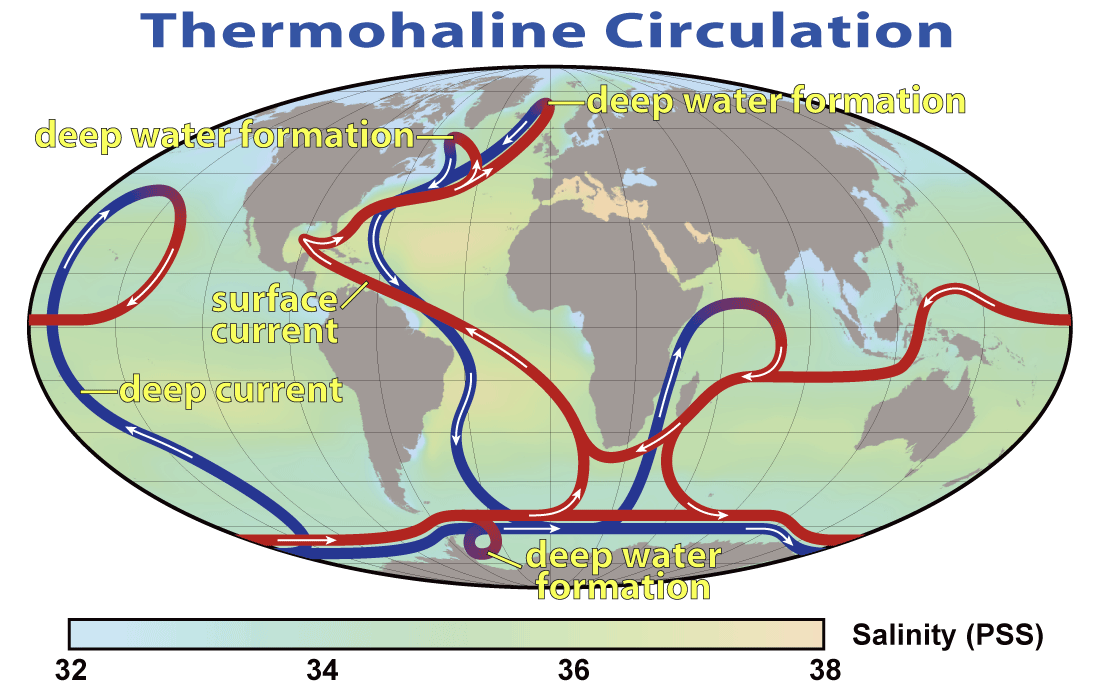
The water mass tracers analysis (on this boat we are testing N15 – an isotope of Nitrogen, and also Tritium – a radioactive isotope of Hydrogen) helps scientists understand where the water here came from. These analyses will help us verify if the Mississippi River water is running through the Florida Coast right now. From a global viewpoint, this type of test is important because it helps us understand about the circulation of ocean water around the world. If the ocean water drastically changes its current “conveyor belt” circulation patterns, there could be real impact on the global climate. (Remember from 2nd and 3rd grade that the water cycle and oceans control the climate of Earth.) For example, Europe could become a lot colder and parts of the United States could become much hotter.
This is an image of the conveyor belt movement of ocean currents
The last type of analysis we prepared for was the CDOM (colored dissolved organic matter) analysis. This is important because like the water mass tracers, it tells us where this water came from. For example, did the water come from the Caribbean Sea, or did it come from freshwater rivers?
I am coming to understand that the main mission of this NOAA bimonthly survey cruise on the R/V Walton Smith is to monitor the waters of the Florida Coast and Florida Bay for changes in water chemistry. The Florida Bay has been receiving less fresh water runoff from the Everglades because many new housing developments have been built and fresh water is being sent along pipes to peoples’ houses. Because of this, the salinity of the Bay is getting higher and sea grass, fish, and other organisms are dying or leaving because they cannot live in such salty water. The Bay is very important for the marine ecosystem here because it provides a safe place for small fish and sea turtles to have babies and grow-up before heading out to the open ocean.
Personal Log
This cruise has provided me great opportunities to see real science in action. It really reinforces everything I tell my students about being a scientist: teamwork, flexibility, patience, listening and critical thinking skills are all very important. It is also important to always keep your lab space clean and organized. It is important to keep accurate records of everything that you do on the correct data sheet. It can be easy to get excited about a fish or algae discovery and forget to keep a record of it, but that is not practicing good science.
It is important to keep organized records
It is also important to stay safe – every time we are outside on the deck with the safety lines down, we must wear a life vest and if we are working with something that is overhead, we must wear a helmet.
I have been interviewing the scientists and crew aboard the ship and I cannot wait to return to Arlington and begin to edit the video clips. I really want to help my students understand the variety of science/engineering and technology jobs and skills that are related to marine science, oceanography, and ships. I have also been capturing videos of the ship and scientists in action so students can take a virtual fieldtrip on the R/V Walton Smith. I have been taking so many photos and videos, that the scientists and crew almost run away from me when they see me pick up my cameras!
Captain Shawn Lake mans the winch
The food continues to be wonderful, the sunsets spectacular, and my fellow shipmates entertaining. Tomorrow I hope to see dolphins swimming alongside the ship at sunrise! I will keep you posted!!
Did you know?
The scientists and crew are working 12-hour shifts. I am lucky to have the “day shift” which is from 8am to 8pm. But some unlucky people are working the “night shift” from 8pm to 8am. They wake-up just as the sun is setting and go to sleep right when it rises again.
Animals seen today…
zooplankton under the dissecting microscope
– Many jellyfish
– Two small crabs
– Lots of plankton
A sampling of zooplankton
– Flying fish flying across the ocean at sunset
– A very small larval sportfish (some sort of bluerunner or jack fish)
Some moon jellyfish that we collected in the tow net
NOAA Teacher at Sea: Sue Zupko NOAA Ship: Pisces Mission: Extreme Corals 2011; Study deep water coral and its habitat off the east coast of FL Geographical Area of Cruise: SE United States from off Jacksonville, FL to Biscayne Bay, FL Date: June 24, 2011
If you are just beginning this blog, you might wish to go back to post #1 and start reading there.
Before reading this post further, take the quiz.
Life at Sea
Dusk on a limitless ocean
Life at sea is things in miniature—except the view. The ocean seems to stretch on forever. It’s easy to see why people in ancient times thought you would fall off the edge if you got too close. Explorers ventured out to prove them wrong. Mathematicians and astronomers also studied it to try to discover the truth. We’ve come a long way in our understanding of the universe since then, but there is so much more to explore and learn. The ocean is just one of those unexplored and undiscovered places.
ROV Guys departing
After the scientists disembarked in Ft. Lauderdale, I stayed aboard the Pisces to learn about the workings of the ship while it steamed back to its home port of Pascagoula, MS. After all, how often does one get an opportunity like this? I had a tour of engineering, discussions on the bridge, conversations with the crew in the mess, and a lesson on bandwidth. This post is an attempt to describe some everyday things you need to know about going to sea with NOAA.
Safety
Shortly after we boarded, we had a briefing in the conference room. This was mostly to cover safety issues and things to help us understand procedures. Of course, meal time hours were shared. I made a mental note of those hours since I knew I wouldn’t want to miss any meals. The stewards’ reputation for good meals preceded them.
ENS Michael Doig began our briefing by drawing the following on the white board.
I thought this was a clever way to introduce what he would later discuss—our alarm bell and whistle patterns. Mike, a former high school teacher, brought this method of capturing the class’s attention to his work on the Pisces. One of the first things we practiced after the briefing was the “fire” drill. Mike explained that one long bell and whistle meant either fire, collision (I figured we would feel that as well), or security alert. If we heard this, we were to bring our PFD (Personal Floatation Device—life preserver), located under our bunks, to the conference room, which was the mustering (gathering) station for the scientists. Our chief scientist, Andy David, would take a head count and call 101 on the phone to report to the bridge our headcount. Mike explained that fire is one of the big concerns on a ship. It really needs to be taken seriously. You can’t run out to the mailbox to gather as many families do for their emergency spot where everyone knows to go. So, they gather the scientists together since we are more like guests and wouldn’t know the correct procedures to fight a fire. Of course, for the first drill the alarm said the fire was near the conference room so we had to muster on the fantail (back-end of the ship). It was interesting to watch the crew quickly go to their duty stations in full gear to fight the fire.
Oh, no! Ensign Doig poses in fake alarm.
During the course of our trip, I did hear alarms sound on the bridge from different locations. Often it was something someone needed to check on. None turned out to be real emergencies, but were alerts to the crew to check on something. Thank goodness. These were always attended to immediately—not just when the bridge crew finished what they were working on. ENS Doig happened to be on duty when one of these alarms went off and I was on the bridge. Knowing I was going to take a picture, he made a face full of alarm. It’s good to have a sense of humor, especially since they had checked out the possibility of a fire and determined the cause for the alarm wasn’t a fire.
Gumby survival suit
After we finished our fire drill (by the way, when the alarm sounds they always announce whether it is a drill or not), we were told we’d be practicing our abandon ship drill. For this you must bring a hat, long-sleeved shirt, long pants, PFD, and your “Gumby suit” (survival suit) to your muster station. The Gumby suit probably has some long special name, but no one calls it that. It is located in one’s stateroom in an orange bag next to the door. It has handles and even pictures and directions explaining how to put it on. Those who hadn’t donned a suit recently, crew and scientists, had to put it on. Never having been at sea, I, of course, had to put it on. What a pain! One hopes never to have to abandon ship, but it would be difficult to put that on in the water. I am pretty sure I’d have it on within the required minute if we were doing the act of last resort and abandoning ship. Easier putting it on aboard the ship than in the water. The signal to abandon ship is 6 or more short bells and/or whistles followed by one long one.
The answer to the quiz is three short bells or whistles is the signal for man overboard. Our mustering station was the conference room for this activity so a head count could be taken.
Get that shot!
When working with a crane or winch and lifting something over the side of the boat, you must wear a hard hat and PFD —even if you’re just watching. My first experience with this was when I stepped out by the door to take a picture of the ROV being launched. The fisherman standing nearby told me I had to get properly dressed. They were just getting ready to launch and I needed to be ready. Oops! I went right in and put on my hard hat and PFD. Stephanie Rogers captured that moment after I was properly attired. I later learned that when entering or leaving a port, you had to wear a hard hat on the bow. Lots of safety rules.
Sliding doors at the far end of the wet lab close automatically.
If there is a fire alarm, some doors automatically close and you must know about it so you won’t stand in the way if they start to close. I think the door would win in a battle for possession of that space. We have similar doors at the school which slam shut during fires. Watch out! In other words, on a ship, just as in school, safety is always on everyone’s mind.
Captain refers to book
On the bridge, someone is always assigned to watch. The captain pulled out his book, COMDTINST M16672.2D: Navigation Rules (COLREGS), to show me the regulation which he had just quoted. I’m telling you, there is a book for everything on the bridge and they use them. Reading makes life so much easier. The Inland Steering section, Rule 5, says the ship “must maintain proper look-out by sight and hearing”. The watch officer cannot risk a collision. There are two radar screens displayed prominently on the helm station. What do you need to watch for? Won’t the radar pick up the boats? Well, no. Large boats usually have a “black box” like airplanes, which have a transponder telling the ship’s name and what type of craft it is.
Game of chicken
Small boats often don’t have this equipment and are a big threat. I found that out the day after we left port. Boaters don’t seem to realize that there might be someone besides them on the water. Even in deep water small fishing boats would cut in front of us. It often seemed like a game of “Chicken”. Victor, an able-bodied seaman (special certification for those with extra training and skill) pointed out that whenever the winds pick up to 15 or 20 knots there are more than a few incidents of boaters getting in trouble and the Coast Guard alerts all ships to be aware and possibly assist in rescue. Besides possibly tipping over, small boats cannot be seen in high swells until a large ship is almost upon them. Many don’t have transponders or radios to contact anyone to communicate problems or questions. Also, they often drink alcohol and drive. Dumb! I asked Victor what the Pisces would do if a small boat got too close. Run ‘em down was not the answer. Trying to radio them, calling to them with a loudspeaker, or blowing the horn usually gets their attention, he told me.
Scott always had interesting socks.
You must wear shoes enclosed on the toes and heels. It’s readily apparent why. The stairs can be treacherous when you are flopping around. In waves you could slide and hurt yourself, walk out of the shoes and twist an ankle, or slip on a wet deck. I found out several reasons for the deck being wet: rain (no kidding), humidity (it’s amazing how quickly water vapor condenses on the deck and makes a pond that sloshes around), swabbing (cleaning), and potable water runoff.
Fresh Water Overflow
The ship makes its own fresh water. If there is too much in the potable (drinking) storage tank, the excess water will exit out a runoff valve onto the deck. I discovered this one morning toward the beginning of the trip. The engineer who explained it to me said that the people on the ship were conserving their water, most likely, and the excess from the tank drained off onto the deck. I heard the captain make the same comment a week later about how the people on this research expedition were doing a good job conserving. That made me feel really good. Those short showers paid off. Fun fact: it takes one gallon of diesel fuel to produce one gallon of fresh water on the ship.
Petey Pelican on handrail
“One hand for yourself, and one for the ship” is how you walk on a ship safely. There are railings everywhere for you to hang on to. It’s a challenge in choppy seas to carry something, such as a laptop, and successfully maneuver down the hall while holding on as well. When the seas were about seven feet high I found it more than a little challenging to stand let alone walk.
Ship Tour
Steep Stairs
Let me explain how a ship is laid out. When I say there are a lot of stairs, I’m not kidding. Before I knew anything about the ship, we took a tour of most of the places we’d be “living” and a few extras. Of course it was all fascinating. We started in the conference room on the deck right across from my stateroom. That deck inside includes staterooms, the lounge and conference room, the dive locker (the ship has three divers who can inspect the propeller, rudder and underwater parts of the hull if there is a problem), and business office. Outside is the rescue boat, a couple of winches, and the bow.
Oxygen tanks at top of stairs on O-2 deck
We climbed some stairs and as we got there the guide told us that this was the O 2 deck. At first I thought he was kidding since right in front of me were two oxygen tanks. I asked for clarification and he said this is the deck with the staterooms of the NOAA officers, bosun, chief engineer, and chief scientist. Hmmm…still didn’t make any sense to me. What does that have to do with oxygen? I kept my thoughts to myself. Later I found a map of the ship. I slept on the O-1 deck, the officers were on the O-2 deck, and the bridge was on the O-3 deck. Hello! It was the level name of the deck and had nothing to do with oxygen. It was just a coincidence. Too funny.
Climbing above the bridge was the “flying bridge” (I wonder if that’s because the flags are there). It houses the radio towers and says, “Danger–Radiation Warning.” We were told to let the bridge know when we were going up there. It’s a great place to try to catch a cell phone signal or watch a sunrise.
Had to throw my weight into this door leading to the exercise room.
Doors
On the Pisces, and I would assume on other ships, there are doors everywhere. I was surprised at how much strength I needed to operate them. When entering the lab from where the ROV was being piloted, which was the center of all the dive activity, I found that I had to “put my hip into it” to push it open. As a matter of fact, I noticed I have a few door-pushing bruises.
There are doors for everything. The fire and watertight doors are to keep you safe from fire and flood. The refrigerator and freezer doors protect food from bacteria and keep them preserved until it’s time to eat. There are doors to the bathroom (yeah), doors for lockers, doors for closets, doors for equipment, medicine cabinet doors, stateroom doors, doors, doors, doors. Almost all doors have a latch at the ceiling behind them so they can be held open. A swinging door is a real safety issue. You either close it right after you use it or go through it, or you latch it open. I found it a pain to have to keep closing my locker door. It would swing with the waves and I didn’t want to have it wake anyone up. The noise bugged me as well. As you can see, I had a bit of trouble with the door leading to the exercise room down below the main deck. The engineers could close it with one hand. I was there for two weeks and, try as I might, it never got any easier.
Wheeled water tight door with wind behind it
Close all watertight doors and fire doors, all the time. Fire or flooding can lead to a rapid death. The engineers and NOAA Corps constantly monitor for this. Although it is a safety thing, opening and shutting doors was one of my biggest challenges on ship. Good thing I have been working out with weights. Opening those doors was often a very difficult—especially if there were a door or window open to the outside at the other end of the room. I brought home several bruises on my hip for throwing my body into the door to get it open. I once remarked that if someone ever opened the door to the ROV lab when I was pushing my way in from the other side, I’d go flying into the room. Not cool since there is a counter right inside the door. Think law of inertia. Push hard against something (heavy door), it moves out of the way (someone opens it), you’re no longer stopped and off you fly (until you run into something). Newton’s law of inertia….
Storage Locker
Exercise
Taking a walk on the ship for aerobic exercise isn’t easy. The whole ship is only 209 feet long. Well, you have to go through doors just about everywhere. The only place I could have done this for any real length was to start near the wet lab, travel around to the right, over the fantail, up the stairs, up to the bow (front of ship), climb stairs to the bridge and turn around. Can’t go farther since there are doors to enter the bridge. When I needed to go just about anywhere inside the ship there were a minimum of two doors to open. To get from my stateroom to the exercise room I had to go through three watertight or fire doors—and three to return. When tired I’d pray for the door to open and someone to step through.
At night, make sure someone knows you are on deck. ENS Doig told us to dial 101 and tell the bridge you’ll be outside in the dark. Even better, take a buddy. I also found it was good to carry a flashlight. If you turn the flashlight off when on deck when you get where you are going, your eyes adjust and it seems almost as bright as day. For this, you must extinguish (turn off) the flashlight.
The Moppets
Politeness Counts
Living on a ship means if you want to make/keep friends, you are nice. People are very close. You can’t even walk two abreast down the hall. If you enter a hallway and someone is half way down, wait for the other person to exit before entering yourself. Same goes for the stairs. If someone is coming down, or going up, don’t start until they pass you. Not only is it polite, it’s just good common sense.
Buddies Jana and Sue
I was fortunate to have the Queen of Politeness, Jana Thoma, as a roommate. She was always thinking of others and expressed thanks for everything they did–often several times. I have thought of myself as pretty polite, but I don’t think I can even compare to Jana. What a great example for me to follow. She was always a patient teacher as she tried to help me learn about cnidarians. Perhaps one of my students will work in her lab someday.
Drink station with juices, water, ice, coffee, etc
If someone drinks the last cup from a pot of coffee, he/she should make a fresh pot for the next folks. Although I am not a coffee drinker, from the way this was stressed by the officers and stewards, it must be very frustrating for someone coming for a warm drink to not have it readily available. They don’t have real long breaks. Remember, they have a lot of doors to slow them down. I think if they found out you took the last cup and didn’t refill the pot, you might be doing the Man Overboard drill as the victim (just kidding).
Clean up after yourself. Seems like common sense. The stewards are not your mother–they are busy working in the kitchen and cleaning. They shouldn’t have to come and bus (clean) the tables. You should take your dishes to the window, put the silverware in the water to soak, and put dishes, cups, bowls, and glasses in the plastic tub. There are two trash cans. One is for paper and plastic and a slop bucket for leftover food. At Tremont food you don’t eat on your plate is called food waste. If you take only what you’ll eat, this bucket has very little in it. They separate the food from the other trash so it won’t get smelly. They cover it with a lid and empty it when folks are all done eating for the day.
Curtains were great for privacy
The ship runs 24 hours a day so someone is probably sleeping at any time. Loved the curtains around the beds. I could get up and not disturb Jana and vice versa. Don’t slam doors. This is not always easy, especially in rough seas. I know I mumbled a couple of times “sorry” when the door slipped from my hands. Locker doors and bathroom doors in staterooms also flop around and make a racket if left open. I got in the habit of keeping these closed so they wouldn’t make noise. Our bathroom door had a neat feature. It had an automatic stay open fixture on it. Unfortunately, it didn’t work in rough seas so we had to prop open. I know if we had told the engineers they would have fixed it, but we kept forgetting to mention it.
The Pisces has an entertainment room for when you or the crew is off duty. There is a selection of DVDs and home theatre chairs to lounge in. My stateroom was right across the hall from this lounge. I never noticed anyone playing the TV too loudly. Movies also would feed into the staterooms. You could put the DVD on a certain channel and go watch while lying in bed. If you put a movie in, the rule was to let it play to the end. Someone might be watching it in their room. I am not sure how many movies can be played at the same time, but it is several. I put one in one time and didn’t get to watch since I had to go do some work. I figure I can watch movies at home, but will probably only be in this situation once.
The walls are really thin between staterooms. Conversations can be heard as can loud TV. Jana and I found that it’s easy to have a not so quiet discussion, especially if telling jokes, and tried to whisper. We did have a lot of fun and had to think of any neighbors who might be sleeping. Laura had hours opposite us and was our neighbor. One rule of politeness is to use headphones when listening to music so as not to disturb others. I used to work the midnight shift and went to school in the morning. Only had a few hours to sleep before going back to work. My upstairs neighbor got a new sound system and literally rocked me awake . I had to go upstairs and remind them that I slept during the day. Headphones would have let me sleep in peace. On a ship this seems to be doubly important because walls are so thin. The one exception to the headphone and music rule is in engineering. When I was exercising it was nice to have some good music playing. This happened a couple of times and it made the walking on the treadmill more enjoyable. I’m glad they were there in the next room working with the music on.
Putting things where they belong makes it easy for those who eat next.
Use paper if not eating during scheduled times. The stewards have to keep the dishes washed and if someone put dirty dishes in the bin, they would have to clean it. I noticed the crew was polite and used disposables after hours.
Conservation
Remember to shut off the water when just lathering up in the shower. This limits water use to about two minutes. I learned to do this during the power outage we had for 5 days in north Alabama after the tornadoes on April 27. My husband and I limited the length of our showers and had warm water for many days. Jana and I both said we loved how the shower on the ship works—it makes short showers possible. It has a knob in the middle to turn the water on and off. The knob on the right adjusts the temperature. When you turn the shower back on after lathering, the temp is the same as when it was shut off. Very neat.
Reuse your cup. One of the scientists said that she loves to bring her coffee cup which has a lid. It’s her way of staying in touch with home when on a ship and she always has a drink nearby. The best part is she is reusing her cup and limiting waste. That’s very smart.
Besides limiting water use and reusing cups, the crew recycles their aluminum cans just as we do at our school. The money is put in a special fund for things such as deaths, births, and celebrations.
Tips
Jana learned on another ship that if you leave the heat lamp on in the head (bathroom), the water from the shower dries on the floor quicker. I would think it would also inhibit mold growth.
It was cold in this lab.
I learned that temperatures vary on a ship. The acoustics lab, filled with computers, is freezing. I used to work in a computer center on the midnight shift. I brought an afghan to wrap up in when sitting at my station and had to wear pants (women didn’t usually wear pants to work in this office back then). However, it wasn’t as cold as the chemical lab where the scientists photographed specimens, cataloged their data, and examined specimens under the microscope. Then, go outside and it would be 82° F (about 28° C). Jason Moeller writes in his blog that it is a lot colder. Check that out. He dresses in many layers–with good reason.
One thing I’ll remember is how bright the stars are. What is really cool about being on a ship at night is that there are no trees to get in the way when viewing the stars. There is very little light pollution too. If I ever get to go to sea again, I’d like an astronomer with me to point out all the constellations. I have a lot of trouble seeing them since there are so many stars which crowd out the major stars in constellations.
Engineering
Watching gauges in engineering.
I didn’t see the engineers very often unless they were fixing something nearby or eating. They stayed below most of the time working on keeping the equipment purring or doing preventive maintenance. Often they were making something using the lathe or other tools. There is always something going on with them in their sauna-like work spaces. I did learn that they watched for a few bad things: squirting fluids, smoke, strange sounds, and changes in their gauges.
The engineers have to be able to fix just about anything. When you’re out at sea on a mission, you don’t just stop and run down to the boat repair shop to get things fixed. They bring the boat repair shop with them. In engineering there are milling machines, lathes, welding equipment, and so much more. I was impressed. At one point I saw Joe Jacovino making a frame to hold a light they were going to be adding outside. Another engineer, Steve Clement, was nominated for an award on the mission for making a part to repair a piece of scientific gear.
Lots of useful machines to help keep the ship operational
I was very interested in engineering. There was so much to learn there. I took more videos than I did photographs there since it was difficult to take notes and juggle all the stuff I had. My students can put together something with all the video I took. It was more as a reference to remind me of the facts that Chief Engineer, Brent Jones, was teaching me.
All in all, it was a fabulous experience. I hope more teachers will apply to learn about the work that NOAA is doing and pass this on to their students. I am looking forward to learning from the other Teachers at Sea. We will have lots of stories and lessons to share.
I took zillions of pictures (well, it seems like it). If you’d like to see some more, click here.