Allan Phipps: Let the Fishing Begin! July 28, 2012

NOAA Teacher at Sea
Allan Phipps
Aboard NOAA Ship Oscar Dyson
July 23 – August 11, 2012

Mission: Alaskan Pollock Survey
Geographical Area: Bering Sea
Date: July 28, 2012

Location Data
Latitude: 61°24’39″N
Longitude: 177°07’68″W
Ship speed: 3.8 knots (4.4 mph) currently fishing

Weather Data from the Bridge
Wind Speed: 6.9 knots (7.9 mph)
Wind Direction: 30°T
Wave Height: 2ft with 2-4ft swells
Surface Water Temperature: 8.7°C ( 47.7°F)
Air Temperature: 7.9°C ( 46.2°F)
Barometric pressure: 1005.8 millibar (0.99 atm)

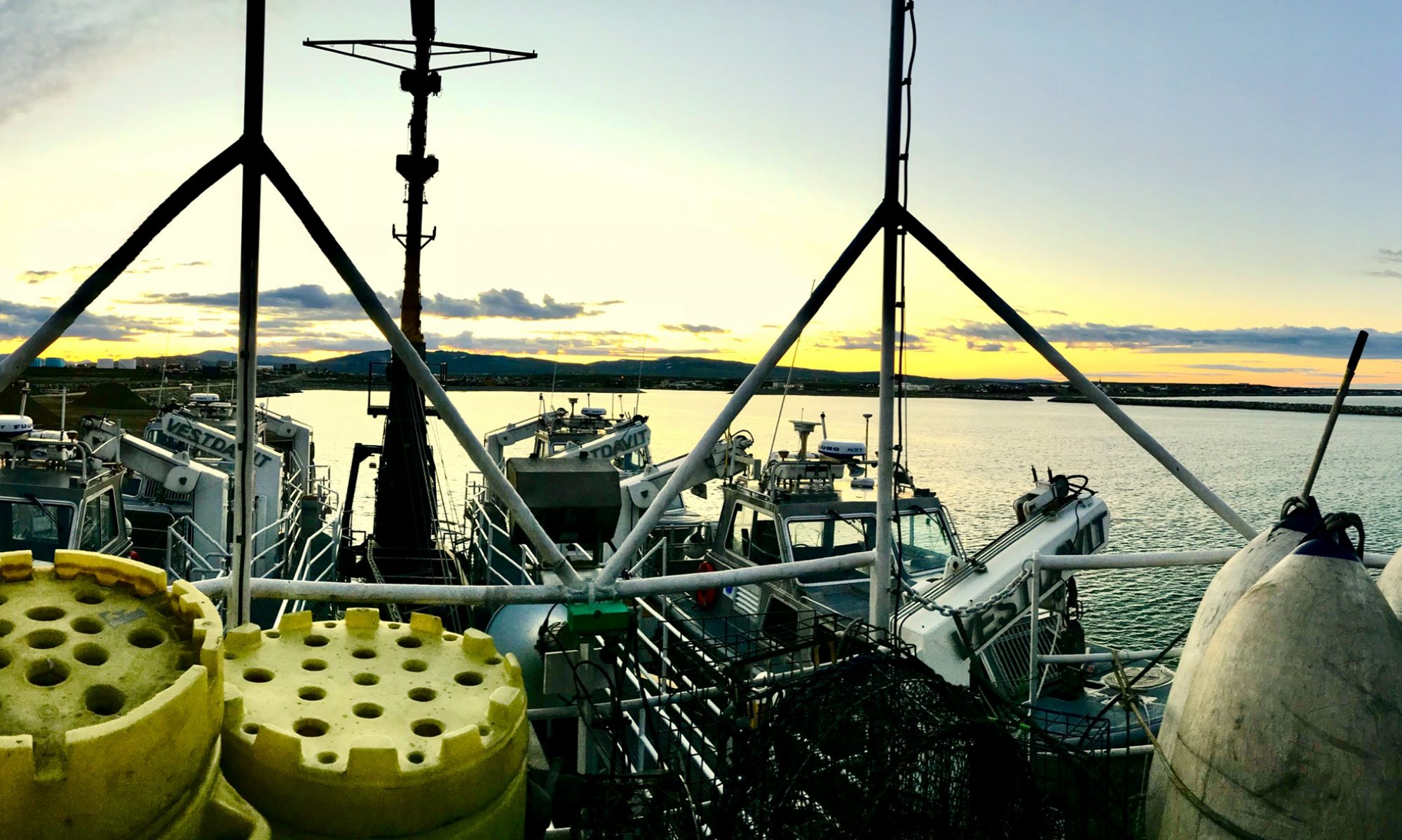
The NOAA Research Vessel Oscar Dyson at port in Dutch Harbor, Alaska.

Science and Technology Log:

Since the main goal of this voyage is the acoustic-trawl survey of the mid-water portion of the Alaskan pollock population, I thought I would start by telling you how we go fishing to catch pollock!  This isn’t the type of fishing I’m used to… Alaskan pollock is a semi-demersal species, which means it inhabits from the middle of the water column (mid-water) downward to the seafloor.  This mid-water survey is typically carried out once every two years.  Another NOAA Fisheries survey, the bottom trawl survey, surveys the bottom-dwelling or demersal portion of the pollock population every year.  I will begin by describing how we are fishing for pollock on this acoustic-trawl survey.

The Oscar Dyson carries two different types of trawling nets for capturing fish as part of the mid-water survey, the AWT (Aleutian Wing Trawl which is a mid-water trawl net) and the 83-112 (a bottom-trawl net that is named for the length of its 83 foot long head rope that is at the top of the mouth of the net and the 112 foot long weighted foot rope at the bottom of the mouth of the net).  One of the research projects on board the Oscar Dyson is a feasibility study that involves a comparison of the AWT and using the 83-112 bottom-trawl net as if it were a mid-water net.  The 83-112 is much smaller than the AWT, so there is concern with the fish avoiding this net and thus causing a reduction in catch.  While the bottom trawl survey acquires good information on the bottom-dwelling pollock using the 83-112 bottom trawl, if they also used this net to sample in mid-water they could help “fill in” estimates of mid-water dwelling pollock in years when the acoustic mid-water trawl survey does not occur.

Scale model of the Aleutian Wing Trawl (AWT) net courtesy of NOAA Scientist Kresimir Williams

When the net is deployed from the ship, the first part of the net in the water is called the cod end.  This is where the caught fish end up.  The mesh size of the net gets smaller and smaller until the mesh size at the cod end is only ½ inch (The mesh size at the mouth of the net is over 3 meters!).

The AWT is also outfitted with a Cam-Trawl, which is the next major part that hits the water.  This is a pair of cameras that help scientists identify and measure the fish that are caught in the net.  Eventually, this technology might be used to allow scientists to gather data on fish biomass without having to actually collect any fish (more on this technology later).  This piece of equipment has to be “sewn” into the side of the net each time the crew is instructed to deploy the AWT.  The crew uses a special type of knot called a “zipper” knot, which allows them to untie the entire length of knots with one pull on the end much like yarn from a sweater comes unraveled.

Cam-Trawl on deck, ready to be “sewn in” to the AWT.
The Cam-Trawl is now “sewn in” to the AWT and is ready to be deployed.

 Along the head rope, there is a piece of net called the “kite” where a series of sensors are attached to help the scientists gather data about the depth of the net, the shape of the net underwater, how large the net opening is, determine if the net is tangled, how far the net is off the bottom, and see an acoustic signal if fish are actually going into the net (more on these sensors later, although the major acoustic sensor is affectionately called the “turtle”).

Close-up view of the AWT scale model to highlight the kite and the turtle that ride at the top of the net. The third wire holds the electrical wires that send data from the turtle to the bridge (courtesy of Kresimir Williams).

Once the kite is deployed, a pair of tom weights (each weighing 250 lbs), are attached to the bridal cables to help separate the head rope from the foot rope and ensure the mouth of the net will open.  Then, after a good length of cable is let out, the crew transfers the net from the net reel to the two tuna towers and attach the doors.  The doors act as hydrofoils and create drag to ensure the net mouth opens wide.  Our AWT net usually has a 25 meter opening from head rope to foot rope and a 35 meter opening from side to side.

This picture shows the A-frame with the two tuna towers on either side. The AWT is being deployed down the trawl ramp on the stern of the ship.

The scientists use acoustic data to determine at what depth they should fish, then the OOD (Officer on Deck) uses a scope table to determine how much cable to let out in order to reach our target depth.  Adjustments to the depth of the head rope can be made by adjusting speed and/or adjusting the length of cable released.

The scientists use more acoustic data sent from the “turtle” to determine when enough fish are caught to have a scientifically viable sample size, then the entire net is hauled in.  Once on board, the crew uses a crane to lift the cod end over to the lift-table.  The lift-table then dumps the catch into the fish lab where the fish get sorted on a conveyor belt.  More on acoustics and what happens in the fish lab in my next blog!

The port side crane is lifting the cod end over to the starboard side where the lift-table will receive this morning’s catch.

Personal Log:

WOW!  What an adventure!!!  So I must get you caught up on some of the happenings thus far.  After a mix-up where my reservation was cancelled on the Saturday afternoon flight from Anchorage to Dutch Harbor and the threat of being stranded in Anchorage for another day, I finally made it to Dutch.  The weather cooperated (which is not the case more often than not), and we landed on Dutch Harbor after a quick refueling stop in King Salmon.  Since we landed after 8pm, we went straight to one of the few restaurants in Dutch Harbor and had a late dinner before heading to the Oscar Dyson for the night.

My flight after landing in Dutch Harbor, Alaska!

Sunday morning, we went with several of the scientists out to Alaska Ship Supply to get some gear.  I picked up my obligatory “Deadliest Catch” shirt and hat as all tourists do here in Dutch Harbor. We made three trips to the airport throughout the day to see if some of the science gear and luggage came, but came back disappointed.  On one of our trips to the airport, we had lunch at the airport restaurant.  I had Vietnamese Pho, which is a beef noodle soup, but it wasn’t nearly as good as the Pho my wife makes. 🙂 We also drove up the “Tsunami Evacuation Route” to an overlook where we could see all of Dutch Harbor and the town of Unalaska.  Later, we drove around Unalaska and stopped to check out some tidal pools on our way back to the Oscar Dyson.  In the afternoon, we checked out the World War II museum that was absolutely fascinating!  I did not know Dutch Harbor was bombed by the Japanese and that so many American soldiers were stationed in the bunkers surrounding the harbor.  For dinner, I had black cod (sablefish) at the Grand Aleutian Hotel.  Yummy!

Overlooking Dutch Harbor after driving up the Tsunami Evacuation Route.

Monday we embarked on our adventure shortly after noon.  We had to leave the dock because another ship was scheduled to offload there in the afternoon.  The scientists’ equipment arrived on a late Monday morning cargo flight, but they didn’t make it to the ship on time!!! We couldn’t go to sea without them, so we deployed the “Peggy D” to go pick them up and bring them aboard!

The Peggy D brings our scientists Rick and Kresimir with their long-awaited research equipment to the Oscar Dyson so we may head out to the Bering Sea!

Once we had our missing scientists, we left the safety of Dutch Harbor and ventured into open water.  On our way, we saw dozens of humpback whales!  None of the whales breached (jumped out of the water), but several of them fluked (dove and put their tail out of the water).

A couple of humpback whales spotted as we were leaving Dutch Harbor.

We started our day and a half journey to get to the starting point of our survey transects (the end point of last month’s survey).  On our trip out, we experienced 6 to 10 ft seas and a 25 knot wind.  It was a “gentle” welcome to the Bering Sea, but I struggled to get my sea legs underneath me.  Meclizine is great motion sickness medication, but it sure knocked me out.  I feel better now that I am not taking anything and am used to the rocking deck.  While we made our way to our first transect, we had a couple of emergency drills.  Here I am with fellow Teacher at Sea, Johanna, in our immersion suits as we completed our abandon ship drill.

Relaxing in the lounge after putting on our “gumby” suits.

On Wednesday morning, we began our first transect and did our first trawl along the transect (more on that later).  I learned how to work in the fish lab collecting biological data on the catch we brought on board.  I have been struggling to adjust to both my shift, which is 4am to 4pm, and the fact that the sun sets around 1am and rises at about 7am.

In the fish lab processing Pollock! Did someone order fish-sticks?

Thursday morning I woke on time and observed the survey scientists and crew deploying the CTD (Conductivity, Temperature, Depth) rosette from the hero deck (on the starboard side).

Skilled Fisherman Jim is assisting with deploying the CTD.

We also had beautiful clear skies and I was able to see Venus and Jupiter.  At sunrise, I saw the GREEN FLASH!!!  It was a beautiful start to the day.

A Bering Sea sunrise!

We processed one mid-water AWT (Aleutian Wing Trawl) trawl that was all pollock, then switched to the 83-112 bottom trawl net (83 foot long head-rope and 112 foot long foot-rope) and pulled up a lot of jellyfish with our pollock.

Last night, I finally got a really good night sleep!  This morning (Friday), I watched the CTD deployment again and learned more about the data being collected (more on this later).  No spectacular sunrise this morning as it was the typical gray, foggy weather.  I went up and spent some time on the bridge and Chelsea, our navigator/medic, taught me a lot about the instrumentation used for navigating the ship.  There sure is a lot of technology on board!!!

A picture of the helm with some of the displays the OOD (Officer on Deck) uses to navigate the ship.

From the bridge, we saw a pod of Dall’s Porpoise feeding, splashing around, and moving fast!  We processed another AWT trawl of pollock that had quite a few herring mixed in.  We traveled further into Russian waters than originally anticipated as we tried to identify the northern boundaries of the pollock population to get the best picture of the entire pollock range.  We spotted a huge Russian trawler from the bridge!

A Russian trawler! I took this picture through the lens of the CO’s (Commanding Officer) binoculars.

We then headed south again towards American waters, but needed to do a quick water column profile test.  Since we did not want to stop to drop the CTD again, I got to deploy a XBT (Expendable Bathythermograph)!  After all the talk about safety briefings, the use of ballistics, and outfitting me with every piece of safety gear we could muster, I got ready to fire the XBT!!!  Turns out, when you pull the firing pin, the XBT just slides out of the tube… no fireworks, no big bang… just a small kurplunk as the XBT enters the water.  We all had a good laugh at my expense.  See, scientists know how to have fun!

Safety first!!! All decked out for the “fireworks” of shooting the XBT. My “was that it?” face says it all…

WOW!  So I have just scratched the surface of our voyage thus far!  Next time, I will give you a snapshot of what life was like aboard the ship.

Susan Kaiser: Safety and Teamwork Needed for Success, July 27, 2012

NOAA Teacher at Sea
Susan Kaiser
Aboard NOAA Ship Nancy Foster
July 25 – August 4, 2012

Mission: Florida Keys National Marine Sanctuary Coral Reef Condition, Assessment, Coral Reef Mapping and Fisheries Acoustics Characteristics
Geographical area of cruise: Florida Keys National Marine Sanctuary
Date: Friday, July 27, 2012

Weather Data from the Bridge
Latitude:  24 deg 41 min N
Longitude:  82 deg 59 min W
Wind Speed: 5.61 kts
Surface Water Temperature: 30.33 C
Air Temperature: 29.33 C
Relative Humidity: 79.0%

Science and Technology Log

Close up of the bridge of NOAA Ship Nancy Foster

Safety is first in the science classroom AND on board the NOAA Ship Nancy Foster too. Our expected departure was delayed by one day because the Public Announcement (PA) system was not working. Without the PA system, communication about emergency situations would not be possible. The ship’s crew worked to solve the problem themselves and also contacted outside help, but in the end a part had to be replaced so we stayed in port at Key West an extra day. Ships don’t sail without meeting safety requirements. By morning on Friday the system was working fine and the crew prepared to set sail.

Lt Josh Slater leads the science team safety briefing in the dry lab.

After boarding the NOAA Ship Nancy Foster one of our first tasks was to review the safety protocols of the ship with one of the ship’s officers.  We learned the whistle signals for man overboard (3 prolonged blasts of the alarm), fire (1 continuous blast of the alarm) and abandon ship (7 or more short blasts followed by 1 long blast) and the designated places to report in these situations. We will be practicing abandon ship in a drill very soon so I will report on that later. Since the ship works on a 24 hour schedule someone is always awake on board which means someone is always asleep too.  Lt. Slater stressed the importance of not being too loud and showing respect for others’ space.  After all this ship is home to the crew and the science team are guests in that home.

NOAA Ship Nancy Foster officers ENS Jamie Park, ENS Michael Doig and Lt Josh Slater (hidden), inspect diving equipment.

Teamwork is critical on board the ship. The science team and the ship’s crew work closely to help each other achieve the best results and stay safe. Most of the data collected on this cruise uses divers. Twice each day, the science team meets to review the Plan of the Day or POD. This meeting allows team members to learn the expectations of them to meet the research objectives of the day. They also have the chance to provide input or to ask questions. What do you think is a main focus of this meeting?  You got it…Safety! While we waited for the PA system repair, the scientists checked their SCUBA gear again under the supervision of the ship’s crew members. This double-check insures all the equipment is safe to use.

After we steamed away from the keys, the scientists did a practice dive to simulate an unconscious diver at the surface. This drill included 5 science team divers as well as the ship’s crew and allowed them to practice their response in an emergency situation as well as deploying a small boat. A debriefing meeting afterward helped to identify the important tasks that need to be completed in the event of an emergency.   Practicing through drills allows a quick response to an unusual situation and helps everyone stay safe.

Unconscious diver drill. Pictured Ben Binder, Lt. Slater, and Chris Rawley. Sarah Fangman, who acts as the unconscious diver, is in the boat.

With the safety issues well-covered, the science team is ready to begin retrieving the “listening stations” called VR2s from their positions on the ocean floor tomorrow.  VR2 stands for Vemco Receiver 2 and is the model of the equipment used by the scientists use to collect fish movement information.  What do you think the “listening stations” are listening for? Read about the “listening stations” in a future posting of my blog. For now you can make an educated guess by reading for hints in this blog and answering this poll.

Personal Log

Mrs. Kaiser at the Reno-Tahoe International Airport ready to start her NOAA Teacher at Sea adventure!

Flying out of Reno, NV the plane took off heading south climbing quickly into the sky.  From my window seat I could see Pine Middle School below. Then after a quick glimpse of Lake Tahoe to the west, the plane turned gracefully eastward. As I looked down I could see the desert valleys that once lay beneath the ancient Pleistocene lakes, covering a good part of the Great Basin with water. Although it doesn’t seem possible, one can still find shells and marine fossils in these now desert locations. I thought how different the landscape is today compared to the distant past. Our environment is undergoing constant changes even though the processes may seem slow and may not be noticed from day to day.

This is why it is important to observe, record and think about all aspects of our environment and to be aware of small changes so we can predict if they may become big impacts. Soon I would be landing in Florida, a state very different from Nevada, and joining the science team aboard the NOAA Ship Nancy Foster. This team is one of many that makes observations of their marine ecosystem, recording data and interpreting any changes or patterns they notice. I am very pleased to join them for the next 2 weeks and expect to learn a great deal.

Greeting me at the airport were artistic decorations made of models of tropical fish found along the Florida coast.  High on the walls, they are creatively arranged in geometric patterns reminding me of synchronized swimmers competing in the Summer Olympics. These fish are more than art. They represent an important economic factor to Florida. They lure tourists for diving and snorkeling activities. Some of them are harvested for food or fished for sport. They are also important to the ecosystems of the coastal reefs and shore communities of Florida. I wonder what changes these scientists are seeing in this marine ecosystem. What are the solutions they will propose to the public? How can a balanced management meet the needs of people who live and work there? These are difficult questions to answer.

Great Basin at 30,000 ft. This area would have been covered with small lakes during the Pleistocene period.

It is dark when I arrive finally in Key West but a scientist meets me at the airport and drives me to the ship where I find my bunk and spend the night! Everyone has been very kind and helpful which makes participating in NOAA Teacher at Sea even more amazing – if that is even possible!

Stacey Jambura: We’re All in This Together! July 20, 2012

Stacey Jambura
July 6 – July 17, 2012
.
Geographical Area of Cruise: Gulf of Mexico
Current Geographical Area: Waterloo, Iowa 
Date: July 20, 2012
.

Science and Technology Log

Crew of the NOAA Ship Oregon II

It is no small feat to conduct a research survey for NOAA. It takes many individuals with many different strengths to ensure a safe and successful cruise. From the captain of the ship who is responsible for the safety of the ship and the crew, to the stewards who ensure the crew is well fed and well kept, every crew member is important.

I interviewed many of the crew members to get a better idea of what their jobs entail and what they had to do to become qualified for their jobs. I complied all of the interviews into a video to introduce you to some of the Oregon II’s crew.

Safety Aboard the Oregon II

While out at sea, safety is a critical issue. Just as schools have fire and tornado drills, ships have drills of their own. All crew members have a role to fulfill during each drill. Emergency billets (assigned jobs during emergencies) are posted for each cruise in multiple locations on the ship.

Emergency Billets
Emergency Billets
Abandon Ship Billets

Fire on a ship is a very critical situation. Because of this, fire drills are performed frequently to ensure all crew recognize the alarm, listen to important directions from the captain, and muster to their assigned stations. (To muster means to report and assemble together.) One long blast of the ship’s whistle signals a fire. (Think of someone yelling “Firrreee!!!”) Each crew member is assigned to a location to perform a specific duty. When the fire whistle is blown, some crew members are in charge of donning fire fighting suits and equipment, while others are in charge of making sure all crew have mustered to their stations.

Immersion Suit
Donning My Immersion Suit

Another drill performed on the ship is the abandon ship drill. This drill is performed so that crew will be prepared in the unlikely event that the they need to evacuate the ship. Seven short blasts of the ship’s whistle followed by one long blast signals to the crew to abandon ship. Crew members must report to their staterooms to gather their PFDs (personal flotation devices), their immersion suits, hats, long-sleeved shirts, and pants. Once all emergency equipment is gathered, all crew meets on the deck at the bow of the ship to don their shirts, pants, hats, immersion suits, and PFDs. All of this gear is important for survival in the open ocean because it will keep you warm, protected, and afloat until rescue is achieved.

The last drill we perform is the man overboard drill. This drill is performed so that all crew will be ready to respond if a crew member falls overboard. If a crew member falls overboard, the ship’s whistle is blown three times (think of someone shouting “Maann Overr-boarrrd..!). If the crew member is close enough, and is not badly injured, a swimmer line can be thrown out. If the crew member is too far away from the ship or is injured, the RHIB (Rigid Hull Inflatable Boat) will be deployed and will drive out to rescue the crew member. The crew member can be secured to a rescue basket and lifted back onboard the ship.

Man Overboard
Chris Nichols and Tim Martin performing a man overboard drill.
(photo courtesy of Junie Cassone)
Man Overboard Drill
Man Overboard Drill
Safety Equipment
Donning my hard hat

It is important to practice allof these drills so that everyone can move quickly and efficiently to handle and resolve the problem. All drills are performed at least once during each cruise.

Daily safety aboard the Oregon II is also important. When any heavy machinery is in operation, such as large cranes, it is important that all crew in the area don safety equipment. This equipment includes a hard hat and a PFD (personal flotation device). Since cranes are operated at least once at every sampling station, this safety equipment is readily available for crew members to use

Personal Log

July 20th

At the bow of the Oregon II
(photo courtesy of Junie Cassone)

I have now returned home from my grand adventure aboard the Oregon II. It took a few days for me to recover from “stillness illness” and get my land-legs back, but it feels nice to be back home. I miss working alongside the crew of the Oregon II and made many new friends that I hope to keep in touch with. Being a Teacher at Sea has been an experience of a lifetime. I learned so much about life at sea and studies in marine science. About half way through the cruise I had started to believe this was my full-time job! I am eager to share this experience with students and staff alike. I hope to spark new passions in students and excitement in staff to explore this opportunity from NOAA.

I want to thank all of the crew of the Oregon II for being so welcoming and including me as another crew member aboard the ship. I also want to thank the NOAA Teacher at Sea Program for offering me such a wonderful opportunity. I hope to be part of future opportunities offered by this program.

Valerie Bogan: First Days at Sea, June 9, 2012

NOAA Teacher at Sea
Valerie Bogan
Aboard NOAA ship Oregon II
June 7 – 20, 2012

Mission: Southeast Fisheries Science Center Summer Groundfish (SEAMAP) Survey
Geographical area of cruise: Gulf of Mexico
Date: Saturday, June 9, 2012

Weather Data from the bridge:  Sea temperature 27.5 degrees celsius, Air temperature 24.2 degrees celsius, calm seas with thunderstorms in the area.

Science and Technology Log

As I mentioned in the previous entry the Oregon II is conducting a groundfish survey.  During this research cruise we are studying many aspects of the Gulf’s ecosystem.  We start by collecting general information about the water chemistry.  To do this we use a piece of equipment called a CTD which stands for Conductivity/temperature/depth.  This piece of equipment collects information on the temperature, salinity, fluorescence and turbidity.

CTD
This is the instrument used to measure salinity, called a CTD.

I am going to briefly explain what each of these readings are and why they are important to the scientific community.  Everyone knows what temperature is but you may not be aware of its importance to the health of our planet.  The phrases global warming and climate change have become very popular in the last few years. By collecting temperature data in the same spot year after year scientists can determine if the oceans really are getting warmer.

sea surface temperature map
Map of the surface temperatures around the world. The highest temperatures are found in the red areas the lowest temperatures are found in the blue areas. (photo courtesy of bprc.osu.edu)

The oceans contain salt water which  is the most important difference between oceans and lakes.  The measurement of the amount of salt in an ocean is called salinity.  And the amount of salt in an ocean can reflect the workings of the water cycle.  If there is an excessive amount of evaporation due to high temperatures, the ocean will become more salty due to the fact that there is more salt in less water.  On the other hand  if there is a lot of rain or melt waters from glaciers and mountains then the water will become less salty because now the same amount of salt is dissolved in more water.

salt
The amount of salt in the water determines the salinity.

Fluorescence is the measurement of light which is connected to the photosynthesis rate of algae.  The health of the algae has a direct connection to the amount of carbon dioxide that can be absorbed by the ocean.  Algae produces its own food just like a tree so if the algae is healthy,  more carbon dioxide will be necessary  to carry out photosynthesis  and then ocean can absorb more natural and man-made carbon dioxide.   These readings can also tell us how well the oceans are responding to climate change.

algae
These algae make their own food through the process of photosynthesis.(photo courtesy of swr.nmfs.noaa.gov

Turbidity is the measure of water clarity.  If the turbidity is high it means that light isn’t getting through to the organisms below which in turn means that the algae and seaweed can’t get the light they need to make their own food.  High turbidity can also cause the water temperature to go up due to the excessive amount of silt and particles floating and absorbing energy from the sun.  High turbidity can also cause small animals on the bottom  of the ocean to be buried alive as the particles settle out the water column.

muddy Mississippi river
This is an example of the silt and particulate matter which is flowing into the ocean everyday.(photo courtesy of http://www.motherjones.com)

Personal log

Greetings from the Gulf of Mexico.  I have now been onboard  the Oregon II for one complete day and am slowly but surely becoming accustomed to the layout of the ship.  It has all the comforts of home even if they have different names and  look different from the parts of your home.  The place I sleep and keep my belongings in  is called a stateroom.  It is a small space but honestly the only thing I use it for is sleeping .  One other difference from your room at home is that the cabinets have latches which keep them closed even when the ship is rolling with the waves.  Given the fact that large waves may come up at any time it is important that all personal belonging are securely stored so that they don’t become flying projectiles which can hurt someone.

stateroom
This is where I am bunking for the voyage.

cabinets

The ship also contains restrooms but they are called the heads.   Fresh water is an important resource on the ship as we only brought so much with us so the toilets are flushed using  seawater which is very easy to come by out here on the gulf.  There are also a couple of showers something which is very important given the fact that our work has the ability to make us very dirty and nobody wants to be stuck on a boat with a bunch of dirty stinky people.

shower
This is where we clean off all the dirt that accumulates during sampling runs.

Safety is very important on ship so we have drills to practice what to do in case of emergency, just like the drills we do at Maple Crest middle school.  Today we had a fire drill during which the scientists were to muster (that means to report) in the lounge and stay out-of-the-way of the crew members who are actually trained to put out a fire if one should occur on the ship.  Following that we had an abandoned ship drill during which we had to put on long pants and shirts and a survival suit.  The purpose of all this clothing is to keep you protected from the elements if you have to float in the water for an extended time while waiting on a rescue ship to come

Survival suit
This is the suit you must wear during abandon ship drills.

Dave Grant: Terra Nova, February 13, 2012

NOAA Teacher at Sea
Dave Grant
Aboard NOAA Ship Ronald H. Brown
February 15 – March 5, 2012

Mission: Western Boundary Time Series
Geographical Area: Sub-Tropical Atlantic, off the Coast of the Bahamas
Date: February 13, 2012

Weather Data from the Bridge

Position: 26.30N Latitude – 71. 55W Longitude
Windspeed: 15 knots
Wind Direction: South (bearing 189 deg)
Air Temperature: 23.2 C / 74 F
Atm Pressure: 1013.9 mb
Water Depth: 17433 feet
Cloud Cover: 30%
Cloud Type: Cumulus

Personal Log

After an uneventful flight from New Jersey and an eventful trip from the airport at Charleston and through security at the naval base (Taxi drivers don’t like to have their vehicles inspected…), I am setting up my bunk on the Brown. There is a skeleton crew since I have arrived early and everyone else is expected to report tomorrow. Crates of equipment are still being loaded, so it is advisable to stay off the outside decks, and after a quick orientation by every  ship’s most important crew member (the chef),  I will have the evening free to find my way around the ship and explore the dock.
First order of business: Pick up bedding from the laundry down below.
Next: PB&J sandwich (Since the galley doesn’t open until tomorrow).
Finally: Grab the camera to catch the sunset and an amazing assortment of cloud types.

South Carolina’s estuaries are noted for their fine “muff” mud and oyster banks and the tideline at the docks is covered with a dense ring of oysters. Besides filtering great quantities of water and improving its quality, oyster “reefs” provide a secure habitat for a myriad of marinelife, and food for many creatures. (As a frustrated oyster farmer in South Jersey once remarked: “There ain’t much that lives in the ocean that doesn’t like to eat oysters!”)

Oyster Chain
Oyster Chain

Comorant
Comorant


Grebe
Grebe

The prettiest bird around is the red-breasted merganser, another diving fish eater. Hunters nicknamed mergansers “saw-bills” since their bills have tooth-like notches for snaring fishes. The word merganser comes via Latin mergere meaning “diver” and “to plunge.” Curiously, one of my favorite students always mixes up the word and somehow it comes out as Madagascar (!).

(Images on the Ron Brown by Dave Grant)

The most secretive and uncommon bird around the piers is the pied-billed grebe. It also dives for its dinner, but on the bottom. When frightened (or pestered by a photographer trying to get close in the fading light) it discreetly sinks straight down and disappears like a submarine. Locally, this trick earned the grebe the nickname water witch, and by Louisiana sportsmen Sac de plomb (bag-of-lead).

Grackle
Grackle

By far the noisiest birds around and the only ones onboard, are boat-tailed grackles. The iridescent, purple-black males are hard to ignore when gathering for the night on our upper rigging. A common bird of Southeastern marshes; since the 1960’s boat-tails have been expanding their range north along the Eastern seaboard beyond Delaware Bay, and now breed all along the New Jersey coast. (A normal extension of their population, or perhaps a response to warming climate? Time will tell.)

Just before dark a peregrine falcon surprised me as it glided past the ship – undeniably the most exciting sighting of the day and a great way to end it.

 “Oh end this day,
show
me the ocean.
When shall I see the sea.
May this day set me in emotion
I ought to be on my way”
(James Taylor)