Cathrine Prenot: Sea Speak. July 25, 2016

NOAA Teacher at Sea
Cathrine Prenot
Aboard Bell M. Shimada
July 17-July 30, 2016


Mission: 2016 California Current Ecosystem: Investigations of hake survey methods, life history, and associated ecosystem

Geographical area of cruise: Pacific Coast from Newport, OR to Seattle, WA

Date: Sunday, July 24, 2016

Weather Data from the Bridge

Lat: 47º32.20 N
Lon: 125º11.21 W
Speed: 10.4 knots
Windspeed: 19.01 deg/knots
Barometer: 1020.26 mBars
Air Temp: 16.3 degrees Celsius
Water Temp: 17.09 degrees Celsius


Science and Technology Log

Typical evening view from the flying bridge of the Bell M. Shimada

We have been cruising along watching fish on our transects and trawling 2-4 times a day. Most of the trawls are predominantly hake, but I have gotten to see a few different species of rockfish too—Widow rockfish, Yellowtail rockfish, and Pacific Ocean Perch (everyone calls them P.O.P.)—and took their lengths, weights, sexes, stomachs, ovaries, and otoliths…

…but you probably don’t know what all that means.

The science team sorts all of the catch down to Genus species, and randomly select smaller sub-samples of each type of organism. We weigh the total mass of each species. Sometimes we save whole physical samples—for example, a researcher back on shore wants samples of fish under 30cm, or all squid, or herring, so we bag and freeze whole fish or the squid.

For the “sub samples” (1-350 fish, ish) we do some pretty intense data collection. We determine the sex of the fish by cutting them open and looking for ovaries or testes. We identify and preserve all prey we find in the stomachs of Yellowtail Rockfish, and preserve the ovaries of this species’ females and others as well. We measure fish individual lengths and masses, take photos of lamprey scars, and then collect their otoliths.

Fish Otolith showing concentric growth rings from here.

Otoliths are hard bones in the skull of fish right behind the brain. Fish use them for balance in the water; scientists can use them to determine a fish’s age by counting the number of rings. Otoliths can also be used to identify the species of fish.

Here is how you remove them: it’s a bit gross.

Otolith instructions from here.
Cod, Redfish, and Hake otoliths from here.


A bigger fish species does not necessarily mean a larger otolith. From here.

If you want to check out an amazing database of otoliths, or if you decide to collect a few and want to see what species or age of fish you caught, or if you are an anthropologist and want to see what fish people ate a long time ago? Check out the Alaska Fisheries Science Center—they will be a good starting spot.  You can even run a play a little game to age fish bones!

Pacific Ocean Perch, or P.O.P.


Personal Log

I haven’t had a lot of spare time since we’ve been fishing, but I did manage to finagle my way into the galley (kitchen) to work with Chief Steward Larry and Second Cook Arlene. They graciously let me ask a lot of questions and help make donuts and fish tacos!  No, not donut fish tacos.  Gross.

How to make friends and influence people

Working in the galley got me thinking of “ship jargon,” and I spent this morning reading all sorts of etymology.  I was interested to learn that the term crow’s nest came from the times of the Vikings when they used crows or raven to aid navigation for land.  Or that in the days of the tall ships, a boat that lost a captain or officer at sea would fly blue flags and paint a blue band on the hull—hence why we say we are “feeling blue.”  There are a lot more, and you can read some interesting ones here.

You can also click on Adventures in a Blue World below (cartoon citations 1 and 2).
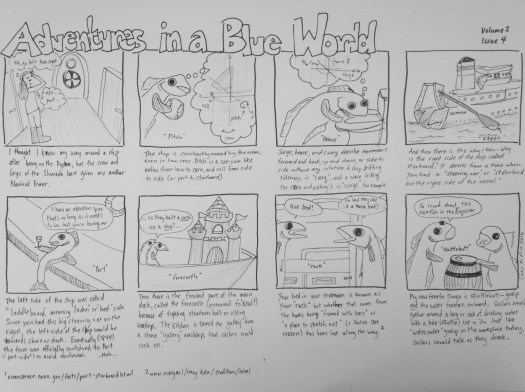
TAS Cat Prenot 2016 cartoon4 v2

And here is a nautical primer from Adventures in a Blue World Volume 1:

A Nautical Primer part I from 2011 aboard the Oscar Dyson
A Nautical Primer from 2011 aboard the Oscar Dyson


Did You Know?

Working in the wet lab can be, well, wet and gross. We process hundreds of fish for data, and then have hoses from the ceiling to spray off fish parts, and two huge hoses to blast off the conveyor belt and floors when we are done. But… …I kind of love it.

Yay Science!
Yay Science!

Resources

Etymology navy terms: http://www.navy.mil/navydata/traditions/html/navyterm.html

Interestingly enough, the very words “Sea Speak” have a meaning.  When an Officer of the Deck radios other ships in the surrounding water, they typically use a predetermined way of speaking, to avoid confusion.  For example, the number 324 would be said three-two-four.


Cathrine Prenot: Lights in the Ocean. Thursday, July 21, 2016

NOAA Teacher at Sea
Cathrine Prenot
Aboard Bell M. Shimada
July 17-July 30, 2016

Mission: 2016 California Current Ecosystem: Investigations of hake survey methods, life history, and associated ecosystem

Geographical area of cruise: Pacific Coast from Newport, OR to Seattle, WA

Date: Thursday, July 21, 2016

Weather Data from the Bridge
Lat: 46º18.8 N
Lon: 124º25.6 W
Speed: 10.4 knots
Wind speed: 12.35 degree/knots
Barometer: 1018.59 mBars
Air Temp: 16.3 degrees Celsius


Science and Technology Log

The ship’s engineering staff are really friendly, and they were happy to oblige my questions and take me on a tour of the Engine Rooms. I got to go into the ‘belly of the beast’ on the Oscar Dyson, but on the tour of the Shimada, Sean Baptista, 1st assistant engineer, hooked us up with headsets with radios and microphones. It is super loud below decks, but the microphones made it so that we could ask questions and not just mime out what we were curious about.

I think the job of the engineers is pretty interesting for three main reasons.

On the way to see the bow thruster below decks

One, they get to be all over the ship and see the real behind-the-scenes working of a huge vessel at sea. We went down ladders and hatches, through remotely operated sealed doors, and wound our way through engines and water purifiers and even water treatment (poo) devices. Engineers understand the ship from the bottom up.

One of four Caterpillar diesel engines powering the ship

Second, I am sure that when it is your Job it doesn’t seem that glamorous, but an engineer’s work keeps the ship moving. Scientists collect data, the Deck crew fish, the NOAA Corps officers drive the ship, but the engineers make sure we have water to drink, that our ‘business’ is treated and sanitary, that we have power to plug in our computers (the lab I am writing in right now has 6 monitors displaying weather from the bridge, charts, ship trackers, and science data) and science equipment.

I did not touch any buttons. Promise.

Finally, if something breaks on the ship, engineers fix it. Right there, with whatever they have on hand. Before we were able to take the tour, 1st Assistant Engineer Baptista gave us a stern warning to not touch anything—buttons, levers, pipes—anything. There is a kind of resourcefulness to be an engineer on a ship—you have to be able to make do with what you have when you are in the middle of the ocean.

The engineers all came to this position from different pathways—from having a welding background, to being in the navy or army, attending the U.S. Merchant Marine Academy, or even having an art degree.  The biggest challenge is being away from your family for long periods of time, but I can attest that they are a pretty tight group onboard.


In terms of the science that I’ve been learning, I’ve had some time to do some research of some of the bycatch organisms from our Hake trawls. “Bycatch” are nontargeted species that are caught in the net.  Our bycatch has been very small—we are mostly getting just hake, but I’ve seen about 30-40 these cute little fish with blue glowing dots all over their sides. Call me crazy, but anything that comes out of the ocean with what look like glowing sparkling sapphires is worthy of a cartoon.

So… …What is small, glows, and comprises about 65% of all deep-sea biomass? Click on the cartoon to read Adventures in a Blue World 3.

Adventures in a Blue World, CNP. Lights in the Ocean


Personal Log

The weather is absolutely beautiful and the seas are calm. We are cruising along at between 10-12 knots along set transects looking for hake, but we haven’t seen—I should say “heard” them in large enough groups or the right age class to sample.  So, in the meanwhile, I’ve taken a tour of the inner workings of the ship from the engineers, made an appointment with the Chief Steward to come in and cook with him for a day, spent some time on the bridge checking out charts and the important and exciting looking equipment, played a few very poor rounds of cornhole, and have been cartooning and reading.

I was out on the back deck having a coffee and an ice cream (I lead a decadent and wild life as a Teacher at Sea) and I noticed that the shoreline looked very familiar. Sure enough—it was Cannon Beach, OR, with Haystack Rock (you’ll remember it from the movie The Goonies)! Some of my family lived there for years; it was fun to see it from ten miles off shore.

Chart showing our current geographic area. Center of coast is Cannon Bean, Oregon.
Chart showing our current geographic area. Center of coast is Cannon Beach, Oregon.
View of Tillamook Head and Cannon Beach. It looked closer in person.


Did You Know?

One of the scientists I have been working with knows a lot about fish. He knows every organism that comes off the nets in a trawl down to their Genus species. No wonder he knows all the fish—all of the reference books that I have been using in the wet lab were written by him. Head smack.

Dan Kamikawa, our fish whisperer
One of the books written by Dan Kamikawa, our fish whisperer


Resources

My sister (thank you!) does my multi media research for me from shore, as I am not allowed to pig out on bandwidth and watch lots of videos about bioluminescence in the ocean.  This video is pretty wonderful.  Check it out.

If you want to geek out more about Lanternfish, read this from a great site called the Tree of Life web project.

Interested in becoming a Wage Mariner in many different fields–including engineering?  Click here.

Cathrine Prenot: A Fish Tale, Too Big to Fail. July 18, 2016

NOAA Teacher at Sea
Cathrine Prenot
Aboard the Bell M. Shimada
July 17-July 30, 2016


Mission: 2016 California Current Ecosystem: Investigations of hake survey methods, life history, and associated ecosystem

Geographical area of cruise: Pacific Coast from Newport, OR to Seattle, WA

Date: July 18, 2016

Weather Data from the Bridge:
Lat: 45º19.7 N
Lon: 124º21.6 W
COG: 11.2
Speed: 17.1 knots
Air Temp: 16.4 degrees Celsius
Barometer (mBars): 1019.54
Relative Humidity: 84%

Science and Technology Log

It is exciting to be out to sea on “Leg 2” of this cruise! The official title of our research is “2016 California Current Ecosystem: Investigations of hake survey methods, life history, and associated ecosystem.” One of the key portions of this leg of the trip is to collect data on whether or not a piece of equipment called the “Marine Mammal Excluder Device” (MMED) makes any difference in the fish lengths or the species we catch. Here is how it works (all images from Evaluation of a marine mammal excluder device (MMED) for a Nordic 264 midwater rope trawl):

The catch swims towards the codend of the net and encounters the MMED
The catch swim towards the codend of the net and encounter the MMED
The catch encounters the grate; some go through the grate while others escape the net through the hatch (shown by the orange buoy).
Some of the catch go through the grate (to the codend) while others escape the net through the hatch (shown by the orange buoy).

Why is this important?  For example, if all of one type of fish in a trawl escape through this MMED, we would be getting a different type of sample than we would if the equipment was off the nets.  Our lead scientist, Dr. Sandy Parker-Stetter explained: “If all the rockfish go out the top escape panel, how will we know they were there?”   To collect data on this, we will be doing a lot of trawls—or fishing, for those non-sea faring folk—some with the MMED and others without it. These will be small catches, we need about 300-400 fish, but enough to be able to make a determination if the equipment effect the data in any way.

We have done a few trawls already, and here are some of the photos from them:

'Young of the Year' Hake
‘Young of the Year’ Hake
Pacific Hake sample
Pacific Hake sample
Wanted: must love fish. And science.

All of this reminds me of why we are so concerned with accurately estimating the population of a little fish. To illustrate, let me tell you a story—a story of a fishery thought too big to fail—the Great Banks Atlantic Cod fishery. Why don’t you click on Issue 2 of Adventures in a Blue World: A Fish Tale, Too Big to Fail.

Adventures in a Blue World, CNP. A Fish Tale: Too Big to Fail

Cod populations decreased to such a degree (1% of previous numbers), that the Canadian Government issued a moratorium on Cod fishing in 1992.  Our mission—to investigate of hake survey methods, life history, and associated ecosystem—is designed to prevent such a devastating result. We don’t want Hake or other species to go the same route.

Atlantic Cod circa 1920s: from here

Personal Log

We left the left the dock on Sunday at 1145, and made our way under the Newport Bridge and out to sea. It was really wonderful to watch the ship leave the harbor from way up on the Flying Bridge—the top-most deck of the ship. There are four tall chairs (bolted to the deck) at the forward end of the deck, an awning, and someone even rigged a hammock between two iron poles. It is rather festive, although again, there were no drinks with umbrellas being brought to us.

View of Newport, OR from the flying bridge of the Shimada

I didn’t have any problems with seasickness on my last voyage, but I did take some meds just in case. One of the researchers said that he doesn’t take any meds any more, he just gets sick once or twice and then feels much better. If you are interested, here is a link to my previous cartoon about why we are sea-sick, and how and why ginger actually works just as well as other OTC drugs. All I can say now is that I’m typing this blog in the acoustics lab, and the ship does seem to be moving rather alarmingly from fore to aft–called pitching.  Maybe I should find a nice porthole. In the meanwhile, you can read “Why are we seasick.”


Did You Know?

The end of the fishing net is called the codend.  Who knew?  This and many more things can be learned about fishing from reading this handy reference guide.

Caitlin Thompson: Introduction, July 25, 2011

NOAA Teacher at Sea
Caitlin Thompson
Aboard NOAA Ship Bell M. Shimada
August 1 — 14, 2011

Mission: Pacific Hake Survey
Geographical Area: Pacific Ocean, Off the U.S. West Coast
Date: July 24, 2011

Bell M.  Shimada
NOAA Ship Bell M. Shimada

This Sunday, I’m headed off to sea! The mission of my cruise is to survey Pacific hake (also called Pacific whiting) populations. Hake is a species of fish that supports a huge fishery off the West Coast. As it states on NOAA’s Fishwatch website, “The Pacific whiting (hake) fishery is one of the largest in the United States. Pacific whiting is primarily made into surimi, a minced fish product used to make imitation crab and other products. Some whiting is also sold as fillets.” I’ll leave from Newport, Oregon, and arrive two weeks later in Port Angeles, Washington. The ship, the Bell M. Shimada, belongs to the National Oceanic and Atmospheric Administration (NOAA). I get to go on the Shimada because of NOAA’s program Teacher at Sea (TAS), which sends teachers aboard research vessels so that we can increase our scientific literacy and bring our new knowledge back to the classroom. I can’t wait. I’ve never even spent a night aboard a ship, so this whole journey will be new for me.

I teach seventh and eighth grade integrated science at Floyd Light Middle School, in the David Douglas School District, in Portland, Oregon. I earned my Master’s in Education at Portland State University and my Bachelor’s of Art in Environmental Science at Mills College, in Oakland, California. In between, I taught English at a public elementary school in Curico, Chile. I love science and I love teaching. As soon as I decided to become a teacher, I made up my mind to participate in TAS, because it will help me teach my students the importance and fun of science.

Caitlin Thompson
At a dragon boat race

When I’m not teaching, I paddle with a dragon boat team, spend time with friends and family, and ride my bicycle. I’m always looking for new projects and new things to learn. I’m lucky to live in a city as great as Portland, where there are always interesting events going on around town.

Bryan Hirschman, August 13, 2009

NOAA Teacher at Sea
Bryan Hirschman
Onboard NOAA Ship Miller Freeman (tracker)
August 1 – 17, 2009 

Mission: 2009 United States/Canada Pacific Hake Acoustic Survey
Geographical area: North Pacific Ocean; Newport, OR to Port Angeles, WA
Date: August 13, 2009

Weather Data from Bridge (0800) 
Visibility: 10 nautical miles
Wind: 6 knots
Wave Height: 1 ft
Wave Swell:  1-2 ft
Ocean temperature: 15.20C
Air Temperature: 14.20C

Science and Technology Log 

This is the net reel. The unit attaches with four bolts in each corner

Life at sea can be very unpredictable. One minute everything is working great, and the next minute problems occur. Last evening a problem occurred with the net reel. The net reel is a large bull wheel that the nets roll into and out of when lowered in the water. The reel is spun by a huge engine that pulls the nets in when they are loaded with fish. This net reel is anchored to the boat with 16 huge bolts and nuts. Four of the bolts were found last night to be weakened during one of the daily inspections of ship’s mechanical instruments. The crew is constantly inspecting each piece of equipment to ensure the safest working conditions. Once this problem was seen all fish tows were canceled. We will be heading into port four days early to fix the problem.

An incorrect assembly of the bolts on the net reel
A correct assembly of the bolts on the net reel

Once in port the entire net reel will have to be lifted by crane and all the bolts will be replaced. The reel will then be lowered back in place and locked in place with nuts. Even though we are not fishing, other work on the ship is still occurring. The XBT (Expendable Bathythermograph) is deployed at regular intervals. This device sends depth and temperature data to a science laboratory to be recorded and used later (discussed in more detail in log 2).

Toxin-producing  phytoplankton pseudo-nitzschia.
Toxin-producing phytoplankton pseudo-nitzschia.

The HABS (Harmful Algal Bloom Sampling) research is also still being completed by Nick Adams, an oceanographer with NOAA. He takes water samples approximately every 10 nautical miles (1 nautical mile = 1.15 miles). After collecting the samples, he filters them for toxin and chlorophyll analysis. He also collects seawater for phytoplankton numeration and identification. His main focus is on toxin-producing genera, such as Pseudo-nitzschia and Alexandrium which are responsible for Amnesic Shellfish Poisoning and Paralytic Shellfish Poisoning, respectively.  At the end of the cruise, Nick will be able to create a map of the concentrations and locations of toxin- producing phytoplankton. This will then be compared with data from years past to determine patterns and trends.

Toxin-producing  phytoplankton Alexandrium
Toxin-producing phytoplankton Alexandrium

The phytoplankton themselves are not harmful to humans, but as they accumulate in the food chain there can be human-related sickness. If we eat the organisms that are eating the plankton that produce toxins, we can become ill. Not much is known about the cause of the toxin producers, but with more research like Nick’s, scientists continually increase their understanding and ultimately hope to prevent human sickness from these phytoplankton.

Personal Log 

I am saddened to be cutting my journey earlier then expected, but I will leave the ship with fond memories of Pacific Hake, Humboldt Squid, and all the wonderful people who work on the ship. I am particularly grateful to the seven scientists who have gone out of their way to make me feel at home on the ship and have answered all of my questions. They are: the acoustic scientists: Dr. Dezhang Chu, Larry Hufnagle, and Steve de Blois; the fish biologists: Melanie Johnson and John Pohl; the oceanographers: Steve Pierce and Nick Adams. They are each extremely dedicated and passionate about their research and equally passionate about protecting our oceans and the organisms living there.

Scientists Steve de Blois, Larry Hufnagle, Dr. Dezhang Chu, and John Pohl

Challenge Yourself 
Volunteers play an integral role in supporting the environmental stewardship conducted every day by the National Oceanic and Atmospheric Administration. Across the United States and its coastal waters, opportunities exist for volunteers to take part in research, observation and educational roles that benefit science, our citizens and our planet.

Visit this website to see where you can help

hirschman_log4g