Brad Rhew: The Sounds of the Sea, July 31, 2017

NOAA Teacher at Sea

Brad Rhew

Aboard NOAA Ship Bell M. Shimada

July 23 – August 7, 2017


Mission: Hake Fish Survey

Geographic Area of Cruise: Northwest Pacific Ocean, off of the coast of Oregon

Date: July 31, 2017


Weather Data from the Bridge

Latitude: 44 49.160 N
Longitude 124 26.512

Temperature: 59oF
Sunny
No precipitation
Winds at 25.45 knots
Waves at 4-5ft


Science and Technology Log

TAS Rhew 7-31 acoustics lab2
Inside the acoustics lab

The scientists on the Hake survey project are constantly trying to find new methods to collect data on the fish. One method used is acoustics. Scientists Larry Hufnagle and Dezhang Chu are leading this project on the Shimada. They are using acoustics at a frequency of 38 kHz to detect Pacific Hake. Density differences between air in the swimbladder, fish tissue, and the surrounding water allows scientists to detect fish acoustically.

The purpose of the swim bladder in a fish is to help with the fish’s buoyancy. Fish can regulate the amount of gas in the swim bladder to help them stay at a certain depth in the ocean. This in return decreases the amount of energy they use swimming.

TAS Rhew 7-31 echosounder
The screen shows the data collected by the echosounder at different frequency levels.

Larry and Chu are looking at the acoustic returns (echoes) from 3 frequencies and determining which are Hake. When the echosounder receives echoes from fish, the data is collected and visually displayed. The scientists can see the intensity and patterns of the echosounder return and determine if Hake are present.

The scientists survey from sunrise to sunset looking at the intensity of the return and appearances of schools of fish to make the decisions if this is an area to fish.

TAS Rhew 7-31 scientists Larry and Chu
Scientists Larry Hufnagle (left) and Dezhang Chu (right) monitor the nets and echosounder while fishing for hake.

The ultimate goal is to use this data collected from the echosounder to determine the fish biomass. The biomass determined by the survey is used by stock assessment scientist and managers to manage the fish stock.

Personal Log

Everyday aboard the Shimada is a different experience. It has been amazing to be able to go between the different research labs to learn about how each group of scientists’ projects are contributing to our knowing more about Hake and marine ecosystems. My favorite part so far has been helping with the sampling of Hake. Some people might find dissecting fish after fish to determine length, sex, age, and maturity to be too much. However, this gives me an even better understanding and respect for what scientists do on a daily basis so we can have a better understanding of the world around us. We have also caught other fascinating organisms that has helped me explore other marine species and learn even more about their role in the ocean.

Even though the wind is a little strong and the temperatures are a little chilly for my southern body I wouldn’t trade this experience for anything…especially these amazing sunsets…

TAS Rhew 7-31 sunset
View of sunset over the Pacific Ocean from NOAA Ship Bell M. Shimada

Did You Know?

Before every fishing operation on the boat we must first do a marine mammal watch. Scientists and other crew members go up to the bridge of the boat to see if any mammals (whales, seals, dolphins) are present near the boat. This is to help prevent these animals from being harmed as we collect fish as well as making sure we are not running a risk of these mammals getting caught in the fishing nets.

Fascinating Catch of the Day!

Today’s fun catch in the net was a Brown Catshark! These creatures are normally found in the deeper parts of the Pacific Ocean. They are typically a darker brown color with their eyes on the side of their head. Their skin is very soft and flabby which can easily lead to them being harmed. They have two dorsal fins and their nostrils and mouth on the underside of their body. One of the sharks we caught was just recently pregnant.


TAS Rhew 7-31 catshark egg sack string
This catshark was recently pregnant; the yellow stringy substance is from an egg sack.

Notice to yellow curly substance coming out of the shark? That is from the egg sac. Sharks only produce one egg sac at a time. It normally takes up to a full year before a baby shark to form!

Brad Rhew: Getting Fishy With It, July 29, 2017

NOAA Teacher at Sea

Brad Rhew

Aboard NOAA Ship Bell M. Shimada

July 23 – August 7, 2017


Mission: Hake Survey

Geographic Area of Cruise: Northwest coast

Date: July 28, 2017


Weather Data from the Bridge

Latitude 4359.5N
Longitude 12412.6 W
Temperatue: 54 degrees
Sunny
No precipitation
Winds at 23.5 knots
Waves at 2-4 feet


Science and Technology Log

We are officially off! It has already been an amazing experience over the last couple of days.

One of the goals of this project is to collect data that will be used to inform the Pacific hake stock assessment. This falls in line with the Pacific Whiting Treaty that the US-Canadian governments enacted to jointly manage the hake stock. NOAA and Department of Fisheries and Oceans-Canada (DFO) jointly survey and provide the hake biomass to the stock assessment scientists. (Refer to the link in my last blog about additional information on this treaty.) Major goals of the survey are to determine the biomass, distribution, and biological composition of Pacific hake using data from an integrated acoustic and trawl survey. Additionally, we are collecting a suite of ecological and physical oceanographic data in order to better understand the California Current Large Marine Ecosystem (CCLME).

There is a very detailed process the scientists go through to collect samples and data on the hake caught and selected for sampling. They want to learn as much as possible about these fish to help with the ongoing research projects.

Here is a quick guide and understanding of how sampling works and what data is collected:

  1. Determine the length and sex of the fish.
    1. To determine the length, the fish is placed on a magnetic sensor measuring board. The magnet is placed at the fork of the tail fin; the length is recorded into the data table. (See figure A.)
      TAS Rhew Blog 2 photo A
      Figure A. Determining the length of the fish.


    2. To determine the sex, the fish is sliced open on the side. Scientist look to see if ovaries (for females) or testes (for males) are present. They also can determine the maturity of the fish by looking at the development of the reproductive organs. (See figure B.)

      TAS Rhew Blog 2 photo B
      Figure B. Determining the sex of the fish.
  2. Determine the mass.
    1. The Hake are placed on a digital scale and then massed. The data also gets entered into the database. (See figure C.)

      TAS Rhew Blog 2 photo C
      Figure C. Massing the fish on a digital scale.
  3. Removing of the otoliths (ear bones).
    1. Hake have two otoliths. How this is done is the scientist first cuts a slight incision on top of the fish’s head. (See figure D.)

      TAS Rhew Blog 2 photo D
      Figure D. Making an incision on the fish’s head to remove otoliths.
    2. The head is then carefully cracked open to expose the bones. (See figure E.)
    3. The bones are removed with forceps and then placed in a vial. The vial is then barcode scanned into the database. The otoliths will then be sent to the lab for testing. Scientists can run test on the otoliths to determine the age of the selected fish. (See figures F and G.)
  4. Removing a fin clip.
    1. Fin clips are removed from the Hake for DNA sampling to be completed back on shore in the lab. This gives researchers even more information about the selected fish.
    2. The fin clip is removed using scissors and forceps. (see figure H.)

      TAS Rhew Blog 2 photo H
      Figure H. Removing a fin clip.
    3. The clip is then placed on a numbered sheet. (see figure I.)

      TAS Rhew Blog 2 photo I
      Figure I. Placing the fin clip on a numbered sheet.
    4. The number is also entered into the database with all the other information collected on that particular fish.
  5. All the information is collected in one database so it can be assessed by scientists for future research. (see figure J.)

    TAS Rhew Blog 2 photo J
    Figure J. All information is stored in a database.


Personal Log

Even though this survey is just beginning this has been such an amazing experience already. I have learned a great deal about oceanography and marine research. I cannot wait to use my experiences back in my classroom to expose my students to careers and opportunities they could be a part of in their future.

Another great aspect of being a Teacher at Sea is the relationships I’m building with other scientists and the crew. It is amazing to hear how everyone became a part of this cruise and how passionate they are about their profession and the world around them.


Did You Know?

This is Leg 3 of 5 of this Summer Hake Survey. Two more legs will be completed this year to collect even more data on the fish population.


Fascinating Catch of the Day!

When we fish for Hake it is very common to collect some other organisms as well. Today’s fun catch was Pyrosomes or Sea Tongues!

These free-floating colonial tunicates are found in the upper part of the open ocean. Pyrosomes rely on the currents to move them around the ocean. They are typically cone shaped and are actually made up of hundreds of organisms known as zooids. The Zooids form a gelatinous tunic that links them together creating the cone shape. They are also bioluminescent and give off a glow in the ocean.

TAS Rhew Blog 2 photo collage
Fun with pyrosomes!

Check it Out!

If you want to learn more about what is happening on the Bell M. Shimada, check out The Main Deck blog for the ship:

https://www.nwfsc.noaa.gov/news/blogs/display_blogentry.cfm?blogid=7

Brad Rhew: “What the Hake?!” July 22, 2017

NOAA Teacher at Sea

Brad Rhew

Aboard NOAA Ship Bell M. Shimada

July 23 – August 7, 2017


Mission: Hake Fish Survey and Data Collection

Geographic Area of Cruise: Northwest Pacific Ocean, off of the coast of Oregon

Date: July 22, 2017


Weather Data from the Bridge

Summer is in full swing in my home state of North Carolina. We are averaging temperatures in the mid 80’s-90’s. Most days are very hot and humid. Traveling to Oregon and sailing off the coast will be bringing weather I haven’t experienced since early Spring. I am excited about having the chance to “cool off” for a while before returning to the southern summer temps.

Looking ahead at the forecast for Newport, Oregon where we will be sailing out of, temperatures will average in the 70’s during the day to lower 50’s in the evening/night.

Science and Technology Log

Since we have just officially set sail, the science and technology log will come in future post. On the Shimada, many experiments and forms of data collection will occur to learn more about Hake and the ecosystems they live in. I will be learning everything from what the in internal organs of Hake look like, how acoustics/sound waves are used to determine the location of Hake to how certain microbes in the water affect the marine ecosystem. Be prepared for some exciting news and amazing discoveries!

Introduction

TAS Rhew intro photo
TAS Brad Rhew

My name is Brad Rhew and I am currently a Science Lead teacher at Cook Literacy Model School in Winston-Salem, North Carolina.

I graduated with my degree in Middle Grades Science and Social Studies from the University of North Carolina at Greensboro.

Before moving into my current role, I was a middle school science teacher. I absolutely LOVED teaching 8th grade science. It was pure enjoyment watching my kiddos get messy in the lab and find their passion for science and learning.

In my current role as a Science Lead Teacher, I work with K-5 teachers planning and executing their science lessons in their classrooms. I also co-teach science lessons in the lab with teachers to help them gain a better understanding of science instruction. This has been a great experience in this role to watch children in kindergarten fall in love with science and then get to foster that passion all the way until they become fifth graders.

I am so excited about my upcoming adventure on the Bell M. Shimada. I know I will experience so many amazing things that I will get to bring back to my classroom. This experience will not only help me in becoming a better educator but will also help me expose my students to even more real-world science concepts.

Did You Know?

On the survey we will be collecting data about Hake fish. Here’s a little bit of information about the type of fish we will be studying.

TAS Rhew hake
Pacific Hake, also known as Pacific Whiting

Hake, also referred to as Pacific Whiting, is normally found off the Pacific coast of the United States. They are typically grey/silver in color with some black speckling. The underside of Hake is a white-cream color. These fish are normally found near the bottom of the ocean since they feed on smaller, bottom-dwelling fish.

These fish normally grow from one to three feet and weigh an average of five pounds. Hake have swim bladders which help them in the changing pressures of the ocean and to be able to navigate between the water columns. In later posts, I will discuss how research scientists in the acoustics lab on the Bell M. Shimada are using these swim batters to locate the fish in the ocean.

Something to Think About                 

You have probably eaten Hake before and didn’t even realize it. Hake is sometimes referred to as “White Fish” on menus. Because Hake is such a great fish for consumption, overfishing of this species is becoming an issue. Many countries and areas are starting to put regulations in place to help with the decreasing of the Hake population. NOAA has also become involved with this movement.

To learn more about NOAA’s involvement with Hake and more about our Summer Hake Survey visit the following website:

http://www.westcoast.fisheries.noaa.gov/fisheries/management/whiting/pacific_whiting.html


Cathrine Prenot: Sea Speak. July 25, 2016

NOAA Teacher at Sea
Cathrine Prenot
Aboard Bell M. Shimada
July 17-July 30, 2016


Mission: 2016 California Current Ecosystem: Investigations of hake survey methods, life history, and associated ecosystem

Geographical area of cruise: Pacific Coast from Newport, OR to Seattle, WA

Date: Sunday, July 24, 2016

Weather Data from the Bridge

Lat: 47º32.20 N
Lon: 125º11.21 W
Speed: 10.4 knots
Windspeed: 19.01 deg/knots
Barometer: 1020.26 mBars
Air Temp: 16.3 degrees Celsius
Water Temp: 17.09 degrees Celsius


Science and Technology Log

Typical evening view from the flying bridge of the Bell M. Shimada

We have been cruising along watching fish on our transects and trawling 2-4 times a day. Most of the trawls are predominantly hake, but I have gotten to see a few different species of rockfish too—Widow rockfish, Yellowtail rockfish, and Pacific Ocean Perch (everyone calls them P.O.P.)—and took their lengths, weights, sexes, stomachs, ovaries, and otoliths…

…but you probably don’t know what all that means.

The science team sorts all of the catch down to Genus species, and randomly select smaller sub-samples of each type of organism. We weigh the total mass of each species. Sometimes we save whole physical samples—for example, a researcher back on shore wants samples of fish under 30cm, or all squid, or herring, so we bag and freeze whole fish or the squid.

For the “sub samples” (1-350 fish, ish) we do some pretty intense data collection. We determine the sex of the fish by cutting them open and looking for ovaries or testes. We identify and preserve all prey we find in the stomachs of Yellowtail Rockfish, and preserve the ovaries of this species’ females and others as well. We measure fish individual lengths and masses, take photos of lamprey scars, and then collect their otoliths.

Fish Otolith showing concentric growth rings from here.

Otoliths are hard bones in the skull of fish right behind the brain. Fish use them for balance in the water; scientists can use them to determine a fish’s age by counting the number of rings. Otoliths can also be used to identify the species of fish.

Here is how you remove them: it’s a bit gross.

Otolith instructions from here.
Cod, Redfish, and Hake otoliths from here.


A bigger fish species does not necessarily mean a larger otolith. From here.

If you want to check out an amazing database of otoliths, or if you decide to collect a few and want to see what species or age of fish you caught, or if you are an anthropologist and want to see what fish people ate a long time ago? Check out the Alaska Fisheries Science Center—they will be a good starting spot.  You can even run a play a little game to age fish bones!

Pacific Ocean Perch, or P.O.P.


Personal Log

I haven’t had a lot of spare time since we’ve been fishing, but I did manage to finagle my way into the galley (kitchen) to work with Chief Steward Larry and Second Cook Arlene. They graciously let me ask a lot of questions and help make donuts and fish tacos!  No, not donut fish tacos.  Gross.

How to make friends and influence people

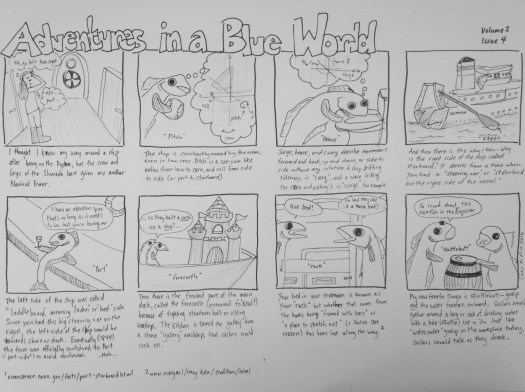
Working in the galley got me thinking of “ship jargon,” and I spent this morning reading all sorts of etymology.  I was interested to learn that the term crow’s nest came from the times of the Vikings when they used crows or raven to aid navigation for land.  Or that in the days of the tall ships, a boat that lost a captain or officer at sea would fly blue flags and paint a blue band on the hull—hence why we say we are “feeling blue.”  There are a lot more, and you can read some interesting ones here.

You can also click on Adventures in a Blue World below (cartoon citations 1 and 2).

TAS Cat Prenot 2016 cartoon4 v2

And here is a nautical primer from Adventures in a Blue World Volume 1:

A Nautical Primer part I from 2011 aboard the Oscar Dyson
A Nautical Primer from 2011 aboard the Oscar Dyson


Did You Know?

Working in the wet lab can be, well, wet and gross. We process hundreds of fish for data, and then have hoses from the ceiling to spray off fish parts, and two huge hoses to blast off the conveyor belt and floors when we are done. But… …I kind of love it.

Yay Science!
Yay Science!

Resources

Etymology navy terms: http://www.navy.mil/navydata/traditions/html/navyterm.html

Interestingly enough, the very words “Sea Speak” have a meaning.  When an Officer of the Deck radios other ships in the surrounding water, they typically use a predetermined way of speaking, to avoid confusion.  For example, the number 324 would be said three-two-four.


Patricia Schromen, August 22, 2009

NOAA Teacher at Sea
Patricia Schromen
Onboard NOAA Ship Miller Freeman
August 19-24, 2009 

Mission: Hake Survey
Geographical Area: Northwest Pacific Coast
Date: Thursday, August 22, 2009

Bringing in the nets requires attention, strength and teamwork.
Bringing in the nets requires attention and teamwork.

Weather Data from the Bridge 
SW wind 10 knots
Wind waves 1 or 2 feet
17 degrees Celsius

Science and Technology Log 

In Science we learn that a system consists of many parts working together. This ship is a small integrated system-many teams working together. Each team is accountable for their part of the hake survey. Like any good science investigation there are independent, dependent and controlled variables. There are so many variables involved just to determine where and when to take a fish sample.

Matt directs the crane to move to the right. Looks like some extra squid ink in this haul.

The acoustic scientists constantly monitor sonar images in the acoustics lab. There are ten screens displaying different information in that one room. The skilled scientists decide when it is time to fish by analyzing the data.  Different species have different acoustical signatures. Some screens show echograms of marine organisms detected in the water column by the echo sounders. With these echograms, the scientists have become very accurate in predicting what will likely be caught in the net. The OOD (Officer of the Deck) is responsible for driving the ship and observes different data from the bridge. Some of the variables they monitor are weather related; for example: wind speed and direction or swell height and period. Other variables are observed on radar like the other ships in the area. The topography of the ocean floor is also critical when nets are lowered to collect bottom fish. There are numerous sophisticated instruments on the bridge collecting information twenty four hours a day. Well trained officers analyze this data constantly to keep the ship on a safe course.

Here come the hake!
Here come the hake!

When the decision to fish has been made more variables are involved. One person must watch for marine mammals for at least 10 minutes prior to fishing. If marine mammals are present in this area then they cannot be disturbed and the scientists will have to delay fishing until the marine mammals leave or find another location to fish. When the nets are deployed the speed of the boat, the tension on the winch, the amount of weight attached will determine how fast the nets reach their target fishing depth.  In the small trawl house facing the stern of the ship where the trawl nets are deployed, a variety of net monitoring instruments and the echo sounder are watched. The ship personnel are communicating with the bridge; the deck crew are controlling the winches and net reels and the acoustic scientist is determining exactly how deep and the duration of the trawl. Data is constantly being recorded. There are many decisions that must be made quickly involving numerous variables.

Working together to sort the squid from the hake.

The Hake Survey began in 1977 collecting every three years and then in 2001 it became a biannual survey. Like all experiments there are protocols that must be followed to ensure data quality. Protocols define survey operations from sunrise to sunset. Survey transect line design is also included in the protocols. The US portion of the Hake survey is from approximately 60 nautical miles south of Monterey, California to the US-Canada Border. The exact location of the fishing samples changes based on fish detected in the echograms although the distance between transects is fished at 10 nautical miles. Covering depths of 50-1500 m throughout the survey. Sampling one species to determine the health of fish populations and ocean trends is very dynamic.

Weighing and measuring the hake is easier with automated scales and length boards.
Weighing and measuring the hake.

Personal Log 

Science requires team work and accountability. Every crew member has an integral part in making this survey accurate.  A willing positive attitude and ability to perform your best is consistently evident on the Miller Freeman. In the past few days, I’ve had the amazing opportunity to assist in collecting the data of most of the parts of this survey, even launching the CTD at night from the “Hero Platform” an extended grate from the quarter deck.

Stomach samples need to be accurately labeled and handled carefully.

Before fishing, I’ve been on the bridge looking for marine mammals.  When the fish nets have been recovered and dumped on the sorting table, I’ve sorted, weighed and measured fish. For my first experience in the wet lab, I was pleased to be asked to scan numbers (a relatively clean task) and put otoliths (ear bones) into vials of alcohol. I used forceps instead of a scalpel. Ten stomachs are dissected, placed in cloth bags and preserved in formaldehyde. A label goes into each cloth bag so that the specimen can be cross referenced with the otoliths, weight, length and sex of that hake. With all the high tech equipment it’s surprising that a lowly pencil is the necessary tool but the paper is high tech since it looks regular but is water proof.  It was special to record the 100th catch of the survey.

Removing the otolith (ear bone) with one exact incision. An otolith reminds me of a squash seed or a little silver feather in jewelry.
Each barcoded vial is scanned so the otolith number is linked to the weight, length and sex data of the individual hake.

Questions for the Day 

How is a fish ear bone (otolith) similar to a tree trunk? (They both have rings that can be counted as a way to determine the age of the fish or the tree.)

The CTD (conductivity, temperature and depth) unit drops 60 meters per minute and the ocean is 425 meters deep at this location; how many minutes will it take the CTD to reach the 420 meter depth?

Think About This: The survey team directs the crane operator to stop the CTD drop within 5 meters of the bottom of the ocean.  Can you think of reasons why the delicate machinery is never dropped exactly to the ocean floor?  Some possible reasons are:

  • The swell in the ocean could make the ship higher at that moment;
  • An object that is not detected on the sonar could be on the ocean floor;
  • The rosetta or carousel holding the measurement tools might not be level.

Launching the CTD is a cooperative effort. The boom operator works from the deck above in visual contact. Everyone is in radio contact with the bridge since the ship slows down for this data collection.

Retrieving the CTD
Retrieving the CTD