Marsha Skoczek: There’s No Place Like Home, July 17, 2012

NOAA Teacher at Sea
Marsha Skoczek
Aboard NOAA Ship Pisces
July 6-19, 2012

Mission: Marine Protected Areas Survey
Geographic area of cruise:  Subtropical North Atlantic, off the east coast of Florida.
Date:  July 17, 2012

Location:
Latitude:  30.4587N
Longitude:  80.1243W

Weather Data from the Bridge
Air Temperature:  26.8C (80.24 F)
Wind Speed:  10.8 knots (12.43 mph)
Wind Direction:  From the SE
Relative Humidity: 79 %
Barometric Pressure:  1017
Surface Water Temperature:  28.9C (84 F)

Science and Technology Log

South Atlantic MPAs

During the thirteen days we have been out to sea doing research, we have sent the ROV down both inside and outside of five different MPAs  from Florida to North Carolina and back again.  This allows the scientists to compare fish populations and densities both inside and outside of the MPAs.  Since we left Mayport Naval Station in Jacksonville, Florida, we have been averaging a distance from shore of between 50 and 70 nautical miles.  It will be fourteen days until we see land once again.  From this distance, the ocean seems to stretch on forever.  Gazing at the beautiful blue water, it is easy to forget an entire other world lies beneath us.  Not all of the ocean floor is flat, there is a small percentage that does have some elevation and structure.  The type of structures on the ocean floor determine what types of species will live there.

For this mission, we have mainly been studying areas within the mesophotic zone of the ocean ranging from 40 to 150 meters (130 – 500 feet) below the surface.  Temperatures here range from 12 – 23 degrees Celsius (50-70 F). Very little sunlight reaches the mesophotic zone, but zooxanthallae are still able to photosynthesize at this depth.  Corals and sponges will also filter feed using the abundant particulate organic matter drifting in the water column they will filter out and eat the plankton.

Tomtates hide in crevices.

The multibeam images help the scientists determine where to launch the ROV.  Areas with a change in elevation tend to indicate that there are rock structures below the surface.  It is around these rocks that the majority of fish prefer to live, so these are often the areas at which the scientists chose to collect data.

The ridges we have seen range in height from 1 meter to 5 meters.  The fish really like areas in the rock that have cracks, crevices and overhangs for them to hide.  Many times as the ROV approached the fish, they would scurry into a nearby hiding place.  I can’t help but imagine that the ROV with its bright lights and unnatural features must seem like an alien spacecraft to these fish that have never had contact with humans before.  But ROVs aren’t the only thing that these fish need to hide from.  I noticed that the larger fish that are toward the top of the food chain were not as skittish as the smaller reef fish.  Sometimes amberjacks and scamp would even follow the ROV as if curious about we were doing.  And lionfish never budged as the ROV passed unless it happened to be sitting in the ROV’s path.

Lobster hiding in rock. Notice how his coloring resembles the reef behind him.
Eel hiding under sponge
Scorpionfish against Diodogorgia

The fish are not the only living things that like these rocky habitats.  Usually when there are rocky surfaces, we find sponges, corals, hydroids and algae growing on top.  These creatures not only give the reef its beautiful appearance, but they also help to provide habitat as well.

Notice how the flounder blends in with the sand?
Sand tilefish make their burrows in the rubble under the sand.
Spider crabs on sandy bottom

Species that live in the sandy bottom habitat have their own set of adaptations. Animals such as the flounder and sea cucumbers have skin colorations that match the speckled appearance of the sand itself.  Sand tilefish carve out burrows from the rubble beneath the sand.  The spider crabs have a carapace that mimics the texture of the rocks it lives near.  The stingrays, with their low profile, sit on the sandy bottom and use their mouth to scour the sand in search of crabs and clams to eat.

Lophelia at artificial reef
Anemone at artificial reef
artificial reef

Artificial habitats are also full of life.  At the shipwreck we visited, not only did we see fish living here, we also saw anemone, tube worms, Venus flytrap anemone, hermit crabs, eels, Lophelia coral to name a few.  Other man-made habitats can help rebuild coral reefs.  John Reed has placed reef balls on the Occulina Reef in an effort to rebuild the original reef damaged by bottom trawling. These reef balls provide a structure for the corals to anchor themselves to and give the fish places to hide. Even oil platforms can be considered as an artificial reef structure giving a wide variety of species a sturdy structure to call home.


Personal Log

The Science Party

While aboard the Pisces I have learned to identify well over 100 different species of fish and invertebrates.   Andy and Stacey quiz me as we are watching the live footage, and I think I finally can tell the difference between a reef butterfly and a bank butterfly.  John frequently hands me a text book and challenges me to look up the species we see on the ROV live feed.  I am extremely appreciative of everyone being so helpful and sharing their knowledge with me.  Each of the scientists have taken the time to answer all of the question that I have.  The crew of the Pisces has also been wonderful to work with.  Everyone has done their best to make me feel at home. This has been such an amazing experience, I am excited to bring it all back to the classroom this fall!  I will never forget my time on the Pisces.

Ocean Careers Interview

In this section, I will be interviewing scientists and crew members to give my students ideas for careers they may find interesting and might want to pursue someday.  Today I interviewed John Reed and Stephanie Farrington.

John Reed

Mr. Reed, What is your job title?  I am the Research Professor in the Robertson Coral Reef and Research Program at Harbor Branch Oceanographic Institute (HBOI) at Florida Atlantic University (FAU).

Why did you decide to become a marine biologist?  I always knew that I wanted a career where I could do my work outside.  My biggest influence came when I was around 13 – 14 years old, I remember watching “The Undersea World of Jacques Cousteau” every Sunday night with my family and thinking that’s what I want to do!

What type of responsibilities do you have with this job?  Currently I am studying deep coral reefs as part of the Robertson Coral Reef and Research Program and several NOAA grants. My focus is primarily off the Florida coast and up through the Carolinas.  My objective is to protect and conserve deep sea coral ecosystems.  Around Florida alone, our group has discovered over 400 individual deep coral mounds some over 300 ft tall.  We have calculated that the area of these deep water reefs may exceed that of all the shallow water reefs in the United States combined.  These reefs habitats are incredibly diverse with hundreds of different species of bivalves, crustaceans and fish just to name a few.  Deep water hard corals grow very slowly, only about half an inch per year, core sampling has dated deep coral mounds at over 1,000,000 years old.  It is vital that we protect these deep reefs from destructive fishing methods such as bottom trawling or energy projects.

I also manage the archives for the biomedical marine division at Harbor Branch where we have over 35,000 deep and shallow marine specimens from around the world.  Each specimen has video footage of it in its natural habitat (in situ from the Johnson-Sea-Link submersible), still photos, museum samples as well as several smaller samples for our biomedical research.  We have discovered novel compounds from some of these marine organisms which may be future cures for cancer or other diseases.  Currently our chemists and biologists are working on the chemical compounds that we discovered in a deep water sponge that grows off Florida.  In the lab it is potent against pancreatic cancer which is a very deadly disease.

What type of education did you need to get this job?  I earned my Bachelors Degree in chemistry and biology from University of Miami and my Masters Degree in marine ecology from Florida Atlantic University.  My Masters Thesis was on The Animal-Sediment Relationship s of Shallow Water Lagoons and took me four years to study and wrote.  While working on my thesis, the Smithsonian had a branch at HBOI, so I would ask the scientists there for help in identifying the animals in my study.  Working with these scientists helped me make the connections that eventually get my job with HBOI.

What types of experiences have you had with this job?  I have been fortunate enough to travel the world visiting over 60 countries and collecting thousands of marine samples for biomedical research at HBOI.  I have been able to dive in the Johns0n-Sea-Link submersible to depths of 3000 ft and scuba dive to 300 ft.  My research on the deep water Oculina coral reefs off the east coast of Florida allowed me to use our submersibles as well as lock-out diving to study the growth rate and fauna associated with these deep water coral.  It is very humbling that my research on these reefs helped to establish the Oculina Marine Protected Area which was the first marine protected area in the world to protect deep sea corals, and more recently the 24,000 sq. mile deep sea coral habitat area of particular concern off the southeastern U.S.

What advice do you have for students wanting a career in marine biology?  Even if people tell you there are no jobs in marine biology, find a way to do it!  Follow what you are passionate about.  Get experiences as an undergrad, do internships, build your resume.  Make the effort!  Do things that are going to set you above everyone else.

When looking at graduate school, compare the course offerings of several universities.  Research the Principal Investigators (PIs) at those same schools and make contact with them.  Get a position as a Teaching Assistant or Lab Aide to build on your resume.  All of these things will help you to get the job you want once you graduate.


Stephanie Farrington

Ms. Farrington, What is your job title?  I am a biological scientist for John Reed at Harbor Branch Oceanographic Institute.

What type of responsibilities do you have with this job?  I accompany John on his research expeditions and help collect data.  When we return to HBOI, I analyze the data and program everything into GIS maps to give us a visual layout of the different habitats we saw and the species that live there.

What type of education did you need to get this job?  I earned my Bachelors Degree in biology and marine science from the University of Tampa.  My Masters Degree is in marine biology from the NOVA Southeastern University Oceanographic Center.  My thesis was on the Biogeography of the Straights of Florida which gave me a solid background in the marine invertebrates of our region.  This is one of the reasons John hired me to work with him.

What types of experiences have you had with this job?  I have been fortunate to travel in our Johnson-Sea-Link submersible six times, twice sitting up front in the bubble, one dive went down to 1700 feet below the surface.  I have also been on 8 research cruises since I started at HBOI two years ago.  I also had the opportunity to sail on the Okeanos Explorer for three weeks.

What advice do you have for students wanting a career in marine biology?  Marine biology is about collecting and analyzing data and doing research and there is so much cooler stuff in the ocean than just dolphins!

Jason Moeller: June 23-24, 2011

NOAA TEACHER AT SEA
JASON MOELLER
ONBOARD NOAA SHIP OSCAR DYSON
JUNE 11-JUNE 30, 2011

NOAA Teacher at Sea: Jason Moeller
Ship: Oscar Dyson
Mission: Walleye Pollock Survey
Geographic Location: Gulf of Alaska
Date: June 23-24, 2011

Ship Data
Latitude: 54.86 N
Longitude: -161.68 W
Wind: 12.1 knots
Surface Water Temperature: 8.5 degrees C
Air Temperature: 9.1 degrees C
Relative Humidity: 95%
Depth: 52.43 m

Personal Log

As I mentioned in the last post, everything here has settled into a routine from a personal standpoint, and on that end there is not much to write about. However, there were three things that broke up the monotony. First, as always, the scenery was beautiful.

Cove
Snow covered hills shield the cove from the winds. Look how smooth the ocean is!
cove2
The view off the back of the ship.

Second, I found out that even with all of the modern equipment on board, catching fish is still not guaranteed. We trawled three times last night on the 23rd and caught a total of 14 fish in all three trawls! Remember, a good sample size for one trawl is supposed to be 300 pollock, so this is the equivalent of fishing all day long and catching a minnow that just happened to swim into the fishing hook.

The first trawl caught absolutely nothing, as the fish dove underneath the net to escape the danger. The second trawl caught two pacific ocean perch and one pollock, and the third trawl caught eleven pollock. All in all, not the best fishing day.

pollock
The lone pollock from the second trawl.

Despite the poor fishing, we did bring up this neat little critter.

isopod
This is an isopod! These animals are very similar to the pillbugs (roly-polys) that we find in the US. Many marine isopods are parasites, and can be a danger to fish!
isopod2
This is the bottom view of an isopod

The third thing to break up the monotony was the Aleutian Islands earthquake. On the evening of June 23rd, a magnitude 7.2 earthquake shook the Aleutian Islands. According to ABC news, the earthquake was centered about 1,200 miles southwest of Anchorage. The quake spawned a brief tsunami warning that caused a large number of Dutch Harbor residents (Dutch Harbor is the home base of the show Deadliest Catch) to head for higher ground. We had been in the Aleutian Islands and Dutch Harbor area on our survey route, but had left two days before, so the Oscar Dysonwas completely unaffected by the earthquake.

Dutch Harbor residents seek higher ground after a tsunami warning was issued. AP photo by Jim Paulin.

Science and Technology Log

In order to obtain photos of all of this neat sealife, we first have to catch it! We catch fish by trawling for them. Some of you may not know exactly what I’m talking about, so let me explain. Trawling is a fishing method that pulls a long mesh net behind a boat in order to collect fish. Trawling is used to collect fish for both scientific purposes (like we’re doing) and also in commercial fishing operations. We have two types of fish trawls onboard the NOAA Ship Oscar Dyson — a mid-water trawl net and a bottom trawl net. We’ve used both types throughout our cruise, so let me tell you a little about each.

The mid-water trawl net is just as it sounds — it collects fish from the middle of the water column — not those that live on the seafloor, not those that live at the surface. The technical name for the net we have is an Aleutian Wing Trawl (AWT) — it’s commonly used by the commercial fishing industry.

trawl net
Part of the mid-water trawl net as it's being deployed.

The end of the net where the fish first enter has very large mesh, which is used to corral the fish and push them towards the bag at the end. The mesh gets progressively smaller and smaller the further into it you go, and at the very end (where the collecting bag is), the mesh size is 0.5 inches. The end (where the bag is, or where the fish are actually collected) is called the codend.

codend
One of the codends on the deck of the Oscar Dyson

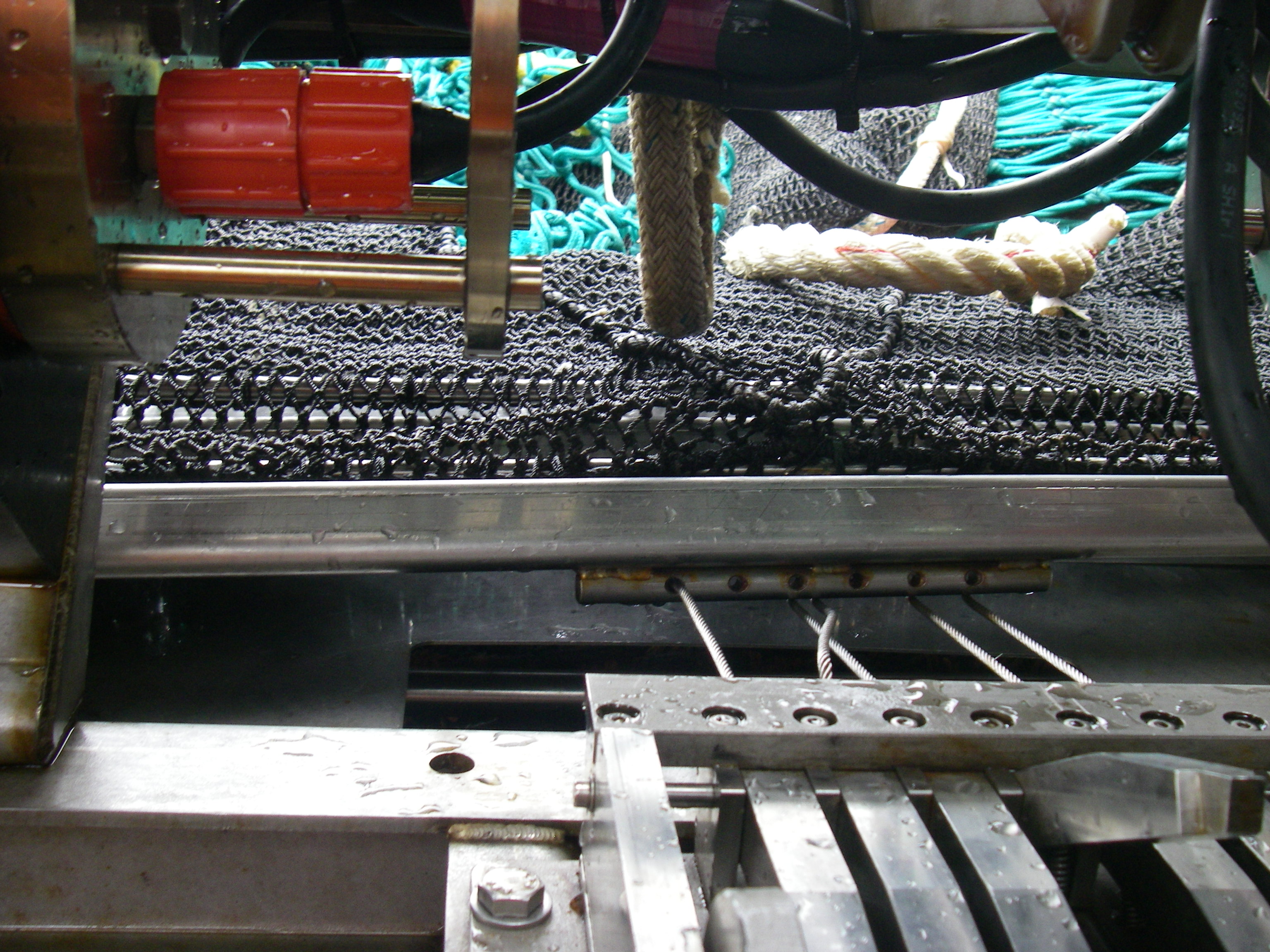
This is the kind of net we use when we want to collect a pollock sample, because pollock are found in the water column, as opposed to right on the seafloor (in other words, pollock aren’t benthic animals). Our particular net is also modified a little from a “normal” AWT. Our trawl has three codends (collecting bags) on it, each of which can be opened and closed with a switch that is controlled onboard the ship. The mechanism that opens and closes each of the 3 codends is called the Multiple Opening and Closing Codend (MOCC) device. Using the MOCC gives us the ability to obtain 3 discrete samples of fish, which can then be processed in the fish lab.

MOCC
The MOCC apparatus, with the 3 nets extending off.
bar
The nets are opened and closed using a series of metal bars. (The bar here is the piece of metal running across the middle of the photo). The net has 6 of these bars. When the first bar is released, the first codend is ready to take in fish. When the second bar is dropped, the first codend is closed. The third and fourth bars open and close the second codend, and the fifth and sixth bars open and close the third codend.
trigger
This is the trigger mechanism for the codends on the MOCC. When the codend is released, the trigger mechanism is up. When the codend is locked and ready to go, it is in the down position.

One other modification we have on our mid-water trawl net is the attachment of a video camera to the net, so we can actually see the fish that are going into the codends.

camera
This is the camera apparatus hooked up to the trawl.

When we spot a school of fish on the acoustic displays, we then radio the bridge (where the captain is) and the deck (where the fishermen are) to let them know that we’d like to fish in a certain spot. The fishermen that are in charge of deploying the net can mechanically control how deep the net goes using hydraulic gears, and the depth that we fish at varies at each sampling location. Once the gear is deployed, it stays in the water for an amount of time determined by the amount of fish in the area, and then the fishermen begin to reel in the net. See the videos below to get an idea of how long the trawl nets are — they’re being reeled in the videos. Once all of the net (it’s VERY long — over 500 ft) is reeled back in, the fish in the codends are unloaded onto a big table on the deck using a crane. From there, the fish move into the lab and we begin processing them.

Videos of the net being reeled in and additional photos are below!

http://www.youtube.com/watch?v=I50Q4SJzzaE
http://www.youtube.com/watch?v=VVAqbAGcxRs

net end
This is the end of the trawl net. They are lines that basically hold onto the net.
codend
One of the codends before being opened up onto the conveyor belt. We are inside waiting for the fish to arrive.
open codend
Opening the codend to release the fish catch!
reeled in
The mid-water trawl net all reeled in!

The other type of trawl gear that we use is a bottom trawl, and again, it’s just as it sounds. The bottom trawl is outfitted with roller-type wheels that sort of roll and/or bounce over the seafloor. We use this trawl to collect benthic organisms like rockfish, Pacific ocean perch, and invertebrates. There’s usually a random pollock or cod in there, too. The biggest problem with bottom trawls is that the net can sometimes get snagged on rocks on the bottom, resulting in a hole being ripped in the net. Obviously, we try to avoid bottom trawling in rocky areas, but we can never be 100% sure that there aren’t any rogue rocks sitting on the bottom 🙂

bottom trawl
The mesh and wheels of the bottom trawl.
btrawl2
More of the bottom trawl
btrawlreel
The bottom trawl, all reeled in!

Species Seen

Northern Fulmar
Gulls
Pollock
Pacific Ocean Perch (aka rockfish)
coral
Isopod

Reader Question(s) of the Day!

The first question for today comes from Rich, Wanda, and Ryan Ellis! Ryan is in the homeschool Tuesday class at the Zoo.

Q. We looked up what an anemone was and we found it was some kind of plant. Is that correct?

A. Great question! The answer is both yes and no. There is a type of flowering plant called the anemone. There are about 120 different species, and they are in the buttercup family. For one example of the plant, look below!

Anemone Nemorosa
Anemone Nemorosa. Taken from pacificbulbsociety.org

The sea anemone, however, is not actually a plant but an animal! Anemones are classified as cnidarians, which are animals that have specialized cells for capturing prey! In anemones, these are called nematocysts, which have toxin and a harpoon like structure to deliver the toxin. When the nematocysts are touched, the harpoon structure injects the toxin into the animal that touches it.

Cnidarians also have bodies consist of mesoglea, a non living jelly like substance. They generally have a mouth that is surrounded by the tentacles mentioned above.

Anemone
The Anemone we found.

The second question comes from my wife Olivia.

Q. What has surprised you most about this trip? Any unexpected or odd situations?

A. I think the thing that has surprised me the most is the amount of down time I have had. When I came on, I assumed that it would be physical and intense, like the show Deadliest Catch, where I would spend my whole time fishing and then working on the science. I figured that I would be absolutely toast by the end of my shift.

While I have worked hard and learned a lot, I have quite a bit of down time. Processing a catch takes about one hour, and we fish on average once or twice a night. That means I am processing fish for roughly two hours at most, and my shift is twelve hours. I have gotten a fair amount of extra work done, as well as a lot of pleasure reading and movie watching.

As for unexpected and odd situations, I didn’t really expect to get your camera killed by a wave. Fortunately, I have been allowed to use the scientist camera, and have been able to scavenge photos from other cameras, so I will still have plenty of pictures.

Another technological oddball that I didn’t think about beforehand was that certain headings (mainly if we are going north) will cut off the internet, which is normally fantastic. It is frustrating to have a photo 90% downloaded only to have the ship change vectors, head north, and cut off the download, forcing me to redownload the whole photo.
I also didn’t expect that the fish would be able to dodge the trawl net as effectively as they have. We have had four or five “misses” so far because the fish will not stay in one spot and let us catch them. While the use of sonar and acoustics has greatly improved our ability to catch fish, catching fish is by no means assured.

Perhaps the biggest “Are you kidding me?” moment though, comes from James and David Segrest asking me about sharks (June 17-18 post). An hour after I read the question, we trawled for the first time of the trip, and naturally the first thing we caught was the sleeper shark. Also naturally, I haven’t seen a shark since. Sometimes, you just get lucky.

Sue Zupko: 14 Cnidarians–Get the Vinegar!

NOAA Teacher at Sea: Sue Zupko
NOAA Ship: Pisces
Mission: Extreme Corals 2011; Study deep water coral and its habitat off the east coast of FL
Geographical Area of Cruise: SE United States from off Mayport, FL to Biscayne Bay, FL
Date: June 10, 2011
Time: 09:30 EDT

Weather Data from the Bridge
Position: 26.0°N  79.5°W
Present weather: 5/8 Alto Cumulus
Visibility: 10 n.m.
Wind Direction: 066°true
Wind Speed:  16 kts
Surface Wave Height:  4 ft
Swell Wave Direction: 120° true
Swell Wave Height:  4 ft
Surface Water Temperature:28.5 °C
Barometric Pressure: 1011.8 mb
Water Depth:  307 m
Salinity: 36.187 PSU
Wet/Dry Bulb: 28°/24.8°

This blog runs in chronological order.  If you haven’t been following, scroll down to “1 Introduction to my Voyage on the Pisces” and work your way back.

Take the quiz before reading this post.


Purple pink sea fan on a cobble bottom
This octocoral is a sea fan

Are all cnidarians corals or are all corals cnidarians?  Definitely, all corals are cnidarians (pronounced nye-dare-ee-ans).  Hydroids, corals, jellyfish and sea anemones are all cnidarians, so all cnidarians are not corals.   Part of our mission is to study deep-water corals in the Gulf Stream.   My berth (room) mate, Jana Thoma, is working on her doctoral dissertation (thesis) on corals.  She gave me an elaborate chart explaining all the branches of cnidarians the first day because I couldn’t remember the difference between hexacorals and octocorals.  So, do you know what these are?  If not, you are in good company.  Octocorals are like octopi (octopuses?) (octopodes?) .  As I’m writing this the scientists in the room are discussing the proper plural form of the word.  Checking the internet we have found the answer is…all are correct.   Back to the coral/octopus example.  An octopus has eight tentacles (or arms).  An octocoral has eight tentacles.  Cousins?  I think not, but the prefix octo- in Greek means eight and they both have eight tentacles.  The octocorals are usually soft.  Sea fans, sea pens, and soft corals are all examples of octocorals.  Originally people thought these were plants because they look and act like plants waving in the current.  Jana is helping me write this, and it’s obvious I’m still having trouble.  So, here is a quote from Jana to help us all better understand corals.

a forest of white-colored black sea coral whips
Stichopathes sp

“Uh…great, this is for posterity.  Okay.”  So, when most people hear the term coral they think of hard corals like brain coral, staghorn, or elkhorn coral that are known to build shallow-water reefs.  However, I study those corals that bend and flex in the water current – like sea fans or gorgonians.  As with all rules, there are exceptions and confusion ensues (follows).  Hexacorals are those animals that have six, or multiples of six tentacles; examples include hard corals, black corals, and anemones (that sometimes house clown fish).  Octocorals have……that’s right, eight tentacles; examples include gorgonians (sea fans), soft corals, sea pens, and the strange blue coral.  Last major group of “corals” are…stay with me folks… lace corals, which are actually hydrozoans and more closely related to the Portuguese Man o’War (the colonial jelly-fish like animal that partially floats on the surface and has long tentacles dangling in the water).” (Jana Thoma, doctoral candidate, University of Louisiana Lafayette )

white hard puffy ball of coral
Oculina varicosa

So, if I’m understanding this correctly, the hard corals, such as the Oculina varicosa, more often than not are the primary reef building animals.  They can provide an exposed hard surface for the sea fans to attach to.  This hard surface can also be covered with sediment that can be home to other sessile (sedentary like a couch potato that can’t ever get up) cnidarians.  Jana is nodding to this last statement.  Yeah!   Further, the living portions of corals are made of polyps, the hard skeletons are calcium carbonate and are formed by the polyps.  One sea fan is not a single polyp, but perhaps thousands.  All stacked up like an elaborate apartment building, they create a beautiful sea fan (or things which look like a sea fan).

What do scientists do when they have a few minutes not looking through a microscope or classifying new species?  At my request, they create songs about what they study.  Here is one, written today by Stephanie Rogers, Chuck Messing, and Jana Thoma:

Marine Snow (set to the tune of “Let it Snow”)

Oh, the sea is quite inspectable

Where the light is not detectable

And since we’ve got funds to go

Marine snow, marine snow, marine snow

Oh, the ocean’s gently rolling

And the crew is out aft trolling

The fish are goin’ to an’ fro,

Marine snow, marine snow, marine snow.

When we finally get to depths,

Oh, the critters swimming around

And I start to hold my breath

When we collect from the mound.

The R-O-V is slowly flying

And the scientists are sighing

Since we can’t collect no mo’

Marine snow, marine snow, marine snow.

Grey anemone waving tentacles in water catching food
Anemone

Just a reminder, marine snow is the detritus and plankton floating along in the current.  Most cnidarians are filter feeders, meaning they grab particles passing by.

We have visited several deep-water coral sites to check on their health and condition.  I know we visited places where we expected to find colonies of Oculina and Lophelia.  The first few we visited were in and near a new Marine Protected Area (MPA), others have been in or near a Habitat Area of Particular Concern (HAPC) established in the 1990s and in a giant HAPC established last year.  The soft bottom areas reminded me of the surface of the moon. However when we reached the coral mounds the abundance and variety of life was amazing.  You can see where we went on the NOAA Shiptracker.

Colorful reef shot with pink, purple, white corals
Protected reef

The difference between the protected and non-protected areas was striking.   In the areas protected for over 20 years I almost felt like I was watching a National Geographic documentary, with lots of beautiful fish, interesting coral, and unusual creatures like the sea cucumber.  While there was still life in the non-protected areas, the corals were in much worse condition and there were fewer fish.  Corals are the architects and builders of elaborate reef habitats that provide habitat and shelter for a huge diversity of life. Coral reefs are complex ecosystems. Many reef species are important fishery resources, or the food for important commercial species; some are sources of compounds with medical uses, others help us understand basic biological, ecological and physiological processes. Reefs offer protection to coastlines from erosion by waves and currents.  Coral reefs are very important.  I think I prefer the ones which look alive and healthy because of protections.  We will all benefit as a result even if we do not see the evidence on a daily basis.

Feathery creature like a duster
Hydroid

What did C3PO say to R2D2?

Hi, Droid!

Jana’s purpose for being on this cruise was to collect samples of the coral gathered from the bottom.  These samples would undergo testing and DNA analysis later in the lab.  It’s a challenging process.   Salt water was refrigerated in clear plastic containers to help keep the samples cold and avoid necrosis (death) of the polyps.  Identification tags were prepared.  The numbers help them catalog the specimens they collect.  John Reed uses the following system: 10-VI-11-201 means the specimen was gathered on the 10th day of June 2011 and 201 is a the category of specimen–in this case a dugong rib.  Every scientist has their own way of cataloging their specimens and this is just one example.

Cnidarians have nematocysts with either sticky, spiraling, hooking, or some other form of “harpoons” which sting and/or capture their prey.  If you happen to get in contact with these nematocysts, you might suffer an adverse reaction (like it might hurt or itch).  So, grab the vinegar and pour it on.  Jana tells me urine is a traditional home remedy that she says she has heard of (she won’t tell me if she has experimented with this or not).  The chemicals in these liquids often help ease the sting from contact with nematocysts.

Blue-gloved hands taking black coral sample from the manipulator arm of the ROV
Retrieving a sample from the ROV arm

When the ROV brought up a coral sample in its manipulator arm, the biologists were  prepared.  Wearing latex or nitrile gloves, like what doctors and nurses snap on with a flourish in the movies, they are ready to catch the coral before it hits the deck and gets contaminated.  Cameras at the ready, the specimen is put on a black background with the prepared tag and a ruler to show its size and a photograph is taken.  Parts of the specimen are put in different containers.  Animals are preserved in different chemicals which have different purposes.  Formalin fixes tissues, but can degrade deposits of calcium, and can be used for future morphological (the study of shape or form of an organism).  Ethanol can be used to slow down the process of decay.  Acetone does an even better job, however, its use is limited because it is more difficult to obtain and isn’t what people normally use.  Additionally, you can freeze the specimen, which slows down decay.  This is when they use the cold sea water, put the specimen in that, and place it in a very cold (-80°C) freezer.  Sometimes it is kept dry and frozen.  On the Pisces I saw them use all of these methods to preserve the specimens.  The specimens which must be kept frozen will be packaged in dry ice for the journey back to the lab.  Andy David, our lead scientist, has developed a strategy for getting people to the airport to catch planes or rent a car for their journey home.  After dropping other scientists off to get their cars, he will stop at the grocery store and pick up some dry ice.  We literally had a meeting to discuss needs and time schedules to be as efficient as possible.

Coral oozing
Oculina varicosa with mucus

I also learned that when they are stressed, corals ooze mucus.  Every creature gets stressed.  When I’m stressed I eat.  Others can’t eat when they are upset.  I witnessed the oozing coral when it was brought into the lab.

I felt the scientists were often speaking a foreign language.  Guess what–they were.  Latin.  I learned that in scientific classification different endings mean different things.  Phylums end in -a such as Porifera (sponges), Mollusca (sea shells) or Cnidaria (coral, anemones, jellies).   Classes end in -da, -iae, -ta, -ea, or -oa.  When writing the genus and species of an animal, you capitalize the genus, but not the species name, and italicize both.

Last, what do you do when you discover a new species?  You get to name it. We found a couple I want to share.

Stuffed toy grey pelican lying on black backgroun with id numbers and ruler below
Bigbeakus zupkoii
Yellow toy stuffed duck with a black shirt on, lying on black background with identification numbers and a ruler below it.
Yellowduckus thomaii

Sue Zupko: 13 Who Ya Gonna Call? Mud Busters!

NOAA Teacher at Sea: Sue Zupko
NOAA Ship: Pisces
Mission: Extreme Corals 2011; Study deep water coral and its habitat off the east coast of FL
Geographical Area of Cruise: SE United States from off Mayport, FL to Biscayne Bay, FL
Date: June 9, 2011
Time: 1900

Weather Data from the Bridge
Position: 25.4°N  79.5°W
Present weather: overcast
Visibility: 10 n.m.
Wind Direction: 075°true
Wind Speed:  20 kts
Surface Wave Height:  4 ft
Swell Wave Direction: 100° true
Swell Wave Height:  4 ft
Surface Water Temperature:28.5 °C
Barometric Pressure: 1011.8 mb
Water Depth:  308 m
Salinity: 36.5 PSU
Wet/Dry Bulb: 28°/24.8°

This blog runs in chronological order.  If you haven’t been following, scroll down to “1 Introduction to my Voyage on the Pisces” and work your way back.

Take this quiz before reading this post.


James and Jeff wait for the winch to lift the pyramind-shaped grey grab
Waiting to lift the grab

When I started my journey as a Teacher at Sea, I wondered what scientific research the ship I would be placed on would be doing.  Would it be marine mammals in Alaska or Hawaii, hydrography (bottom mapping), a fishery study, buoy placement, or something I’d never heard of.  When I was told I was placed on the Pisces and we’d be using an ROV (remotely operated vehicle), I only knew we’d be using the vehicle to go to the bottom and look at corals since it is too deep to scuba dive.  I had no real concept of what else would be going on.  I did know my students liked the idea of the ROV since I am the Robotics Club advisor at Weatherly Heights Elementary.

Pyramid shaped grey grabber hanging over the ocean
Benthic Van Veer Grab

We have three missions on the Pisces.  One is to look at the bottom through the eyes of the camera lens to see what is actually happening with the coral and its habitat.  Another purpose was to update existing maps.  The third mission was the most difficult for me to get a grasp of just because it sounds so strange.  Benthic grabbing.  Benthos means bottom in Greek.  Like the soil on land, sediment lying on the bottom of the sea is full of creatures and information needed to fully understand the health of the corals and their habitat.  You don’t see the most of the animals living in soil usually either.  In soil on land and in the sea sediment, the animals living inside are called infauna, and provide food and nutrients to the epifauna (those living above the surface).  What effect has man had on this foundation of the coral reef?  What diversity of life is there and how plentiful are they?  What size are the lithogenic (of rock origin) particles?  It all means something and needs to be studied.

Sand on bottom of ocean
Sandy bottom for grab

According to Dr. Jeff Hyland, NOAA NCCOS (National Centers for Coastal Ocean Sciences), “People may wonder why scientists want to study the seemingly ‘barren’ sand (or muddy sand) layer that covers vast stretches of the ocean floor.  One good reason is because this important habitat is not barren at all!  The unconsolidated (loose) bottom that occupies the majority of the sea floor can be teaming with life.  The types of animals found can include polycheate worms, mollusks, crustaceans, and fish.  Some are large enough to see with the naked eye, but many are so small that you would need to use a microscope to see them. “

Three men in safety gear standing behind the pyramid shaped grey grab
James, Steve, and Jeff harvest their grab

The crew of scientists using the Van Veen grab equipment include: Dr. Jeff Hyland, James Daugomah, and Steve Roth (Grab Guys) of NOAA’s NCCOS Laboratory in Charleston, SC.  Ocean floor mapping is done prior to an ROV dive to help pinpoint the choicest spots for investigation.  After the ROV records the video from its dive, the “Grab Guys” go to work.  The science team confers and selects the best spots for study.  The beginning spot is relayed to the bridge, which then “makes it so” by taking the ship to those coordinates.

So, now what?  Every group on deck must wear hard hats and PFDs (life jackets—Personal Floatation Devices) since the winch will be used and they will be working near the side rail of the ship.   The fishermen (deck hands), scientists (both observers and the Grab Guys), and anyone who happens to be nearby must wear this equipment.  Safety first.

The fishermen and Grab Guys prepare for the sampling by dragging the 300 pound Van Veen grab close to the side.  It sits on a specially constructed table made of 2×4 wood and is painted grey.

Sink with water and plug plus two buckets on the left
Benthic cleaning equipment

Nearby, Steve sets up a smaller table with a sink in it, plus several buckets, a large spoon, and two rectangular plastic tubs nearby.  I really wondered what that was all about.

The winch hook is attached to the Van Veer grab and everyone stands ready.  When the bridge radios to the fishermen that the ship is over the drop site, they spring into action.  The winch operator waits for the signal from the lead fisherman that all is ready and is told by hand signals to raise it up.  As the winch lifts up the grab, those working the equipment help steady it over the deck and release it when it’s over the side.  The grab is lowered to the bottom as the winch operator monitors the amount of cable deployed.  The idea is that when the grab hits the bottom the release bar will pop and close the “grab jaws”.  If the grab isn’t going fast enough or lands on an angle it won’t close.  Plus, it might not go deep enough into the sediment to get a good sample.

Men standing in protective gear looking upward at the winch pulley
Watching the pulley for movement

It takes longer than you would think for that grab to hit bottom.  Remember, patience is a virtue.  The equipment drops 80 meters per minute.  Yesterday we were dropping to 320 meters.  All eyes are targeted on the winch’s pulley.  When the grab hits the bottom, it causes the pulley on the winch cable to swing, meaning that the grab has made contact.  Everyone crosses their fingers that the grab not only closed, but also got a large enough sample for an accurate test.  The winch driver begins to retrieve the gear.  It’s just like doing a science fair project.  You must repeat your experiment and have the right amount of sample so your repeated experiments  are as similar as possible when you repeat your procedure.  They must make three grabs which bring up the correct amount of sediment.  Often trial and error comes into play.  The current not only made things difficult for the ROV operations, it made the grab go down at an angle so it wouldn’t close (grab or fire) a few times.  They had to keep dropping until it worked correctly.  At one point the bottom was 370 meters and we had let out 425 meters of cable.  That meant that the wind and the current were really strong and pulling the grab out at an angle.

Pulley wheel hanging from an orange support
The winch pulley moved
Sieve bucket being swirled around in sink
Cleaning the mud off

Once the grab gets a sample, they scoop out sediment with a spoon and put it in a blue bin.  This is carried over to a sieve bucket and is half submerged and swished around in the sink to get the mud off.  This is repeated until all the sediment particles are clean.

Jeff in white helmet and orange PFD write information on a clipboard
Jeff records important information

The samples are scooped out of the sieve bucket and placed in containers which will be processed back at the laboratory.  In general, they are looking for sediment size (grain size), infauna (living organisms from the sediment), and chemicals from man.  The containers have been labeled with what tests need to be run.  Jeff is recording the numbers on the containers and whether that sediment should be tested for metals, toxicology, total carbon, organics, and sediment size.

Steve in PFD holding container with sediment and pink color
Steve holding organics sample

A special insert is placed in the grab to measure an exact amount of sediment to determine the amount of  the infauna.  This sample is cleaned and put in a large container with formalin mixed with rose bengal.  The rose bengal had been premixed by Dr. Hyland the first day so that when added to the sediment it will turn the living organisms a pink color, making them easier to find.

After the sediment samples are put in the smaller bottles, the top is screwed on, sealed with electrical tape to make sure it doesn’t open, and stored in the refrigerator or freezer. All these benthic samples will be sent to Barry Vittor, a company specializing in sediment analysis.

I have a new appreciation for the sediment in the ocean.  I’ve learned that sediment on the north side of a coral mound in the Gulf Stream usually has less nutrients since the current flows from south to north.  The coral and other plankton-consuming animals eat a lot of the food flowing in the current over the mound so the water on the north side contains less food and can support less infauna.  I hope my students enjoy learning about the benthos as much as I have.  Perhaps with the data we collected, scientists will be able to help determine what we need to do to preserve the corals of the reefs.

Sue Zupko: 11 Belts and Suspenders

NOAA Teacher at Sea: Sue Zupko
NOAA Ship: Pisces
Mission: Extreme Corals 2011; Study deep water coral and its habitat off the east coast of FL
Geographical Area of Cruise: SE United States from off Mayport, FL to St. Lucie, FL
Date: June 7, 2011
Time: 10:00 EDT

Weather Data from the Bridge
Position: 27.3°N 79.6°W
Present weather: 4/8 Alto cumulus
Visibility: 10 n.m.
Wind Direction: 082°
Wind Speed: 4 kts
Surfacel Wave Height: 2-3 ft
Swell Wave Direction: 100° true
Swell Wave Height: 2-3 ft
Surface Water Temperature: 27.1°
Barometric Pressure: 1014.5mb
Water Depth: 80m
Salinity: 36.56 PSU
Wet/Dry Bulb: 27.2/24

This blog runs in chronological order.  If you haven’t been following, scroll down to “1 Introduction to my Voyage on the Pisces” and work your way back.

The first ROV we used on the Pisces for our Extreme Corals 2011 expedition is a custom designed craft called The Arc.  The crew, led by Dr. John Butler at the Southwest Fisheries Science Center, has been developing The Arc since 2007 and launched it in January of 2011.  The Arc is ideal for monitoring fisheries, improving species identification, and developing new methods of studying fisheries.  It can withstand pressures and dive to 1000 meters (actually it dives to 600 meters since that is how long the tether is).  When on land, it weights 264 kg (580 pounds).  It has a rectangular prism shape with a length of 190 cm (75 in), width of 117 cm (46 in), and a height of 84 cm (33 in).  Just for fun, do this math quiz.

 The pilot sits on the ship and tells The Arc what to do.  It’s like playing a video game.  The pilot and his navigator coordinate movements, watching the computer screen with the ship’s and The Arc’s positions clearly showing.  The navigator is in constant communication with the officers on the bridge of the Pisces using a walkie-talkie to relay messages and information between the ship’s pilot and the ROV’s pilot.  The bridge also has a navigation screen to monitor the position of the ship relative to the ROV.  The fishermen on the deck running the winch also have  walkie-talkies so they can be told when to adjust the length of the cable to the ROV.  Communication is very important.

Front of ROV with headlights peering down.  Lots of black tubing and a yellow rectagle.
Front of ROV

The ROV is pretty neat.  It has headlights similar to robots from old Sci-Fi movies so it appears creature-like, but without the spindly legs.  Bright lights are needed because that’s about the only light that is available at great depths.  There are four LED lights with 2600 lumens each.  A 100 watt incandescent light bulb in your lamp has about 1750 lumens.  How many lumens total does the ROV produce?  Again, doing the math it would be 2600×4=10,400 lumens for the ROV.  This is roughly twice as much as your four lightbulbs at home.   Looking at the pictures from the bottom of the sea where it is normally dark and the tiny amount of light reaching the bottom makes everything look dark blue or black (see my earlier post on light in the ocean) we can see the colors almost as they would appear in a tidal pool.

ROV hanging from a cable being lowered into the water.

The ROV has many instruments to measure data and take photographs of what it “sees.”  It has a  CTD ( measures Conductivity, from which we calculate salinity,  Temperature, and Depth) as well as an oxygen sensor.  The best part is the laser beam system which measures things like a ruler.  With the help of the high definition camera, we were able to see the fish and invertebrates we were studying.  Using the laser beams, we could not only measure their size, but how far away they were.

Crab on sandy bottom with 4 red laser beam lights and one green
Cancer borealis

Note the red dots parallel to each other.  The top two red ones are always 20 cm apart and in this picture the two on the bottom are 40 cm apart.  The green light helps measure the distance to the crab.  Apparently this crab is about 20 cm across.  The lasers are fabulous for helping to keep things in perspective.

Yellow hose with some pink covering
ROV Tether

Dave Murfin, one of the ROV crew, was commenting to me about this picture after reading my blog.  He said the pink stuff was the foam jacket used for floatation cut off from an old ROV cable, and he thought it looked ugly.  However, given a new perspective of it, he thinks it looks cool.  The pink foam helps protect the tether on deck and if it scrapes across rocks on the ocean floor.  These ROV engineers added the large floats for the last 40 meters of the tether to keep it off the bottom and avoid becoming tangled in the coral and rocky habitats we are studying.

Spool with yellow tether
Spool of ROV tether

The tether for The Arc is wrapped on a spool for easy retrieval and transport.  It is 610 meters long and has three fiber optic cables in the center surrounded by insulation.  Around that are copper wires to conduct power from the ship, which is why they need a cable.  If it ran on a battery, like a submarine, it could be on the bottom alone and the scientists would have to wait for it to return to see what data was stored inside.  By using a tether, the scientists have much more control and can move the ship to study something of interest.  Although technology is rapidly advancing, it is not quite possible yet to create a vehicle which would do everything the scientists need.  Therefore, we continue to use the tether with the ROVs.

So, what do belts and suspenders have to do with the ROV?  Well, there is an old saying that you don’t rely on just one thing; you always have a backup.  If the belt on your pants doesn’t work, you have the suspenders to hold them up.  The Arc is a new system.  It is the belt and the system with 700+ dives to its credit is the spare (suspenders), just in case.   Technology.  It can be fabulous, but very frustrating when it gives you problems.  As a teacher, I have to plan for technology to be down as well.  I can’t have my whole lesson plan revolving around technology.  What if the internet is down that day?  Well, the students could get pretty wild without a back up plan.  As my mom used to say, “Don’t put all your eggs in one basket.”  What if the basket dropped?  You are out of luck.

As I mentioned before in my blog, these men and women are dedicated professionals.  They have lots of experience with this equipment and know the unexpected can happen.  If you forecast about the unexpected, you can be prepared.  I have always known that duct tape is a useful tool.  Bungee cords are useful.  Redundant cables, nuts, bolts, and spare parts are all on board.  Having the spare ROV was just good planning and good sense.  We have still been able to work our mission with some modifications.  Bravo to this bunch for continuing to make things happen despite the unexpected happening.  Because of them, we have some wonderful video and photographs to see what is happening on the coral reefs we have been studying.

Scott searching for cables in a box
Scott Mau searches for necessary cables

And the answer to the poll at the beginning of this post is…less than 2 knots.  They really prefer currents less than 0.5 knots.  This week we’ve launched in currents which were 3.5 knots.  Sometimes it caused problems, sometimes not.  Here are some pictures from the bottom.

Purple sponge which looks like a jaw opening from the bottom.
Purple barrel sponge
Pinkish purple sea fan on bottom
Sea Fan Octocoral
Sea floor with white whiplike strands
Black coral "forest", Stichopathes

Everyone keeps asking me if I have driven the ROV.  I asked the ROV crew about it and they all just smiled.  Although it looks like a video game, the ROV is not a toy and not to be given to a novice to control.  Considering I can’t get down the stream on Wii Fit without crashing into the side of the stream, they sure don’t want me at the helm of this incredible piece of technology.  With the ROV, there is no opportunity for a second chance if you crash and burn.  Therefore, I’ll leave the driving to them.

Men watching computer screens in control room piloting the ROV
Teamwork. Kevin is piloting the ROV with the help of John and Dave.