Mary Cook: Days 5 & 6, March 23-24, 2016

NOAA Teacher at Sea
Mary Cook
Onboard R/V Norseman II
March 18-30, 2016

Mission: Deepwater Ecosystems of Glacier Bay National Park
Geographical Area of Cruise: Glacier Bay, Alaska
Date: Wednesday, March 23 – Thursday, March 24, 2016

Data from the Bridge
Temperature:
46.6°F
Pressure: 1012 millibars
Speed: 11.3 knots
Location: N 58°22.470’, W 135°59.779’

Science Log

Before I left Scammon Bay, all of our students K-12 signed and decorated a Styrofoam cup. I carefully packed these cups and brought them onboard the Norseman II in order to send them to the bottom of the Bay with the ROV Kraken on one of its nighttime dives. So, last night was the night for the deepest dive! I stuffed paper towels into each cup and dropped them into a mesh bag. The ROV crew tied the bag of cups to the frame and down, down, down they went!


About 6:30 the next morning, I hurriedly went up to check on our cups. Wow! All the cups were miniatures! The water pressure had compressed the air from the Styrofoam as the ROV had descended and the cups shrank!

Mary w Tiny Cups 3-24

Now all the students of Scammon Bay have a souvenir from the bottom of Glacier Bay! What a neat object lesson these little cups will be for all the kids at school. I hope it will be something they’ll never forget.

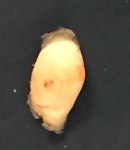
In addition to my excitement about my student’s cups, the scientists were excited about the samples brought up from the dive. A big Red Tree Coral sample was lying on deck. By its name you would think the coral is red. But it’s not. It’s kind of pinkish orange sherbet colored. It does look like a tree, though. The bottom of it looks like a young tree trunk. And it has rings like tree rings! According to Chief Scientist Rhian Waller, unlike tree growth rings, the rings aren’t indicative of yearly growth, but of growth due to abundance of food and living conditions.

Today, we steamed back toward Bartlett Cove. Bartlett Cove is the headquarters for the Glacier Bay National Park Rangers and the little town nearby is Gustavus. Gustavus has a population of 350 and the school has about 70 students. When we arrived in port, a sea otter greeted us, just hanging out. Eating while he floated on his back. He was noisily, crunching and smacking. Sea otters typically eat urchins, clams, and mussels. At one point he crawled out onto the dock to sun himself.

While in port, we had “open-ship” tours for the community of Gustavus. Scientists and ship’s crew took groups of ten through the Norseman II showing equipment, samples and answered questions. We were thrilled that about 65 people, including children with parents and grandparents, turned out and enjoyed learning about scientific research conducted in their Bay!

I rode into the little town of Gustavus with Ranger Sarah to drop Scientist Bob Stone off at the airstrip. Sarah drove us around on a tour. Gustavus is a beautiful little town with a gorgeous view of the Fairweather Mountain Range. One super cool thing that you can see in the Gustavus Public Library: an Orca skeleton hanging from the ceiling! Orca whales stay in Glacier Bay year round.

Orca skeleton in library 3-24
An orca skeleton hangs in the Gustavus Public Library

After the ship tours, the Park Rangers took us on a short walking tour around the visitor’s center. The National Park Service is partnering with the local Tlingit tribes in making this location once again a gathering place for them. They are building totem poles and a tribal meetinghouse designed by the tribal elders.

We learned that the Tlingit tribe lived in the area before the Bay was formed. It wasn’t yet a Bay because it was still covered in a giant glacier. The Tlingit still have songs and stories that tell of the glacier moving as fast as a dog running! So they hurriedly got in their canoes and fled to safety. As the glacier surged it destroyed their homes and scoured the land. They re-settled into places like nearby Hoonah, a native village across the way.

Before we left Bartlett Cove, everyone gathered with Qanuk and I on the dock sign for a photo with the winning banner designed by Scammon Bay 4th graders!

Mary Qanuk Banner on Ships Bow crop
Mary and Qanuk hold up the winning banner from Scammon Bay School


Now we’re all back on the ship and heading out to open waters. The glassy waters of the Bay are gone and it’s looking like a rough ride.

I already feel a bit queasy……

Rougher Water Headed to Open Waters crop


Personal Log

Since the ship’s work is ongoing 24-7, it seems that one day runs into the next because someone is always up and at work. And someone is always asleep in the stateroom. I’m amazed at how smoothly things work. Everyone pulls together to help each other and get the work done. If you think about it, there are LOTS of things going on. For example, the meals must be prepared and dishes washed. The science work must be done—scuba diving and processing during the day and ROV diving at night. The ship must be piloted and navigation is critical at all times. General housekeeping is always going on. It’s all an impressive operation and I’m happy to be here and hopefully a productive part of the team!

Mary Cook: Day 4 at Sea, March 22, 2016

NOAA Teacher at Sea
Mary Cook
Onboard R/V Norseman II
March 18-30, 2016

Mission: Deepwater Ecosystems of Glacier Bay National Park
Geographical Area of Cruise: Glacier Bay, Alaska
Date: Tuesday, March 22, 2016
Time: 7:40pm

Data from the Bridge
Temperature:
37.6°F
Pressure: 1013 millibars
Speed: 0.0 knots
Location: N 58°51.902’: W 137°04.737’

Science Log

Happy Birthday to Cheryl!

Cheryl small
This is Cheryl!

Unbeknownst to Cheryl, Chief Scientist Rhian Waller, even though she was very busy preparing for the cruise, brought balloons, streamers, candles, and noisemakers to celebrate Cheryl’s birthday today.

Birthday Decor small
Surprise Birthday Decor

The ship’s chef is secretly making her a cake. The celebration is slated for tonight at dinner. Shhhhh……

This morning, Chief Scientist Rhian Waller announced that we are steaming toward the end of the west arm of Glacier Bay to Johns Hopkins Glacier. This is a place where cruise ships take tourists in the Fall. But the Park Service has it closed during the Spring and Summertime because it’s a harbor seal nursery. The nightshift workers are trying to catch a few winks of sleep before we get there. No one wants to miss it. We are hoping for clear skies. Johns Hopkins Glacier is one of the few glaciers that is advancing instead of receding. As it advances, it is joining the Gilliman Glacier.

Park Service Map small
Map showing John Hopkins Glacier. Credit: National Park Service

It’s 10:30 am and we’ve arrived sooner than I expected. Johns Hopkins Glacier is really something to see! So massive. Once again everyone is out on deck taking pictures and oohing and aahing.

The glacier has shades of blue and white with streaks of brown and gray. It has a covering of white snow that looks like cake icing. The glassy water is a blue-green color with a multitude of icebergs floating in it. Bob Stone uses a term we all like—“bergy bits”—meaning small pieces of floating ice. He even brought some “bergy bits” onto the ship for us to add to our water or soft drinks. So refreshing!

This slideshow requires JavaScript.

While on deck taking pictures we hoped to see the glacier calve and fall into the sea. It sounds like thunder. We waited and we waited and finally a couple of small ones happened. Also, a couple of snow avalanches slid off the mountains into the water leaving dirty brown streaks along the slopes.

Avalanche medium
Occasional avalanches leave dirty streaks in the glacier’s white snow covering

Our scuba divers went down for another exploratory look and came up with a first! They found Primnoa pacifica in the West Arm! This is the first Primnoa pacifica ever found here. They described it as spindly and small in comparison to the others found in the East Arm.

The scuba divers continue their search for Red Tree Coral.

The significance of this Red Tree Coral being in the shallow water is that it has been considered a deep-water coral. There are two broad categories of coral: warm-water coral and cold-water coral. Generally, warm-water coral live in shallow, tropical waters. Cold-water coral live in deep water. The emergence of cold-water corals like Primnoa pacifica in the shallow waters of Glacier Bay has caused scientists to re-evaluate their understanding and descriptions of these organisms.

The third and last scuba dive for today was described as “mud, mud, and more mud”. A bit of a disappointment but they did bring up an interesting little critter.

Sea Peach small
Maybe a sea peach?

This sea peach is a tan color here in the wet lab, but according to Bob, in its natural habitat it has a bright cherry red color.

Cheryl Birthday Party large
Birthday party for Cheryl!

Well, it’s finally suppertime! That means “Birthday Party Time!” The ship’s chef, Harry served up a delicious meal of salmon, barbeque chicken, steamed kale, baked summer squash, scalloped potatoes and a big salad. For dessert, he prepared a layered chocolate cake with freshly made whipped cream and strawberries. Everyone sang “Happy Birthday” to Cheryl.

After she blew out the candles we went out on the deck and ate cake with new friends in the view of majestic mountains and glaciers.

Eating Cake on the Deck large

A birthday to remember, I’ll say.

Now it’s back to work and the ROV crew is getting ready to deploy Kraken 2 for another night of exploration!

Personal Log

Today has been a day of anticipation and inspiring wonder. I’ve tried to stay out on deck watching the glacier. Hoping for calving and avalanches. It’s really neat to me that no one else is here. We haven’t seen anyone else except four Park Service employees who boated out to meet us today. I found out that there are over 1,000 glaciers in Glacier Bay National Park! Some of them aren’t even named. I enjoyed watching a couple of bald eagles sitting on icebergs. And the absolute coolest thing has been the discovery of Primnoa pacifica in the West Arm of Glacier! I could feel the excitement in the air!

It’s so thrilling to be a part of this scientific exploration and to learn from these world-class researchers!

Mary Cook: Day 3 at Sea, March 21, 2016

NOAA Teacher at Sea
Mary Cook
Onboard R/V Norseman II
March 18-30, 2016

Mission: Deepwater Ecosystems of Glacier Bay National Park
Geographical Area of Cruise: Glacier Bay, Alaska
Date: Monday, March 21, 2016
Time: 7:54pm

Data from the Bridge
Temperature:
45.7°F
Pressure: 1007 millibars
Speed: 1.9 knots
Location: N 58°51.280’: W136°05.795’

Science Log

My Lab Work large
My lab work: a tray of Primnoa pacifica samples labeled and preserved for reproductive studies

Today, the coral processing continued for genetic, isotope, and reproductive studies, which has been very intensive for the last two days and nights. During the daylight hours, the divers collected samples of the coral in shallow water (30 meters) and during the nighttime hours ROV Kraken 2 collected the coral samples from the deep (210 meters).

Chief Scientist Rhian Waller tells me that the coral processing work will slow down for a few days because we are leaving the known sampling sites and heading into the unknown. Unknown territory for Primnoa pacifica, that is.

According to Rhian, the most important task today has been the completion of this collection series for Primnoa pacifica (Red Tree Coral). With both shallow and deep samples, geneticist Cheryl Morrison will be able to map the spreading patterns of the Red Tree Coral in Glacier Bay!

There were a total of four exploratory dives today. The divers are having a blast! They wore GoPro cameras on their helmets and used “underwater scooters” to go faster and farther during their dive time constraints. A scooter is a handheld engine with a propeller that pulls a diver behind it. Bob Stone describes it to be like sledding underwater!

In addition to the Red Tree Coral, they’ve brought up some really interesting specimens, which include sea stars, nudibranchs, shrimps-one very pregnant shrimp loaded with eggs, a polychaete worm, a bioluminescent ctenophore, sea pens, and sponges.

On one of the dive outings, they took Qanuk and sat him on an iceberg! It was a really beautiful blue iceberg. Blue icebergs have ice crystals that are more tightly packed therefore they reflect more blue light wavelengths than other colors of wavelengths.

Qanuk Sitting on Iceberg large

This evening, scientists are once again gathered around the monitor to see what the ROV Kraken 2 will discover. So far, we’ve seen crabs, goose barnacles feeding on plankton floating in the water, anemones, poacher sturgeon, sea cucumbers and moon snails. Sounds like a yummy salad, doesn’t it?

Personal Log

Today everyone settled into their jobs and it was a smooth operation. The scientists and crew are still brimming with excitement about the possibilities for this voyage. I was glad to get the intensive coral processing completed. Though it’s very important work, it’s tedious and repetitive. One very nice bi-product of working with the coral is the scent. Red Tree Coral smell like cucumbers! Also, we get to see all the other curious types of samples brought aboard such as glowing ctenophores and jumping shrimp! I’m getting to see so many things I’ve never seen before and it’s wonderful to have experts help explain everything. They are genuinely interested in sharing knowledge with me in hopes that I will take it back to the classroom for my students in Scammon Bay. Scammon Bay kids have become important to these world-class scientists! Another cool thing about these scientists, even though they are experts in their fields, they are also eager students for learning something new. Enthusiastic lifelong learners— what an inspiration!

All in all, it’s been a good day in Glacier Bay.


Mary Cook: Day 2 at Sea, March 20, 2016

NOAA Teacher at Sea
Mary Cook
Onboard R/V Norseman II
March 18-30, 2016

Mission: Deepwater Ecosystems of Glacier Bay National Park
Geographical Area of Cruise: Glacier Bay, Alaska
Date: Sunday, March 20, 2016
Time: 6:00pm

Data from the Bridge
Temperature:
38°F
Pressure: 1005 millibars
Speed: 0.3 knots
Location: N 59°02.491’ , W136°11.193’
Weather: Sunny with a few clouds

Science Log

Happy First Day of Spring!

Last night the remotely operated vehicle (ROV) Kraken2 dove and collected many samples of Primnoa pacifica (Red Tree Coral). The science crew excitedly gathered around the monitor to see what Kraken2 was “seeing”-lots of rocks, a few fish, a few shrimp, a few crabs, a couple of sponges, an octopus and lots of beautiful Red Tree Coral attached to the rock faces.

The ROV Kraken2 is run by a crew of engineers from the University of Connecticut and makes nighttime dives to deeper depths between 130 and 170 meters.

Today we busily processed the coral for genetics, isotopes, and reproduction studies to be conducted later by a series of scientists in various labs scattered across several states.


For the genetic samples, polyps (one individual) of coral are smashed onto special paper folders that contain a preservative. For the isotope samples, polyps are put into tiny vials then frozen. For the reproductive samples, an intact piece of coral is placed in a 15-milliliter tube and then submerged into formalin preservative. Later the formalin will be poured out and ethanol will be poured into the tubes. Preparing the reproductive samples is my job!

Three divers went down four different times collecting samples, all near White Thunder Ridge and Riggs Glacier in the eastern arm of Glacier Bay.

Riggs Glacier is showing numerous crevasses, which are usually snow-covered at this time of year. A crevasse is a big crack on the topside of the glacier.

As the evening approached, the ship steamed to the northernmost end of the East Arm where Muir Glacier was waiting to greet us. Muir Glacier is named for Naturalist John Muir who explored in Glacier Bay during the late 1800’s.

Muir Glacier was once a tidewater glacier at the water’s edge but in the last ten years has melted and receded back up into the valley.

The sky was clear and the snow-capped mountains and waterfalls were beautifully reflected in the still waters of the Bay. A gibbous moon rose over the mountain peaks just as the Sun was setting.

Personal Log

Today I learned how to process the samples for genetics, isotopes, and reproduction. My responsibility was to put a small branch of coral into a tube of Formalin. Labeling the tubes with place, depth, and species is important so the scientists as they begin working in the laboratory weeks later will know the source of the coral sample.

The Norseman ll as seen from the RHIB leaving for a dive outing
R/V Norseman II as seen from the RHIB (rigid hull inflatable boat) leaving for a dive outing

As we worked, Chief Scientist Rhian Waller came into the wet lab asking if anyone wanted to ride in the skiff, my heart started beating faster! I didn’t want to be pushy so I kept quiet. Then she said, “Mary would you like to go out on the skiff?” “Yes! I loved to go!” was my reply. I donned the Mustang suit, hardhat, and rubber boots. I grabbed Qanuk and went outside to load into the little RHIB, which had been lowered from the deck on to the water beside the ship’s hull. When everyone was ready, we motored closer to White Thunder Ridge. The diver’s entered the water and explored the region at about 70 feet deep. Meanwhile we waited for them and kept a watch on their bubbles rising to the surface. We used binoculars and viewed five fluffy mountain goats moving along the Ridge! It was cool to see the mountain goats but they were creating a “falling rocks” hazard for those of us down below. Our boat driver decided to move the RHIB away from the Ridge in order to avoid the rocks tumbling down into the water.

Later in the day, when the Norseman II got closer to Muir Glacier, almost everyone was on deck getting that perfect photo of the mountains reflected in the mirror-like waters of Glacier Bay. It was a remarkable scene!

This slideshow requires JavaScript.

So at the end a good day, I am feeling very thankful to be a witness to the scientific work in an effort to better understand this pristine wilderness.

Beverly Owens: What Is That? June 23, 2013

NOAA Teacher at Sea
Beverly Owens
Aboard NOAA Ship Henry B. Bigelow
June 10 – 24, 2013

Mission:  Deep-Sea Corals and Benthic Habitat: Ground-Truthing and Exploration in Deepwater Canyons off the Northeastern Coast of the U.S.
Geographical Area: Western North Atlantic
Date: June 23, 2013

Weather Data from the Bridge:
Air temperature: 17.23 oC (63.014 oF)
Wind Speed: 6 knots (6.90 mph)

Science and Technology Log:

We’ve seen amazing and beautiful animals living in these deep water canyons, many of which I did not recognize. During the progression of each tow I find myself asking the scientists around me, “What is that?” But that is what science is all about: being curious and trying to obtain the answers.

No matter how many hours I’ve sat on watch, or how many TowCam images I’ve looked at on the computer monitor, it’s still exciting to be one of the few people who get to see images directly from the ocean floor! It’s incredible that a large metal apparatus with a camera can send images and data thousands of meters through a tiny cable back to computers on the ship. As the pilots navigate TowCam through the water, images are sent back to the ship every 10 seconds.

Image Highlights taken using TowCam during the Canyons CSI research expedition.
Image highlights taken using TowCam during the Canyons CSI research expedition.

So what do we see in the images that are being sent back? I’ve gotten to see amazing things living more than a mile below the ocean. These include octopods and squids,  skates, sea pens, anemones, delicate brittle stars, bivalves, and lush colorful coral gardens. All these organisms live on the  bottom of the ocean in cold, dark water and under extreme amounts of pressure.

Morphology: The structure of a corallum.

How many different kinds of deep-sea corals are living at the bottom of the ocean? At least 71 species are known to occur  off the northeastern coast of the U.S.; and new species are likely to be discovered.  Many of the deep-sea corals look similar in color or structure. How do scientists tell them apart? They use taxonomic keys and DNA analysis to identify species.  Dichotomous keys are a systematic way of identifying organisms by making a series of choices based on an  organism’s characteristics. These keys are particularly useful if you don’t have instrumentation to conduct a DNA analysis.

Earlier this week, marine ecologist Dave Packer from NOAA’s National Marine Fisheries Service taught me how to use a dichotomous key for deep-sea corals. Corals are actually animals, even though many of them look plant-like in shape, so they belong in the Kingdom Animalia, the Phylum Cnidaria, and the Class Anthozoa. We began by discussing animals in the four Orders of deep-sea corals within the Anthozoa that are found off our northeastern coast: Scleractinia (stony corals), Antipatharia (black corals), Alcyonacea (soft corals and sea fans), and Pennatulacea (sea pens). Compare  the corals shown below. You will notice that each group has a different style or appearance.

The Four Orders of Corals.
The Four Orders of Corals

Even though corals appear to be morphologically simple animals, they are highly detailed. Individual corals can be very small. Look at the image to the left to become familiar with some of the structures. Below are some additional features that may be found on different types of corals.

Some additional features that may be found in corals.
Some additional features that may be found in corals

Mr. Packer showed me a piece of coral that we would be “keying out.”  By looking at the surface of it, we could tell it was a stony coral and belonged to the Order Scleractinia. Stony corals are usually very hard to the touch.  Then, we examined its characteristics. Look at the picture to the right, and see if you can identify the characteristics that we examined on this coral:

Try your hand at Taxonomy
  1. Is it solitary (grows alone) or is it colonial (grows with other coral polyps)?
  2. Are the septa (fins sticking out at the top) smooth or rough?
  3. Are the coral polyps only on one side, or scattered in a random pattern?
  4. Is the coenosteum (portion of the skeleton between the polyps that looks like tree branches) porous or smooth?
  5. Corals reproduce by “budding.” Do new corals bud inside an older coral (intratenticular) or are polyps added to the outside near older coral polyps?
  6. Does it have 24 septa?

Check your answers below to see if you got these questions correct!

Drum roll, please… This coral is Solenosmilia. Try pronouncing that one! Going through an actual dichotomous key requires answering many more questions and making more choices. Coral polyps and structures can be so small that often a microscope is necessary to look at some parts. Sometimes corals may look very similar, so DNA testing is conducted to confirm the identification.  Dichotomous keys can be used in identifying many other types of organisms as well, such as plants and fungi.

Want to try your hand at using a dichotomous key? Try this sweet activity using candy! Think about the characteristics of the candy pieces listed in the picture and key: Skittles, M & M’s, Gummy Bears, packaged Lemon Heads, unpackaged Lemon Heads, Dum Dum lollipops, Sugar Babies, Atomic Fireball, Mike and Ike’s, Tootsie Rolls, and Gobstoppers. What characteristics do they have in common? If you were going to sort them, how would you begin? We’re going to start with packaged versus unpackaged. Continue to follow along with the Candy Dichotomous Key until all the candy is sorted. How are the candy pieces similar? How do they differ?  You have now used  a dichotomous key to identify candy!

Candy Dichotomous Key (click to enlarge)

Check your answers to the Coral identification:

  1.  Colonial
  2. The septa are rough
  3. The coral polyps  appear to be randomly scattered
  4. The coenosteum is smooth
  5. These corals are intratenticular – notice how some appear to be budding off from one another.
  6. No.

    Beverly Owens, Teacher at Sea, with coral sample of Solenosmilia
    Beverly Owens, Teacher at Sea, with coral sample of Solenosmilia

Personal Log:

One of my favorite marine organisms is the starfish. We have seen many brittle stars during the course of our research expedition. There have been many large white brittle stars, and many tiny pink brittle stars that live symbiotically with certain corals.

Did You Know?

Corals are actually animals? They belong in the Kingdom Animalia. Corals can live colonially, with other coral animals, or can be solitary and develop alone.