NOAA Teacher at Sea
Jacob Tanenbaum Onboard NOAA Ship Miller Freeman June 1 – 30, 2006
Mission: Bering Sea Fisheries Research Geographic Region: Bering Sea Date: June 17, 2006
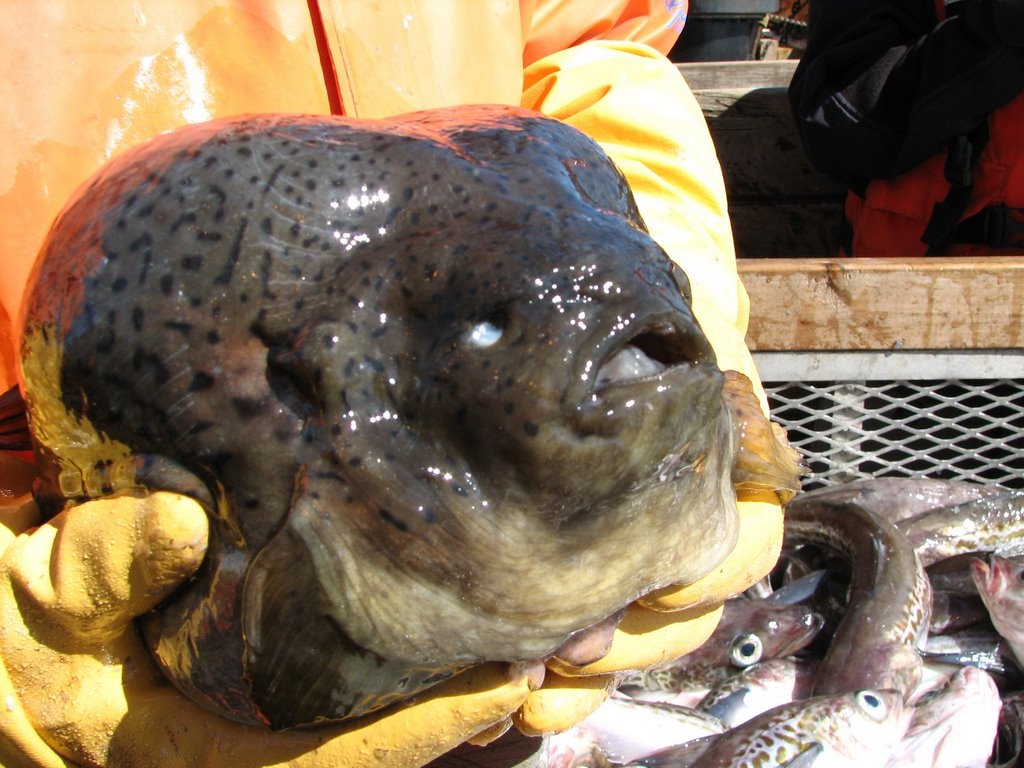
Smooth Lumpsucker fish.
Weather Data from the Bridge
Visibility: 14 miles
Wind Speed: 25 miles per hour
Sea Wave Height 7: feet
Water Temperature: 44.06 degrees
Air Temperature: 44.96 degrees
Pressure: 1009 Millibars
Personal Log
NOTE: We will arrive in the port of Dutch Harbor, Alaska on June 20. As the project draws to a close, I would like to evaluate how effective it was. There is a link to an electronic survey. I would like to ask students, teachers, parents, and other visitors to the site to take a few moments to let me know what you think of this idea. The survey is all electronic and only takes a minute or two to complete. Thank you in advance for your time. Click here to access the survey.
Well, we had pea soup for lunch today, also called storm soup by sailors. Legend is that when you serve pea soup, the weather will turn stormy, and sure enough, a gale is blowing nearby and the waves are picking up. The soup was great, though. As the ship rocks and rolls to the rhythm of the waves, lets take a closer look at how it moves. Sailors have lots of different terms for ships movement:
Pitch – refers to the up and down movement of the front, and back, or bow and stern of the ship
Yaw — when the ship spins from side to side.
Heave — When the entire ship moves up and down.
Roll — When the ship rocks from side to side.
Surge – When the ship jumps forward or backward.
Sway – When the ship jumps sideways.
Happy Father’s Day to all. A special hello to my own father, Elias, and my two son’s Nicky and Simon. I miss you, guys.
Science Log
Our trawl nets picked up the smooth lumpsucker fish near the bottom last night. This fish tends to say near the bottom and can inflate itself with water as a defense against predators. A good defense, I would say. Would you want to eat it?
Our survey continues. We brought in two hauls of fish this morning. Tamara is having less time on the bridge looking for birds in the last day or so. Her time is limited because we are fishing more and a large group of birds following a fishing net is not considered a natural occurrence, so she does not count them in her study. If the waves are too high, she cannot see the small birds in the troughs of the waves, so she can’t count during heavy seas, and right now, the seas are fairly heavy.
Question of the Day:
Look at the movements of the ship described above. When the ship drives into the wind and waves, sailors call it a corkscrew motion. Can you think why?
Answer to Yesterday’s Question
It is about 8:00 AM on Saturday morning. If the ship uses 2100 gallons of fuel a day, how many gallons of fuel will we need to get to Dutch Harbor on Tuesday Morning at about 8:00 AM?
It will take 3 days to reach Dutch Harbor. Since the ship uses 2100 gallons of fuel a day, we have to multiply 2100 x 3 which equals 6300 gallons of fuel. Enough for my car to drive 157500 miles. Wow.
Answers to Your Questions
NOAA Teacher at Sea
Jacob Tanenbaum Onboard NOAA Ship Miller Freeman June 1 – 30, 2006
Waves washing over the bow of NOAA Ship MILLER FREEMAN
Mission: Bering Sea Fisheries Research Geographic Region: Bering Sea Date: June 16, 2006
Weather Data from the Bridge
Visibility: 14 miles
Wind Speed: 27 miles per hour
Sea Wave Height: 7 feet
Water Temperature: 41.7 degrees
Air Temperature: 42.4 degrees
Pressure: 1013.8 Millibars
Plotting longitude and latitude
Personal Log
NOTE: We will arrive in the port of Dutch Harbor, Alaska on June 20. As the project draws to a close, I would like to evaluate how effective it was. There is a link to an electronic survey. I would like to ask students, teachers, parents, and other visitors to the site to take a few moments to let me know what you think of this idea. The survey is all electronic and only takes a minute or two to complete. Thank you in advance for your time. Click here to access the survey. How do you find your way around when you can’t see any land? I spent some time with Ensign Lindsey Vandenberg, on NOAA Ship MILLER FREEMAN.
Plotting longitude and latitude
Every 30 minutes or so, the bridge officers take a “fix” on their position. How do they do it? When they are out at sea, they take the latitude and longitude from the GPS and plot their exact position on a chart. A GPS is a machine that uses satellites to display the exact longitude and Latitude on a screen. The charts also have the latitude and longitudes written on them, but there is a problem. The longitude and latitudes scales on the chart are on the side and bottom of the chart, not where the ship is located. Every so often, there is a line across the entire chart. The navigator must use a tool, like the same compass you might use in math class, to mark the distance to the exact point on a scale from a line on the chart. She can then use the same tool to mark the distance in the part of the chart where we actually are. This must be done for both the longitude and latitude of the ship.
Ploting the bearing on a map
When we are near land, we can use Terrestrial Navigation. This means we can use the distance to an object on the shore, such as a lighthouse, to find out wherewe are. With a large ship close to shore, it is very important that we know exactly where we are so that we don’t wind up in shallow water. Ensign Vandenberg uses a tool called an alidade to help her. She puts the alidade over a large compass outside of the ship. The instrument reflects the compass into the viewer so she can see both the object on shore and the exact compass heading. If she takes a few bearings to objects on shore, she can use tools to chart her exact position on the chart.
Science Log:
I’ve been asking many of the people on the ship what becomes of the data that we are collecting. This survey will be used to set quotas for one of the most important fisheries in the world. Here is how it works. If too many fish are caught in an area, there will not be enough fish left for the species to come back the next year. That is bad for the fish, and bad for the fisherman. To prevent this “overfishing,”. A quota, or limit to the number of fish that can be safely caught, is established. Methods are put in place to make sure that all fishing boats in the area respect the quotas. Do you want to learn more? Take a look at this short video on the subject.
Question of the Day:
It is about 8:00 AM on Saturday morning. If the ship uses 2100 gallons of fuel a day, how many gallons of fuel will we need to get to Dutch Harbor on Tuesday Morning at about 8:00 AM?
Answers to Yesterday’s Question:
If our ship wants to do a trawl 50 meters below the surface, how much wire would it need.
The ship must put out two feet of wire for every one foot of depth. So you have to multiply 50 x 2 which gives 100 meters of wire. Each net has, not one, but three wires holding it to the ship. So you would need 3 wires. All three are 100 meters in length. That gives us 300 meters of wire to do our trawl.
Answers to Your Questions:
Hello to all who wrote today.
Colin, no seawater on the equipment yet. They have a couple of computers in the lab where we process fish that can be drenched with water and will still work. Maybe I need one of those.
Mrs. Z. Click here to see the route we have taken so far. I do not think it will give you exact miles, but you can get a good idea of our total.
NOAA Teacher at Sea
Jacob Tanenbaum Onboard NOAA Ship Miller Freeman June 1 – 30, 2006
Mission: Bering Sea Fisheries Research Geographic Region: Bering Sea Date: June 15, 2006
Holding up the catch
Weather Data from the Bridge
Visibility: 14 miles
Wind Speed:19.5 miles per hour
Sea Wave Height: 4 foot
Water Temperature: 44.4 degrees
Air Temperature: 44.2 degrees
Pressure: 1018.8 Millibars
Personal Log
I got to thinking the other day that the engines on this ship have been running since we left port almost two weeks ago now. I started to wonder how they could stay running for so long and so I decided to ask Chief Engineer Steve Bus to tell me more about them. So put on your ear protection, and lets go to the engine room. The engine room on NOAA Ship MILLER FREEMAN is like a small city below the deck. In addition to the 2100 horsepower diesel engine that moves the ship forward, there are generators sufficient to power a small town. A research vessel, after all, needs a lot of electricity to run all the electronics we need. In addition, the engine room has equipment to make it’s own drinking water out of sea water. We cannot drink sea water because it has too much salt for our bodies to handle. The machines in the engine room take the salt out of the water and, clean it, and make it possible for us to drink it.
There are boilers to heat water and make steam to keep the ship warm. There are also machines that process waste water. Finally, there is shaft alley. This is the part of the engine room where a long metal shaft connects the diesel engine to the propeller. Take a look at this video to see shaft alley. The ship burns 2100 to 2200 gallons of fuel on an average day. Who keeps it all running? Chief Engineer Steve Bus and his crew. They are responsible for the ship from bow to stern.
How do you prepare for an emergency at sea? The same way you do in school. By drilling over and over. Today, we had a fire drill where the some of the crew got into firefighting gear and practiced what they would do in an actual emergency. Want to come along? Click here for a video.
Science Log
We had some interesting returns on the echosounder this morning. Take a look at the screen. You can clearly see the top and bottom of the water column. You can clearly see the different groups of fish. The echosounders can tell us so much information. When we put the nets down near the surface, we knew exactly what to expect. We did a trawl along the bottom of the sea floor last night and brought up some of the most interesting creatures I’ve ever seen. Here are a few.
This is a basket star, a kind of sea star. Its branches are hard and are divided into many different branches. The basket star uses all of these to catch plankton. In the center is the mouth.
Next, we have a lyre crab. Have you ever seen a hermit crab without a shell? This one lost his on the way up from the bottom.
This next photo includes a huge sea star, a sea urchin, a hermit crab without its shell, a tanner crab and several fish called poachers. These fish have scales that are hard, almost like bone or a shell. This last one is my personal favorite. The fish at the top of the screen is called a big mouthed sculpin. It has the biggest mouth of any fish I’ve ever seen. This fish stays on the bottom waiting for smaller fish to come by, and then… watch out! When it came up in the net, it had a smaller fish in its mouth.
Finally, we brought up a creature called a brittle star. It is a kind of sea star with soft tentacles. It moves very fast for a sea star. The arms can break easily, but don’t worry, they grow back. That’s why they call it a brittle star. Here is a video of a brittle star moving across the lab table.
Later on the same day, our ship was visited by some dall’s porpoises. Click here for a video
Question of the Day
Look at the answer to yesterday’s question. Let’s try another one. If our ship wants to do a trawl 50 meters below the surface, how much wire would it need.
Answer to Yesterday’s Question
How much wire would the ship need to let out if it wanted to put the nets 200 feet below the surface? Make sure to watch the video on nets before you try to answer the question.
The ship must put out two feet of wire for every one foot of depth. So you have to multiply 200 x 2 which gives 400 feet of wire. Wait, we are not finished yet. Each net has, not one, but three wires holding it to the ship. So you would need 3 wires. All three are 400 feet in length. That gives us 1200 feet of wire to do our trawl.
Answers to Your Questions
Hello to all who wrote today.
The MILLER FREEMAN does seem like home to me now. I have gotten used to the constant rocking of the ship and the routines of the day. I really enjoy being at sea. By the way, they had pizza for lunch, but I asked the cook to make me some fresh pollock that we caught and filleted last night.
Do people eat jellyfish? I asked our chief cook, Mr. Van Dyke. He told me many species of jellyfish are poisonous. Even those that are safe to touch with your hands. So, no, we don’t’ eat them here, but in some countries they do. We have caught many tons of fish, but more importantly, we have seen many fish without catching them using our echosounder. This device allows us to survey fish without capturing so many.
There are 34 people on board with us for this cruise. That will change next week when we get to port.
The squid felt slimy, but not much more slimy than most fish seem. I don’t recall it spraying anything.
NOAA Teacher at Sea
Jacob Tanenbaum Onboard NOAA Ship Miller Freeman June 1 – 30, 2006
Mission: Bering Sea Fisheries Research Geographic Region: Bering Sea Date: June 14, 2006
Orca off the port beam.
Weather Data from the Bridge
Visibility: 14 miles
Wind Speed:14 miles per hour
Sea Wave Height: 3 foot
Water Temperature: 5.3 degrees
Air Temperature: 6.2 degrees
Pressure: 1018 Millibars
Personal Log
The coffee pot. See the ring to keep the coffee from flying when the seas get rough?
A lot of you have been asking about the food on ship. How do we eat? What do we eat? Where do we get our food. All of these are great questions, so yesterday I spent some time with Chief Cook Russell Van Dyke to get some answers for you. He, along with the Chief Steward and the Second Cook, is responsible for preparing all the meals on NOAA Ship MILLER FREEMAN.
How do people eat on a ship? “With a knife and fork,” said our chief cook with a smile. Food is prepared and served on the ship in much the same way that you prepare and serve food athome. The main difference is quantity. Here on the ship, food is prepared for 40 people instead of just a few. “We don’t cook one, chicken, like you do at home,” said Mr. Van Dyke, “we cook 5 chickens. Here are some pictures of where the food is cooked, and where the food is served. On a ship, this is called the galley. Can you see the ring around the coffee pot? Can you guess what that is for? During storms at sea, when the waves are high, that ring keeps hot coffee from flying around the galley. Good idea!
Chief Cook Russell Van Dyke
Another interesting difference between food on a ship and food at home is that when you are out to see for a month, you cannot run down to the corner to get some milk if you run out. Each time NOAA Ship MILLER FREEMAN is in port, it must take on enough food to last for the entire journey to come. How do they keep all that food? Aside from being a great cook, Mr. Van Dyke and the rest of the crew are also experts in how to store food and keep it from going bad. NOAA Ship MILLER FREEMAN has not one but three refrigerators and two freezers. The refrigerators are kept at slightly different temperatures. The dairy products, like milk and cheese are kept at 37 degrees . The fruits and vegetables are kept in a separate refrigerator at 42 degrees. They keep the humidity in that refrigerator higher as well. Those slightly different conditions help keep the food fresh for a longer period. Meats and ice cream are kept frozen. Dry foods, like cereal are kept in a separate area. Put it all together and the crew on board eat great meals every day. The photo here shows the inside of one of the refrigerators.
Click below to listen to Chief Cook Russell Van Dyke describe cooking on board a ship:
One more question: Does the crew eat split pea soup? There is a superstition among mariners that cooking split pea soup will bring on a storm. I asked Mr. Van Dyke about it. He told me they eat it all the time. This brave crew last had “storm soup” on May 27th and we may have it again in a few days. I guess the only thing they can’t do on board this ship at sea is have a pizza delivered.
The inside of one of the refrigerators. Look how big it is.
Science Log
We continue surveying pollock and surveying birds as we move along the transact lines in the Bering Sea. Most of the surveying is being done with the echosounder, but from time to time, we put the nets into the water and trawl for fish. This helps the scientists know more detail about the fish they see on the echosounders. The nets on NOAA Ship MILLER FREEMAN work basically the same way that nets on large commercial trawlers work. We just catch far fewer fish. Would you like to learn more? Click here for a video on the nets.
The Galley where the crew eat
Question of the Day:
How much wire would the ship need to let out if it wanted to put the nets 200 feet below the surface? Make sure to watch the video on nets before you try to answer the question.
Answer to Yesterday’s Question:
Look at the speed of the ship on this website: About how far would it go in 24 hours? To get your answer, you should multiply the speed you see by 24. Remember to express your answer in nautical m iles. At the moment, the ship is going about 12 nautical miles per hour. At that speed it will travel about 288 miles per day. The real figure will vary because of winds and currents that effect our speed, and because we sometimes stop to fish.
Rusty, the ships cat and Teacher at Sea Jacob Tanenbaum
Answers to Your Questions:
I also had an email request from Marcelo for photos with Rusty and I. Here is one. I’m also putting a second photo on to show you one of Rusty’s favorite games. There is a mail slot in the door to the office where he spends a good part of his day. He loves to stick his paw through and introduce himself to passersby. Surprise!!
Mrs. McBride, thanks for your kind words.
To my Kindergarten friend, was the squid slimy? YES!!! 🙂
Crewmembers retrieve a marine mammal listening device from the water.
Weather Data
Latitude: 57, 37, 50 North
Longitude: 156, 02, 34
West Visibility: 8 Nautical Miles
Wind Direction: 161 Degrees
Wind Speed: 17 Knots
Sea Wave Height: 4-5 Feet
Swell Wave Height: 4-6 Feet
Sea Water Temperature: 4 Degrees C
Sea Level Pressure: 1001.5
Cloud Cover: Partly Cloudy
Science and Technology Log
Marine Mammal Listening Device
Earlier, a marine mammal listening device scheduled for recovery could not be picked up because the instrument responded to signals and released from its anchor, but it did not rise to the surface for recovery. You may remember the theory was that it was stuck in the mud which prevented it from rising. Well, things changed on the second effort to pick up one of these devices. This one popped to the surface and is now onboard the ship. The data and sounds recorded will be of great interest to scientists at the Scripps Institution of Oceanography.
Crewmembers deploy bongo nets.
A couple of days ago, I sent some photos of brittle stars, bivalves, barnacles and worms that had gathered on a mooring that had been 200 meters deep in the Bering Sea for about a year. Were you as impressed with all the life forms as I was?
I expected to see life forms on the marine mammal listening device because it had also been beneath the water for 1 year. You may be surprised to learn that there was almost nothing on the surface of the entire instrument! Would you like to take an educated guess as to the reason for the lack of life on this mooring? You would be correct if you noted that this one was deployed at a deeper depth. In fact, this one was 1,800 meters deep. The role of the sun in starting the process of photosynthesis to feed all life is pretty impressive isn’t it? I hope this example helps you even more appreciate the role of penetration of sunlight into the water as a huge factor in ocean food chains.
Bongo Tows
Four bongo shaped nets were lowered into the water this morning to catch zooplankton. Two of the nets had a 60centimeter diameter and 133micron holes in them. This means that anything smaller than 133 microns simply passes through the net and is not collected. Lots of phytoplankton fall into this category and are not collected.
Mr. Jenkins displays a sample of zooplankton
Two more nets had 20-centimeter diameter openings and nets which had 153-micron holes in them. Can you see that these nets are set up to catch smaller plankton species? All nets were lowered to the bottom by a winch until they were 10 meters from the bottom. The nets are then pulled up to the surface by a winch at a rate of 20 meters per minute. All organisms are collected in a cylinder attached to the base of the net. The cylinders are removed from the nets, taken into the laboratory where they are put into bottles. The bottles are then sent to a lab in Poland where technicians use microscopes to identify the species, and the number of each species, in each sample.
Today’s specimens had a lot of organisms visible to the naked eye. I will be forwarding a photo in which you may be able to make out some specimens. There were a few fish larva and even some squid larva. Have you noticed that rivers around Virginia tend to have a greenish hue once algae populations begin to grow in the summer? Well, this process also happens in the Bering Sea. The size of the mesh on bongo nets is adjusted during the summer months because a larger amount of algae growing in the water tends to be picked up. These algae may even clog a net if too much is collected. What can be determined by the small specimens collected in the bongo nets? For starters, finding a lot of zooplankton means that larger species are going to have more to eat. This could mean healthier populations and better fishing. Eggs of fish collected in the tows give an indication of the future of fish populations. More eggs may mean more fish.
Our friend, the Walleye Pollock’s, eggs soon turn to a larval form before developing into small fish. The larva of the Walleye Pollock have small ear bones called otoliths. These ear bones have growth rings in them which are similar to growth rings in trees. It is possible to determine the age of Pollock larva to the number of days by examining and counting the rings in its ear! Knowing the age and number of larva in the water can be extremely helpful in predicting the number of fish that are likely to be available for harvest in the future.
Crab Classic contains “Surimi Crab.”
Argos Apex Drifters
Two instruments have been dropped into the water and they are probably not going to be recovered. In fact there will be no effort to recover them!
The first of these long yellow cylinders with satellite transmitters on the top was dropped into the water yesterday. At first, the instrument simply sat horizontally on the surface of the sea until it picked up a signal from a satellite in orbit. When the signal was received by the Argos Drifter, the instrument filled a bladder with water causing it to sit upright and sink into the sea. The instrument descends to depths of up to 2,800 meters. It then rises slowly to the surface, all the time collecting data on salinity. Upon reaching the surface, the instrument transmits all its data to the satellite. After transmission, the instrument dives again and repeats this process of collecting data for 8 or 9 months.
Plans are to have 3,000 or more of these instruments in the water of all the world’s seas collecting data. Do you think that this is an improvement on having to actually travel to a particular site to collect salinity data?
Personal Log
E-mails from home tell me of balmy warm weather and spring plants coming out in profusion. Conditions are a little different here today. Hands went back into pockets so that my they would not be made so inflexible by the cold that I could not use a pencil well to keep records when working on the deck this morning. A winter coat and felt liners in my boots felt wonderful. Do you think I may have some adjusting to do when I return to springtime in Virginia?
Several of you have asked about stars. It is getting dark rather late here, so I woke up the last couple of nights at 1:00 AM to take a walk on the deck to enjoy the stars. The weather has been pretty cloudy, so I could only see two stars as I walked around the deck. You would have appreciated the flat blackness of the sky, however. I can imagine the stars being quite radiant on a clear night. I will keep looking and let you know what I see.
Surimi Crab sandwiches were on the menu for lunch today. Being a big fan of the Chesapeake Blue Crab, I ordered a sandwich and found it delicious. After lunch, I went back to the kitchen to ask Chief Steward, Russell Van Dyke, to tell me about the Surimi crab. I was surprised to find out that there is no such thing as a Surimi Crab!
Russell was good enough to go down to the freezer to get a bag of Surimi Crab so that I could look at it. I discovered that the package contained only 20% of a crab product.
Now for the question of the day: What makes up the other 80% of Surimi Crab?