Spencer Cody: Of Geology, Time, and Ice, June 2, 2016

NOAA Teacher at Sea
Spencer Cody
Onboard the NOAA Ship Fairweather
May 29 – June 17, 2016

Mission:  Hydrographic Survey
Geographical Area of the Cruise:  along the coast of Alaska
Date: June 2, 2016
Observational Data:
Latitude:  58˚ 17.882′ N
Longitude:  134˚ 24.759′ W

Weather Data from the Bridge:  
Air Temp: 16˚C (61˚F)
Water Temp: 8.9˚C (48˚F)
Ocean Depth:  9.7 m (31.8 ft. at low tide)
Relative Humidity:  56%
Wind Speed:  18 kts (21 mph)
Barometer:  1,006 hPa (1,006 mbar)


Science and Technology Log: After a full day of flying, I arrived in Juneau, Alaska, on Sunday.  The Fairweather came into dock early the next morning to host a very special occasion for friends, family, and the public.  It was a Dependents Day Cruise to go with the Memorial Day celebration.  It was an opportunity for those

151_3083 (2)
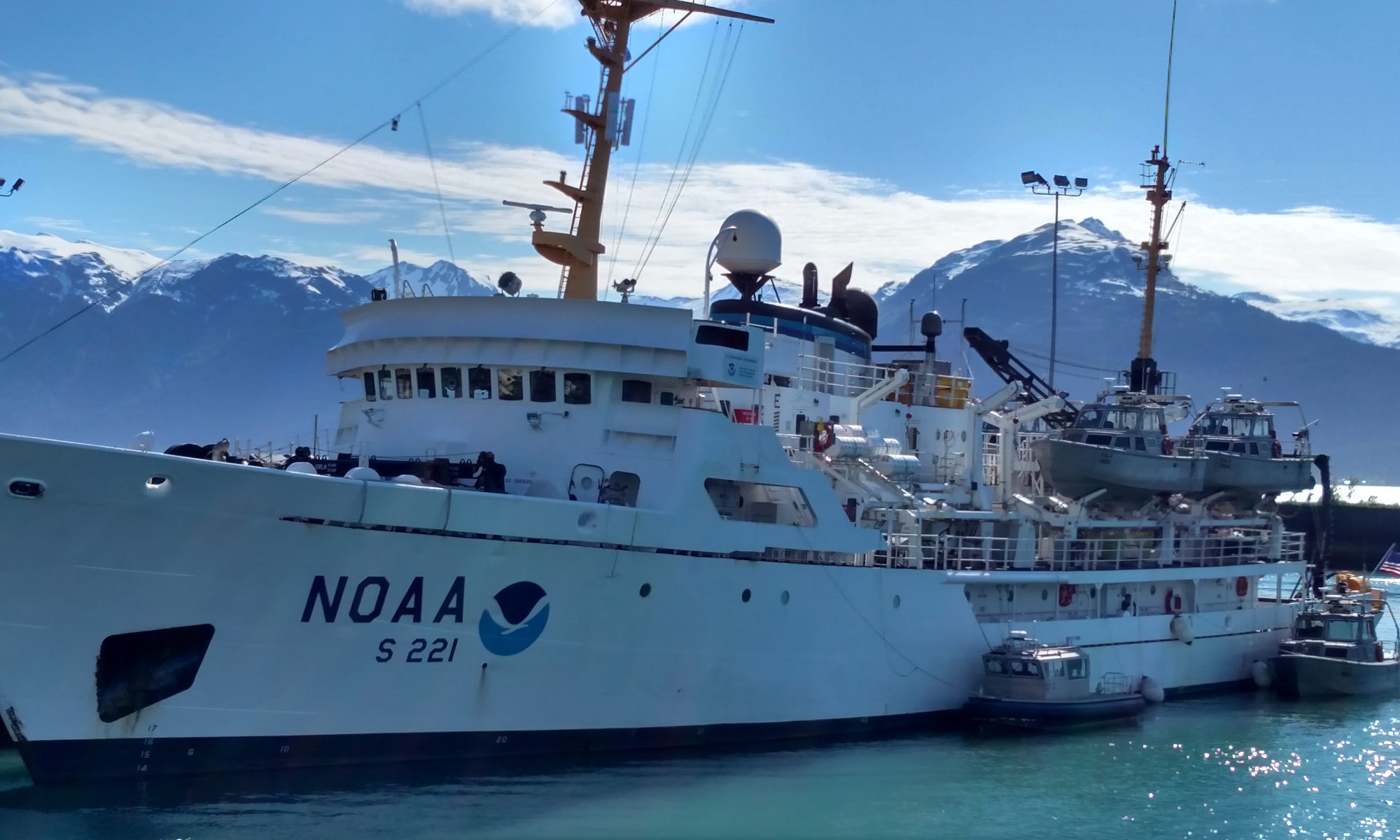
The NOAA Ship Fairweather in the bottom center docked in Juneau, Alaska, preparing for her next hydrographic leg.

who work onboard the Fairweather to show others outside of NOAA what they do while the crew, friends, family, and guests sailed onboard to the Taku glacier in Taku Inlet and back to dock in Juneau.  The day was filled with demonstrations on what the crew does in order to complete their missions and the significance of having a ship such as the Fairweather fulfill its assigned tasks.  We were split up into multiple groups in order to cover the basics of ship operations and the science and research carried out by the crew.  Guests were treated to demonstrations of bridge operations, hydrographic survey techniques and equipment, dive operations and control station demonstrations.  One highlight of the many demonstrations that were carried out

150_2900 (3)
The crew demonstrate a launch and retrieval of one of the hydrographic survey launches.  The Fairweather has four of these 28′ boats including three additional boats for fast rescue and utility purposes.

was the showing of how the launch boats are lowered into the water and then retrieved.  The Fairweather was maneuvered in such a way that the launch boat was provided a small patch of sea that was calm, a “duck pond,” by blocking the oncoming waves for the launch boat.  While this was not necessary for the weather that day, it did drive home the point about the many ingenious methods that must be employed in carrying out day-to-day operations on a vessel like the Fairweather.  By the time these demonstrations and tours were concluded, we had arrived at the Taku Inlet to see the Taku glacier.

Seeing something that is massive enough to carve solid rock such as the Taku glacier was awe inspiring.  This brings us to one of the key reasons for the complexity of the local geology and the sea channels that the Fairweather will be mapping on the next leg.  After periods of uplift and mountain building, the terrain was recently sculpted with rivers of ice flowing outward to lower sea levels from the ice fields above.  Glaciers encapsulated much of Southeastern Alaska up until the Wisconsin glaciation came to an end about 14,000 years ago.  During this same time, the Laurentide continental glacier still covered much of East River South Dakota.  As the glaciers receded, the ocean levels rose to accommodate the global deluge of melt water.  What was once

150_2940 (2)
The Taku glacier at the end of Taku Inlet displays the forces of erosion at a remarkable scale.

glaciated land is now well below sea level.  Since glaciers have a remarkable power of erosion, U-shaped valleys have been carved throughout this region.  Where these valleys dip below sea level, they frequently end up becoming important bays or passageways for commercial and private traffic.  Glaciation has also given these passageways some unique characteristics that makes having reliable navigation mapping critical.  Many of the navigable passageways in Southeastern Alaska are your characteristic fjords.  They have been carved deeply by the weight of hundreds or even thousands of feet of ice; yet, they are usually narrow with valley walls that run vertically straight into the air.  This topography largely continues below sea level meaning that in many locations the passageways, straits, and canals formed by glacial action can quickly deviate from hundreds of feet deep to shoals in a matter of very short distances.  The complexity and potential hazards of these fjords is enhanced through the process of glacial isostatic adjustment when the earth shifts back upward after the massive weight of a glacier subsides.  Take these relatively recent geological and climatological

150_3025 (2)
Much of the rock of the area shows obvious signs of glacial action scouring across the landscape such as this rock near the Mendenhall glacier outside of Juneau.

processes and apply them to the complex system of islands of the Alexander Archipelago that was formed through shifting transform boundaries between the North American and Pacific plates.  Now one can start to appreciate the degree to which timely mapping is needed for this part of the world requiring precision and accuracy in order to provide nautical charts that cater to the needs of growing commercial and private interests in the area.


Personal Log:

Dear Mr. Cody,

We boarded our ship in San Francisco and cruised under the Golden Gate Bridge passing by Alcatraz Island.  At sea I had the chance to tour the ship.  It is huge!  It holds 1,800 passengers and has a crew of 932.  I am still learning how to get around the ship.  It is like a little city on the ocean.  (Dillion is one of my science students who went on an Alaska cruise with his family in May and will be corresponding with me about his experiences as I blog about my experiences on the Fairweather.)

20160508_085804 (2)
Dillion finally at sea en route to his first stop in Alaska.

Dear Dillion,

I boarded the Fairweather the day after I arrived in Juneau.  I, too, am still learning my way around the ship and learning the names of the crew.  Everyone on the crew has been very helpful in helping me find my way around the ship and learning about what they do to make the Fairweather’s mission successful.  The Fairweather is designed to hold more than 50 crew members consisting of NOAA Corps officers, engineers, deck, survey, stewards, and electronic technicians.  While your cruise ship is built for comfort for vacationers, the Fairweather is built for utility and efficiency in accomplishing a wide range of tasks.  Though the Fairweather’s primary role is to carry out hydrographic mapping of the sea floor in order to provide reliable navigation charts and increase our understanding of the ocean floor, the ship’s crew has been involved in numerous other projects in just the last year including launching wave and weather monitoring buoys, contributing data to surveys tracking changing climate in the Arctic, participating in marine

WIN_20160602_173414 (2)
Unpacking and settling into my stateroom aboard the Fairweather.

mammal observations and new marine mammal survey techniques, carrying out phytoplankton tows, aiding the Navy in glider development, mapping nautical obstructions, and retrieving climate and ocean sensors.


Did You Know?

The Fairweather was launched in 1967 and named after Mount Fairweather in Alaska.  She was constructed along with two other sister ships, the Rainier, in service, and the Mount Mitchell, retired from NOAA service.  All three ships were named after tall mountains in the United States.

Can You Guess What This Is?

152_3230 (2)

A. a vent   B. a speaking tube   C. a horn   D. a periscope

The answer will be provided in the next post!

Donna Knutson: TAS 2, June 1, 2016

 NOAA Teacher at Sea
Donna Knutson
Onboard R/V Hugh R. Sharp
June 8-24, 2016

Mission: Atlantic Scallop/Benthic Habitat Survey
Geographical Area of Cruise: Northeastern U.S. Atlantic Coast
Date: June 1, 2016

School is almost done for another year.  It is amazing how time goes by so quickly.  Then off to another adventure. Teacher at Sea again!  How fortunate I am to be involved in another incredible learning opportunity! The NOAA Teacher at Sea program has provided me with the most unique professional development of my career.  As a TAS I am allowed to join a team of scientists and learn first hand what it takes to “do” science.  I am already anticipating what it will be like to return to class in the fall with my new experiences to share.  TAS really does breathe life into a science teacher and her classroom even after 27 years of teaching!  I better go finish packing!!

TAS Donna Knutson Sette 2010
TAS Donna Knutson sailed on NOAA Ship Oscar Elton Sette in 2010

Denise Harrington: Saying Farewell To NOAA Ship Pisces and the Pacscagoula Lab, May 12, 2016

NOAA Teacher at Sea
Denise Harrington
Aboard NOAA Ship Pisces (In Port)
May 04, 2016 – May 12, 2016

“Gross!”

“Is that an eyeball in its stomach?”

“Can I touch it?”


This slideshow requires JavaScript.


I hear the inquiry skills of tomorrow’s scientists develop under the guidance of Fisheries Biologists Lisa Jones and Christian Jones during a recent shark dissection at the Pascagoula, Mississippi Laboratories of NOAA’s Southeast Fisheries Science Center. The NOAA mission of “Science, Service, and Stewardship” is taken very seriously as fishery biologists work with students of all ages to learn about our natural resources and how to understand and manage them wisely. But NOAA Fisheries doesn’t just educate people about science, they do research, provide national data collection, collaborate with other scientists, help make everything from nets to policies to help manage our scarce resources, and even sniff our fish to make sure it is safe to eat.

Science

Developing scientific methods to answer questions that can only be answered by collecting data, science, is the first of NOAA’s three part mission.  Kevin Rademacher, a Fisheries Biologist, uses his understanding of scientific inquiry and standardized data collection to inspire students.  He encourages students to consider characteristics, purpose, and habitat to expand their inquiry when they ask questions like why one shell spiky and the other one is smooth.

P1060167
Kevin shows students the head of an Atlantic cutlassfish.

Kevin’s deep understanding of the diversity of life in the Gulf of Mexico is obvious as he inspires students from nearby Pascagoula, and as far away as Tillamook, Oregon to learn more about the ocean and its inhabitants.

Stewardship

While Kevin, Christian and Lisa teach science, other students head outside to learn about stewardship. Stewardship, using sound science to protect and manage people and resources, is another component of NOAA’s mission. The Harvesting Systems Unit helps develop and test more efficient and environmentally friendly gear used to catch fish and other seafood.  For example, fishermen are happy to let other marine species like sea turtles escape from nets, leaving more room for the shrimp they are trying to catch and helping sea turtles at the same time.

Provide national fisheries gear engineering support in the development, fishery-dependent assessment and implementation of more efficient and environmentally friendly fishing gear;

P1050593
Here, Fisheries Methods and Equipment Specialist Warren Brown builds and makes changes to a Turtle Excluder Device using generations of family history in the shrimp trawling industry to guide his work.

By 1978, all five species of sea turtles in the northern Gulf of Mexico were on endangered or threatened species list, in no small part because of shrimp trawling methods.  Sea turtles, who need to take a breath of air at least every 55 minutes, would get caught in the nets and die.  NOAA responded to this problem by designing new equipment and gear meant to decrease the amount of by-catch, or other living things, shrimp trawlers and fisherman pulled up in their nets. A Turtle Excluder Device, or TED, allows sea turtles to escape from shrimp nets. Learn more about sea turtles and what you can do to help them through NOAA’s great educational resources.

ted
This sea turtle is escaping from a bottom opening TED!        Photo Credit: NOAA

Andre DeBose, Fisheries Biologist, educates, inspires, and engages students of all ages as they learn what it feels like to be an endangered sea turtle crawling out of a shrimp net through the TED.

P1060184
Andre DeBose shows students each component of the TED, how it was designed and how it works.


Service

The three components of NOAAs service, science, and stewardship mission are inseparable. While most scientists work in the field or educate others, the scientists in National Seafood Inspection Laboratory (NSIL) use good science to make sure the seafood we eat is good.

IMG_0115
Angela Ruple wears protective glasses to make sure the germs that grow in these petri dishes don’t get in her eyes!

Angela Ruple is the Lead Analyst at NSIL, keeping a close protected eye on any seafood that is tested for hazards like Salmonella and chemical contaminants.  She works with other government agencies and encourages food safety education programs such as the Partnership for Food Safety Education’s FightBac program, which uses fun games and other tools, to educate us about food hazards like bacteria.

Shannara Lynn is one of NOAA’s seafood detectives.  Untrustworthy seafood dealers may sell fish that are easy to catch as more expensive fish.  They will take a piece of less expensive ray or shark and pretend it is a scallop. But each species of fish has DNA and protein markers that make them unique.  Looking at proteins, Shannara can run 72 fish in 1 day to see if they match their label, but only 8 fish in 2 days using DNA analysis.  So, stores like Kroger, with lots of fish to test, might want to screen with protein banding first to make sure they aren’t getting hoodwinked.

P1060196
This graph I made is similar to the ones Shannara uses on the computer.  A shark (red line) has three characteristic protein peaks above the 500 unit line. The blue line represents a different species of fish. No match!

Cheryl Lassitter, Lead Chemist at NSIL, (pictured below) combined her mathematical, technological, and scientific skills, to make a library that makes the protein identification of each fish easy to find in a computer program.

All senses are used at NOAA’s Seafood Inspection Program (SIP) to test fish.  Susan Linn, Approving Officer for SIP, travels around the nation to teach seafood inspection testers to use the same vocabulary and methods when testing fish with their noses.  If it smells like “dirty socks,” it’s gone bad.

susan sniffing fish
Susan sniffs a salmon for freshness.  Photo courtesy of Kevin Rademacher.

Patience and Tenacity

Patience and tenacity do not start with an “S,” but these two life skills are what fuel the “Science, Service, and Stewardship,” three part mission of NOAA aboard the Pisces.

When told there was a problem that would delay our departure, I asked to “see it.” What I learned over the next ten days is that science requires precision, complex tools, experts working in teams, and lots of money.  Brent Jones, Chief Engineer and Augmenter William Osborn, showed patience and tenacity as they helped me understand some of the unique features of the power system for the Pisces.

CLICK ON PICTURES BELOW TO MAKE THEM BIGGER AND TO READ ABOUT PARTS OF THE POWER SYSTEM.


For fisheries science, the boat has to be quiet in the water.  A simple diesel engine would have been easy to fix, but would scare away many of the fish that scientists are trying to study. Second graders use their “fox feet” in our outdoor classroom, and Pisces scientists use a stealthy diesel electric engine, to sneak up on their specimens.   The unique ship requires experts capable of finding problems in a maze of technology without major calamity.

Once again, the more questions I asked, the more questions I had.  The problems were in the SCR drives, behind big gray panels.  Diodes convert AC power to DC power and the SCR drives smooth out and clean up the pulses of power.

P1060209
How fortunate I was to meet Eric Richards, from VT Halter Marine, who built Pisces and  drew this block diagram, and gave me a builder’s perspective on how the ship operates.

Somewhere in a room of grey closets filled with live wires, pulsing with 600 volts of electricity, was the problem that kept Pisces from sailing.  As long as I worked as a Teacher in Port, the problem hid like a second grader after the recess whistle blew.

P1050806
Here Chief Engineer Brent Jones, “Chief,” sensing my desire to get my hands on the problem, tells me to stay away from the SCR drives. Photo credit: William Osborn

The Reef Fish Survey has four parts or legs.  During the first leg, the motor died a couple times while at sea.  Fortunately, the crew was able to shut down the engine and restart it.  If something like this happened when pulling into a tight space, the ramifications could be scary.

P1050599
Commanding Officer, Commander William Mowitt, Field Party Chief Scientist Kevin Rademacher, and Junior Officer Nathan Gilliam have one of many brainstorming meetings as they figure out how to tackle mechanical problems and reschedule surveys, so that they can collect the scientific data needed to complete the Reef Fish Survey on time.

Experts took a systematic approach to solving the intermittent problem, complicated by a limited budget, with equanimity. Yet they could not solve the problem fast enough to go on leg two or three of the survey. Now, Kevin Rademacher, the Field Party Chief Scientist has to negotiate other ways to collect the data required for the last two legs of the survey. Junior Officer Nathan Gillman summed it up as follows, “with science, nothing goes according to plan, but it gets done.”

Personal Log

While Pisces ultimately never left port, I imagine that I learned a broader scope of the role NOAA plays in protecting and managing our ocean resources on land than I would have at sea. Thank you, Kevin Rademacher, for showing me the port side of NOAA while juggling a crazy, changing schedule, and teaching me about many intriguing aspects of fisheries science. I also send a big thank you to the scientists in the lab who have inspired me to continue asking curious questions, and to encourage students to embrace science and technology. Thanks to the ship engineers who showed me how the ship works, and sometimes doesn’t. Thank you Keigm and Eric Richards, for showing me the path less traveled.

Thank you to Daeh Kujak, Second Grade Teacher, Karen Thenell, Principal, South Prairie Elementary, and our superintendent Randy Schild for being so flexible and supportive, allowing me to become inspired, ocean literate, and an advocate for our limited natural resources. Thank you TAS administrators for creating a life changing program that inspires teachers and students by getting us out in the field with scientists. It takes the whole team to manage our limited ocean resources, and to educate our leaders of tomorrow.  Thanks to the team, I can see the significant, beneficial difference in how I learn and teach.

Dana Chu: May 17, 2016

NOAA Teacher at Sea
Dana Chu
On Board NOAA Ship Bell M. Shimada
May 13 – 22, 2016

Mission: Applied California Current Ecosystem Studies (ACCESS) is a working partnership between Cordell Bank National Marine Sanctuary, Greater Farallones National Marine Sanctuary, and Point Blue Conservation Science to survey the oceanographic conditions that influence and drive the availability of prey species (i.e., krill) to predators (i.e., marine mammals and sea birds).

Geographic area of cruise: Greater Farallones, Cordell Bank, and Monterey Bay National Marine Sanctuaries

Date: Tuesday, May 17, 2016

Weather Data from the Bridge
Clear skies, light winds at 0600 increased to 18 knots at 0900, 6-8 feet swells

Science and Technology Log

Ahoy from the Bell Shimada! Today, I will explain three of the tools that are deployed from the side deck to obtain samples of the water and the ocean’s prey species.

First off we have the Harmful Algal Bloom Net, also known as the HAB Net, which is basically a 10-inch opening with a 39-inch fine mesh netting attached to a closed end canister. The HAB net is deployed manually by hand to the depth of 30 feet three consecutive times to obtain a water sample. The top fourth of the water collected is decanted and the remaining water (approximately 80ml) is transferred to a bottle which is then sealed and labeled with the location (latitude, longitude), date, time, vertical or horizontal position, and any particular comments. The samples will eventually be mailed off to California Department of Health Services lab for analysis for harmful toxins from algae that can affect shellfish consumers.

Next we have the hoop net, which is pretty much similar in design to the HAB net, except for a larger opening diameter of 3 feet (think hula hoop) and a net length of nine feet. The net tapers off into a closed container with open slits on the sides to allow for water drainage. The purpose of the hoop net to collect organisms that are found at the various depth levels of the deployment. The hoop net is attached to a cable held by the winch. The hoop net is lowered at a specific angle which when calculated with the speed of the vessel equates to a certain depth. The survey crew reports the wire angle sighting throughout the deployment.

Every time the hoop net is brought back up there is a sense of anticipation at what we will find once the canister is open. Coloring is a good indicator. Purple usually indicates a high concentration of doliolids, while a darker color may indicate a significant amount of krill. Phytoplankton usually have a brownish coloring. Many of the hoop net collections from today and yesterday include doliolids and colonial salps, neither are very nutrient dense. Yesterday we also found pyrosomes, which are transparent organisms that resemble a sea cucumber with little bumps and soft thorns along their body. The smallest pyrosome we came upon was two and a half inches with the largest over six inches long. A few small fish of less than one inch in length also showed up sporadically in these collections as well.

The Scientific team is looking for the presence of krill in the samples obtained. The Euphausia pacifica is one of the many species of krill found in these waters. Many tiny krill were found in the various hoop net deployments. On the last hoop net deployment for today and yesterday, larger sized krill of approximately 1 inch) were found. This is good news because krill is the dominant food source for marine mammals such as whales. Ideally it would be even better if the larger krill appeared more frequently in the hoop net samples.

Finally, we have the Tucker Trawl, which is the largest and most complex of the three nets discussed in today’s post. The Tucker Trawl consists of three separate nets, one for sampling at each depth: the top, middle, and bottom of the water column. Like the hoop net, the tucker trawl nets also have a canister with open slits along the side covered with mesh to allow water to drain. All three nets are mounted on the same frame attached to a wire cable held by the winch. As the Tucker Trawl is towed only one net is open at a time for a specific length of time. The net is closed by dropping a weight down along the tow. Once the weight reaches the net opening, it triggers the net to shut and sends a vibration signal up the cable line back to the surface which can be felt by the scientist holding the cable. The net is then towed at the next depth for ten minutes. Once the last net tow has been completed, the Tucker Trawl is brought back up to surface. Similar to the hoop net, the survey tech reads the wire angle throughout the deployment to determine the angle the cable needs to be at in order for the net to reach a certain depth. This is where all the Geometry comes in handy!

As mentioned already, with three nets, the Tucker Trawl yields three separate collections of the nutrients found within the top, middle and bottom of the water column. Once the nets are retrieved, each collection container is poured into a different bucket or tub, and then into a sieve before making it into a collection bottle. If there is a large quantity collected, a subsample is used to fill up a maximum of two bottles before the remainder is discarded back into the ocean. Once the samples are processed, an outside label is attached to the bottle and an interior label is dropped inside the bottle, formalin is added to preserve the sample organisms collected so that they can be analyzed later back in the lab.

Personal Log

It is so good to finally get my sea legs! I am glad I can be of use and actively participate. Cooperative teamwork is essential to getting everything to flow smoothly and on time. The Bell Shimada’s deck crew and NOAA team work hand in hand with the scientists to deploy and retrieve the various instruments and devices.

In the past two days I am getting a lot of hands on experience with deploying the HAB net to assisting with processing samples from the HOOP Net and Tucker Trawl. It’s always exciting to see what we might have collected. I can’t wait to see what the rest of the week may bring. I wonder what interesting finds we will get with the midnight Tucker Trawl samples.

Lesson Learned: Neatness and accuracy are imperative when labeling samples! Pre-planning and preparing labels ahead of time helps streamline the process once the samples are in hand.

Word of the Day:        Thermocline – This is the depth range where the temperature of the water drops steeply. The region above the thermocline has nutrient depleted waters and while the region below has nutrient rich waters.


Spencer Cody: 1,000 Miles or 70 Million Years, Whichever Is Closer – May 16, 2016

NOAA Teacher at Sea

Spencer Cody

Soon To Be Onboard the NOAA Ship Fairweather

May 29 – June 17, 2016


Mission:  Hydrographic Survey

Geographical Area of the Cruise:  Southeast Alaska Survey

Date: May 13, 2016

Personal Log:

Dillion
Dillion packing for his trip to Alaska with his family.  Credit Suzi Vail for the photo.

Dear Mr. Cody,

I am looking forward to relaxing and having a good time.  Also, I have been on a ship two years ago which was on the Carnival Sunshine.  I’m excited to explore new things on the ship.  I’m looking forward to seeing the glaciers and seeing new things and learning new things!  (Dillion is one of my science students who went on an Alaska cruise with his family in May and will be corresponding with me about his experiences as I blog about my experiences on the Fairweather.)

Dear Dillion,

I hope you enjoy your trip to Alaska with your family. Your cruise sounds very exciting.  We missed you on the geology trip to the Black Hills, but Mrs. Kaiser was able to find a creative way to bring you with us.  I look forward to hearing more about your trip when you get back and your continued correspondence concerning your trip.  I am sure we will have a number of things in common with our trips to Alaska.  Take care.

As I look forward to another mission with the NOAA Teacher at Sea program aboard the NOAA Ship Fairweather and the prospect of again being embedded among NOAA’s ocean research, I cannot help but to think back to our recent geology trip earlier this month and the implications of geology on geography on my next NOAA mission.  The NOAA Ship Fairweather promises to be a very different experience than my experience aboard the NOAA Ship Pisces.

Needles
While Dillion was on his Alaska trip with his family, Mrs. Kaiser found a clever way to bring him with us.  Look closely for Dillion on our tour through the Needles of the Black Hills of South Dakota.  Credit Laurel Kaiser for the photo.

The Pisces was a survey ship that usually focused on fisheries missions similar to the Reef Fish Study that I worked on in 2014 while the Fairweather represents another key component of the NOAA fleet, the hydrographic ship.  Yes, this is where geology meets mapping, and when these two come together in the ocean, it is NOAA’s task to ensure that the data needed to manage and safely navigate coastal waters is up to date and accurate.

It can be a challenge to ponder upon an obvious connection to the ocean in a state like South Dakota.  During our geology field trip this May, there were times when we were no more than a few miles from the very center of North America’s landlocked isolation.  It may be quite fitting that North America’s pole of inaccessibility, the point at which one is the farthest from every ocean shore is in the Badlands of South Dakota where 100 miles to each horizon one can look in such a place and easily be led to the conclusion that this is, indeed, an ocean-less planet that stretches endlessly into beautiful desolation.

Badlands II
If you squint you can just make out the sea shore in the distance…just kidding.  The Badlands of South Dakota are as far as one can get from all shores in North America, more than 1,000 miles in every direction.  Credit Laurel Kaiser for the photo.

But, that is the illusion of South Dakota. The reality is that we live on an ocean planet that is dominated ecologically and cyclically and in every conceivable way by a giant reservoir of water far bigger than the vastness of the great North American interior.  The reality is that ocean deposits built much of what South Dakota is today through hundreds of millions of years of deposition.  The reality is that South Dakotans are tied to the ocean in a multitude of ways, yet it slips the grasp of our awareness and often our understanding.  Imagine the challenge with our students in South Dakota who have few, if any, personal experiences to draw upon when science teachers cover oceanography and other ocean sciences in classes throughout the state.  Thankfully, programs such as NOAA’s Teacher at Sea are tremendously helpful in confronting this challenge through this valuable education and research program.

I have two primary goals during my mission:  connecting NOAA’s oceanic and atmospheric work to the classroom and connecting students to the education and vocational pathways that could potentially lead to NOAA careers.  Basically, I am to learn and document as much as I can on my mission and use this experience to enhance the education of my students and to provide access to possible careers in oceanic and atmospheric work through NOAA.  I am greatly thankful and humbled to receive such an opportunity, yet again, through the NOAA Teacher at Sea program.  This is truly another great opportunity for learning for both me and my school.

13177554_943959909055546_7135506633857238816_n
There was once an ocean here…70 million years ago.  The great North American interior is largely comprised of ocean deposits of varying composition.  Hundreds of vertical feet of this ancient marine mud, Pierre Shale, is exposed through much of West River South Dakota serving as a constant reminder of our ancient watery origins.  Credit Laurel Kaiser for the photo.

As with me I will be starting my eleventh year of teaching in Hoven this August.  I teach 7-12 science:  Earth, Life, Physical, Biology, Biology II, Chemistry, and Physics.  I am also the testing coordinator and student adviser for our school district.  Like most staff members in a small school, one must get accustomed to wearing many hats with many roles.  I enjoy teaching all of the varied sciences.  It keeps my brain entertained and occupied!  Hoven is a very nice town to live and teach in.  It reminds me a lot of growing up in Veblen, another small, rural South Dakota town.  I have always been an advocate for rural education and strongly believe that small schools like Hoven offer an exceptional learning experience for students.

Unfortunately, I will have to leave my wife, Jill, and my daughters, Teagan and Temperance, behind for a few weeks.  I will miss them and did get a little home sick the last time with their absence.

I am counting down the days until I fly out on May 29 to Juneau, Alaska, where the Fairweather will be leaving.  I am to report a week early in order to work with the crew of the Fairweather on tidal gauges.  After my work with gauges, I will embark with the Fairweather on its mission and disembark in Ketchikan, Alaska.  I am very excited about the research involved in my upcoming mission.  I look forward to learning more about the various technological aspects of the mission and will report more on the subject once I am underway.  For more information about the Fairweather, visit the Fairweather homepage.

FullSizeRender
My family and I and Einstein.