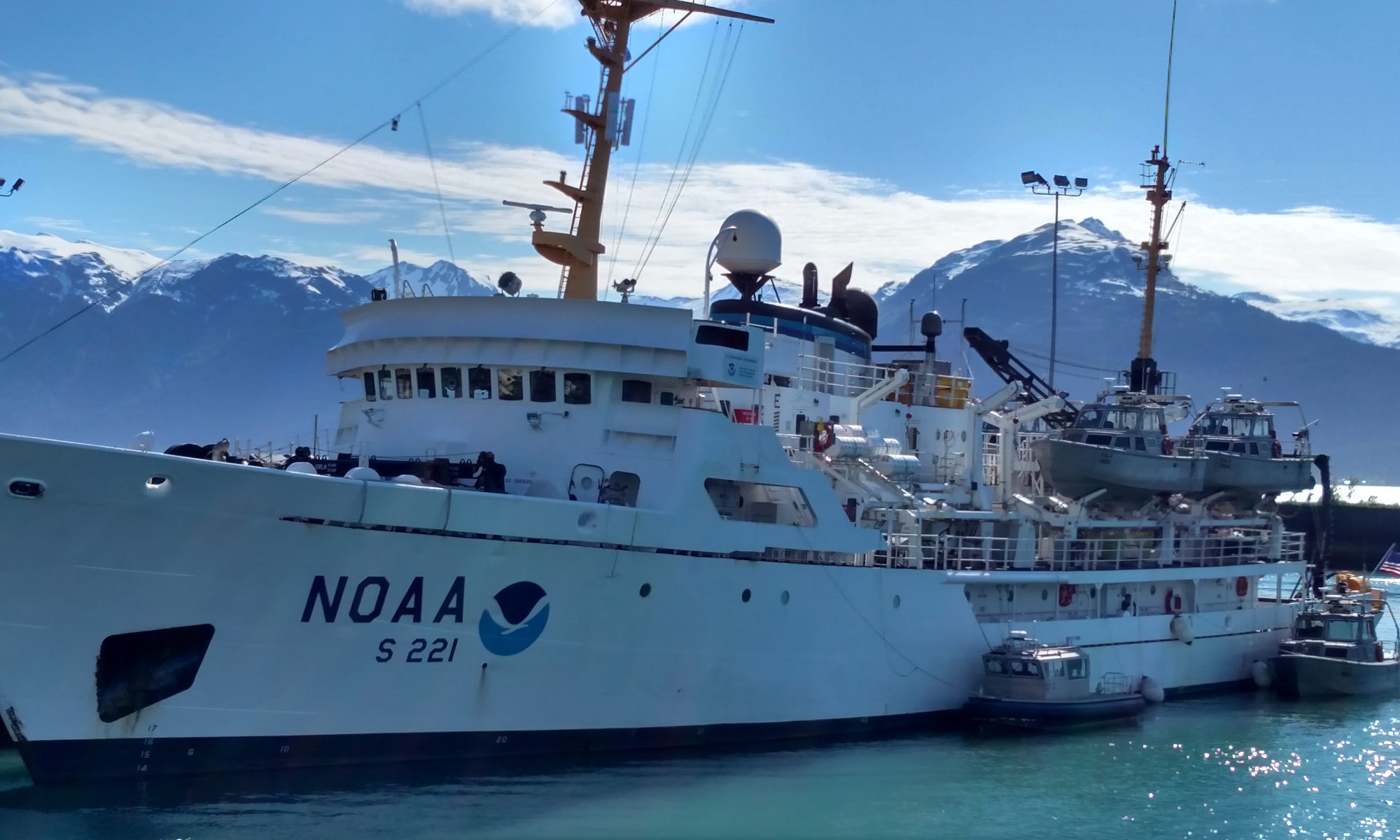
Mission: Mapping Deep-Water Areas Southeast of Bermuda in Support of the Galway Statement on Atlantic Ocean Cooperation
Date: July 25, 2018
Latitude: 28.37°N
Longitude: 63.15°W
Air Temperature: 27.8°C
Wind Speed: 9.7 knots
Conditions: partly sunny
Depth: 5236.01 meters
Science and Technology Log
Since the Okeanos Explorer is known as “America’s Ship for Ocean Exploration,” it is equipped with two important vehicles that allow scientists to study normally inaccessible ocean depths. Deep Discoverer (D2) is a remotely operated vehicle (ROV) that is mechanically designed with software and video engineering programs that generate precise images and videos. A total of nine cameras, including a Zeus Plus camera with impressive zoom capabilities, produce high-definition images that give scientists and those on shore insights about deep-sea ecosystems. The 9,000 pound ROV contains approximately 2,400 feet of intricate wiring as well as specially designed Kraft predator hand that can hold up to 200 pounds. The hand is especially useful for deep-sea sampling and allows scientists to bring certain organisms to the surface for further analysis. D2 can dive up to 30 meters per minute and is designed to withstand pressures almost 600 times that at sea level.
Front view of the Deep Discoverer featuring the Zeus Plus Camera
Rear view of D2
Side view of D2 (Check out the intricate wiring and size of the circuit board!)
Side view of D2 (Check out the intricate wiring and size of the circuit board!)Rear view of D2
D2 does not operate alone during the eight-hour dives. Instead, it relies on assistance from Seirios, another 4,000-pound machineknown as a camera sled. This deviceis powered and controlled by the Okeanos Explorer and offers the pilots and scientists a wide-angle perspective as they navigate the ocean floor. Seirios is tethered to the Okeanos Explorer and illuminates D2 from above to allow for increased visibility. The frame of this machine is relatively open which increases the distance cameras can be separated from the mounted lighting. This design reduces the light that reflects off particles in the water (optical backscatter) and results in high-quality images.
This camera sled, known as Seirios, is used to illuminate D2 during ROV dives.
All of the deep ocean images and video collected by D2, Seirios, and the Okeanos, can be transmitted to the rest of the world by satellite. The Okeanos is fitted with telepresence technology that enables everyone involved in the operation to provide scientific context to the public.The ability to broadcast this exciting information requires effective collaboration between the Engineering Team, NOAA ship crew, and scientists both onboard and onshore. It is amazing that anyone with Internet connection can be involved the expedition and science in real time.
The Mapping Team learning about Seirios!
Personal Log
In order to make it back to Norfolk on time for dry dock, we will have to finish our mapping our survey area on the 27th. In the meantime, we have been continuing to process data, collect sunphotometer readings, launch XBTs, and play cribbage. Our cribbage tournament will conclude on Friday night! Everyone aboard is excited about the data we’ve collected and looking forward to a successful end of the expedition.
The Mapping Team was on the lookout for dolphins!Dolphins playing on the waves near the bow!Another fantastic end to the day!
Did You Know?
The first fully developed ROV, POODLE, was created by Dimitri Rebikoff in 1953. However, it was not until the US Navy took an interest in ROVs that this unique technology became very popular. In 1961, the US Navy created the Cable-Controlled Underwater Research Vehicle (CURV).
72.5 North latitude: This past week we had 3-4 days of below freezing temperatures (27) with snow showers
Nome, Alaska: (8/25/18) Departing temperature 51 and cloudy
Contoocook/Hopkinton, NH: First day of school Tuesday (8/28/18)- Forecast 94 degrees Mostly Sunny (did I mention we don’t have air conditioning in New Hampshire?)
Ashore and I am headed back to NH
After completing our work in our most Northern point stop, we steamed back to Nome with just one more set of measurements on the way back, then had one final day of travel. It was sunny on the first day back but rougher seas than we had experienced thus far.
Rough Seas
There were estimated 8-12 ft waves and some even larger that crashed over the Healy. To the right is a picture that I captured of the bow during this portion of our trip and the rocky seas. Keep in mind that for most of the day we were lucky enough to be on the front deck of the boat! After the waves calmed we were in the fog for most of the way home so spotting more whales and seals was difficult.
Cruise Summary
In short, the trip was a success with the tremendous amount of data collected. This data will now be analyzed by scientists and students and I hope to see some scientific papers on this research in the future. Here is a list of what was done on this trip:
31 mooring deployments and 24 mooring recoveries
(To review what the work involved in this see my blog: Moorings all day
In addition to the above, there were many (I don’t have the exact count) Van Veen Grabs. I did not get to explain these in a blog so here is a quick overview. Scientists that study the sea floor, including the top layer of soil called the benthic zone, use a VanVeen Grab Sampler pictured below. It is lowered to the sea floor and then the scissor-like arms close the catch capturing a hunk of the sea floor and everything that was living on it. Once on shore the catch is rinsed through a sieve until all the clay is rinsed away leaving just the organisms that were living there (such as mollusks, clams, starfish, worms and more) and a few stones.
Van Veen Grab Sampler process
The scientists on the team also took HAPS core samples. I did not get to explain these in a blog so here is a quick overview. The HAPS corer, pictured below, is a gravity corer. This is a device that is lowered to the sea floor and then the weight of the device settles into the sea floor. When the HAPS corer is lifted, the bottom of the tube containing the cut into sediment closes, trapping the sample. These samples are then stored in clear tubes as shown in the picture. Scientists can examine sentiment layers to gain a better understanding of the sea floor at that location by studying the sedimentary layers.
HAPS corer
HAPS core samples stored in tubes
All this above data has been copied and specimens are stored. The primary focus of this trip was to gather data and now the long process of analyzing and communicating the results will begin.
Cruise Reflections
This was such a great opportunity for me to meet so many different scientists and to both observe and assist the varied scientific studies occurring all at once. I needed all three weeks to get a handle on it all. I am looking forward to sharing what I have learned with my Maple Street School students back in New Hampshire and following the scientific studies as they move forward. Thanks to NOAA, Maple Street School, everyone else that allowed this learning opportunity to happen. It was a summer I will not forget experiencing a ship crash through ice in August! I leave you with some of the reflections of the birds I captured on those calmer days at sea.
The tufted puffin is not all that graceful at taking off. (below)
The tufted puffin is not all that graceful at taking off.
Geographic Area of Cruise: Northeast Atlantic Ocean
Date: August 24, 2018
Weather Data from the Bridge
Latitude: 40.15 N
Longitude: 68.71 W
Wind direction: NE
Wind speed: 14 knots
Water temperature: 23.8 degrees C
Air pressure: 1023 millibars
Air temperature: 24.2 degrees C
Water depth: 165 meters
Science and Technology Log
What an exciting first full day out at sea! I have been so grateful that our science team has allowed me to be completely hands-on and take responsibility for some of the science happening on the ship. In addition to checking the Imaging Flow Cytobot (IFCB) periodically, I am very much involved in the data collection at each of our stations.
There are specific stations along our course where scientists need to collect data. The crew announces when we are close to the station. At that time, along with another volunteer on watch, I don my foul weather gear to head out to the deck. We get pretty splashed as we are working with the equipment so the gear is a good idea. We help the crew as they lower “bongo nets” into the water using a cable and pulley system. Can you guess why they are called bongo nets? These nets have a very fine mesh that helps collect, you guessed it, PLANKTON!
bongo nets waiting on the deck to be deployedThe bongo net and the “baby” bongo net being deployed.
We also help raise the bongo nets after several minutes dragging them through the water. We rinse all of the plankton down to the bottom of the net and then open up the end of the net to allow all of the plankton into a sieve where we will collect it. I have been surprised by the amount of jelly-like animals that have shown up in the nets!
Then it’s time to use special liquids (ethanol or formalin) and water to wash the plankton into collection jars. These chemicals will preserve the plankton so scientists can study it back in the lab!
It has been so much fun working with this equipment, asking the scientists questions about the plankton, and being a part of it all.
Harvey, our chief scientist, explained to me that many scientists can use the plankton samples for all different studies. Some of the samples can be used to study larval fish (baby fish) otoliths, the tiny ear bones that can verify the identification of larval hake using genetics. Knowing this, scientists can do research to determine where the larval fish were born! What a great example of the beginning of a scientific
Some examples of larval hake. Photo courtesy of Harvey Walsh
experiment!:
Question – Where are most larval red hake fish born in the Northeast Atlantic Ocean?
Research – Scientists might research currents in the area, wind patterns, and other things that would push plankton from place to place. They also would research what other scientists have already learned about larval red hake.
Hypothesis – Most larval red hake fish are born in the Southern New England and Georges Bank regions in the northeast US shelf.
Didn’t I tell you plankton were amazing?
At some of the stations, we also lower Niskin bottles and CTD instruments into the water to collect a lot more data! More on that to come!
Here I am getting ready to deploy the bongo nets.Jessica and I rinsing the bongo nets.Plankton looks tiny when we filter it into a sieve.Our plankton samples after being rinsed into the jars.
NOAA Corps Corner
Today I spoke with Lola Ajilore, Officer with NOAA Corps, and asked her a few questions about her important work. A pod of humpback whales off the bow stole the show! Here’s what we got in before the exciting interruption…
Me – Tell me more about your roles on the ship.
Lola – I am the Navigation Officer, Medical Officer, Environmental Officer, Ship Store Officer, and Morale Officer. As you can see, we all have multiple roles on the ship. As Navigation Officer, for example, I plot charts, track directions, and coordinate with the Operations Officer and Commanding Officer on track lines and routes that are requested by the scientists.
Me – Where do you do most of your work?
Lola – I am always with NOAA Ship Gordon Gunter. The ship’s home port is in Pascagoula, Mississippi. Our missions often take place in the Gulf of Mexico but we also run these Northeast Shelf cruises for Ecosystem Monitoring every year.
Me – What kind of training is needed for your line of work?
Lola – We undergo an application process that includes several interview steps. We then train at the Coast Guard Academy. Much of our training parallels that of the Coast Guard, but we also do our own NOAA Corps training as well.
Me – What tool do you use in your work that you could not live without?
Lola – Radar! [Radar aids navigation by detecting things that are far away such as an island or another ship]
Lola as Navigation Officer.Can you see the little black dot in the middle of the picture? It’s a humpback whale! It looked a lot closer in real life.
Personal Log
Sunset on NOAA ship Gordon Gunter
I cannot believe the amazing views that we have on this ship 24 hrs. a day! The water has been super calm and the sunrise, sunset, breaching whales, and pods of dolphins have taken my breath away.
Yesterday was emergency drill day! Libby, our Operations Officer, had given us directions on how to respond to emergencies prior to leaving the
Mustering on the deck during the emergency fire drill.
dock. There are emergency drills for a fire (just like at school!), abandon ship (in the case that we had to immediately leave the ship in an emergency), and man overboard.
We practiced a fire drill and an abandon ship drill. The Officers on the ship sounded the alarm, using a different number and duration of blast based on the type of emergency. For a fire, we all “mustered” (got together in one place) in assigned areas. All of the science team members mustered together. For abandon ship, we all mustered near the life boats along with our life jackets and immersion suits (suits that can help you survive if you end up in the water).
Here I am in my immersion suit!
The fun part of the abandon ship drill was donning our immersion suits in one minute or less! This was a great thing to practice so if there ever was a real emergency, we would know how to put on the suit. I thought I looked pretty cool in my immersion suit.
Did You Know?
Salps are barrel-shaped planktonic tunicates. Our plankton bongo nets always contain some jelly-like salps. Where I live in the Florida Keys, we see mangrove tunicates growing on mangrove roots. Here in the open ocean, salps stick together in long colonies and drift! Sometimes there are so many salps in our nets, we have to filter them out with sieves and put them back in the water.
An example of a colony of salps. Photo courtesy of NOAA
Something to Think About
We have been finding up to 4,000 phytoplankton in 5 mL of water. A gallon of water is equal to about 3785 mL. There is about 352,670,000,000,000,000,000 gallons of water in the Atlantic Ocean. How much plankton is in the Atlantic? You do the math.
This is what some plankton look like under the microscope. Photo courtesy of NOAA
Geographic Area of Cruise: Northeast Atlantic Ocean
Date: August 22, 2018
Weather Data from the Bridge
Latitude: 991 N
Longitude: 590 W
Water Temperature: 22.3◦C
Wind Speed: 1 knots
Wind Direction: WSW
Air Temperature: 23.3◦C
Atmospheric Pressure: 66 millibars
Sky: Mostly Cloudy
Science and Technology Log
Haven’t you always dreamed of having your own Imaging Flow Cyto Bot (IFCB)? What an interesting scientific instrument that I am lucky enough to be taking care of while on this cruise! Before we even left the dock, Jessica Lindsey (volunteer from the Maine Maritime Academy) and I were trained by Emily Peacock, research associate at Woods Hole Oceanographic Institution, on how to run this amazing piece of equipment!
The IFCB is a computer, microscope, camera, and water flow controller all in one. Emily describes it as “plumbing combined with electronics”. It uses a water intake system from the ship to run a constant flow of water into extremely tiny hoses. As the water flows through these hoses, a laser beam of light shoots at every tiny particle that is in the water. The tiny particles in the water, mainly phytoplankton (microscopic drifting plants), react to the sudden burst of light. The phytoplankton scatters the light and also can react by fluorescing (reacting to one wavelength of light by giving off a different wavelength). The computer detects this scattering and fluorescing to determine where the phytoplankton is in the water flow. The microscope focuses in on each phytoplankton cell and the camera takes a picture! Scientists simply get the IFCB going and at the end of the day they have hundreds of pictures of plankton! Isn’t that incredible?!
Here I am learning how to use the IFCB! It is SO COOL!
One thing I’ve learned about this particular cruise is that it’s all about plankton! We are collecting samples and data for scientists at the University of Rhode Island, Woods Hole Oceanographic Institution, and NOAA’s own Narragansett Lab, just to name a few. What are all of these scientists studying? Plankton! Why? Plankton is the microscopic lifeblood of the ocean. The word plankton comes from a Greek word, oikos, meaning “drifter.” Plankton refers to all the living things of the ocean that are drifting with the currents. They are present throughout the water column and consist of two types: phytoplankton and zooplankton. Can you guess the difference? Phytoplankton is like a plant. It has chlorophyll and does photosynthesis. Zooplankton is an animal. There are many zooplankton species that hunt, hide, and do other things that larger animals do. Most plankton is microscopic or close to it. Phytoplankton does at least half of all the photosynthesis in the WORLD. So you can think that every other breath you take contains oxygen created by phytoplankton.
Both types of plankton are the base of the marine food chain. If major changes happen in the community of plankton in the sea, these changes will impact the entire food chain all the way up to the apex predators (top predators). So, as you can see, plankton is SUPER important. If plankton populations are healthy, it indicates that much of the rest of the ecosystem is healthy too.
Some scientists use equipment, like the IFCB, to study samples of phytoplankton.
Associate Researcher Emily showing us the program that allows you to see pictures of the phytoplankton sampled.
We also are collecting zooplankton in nets (called “bongo” nets) and preserving samples for scientists to analyze in the lab. More on that to come soon!
My students have been learning that scientists always start an experiment with a question.
Scientists on this mission are not exactly leading an experiment, but they are responsible for monitoring. The monitoring of an ecosystem tells us WHAT is happening there. Scientists from all over the world can then use the monitoring data that we find to research and experiment WHY things are happening the way they are. This is where the scientific method will come in and an experiment will start with a question.
For example, through the plankton samples that we take on this monitoring mission, scientists may notice a change in the amount of larval hake (tiny baby hake fish). They can then ask the question, “Why are larval hake populations decreasing?” which may lead them to a hypothesis such as, “larval hake populations are decreasing due to climate change”. They can test this hypothesis by comparing the plankton data to other types of data (such as pH and water temperature) in the same areas over time. Thus, an experiment!
So our job now is to collect the important data that can help scientists understand what’s happening and think of ways to investigate “why” and “how”.
Bottom line, I really love plankton. And you should too. That breath you just took? Thank plankton.
Pictures of glorious plankton!
Scientist Spotlight – John Loch – Seabird Observer
Enough about plankton! During all of this plankton excitement, I have also spent some time on the fly bridge (the top level of the deck of the ship), asking questions to our two seabird observers, John and Chris. Their job is to stand watch all day, looking for and identifying seabirds, marine mammals, sea turtles, and any notable (large) animals. Here’s a little interview with John Loch, Seabird Observer:
John observing seabirds from the fly bridge
Me – Why is your job so important?
John – My job is to monitor seabird populations to help detect changes in numbers or distribution of species. We estimate a 300 square meter area around the ship and record all birds seen within that area. We enter our data into a computer, noting species, life stage, number seen, and direction of flight. Over time, we may notice trends in numbers and distribution which is important to understand this ecosystem.
Me – What do you enjoy most about your job?
John – I enjoy seeing anything new or rare.
Me – How could scientists use your monitoring data to lead an investigation (using the scientific method)?
John – Our data has shown, for example, that some populations of birds, such as the gannet, have steadily declined over the last 20 years. Researchers can ask “Why are gannet populations declining?” and can use oceanographic data in combination with bird observation data to come up with a hypothesis to test.
Personal Log
I was excited to get underway this afternoon! Although many of us slept on the ship last night, we have been on the dock until 2:30 this afternoon, when we finally watched the crew release the lines and the ship cruise through the harbor and out to sea!
A view of the bow as we head out to sea!!
We began our day with a scientist meeting where Harvey Walsh, our Chief Scientist, explained our route and the “stations” where we would be slowing down or stopping the ship to take our data. He explained our 3am-3pm/3pm-3am shifts that we alternate so that whenever a station is reached, day or night, data can be collected. I’m lucky to intersect these shifts and work “on watch” from 8am-8pm! This means that I will support and assist scientist in their data collection during this time, and generally be present and available.
Chief Scientist Harvey explaining our route on the Northeast Shelf.
We also heard from Libby, our Operations Officer, who explained our state rooms, bathrooms, shared spaces, and general “do’s and don’ts” of the ship.
Libby, our Field Operations Officer, explaining the safety procedures of Gordon Gunter
I have to say I am pleasantly surprised by our living quarters aboard NOAA Ship Gordon Gunter. I have my own state room with a shared bathroom, small closet, sink, and even a desk. It is quite spacious! I’m also excited about the food options on board, but more about that later!
The view from my state room…not bad!
Tonight is our first night out at sea! Luckily, I’m not feeling seasick, but rocking and rolling as I type this does feel pretty strange! Everyone says we’ll get used to it and it will feel normal in no time.
I am so excited for our first morning and sunrise out at sea! Stay tuned!
Did You Know?
Phytoplankton come in all different colors, just like the flowers in your garden. Since they are so tiny, we don’t see the colors unless there is a lot of plankton all together. They also contain more than one color in their cells, similar to leaves that change from green to brown, red, or orange.
Colorful phytoplankton, photo courtesy of NOAA
Question of the Day
Do you think the amount and type of plankton in an area can affect how many sharks live there? Why?
Do sharks rely on plankton? Photo courtesy of NOAA
Geographic Area of Cruise: Point Hope, northwest Alaska
Date: August 23, 2018
Weather Data from the Bridge
Latitude 87 43.9 N
Longitude – 152 28.3 W
Air temperature: 12 C
Dry bulb 12 C
Wet bulb 11 C
Visibility: 10 Nautical Miles
Wind speed: 2 knots
Wind direction: east
Barometer: 1011.4 millibars
Cloud Height: 2000 K feet
Waves: 0 feet
Sunrise: 6:33 am
Sunset: 11:45 pm
Science and Technology Log
Today we deployed the drifter buoy off the stern of the Fairweather off the southeast coast of Kodiak Island Alaska, at 3:30 pm Alaskan time zone. The buoy will be transmitting its location for approximately one year. During this time, students will be have the opportunity to logon and track its progress.
This project is very exciting for many of my students at the Henderson County Early College and elementary students at Atkinson Elementary (Mills River, NC) and Hillandale Elementary (Henderson County, NC) that have participated in my “Young Scientists” program. Prior to my journey to Alaska, I visited those elementary schools introducing them to the mapping that we were going to collect and the important mission of NOAA. As part of this outreach, students designed stickers that I placed on the buoy prior to deployment yesterday. In addition, Ms. Sarah Hills, a middle school science teacher from the country of Turkey, is also going to track its progress.
An interesting note: my “Young Scientists” program was inspired in 2015 after participating in my first Teacher at Sea trip on board NOAA Ship Henry Bigelow. I would like to thank the NOAA Teacher at Sea Alumni coordinator Jenn Annetta and Emily Susko for supporting this effort!
Deploying the drifter buoy off the stern of the Fairweather – Photo by NOAA
All schools are welcome to track its current location. Visit the following site http://osmc.noaa.gov/Monitor/OSMC/OSMC.html. In the upper left hand corner enter the WMO ID# 2101601 and then click the refresh map in the right hand corner.
The last day at sea, crew members had the opportunity to fish from the ship in a region called the “Eight Ball,” which is a shoal just of to the southwest of Kodiak Island. Within ten minutes, the reels were active hauling in Halibut. I have never seen fish this big before and Eric reeled in the biggest catch weighing around 50 lbs! Alaska is a big state with big fish!
Eric hauling in his catch! Photo by Tom
Personal Log
This is my last day on board the Fairweather. For three weeks I witnessed a young NOAA Corps crew orchestrate an amazing level of professionalism and responsibilities to ensure a productive mission. While on board and I met new friends and I have learned so much and will be bringing home new lessons and activities for years to come. The crew on board the ship has been very warm, patient and very happy to help answer questions. I am very honored to be selected for a second cruise and have enjoyed every minute; thank you so much! As we sailed into Kodiak Island, witnessed an eye catching sunrise, wow!
Sunrise, Kodiak Island – photo by Tom
I wish the crew of the Fairweather, Fair winds and happy seas.