Sinh Nguyen: Scientists who SEA, July 14, 2025

NOAA Teacher at Sea

Sinh Nguyen

Aboard NOAA Ship Pisces

July 7, 2025 โ€“ July 24, 2025

Mission: Larval Bluefin Tuna Slope Survey

Geographic Area of Cruise: North Atlantic Ocean, Slope Sea

Date: July 14, 2025

Weather Data:

1:32 PM Eastern Time

Norfolk, Virginia

The temperature is 32ยฐC (89ยฐF)

Career Spotlight

Uplift Education, Mighty K-12 scholars: Did you know some people have jobs where they explore the ocean, study sea animals, and help take care of our planet? 

Some of you, even those already thinking ahead in middle or high school, might be wondering what kinds of jobs or studies you can pursue one day.  Well, today weโ€™re going to meet some real-life ocean heroes: the scientists on the science crew who are sailing aboard NOAA Ship Pisces for the larval bluefin tuna mission.   They come from all over the United States and are experts at what they do. 

Why are they awesome?  If youโ€™d like: go ahead and think, share, and then draw or write your responses on this digital whiteboard:

https://www.whiteboard.chat/board/963e0100-9dc6-4679-85ff-2116fdc539d1-pgNum-1

Based on some of your responsesโ€ฆ these scientists are curious like inquirers, hardworking and knowledgeable, and they show they are caring by helping protect sea life.  They are communicators who share what they know, and courageous learners who explore the unknown!  Now, letโ€™s learn more about our science crew to find out how you might be a sea explorer one day!

* Note: I’ll be updating this post throughout the cruise. These interviews were rephrased to fit into the blog. For full interview responses, please click here: https://docs.google.com/document/d/1bvKvswISdjFMMqG7QNoc8FDox74Ysey-Xp2ERMLvajc/edit?usp=sharing

a view from an upper deck of NOAA Ship Pisces over the bow. Four women stand at the rail, leaning on their elbows, looking ahead as the ship exits the port of Norfolk. We can see tall buildings and other large ships off to each side. The words Meet the Scientists! are imposed in the middle of the image.

Meet the Scientists!

Hi, Iโ€™m David Richardson! I live in South Kingstown, Rhode Island, but grew up in Sierra Madre, California. I studied Natural Resources at Cornell University, then went to grad school at the University of Miami. Iโ€™m the chief scientist on this cruise, which means I help plan how we collect data to meet our science goals. My research focuses on larval fish, fish migrations, and how ocean conditions affect fisheries. My favorite marine animal’s the sail fish. Theyโ€™re beautiful at every stage of life! I love science because it helps us make the world better. In fisheries science, our work helps keep fish populations healthy so people can continue to enjoy fishing and have access to food.

Fun fact: My first research was on baby eels near Barbados. I discovered and illustrated six types of eel larvae that were new to science! That experience showed me how much of the ocean is still a mystery. My advice: Pay attention in math and writing but also get outside! Observing nature is one of the best ways to become a great scientist.

portrait headshot photo of a man in a green t-shirt in front of what may be a Christmas tree

photo of a woman in a float coat, black overalls, a beanie, aand workboots standing on an upper deck of the ship; we can see part of the bow, calm seas, and a cloudy sunset in the distance

My name’s Allison Black! Iโ€™m from eastern Connecticut and often at sea. I studied Zoo and Wildlife Biology at Malone University and worked briefly as a zookeeper before focusing on ornithology. My favorite (yet unseen) marine animal is the Wandering Albatross. They can travel over 75,000 miles a year! On this project, Iโ€™m surveying seabirds and marine mammals. I love the oceanโ€™s mystery and the chance to keep learning through different cruises. Fun fact: by yearโ€™s end, Iโ€™ll have 500 sea days! My advice: stay flexible, stay curious, and seize opportunities you didnโ€™t know existed.


I’m Chrissy Hernรกndez! I grew up in New Jersey and now live in Oxford, England. I earned my bachelorโ€™s from Columbia University and my PhD from the MIT-WHOI Joint Program in Oceanography. Iโ€™ve worked as a researcher at Cornell and Oxford. Iโ€™m a population ecologist who studies biological oceanography and theoretical ecology. My favorite marine animal is the bluefin tuna! Aboard the ship, I help deploy plankton nets, identify tuna larvae, and guide sampling efforts. I love the oceanโ€™s vastness and mystery, and how tiny organisms like phytoplankton produce half the worldโ€™s oxygen. Fun fact: I once shaved my head and tossed the hair overboard during an equator-crossing tradition!

portrait headshot of a woman wearing an orange t-shirt and glasses; we see trees and a city skyline behind her

headshot selfie of a woman standing in front of the ocean, a beautiful pastel sunset in the background

Hi, I’m Autumn Moya! Iโ€™m from Colorado and now live in Silver Spring, Maryland. I studied Biology at Western Colorado University with a focus on environmental biology, and Iโ€™m finishing my Masterโ€™s in Coastal Science at the University of Southern Mississippi. My research models how offshore development might affect the Atlantic surf clam fishery. I’m currently a John A. Knauss Marine Policy Fellow with NOAAโ€™s Office of Marine and Aviation Operations. I support communications, policy, and events. Iโ€™m excited to join research cruises like this one. My favorite marine animal is the cuttlefish. Did you know they can change color as fast as a blink? Iโ€™ve always loved the ocean, even growing up in a landlocked state. Since finishing my bachelorโ€™s, Iโ€™ve lived in seven states! My advice to future scientists: stay curious and never hesitate to reach out. Science is for everyone!


Hi, I’m Amanda Jacobsen! I’m from Rhode Island. I studied Environmental Studies at Connecticut College and now I’m working on my masterโ€™s in Marine Biology at UMass Dartmouth. On this cruise, I help deploy nets and collect seawater to study the carbon in it. My favorite sea creature is the lumpfish. Look it up, itโ€™s cool! Iโ€™ve worked on over 80 boats, and I love biology because it lets me explore the hidden world of ocean life.

Sometimes only visible under a microscope.

My advice to you: Stay curious and try new things, you might discover something amazing or meet someone who inspires you!

a woman kneels on the aft deck on one knee, both hands on a piece of scientific equipment (maybe a water profiler) resting on deck. she pauses what she is doing to turn and smile for the camera.

Hi! My name is Kristen Walter and I live in Miami, Florida. I graduated from the College of William and Mary with a master’s in marine science. I now work for the University of Miami/CIMAS studying coral reef fishes and bluefin tuna! My favorite marine animal is probably the nudibranch! Iโ€™m here on this cruise to help locate larval bluefin tuna, set and recover nets, preserve and identify fish, and test out new methods of capture using light traps. A fun fact about me is that I got to participate in the Aquarius Reef Base Underwater Habitat in Key Largo when I was in grad school. If you’d like to get into marine science, look for summer internships. Many places offer programs for high school students. Get your feet wet. Anything is possible!


A group photo of the science crew!

Personal Log

Over the weekend, we moved back onto NOAA Ship Pisces.  It felt nice to return after a few nights in a hotel while crew members got everything ready for our big mission. 

view of computer screens, keyboards, mice on a wooden desk in an interior room of the ship
When weโ€™re not setting things up, we spend time working in a place called the dry lab.  The dry lab has computers, machines, and tables for us to study the ocean data we collect during the mission.  Iโ€™ve been using this time to write my blog! 
broader view of the dry lab: metal tables, a wooden desk, computers, computer chairs, two unidentifiable people sitting, facing away from the camera
Many scientists also bring their laptops, journals, or books to read or work on.  Itโ€™s a quiet place where people come and go, but when itโ€™s time to work, everyone jumps in to help!
three women - one seated at a desk, two standing - are in discussion. the seated woman holds up a piece of plastic film with her left hand.
Scientists Kristen, Chrissy, and Sarah are making sure the light traps for our drifters (for catching fish) are ready.

Just like we practice fire drills and safety rules at school, there are also important rules and practice drills in case of emergencies. 

two people walk through a hallway of the ship toward an exit to an outer deck
Staying safe is super important when youโ€™re out at sea.
a NOAA Corps Officer (in blue uniform) stands at the front of the mess hall and holds a breathing apparatus up; it blocks the view of his face. we can see the chair legs are capped in cut tennis balls to prevent them from sliding
Lieutenant Musick, one of the operations officers, is giving us safety training.  Heโ€™s showing us how to use an EEBD (emergency escape breathing device).  
a group of people stand outside on the aft deck, surrounding a NOAA Corps Officer in a blue uniform using his hands to illustrate a point
We were given a tour of places to know for emergencies. All crews were involved including members from science, NOAA Corps, engineer, and deck teams pictured here
a piece of paper attached to a door with a magnet. the paper reads: TAS Nguyen, Sinh, and then lists three sets of muster locations for Fire & Emergency, Abandon Ship, and Mariner Overboard. The three scenarios also include depictions of the corresponding morse code, shown as boxes or rectangles
Outside of each stateroom, or everyoneโ€™s rooms, there is information on where you report to and what your role is during emergencies.  Itโ€™s a good idea to study this information!
Sinh (right) and a woman (left) pose for a selfie with a dummy used in safety exercises
With our floaty rescue dummy!

Safety first! I need to make sure I can stay afloat in case I ever have to evacuate into the water.

I tried on an immersion suit, or “Gumby suit,” to make sure I can float in water. It’s also designed to keep people warm in the water in case they have to abandon ship or go into the water.
Sinh, wearing his Teacher at Sea baseball cap, poses for a photo - making a shasta sign with his left hand and with his right, grasping the bagged survival suit and personal flotation device. he is standing on an outer deck.
So far, Iโ€™ve really enjoyed getting to know everyone on board.  Iโ€™m a lot more familiar with everything around the ship, including where all the rooms, crew members, and emergency equipment are.  Iโ€™m feeling excited about our mission once we set sail. 

Next time, Iโ€™ll be writing about a special tool we use called the CTD (Conductivity, Temperature, and Depth), which helps us learn more about the ocean!

Did you know?

NOAA ships have their own weather stations right on board.  That means they can measure wind, rain, temperature, and more.  Even while theyโ€™re sailing across the ocean!  What do you think scientists do with that information?

close up of a digital display mounted to a ceiling. currently it displays latitude and longitude
The station also shows navigational information, which gives everyone exact locations (coordinates) of the ship.

Sinh Nguyen: On a Tuna Mission, July 11, 2025

NOAA Teacher at Sea

Sinh Nguyen

Aboard NOAA Ship Pisces

July 7, 2025 โ€“ July 24, 2025

Mission: Larval Bluefin Tuna Slope Survey

Geographic Area of Cruise: North Atlantic Ocean, Slope Sea

Date: July 11, 2025

Location: Norfolk, Virginia

Science Log

Uplift Education, Mighty Primary students:  Happy Friday!  Thereโ€™s still a month of summer break left, but that doesnโ€™t mean the learning stops.  Today, Iโ€™m writing about our science mission.  A mission is a special job or task that people work hard to complete.  Letโ€™s keep growing our brain today by learning more about bluefin tuna.

Have you ever heard of bluefin tuna before?  What do they look like?  Where might it live in the ocean?  Go ahead and visualize, or imagine, the answers in your mind.

Now, letโ€™s learn about bluefin tuna.

an underwater view of a school of bluefin tuna, looking up toward the surface of the water
Bluefin tuna live in the Atlantic Ocean.  Scientists have found that they can be born in places like the Gulf of Mexico and now the Slope Sea, where we are sailing to, near the US East Coast!  Photo credit: NOAA Fisheries

Did you know that some bluefin tuna are as long as a small car and can weigh over 1,000 pounds?  Thatโ€™s heavier than a big bear!  But, when theyโ€™re born, theyโ€™re super small.  Only about the size of a grain of rice. 

When theyโ€™re babies, they’re called larvae.  Scientists have found a new place in the ocean, called the Slope Sea, where many larvae are born and grow.  This area is near the Northeast coast of the US, between the land and a strong ocean current called the Gulf Stream.

an illustration of a bluefin tuna, which sports blue dorsal (back) and caudal (tail) fins
Can you guess why bluefin tuna are named that way?  Hint: take a close look at their fins! 
Photo credit: NOAA Fisheries

Scientists are excited because this new discovery helps protect bluefin tuna and understand how they grow.  They used special nets to catch the tiny larvae and studied their bones to learn how fast they grow.  This research helps us take better care of these incredible ocean animals.

magnified view of a larval bluefin tuna, which looks like a mostly see-through triangle-shaped creature with a large reflective eye.
What do you think a larvae needs to stay safe and grow in the ocean? Photo credit: NPR

So, what is our mission?  We know that tuna are big fish, but they start out super tiny when they are larvae. Scientists want to know how many bluefin tuna live in the ocean.  To do this, they look at larvae and try to match them to their parents using something called DNA, like a puzzle piece from your family.  Everyday, we will look in the ocean for larvae.  If we find a lot, weโ€™ll stay there.  If we donโ€™t, weโ€™ll try a new spot.  This helps us learn how to protect tuna and keep them safe.

on the deck of the ship (in port), a group of people stand around a scientific instrument. it has four canvas sails in a cross arrangement around a central pole. Dave holds two round orange floats, and Cristina holds a mesh net trap suspended from lines. lying around the deck underfoot are thick teal ropes.
Weโ€™re building special tools called drifters that will float in the ocean.  These drifters have light traps on them.  The light helps attract larvae.  They will be dropped into the water.  This will help us collect larvae for our mission.  Itโ€™s like setting up a gentle trap to learn more about sea babies!

Uplift Education, Mighty Primary students and parents: if you’re interested in learning more about this research, please find more information here: https://www.whoi.edu/press-room/news-release/evidence-bolsters-classification-of-a-major-spawning-ground-for-atlantic-bluefin-tuna-off-the-northeast-u-s/.  Can you point to the pictures of the bluefin tuna larvae?

One of the scientists on our ship is Dave Richardson, who wrote the paper you just read about.  He’s the Chief Scientist of this mission.  This means that he’s the leader of all scientists on this mission.  Dave’s an expert in bluefin tuna, and he knows a lot about how they live and grow!  In the next few blog posts, I’ll tell you more about him and the amazing team of scientists working with him!

a group photo of five women and one man lined up in front of a railing on an upper deck of NOAA Ship Pisces; large ships docked in the port of Norfolk are visible in the distance
Some members of our science team, including Chief Scientist, Dave Richardson (far right).  I will introduce and talk more about each scientist in the next few blog posts.

Personal Log

Sometimes, even when we plan a lot, things donโ€™t go the way we want.  This happens in our classroom when we learn new things.  It can also happen on a boat!  A few hours into the sea, our boat had to come back to the port in Norfolk, Virginia.  For the last few days, lots of people have been working hard to get the boat ready to sail again.  Iโ€™ve learned that being flexible, which means being okay with change, is very important on a boat because things can change anytime.

Selfie photo of Sinh from the flying bridge (topmost deck) of NOAA Ship Pisces, with a view of the Pisces' bow behind him, and the large vessels of the port of Norfolk beyond. The sky is blue and cloudless, and the water has a very even ripple.
view from a high deck over the bow of NOAA Ship Pisces; large vessels line the docks at the port to the right. the sky is blue and cloudless, and the water has an even ripple.
A view of other boats and vessels as we departed from the port.  While sailing, you can hear birds, feel the cool breeze, and even see dolphins!
Watch carefully. What animals do you see?

We can practice being flexible every day, just like on the boat!  Can you tell your parents about a time when you had to be flexible or change your plans?  How did it feel?

I know the scientists worked hard to plan this mission, so I practiced being flexible by staying calm and understanding when the schedule changed.  When we had free time, I tried to help whenever I could.  For the last few days, weโ€™ve been staying outside of the ship.  This gave us lots of time to bond, which means getting to know each other better.  On our science team, there are a total of 9 people.  Iโ€™ve really enjoyed spending time exploring the city with everyone.  Bonding with your teammates is important because it helps us build trust, feel appreciated, and work together as a team when the hard work starts!

The following pictures show us exploring Norfolk. The weather here feels just like a Texas summer: hot and humid!  We saw big naval ships and visited a cool place called the Nauticus Museum.  There, we learned all about the history of Norfolk and the many different ships that have sailed in the past.  It was a fun way to learn while exploring.

Sinh smiles for a photo on a brick walkway, near a sign that reads Welcome to Waterside Marina
At the Waterside Marina
two women read an interpretive sign along a walkway, near the water; we can see pilings, water, a bridge in the distance. the sign is titled: The Cannonball Trail.
Norfolk is a city by water.  It is next to the Atlantic Ocean and Chesapeake Bay.  You can see boats, bridges, and seagulls everywhere!
Sinh stands on one leg, arms outstretched, to mimic the pose of a statue of a swimming mermaid located along a brick walkway near the water. in the background we see docked pleasure craft and the masts of a tall ship.
Norfolk has a mermaid as its city symbol.  Just like how a lion is our school symbol.  You can find colorful mermaid statues all around town.
view of the outside of the Nauticus museum, from the parking lot
Nauticus is an amazing museum where you can explore real ships, touch sea animals, and discover what life is like on the water. You can even see NOAA photos and research on display!
a woman sits on a machine mock up  of a sail boat, turning a rudder to turn the sail, while a fan creates a wind effect
four people stand around a circular feature at the museum; it is unclear what it does
Teamwork makes the dream work!
heat map image of Sinh
a woman stands next to a small wooden boat mounted on a deck of the museum
a woman plays a game with sailboats at the museum
Sinh takes a selfie - with a group of five others in the background - on the deck of a battleship
Norfolk is home to the worldโ€™s largest naval base, which means lots of ships and sailors live and work here.
view from the dock, towards the bow, of the battleship in port
We went on a tour of Battleship Wisconsin, one of the largest and last battleships ever built by the U.S. Navy.

Did You Know?

Bluefin tuna are fantastic swimmers!  They can swim as fast as a car driving on the highway, up to 40 miles per hour!  That helps them catch their food and travel across the ocean.

Video source: SUPERFISH BLUEFIN TUNA, broadcasted on the National Geographic Channel.

Sinh Nguyen: A Change of Command, July 8, 2025

NOAA Teacher at Sea

Sinh Nguyen

Aboard NOAA Ship Pisces

July 7, 2025 โ€“ July 24, 2025

Mission: Larval Bluefin Tuna Slope Survey

Geographic Area of Cruise: North Atlantic Ocean, Slope Sea

Date: July 8, 2025

Weather Data:

12:06 PM Eastern Time

Currently, the temperature is 28.9ยฐC (84ยฐF).  The wind speed is 10 knots.

Career Log

Uplift Education, Mighty Primary scholars: Howdy from the sea!ย  Mr. Nguyen here.ย  I hope youโ€™re enjoying your summer (and reading lots of books).ย  Yesterday, I moved onto NOAA Ship Pisces.ย  It was a long day at the port meeting everyone and learning the rules.ย 

view of NOAA Ship Pisces in port, as seen from the dock well ahead. also along the dock are a truck, some dumpsters, a large spool - various equipment involved in loading the vessel
I arrived early morning at the port in Norfolk, Virginia
Sinh, wearing his Teacher at Sea t-shirt, poses for a photo in front of the ship on the dock. We can see the NOAA logo, NOAA acronym, and hull number (R 226) painted on the hull of the ship.
Right away, everyone made sure I felt comfortable, safe, and prepared for the sail.

On the ship are the following crews, or teams: NOAA Corps, deck department, engineering, survey, stewards, electronics, and scientists – which Iโ€™m a part of.  Excitingly, there was a Change of Command ceremony, a special event when one commanding officer (CO) gives the ship to a new one.  So, in honor of this celebration, Iโ€™ll be dedicating this post to the ceremony and to the career stages of NOAA Corps officers!

NOAA stands for National Oceanic and Atmospheric Administration.  They study and protect the ocean, weather, and animals. 

Uplift Education, Mighty Primary scholars, what kind of animals do you think NOAA study in the ocean and in the sky?ย  Letโ€™s think, act them out, and draw!ย  If youโ€™d like, ask your parents to post your work in the comments!

A NOAA Corps officer is like a scientist and a ship captain.  They wear uniforms and lead missions (special tasks) on ships.  We respectfully address an officer by his/her rank or ship position.  Yesterday, I got to see a Change of Command ceremony.  Thatโ€™s when one commanding officer (CO) finishes his/her job, and a new commanding officer (CO) takes over the ship.  Itโ€™s kind of like picking and celebrating a new class leader.  It shows respect, teamwork, and leadership.

view down (perhaps from the ship?) of a tent and chairs set up in the parking lock of the dock. We cannot see NOAA Ship Pisces, but another NOAA Ship, Ferdinand R. Hassler, is docked nearby and its name is clearly visible.
NOAA Corps Officers and crew members set up the Change of Command ceremony.
a group photo of 15 NOAA Corps Officers in formal white uniforms and hats in front of NOAA Ship Pisces. We can see the NOAA logo, NOAA acronym, and hull number (R 226) painted on the hull, at right. the sky is light blue with dramatic, swirling clouds.
NOAA Corps outside NOAA Ship Pisces.

The ceremony took place outside Pisces.  All officers wore white uniforms with badges and stripes that showed their rank (like how high their job is) and accomplishments (the amazing things theyโ€™ve done).  Families, friends, and crew members said goodbye to the former CO and later cheered for the new CO.  There were speeches and salutes to celebrate!  After the event, there was time for lots of photos and personal congratulations.

two men in white uniforms and hats stand facing each other, saluting, in front of a podium with the NOAA logo on it. a third officer overseas the ceremony from behind the podium. we can see the gangway of a ship beyond the tent's edge.
The former CO and new CO saluting each other.
Sinh, wearing a Teacher at Sea t-shirt, stands for a photo next to the new commanding officer, in formal white uniform. they stand on deck in front of NOAA Ship Pisces, and we see the city of Norfolk in the distance.
The ceremony went great! The rain stopped and the weather was nice when everything started.

Seeing this ceremony was a great way to understand NOAA Corps officers and the importance of their work.

It takes a lot of practice and leadership skills to become a NOAA Corps officer!  Hereโ€™s how it works:

  1. Apply to join: https://www.omao.noaa.gov/noaa-corps
  2. If accepted, go to Basic Training Academy as an Ensign.
  3. Complete Basic Officer Training Class
  4. Serve as a Junior Officer aboard a NOAA Ship
  5. Show leadership, earn sea time, and complete more training.
  6. Be promoted to Lieutenant Officer and you may be selected as an XO.
  7. Get more leadership training and experience and you may be selected as a Commanding Officer (CO).

Can you list and write the steps someone takes to become a NOAA ship leader?

a flow chart with five empty steps connected by arrows
Document source: Sinh Nguyen

The NOAA Corps supports all crews on ship in many important ways.  For the science crew, they make it possible for scientists to do their work safely and successfully on sea.  Learning more about NOAA Corps makes us appreciate their incredible leadership and accomplishments! 

In the classroom, how can you start developing your leadership skills?  Just like NOAA Corps officers, we can show leadership skills in many ways.  Every day is a chance to grow into a leader.  Which learner profiles can we demonstrate to help others, take responsibility for our actions, and work together as a team?  Go ahead and point to a trait that you can commit to for the new school year.

a diagram with an illustration of the globe in the center and 10 spokes leading out to images in circles. the spokes are labeled: inquirers, balanced, principled, caring, open-minded, communicators, reflective, risk taker, knowledgeable, thinkers.
These are International Baccalaureate (IB) attributes that help us become great leaders at Uplift Education, Mighty Primary.ย  NOAA Corps officers show these traits when they lead their crew and support science missions on the ship.ย  How can we practice these traits every day to grow as leaders? Photo credit: IB/PYP Website

Personal Log

There was so much to learn about crew members and rules, but everyone was so helpful.  I felt like many of you have before, like a new student on the first day of school.  A challenge was figuring out the layout, or set-up, of Pisces.  At first, it felt like a maze as I was trying to figure out where to go and which rooms are in which deck.  However, after asking for help, I was able to understand the layout better. 

view of one of the ship's narrow hallways
The hallways can be tight, but it taught me to be respectful and safe moving through a shared space.

I really felt welcomed by my Chief Scientist, Dave Richardson, and by his science crew.  The Chief Scientist is responsible for leading science research during this mission.  In my next post, Iโ€™ll share more about the scientific work weโ€™re doing at sea!

a group of four people walk across a brick-covered pathway through a park
Some of us explored Norfolk, Virginia, as we walked to a restaurant for dinner.  Downtown Norfolk is about a 15-minute walk from the dock, with a lot of beautiful ocean views and history. 
selfie photo (taken by Sinh) of six people on a dock; the four closest people are smiling for the camera and the two in the back seem to be looking elsewhere
Hanging out in Norfolk
two women smile from a bench seat in a bar and hold up a piece of paper awarding a $15 prize
At the restaurant, we played and placed 3rd in a game of trivia. 
six people standing around on deck looking at large thick rope snaking all around; we can see the dockside area of Norfolk in the background, off ship
On deck on NOAA Ship Pisces
four people, two sitting in computer chairs and two leaning against nearby walls, look intently at a computer screen in the computer lab of the ship
There were lots of opportunities to get to know the scientists, who are very supportive and friendly, just like all the crew members Iโ€™ve met so far!
three people stand around some sort of equipment on board that has cross pieces, a mast of sorts, and canvas wings. Sinh is at right, and he and the woman in the center smile for the camera while another woman works on the equipment.
We continued preparation.  Iโ€™m excited to share more about this for the next post!

Did You Know?

On NOAA ships, there are different names used for what weโ€™re usually used to.  For example:

Bedroom = stateroom

Bathroom = head

Floor = deck

Kitchen = galley

Dining Room = mess deck

Front of the house: Bow (front of the ship)

Back of the house: Stern (back of the ship)

view of a ship's stateroom containing two bunk beds (so, four berths total.) there is a locker room at the far side. each bed has navy bedding and brighter blue sliding curtains.
This is a photo of my stateroom (bedroom) on the ship. I share it with three other crew members. We all work at different times, so we have to be quiet and respectful so everyone can rest.

Learn more about NOAA Ship Pisces here: https://oceanexplorer.noaa.gov/technology/vessels/pisces/pisces.html

Explore previous research missions here:
https://www.ncei.noaa.gov/maps/ocean-exploration-data-atlas/

Jojo Chang: See/Seafood, July 10, 2025

NOAA Teacher at Sea

Jojo Chang

Aboard  Bell M. Shimada

June 30 – July 15, 2025

Mission: Integrated West Coast Pelagics Survey (Leg 2)

Geographic Area of Cruise: Pacific Ocean, California Coast

Date: July 10, 2025

portrait photo of Jojo wearing a Teacher at Sea beanie, a Teacher at Sea t-shirt, a raincoat, and gloves with cut off fingers. She's on the aft deck an flashes a peace sign with her right hand.
TAS Jojo Chang

Weather Data from the Bridge

Itโ€™s noon, and the weather is cloudy and foggy.  We are passing the coastal city of Carmel, California, but only a tiny sliver of land is visible from the ship.  We are sounding the fog horn and traveling slowly. Currently, the air temperature is 54.5 degrees Fahrenheit, and the wind speed is 14 knots.

Culinary: Art and Science

Letโ€™s talk about Chef Phil, the Chief Steward on board. First things first: we are eating very well out here. And by โ€œwell,โ€ I mean gourmet-level delicious. Chef Phil is a culinary artist, crafting remarkable meals that blend creativity and technique, even as the ship rocks and rolls like a theme park ride.

portrait photo of a man wearing a black baseball cap and a black and red apron. He stands in the mess hall with his hands resting on the backs of two dining chairs. Superimposed on the photo are the words: Phil / Chief Steward
Chef Phil Jones

His knife skills? Letโ€™s just say theyโ€™re literally โ€œrolling with it.โ€ Thatโ€™s how he describes chopping food at seaโ€”adjusting in real-time to the shipโ€™s motion.

Chef Phil has a rich background in the culinary world. He once spent six months perfecting the art of sushi rice with Morimoto, the world-renowned Japanese culinarian (made famous for his role on the TV series Iron Chef). Phil has also cooked for Disney at the Hilton Orlando and aboard multiple cruise lines.

Photo of a computer screen displaying the breakfast, lunch, and dinner menus in three columns. The dinner list is Louisiana themed: "duck & andouille gumbo, gator nuggets w/remi, blackened shrimp, dirty rice, cheddar grits, succotash"
Sample daily menu . YES! We did have real gator nuggets.

โ€œIโ€™m not looking for a Michelin Star,โ€ he says. โ€œI just love what I do.โ€

view of a metal cafetaria bar with the dinner items in removable metal trays. we can see gumbo, nuggets, shrimp, and other dishes beyond.
Louisiana dinner menu

And that love showsโ€”every single day. His food doesnโ€™t just nourish, it brings joy. Thank you, Chef Phil, for making this shipโ€™s mess hall taste like world class cuisine. Itโ€™s not a Michelin Star, but Iโ€™d give you five Shimada Stars. Chef Phil is assisted by Ted in the mess hall, preparing three amazing meals every day.

portrait of a man wearing a blue baseball cap and making a shaka sign with his left hand. he is standing in the galley.
Ted Partosan: Kitchen assistant

Market Squid

In the wet lab, we encounter the ocean food web on a very real level every day with each trawl that comes up from the depths of the sea.   Itโ€™s one thing to read about the food web; itโ€™s an entirely different thing to see the organisms arrive in a basket for dissection and inspection. You should know that before I came on this boat, I had only dissected (reluctantly) one small frog in high school biology class. In college and graduate work, I studied education and American literature.  There was nothing in my Captain Ahab/Moby Dick thesis paper that prepared me for this experience except background research into the Nantucket whaling industry of the 1800s.   

Now, my scalpel skills have become quite remarkable. I have seen the insides of hundreds of hake fish and preserved many an ear bone for science.  Inside, Iโ€™m telling myself, โ€œI can do hard (and often gross) things.โ€ When I say this is a life-changing experience, Iโ€™m not kidding. It is life-changing because of the wonder and amazingness of the life force of the underwater world, which is both fascinating and mysterious.  I loved the ocean before I came out here, but now Iโ€™m just blown away by the life and living creatures that are under the sea.  

One creature that comes into the wet lab regularly is the market squid.  At first, they seem rather ordinary, but on further inspection, these creatures have the most beautiful pink, yellow, and brown random polka-dotted pattern.  It turns out that this crazy cool feature is called chromatophores (cells that produce color) , and cephalopods use them to communicate, camouflage, and attract a mate.  

Most days, we haul in 100s of these remarkable sea squids.  The magic can be seen by tapping them lightly, and watching as the polka dots appear. The transformation is fleeting, but amazing.  Unfortunately, it is an important feature for live squid, and as they die, they lose the chromatophores.  

close up view of the skin of a squid; it has a translucent background but is covered in magenta spots of varying intensity
Chromatophores on market squid.
Video showing how the polka dots magically appear and disappear.

Fish Vocabulary

So, I have all these new science friends, and at first, they seem like totally normal ocean-loving peopleโ€”you know, the kind who go on coastal vacations, talk about scuba diving, and swap fishing stories. But get them into the wet lab? Suddenly, itโ€™s like flipping a switch. These folks light up over fish ovaries, otoliths, and fin clips like they just unwrapped an Apple Watch on Christmas morningโ€”or scored Tiffany diamonds from a secret admirer. I’ve never seen someone so genuinely thrilled to dissect a hake fish. Itโ€™s both impressive and slightly shocking. However, what I see with everyone on board, from the deck crew to the engineers, is joy in their occupation.  Thereโ€™s a passion and a purpose to what they are doing that is both impressive and heartwarming.

Before arriving on this boat, I had never heard of an otolith, aka oties.  This is a fish ear stone or ear bone, and is the most commonly used item for understanding the age of a fish. Scientists count the rings on a pair of otoliths to age a fish much like they count the rings on tree. Ear stones and tree rings are like natureโ€™s timekeepers and just as trees lay down a new ring each year as they grow, many fish form growth rings on their otoliths. These rings can be counted to estimate the fishโ€™s age, offering a biological calendar etched in bone.

Both items that appear in Mother Nature’s patterns reflect changes in growth rate, which are influenced by environmental conditions. For trees, wider rings typically suggest years of good rainfall and favorable climate, while narrow rings indicate harsher times. Similarly, in fish, the spacing between otolith rings can vary depending on water temperature, food availability, and seasonal changes. Scientists aboard NOAA ships collect fish oties because they tell a hidden story about the life history and environment of the organism.

These ear bones are important to living fish for other reasons. According to NOAA Fisheries, โ€œOtoliths are part of the fish’s inner ear, allowing fish to hear and sense vibrations in the water and providing a sense of balance so they may better navigate their surroundings.โ€ Once, when my children were small, we had a pet fish named โ€œBubblesโ€. Bubbles swam upside down. I guess he must have had an otie issue.

Animals recently spotted from the ship or in the wet lab 

Common dolphin, Risso’s dolphin, rockfish, dogfish shark, strawberry squid, baby octopus, hake, butterfish, anchovy, market squid, king of the salmon

Live dogfish shark on board.
Three women work together to hold up a rather long, perhaps 4 ft, narrow fish with a large eye above a large bin of much smaller fish. The women all wear bright orange or yellow foul weather gear, personal flotation devices, and hard hats. Jojo stands at left and holds the fish's tail; the two other women hold the middle and the head. in the background, through a doorway, we see two other science team members and a portion of the trawl net.
Bringing in a ribbon fish known as king of the salmon. This is fish is not a salmon but is named such because of the legend that it leads salmon to its spawning area.

Works Cited

National Oceanic and Atmospheric Administration. “Age and Growth.” NOAA Fisheries, 28 Feb. 2025, https://www.fisheries.noaa.gov/national/science-data/age-and-growth.

Jacqueline Omania: A Second Chance! July 9, 2025

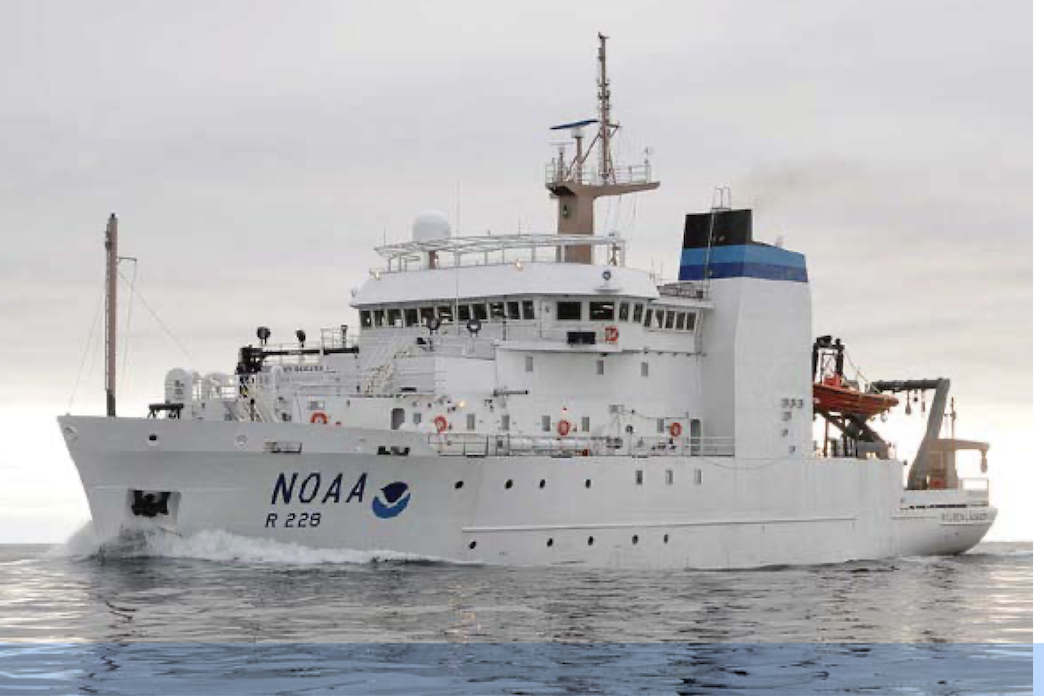
view of NOAA Ship Reuben Lasker underway, as seen from an adjacent vessel. The ship is painted white, and we can see the NOAA logo, the acronym NOAA, and the hull number R 228 painted on the hull.

NOAA Teacher at Sea

Jacqueline Omania

Aboard NOAA Ship Reuben Lasker

July 14- July 24, 2025

Mission: Oceanographic and Biological Monitoring of Davidson Seamount
Geographic Area of Cruise: Monterey Bay National Marine Sanctuary
Departure Port: Alameda, CA
Arrival Port: Alameda, CA

Date: July 9, 2025

Yes, I am back for a second chance! Last year, after a wonderful orientation at the Coral Lab in Galveston, I unexpectedly came down with Covid just days before my cruise on Thomas Jefferson. Thanks to the Teacher at Sea Program and specifically the support of Emily Susko, I was placed on a new cruise on Reuben Lasker in the Monterey Bay National Marine Sanctuary. I am so grateful for this chance to sail and learn in my local marine sanctuary. Easier yet, the port of departure- Alameda- is just a 20 minute drive from my home in Berkeley!

In this cruise, the Monterey Bay National Marine Sanctuary (MBNMS) will be working with Point Blue Conservation Science and the Monterey Bay Aquarium Research Institute to study the Davidson Seamount. The Davidson Seamount is an undersea mountain that rises 8,000 feet above the sea floor and hosts a unique ecosystem due to the nutrient rich waters that are pushed to the surface. It is located 50 miles offshore of central California. I am very excited to learn more about seamounts!

In our survey, we will sample the water above and adjacent to the seamount. We will also be surveying marine mammals and seabirds and their prey and collecting environmental DNA (eDNA) to understand animals that we are not able to observe. This data will help give a more complete picture of oceanography and biology of the entire seamount from its base to the ocean surface and help us to understand connections between climate, ocean conditions and marine life. One goal is to use this data to inform the shipping industry so that ships crossing the Davidson Seamount lower their speed to avoid hitting whales. This work is of great importance to me as I have been saddened by the many whale strikes in the Bay over the recent months. All of our work will be done on board Reuben Lasker, a 208ย ft research vessel equipped for both fishery and oceanographic research.

view of NOAA Ship Reuben Lasker underway, as seen from an adjacent vessel. The ship is painted white, and we can see the NOAA logo, the acronym NOAA, and the hull number R 228 painted on the hull.

NOAA Ship Reuben Lasker, Photo courtesy of NOAA

While I shared my background in my introductory blog last summer, there have been some new developments. First is the great news that after 9 years of leading student activism to end single use plastics in school meals, we began reusable dishware for school lunch. The change is not just for my school, but will be rolled out in all schools across the district, impacting 9,000 students daily and vastly reducing the plastic waste our schools generate. I am really happy that students will be able to experience more sustainable meals at school — since lunch is school too.

This school year, I also had the opportunity to travel for 12 days to Antarctica as a Grosvenor Teacher Fellow with National Geographic on the polar expedition ship Endurance. This life-changing experience of exploring the Southern Ocean deeply impacted both myself and my class. We spent the school year diving into a study of Antarctica, interacting with polar scientists and learning of the critical role Antarctica has for the health of our water planet. We discovered how our local actions impact the environment and affect places as far away as Antarctica.

Though I couldnโ€™t take my students on the voyage with me, I did instill in them the curiosity and joy I experienced exploring. Thus, my class became explorers of our local environment — the Berkeley Marina and the San Francisco Bay. In a series of 10 field trips, we learned to identify local birds, trawled and studied plankton and charted and sailed a course on the schooner Pegasus, engaged in multiple beach clean-ups (with data sheets) and camped on the cliffs in Marin overlooking the Pacific Ocean. I hope that through these joyful experiences of learning in nature, my students will be inspired to continue to grow their connection, curiosity and sense of caring for our planet — and especially for our ocean.

The following photos are included courtesy of Oxford Elementary.

Sailing on Pegasus (a youth sailing project)

Finally, I am especially excited for my Teacher at Sea experience because Monterey Bay is close to my heart. In 2019, my students and I participated in the Monterey Bay Aquariumโ€™s Ocean Plastic Pollution Summit; it was a life changing 2-day experience where we explored the aquarium at night, slept next to the tanks, listened to inspirational youth ocean activists and connected with students from all over California who were also working to solve the plastic pollution crisis. Many of the students pictured below are still active in working to protect our ocean by volunteering at the Marine Mammal Rescue Center or serving as youth representatives on our cityโ€™s Climate Commission.

a group photo of seven students and Jacqueline, in matching black shirts, in front of a backdrop that is printed with a school of fish and the words Monterey Bay Aquarium Ocean Plastic Pollution Summit
Ocean Plastic Pollution Youth Summit. Photo courtesy of Monterey Bay Aquarium

As I embark on this voyage of discovery, learning and adventure, these words of the great oceanographer and ocean activist Sylvia Earle, whom I deeply admire, come to mind:

โ€œThe ocean is the cornerstone of Earth’s life support system, it shapes climate and weather. It holds most of life on Earth. 97% of Earth’s water is there. It’s the blue heart of the planet โ€” we should take care of our heart. It’s what makes life possible for us.”

a photo of two women leaning toward each other and smiling for the camera. Jacqueline, on the right, holds up a handwritten note that reads: "To the Zero Waste Class - Bravo! With admiration and thanks for all you are doing to make a difference. Sylvia Earle.  December 2017."
With Sylvia Earle and my students (not pictured) in Alameda, CA

Thank you to the scientists and crew of Reuben Lasker for the opportunity to join you in this most important work!