Becky Moylan: Acoustics and Trawling, July 5, 2011

NOAA Teacher at Sea
Becky Moylan
Onboard NOAA Ship Oscar Elton Sette
July 1 — 14, 2011


Mission: IEA (Integrated Ecosystem Assessment)
Geographical Area: Kona Region of Hawaii
Captain: Kurt Dreflak
Science Director: Samuel G. Pooley, Ph.D.
Chief Scientist: Evan A. Howell
Date: July 5, 2011

Ship Data

Latitude 1940.29N
Longitude 15602.84W
Speed 5 knots
Course 228.2
Wind Speed 9.5 knots
Wind Dir. 180.30
Surf. Water Temp. 25.5C
Surf. Water Sal. 34.85
Air Temperature 24.8 C
Relative Humidity 76.00 %
Barometric Pres. 1013.73 mb
 Water Depth 791.50 Meters

July 5, 2011

Science and Technology Log

Work is going on 24 hours here on the ship. The crew have different shifts, so nothing ever stops. It may be 3:00 in the morning, and you’ll see people sorting fish, filtering water, or working the acoustics table.


Acoustics Computer Screen

To improve the accuracy of identifying what organisms are seen on the acoustic system, Sette researchers collect samples from the scattering layers at night using a large trawl net towed from the ship.One important part of the research here is using the acoustic system to find where groups of fish and other organisms are located. This is done with a “ping”, or noise, sent down in the ocean. The sound waves bounce back when they find something, letting scientists know where, and sometimes what, is swimming underneath. Computers keep data on all the different sound waves showing patterns of fish movement. They have found that some groups move upward during the nighttime, and then move back down during the day.

Cookie Cutter Shark
Cookie Cutter Shark
Trawl Net
Trawl Net

Every night on the ship, there is at least one trawl. The method of trawling started back in the 1400’s. Some people use these nets to catch large amounts of fish to sell, and that has been an environmental concern. NOAA is using this method as a scientific sampling, or survey, method to try and help the environment. They are trawling in the Epipalagic Zone (mid to shallow) which is around 200 meters deep, depending on the total depth at location and where the acoustics pick up signals.

Scientists want to find out the status of the smaller life in order to try and predict the outcome of the larger life. Only a small amount is caught for sampling. They weigh, sort, count, and study them. The goal is to be aware of what is happening in this area of the ocean. Some of the species they have found are different types of shrimp, squid, Myctopids, small crabs, and jellies. Last night they wound up with two Cookie Cutter Sharks. These results will then be combined with the measured acoustic data in order to improve the accuracy and effectiveness of acoustic monitoring.
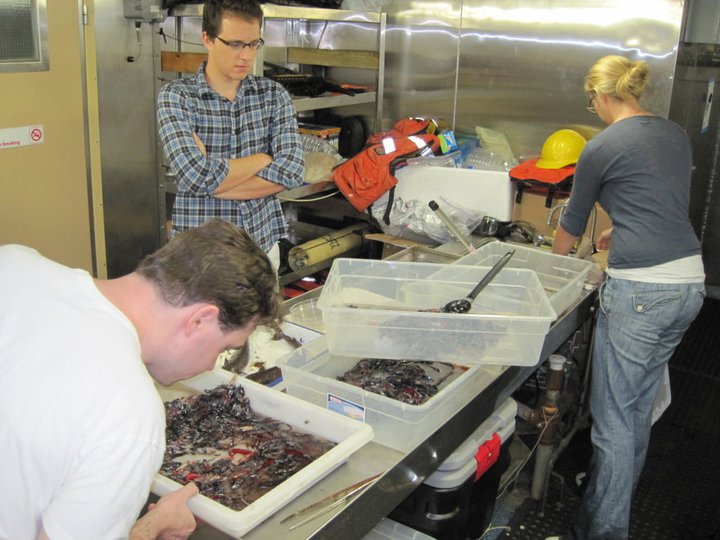
Examining a Trawl Catch
Puffer Fish
Puffer Fish

One scientist from New York, Johnathan, is looking for specific species of Myctopids. He studies them under the microscope and records detailed data found. The Myctopids are sometimes called Lantern Fish. This is because they have organs that produce light. The lights are thought to be a way of communicating with other fish and also as a camouflage. As mentioned earlier, some fish rise to shallower waters at night and the Myctopid is one of these. The reason might be to avoid predators, yet also to follow zooplankton which they feed upon.


Personal Log

Abandon Ship Suits
Abandon Ship Suits

Last night some of us went out on deck to watch the Kona fireworks. I didn’t realize how far out we were until I saw how tiny the little ball of colors appeared. You could see three different areas along the coast where they were shooting off fireworks. As a fourth of July treat, the cooks barbecued on deck and made special deserts. I especially liked the sweet potato pie.

This morning I was out at 6am preparing the CTD for deployment. It is getting easier each time. There are many precautions and steps to make sure the procedure is done correctly and safely. We could only drop it to 200 meters today because this area is shallower here. I watched and learned how to control the computer from the inside. Very impressive!

CTD Screens
CTD Screens

I’m wondering when the ship is going to have another “abandon ship drill”. That’s when we all carry our floatation suits to the upstairs deck and put them on, and it is not easy to do. You lay the suit down, sit on it, and put your legs in first. Then you stand up, pull the suit hood on, then lastly the arms. This is because the hands don’t have fingers. It is quite a funny sight.

I found out today that the 3am trawl ended up with only one fish because a Cookie Cutter Shark had eaten a round hole in the net. This is where they get their name. They always bite a round hole. Some have even eaten a hole out of humans!

Jacob Tanenbaum, October 12, 2008

NOAA Teacher at Sea
Jacob Tanenbaum
Onboard NOAA Ship Henry Bigelow
October 5 – 16, 2008

Mission: Survey
Geographic Region: Northeast U.S.
Date: October 12, 2008

Science Log

Here is a sample of what has come up in the nets overnight.

Sea stars and baby invertebrates

Here are several different types of sea-stars. I am always amazed by the wide variety of these creatures that exist in the ocean.

a brachiopod
a brachiopod

This little fellow might not look like much, but it has an interesting history. This creature is called a brachiopod. It belongs to one of the oldest family of creatures on earth. There have been brachiopods in the sea for at least 550 million years. That is long before there were even plants on land, let alone animals and dinosaurs. It is a simple shelled animal that has a single stalk that helps is stay attached to the rocks around it. Click here to learn more about this amazing creature.

a brachiopod
a sea cucumber

Here is a sea cucumber. They live at the bottom of the sea and can be found all over the world. They are used to make medicine in some countries in Asia.

Sargassum up close
Sargassum up close

Remember that large raft of sargassum weed we saw yesterday? Some came up in the nets today. Here is what it looks like close up. She the little pockets that hold air? They help the sargassum stay afloat.

This is a sea spider.

And of course, there is always garbage. We keep getting bits and pieces each time the nets come up. Here is a sampling. We found one entire Butterfinger candy bar with the chocolate still inside (no, we did not eat it), as well as some rope. How do you think it got here?

Let take a closer look at a sensor called a CTD. That stands for conductivity, temperature and depth. Remember the drifter buoy that we released a few days ago? It measures temperature on the top of the water and it can drift all over the ocean taking readings. A CTD takes its measurements as it descends through the water column and can go all the way to the bottom.

Trash pulled up with the rest of it

Have you ever seen barnicles move? They do. We found these huge barnicles in our net and we put them in water to encourage them to come out. Check out this video!

A lot of people have asked me about sea-sickness. Sea Sickness happens when your brain and body, which are constantly working to keep you balanced, get confused by the rocking of the ship. It is a terrible feeling, and I’m glad I have not been sea-sick at all on this trip. Some people do better than others on boats. I do not tend to get sea-sick unless the waves are very high, and I am used to the rocking of the ship now. The other night I was working on deck and I caught sight of the moon moving quickly across the sky. I wondered why it was moving so fast until I realized it was my ship that was moving in the sea and me with it. The moon only seemed to move. I guess that means I’m used to the rocking back and forth and hardly notice it now.

——————–

More marine debris
More marine debris

MLL, SPL and MCL, Snuggy and Zee are having a great time and none of us are sea-sick. I put more information about it in the upper part of the blog entry. Thanks for writing.

SQ, CS, KM and VM: It is nice fall weather. Not too hot, not too cold. I love it. I have not felt uncomfortable even when I am working out on the wet deck of the ship.

GG: It is not hard to sleep at all most nights. There was only one night where the waves were high and I bounced around too much to sleep well. The rest of the nights were fine. The ship rocks me to bed at night. I do miss WOS. See you soon.

Jacob Tanenbaum, June 17, 2006

NOAA Teacher at Sea
Jacob Tanenbaum
Onboard NOAA Ship Miller Freeman
June 1 – 30, 2006

Mission: Bering Sea Fisheries Research
Geographic Region: Bering Sea
Date: June 17, 2006

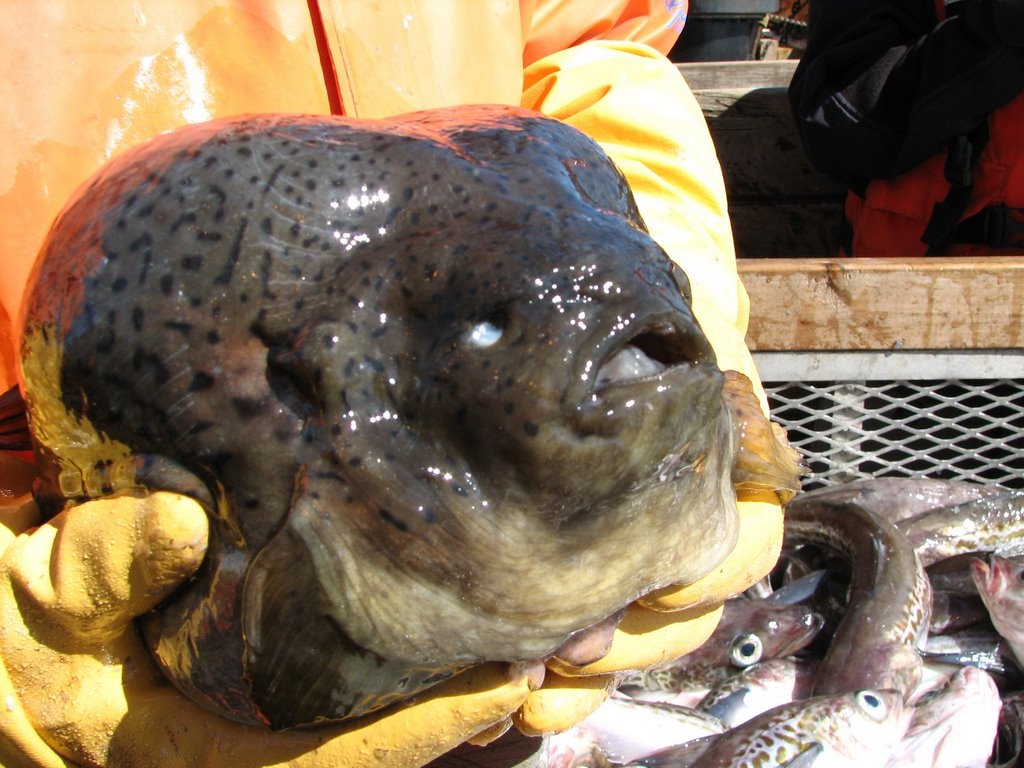
Smooth Lumpsucker fish.

Weather Data from the Bridge

Visibility: 14 miles
Wind Speed: 25 miles per hour
Sea Wave Height 7: feet
Water Temperature: 44.06 degrees
Air Temperature: 44.96 degrees
Pressure: 1009 Millibars

Personal Log

NOTE: We will arrive in the port of Dutch Harbor, Alaska on June 20. As the project draws to a close, I would like to evaluate how effective it was. There is a link to an electronic survey. I would like to ask students, teachers, parents, and other visitors to the site to take a few moments to let me know what you think of this idea. The survey is all electronic and only takes a minute or two to complete. Thank you in advance for your time. Click here to access the survey.

Well, we had pea soup for lunch today, also called storm soup by sailors. Legend is that when you serve pea soup, the weather will turn stormy, and sure enough, a gale is blowing nearby and the waves are picking up. The soup was great, though. As the ship rocks and rolls to the rhythm of the waves, lets take a closer look at how it moves. Sailors have lots of different terms for ships movement:

Pitch – refers to the up and down movement of the front, and back, or bow and stern of the ship

Yaw — when the ship spins from side to side.

Heave — When the entire ship moves up and down.

Roll — When the ship rocks from side to side.

Surge – When the ship jumps forward or backward.

Sway – When the ship jumps sideways.

Happy Father’s Day to all. A special hello to my own father, Elias, and my two son’s Nicky and Simon. I miss you, guys.

Science Log

Our trawl nets picked up the smooth lumpsucker fish near the bottom last night. This fish tends to say near the bottom and can inflate itself with water as a defense against predators. A good defense, I would say. Would you want to eat it?

Our survey continues. We brought in two hauls of fish this morning. Tamara is having less time on the bridge looking for birds in the last day or so. Her time is limited because we are fishing more and a large group of birds following a fishing net is not considered a natural occurrence, so she does not count them in her study. If the waves are too high, she cannot see the small birds in the troughs of the waves, so she can’t count during heavy seas, and right now, the seas are fairly heavy.

Question of the Day:

Look at the movements of the ship described above. When the ship drives into the wind and waves, sailors call it a corkscrew motion. Can you think why?

Answer to Yesterday’s Question

It is about 8:00 AM on Saturday morning. If the ship uses 2100 gallons of fuel a day, how many gallons of fuel will we need to get to Dutch Harbor on Tuesday Morning at about 8:00 AM?

It will take 3 days to reach Dutch Harbor. Since the ship uses 2100 gallons of fuel a day, we have to multiply 2100 x 3 which equals 6300 gallons of fuel. Enough for my car to drive 157500 miles. Wow.

Answers to Your Questions

Hello to James H from yesterday.

Thanks for writing