Lisa Carlson: โ€œNo life is too short, no career too brief, no contribution too small,โ€ July 16, 2023

NOAA Teacher at Sea

Lisa Carlson

NOAA Ship Bell M. Shimada

July 5, 2023 โ€“ July 19, 2023

Mission: Fisheries: Pacific Hake Survey (More info here)

Geographic Region: Pacific Ocean, off the coast of California

Date: July 16, 2023

โ€“ โ€“ โš“ โ€“ โ€“

Weather Data from the Bridge

July 14 (1200 PT, 1500 EST)
Location: 38ยฐ 34.9โ€™ N, 123ยฐ 42.7โ€™ W
15nm (17mi) West of Stewarts Point, CA

Visibility: <1 nautical miles
Sky condition: Overcast, fog
Wind: 19 knots from NW 330ยฐ
Barometer: 1014.6 mbar
Sea wave height: 3-4 feet
Swell: 5-6 ft from NW 300ยฐ
Sea temperature: 11.0ยฐC (51.8ยฐF)
Air temperature: 13.1ยฐC (55.6ยฐF)
Course Over Ground: (COG): 330ยฐ
Speed Over Ground (SOG): 10 knots

July 15 (1200 PT, 1500 EST)
Location: 38ยฐ 56.3โ€™ N, 124ยฐ 02.1โ€™ W
13nm (15mi) West of Point Arena Lighthouse, Point Arena, CA

Visibility: 10 nautical miles
Sky condition: Overcast
Wind: 20 knots from NW 340ยฐ
Barometer: 1013.1 mbar
Sea wave height: 3-4 feet 3-4
Swell: 7-8 ft from NW 320ยฐ
Sea temperature: 10.8ยฐC (51.4ยฐF)
Air temperature: 13.3ยฐC (55.9ยฐF)
Course Over Ground: (COG): 270ยฐ
Speed Over Ground (SOG): 9 knots

July 16 (1200 PT, 1500 EST)
Location: 39ยฐ 36.2โ€™ N, 124ยฐ 01.6โ€™ W
14nm (16mi) Northwest of Fort Bragg, CA

Visibility: 10 nautical miles
Sky condition: Overcast
Wind: 29 knots from NW 320ยฐ
Barometer: 1011.4 mbar
Sea wave height: 3-4 feet
Swell: 5-6 ft from NW 320ยฐ
Sea temperature: 11.3ยฐC (52.3ยฐF)
Air temperature: 13.9ยฐC (57.0ยฐF)
Course Over Ground: (COG): 280ยฐ
Speed Over Ground (SOG): 7 knots

โ€“ โ€“ โš“ โ€“ โ€“

Science and Technology Log

Without a vessel and without a crew, none of this mission would be possible. As Iโ€™ve said before, this crew is special. Like any job, employees are required, but that does not mean that you will work well cohesively and passionately towards a goal. The two weeks Iโ€™ve been spending with this crew who is so wholeheartedly excited about their job and role, while being on the ocean, has been so rewarding and inspiring. More later, this is starting to remind me of crying along with my sobbing fourth graders on the last day of school.

While Iโ€™ve discussed a lot of the daily operations of the crew and ship, and what Iโ€™ve been learning and working on myself, however, I have not discussed the vessel and agency that has made all of this possible. Many people question, โ€œWhat is NOAA?โ€ when I explain this opportunity.

About NOAA

NOAA logo: a circle bisected by the outline of a seagull, dark blue above the seagull's wings and lighter blue below. Around the circle read the words: National Oceanic and Atmospheric Administration, U.S. Department of Commerce.

โ€œThe National Oceanic and Atmospheric Administration (NOAA) is a U.S. government agency that was formed in 1970 as a combination of several different organizations. The purpose of NOAA is to study and report on the ocean, atmosphere, and coastal regions of Earth.โ€

National Geographic Education: โ€œNational Oceanic and Atmospheric Administration (NOAA)โ€

โ€œOur mission: To understand and predict changes in climate, weather, ocean, and coasts, to share that knowledge and information with others, and to conserve and managecoastal and marine ecosystems and resources.โ€
NOAA: โ€œAbout Our Agencyโ€

NOAA: โ€œAbout Our Agencyโ€

NOAA Ship Bell M. Shimada can carry a total crew of 24, which include NOAA Corps officers, engineers, other crew members, and scientists.

โ€œThe NOAA Commissioned Officer Corps (NOAA Corps) is one of the nationโ€™s eight uniformed services. NOAA Corps officers are an integral part of the National Oceanic and Atmospheric Administration (NOAA), an agency of the U.S. Department of Commerce, and serve with the special trust and confidence of the President.โ€

NOAA OMO: โ€œNOAA Commissioned Officer Corpsโ€

The Vessel

NOAA Ship Bell M. Shimada, commissioned in 2010, is a fisheries survey vessel designed to produce a low acoustic signature, built to collect data on fish populations, conduct marine mammal and seabird surveys, and study marine ecosystems. The quiet operation provides scientists the ability to study fish and marine mammals without significantly altering their behavior.

Stats and Specs (Link for more information)
Length: 208.60 ft
Beam (width): 49.2 ft
Draft (bottom of the lowered centerboard to waterline): 29.7 ft
Displacement (full load): 2,479 tons (4,958,000 lbs)
Speed: 11.00 knots
Endurance: 40 days
Range: 12,000 nautical miles
Home port: Newport, Oregon
Crew:
– 24 (5 NOAA Corps officers, 4 licensed engineers, and 15 other crew members)
– Plus up to 15 scientists

Namesake

โ€œ[Dr.] Bell M. Shimada (1922-1958), served with the United States Fish and Wildlife Service and the Inter-American Tropical Tuna Commission, and was known for his studies of tropical Pacific tuna stocks.โ€

Wikipedia: โ€œNOAAS Bell M. Shimadaโ€

The ship’s namesake was known for his contributions to the study of Tropical Pacific tuna stocks, which were important to the development of West Coast commercial fisheries following World War II. Dr. Bell Shimada and colleagues at Pacific Oceanic Fisheries Investigations (POFI) Honolulu Laboratory were among the first to study the population dynamics of tunas and the oceanography affecting their abundance and distribution.

a man (Dr. Shimada) wearing a white t-shirt, shorts, and red baseball cap stands holding a penguin. He grasps the penguin securely beneath its wings, which are spread out to each side. The man, and the penguin, look at the camera. He appears to be on a vessel - we can see some ocean water in the background - and we can tell that two other people are behind him, mostly obscured.

Dr. Bell M. Shimada, circa 1957.
Wikipedia: โ€œBell M. Shimadaโ€

โ€œIn her remarks at the christening and launch, [Dr. Shimadaโ€™s daughter] Julie Shimada offered the following, “I hope the Bell M. Shimada is a lasting testament that no life is too short, no career too brief, no contribution too small, to make a difference.โ€

NVC Foundation: โ€œNOAA Honors Nisei With Launch of Fisheries Vessel โ€œBell M. Shimadaโ€”

โ€“ โ€“ โš“ โ€“ โ€“

Interviews with the Crew
(Part 1 of 2)

(Take note of the similarities and differences between how these crew members chose an ocean-related career and got to be assigned to NOAA Ship Bell M. Shimada)


A photo of a photo in a wooden frame with a name plaque reading CDR Laura Gibson. The photo is a portait of a woman posing in a survival suit, hands in the air. She's wearing a navy blue hat that says Bell M Shimada R-227.

Executive Officer
Commander Laura Gibson

What is your role aboard NOAA Ship Bell M. Shimada?
CDR Gibsonโ€™s role includes a lot of administrative work, handling the budget, standing bridge watches as the Officer on Duty (OOD), along with other executive duties.

What do you enjoy the most about your role?
The mission and camaraderie of the crew, as well as getting to know the ship and happy, successful operations.

When did you know you wanted to pursue an ocean-related career?
CDR Gibson enjoys Scuba diving and grew up on lakes. She worked on a research ship in college and continued working on the water which led her to NOAA. She mentions her Dad as a large motivator and inspiration of wanting to pursue an ocean-related career.

What do you think you would be doing if you were not working for NOAA?
Working a boring 9-5 desk job!

Favorite animal
Rhinoceros

Fun Fact: she brings a stuffed animal dog with her from her son, named Barfolomew.

His nickname is Barf!

a stuffed animal (a brown dog with long black ears) photographed against a carpet

A photo of a photo in a wooden frame with a name plaque reading LT Nicole Chappelle. The photo is a portait of a woman wearing a blue jacket.

Operations Officer
Lieutenant Nicole Chappelle

What is your role aboard NOAA Ship Bell M. Shimada?
Coordinate with scientists to make the plan of the day, assist in navigation and operation of the vessel.

What do you enjoy the most about your role?
Nicole enjoys seeing all of the sea life and creatures, and hearing and learning what the scientists are doing and why.

When did you know you wanted to pursue an ocean-related career?
She originally wanted to work with animals, which she did as a member of a rehabilitation team at Sea World. She then wanted to join uniformed service. Nicole chose NOAAโ€™s uniformed service (NOAA Corps) because their science missions aligned with her interests.

What do you think you would be doing if you were not working for NOAA?
Working with animals and marine life or being a scuba instructor.

Do you have an outside hobby?
Horseback riding, Scuba diving, jogging, kayaking, hiking.

Whatโ€™s something you were surprised to see or learn about living and working onboard when you first started?
Nicole remarked on the times sheโ€™s been out in the ocean, hundreds of miles away from shore, and how few other vessels you see there. She says it gave her a much greater appreciation for just how big the ocean is.

Favorite animal
Horses


A photo of a photo in a wooden frame with a name plaque reading Deb Rose. This is a photo of woman wearing a green NOAA t-shirt, a purple bandana, and sunglasses.

Junior Engineer
Deb Rose

What is your role aboard NOAA Ship Bell M. Shimada?
Junior Engineer Deb Rose (in her words) handles the โ€œhotel servicesโ€ of the vessel. Her role includes plumbing, electrical work, repairs, and many other behind the scene tasks to keep the vessel running safely.

What do you enjoy the most about your role?
I get to fix stuff! Troubleshooting, figuring out whatโ€™s wrong, and fixing the problem were among steps that she described as part of her work onboard.

When did you know you wanted to pursue an ocean-related career?
While working at Firestone, Deb met and befriended Jason who became a wiper on NOAA Ship Oscar Elton Sette. She saw pictures and heard his stories of how he is now a licensed engineer, and decided to follow in his footsteps! She mentions Jason as a motivator that inspired her to pursue an ocean-related career.

What do you think you would be doing if you were not working for NOAA?
Continue to work on the Alaska Marine Highway ferries. (These ferries cover 3,500 miles of Alaskaโ€™s coastline.)

Outside hobbies: Video games, Scuba diving, swimming, fishing

Whatโ€™s something you were surprised to see or learn about living and working onboard when you first started?
How few women there still are in the industry. Deb has often been the only or one of the only female crew members both on land and at sea. She hopes that this trend will keep changing and that women will be in more engineering industries.

Favorite animal
Her favorite animals are the Jackson Chameleon and dogs.

Fun Fact: Humans are more related to salps than any other creatures we catch. She can also identify 12 Rockfish species!


A photo of a photo in a wooden frame with a name plaque reading Connor Rauch. The photo is a portrait of a man with glasses standing against a wall.

Deck Department
Connor Rauch

What is your role aboard NOAA Ship Bell M. Shimada?
Connor is a General Vessel Assistant as part of the Deck Department. He helps deploy and recover the trawl net and CTD rosette, stands watch as a lookout, helps keep the ship clean, and much more! He took classes at Seattle Maritime Academy for one year and is now applying his education on his first NOAA vessel!

What do you enjoy the most about your role?
He is enjoying his first assignment on a NOAA vessel and traveling up and down the Pacific coast. He says he is also enjoying being on the water, applying new knowledge to tasks, and training to a real ship. He also enjoys learning about trawling and commented on how nice the people onboard are.

When did you know you wanted to pursue an ocean-related career?
He wanted to try something new after working for a non-profit group during the Covid-19 pandemic assisting those in need. He decided to work on the water since he grew up sailing and kayaking. He thought of working on local ferries, but after taking classes at Seattle Maritime Academy, he had the confidence to apply for NOAA.

Do you have an outside hobby?
Reading, kayaking, camping, and hiking.

Whatโ€™s something you were surprised to see or learn about living and working onboard when you first started?
Connor said he was pleasantly surprised at how tight the crew is, how easy it is to sleep, how comfortable the ship is, and the good food!

Favorite animal
Beavers and dog

โ€“ โ€“ โš“ โ€“ โ€“

Personal Log

As this experience comes to the end, I reflect on all parts of this mission. The crew, vessel, marine life, food, sleep, friendships, and more. Iโ€™m so thankful I was able to have this experience and share NOAAโ€™s Teacher at Sea program more with coworkers, family, friends, and my students. Meeting and talking with the crew resulted in long conversations and plenty of laughs and connections amongst each other that they previously had not known.

Winds and swells picked up over the weekend and on Sunday July 16 we only caught six Hake. After that trawl and an increase in marine mammals being sighted when we were trying to trawl, fishing was called off for the rest of the Leg. At 1020 Monday July 17, we completed our last transect for Leg 2 of the Survey and headed due North for the long trek to Newport, Oregon. We still found ways to entertain ourselves, nap, snack, share stories and riddles, take photos of sunsets and marine mammals, watch shooting stars and have a movie night. Below are photos of our art craft: fish prints of two Chilipepper Rockfish!

โ€“ โ€“ โš“ โ€“ โ€“

Did You Know?

NOAA Ship Bell M. Shimada has an endurance, the amount of time the vessel can be at sea in a row, of forty days. This is not because the ship canโ€™t make its own fresh water through reverse osmosis from sea water, or a lack of fuel, oil, extra parts, or a way to exhume waste and trash in an environmentally friendly wayโ€ฆ

but because of food!

Our galley crew is amazingly talented and spoils us with a huge all you can eat buffet, desserts, and drinks every day! But, as per various laws and for the safety of the crew, they are lawfully entitled to fresh fruit, vegetables, meat, etc. within set guidelines and window of time.


โ€“ โ€“ โš“ โ€“ โ€“

Animals Seen Today

Pacific White-Sided Dolphins! Although these energetic friends caused us to abandon a trawl attempt after multiple marine mammal watches ended early because of their presence, they were so much fun to watch! I brought my DSLR camera up to the bridge deck and eventually sat down on the deck watching them jump and race through the ocean waters next to the hull. Below are some of my favorite photos I took of the pod.

Lisa Carlson: One Fish, Two Fish, Rockfish, Hake fish! July 10, 2023

NOAA Teacher at Sea

Lisa Carlson

NOAA Ship Bell M. Shimada

July 5, 2023 โ€“ July 19, 2023

Mission: Fisheries: Pacific Hake Survey (More info here)

Geographic Region: Pacific Ocean, off the coast of California

Date: July 10, 2023

โ€“ โ€“ โš“ โ€“ โ€“

Weather Data from the bridge:

July 7 (1200 PT, 1500 EST)
Location: 36ยฐ 00.4โ€™ N, 122ยฐ 05.9โ€™ W
16nm (21mi) West of Big Sur, CA

Visibility: 10 nautical miles
Sky condition: Overcast
Wind: 20 knots from NW 330ยฐ
Barometer: 1013.1 mbar
Sea wave height: 3-4 feet
Swell: 6-7 ft from NW 320ยฐ
Sea temperature: 14.0ยฐC (57.2ยฐF)
Air temperature: 14.4ยฐC (57.9ยฐF)
Course Over Ground: (COG): 323ยฐ
Speed Over Ground (SOG): 10 knots

July 8 (1200 PT, 1500 EST)
Location: 36ยฐ 34.5โ€™ N, 122ยฐ 05.3โ€™ W
17nm (20mi) Southwest of Monterey, CA

Visibility: 10 nautical miles
Sky condition: Few clouds
Wind: 19 knots from NW 330ยฐ
Barometer: 1013.8 mbar
Sea wave height: 5-6 feet
Swell: 6-7 ft from NW 330ยฐ
Sea temperature: 14.0ยฐC (57.2ยฐF) 13.7
Air temperature: 14.4ยฐC (57.9ยฐF) 14.3
Course Over Ground: (COG): 089ยฐ
Speed Over Ground (SOG): 10 knots

July 9 (1200 PT, 1500 EST)
Location: 37ยฐ 06.8โ€™ N, 123ยฐ 00.5โ€™ W
30nm (35mi) West of Pigeon Point Light Station, Pescadero, CA

Visibility: 10 nautical miles
Sky condition: Overcast
Wind: 13 knots from NW 332ยฐ
Barometer: 1016.0 mbar
Sea wave height: 2-3 feet
Swell: 4-5 ft from NW 310ยฐ 4-5
Sea temperature: 14.3ยฐC (57.7ยฐF)
Air temperature: 15.2ยฐC (59.4ยฐF)
Course Over Ground: (COG): 093ยฐ
Speed Over Ground (SOG): 10 knots

July 10 (1200 PT, 1500 EST)
Location: 37ยฐ 26.7โ€™ N, 123ยฐ 06.4โ€™ W
32nm (37mi) West of Pescadero, CA

Visibility: 8 nautical miles
Sky condition: Overcast, fog in vicinity
Wind: 20 knots from NW 330ยฐ
Barometer: 1015.9 mbar
Sea wave height: 2-3 feet
Swell: 3-4 ft from NW 320ยฐ
Sea temperature: 14.5ยฐC (58.1ยฐF)
Air temperature: 13.6ยฐC (56.5ยฐF)
Course Over Ground: (COG): 314ยฐ
Speed Over Ground (SOG): 3 knots

โ€“ โ€“ โš“ โ€“ โ€“

Science and Technology Log

Lisa poses for a photo in the wet lab with a hake fish. She's wearing heavy-duty orange overalls and large orange gloves. With her right hand, she grasps the fish by its open mouth, and her left hand holds on to the tail. We can see metal tables and equipment in the background.
Me holding a Hake before sorting. After observation, we determined this was a developmentally mature female, measuring 50cm (20in) long!

In my July 6 blog post, I explained how NOAA Ship Bell M. Shimada is equipped to collect acoustic data in the form of echo grams. The acoustics team uses the data to determine if there are enough return signals to suggest fish are present and attempt a trawl. In this blog post, I will explain how we get the fish onboard, and what we do with the sample of marine life once it is collected from the net.

One question I had after learning about the acoustics and environmental DNA (eDNA) pieces of the survey mission was, โ€œHow does physically collecting and researching Hake samples fit into the puzzle of understanding their ecosystem and supporting sustainable fisheries?โ€ (NOAA Fisheries quick facts and video here)

โ€œWhile echosounders are useful, they do not provide certain quantitative data that researchers need to understand the ecology of these organisms and the midwater zone. To collect quantitative data, such as biomass, length and weight, and age class distributions, researchers must gather representational samples and take direct measurements of them. The best way to do this is by employing trawls.โ€

NOAA Ocean Exploration: โ€œTrawlsโ€

So, although acoustics and eDNA research is important to the overall survey, they are only pieces of the puzzle, and the puzzle is not complete without conducting trawls and physically researching samples. NOAA Ship Bell M. Shimada uses a midwater trawl net that is deployed from the stern over the transom, and towed behind the vessel. As the name suggests, midwater trawls occur in the middle section of the water column, versus surface and bottom trawls. The net is conical in shape and uses two metal Fishbuster Trawl Doors, and two sets of heavy chain links called Tom weights, in order to keep the trawl in the middle of the water column.

a simple and stylized monochrome illustration of a fishing vessel towing a midwater trawl behind it. The net in tow is conical, attached at four points to two bars that hold the opening apart, and these bars are attached to lines (ropes) extending back from the vessel. This net is capturing two fish and missing a third.
NOAA Fisheries: โ€œFishing Gear: Midwater Trawlsโ€

โ€œThe midwater region is especially important because the creatures that inhabit it constitute the majority of the world’s seafood. Understanding the ecology of midwater organisms and their vast environment can provide us with better information to manage these important natural resources and prevent their overexploitation.โ€

NOAA Ocean Exploration: โ€œTrawlsโ€

Deck department assisting in recovering the trawl net after a successful deployment.

Two deck crewmembers work with an orange and white fishing net on the aft deck of NOAA Ship Bell M. Shimada. They are wearing foul weather gear, life vests, and hard hats. At right, one leans over the net, searching for remaining captured fish. The other approaches from the left, looking down at the net, to assist. We can see a cloud-capped mountain range in the distance beyond the water.

Once the net is onboard, the net is emptied one of two ways depending on the size of the sample. For large samples, marine life is deposited into a hopper and subsequent conveyor belt. For smaller samples, the Hake will be put into a large basket then divided into smaller baskets of approximately 100 Hake each. Any other marine life like Salps, Myctophids, Pyrosomes, Rockfish, King of the Salmon, and small bony fish, etc. are recorded in the database and returned to the ocean.

โ€œThe shipโ€™s wet lab allows scientists to sort, weigh, measure and examine fish. The data is entered directly into the shipโ€™s scientific computer network.โ€

NOAA Office of Marine and Aviation Operations (OMAO): โ€œBell M. Shimadaโ€
a large black plastic bin filled with fish - mostly hake, but a few splitnose rockfish (eyes bulging from the pressure change) stand out for their red color. An orange-gloved hand reaches toward the basket from the upper left corner of the image.

Large basket containing a sample of Hake with a few (red) Splitnose Rockfish.

With our boots and bright orange rubber pants and gloves on, our first task is to distribute the sample of Hake into baskets of about 100 each. Based on how many baskets we fill, a random selection of baskets will be kept, and the others will be returned to the ocean. With the remaining groups of Hake, we determine their sex and length.

In order to do this, we use a scalpel to make an incision on the underside/belly of the Hake. Once open, we are able to examine their organs, including the gonads to determine if the fish is male or female, and if they are developmentally immature or mature. Young Hake are difficult to sex, and it takes practice to get over any initial fears of cutting into an animal; let alone being able to locate and identify the gonads. Hake usually spawn in early winter, so many of the smaller Hake we sample from during the summer are age one or younger.

Our largest Hake thus far was a developmentally mature female, measuring 50cm (20in). In order to accurately and consistently measure the length of the sample, we use a waterproof, magnetic plastic board with metric (centimeter and millimeter) markings called an Ichthystick (think: high-tech meter stick). The fish is placed on the board with its mouth touching the black board at 0cm, then a magnetic stylus is placed at the fork of the fishโ€™s tail. Once the magnetic stylus is placed on the board, the length to the nearest millimeter is displayed on the LCD screen and automatically entered into the database program. The length data is grouped with the date, time, and identified sex for later observation and comparison.

Additional information, abstracts and outline about Ichthystick here

Ichthystickโ€™s LCD display, motherboard, magnetic board, and magnetic stylus. Digital scale in background.

Ichthystickโ€™s LCD display, motherboard, magnetic board, and magnetic stylus. Digital scale in background.

An even smaller subgroup is then selected and examined to record weights of individual Hake, collect ear bones called Otoliths for aging, stomach samples for diet, liver for RNA, and ovaries for maturity development. Otolith bones help determine the age of the Hake because they grow a new โ€œlayerโ€ of bone each year, similar to coral structures and annual tree rings. Organs and bones removed from the Hake are sent to NOAA Fisheries centers for analysis and included in databases with the date, identified sex, length, weight, and location in which they were collected.

This data is used to build more of the puzzle, along with acoustical information, water samples, and eDNA data in order to further understand the ecosystem, biomass, diet, and

โ€œsupport sustainable populations of Pacific hake on the West Coast.โ€ (โ€ฆ)
โ€œIt provides vital data to help manage the migratory coastal stock of Pacific hake. The hake survey, officially called the Joint U.S.-Canada Integrated Ecosystem and Pacific Hake Acoustic Trawl Survey, occurs every odd-numbered year.โ€

NOAA Fisheries: โ€œJoint U.S.-Canada Integrated Ecosystem and Pacific Hake Acoustic Trawl Surveyโ€

โ€“ โ€“ โš“ โ€“ โ€“

Personal Log

Although this subtopic of explaining the Integrated Ecosystem and Pacific Hake Acoustic Trawl Survey is a bit easier to understand than my July 6 Acoustics Lab post, it certainly does not mean itโ€™s an easy task!

When I had a tour on July 4, I remarked how clean and
organized the Wet Lab is. I hadnโ€™t see it in action yet, but noticed how everything had its place and use. On July 6 we conducted our first trawl and collected a sample of 11 baskets of Hake (approximately 1,100 Hake since we group about 100 Hake together in each basket.) From that sample, we kept four baskets and counted, sexed, and measured 541 Hake.

Five of us were working together in the Wet Lab for that haul. Iโ€™ll admit I probably
didnโ€™t sex 100+ Hake. It took a few minutes of watching the others carefully and swiftly cut into the underside of a fish, open the two sides, and know what to look for to determine the sex of very young Hake. Eventually I found the courage to slice in and take a look. By the fourth or fifth Hake, the uneasiness had subsided and I found the process very interesting and educational. Although young samples are hard to sex as they are often undeveloped, the others encouraged me and answered my questions and guesses with enthusiasm and support.

While working on measuring the lengths of our samples, one Science Team member paused and remarked how beautiful he found the fish. Although they do not have vibrant, bold colors, shimmering scales, or anything else particularly remarkable, he found the beauty in them. He digressed into a conversation of their role in the ecosystem, how they are living and breathing creatures, and how they probably all have their own personalities and slight physical differences. I noticed some of their eyes were shiny and sparkling, and how their faces and expressions were
noticeably unique the more you looked. That โ€œdown to earthโ€, heartfelt discussion was very special and demonstrated how the crew respects the process of catching and sampling Hake, while keeping each other and marine mammals safe.

From the NOAA Corps Officers, to the deck department, to the engineers,
electronics, science team, survey team, galley crew, volunteers, and everyone in between; the crew on NOAA Ship Bell M. Shimada is special. They take pride in their vessel and job, and always seem to have a smile and kind greeting. Being away from land and loved ones for weeks and months at a time will certainly take a toll on the body and mind, but this team is there for each other. To all of the crew, thank you for making me feel so welcomed and appreciated. Weโ€™re almost halfway through the mission, and as tired as I may get after (sometimes) 12+ hour days, I sleep well knowing the crew trusts their vessel and each other; and look forward to learning and becoming more and more acquainted each day with the people that make this mission possible. Thank you!

โ€“ โ€“ โš“ โ€“ โ€“

Did You Know? (FAQs)

1. Are you finding schools of them?

Weโ€™ve had seven successful trawls out of nine attempts for Pacific Hake fish. They often come with pyrosomes (Sea Pickle) myctophids (Lanternfish), and salps in the net too. Some trawl attempts are successful without a hitch, but more often than not we have to restart our Marine Mammal watches a few times before deploying in order to keep our ocean life safe and not get tangled in the net. Two trawl attempts have been abandoned because of the amount of persistent marine mammal life and playfulness near the ship. (I think they know weโ€™re watching and show off for our cameras.)

2. What’s your average depth?

The transects (Set and numbered longitudinal east-west lines NOAA Ship Bell M. Shimada navigates on while collecting acoustic data) usually range from 50m – 1,500m (164ft – 4,921ft) in depth.

  • However, right now one of the displays in the Acoustics Lab, the depth reading is 3,240m which is about 10,630ft or just over two miles deep! 
  • This depth is only 1,870ft shallower than the wreck of the RMS Titanic! 
  • (We were on a long transect, we do not often see depths this great.)

3. Have you gotten seasick? Seasickness should subside after about 3 days.

Iโ€™ve never gotten seasick thankfully! Knock on wood and all the other premonitions, please.

4. What is the Hake role in the ecosystem?

More info on this coming in later posts after explaining our Chemistry lab and technology aboard! 

  • However, as predators, they can be cannibalistic towards their own kind. 
  • As far as their role in human consumption: They are often used as a substitute for Cod and Haddock, and in fish sticks and imitation crab meat.

โ€“ โ€“ โš“ โ€“ โ€“

Animals seen July 5-July 10:

Mammals: Sea Lions, Harbor Seals, Dallโ€™s Porpoise, Rissoโ€™s Dolphins, Pacific White-Sided Dolphins, Northern Right Whale Dolphins, Humpback Whales

Birds: Gulls, Black-Footed Albatross

Bony Fish: Hake, Lanternfish (Myctophid), Flatfish, King of the Salmon, Split Nose Rockfish, Chili Pepper Rockfish

Other Marine Life: Giant or Humboldt Squid (15 foot tentacles in trawl), Spiny Dogfish Shark, Shrimp, Plankton, Krill, Sea Pickle (Pyrosome), Salp, Eel Larva

Lisa Carlson: Come Out, Come Out, Wherever You Are, Hake! July 6, 2023

NOAA Teacher at Sea

Lisa Carlson

NOAA Ship Bell M. Shimada

July 5, 2023 โ€“ July 19, 2023

Mission: Fisheries: Pacific Hake Survey (More info here)

Geographic Region: Pacific Ocean, off the coast of California

Date: July 6, 2023

Weather Data from the Bridge:

โ€” July 5 Departure
(1800 PT, 2100 EST)

Location: 37ยฐ 44.9โ€™N, 122ยฐ 39.2โ€™W
Docked at Pier 30/32
San Francisco, CA

Visibility: 10 nautical miles
Sky condition: Overcast
Wind: 17 knots from NW 300ยฐ
Barometer: 1012.8 mbar
Sea wave height: 1-2 feet
Swell: 2-4 ft from W 270ยฐ
Sea temperature: 14.2ยฐC (57.6ยฐF)
Air temperature: 14.7ยฐC (58.5ยฐF)
Course Over Ground: (COG): N/A
Speed Over Ground (SOG): N/A

โ€” July 6 (1200 PT, 1500 EST)
Location: 35ยฐ 38.2โ€™ N, 121ยฐ 18.9โ€™ W
16nm (18mi) West of San Simeon, CA

Visibility: 10nm
Wind: 6 knots from 330ยฐ
Barometer: 1013.9
Sea wave height: 1-2ft
Swell: 2-4ft from 280ยฐ
Sea wave temperature: 14.4ยฐC (57.9ยฐF)
Air temperature: 14.9ยฐC (58.8ยฐF)
Course Over Ground: (COG): W 270ยฐ
Speed Over Ground (SOG): 10 knots

โ€“ โ€“ โš“ โ€“ โ€“

Science and Technology Log

On July 6, our first full day at sea, we gathered in the acoustics lab to observe and keep watch on data from various screens. Data includes our current course plotted on a digital chart, a camera showing current sea state, measurements of the wind speed and direction, and displays of the multiple frequencies at which the Simrad EK80 transmitter emits sound. The EK80 is used while traveling on numbered longitudinal east-west lines called transects. NOAA Ship Bell M. Shimada navigates on these lines while collecting acoustic data along the west coast of the U.S. and into Canada, in hopes of finding schools of Hake to collect for surveying.

A topographic map of a portion of the coast of California. The topographies of the both the land (beige and green scales) and water (blue scale) are depicted. Black dots mark the locations of three coastal cities: Crescent City, near the top of the map; San Francisco, a little more than halfway down; and Morro Bay, toward the bottom of the map. Black horizontal lines mark transects extending west from the coast line. The black lines are marked with red or black x's (showing previous sampling locations, perhaps) and a couple have green triangles.
Map showing transects 1-45 off the coast of California. Transect 1 is south of Morro Bay, CA and transect 45 is near Crescent City, CA.
(We hope to survey transects 8-35 by Cape Mendocino, CA before traveling north to dock in Newport, OR.)

โ€œFor acoustic surveys, the ship uses a multibeam echo sounder (MBES) that projects a fan-shaped beam of sound that bounces back to the ship. The shipโ€™s MBESโ€”one of only three systems of its type worldwideโ€”acquires data from both the water column and the sea floor.โ€

NOAA Office of Marine and Aviation Operations (OMAO): โ€œBell M. Shimadaโ€

The Simrad EK80 emits sound waves from the hull of the vessel down to the sea floor. The process is very similar to a dolphin or bat using echolocation to find prey. Any object the signal hits that has a different density and reflectivity than the surrounding water will cause the waves to bounce back to the ship. An image, called an echo gram, is pieced together each time this occurs and the acoustics team is able to use this information to determine if there are enough return signals that suggest fish are present to attempt a trawl.

Fish that have swim bladders, like bony fish, reflect or echo the sound wave back to the vessel very strongly. Other marine life such as myctophids and zooplankton also have a different density than the sea water, and reflect sound, although not as strongly as fish with air-filled swim bladders. The sea floor itself also reflects sound very strongly, because of the density difference between water and rocks, sand, and mud.

Marine life that have swim bladders (represented in blue) reflect or echo the sound wave back to the vessel. Examples of such marine life include bony fish, myctophids, and zooplankton, as well as the sea floor itself, which has a different density than the sea water.

Image: Cross section example of a Black Sea Bass to show a swim bladder.

an illustrated diagram of the internal anatomy of a bony fish (perhaps a black sea bass). Labels mark the locations of the gills, kidney, swim bladder, urine bladder, gonad, intestine, spleen, stomach, liver, and heart.

If the acoustics team determines there is enough marine life (that they are interested in surveying) to attempt a haul, they will notify the bridge deck and officers that they would like to have the fishing net deployed.

Before an attempted haul, the science team conducts a marine mammal watch for ten minutes. In this time window, several pairs of eyes are observing from the bridge deck and stern for any signs of dolphins, whales, sea lions, seals, and any other marine mammals that are within 500 meters of the vessel. If any marine mammals are spotted within the ten minute observation, we will stand down and wait ten minutes before restarting the marine mammal watch. Net deployment cannot occur until the full observation window has completed.

First haul July 6:
1422-1432 Mammal watch, no marine mammals spotted.
The net deployment started, at which time the vessel continues forward at two knots. Vessel speed increases to three knots when the net is fully deployed with doors and weights in the water, which assist in opening the conical shaped net outwards linearly and laterally. During this time the science team watches displays of the EK80 frequencies and observe the linear width and depth of the net. Scientists can compare these displays to determine if the net is in the correct position to have the best chance of collecting fish.

Hauling back the net occurs after several minutes, at which time the vessel returns to a speed of two knots, and we estimate how many fish were collected. The amount of time in which the net is submerged depends on the depth of the water and acoustic information about the size of the school of fish the net is (hopefully) sampling. After recovery, the haul is deposited into a hopper which feeds onto a conveyor belt in the wet lab, then into large baskets and the wet lab team takes over.

During the first attempt, two sea lions were spotted which required the haul attempt to be paused. We restarted the ten minute marine mammal watch from 1500-1510, the deck department retrieved and reset the net, and the vessel was turned around to return to the start of the noted longitudinal transect. With no marine mammals spotted during the observation period, the second attempt was successful and resulted in:

– 1604-1634: 30 minute haul at 350m depth.

– 11 baskets of Hake collected.

– 4 sample baskets kept at random.

– 541 Hake counted and studied in the wet lab.

Photo: Two deck department members about to open the net to allow the sample to drop into a large collection basket.

Two crewmembers, dressed in orange paints and black and neon yellow coats, face away from the camera, toward a large orange net suspended from above. They may be working to empty the net.

โ€“ โ€“ โš“ โ€“ โ€“

Personal Log

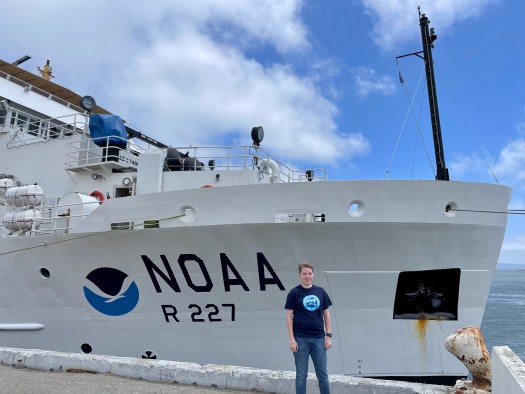
On July 4 I arrived to pier 30/32 in San Francisco, CA to board NOAA Ship Bell M. Shimada. Although I grew up volunteering on the 441โ€™ WWII Liberty Ship SS John W. Brown in Baltimore, MD, seeing a new ship still resulted in a mix of emotions, nervousness, adrenaline, excitement, and everything in between. After five and a half years, finally seeing the 208โ€™ vessel that would become my home for the next two weeks was a core memory and feeling I will always remember.

NOAA Ship Bell M Shimada in port, as seen from a point on the dock beyond the bow. We can see the NOAA logo and read: NOAA R 227. The water is calm and turqoise; the sky is blue with clouds. A portion of what may be the Golden Gate Bridge is visible in the background.
NOAA Ship Bell M. Shimada docked at Pier 30/32 in San Francisco, CA on July 4

Once onboard, I met Chief Scientist Steve de Blois and Wet Lab Lead Ethan Beyer. I was given a tour of the acoustic, chem, and wet labs and shown to my cabin. After dinner ashore, I joined some of the crew on the flying bridge to watch the July 4th fireworks. I met additional science team members and enjoyed a long nightโ€™s rest.

In the morning on July 5, we had a welcome aboard meeting, various trainings, a safety meeting and orientation, fire and abandon ship drills, and a science team meeting. We introduced ourselves, took an official team photo, and soon departed pier 30/32 for our 14 day mission. After passing under the Golden Gate Bridge and heading to the Pacific Ocean, our cold hands were warmed by a wonderful hot dinner of chicken, steak, fresh veggies, salad, and desserts from our galley crew. After dinner, we settled in for our first night at sea, waiting with anticipation for our first trawl on July 6.

โ€“ โ€“ โš“ โ€“ โ€“

Did You Know?

an orange-gloved hand holds a hake (fish) up so that it faces the camera. We can see the another smaller hake hanging limply across its open mouth

– Hake can be cannibalistic!
– Some larger Hake we have collected have had a smaller Hake in their mouth, throat, or stomach!
– Their very sharp teeth often stick to our thick rubber gloves.

โ€“ โ€“ โš“ โ€“ โ€“

New Terms/Phrases:

โ€œSalp: Barrel-shaped, planktonic tunicate in the family Salpidae. It moves by contracting, thereby pumping water through its gelatinous body.โ€

Wikipedia: โ€œSalpโ€

โ€œMyctophid: Lanternfish (or myctophids, from the Greek ฮผฯ…ฮบฯ„ฮฎฯ myktแธ—r, “nose” and ophis, “serpent”) are small mesopelagic fish (โ€ฆ) Lanternfishes are aptly named after their conspicuous use of bioluminescence.โ€

Wikipedia: โ€œMyctophidโ€

Simrad EK80: Multibeam Echo Sounder (MBES) transducer that emits sound waves from the hull of the vessel down to the sea floor. It allows scientists to observe and study returned sound wave signals that may suggest marine life is present.

Transect: Set and numbered longitudinal east-west lines NOAA Ship Bell M. Shimada navigates on while collecting acoustic data.

Daniel Rivera, Days 3 & 4 Bird & Mammal Observation

NOAA Teacher at Sea

Daniel Rivera

Aboard the Ship R/V Fulmar

July 16-24, 2014


Mission: Water conductivity, temperature, and depth (CTD) readings; marine bird and mammal counts

Geographical Area: Gulf of the Farallones and Cordell Bank National Marine Sanctuaries; Sonoma County Coast, Pacific Ocean

Dates: July 18 and 19, 2014

ย Weather Data from the bridge: Wind speed variable, less than 10 knots; wind waves less than 2 feet; visibility about 3 KMs, temperature range from 59-68

ย Science and Technology Log: Friday and Saturday are mostly filled with marine bird and mammal observations, and we covered many transect lines in the last 2 days: Lines 1, 3, 5, 7, N1, and N3-N7.

These are the paths, or transect lines, taken by our ship on our cruise.

The transects lines with an โ€œNโ€ stand for near-shore lines, and they are shorter. During these two days the near-shore lines were the only lines where we took CTD readings, so the majority of the time was spent monitoring birds and mammals from the flying bridge, which is the top deck of the boat.

Scanning for birds and mammals while riding atop a moving vessel can be quite challenging for a number of reasons. First of all, a boat is at mercy of the waves, so the bobbing motion makes it hard to focus your eyes. Second, the organisms you are monitoring are in motion as well, so you have to have a quick eye to see them and follow them. Finally, many of the organisms arenโ€™t directly in front of the boat, so you have to be well-trained in spotting the subtle and not so subtle differences in hundreds of organisms. Itโ€™s a tough job that requires good eyes, patience, a strong stomach, lots of practice, and the ability to withstand ever-changing weather conditions.

When a marine bird is spotted, there are a series of codes that the watcher calls out to the person recording the sightings on the laptop. As mentioned in an earlier post, these codes stand for location, number of organisms, etc. For example, when on the top deck you might here this: Common Murre 2, zone 1, flying, 160. This means that there are two Common Murre birds within 100 meters of the boat, and they are flying toward 160 degrees in relation to the boat (in a 360-degree circle). For this protocol, zero degrees is always at the bow, or the front, of the boat, and 180 degrees points directly to the stern, or the back, of the boat.

When a marine mammal is sighted, there are even more codes. For example, you may hear this: Mammal, by eye, bearing 270, reticle 7, observer 9, side 1, traveling, immature, sex unknown, 2-2-2.

Now, that is a lot of information. What does all this mean? Take a look at this picture, which has the meanings for all of the codes.

Here are the codes that are called out while monitoring marine mammals and birds. As you can see, there is a lot of information that is called out during a spotting.

Now look at the bottom half of this picture where itโ€™s labeled Line Transect Entries-Marine Mammals and Vessels. In order to make sense of these codes, start with the left column and work your way down, moving along to the second column on the right and back down again. By using this chart, you realize what is being said: Marine mammal, spotted by eye (as opposed to binoculars), and itโ€™s located at 270 degrees. Next up is reticule, which is a bit more complicated.

On reticule binoculars, there are 14 tick marks in a vertical column that the observer can see when looking through the lens; the top tick mark is 0 and the bottom is 14. When looking for marine mammals, you can estimate where they are located by these tick marks, called reticules. Reticule 0 is the horizon, and reticule 14 is the boat. If you have a mammal sighting at reticule 7, that means the mammal is roughly somewhere in the middle between the horizon and the boat, which is quite a distance. It takes a lot of practice to accurately estimate distance this way, especially on a rocking boat, but the ACCESS crew is well versed in this task. This is an important data point because the computer program will use compass direction and distance to provide a location on the ocean for the observation. At the end of the cruise, all the observations will be mapped out and you can see how many of which animals were seen in what locations as we criss-crossed the ocean on the boat.

The rest of the codes are pretty self-explanatory until you reach the counts, which gives your best estimate for number of organisms. A count of 2-2-2- means your best estimate of number of organisms is 2, the high number of organisms is 2, and the low count is 2; when you hear a call like this, the observer is certain that the number of organisms is 2 because there is no fluctuation. If you heard a count of 2-3-2, the observer saw at least 2 organisms but it could have been 3. The observers include these different estimates because sometimes it is very hard to count exactly how many dolphins or other fast-moving animals there are.

Here are some pics from the flying bridge (or top deck of the boat). Notice the different weather conditions on two different days, and how the observers have to be prepared to bundle up for the fog and have on hats and sunglasses against the sun. Conditions can change rapidly while at sea.

Many hours are spent perched atop the flying bridge when marine mammal and bird observations take place.

A sunny day on the flying bridge.


Personal Log: I woke up later these past two days because I learned there is time to wake up while the boat is heading out to the first transect. There is no need to wake up before the crew starts the engines because on days such as these we have at least one hour from when we leave port to ready ourselves for the tasks at hand.

As mentioned earlier in the blog, these past two days were mostly bird and mammal observations with CTD readings toward the end of the day. When the boat first set out in the morning, we headed out to the west end of the transect line, and because we have more time, everyone on board shares stories, some work-related, some personal. Itโ€™s quite nice to have time for these conversations because even though you spend 8 days at sea with everyone, itโ€™s hard to fit in conversation when youโ€™re watching for organisms or trying not to fall off the boat while deploying a net.

Dani Lipski, the Research Coordinator from Cordell Bank National Marine Sanctuary, is a dive master for NOAA. She has lots of wonderful stories about diving, conducting research on different ships and islands up and down the West coast, and she is great at preventing me from tripping over myself on the back deck (I work with Dani the most). Kirsten Lindquist, from the Farallones Marine Sanctuary Association, loves to cook, spent two seasons in Alaska studying whales, and is an expert seabird observer. Rudy, the man in charge of IT at Farallones Marine Sanctuary Association, can spot birds, mammals, and even mylar balloons; if itโ€™s on or in the ocean, heโ€™ll notice it. He is also the resident comedian, providing many instances of humor throughout the day. In short, everyone on board is knowledgeable about their jobs and dedicated to protecting the health of the worldโ€™s oceans, and itโ€™s inspiring to be around a group as dedicated as the ACCESS cruise team.

Some other tidbits learned: Jaime–the director of all the marine work at Point Blue Conservation and the master of the Tucker Trawl–has a favorite spot to rest on the boat; the bunk rooms never seem to completely dry out; the best place to feel wellย on a boat is the back because of the least amount of up and down motion; and Dru, mammal spotter extraordinaire from Farallones Marine Sanctuary Association, can make an excellent guacamole.

Speaking of food, Cheez-Itโ€™s are a favorite of everyone on board, Coke Zero is consumed at nauseam, and apparently the presence of M&Ms brings whale sightings (having a Teacher at Sea on board also seems to bring good whale sightings). Everyone takes turns cooking dinner, but breakfast and lunch are a free-for-all; you basically eat when you want or can while at sea, but dinner is a time for everyone to come together and share their day.

One interesting fact I forgot to mention is that when you come back to shore after spending 10 hours at sea, you still feel like you are moving up and down. When I was in the shower or even just sitting down on land, I felt like I was bobbing up and down and moving back and forth. You have a dizzy-like feeling,. Some people who donโ€™t get sick at sea will get sick from this feeling when they return to land; this is called dock rock. Who knew?!

ย 

Did you know? Northern Right whale dolphins do not have dorsal fins.

Question of the Day? What types of foods do you think are ideally suited to a trip to sea with limited or no refrigeration?

New Term/Phrase/Word: Reticule

Something to Think About: Bananas on a boat are considered bad luck for several reasons. First, when they go bad the give off a gas that causes other fruit to rot faster. But there are more superstitious reasons as well: banana boats tended to be overloaded and, thus, sank a lot. Bananas carry tarantulas in them, so sailors didnโ€™t want to get bit. You donโ€™t want to bring something from the mountains to the sea, so you canโ€™t bring bananas; there are sure to be more reasons why.

Challenge Yourself: Next time youโ€™re at the shore or beach, count how many different species of birds you see and try to estimate their direction of travel, using a 360-degree circle as reference and using the horizon as 0 degrees.

Kacey Shaffer: Let’s Go Fishing! August 1, 2014

NOAA Teacher at Sea

Kacey Shaffer

Aboard NOAA Shipย Oscar Dyson

July 26 – August 13, 2014

Mission: Walleye Pollock Survey

Geographical Location: Bering Sea

Date: August 1, 2014

Weather information from the Bridge:

Air Temperature:ย 9.7ยฐ C

Wind Speed:ย 11.9 knots

Wind Direction:ย 153ยฐ

Weather Conditions:ย Foggy

Latitude:ย 58ยฐ19’42 N

Longitude:ย 175ยฐ14’66 W


Science and Technology Log: ย  ย  ย  ย  ย  ย 

If you’ve ever been fishing, be it on a lake, river or stream, you know it is not productive to fish all day in a spot where they aren’t biting. If the fish aren’t biting in one spot, you would most likely pack up and move to a different spot. Now imagine trying to fish in an area that is 885,000 square miles. The equivalent to trying to find a needle in a haystack! Luckily, the Oscar Dyson has sophisticated equipment to help us determine where the fish are hanging out. Allow me to introduce you to a very important location on the ship โ€“ The Acoustics Lab.

When you enter The Acoustics Lab, youโ€™ll immediately see a wall of nine computer screens. The data shown on the screens help Chief Scientist Taina and Fishery Biologist Darin make the key decision of where we will deploy the nets and fish. What information is shown on the screens? Some show our location on the transect lines we are following, which is similar to a road map we would use to get from point A to point B on land. The transect lines are predetermined โ€œroadsโ€ we are following. Another screen tells us which direction the boat is heading, barometric pressure, air temperature, surface temperature, and wind direction and wind speed. The most technical screens show the data collected from transducers attached to the bottom of the ship on what is referred to as the Center Board. There are five transducers broadcasting varying frequencies. Frequency is the number of sound waves emitted from a transducer each second. The Dyson transducers emit sound waves at 18kHz, 38kHz, 70kHz, 120kHz and 200kHz (kHz= kilohertz). Why would it be necessary to have five transducers? Certain organisms can be detected better with some frequencies compared to others.ย  For example, tiny organisms like krill can be seen better with higher frequencies like the 120kHz compared to the lower frequencies. Also the lower frequencies penetrate farther into the water than the higher frequencies so they can be used in deeper water. Having this much data enables the scientists to make sound decisions when choosing where to fish.

A map of the Bering Sea showing transect lines in white. During this pollock survey the Oscar Dyson follows transect lines which benefits both the crew and scientists.

Transducers produce these images displayed on the screens in the Acoustics Lab. The thick red line at the bottom is the sea floor and the  many red, oblong shaped areas indicate large clusters of fish. Letโ€™s go fishing!
Transducers produce these images displayed on the screens in the Acoustics Lab. The thick red line at the bottom is the sea floor and the many red, oblong shaped areas indicate large clusters of fish. Letโ€™s go fishing!

Personal Log:

Each time I share a blog post with you I am going to focus on one area of the ship so you can get acquainted with my new friend, Oscar Dyson. Iโ€™ll begin sharing about my stateroom and the lounge. I was very surprised by the size of my room when I arrived last Thursday. My roommate is Alyssa, a Survey Tech. You will learn more about her journey to the Dyson later. She has been on the ship for a while so she was already settled in to the top bunk which put me on the bottom bunk! The beds are very comfortable and the rocking motion of the ship is really relaxing. Iโ€™ve had no trouble sleeping, but then again, when have I ever had trouble sleeping?! We have our own private bathroom facilities, which is a definite bonus. Take a look at our room.

The stateroom Kacey shares with Alyssa.

Our stateroom's private bath. Could that shower curtain be any more fitting?!
Our stateroom’s private bath. Could that shower curtain be any more fitting?!

Alyssa and I are on opposite shifts. She works midnight to noon and I work 4:00pm to 4:00am. There is a little bit of overlap time where sheโ€™s off and I havenโ€™t gone to work yet. This is quite common for all of the people on the ship. This is a twenty-four hours a day, seven days a week operation. Someone is always sleeping and someone is always working. Fortunately there is a place where we can hang out without bothering our roommates. The Lounge is a great place to kick back and relax. There are comfy chairs and a very large couch and a television with the ability to play dvdโ€™s or video games. Over the years people have brought books with them and then left them on the ship so we have an enormous library. Sometimes there are people just reading in the Lounge and other times a group of us will watch a movie together. There is one important rule of showing moviesโ€ฆif you start a movie you have to let it play all the way out. Even if you get bored with it or need to leave you must let it play because someone may be watching it in their room. It would be rude of us to continually shut movies off an hour into them!

Career Connections: ST Alyssa Pourmonir

ST Pourmonir checks data on the computer during a CTD deployment.

Alyssa hails from Pennsylvania. During her senior year of high school she chose to further her education at the Coast Guard Academy. She spent three years studying with the Coast Guard, but ultimately graduated from SUNY Maritime this past January. Alyssa landed a 10 week internship with a NASA facility in Mississippi. During the course of her internship she learned of an opportunity with NOAA. This position would be a Survey Tech, traveling on one of NOAAโ€™s many ships. She arrived at the Dyson only a few weeks before I did.

Alyssa has many responsibilities as a Survey Tech. She assists with the deploying and recovery of the CTD instrument, helps process fish in the wet lab, completes water tests, and serves as a liaison between the shipโ€™s crew and its scientists. When a trawling net is deployed or recovered, Alyssa is on the deck to attach or detach sensors onto the net. She also looks for safety hazards during that time.

When asked what the best part of her job is she quickly responds learning so much science is the best! As a Survey Tech, she gets the chance to see how all the different departments on the ship come together for one mission. She works closely with the scientists and is able to learn about fish and other ocean life. On the other hand, she also works side-by-side with the shipโ€™s crew. This allows her to learn more about the shipโ€™s equipment. Being the positive person she is, Alyssa turned the hardest part of her job into a benefit for her future self. Adjusting to 12 hour shifts has been a challenge but she noted this can also be helpful. When she is super busy she is learning the most and it also makes the time go faster.

Looking ahead to her future, Alyssa sees herself getting a Masterโ€™s Degree in a science related field. Some areas of interest are oceanography, remote sensing or even meteorology. Alyssaโ€™s advice for all high school students: STUDY SCIENCE!

Did you know?

Lewis Richardson, an English meteorologist, patented an underwater echo ranging device two months after the Titanic sunk in 1912.