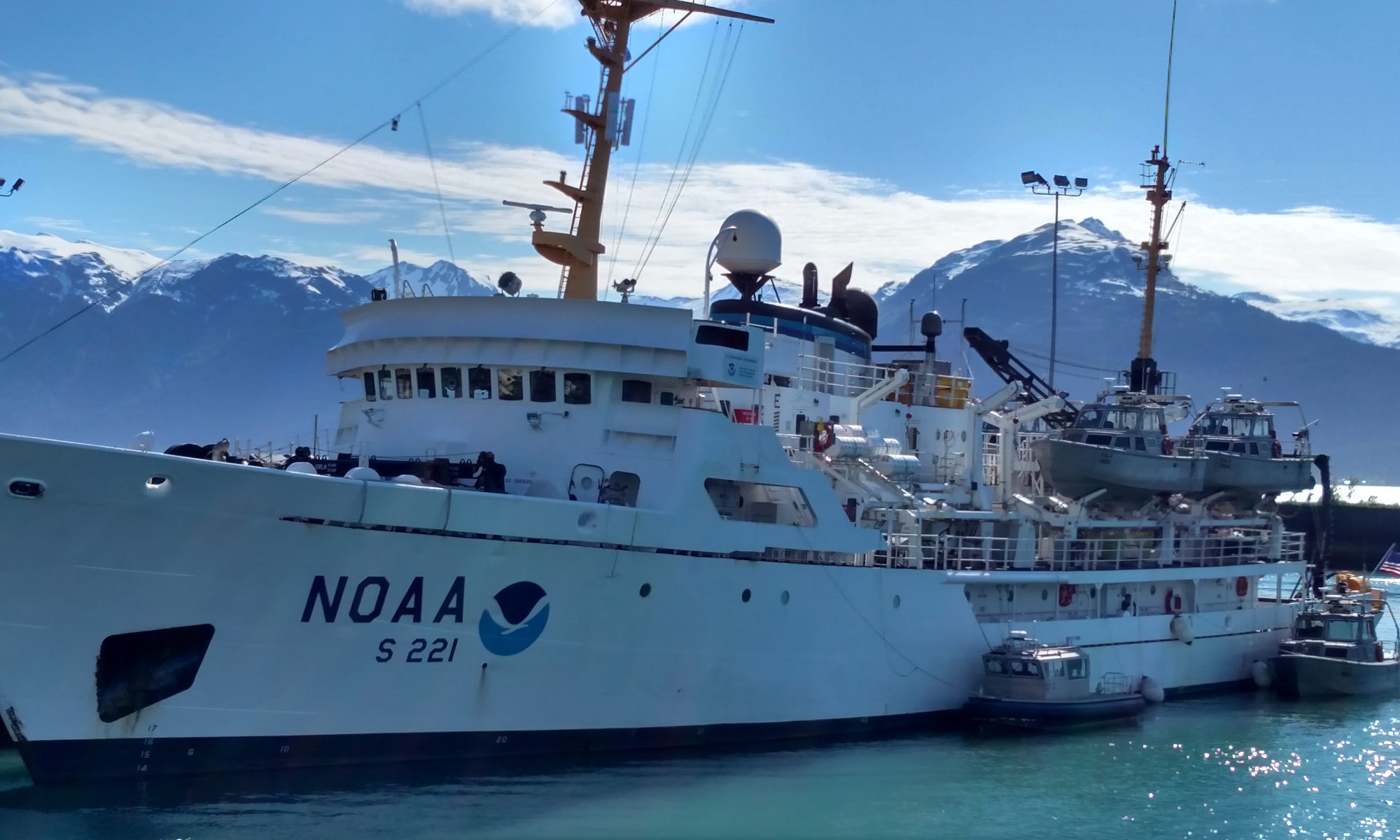
Janet Nelson: Sand Dollars and Sea Stars! June 20, 2012

NOAA Teacher at Sea
Janet Nelson Huewe
Aboard R/V Hugh R. Sharp
June 13 – 25, 2012

Mission: Sea Scallop Survey
Geographic Area: North Atlantic
Wednesday, June 20, 2012 

Weather Data from the Bridge:
Latitude: 41.03.21 North
Longitude: 071 32.79 West
Air temp: 21 C
Wind Speed: 15.6 kt
Depth: 135.2 feet

Science and Technology Log:

I came on shift yesterday at noon with three back to back dredge tows (we have done 30 dredges thus far on Leg II). We are off the coast of Long Island. Most of the dredges around here have been filled with sand dollars and sea stars. In total, we have processed and counted on this leg of the survey 5, 366 scallops, 453 skates, and 58 Goosefish, a very interesting fish that  buries itself in the sand and uses a filamentous lure to attract prey and engulf them. In addition, we have counted 132, 056 sea stars (wow!) and 590 crabs. The HabCam had some glitches yesterday but we began running the vehicle on our shift at approximately 1245 hrs. It made a run for approximately three hours and 57 minutes, with approximately 22.387 nautical miles of pictures before we dredged again.

While looking at the images of the HabCam, it astounds me at seeing prior dredge track marks from commercial scallopers and clamers. By looking at the side scan sonar, some of the dredges are very deep and very invasive. It reminds me of strip mining and clear cutting in terrestrial ecosystems. It is also evident, by observing the images, that little is left in those areas but shell hash. With that said, there are still some interesting species that get photographed, such as jelly fish and sea stars in patterns you would think they orchestrated.

We are working our way toward Georges Bank and will be there, from what I’m told, sometime late this afternoon or evening. All equipment is running well and what time we lost with the late departure has mostly been made up. It’s amazing what technology can do!

Personal Log:

As of yesterday, I have been away from home with little to no contact for six days, so when I was told yesterday morning prior to coming on shift that we had cell phone signal, I immediately went up on deck and called my husband! Although I only got an answering machine, it was good, and familiar, to hear his voice.

We then had a fire drill at noon and after that, set to work. It was nice to be outside working for the next 4 hours. I think I finally have my sea legs. However, the seas have also been cooperating with only 1-3 foot swells, at best. When they are higher, I sometimes feel like the Scarecrow in “The Wizard of Oz”. It’s a good thing I can laugh at myself when I look completely ridiculous while tripping through a door or, with no warning whatsoever, bump into a wall!  From what I understand, this ship has a flatter bottom than most so every wave and swell catches it and tosses it in whatever direction that wave is going, despite having just gone in the opposite direction! I am hoping the sea remains calm when we get to Georges Bank.

I am learning a great deal about the critters that live in the ocean around here. It is so strange to have at times hundreds upon hundreds of sand dollars being pulled up in the dredge at one location and then to have mostly sea stars pulled up at another location. My favorite, however, are the hermit crabs! They are so cool! They will begin to crawl out of their shells, see you coming to pick them up and immediately crawl way back inside and stare at you. I actually think I saw one blink at me. Not really, but my imagination does run away at times.

Those are also the times someone, usually me or the watch chief (chief scientist is guilty of this too!), bursts into song or starts quoting a movie line, and then half the crew is joining in. I have gotten more proficient at using the technology equipment on board that does the recording of the measurements of the specimens, and also at cutting/shucking the scallops. Never thought I would know how to do that! I have a feeling there are a few things I never thought I would do before this cruise is over. I have five more days at sea. Anything is possible!

Side note: Today is beautiful for being at sea! Clear sky, moderate winds, and sea legs that are working!!

Cheers!

This slideshow requires JavaScript.

Anne Byford, June 15, 2010

NOAA Teacher at Sea
Anne Byford
Aboard R/V Hugh R. Sharp
June 8 – 15, 2010

Mission: Sea Scallop Survey
Geographic Location:  off the coast of New England
June 15, 2010

Aboard: R/V Hugh R. Sharp

Weather Data at 1:30pm

EDT: Clear and sunny, 14.5˚C

Location at 1:30pm

EDT: Lat: 41 23.78 N

Long: 66 56.64 W

Water Depth: 68.2 m

8th Day at Sea

What kinds of things are you going to catch? Part 2 – non-fish along with a few new fishes

 There are many more species in the areas than I have listed here; these are simply the ones that I found most interesting. There are several different types of bivalves, sea weeds, etc. Material about the species on this page came from several sources, including the Bigelow and Schroeder’s book referenced in the previous posting. Also, Kenneth Gosner’s A Field Guide to the Atlantic Seashore published by Houghton Mifflin Company in Boston, Ma, 1978. I also used Norman Mein-Koth’s Field Guide to North American Seashore Creatures published by Alfred A. Knopf in New York in 1990.

Sea Stars (aka starfish) – Every third dredge, the contents of the dredge are sampled and the sea stars are separated by species and counted. Most sea stars can regenerate a lost arm, but a few can regenerate an entire organism from the lost arm as well. All sea stars are predators; many species do eat scallops.

Hippasteria phygiana – a cushion star with a much wider central disk and shorter arms than the other types of sea stars.

H. phygiana dorsal

Northern Sea Star (Asterias vulgaris) – is one of the more common sea stars found. It can have a radius of up to 20 cm.

Northern Sea star dorsal

Blood Star (Henricia sanguinolenta) – is a thin armed sea star that ranges in color from bright red to orange. This particular blood star shows some aberant regeneration occurring on one arm.

Blood Star

Leptasterias tenera – smaller sea stars than the others. They are usually whitish-tan. Some have purple centers and arm bands.

L. tenera

Sclerasteras tanneri – are spinier than the other sea stars seen. They are bright red with thin arms.

S. tanneri

Spiny Sun star (Crossaster papposus) – is the only sea star that I’ve seen here with more than 5 arms. It has concentric rings of color radiating from the central disk of the sea star.

Sun Star

Green Sea Urchin (Strongylocentrotus droebachiensis) – can grow up to 8.3 cm wide and 3.8 cm high. The shell (test) is usually a greenish color and the spines are all approximately the same length.

Green Sea Urchin

Sand Dollar (Echinarachnius parma) – the common sand dollar. This species does not have openings in the test like the Keyhole type that is commonly found off the coast of the Carolina’s, but does have the flower-like markings on the dorsal side. A great many of these (hundreds of thousands) are found in the dredge on some tows.

Sand Dollar

Hermit Crabs (various species) – move from shell to shell as they grow.

Hermit Crabs

Northern Lobster (Homarus americanus) – can grow up to 90 cm in length. Lobsters are scavengers and can be cannibalistic. Claws and tail are highly prized for meat.

Lobster with eggs

Winter flounder (Pseudopleuronectes americanus) – are darker than the other flounder. Like summer flounder, they can change color to match the underlying ocean floor. Winter flounder can live up to 15 years. They can reach a maximum size of 64 cm and 3.6 kg, with the average being 31-38 cm and 0.7-0.9 kg. Winter flounder eat mostly small invertebrates, like polychaetes and shrimp and some small fishes. They are preyed upon by cod, skates, goosefish, and spiny dogfish. Winter flounder are the thickest of the flatfish, but are considered over-exploited.

Winter Flounder Dorsal

Haddock (Melanogrammus aeglefinus) – a silvery fish that is dark grey on the dorsal side with a dark patch behind the gills. The largest recorded haddock was 111.8 cm long and 16.8 kg. The average haddock is 35-58 cm long and 0.5-2 kg. Small haddock eat crustaceans, polychaetes, and small fish, while larger haddock eat more echinoderms, but will eat most anything. Predators include spiny dogfish, skates, cod, other haddock, hakes, goosefish, and seals. Haddock aquaculture was begun in 1995. The biomass of haddock was considered below maintenance levels in the late 1990s.

Haddock Large

Fawn Cusk-eel (Lepophidium profundorum) – are greenish with light green or tan spots down the sides and, unlike true eels, have pectoral fins. They average about 26 cm in length. They eat sea mice, shrimp, and echinoderms. Larger fawn cusk-eels eat flatfish as well. They are eaten by skates, spiny dogfish, hakes, flounders, and sea ravens.

Fawn Cusk eel dorsal

Winter Skate (Leucoraja ocellata) – large, heart-shaped skate. Like the barndoor skate, winter skates can be quite large, up to 150 cm long. They eat bivalves, shrimp, crabs, echinoderms, and many types of fishes. They are eaten by sharks, other skates, and grey seals. They are considered to be commercially important.

Winter Skate Female Dorsal

Personal Log

I have to admit, when I first went up to the bridge of the ship, with its wrap-around windows, the first words that came to mind were the lines from Rhyme of the Ancient Mariner (which I may have not remembered entirely correctly)

Water, water everywhere

And not a drop to drink
Water, water everywhere
And all the boards did shrink

At the time that I was there, no land and no other ships were within sight; there was nothing but water and wavelets as far as I could see. We’ve see several ships on the horizon, and two container ships close enough to get a good look at. One of those passed quite close as we had a dredge down.

Julianne Mueller-Northcott, May 15, 2010

NOAA Teacher at Sea
Julianne Mueller-Northcott
Onboard R/V Hugh R. Sharp
May 11 – 22, 2010

NOAA Teacher at Sea: Julianne Mueller-Northcott
University of Delaware R/V Hugh R. Sharp
Mission:  Sea Scallop Survey: Leg III
Port of Departure: Lewes, Delaware
Location:  Off the coast of Maryland
Date: May 15, 2010

Weather Data from the Bridge
Air temp: 16.6⁰C, clear skies, 10% cloud cover

Water conditions
SST: 13.16⁰C, Salinity: 31.7ppt

Science and Technology Log
Got sea stars?
We have pulled up some impressive loads of scallops so far on this trip!  Our largest load included 2,083 scallops (which is about 750 lbs).  When they come up in the dredge you can hear them coming.  They clatter in the net as they get hauled out and dumped out onto the deck.  But even when we are so tired of counting the scallops and lifting the heavy baskets, the scientists and crew members have said, “Just wait!  You haven’t seen anything yet!” referencing the fact that there were many more scallops to come.

But today, in a location where in years past have been home to a large numbers of scallops, we didn’t find many.  In fact at our last station, there were only five.  Instead, the net bulges with the sea star, Astropectin. “Where are all the scallops?” is a question that the scientists keep asking themselves because this data is so surprising to them.  Today we passed many fishing boats, in fact at one point there were at least five on the horizon surrounding us.  I had thought that was an important clue that meant we were bound to find lots shellfish, but that hasn’t been the case.  Because this data is surprising, it has the scientists asking another question “Is there a problem with the collection gear?”  Fortunately, there are many systems set in place to guarantee that everything is working properly.

During experiments at school, we try to make sure that students know to standardize the procedure and limit variables so that they can be sure the results they attain are based on the one variable they isolated and not due to some other environmental factor.  That principle couldn’t be more true on this scallop survey.  It is of the utmost importance that all the data that is collected, is collected the same way at each location, and as it was collected in previous years.  For this reason, all the specifications about the dredge (the size of the dredge, the size of the rings that let small organisms out, but trap the larger organisms) are kept the same throughout each leg of the survey and each year. In addition to this, they also measure the angle of the dredge with an inclinometer. This way they can make sure that the dredge is always in the same position as it moves along the seafloor.  The tow is always for the same length of time, going at the same speed, and going in a straight line.  You can see that if a tow was down for a longer amount of time that would change the amount of organisms being caught. To double check all of these procedures, we mounted a camera on to the dredge.  This camera had a timer on it as well.  It was really fun to watch the video; the dredge fell through the water column and then settled on the sea floor in a puff of mud.  The dredge sped along the substrate and we could see little sea stars falling back into the net. Watching the footage, the scientists were able to double check that the angle on the dredge and the amount of time it spent on the bottom was consistent with the measurements they were getting from the inclinometer.  Since this data is helping to manage such a valuable economic resource, the scientists need to be extremely confident in the data collection methods.  Using this data, decisions will be made about the fishing regulations in the area which ultimately impacts people’s jobs and income.

Because these scientists have carefully and deliberately eliminated so many variables they can be sure that their equipment is working properly and that they can trust their data.  But that still leaves the question, where are they scallops?  Have all of the scallop fishing boats that we can see in the distance totally wiped this area clean?  Or is it to do with the incredible numbers of sea stars that we have seen, gorging themselves on their favorite delicacy? Hopefully, this particular region is isolated and we will have been luck finding scallops tomorrow.

Jack C’s question was, “Did you catch any sharks?” And yes we have!  We have caught a bunch of a small type of shark called a chain dogfish.  They have a very cool pattern on their skin that looks like a chain link fence and they are usually around a foot or so long.  We also caught a shark that was a little bigger called a smooth dogfish.  What is great about these guys is that they are a little more resilient that some of the other fish that we catch.  They make it back to the water without a problem and we watch them swim away.

My patrol of the bow of the boat certainly paid off today.  I saw so many dolphins!  The past couple of days I have been in awe of the handful of dolphins we have seen and by the sunfish.  But, honestly, I was a little surprised that we hadn’t seen more mammals. Well, the dolphins found us today! On and off today, dolphins would stop by the boat for a few minutes to play in the wake or up near the bow.  They would leap and splash a couple of times and then be on their way.  It was a different species than the dolphins that had visited us at night—these were grey on the top, then a tan color on the sides and white underneath. This afternoon a couple were near the back of the boat when we had a break between hauls.  Knowing that the dolphins especially like to play near the bow of the boat, I went to see if maybe some of their friends were up front.  Sure enough, surging through the water, weaving between each other were at least a dozen dolphins.  Then I happened to look up—and there coming towards the boat were even more dolphins.  They were porpoising through the water coming from ahead of the boat.  You could see them coming from at least a ½ mile away by the repetitive, white splash of the water.  It was like a dolphin convention was happening at the Sharp!  They would meet each other at the bow and enjoy being pulled along by the drag in the water created by the ship.  Probably the most amazing part was not only watching them but listening to them as well.  Because they were so close, just about 12 feet below me as I stood on the deck of the ship, I could hear their clicks and high-pitched whistles.   Watching their fun dance in the water, I noticed that many of the dolphins would swim for a few seconds together, belly to belly.  Then they would speed off and find a new dance partner; I thought it was very sweet and adorable.  It took me a minute to figure it out, but then I realized that they were doing a little more than just “dancing” together.  Oh….They were truly enjoying themselves!

Personal Log
I didn’t realize how long it had been since I had watched the sun set.  Not just the casual, driving in your car and you notice the daylight fade, but when you sit down with the intention of taking in a real sunset.  When you watch from the first signs of an orange sky until the last smidge of brilliant red slips gently down over the horizon.  I had the chance to watch one of those sunsets today, start to finish.  It reminded me of summers out at the Shoals Marine Lab when we would actually stop teaching class just to sit out on the porch and admire something that happens every day, but is nevertheless spectacular.   I am always surprised how quickly it happens.  All day long, it is impossible to notice our movement relative to the sun, but it only takes a few minutes to transition from day to night.  And the real highlight is not the exact moment that the sun disappears, but minutes after the sun has set, when the entire sky glows red. Tonight was the first moon that I have seen on the trip, and it was curved into a smile hanging in the sky.  It grinned next to a bright star (or maybe a planet?) on the pink backdrop, above the midnight water with a large tanker drifting by in the distance.

One of my favorite parts of this adventure so far is just being able to spend all day outside.  I wake up in the morning—usually around 9:00 (I haven’t slept in so late since before Madelyn was born—but it is because my night shift ends at midnight—and maybe because the gentle rocking of the ship helps me sleep so fitfully!).  I hurry to get dressed and then head right for the bow of the boat.  There I search for dolphins and sunfish for about an hour or so before it is time to get ready for work.  The past two days have been so beautiful, that I haven’t wanted to be inside the boat at all during the day—for fear that I might miss something spectacular!  Because of this, I haven’t had the chance to do as much writing as I would like.  I tried using the laptop outside—but the glare is too great. It just doesn’t work!  After a long and draining winter/spring, it feels so good to get recharged by the solar energy!

Julianne Mueller-Northcott, May 12, 2010

NOAA Teacher at Sea
Julianne Mueller-Northcott
Onboard R/V Hugh R. Sharp
May 11 – 22, 2010

NOAA Teacher at Sea: Julianne Mueller-Northcott
University of Delaware R/V Hugh R. Sharp
Mission:  Sea Scallop Survey: Leg III
Port of Departure: Lewes, Delaware
Location: Off the coast of Virginia
Date: May 12, 2010

Weather Data from the Bridge

Air temp: 13.72⁰C, 85% humidity, overcast

Science and Technology Log
When the dredge gets pulled up the ramp of the ship, I always strain to try to see past the chain and netting to see what amazing creatures might have gotten caught in the dredge.  I can see the pale-as–a-ghost face on the underside of skates and flounders.  The sea stars fall to the table in a big mound and you can see the crabs trying to climb the net.  And of course the scallops!  They get dumped out onto the table in a wave.  The pile of creatures undulates as organisms try to right themselves and seek cover.  Each dredge so far has been different.  Some are chock full of sea stars such as Asterias forbesii and Asterias vulgaris which we have at home, but by far the most abundant sea star species is Astropectin sp.   There was one dredge that was all sand dollars and they tumbled out onto to the deck, like hundreds of poker chips, hockey pucks and small frisbees.  I noticed that all of the fish in the dredge were green and then everything else started turning green. Apparently, sand dollars turn everything green! No one was quite sure why—this will be something to investigate once I get home.

So you can imagine how exciting it is to see hundreds (in some cases maybe thousands) of your sea friends, dumped out in front of you to examine!  I think about all the hours toiling at Odiorne Point with my students searching under rocks and peeling back algae in the intertidal zone looking for a hidden gem.  Here on the sorting table at the back of the boat there are so many species, so many things waiting to be discovered.  I think about my marine biologists at home and how excited they would be to have some of these critters for our tank!  (And while the thought has crossed my mind to try to kidnap some, that might be a difficult situation to explain going through security at the airport—a cooler full of crabs, sand dollars, sea stars and scallops!) The object here is not to study all the cool creatures for hours under a microscope which is what I would love to do (there isn’t even a microscope on the ship!) but instead, to sort.  My job, with 5 other people, is put out all the scallops and fish.  Those get measured and counted and everything else goes back into the water.  It all happens very quickly.  Because the goal is to do so many dredges in a relatively short amount of time, the faster you process everything the faster we can move on to our next sampling location, which means the more data that can be collected.  Also time is money on this high tech ship we are on.  For the scientists to use the R/V Hugh R. Sharp it costs $12,000 a day.  So it is imperative to work quickly to get the job done. But I am learning some tricks so that I can spend a little more time with the creatures I really want to check out.  I usually sneak a couple of neat things to photograph off to the side and after we are finished with the work at hand take a few minutes to study them.  And the scientists have figured out that when they have an organism that we haven’t seen yet, they have to show it to me before it gets tossed back overboard!

We were just pulling up a dredge last night when Ben pointed to the starboard side of the ship.  There in the starlight were about eight dolphins riding in the wake of the boat.  They were porpoising in and out of the water.  They were gray, with speckled black dots—we don’t have a mammal field guide on board—so I am not sure which species it was.  It was the first night that we could see stars, other than the sea star variety. I thought of Kat S. who was the first person who got me excited about the prospect of seeing stars at night from the boat.  Between the starlight and the spotlights on the ship, the sea below sparkled.  Even in the dark water you could see the water shimmer and change to a light green color, letting you know where the dolphins were just before they surfaced.  I have a list of top wildlife encounters in my life (swimming with whale sharks and eagle rays, saving stranded pilot whales in the keys, viewing humpbacks breech in a storm in the Bay of Fundy, nesting sea turtles Mexico, watching baby orcas play in the San Juan Islands, etc) but even with this list, watching the dolphins at night beneath the stars was pretty magical!

Captain Bill nonchalantly mentioned that he had seen an ocean sunfish (Mola mola) yesterday morning.  “What?!” I guess I hadn’t made it clear that I wanted to witness any such animal encounters.  I had told my students that the ocean sunfish was the one species I was really looking forward to seeing on this trip.  I had seen them in various aquariums but never in the wild. The ocean sunfish has always seemed to me a freak of natural selection.  How could something so big, clumsy and awkward looking have survived evolution?  Something about the way it lazes around without a care in the world has always appealed to me.  This morning, I took my usual watch on the bow of the boat (as I do every morning before my watch begins at 12:00). There, about 50 ft from the boat, I saw two large fins, flopping this way and that without an apparent purpose.  It was Mola mola! We didn’t get very close and our boat was traveling fast but through my binos I at least got a glimpse of its round, disc body.  And a couple of hours later, I saw another—this one a little further away.  So I know there are lots out there—now the goal is to get an up-close view and hopefully a photo!

Personal Log
It is pretty awesome now that the weather is brightening and we are seeing some beautiful species!  I love being on the top decks watching the sunlight dance on the water.  I love that everywhere I look all I see is ocean.  Yesterday we saw many other ships on the water—but today it is really just us steaming along. At first it was a little hard to get used to seeing lots of dead fish in the dredge and lots of animals that don’t survive the sampling.  There is a lot more by catch than I would have expected. It is going to take a little more time for me to process my thoughts about it all, but I am starting to understand that for now this is the best way for the data to be collected.  While it might not be the best thing for individual organisms, these sampling techniques are important for protecting the fisheries and ultimately the ecosystem.

Tiffany Risch, August 2, 2008

NOAA Teacher at Sea
Tiffany Risch
Onboard NOAA Ship Delaware II 
July 28 – August 8, 2008

Mission: Clam and Quahog Survey
Geographical Area: South of Long Island, NY
Date: August 2, 2008

Weather Data from the Bridge 

  • Mostly cloudy with isolated showers
  • Surface winds: 5 to 10 knots
  • Waves: Swells 2-4 feet
  • Water temperature:  23o Celsius
  • Visibility:  7 nautical miles
The dredge being brought back up onto the ship after being deployed

Science and Technology Log 

As I began my shift, I noticed on the map hanging in the dry lab that we are working our way towards an area southeast of Nantucket called Georges Bank.  Georges Bank is a shallow rise underwater where a variety of sea life can be found. Before long, we were called to the deck for our first station of the morning.  We set the dredge, hauled it back, sorted the catch, measured and recorded data, and moved on to the next station. Recording data and sorting are two of my favorite things to do, especially when it involves shucking the clams for the meat to be measured!  My watch seemed to be on a record pace, as we managed to complete seven hauls all before breakfast at 5:00am.  This process happens around the clock on the DELAWARE II, maximizing the amount of data we collect while at sea for two weeks.  

Later in the day, the winch that is used to haul the dredge back from the water suffered a power problem.  I and the person controlling the dredge noticed this right away, as one of my jobs is to switch the power on to the pump that the dredge uses.  I alerted my watch chief, and also the chief scientist for this cruise who quickly began to assess the situation.  Over the next hour or so, things became very busy on the back deck as the captain, engineers, and scientists tried to solve the problem.  They did manage to get the power back to the winch again, which enabled the dredge to be brought back onboard the ship. The amount of talent exhibited by so many people on this ship continues to amaze me.  They always have answers for everything, and Plan B for any situation is always on their minds!

Collecting and sorting the variety of marine life that we find. Here, TAS Risch holds up some sea stars.

Personal Log 

Today was a really exciting day of sorting, as my watch found a variety of different organisms.  I actually saw a live scallop clapping in the bucket after it was hauled up!  Other interesting creatures included a Little Skate (Raja erinacea), which is a fish made of cartilage and is closely related to rays and sharks, a sea robin, sea squirts, hermit crabs, some sea stars, and even a few flounders. One of the more unusual characters that we encountered onboard was called a Yellow boring sponge, otherwise known as a Sulfur sponge or “Monkey Dung”. We take measurements of all of these things and quickly return them to their home in the ocean. Very early this morning, around 1:00am I visited the bridge, or the area where the captain controls and steers the ship from, to see what everything looks like at night. Crew member Claire Surrey was on the bridge tonight, making sure the ship stayed on its course.  The area was very quiet and dimly lit by the various monitors that broadcast

information back to the officer in charge.  The ocean was pitch black, and I could only see faint lights of a few other ships bobbing up and down in the waves very far away.  What a cool experience to see the ocean at night, with a starry sky, and know that all types of instruments are guiding my voyage through the sea!

New Words/Terms Learned 

Min-logs:  sense temperature, depth, and pressure underwater on the dredge, and are brought back to the surface and recorded via computer.

Starboard: the right side of a ship

Port: the left side of the ship