Linda Depro, August 1, 2006

NOAA Teacher at Sea
Linda Depro
Onboard NOAA Ship Albatross IV
July 31 – August 11, 2006

Mission: Sea Scallop Survey
Geographical Area: Georges Bank, New England
Date: August 1, 2006

Science and Technology Log 

To quote that famous seaman, Popeye, “A sailor’s life for me!!”  I’m thinking about joining him and changing careers – this experience is fantastic.

The ALBATROSS IV is conducting the second leg of the Atlantic scallop survey, and we are in Georges Bank off the coast of New England.  In specific stations (areas of the ocean) the scientists are keeping data;  the number of scallops, their size, and weight, the number and kind of fish, the volume of the entire catch, and at specific stations the number of crabs, or the number of starfish.

The vessel steams to each station where the dredge is lowered and then AIV trawls for fifteen minutes.  The haul is brought in and emptied onto the aft deck where the scientists, volunteers, and me (teacher at sea) sort through and put the scallops and fish into different baskets. With that completed we go back and shovel all unneeded shells, sand, etc. into baskets that are recorded (for volume) and returned to the sea.  The scallops and fish are taken into the wet lab where they are counted, weighed, and measured.  Five random scallops are chosen to be individually surveyed.  The shells are scrubbed clean (one of my jobs) so their age can be determined later; each is measured, weighed, and opened. The sex of the scallop is recorded, the gonad weighed, and the abductor muscle weighed.  Finally the shell is numbered to correspond to the data (in a computer) for each.  The shells are bagged, marked, and frozen for later study.

Personal Log 

All my expectations about this adventure pale to the experience that it has been so far.  When Patti Connor (the other Teacher at Sea) and I saw the ALBATROSS IV for the first time we were awe-struck.  My excitement at that moment wiped away any worries or fears about the adventure. Tony, the first bo’sun, was on deck and welcomed us aboard.  He was the first, and with each new crewmember, from the steward to the engineer to the captain we met I felt more and more “at home.”

The staterooms hold three scientists; my bed is on the bottom of the bunk bed.  We have two portholes for light, a sink, two closets, and some storage drawers.  The head and shower are shared with the next stateroom.  The room is pretty much for sleeping and showering because I cannot go in while one roommate on the opposite watch is sleeping.  It is amazing how the roll of the boat puts me to sleep, and so far I have been sleeping quite well.

Sorting through the piles that are brought up from the bottom of the sea is very exciting.  Even those who have been doing this for a while are enthusiastic about the catch.  I am picking up REAL LIVE hermit crabs, flounder, scallops, crabs, starfish, sand dollars, and more!
Jacob Tanenbaum, June 15 2006

NOAA Teacher at Sea
Jacob Tanenbaum
Onboard NOAA Ship Miller Freeman
June 1 – 30, 2006

Mission: Bering Sea Fisheries Research
Geographic Region: Bering Sea
Date: June 15, 2006

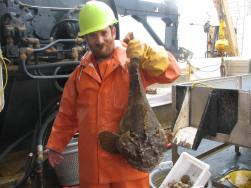
Jacob holds a monkfish
Holding up the catch

Weather Data from the Bridge

Visibility: 14 miles
Wind Speed:19.5 miles per hour
Sea Wave Height: 4 foot
Water Temperature: 44.4 degrees
Air Temperature: 44.2 degrees
Pressure: 1018.8 Millibars

Personal Log

main_engine-702351I got to thinking the other day that the engines on this ship have been running since we left port almost two weeks ago now. I started to wonder how they could stay running for so long and so I decided to ask Chief Engineer Steve Bus to tell me more about them. So put on your ear protection, and lets go to the engine room. The engine room on NOAA Ship MILLER FREEMAN is like a small city below the deck. In addition to the 2100 horsepower diesel engine that moves the ship forward, there are generators sufficient to power a small town. A research vessel, after all, needs a lot of electricity to run all the electronics we need. In addition, the engine room has equipment to make it’s own drinking water out of sea water. We cannot drink sea water because it has too much salt for our bodies to handle. The machines in the engine room take the salt out of the water and, clean it, and make it possible for us to drink it.

sewage-793154There are boilers to heat water and make steam to keep the ship warm. There are also machines that process waste water. Finally, there is shaft alley. This is the part of the engine room where a long metal shaft connects the diesel engine to the propeller. Take a look at this video to see shaft alley. The ship burns 2100 to 2200 gallons of fuel on an average day. Who keeps it all running? Chief Engineer Steve Bus and his crew. They are responsible for the ship from bow to stern.
How do you prepare for an emergency at sea? The same way you do in school. By drilling over and over. Today, we had a fire drill where the some of the crew got into firefighting gear and practiced what they would do in an actual emergency. Want to come along? Click here for a video.

water-737525Science Log

We had some interesting returns on the echosounder this morning. Take a look at the screen. You can clearly see the top and bottom of the water column. You can clearly see the different groups of fish. The echosounders can tell us so much information. When we put the nets down near the surface, we knew exactly what to expect. We did a trawl along the bottom of the sea floor last night and brought up some of the most interesting creatures I’ve ever seen. Here are a few.

This is a basket star, a kind of sea star. Its branches are hard and are divided into many different branches. The basket star uses all of these to catch plankton. In the center is the mouth.

This is a basket star, a kind of sea star. Its branches are hard and are divided into many different branches. The basket star uses all of these to catch plankton. In the center is the mouth.

crab-726932 Next, we have a lyre crab. Have you ever seen a hermit crab without a shell? This one lost his on the way up from the bottom.

bottom-777997

This next photo includes a huge sea star, a sea urchin, a hermit crab without its shell, a tanner crab and several fish called poachers. These fish have scales that are hard, almost like bone or a shell.
h-crab-706029 This last one is my personal favorite. The fish at the top of the screen is called a big mouthed sculpin. It has the biggest mouth of any fish I’ve ever seen. This fish stays on the bottom waiting for smaller fish to come by, and then… watch out! When it came up in the net, it had a smaller fish in its mouth.

Finally, we brought up a creature called a brittle star. It is a kind of sea star with soft tentacles. It moves very fast for a sea star. The arms can break easily, but don’t worry, they grow back. That’s why they call it a brittle star. Here is a video of a brittle star moving across the lab table.

Later on the same day, our ship was visited by some dall’s porpoises. Click here for a video

Question of the Day

Look at the answer to yesterday’s question. Let’s try another one. If our ship wants to do a trawl 50 meters below the surface, how much wire would it need.

Answer to Yesterday’s Question

How much wire would the ship need to let out if it wanted to put the nets 200 feet below the surface? Make sure to watch the video on nets before you try to answer the question.

The ship must put out two feet of wire for every one foot of depth. So you have to multiply 200 x 2 which gives 400 feet of wire. Wait, we are not finished yet. Each net has, not one, but three wires holding it to the ship. So you would need 3 wires. All three are 400 feet in length. That gives us 1200 feet of wire to do our trawl.

Answers to Your Questions

Hello to all who wrote today.

The MILLER FREEMAN does seem like home to me now. I have gotten used to the constant rocking of the ship and the routines of the day. I really enjoy being at sea. By the way, they had pizza for lunch, but I asked the cook to make me some fresh pollock that we caught and filleted last night.

Do people eat jellyfish? I asked our chief cook, Mr. Van Dyke. He told me many species of jellyfish are poisonous. Even those that are safe to touch with your hands. So, no, we don’t’ eat them here, but in some countries they do. We have caught many tons of fish, but more importantly, we have seen many fish without catching them using our echosounder. This device allows us to survey fish without capturing so many.

There are 34 people on board with us for this cruise. That will change next week when we get to port.

The squid felt slimy, but not much more slimy than most fish seem. I don’t recall it spraying anything.

Jeff Grevert, June 13, 2005

NOAA Teacher at Sea
Jeff Grevert
Onboard NOAA Ship Delaware II
June 8 – 16, 2005

Mission: Surf Clam Survey
Geographical Area: New England
Date: June 13, 2005

Clam sizes
Clam sizes

Weather Data

Latitude: 41° 12′ N
Longitude: 070° 45′ W
Visibility: 2 nm
Wind Direction: 220°
Wind Speed: 13 kts.
Sea Wave Height: 2 ft.
Swell Wave Height: 2 ft.
Sea Water Temp.: 13.3° C
Sea Level Pressure: 1007.9 mb
Cloud Cover: 5/8 (Altocumulus, Cirrus)

Science and Technology Log

We’re back underway 🙂 The repairs went well and the Delaware II set sail at 1400 hours. It was about a three-hour steam to our first sampling station.  Once we arrived, there was time on my watch to conduct one trawl. Only one Ocean Quahog was collected. Some bycatch included sea stars, sponges, sand dollars and a crab. At 1800 hours I went off watch and ate dinner. Later I worked on my lesson plans and collected data from the ship’s weather log.  Currently I’m waiting for my second watch (midnight).  I think I’ll get some rest.

Taking measurements and collecting data