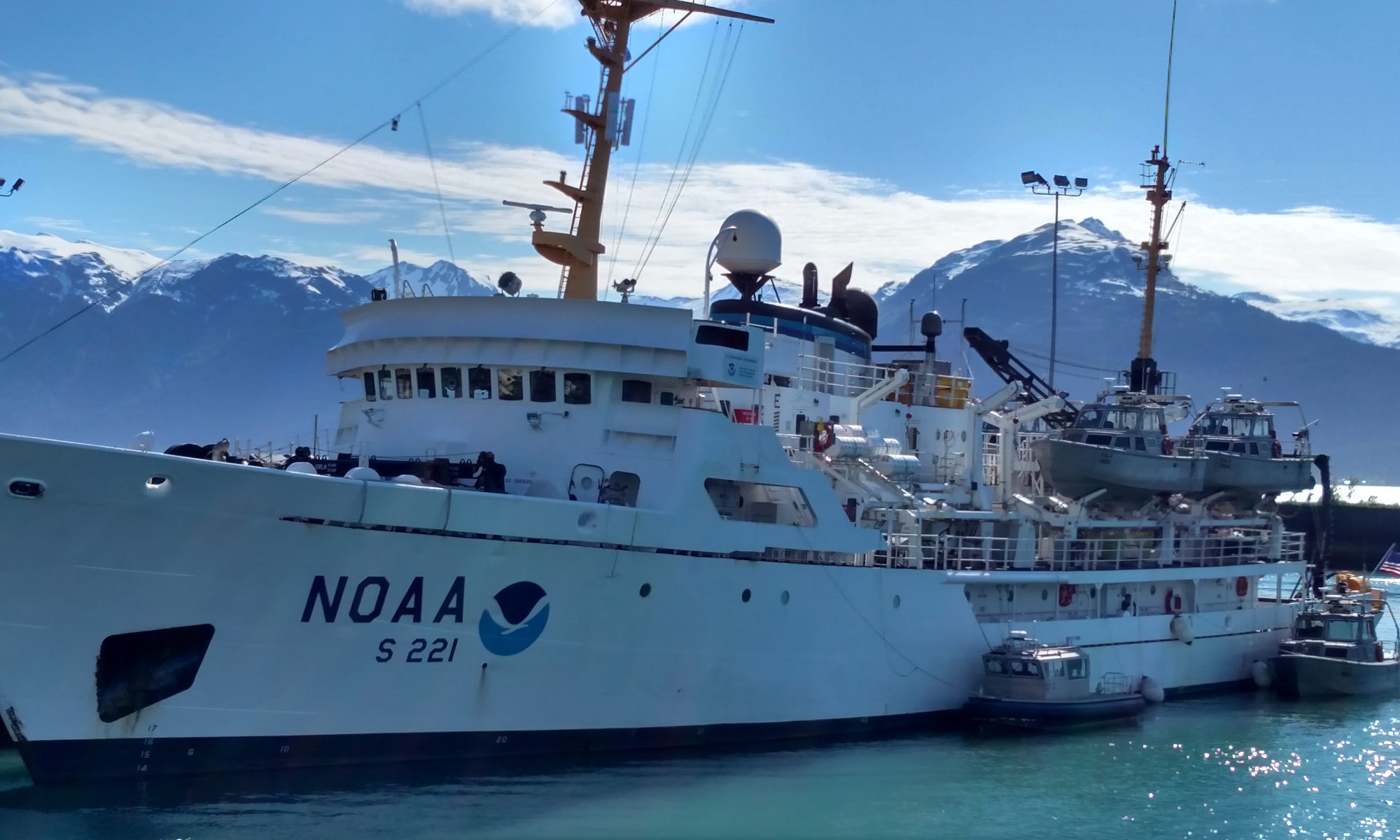
Allan Phipps: Fish heads, fish heads, rolly polly fish heads…. July 31, 2012

NOAA Teacher at Sea
Allan Phipps
Aboard NOAA Ship Oscar Dyson
July 23 – August 11, 2012

Mission: Alaskan Pollock Mid-water Acoustic Survey
Geographical Area: Bering Sea
Date: July 31, 2012

Location Data
Latitude: N 61°39’29”
Longitude: W 117°55’90”
Ship speed: 11.7 knots (13.5mph)

Weather Data from the Bridge
Wind Speed: 26 knots (30mph)
Wind Direction: 044°
Wave Height: 4 meters (12 ft)
Surface Water Temperature: 8.2°C ( 46.8°F)
Air Temperature: 7.4°C (45°F)
Barometric Pressure: 994 millibar (0.98 atm)

Science and Technology Log:

Last blog, we learned about the different trawl nets and how the NOAA scientists are comparing those nets while conducting the mid-water acoustic pollock survey.  We left off with the fish being released from the codend onto the lift table and entering the fish lab.  Here is where the biological data is collected.

Walleye pollock on the sorting table. Various age groups are seen here, including one that is 70cm long and may be over 12 years old! Most are 2 to 4 year olds.

The fish lab is where the catch is sorted, weighed, counted, measured, sexed, and biological samples such as the otoliths, or earbones,  are taken (more about otoliths later in this post).  First, the fish come down a conveyor belt where they are sorted by species (see video above).  Typically, the most numerous species (in our case pollock) stay on the conveyor and any other species (jellyfish and/or herring, but sometimes a salmon or two, or maybe even something unique like a lumpsucker!), are put into separate baskets to weigh and include in the inventory count.  In the commercial fishing industry, these species would be considered bycatch, but since we are doing an inventory survey, we document all species caught.  Here are some pictures of others species caught and included in the midwater survey.

This slideshow requires JavaScript.

The goal of each trawl is to randomly select a sample of 300 pollock to measure as a good representation of the population (remember your statistics!  Larger sample sizes will give you a better approximation of the real population).  If more than 300 pollock are caught, the remainder are weighed in baskets and quickly sent back to sea.  All of the catch is weighed so the scientists can use the length and gender data taken from the sample to extrapolate for the entire catch.  This data is combined with the acoustics data to estimate the size of the entire fishery (more on acoustic data in a future post). Weights are entered via touch screen into a program (Catch Logger for Acoustic Midwater Surveys – CLAMS) developed by the NOAA scientists onboard.

The CLAMS display showing that I am “today’s scientist.”

The 300 pollock are sexed to determine the male/female ratio of this randomly selected portion of the population.  Gender is determined by making an incision along the ventral side from posterior to anterior beginning near the vent.  This exposes the internal organs so that either ovaries or testes can be seen.  Sometimes determining gender is tricky since the gonads look very different as fish pass through pre-spawning, spawning, or post-spawning stages.  When we determine gender, the fish are put into two separate hoppers, the one for females is labeled “Sheilas” and the hopper for males is labeled “Blokes.”

Making incision to determine gender on pollock sample.
Hopper for female pollock ready to be measured with the Ichthystick and entered into CLAMS.

We use an Ichthystick to then measure the males and females separately to collect length data for this randomly selected sample.  Designed by NOAA Scientists Rick and Kresimir, the Ichthystick very quickly measures lengths by using a magnet placed at the fork of the fish’s tail (when measuring fork-length).  This sends a signal to the computer to record the individual fish’s length data immediately into a spreadsheet and the software creates a population length distribution histogram in real-time as you enter data.

The Ichthystick with fingertip magnet used to quickly measure and enter length data into CLAMS.

A randomly selected subset of 40 pollock get individually weighed, length measured, sexed, evaluated for gonadal maturity and have the otoliths removed.  Otoliths (oto = ear, lithos = bone) are calciferous bony structures in the fish’s inner ear.  These are used to determine age when examined via cross-section under a dissecting scope.  The number of rings corresponds to the age of the pollock, similar to rings seen in trees. The otoliths are taken by holding the fish at the operculum and making an incision across the top of the head to expose the brain and utricle of the inner ear.  The otolith is found inside the utricle.  Forceps are used to extract the otoliths, which are then washed and put in individual bar-coded vials with glycerol-thymol solution to preserve them for analysis back at the Alaska Fisheries Science Center.

Incision across the skull revealing the otoliths on either side of the brain stem.
One otolith from a Walleye pollock.

Watch this short video to see what the entire process of data collection looks like.

So… why collect all of this data?  How is this data analyzed and used?  Stay tuned to my next blog!

Personal Log:

Well, I can officially say… the honeymoon is over.  The Bering Sea had been so extremely kind to us with several days of great weather while we had a high pressure system over us.  We enjoyed spectacular sunrises and sunsets, cloudless days and calm seas.

Sunny skies and calm seas on the Oscar Dyson.

Now… we have a low pressure system on top of us.  Last night, we experienced 35 knot winds and 12 foot seas.  I have spent a lot of time in my room in the past 24  hours…  Late this morning, the sun came out and the winds calmed down, but the barometric pressure was still very low (around 990 mbars) which basically meant we were in the center of the low pressure system (similar to the eye of a hurricane, but not as strong… thank goodness!).  We had a few hours relief, but we are back to pounding through the waves as the wind picks back up.  It will be another long and sleepless night for this landlubber…

On a positive note, we did see two Laysan Albatrosses (Phoebastria immutabilis) from the Bridge as the winds began to kick up.  They seemed to really enjoy the high winds as they soared effortlessly around the ship.  The Officer on Deck (OOD) also said he saw a humpback breaching, but by the time I got up to the Bridge, it had moved on…

Next blog, I will share pictures of my room, the galley, “the cave,” the Bridge, etc.  Right now, I am just trying to hold on to my mattress and my stomach…

Johanna Mendillo: Alaska Bound! July 13, 2012

NOAA Teacher at Sea
Johanna Mendillo
Aboard NOAA Ship Oscar Dyson
July 23 – August 10, 2012

Mission: Pollock Survey
Geographical area of the cruise: Bering Sea
Date: Friday, July 13, 2012

Introductory Blog 

Hello everyone!  It is finally time– I am getting ready for my journey to sea.  What a journey this will be!  To Alaska, and the Bering Sea, to be exact.  I am very excited to share this work with you– both on the blog this summer and back at school in the fall.  As I learn more about NOAA, my ship (the Oscar Dyson), and the research work on Pollock, so will you!

First off, the basics.  What do you know about Alaska?  The Bering Sea?  The species Pollock?  If you are like me, there are probably a million or so questions on each running through your head.  So, those are the three topics I began to research first.  Here is what I learned:


Alaska:

Alaska is a vast and fascinating state.  It will also be the 40th state I visit!

Map of Alaska and Bering Sea

State Capital: Juneau, located in the Southeast region of Alaska, has a population of 31,275 (according to the 2010 Census)

The Name: “Alaska” is derived from the Aleut word “Alyeska,” meaning “great land.”

State Flower: The forget-me-not!

State Gem: Jade.  Alaska has large deposits, including an entire mountain of jade on the Seward Peninsula!

State Mineral: Gold!  Perhaps I will find some on my journey?  Gold has played a major role in Alaska’s history.

State Tree: The tall, stately Sitka spruce; it is found in southeastern and central Alaska.

State Fish: The huge king salmon (also called Chinook), which can weigh up to 100 pounds.

Fun Fact: Secretary of State William H. Seward arranged for the United States to purchase Alaska from Russia in 1867 for $7.2 million dollars— or 2 cents per acre!


The Bering Sea

The Bering Sea, a northern extension of the Pacific Ocean, separates two continents- Asia and North America.  Covering over two-million sq. km (775,000 sq mi), the sea is bordered in the west by Russia and the Kamchatka Peninsula; in the south by the Aleutian Islands; in the north by the Bering Strait and the Arctic Ocean; and in the east by Alaska.  It is the third largest sea in the world and home to some of the richest fisheries in the world!

There is a donut in the Bering Sea?  Well, not exactly, but there is “The Donut Hole”—let me explain.  The Western side of the Bering Sea, out to 200 miles from shore, is Russian territory, and the first 200 miles offshore on the Eastern side belongs to the United States.  The section in-between, which lies 200 miles out from the coastlines of both countries, is known as “The Donut Hole,” and is considered international waters.  This area comprises 10% of the Bering Sea.

Fig. 1
Bering Sea “Donut Hole”

Now, as I had mentioned above, the Bering Sea is one of the world’s most productive fishing grounds, producing huge quantities of king crab, salmon, pollock, and other varieties of fish.  In addition, it is home to vast quantities of wildlife, including many species of whales, walrus, and millions of seabirds!  I can’t wait to take lots of pictures and videos for you to see!

Now, when many folks think of the Bering Sea, they think of the TV show “The Deadliest Catch”!  Are any of you fans?  Well, it is true that the Bering Sea is one of the most dangerous bodies of water in the world, and waves can easily reach 30-40 feet high.  Let’s hope we do not encounter too many of those this summer!


Pollock

OK, so here is perhaps your first look at a Pollock!

Plenty of pollock!
Plenty of pollock!

Did you know:

  • Pollock has consistently been one of the top five seafood species consumed in the U.S.
  • Since 2001, U.S. commercial landings of Pollock (primarily in Alaska) have been well over 2 billion pounds each year.
  • Pollock are mid-water schooling fish that can live up to 15 years.
  • All Pollock is wild-caught in the ocean.  There is no commercial aquaculture for this species.

The wild fishery for Alaska Pollock, also known as Walleye Pollock, is the largest by volume in the United States and is also one of the largest in the world!  If you are a fan of fish sticks, chances are you have eaten Pollock!  FYI, Alaska Pollock is a different species than the Pollock found on the Atlantic coast.

It is primarily harvested by trawl vessels, which tow nets through the middle of the water column.  Some vessels are known as catcher/processors because they are large enough to catch their own fish and then process and freeze them at sea.  Other vessels deliver their catch to mother ships (at-sea processing vessels that do not catch their own fish) or to shore-side seafood processors.

Pollock is a high protein, low fat fish with a mild-flavor and a delicate and flaky texture.  Because of its adaptability, Pollock is consumed in a variety of forms that include fresh and frozen fillets, fish sticks and other breaded and battered fish products, and “surimi” products.

What is surimi, you ask?  Surimi products are formulated to imitate crab, shrimp and scallop meat and then marketed in the U.S. as imitation crab, shrimp or lobster.  They are often the “seafood” in seafood salads, stuffed entrees, and other products!  Surimi is produced by mincing and washing Alaskan Pollock fillets and then adding other ingredients to stabilize the protein in the fish and enable it to be frozen for extended periods of time.  Alaska Pollock fillets or mince is also frozen into blocks and used to produce fish sticks and used in a variety of products in fast food restaurants.

The Pollock fishery is highly regulated by the U.S. Federal government through the National Marine Fisheries Service (NMFS) and the North Pacific Fishery Management Council (NPFMC).  On the Eastern end, the Russian State Fisheries Committee handles government oversight.  Annual catch limits (called quotas) and seasons are set for Pollock fisheries, and limits are also set for bycatch species that may be caught unintentionally when fishing for Pollock.

In the next few days, I will continue to learn and prepare, so please send me any questions you’d like and leave comments below!  My next post will be from Alaska…stay tuned!

Amanda Peretich: Theragra chalcogramma, July 6, 2012

NOAA Teacher at Sea
Amanda Peretich
Aboard Oscar Dyson
June 30 – July 18, 2012

Mission: Pollock Survey
Geographical area of cruise:
Bering Sea
Date:
July 6, 2012

Location Data
Latitude: 58ºN
Longitude: 172ºW
Ship speed: 11.4 knots (13.1 mph)

Weather Data from the Bridge
Air temperature: 4.6ºC (40.3ºF)
Surface water temperature: 6.3ºC (43.3ºF)
Wind speed: 5.7 knots (6.6 mph)
Wind direction: 108ºT
Barometric pressure: 1016.5 millibar (1.00 atm, 762 mmHg)

Science and Technology Log
Today’s lesson is all about the lovely object of FRV (fisheries research vessel) Oscar Dyson’s affection on the summer survey: Theragra chalcogramma, also known as pollock, walleye pollock, Pacific pollock, or Alaska pollock. However, the word pollock could actually refer to the Pollachius genus, which includes Atlantic pollock, but this blog is about the Pacific variety.

DYK? (Did You Know?): biological organisms are classified using a system created by Carolus Linnaeus. Theragra chalcogramma refers to the genus and species classification for Pacific Pollock, just as Homo sapiens is used to classify humans. This is known as binomial nomenclature. You will see this naming throughout the blog. One mnemonic device to remember the order of classification (Kingdom –> Phylum –> Class –> Order –> Family –> Genus –> Species)? King Phillip Called Out For Greasy Spaghetti!

What do they look like?

Alaska Pollock
Alaska Pollock

All pollock are part of the cod family Gadidae. They can grow to a maximum of over 3 feet (91 cm) but will be about 12-20 inches (30.5-50.8 cm) in length on average. Their speckled color pattern allows them to blend in with their surroundings to avoid predators.

This is the main area where pollock can be found.

Where do we find them?
Alaska pollock are a semipelagic schooling fish closely related to Atlantic cod, which means they mainly swim together in the middle of the water column. Alaska pollock are found throughout the northern part of the Pacific Ocean, most notably in the Bering Sea, but also can be found in the Gulf of Alaska.

What do they eat?
Juvenile (younger) pollock eat zooplankton and small fish whereas older pollock eat other fish including juvenile pollock. We have seen some very full stomachs when sexing the pollock this week!

Who studies them?
Scientists are constantly conducting various pollock surveys in the Arctic area. The Alaska Fisheries Science Center (AFSC) as well as the Alaska Department of Fish and Game are two places that will use both acoustics and midwater and bottom trawls to determine the relative abundance and more during a pollock survey. You can read more about the AFSC walleye pollock research here. This type of research allows for decisions to be made with respect to how much pollock can be harvested each year.

How are they harvested?

Westward Seafoods
The seafood processor Westward Seafoods in Captains Bay, Dutch Harbor, Alaska

Pollock are harvested by trawlers. This means that the ship has a large net (see my previous blog on trawling) that is towed behind the vessel in midwater. Some vessels (not the scientific ones like the Oscar Dyson) are “catcher-processors”, which means that they will both catch pollock and process them at sea. Other ships are just “catchers” and will then transfer their loot to a shore-based processor or a “tramper” vessel. In Dutch Harbor and Unalaska, there are multiple seafood plants: UniSea, Westward, Alyeska, Icicle, Trident, and Royal Aleutian Seafoods. The “trampers” are most often foreign vessels that are not able to dock in the United States but will instead anchor in a place such as Captains Bay in Dutch Harbor and await a commercial fishing vessel to unload their catch. The tramper can then return back home to somewhere like South Korea with the seafood.

DYK? The two-tone color on the trampers is helpful to know how “full” the ship is – the less red you can see above the water, the more fish that are onboard!

"Tramper"
This is a foreign “tramper” vessel, sitting in Captains Bay in Dutch Harbor, Alaska

In the United States, there is a 12-mile boundary from the shore that is marked on nautical charts to allow individual states to determine the fishing rules. They will dictate how many of each species can be kept, what months fishing can occur, and what size fish must be thrown back. Foreign ships can pass through these areas, but are not allowed to fish or look for resources (hence the “trampers”). Outside of this exists the exclusive economic zone, or EEZ, 200 nautical miles off shore. Permits are required to travel or fish through a foreign EEZ. For example, on Leg 3 of the Pollock survey, the Oscar Dyson is set to cross the International Date Line into Russian waters, which requires a permit.

Fun Fishy Facts
* You’ve actually probably eaten Alaska pollock and not even known it! It is used to make imitation crab meat (surimi) and fish sticks, amongst other things.
* Compared to Atlantic pollock, Alaska pollock has a milder taste, whiter color, and lower oil content.
* Alaska pollock is considered to be an eco- and ocean-friendly choice due to abundance and the fact that trawling does not cause significant habitat destruction.
* Alaska pollock is the largest fishery in the U.S. by volume and one of the best managed fisheries in the world.

Midwater Pollock Cam Trawl
This photo showing Alaska pollock is from a midwater trawl on the Oscar Dyson on July 6, 2012 using the AWT (Aleutian Wing Trawl) at about 100 meter depth.

References
NOAA Fishwatch: Alaska Pollock
Wikipedia: Alaska Pollock
New England Aquarium: Alaska Pollock
Assessment of the walleye pollock stock in the Eastern Bering Sea
– Scientists on board the Oscar Dyson 🙂

Personal Log

Pyrotechnics Demonstration
Pyrotechnics demonstration (aka shooting off expired flares after getting permission from a bunch of people) for the Fourth of July off starboard on the Oscar Dyson

I last posted on the Fourth of July, before our big “pyrotechnics demonstration” to celebrate the holiday. What a great ending to a beautiful day filled with blue skies!

I’ve finally gotten my “sea legs”, which I’ve been told isn’t how well you can walk in a straight line on board, but how well you can maintain standing position and move with the rolling, pitching, and yawing of the ship. I may not have mastered the treadmill yet, but I’m quickly learning to enjoy the elliptical again.

During the night shift on the Fourth of July, my wonderful roommate Carwyn came to tell me they were doing a bottom trawl if I wanted to come check it out. The lost hours of sleep were well worth the vast array of new critters and creatures that came up in the net! I plan to do a future blog on what we found, so be sure to look for that.

In adding to the awesome experience I’m having on board, I’ve gotten some great news online in the past few days. First, my amazing AP chemistry class earned all 3s, 4s, and 5s on the AP chemistry exam they took back in May (scores were just posted online for teacher access). Then I received an e-mail with a job offer to teach chemistry and honors biology at La Plata High School in La Plata, Maryland, after having a phone interview from the Anchorage airport the day I was flying out to Dutch Harbor. This helped relieve a little bit of stress from not having a full-time job offer after my big move to Maryland from Tennessee and helped to confirm that teaching high school is what I should be doing with my life!

Animal Love
I have been spending plenty of time on the bridge, up above that on the flying bridge, and looking out my stateroom window for something in the water other than birds. Today was the day I finally saw something (although this was thanks to ENS Kevin Michael coming to get me and show me)!

Introducing a Dall’s porpoise (Phocoenoides dalli):Dall's porpoise

A Dall’s porpoise swimming next to the Oscar Dyson around 6am on July 6, 2012

They resemble a killer whale in coloring and have a very thick body and smaller head, ranging through much of the northern Pacific Ocean and nearby seas (like the Bering Sea). Lucky for me!

Amanda Peretich: Trawling for Fish, July 4, 2012

NOAA Teacher at Sea
Amanda Peretich
Aboard Oscar Dyson
June 30, 2012 – July 18 2012

Mission: Pollock Survey
Geographical area of cruise:
Bering Sea
Date:
July 4, 2012

Location Data
Latitude: 56ºN
Longitude: 170ºW
Ship speed: 12.5 knots (14.4 mph)

Weather Data from the Bridge
Air temperature: 7.3ºC (45.1ºF)
Surface water temperature: 5.8ºC (42.4ºF)
Wind speed: 7 knots (8.1 mph)
Wind direction: 280.8ºT
Barometric pressure: 1011.5 millibar (1.0 atm, 758.6 mmHg)

Science and Technology Log
For those that know me, I like to press snooze on my alarm clock. A lot. So this whole being in the acoustics lab at 0400 has been pretty hard for me, but I haven’t been late yet (knock on wood). On July 3rd, I was a little snooze-happy and didn’t climb out of bed until 0355. Now, I could have showered and been a little late down to the lab, but I’m so glad I decided to forgo smelling good in order to not be late. The night shift was processing our first trawl to catch fish and I was lucky enough to catch the “tail” end of it. We had three more fish trawls during my shift yesterday, too!

Stern View
View of the stern (back) of the Oscar Dyson, showing both trawl nets: midwater trawl on right, bottom trawl on left

So what exactly is a trawl? Trawling is used in fishing when you pull a net in the water behind a ship, with the net itself being called the trawl. There are two main types of trawling, based on where the net is located in the water column:
* bottom (or benthic) trawling – the net is towed along the ocean floor
* midwater (or pelagic) trawling – the net is towed above the benthic zone

Bottom trawling can have various negative impacts on the environment, most notably the fact that the trawl disturbs seabed habitats. It can also remix sediments with the water column so if there were any pollutants (like DDT) that had settled to the bottom, they could make their way back into the food chain and into the food we eat. However, there are also many positive things to be learned from bottom trawling, and it is necessary in scientific investigations. Some of the scientific research in this field involves adjusting various factors on the trawl to minimize habitat disturbance.

On the Oscar Dyson, the ship is large enough to have reels for both a bottom and a midwater net. The bottom net is called the 83-112 (83 ft headrope and 112 ft footrope) and the midwater net is called the AWT (Aleutian Wing Trawl). One of the side research projects that has been going on here: adjustments on a bottom trawl to allow for midwater fishing.

A basic trawl net looks like this:

Trawl Net
This is what a trawl net looks like!

The trawl doors help keep the net open at the front when the net is in the water and there are floats on the top of the net along with the headline and there can be weights on the bottom of the net along with the foot rope. There are other things attached to the net to collect data, such as something that knows how deep the fishing occurred and at what temperature and another device that measures the amount of light.

The chief scientist will be watching various things on the computer screens in the acoustic lab (more on this later) to know when they should put the net in the water. He will relay this information to the people on the bridge that will then have the deck crew get ready to fish. There has to be plenty of good communication onboard, that’s for sure! The chief scientist then goes up to the bridge and analyzes more screens to determine when he thinks we have caught enough fish to reel in the net and begin processing.

There are 7 main objectives for the Oscar Dyson DY1207 cruise, which is also how scientific research works – there is more than one “project” going on at a time to maximize productivity. These objectives are:

1. collect acoustic data and trawl data necessary to determine the distribution, biomass, and biological composition of walleye Pollock and other scatterers
2. calibrate the ER60 and ME70 acoustic systems
3. collect target strength data using hull-mounted transducers or a lowered transducer for use in scaling echo integration data to estimates of absolute abundance
4. collect physical oceanographic data (temperature, salinity, fluorescence, and oxygen profiles with associated water samples), and continuously collect sea surface temperature, salinity, fluorescence, and oxygen data with associated water samples
5. collect data on fish distributions and school characteristics using ME70 multi-beam echosounder
6. collect light intensity and penetration data
7. conduct midwater trawl and bottom trawl comparisons

When we go “fishing” we are working on the first objective most of the time. Why is this pollock survey even important? The data from this survey allows managers to adjust the amount of Alaskan pollock (or other types of fish from other surveys) that commercial fisherman can harvest without overfishing. This helps ensure the viability of pollock fishing for future generations. Check out this great article as NOAA scientists kick off surveys to collect data vital to success of Alaska’s fisheries!

Here’s a little video to walk through what happens in the fish lab to process the fish and collect data:

Personal Log

Rare sunny day in the Bering Sea
It’s a rare beautiful sunny day in the Bering Sea for the Fourth of July

I am lucky enough to be able to say I’m spending Fourth of July in the middle of the Bering Sea with some pretty great people! Last night was probably the roughest seas we’ve had so far, and lucky for me, I had taken some Dramamine right before heading to sleep because I still wasn’t feeling 100% myself. I was sliding around all over my bed and at one point thought we had gone headfirst into the water. Apparently this isn’t even really bad weather, so I’m definitely glad that I’m on a summer cruise with calmer waters.

Today the sun finally came out (I haven’t seen it since we were back in Dutch Harbor), and I was able to get a nice “Alaskan tan” (and a quick nap) on my face and hands up on the flying bridge with ENS Chelsea Frate for a little bit.

Flying Bridge Naptime
Enjoying a quick nap in the rare sunshine on the flying bridge of the Oscar Dyson

So far there are some things I’ve found challenging on board:
* showering (those handles are in there for a reason!)
* passing up on any of the delicious food (making the following thing difficult as well)
* using the treadmill (elliptical – ok, bike – ok, stair stepper – ok, treadmill – are you kidding me?!)
* staying awake during movies in the lounge off shift – those couches are just so comfy!

Animal Love
We caught a few extra critters in our fish trawl this morning, so here they are:
* Rock sole (Lepidopsetta bilineata), normally found in the benthic zone

Rock sole
This is a rock sole fish, which is a type of flatfish.

* Yellow Irish lord (Hemilepidotus jordani)

Yellow Irish lord
This is a Yellow Irish lord fish

* Pacific herring (Clupea pallasii)

Pacific herring
This is a Pacific herring

Allan Phipps: Teacher from South Florida to Test the Waters in Alaska! June 29, 2012

NOAA Teacher at Sea
Allan Phipps
Soon to be aboard NOAA Ship Oscar Dyson
July 23 – August 10, 2012

Mission:  Alaskan Fisheries Walleye Pollock Survey
Geographic Area of Cruise:  Bering Sea Shelf
Date:  June 29, 2012

Introductory Log

Greetings from Washington, D.C. and from South Florida!  My name is Allan Phipps and I am a teacher from South Plantation High School’s Everglades Restoration and Environmental Science Magnet Program in Plantation, Florida (part of the greater Fort Lauderdale metropolis area).  I teach Advanced Placement Environmental Science, a course entitled Solar & Alternative Energy Honors, and serve as a senior research advisor.

Allan Phipps at Capital Building in DC
Einstein Fellow Allan Phipps at the Capital Building in DC

This year, I have had the distinct pleasure to serve as an Albert Einstein Distinguished Educator Fellow here in Washington, D.C. at the National Science Foundation.  While at the NSF, I have worked with both the Noyce Scholarship Program and the Math Science Partnership, both of which focus on improving the quality and quantity of highly qualified new STEM teachers in high-needs school districts across the country.  It has been a wonderful experience working at the NSF and with pre-service teachers.  I have also worked with the Presidential Awards for Excellence in Math & Science Teaching program that is operated through the NSF.  As a former PAEMST awardee, it was great to be able to work behind the scenes to reward outstanding teachers!  A highlight of my experience here in D.C. was when I spoke at the White House Environmental Education Summit!  I discovered the NOAA Teacher at Sea opportunity while here in Washington, D.C. working with the Einstein Fellows.

Solar Knight III racing at the Texas Motor Speedway

At South Plantation High, I am the sponsor of our Solar Knights Racing Team that has won 1st place in the nation twice in the past six years at the high school level Solar Car Challenge (see video below)!  We have been building and racing solar cars at the high school level for six years!  Two of the races we have competed in were cross-country, the latest of which went from Fort Worth, Texas to Boulder, Colorado over 7 days in July 2010.  Last year’s race was a track race at the Texas Motor Speedway.

Here I am with students helping deploy reef balls in south Florida.

I also sponsored our school’s Project ORB (Operation Reef Ball) and deployed thirty 500-1,500 lb concrete reef balls off the coast of

South Florida to encourage coral colonization and propagation to offset some of the damage done to our beautiful South Florida coral reefs.   Recently, I had the privilege of presenting a poster session about our Project ORB at the European Geophysical Union conference in Vienna, Austria!

One of my students, Carson Byers, takes the solar kayak out for a test drive.

One of my favorite senior projects was a solar-powered kayak, which would improve accessibility to the Florida Everglades as well as other coastal environments for persons with disabilities.  I really enjoyed this project as it blended my passion for alternative energy with my love for getting out on the water.  This project won the WOW Award at the Florida Solar Energy Center’s Energy Whiz Olympics!

Now, I am incredibly excited about the opportunity to sail aboard the NOAA Ship Oscar Dyson out of Dutch Harbor, Alaska!  This will officially be the furthest north I have ever traveled!  As we experience climate change, particularly in areas near the poles where the effects of climate change are more dramatic, it is important to study these changes and how they affect economically important species such as the Alaskan or Walleye Pollock (Theragra chalcogramma).  Walleye Pollock is said to be the largest remaining supply of edible fish in the world, and is the fish used in high quality breaded and battered fish products, fish sticks, and surimi (also known as “imitation crabmeat”).  Many fast food restaurants commonly use Walleye Pollock in their fish sandwiches.  It is important that this fishery be monitored and maintained so that harvest remains sustainable.  I hope that I may enlighten my students about their impacts on the environment when they decide what they will eat so they may become more conscientious consumers.

What’s Next?

I am getting ready to head out to sea and am really looking forward to working with the scientists on board the NOAA Ship Oscar Dyson!  While my blog will be geared towards my AP Environmental Science students, I hope that people of all ages will follow me along my journey as I learn about the science behind maintaining a sustainable fishery.  I also hope to inspire my own students, and others, about the career opportunities in STEM associated with NOAA.  Stay tuned!