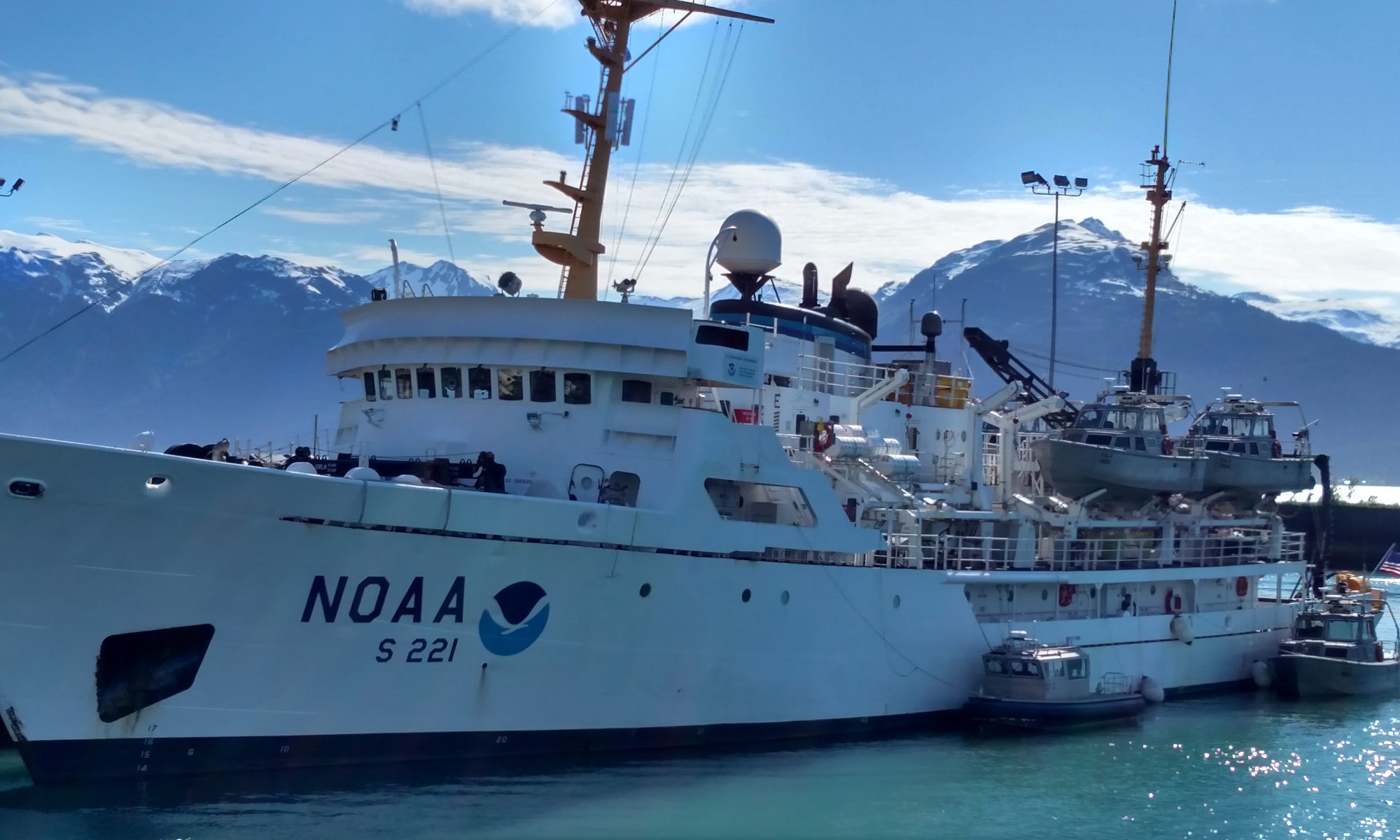
Allan Phipps: Shhh! Be very, very quiet! We’re hunting pollock! August 7, 2012

NOAA Teacher at Sea
Allan Phipps
Aboard NOAA Ship Oscar Dyson
July 23 – August 11, 2012

Fun with Blue King Crab (Paralithodes platypus)!
Mission: Alaskan Pollock Midwater Acoustic Trawl Survey
Geographical Area: Bering Sea
Date: August 7, 2012

Location Data
Latitude: 60°25’90” N
Longitude: 177°28’76” W
Ship speed:  3 knots (3.45 mph)

Weather Data from the Bridge
Wind Speed:  5 knots (5.75 mph)
Wind Direction: 45°
Wave Height:   2-4 ft with a  2 ft swell
Surface Water Temperature: 8.6°C (47.5 °F)
Air Temperature: 8°C (46.4 °F)
Barometric Pressure: 1019 millibars (1 atm)

Science and Technology  Log:

In my last blog, we learned about how the scientists onboard the Oscar Dyson use some very sophisticated echo-location SONAR equipment to survey the Walleye pollock population.

Can the Walleye pollock hear the “pings” from the SONAR?

No.  Unlike in the movies like “The Hunt for Red October” where submarines are using sound within the human audible range to “ping” their targets, the SONAR onboard the Oscar Dyson operates at frequencies higher than both the human and fish range of hearing.  The frequency used for most data collection is 38 kHz.  Human hearing ranges from 20 Hz to 20 kHz.  Walleye pollock can hear up to 900 Hz.  So, the pollock cannot hear the SONAR used to locate them…

Can the Walleye pollock hear the ship coming?

Normally, YES!  Fish easily hear the low frequency noises emitted from ships.

A comparison of hearing ranges for various organisms showing the anthropogenic source noise overlap (courtesy of oceannavigator.com).

If you are operating a research vessel trying to get an accurate estimate on how many fish are in a population, and those fish are avoiding you because they hear you coming, you will end up with artificially low populations estimates!  The International Council for the Exploration of the Seas (ICES) established noise limits for research vessels that must be met in order to monitor fish populations without affecting their behavior.  Fish normally react to a threat by diving, and that reduces their reflectivity or target strength, which reduces the total amount of backscatter and results in lower population estimates (see my last blog).

A comparison of two ships and fish reaction to the noise produced by each.  The Oscar Dyson has a diesel electric propulsion system as one of its noise reduction strategies.  Notice the smaller noise signature (in blue) and fewer fish avoiding (diving) when the ship approaches (www.uib.no).

That is why NOAA has invested in noise-reducing technology for their fish survey fleet.  The Oscar Dyson was the first of five ships build with noise-reducing technology.  These high-tech ships have numerous strategies for reducing noise in the range that fish might hear.

There are two main sources of engine noise onboard a ship:  machinery noise and propeller noise.

The two main sources of ship noise. (www.nmfs.noaa.gov/pr/pdfs/acoustics/session2_fischer.pdf)

The best acoustic ship designs are going to address the following:

1)   Address hydrodynamics with unique hull and propeller design.

2)   Use inherently quiet equipment and choose rotating rather than reciprocating equipment.

3)   Use dynamically stiff foundations for all equipment (vibration isolation).

4)   Place noisier equipment toward the centerline of the ship.

5)   Use double-hulls or place tanks (ballast and fuel tanks) outboard of the engine room to help isolate engine noise.

6)   Use diesel electric motors (diesel motors operate as generators while electric motors run the driveshaft.

Propeller Design:

The U.S. Navy designed the Oscar Dyson’s hull and propeller for noise quieting.  This propeller is designed to eliminate cavitation at or above the 11 knot survey speed.  Not only does cavitation create noise, it can damage the propeller blades.

Photo of cavitation caused by a propeller. These air bubbles that form along the edge of the blades can cause damage to the propeller and cause excess noise. (www.thehulltruth.com/boating-forum/173520-prop-cavitation-burn-marks.html)

Hull Design:

The Oscar Dyson’s hull has three distinguishing characteristics which increase its hydrodynamics and reduce noise by eliminating bubble sweep-down along the hull.  The Oscar Dyson has no bulbous bow, has a raked keel line that descends bow to stern, and has streamlined hydrodynamic flow to the propeller.

An artist rendition of the NOAA FRV-40 Class ships. Notice the unique hull design. (http://www.noaanews.noaa.gov/stories2004/images/bigelow2.jpg)

Vibration Isolation:

To reduce a ship’s noise in the water, it is absolutely crucial to control vibration.  The Oscar Dyson has four Caterpillar diesel gensets installed on double-stage vibration isolation systems.  In fact, any reciprocating equipment onboard the Oscar Dyson is installed on a double-stage vibration isolation system using elastomeric marine-grade mounts.

A picture of one of the Caterpillar diesel generators before installation in the Oscar Dyson. Notice the double vibration isolation sleds to reduce noise (www.nmfs.noaa.gov/pr/pdfs/acoustics/session2_fischer.pdf).

Since the diesel engines are mounted on vibration isolation stages, it is necessary to also incorporate flexible couplings for all pipes and hoses connecting to these engines.

A look at one of the four diesel generators onboard the Oscar Dyson. Notice the black flexible hose couplings in place to allow vibration isolation in the white pipes.

Any equipment with rotating parts is isolated with a single-stage vibration system.  This includes equipment like the HVAC, the electric generators for the hydraulic pumps, and the fuel centrifuges that remove any water and/or particles from the fuel before the fuel is pumped to the diesel generators.

A close-up of the single sled vibration isolation system supporting the hydraulic pumps that run the deck winches.


Low Noise Equipment:

The only equipment that does not use vibration isolation stages are the two Italian-made ASIRobicon electric motors that are mounted in line with the prop shaft.  Both are hard-mounted directly to the ship because they are inherently low-noise motors.  This is one of the benefits of using a diesel-electric hybrid system.  The diesel motors can be isolated in the center of the ship, near the centerline and away from the stern.  The electric motors can be located wherever they are needed since they are low noise.

Even the propeller shaft bearings are special water-lubricated bearings chosen because they have a low coefficient of friction and superior hydrodynamic performance at lower shaft speeds resulting in very quiet operation.  They use water as a lubricant instead of oil so there is a zero risk of any oil pollution from the stern tube.

Acoustic Insulation and Damping Tiles:

The Oscar Dyson uses an acoustic insulation on the perimeter of the engine room and other noisy spaces.  This insulation has a base material of either fiberglass or mineral wool.  The middle layer is made of a high transmission loss material of limp mass such as leaded vinyl.

The Oscar Dyson also has 16 tons of damping tiles applied to the hull and bulkheads to reduce noise.

The Results:

All of these noise-reducing efforts results in a fully ICES compliant research vessel able to survey fish and marine mammal populations with minimal disturbance.  This will help set new baselines for population estimates nationally and internationally.

A comparison of the Oscar Dyson and the Miller Freeman. Notice that the Oscar Dyson is at or below the standards set by ICES (http://icesjms.oxfordjournals.org/content/65/4/623.full).

As you can see from the graph above, The Oscar Dyson is much quieter than the Miller Freeman, the ship that it is replacing.  You can see the differences in the hull design from the picture below.

The quieter Oscar Dyson (on right) replaced the noisy Miller Freeman (on left) http://www.afsc.noaa.gov.

Next blog, I will write about new, cutting edge technology that might reduce the need for biological trawling to verify species.

Sources:

Special thanks to Chief Marine Engineer Brent Jones for the tour of the engineering deck and engine room, and for the conversations explaining some of the technology that keeps the Oscar Dyson going.

http://marine.cat.com/cda/files/1056683/7/VRS_Commercial+Vessel+3512B%26+Commercial+Vessel+3508B+Workboat+(6-2005).pdf

www.maritimejournal.com/features101/power-and-propulsion/no_noise_for_noaa

www.publicaffairs.noaa.gov/nr/pdf/aug2002.pdf

www.nmfs.noaa.gov/pr/pdfs/acoustics/session2_fischer.pdf

http://icesjms.oxfordjournals.org/content/65/4/623.full

Personal Log:

I found out drills aboard ships are serious business!  Unlike a fire drill at school where students meander across the street and wait for an “all clear” bell to send them meandering back to class, fire drills on a ship are carefully executed scenarios where all crew members perform very specific tasks.  When out at sea, you cannot call the fire department to rescue you and put out a fire.  The crew must be self-reliant and trained to address any emergency that arises.  When we had a fire drill, I received permission from Commanding Officer Boland to leave my post (after I checked in) and watch as the crew moved through the ship to locate and isolate the fire.  They even used a canister of simulated smoke to reduce visibility in the halls similar to what would be experienced in a real fire!

Robert and Libby suit up during a fire drill!

Late last night, we finished running our transects!  Our last trawl on transect was a bottom trawl which brought up some crazy creatures!  Here are a couple of photos of some of the critters we found.

From left to right, Blue King Crab (Paralithodes platypus), Alaska Plaice (Pleuronectes quadrituberculatus), Red Irish Lord eating herring on the sorting table (Hemilepidotus hemilepidotus), and Skate (unidentified).

Next blog will probably be my last from Alaska.  T-T

Johanna Mendillo: Hello pollock…. can you hear me now? August 7, 2012

NOAA Teacher at Sea
Johanna Mendillo
Aboard NOAA ship Oscar Dyson
 July 23 – August 10

Mission: Pollock research cruise
Geographical area of the cruise: Bering Sea
Date: Tuesday, August 7, 2012

Location Data from the Bridge:
Latitude: 59 52 ’ N
Longitude: 177 17’ W
Ship speed:   8.0 knots ( 9.2 mph)

Weather Data from the Bridge:
Air temperature: 7.3C (45.1ºF)
Surface water temperature: 8.4C (47.1ºF)
Wind speed:  4 knots ( 4.6 mph)
Wind direction: 75T
Barometric pressure:  1018 millibar (1 atm)

Science and Technology Log:

We are wrapping up our final few sampling transects.  Now that you are practically fisheries biologists yourselves from reading this blog, students, we must return to the fundamental question— how do we FIND the pollock out here in the vast Bering Sea?  The answer, in one word, is through ACOUSTICS!

Look at all of these birds off the stern!  Why do you think they are following us?  Are we about to haul up a catch, perhaps?
Look at all of these birds off the stern! Why do you think they are following us? Are we about to haul up a catch, perhaps?

Hydroacoustics is the study of and application of sound in water.  Scientists on the Oscar Dyson use hydroacoustics to detect, assess, and monitor pollock populations in the Bering Sea.

Now, you may have heard of SONAR before and wonder how it connects to the field of hydroacoustics.  Well, SONAR (SOund Navigation and Ranging) is an acoustic technique in which scientists send out sound waves and measure the “echo characteristics” of targets in the water when the sound waves bounce back— in this case, the targets are, of course, the pollock!  It was originally developed in WWI to help locate enemy submarines!  It has been used for scientific research for over 60 years.

(PLEASE NOTE: The words sonar, fishfinders, and echosounders can all be used interchangeably.)

The transducer sends out a signal and waits for the return echo...
The transducer sends out a signal and waits for the return echo once it bounces off the fish’s swim bladder… (Source: http://www.dosits.org)

On the Dyson, there is, not one, but a collection of five transducers on our echosounder, and they are set at five different frequencies.  It is lowered beneath the ship’s hull on a retractable centerboard.  The transducers are the actual part of the echosounder that act like antennae, both transmitting and receiving return signals.

The transducers transmit (send out) a “pulse” down through the water, at five different speeds ranging from 18-200kHz, which equals 18,000-200,000 sound waves a second!

When the pulse strikes the swim bladders inside the pollock, it gets reflected (bounced back) to the transducer and translated into an image.

First of all, what is a swim bladder?  It is simply an organ in fish that helps them stay buoyant, and, in some cases, is important for their hearing.

Swim Bladder (Source: www.education.com)
Swim Bladder (Source: http://www.education.com)

Now, why do the pulses bounce off the swim bladders, you ask?  Well, they are filled mostly with air and thus act as a great medium for the sound waves to register and bounce back.

Think of it this way: water and air are two very different types of materials, and they have very different densities.  The speed of sound always depends on the material through which the sound waves are traveling through.  Because water and air have very different densities, there is a significant difference in the speed of sound through each material, and that difference in speed is what is easy for the sonar to pick up as a signal!

It is the same idea when sound waves are used to hit the bottom of the ocean to measure its depth- it is easy to read that signal because the change in material, from water to solid ground, produces a large change in the speed of the sound waves!

Here is a sonar system measuring the depth of the ocean...
Here is a sonar system measuring the depth of the ocean… (Source: http://www.dosits.org)

Interestingly, different types of fish have different shaped and sized swim bladders, and scientists have learned that they give off different return echos from sonar signals!  These show up as slightly different shapes on the computer screen, and are called a fish’s “echo signature”.  We know, however, that we will not encounter many fish other than pollock in this area of the Bering Sea, so we do not spend significant time studying the echo signatures on this cruise.

So, what happens when these signals return to the Dyson?  They are then processed and transmitted onto the computer screens in the hydroacoutsics lab on board.  This place is affectionately known as “the cave” because it has no windows, and it is, in fact, the place where I spend the majority of my time when I am not processing fish!  Here it is:

Here is Anatoli observing potential fish for us to go catch!

We spend a lot of time monitoring those computer screens, and when we see lots of “specks” on the screen, we know we have encountered large numbers of pollock!

Here we are approaching a LARGE group of pollock!

When the scientists have discussed and confirmed the presence of pollock, they then call up to the Bridge and announce we are “ready to go fishing” at a certain location and a certain depth range!  Then, the scientists will head upstairs to the Bridge to work with the officers and deck crew to supervise the release, trawling, and retrieval of the net.

Now, in addition to the SONAR under the ship, there are sensors attached to the top of the net itself, transmitting back data.  All of the return echos get transmitted to different screens on the bridge, so not only can you watch the fish in the water before they are caught, you can also “see” them on a different screen when they are in the net!  As I told you in the last post, we will trawl for anywhere from 5-60 minutes, depending on how many fish are in the area!

Left: Echosounder at work/  Right: The "return signature" is visible on the computer!
Left: Echosounder at work/ Right: The “return signature” is visible on the computer!  (Source: http://www.dosits.org)
A full catch- success!  Without acoustics, it would be much harder for NOAA to monitor and study fish populations.
A full catch- success! Without acoustics, it would be much harder for NOAA to monitor and study fish populations.

Personal Log:

In these last few days, we have crossed back and forth from the Russian Exclusive Economic Zone (EEZ) and the U.S. several times.  There were some nice views of Eastern Russia before the clouds and fog rolled in!

I can see Russia from my ship!
I can see Russia from my ship! (Photo Credit: Allan Phipps)

In addition, we crossed over the International Date Line!  It turns out that everyone on board gets a special certificate called the “Domain of the Golden Dragon” to mark this event.  This is just one of a set of unofficial certificates that began with the U.S. Navy!  If you spend enough time at sea, you can amass quite a collection- there are also certificates for crossing the Equator, Antarctic Circle, Arctic Circle, transiting the Panama Canal, going around the world, and more…

I will award a prize to the first person who writes back to tell me what does it mean when one goes from a “pollywog” to a “shellback”, in Navy-speak!

Here is a picture of me with the largest pollock I have seen so far- 70cm!

If I am 5' 4", how many 70cm pollock would it take to equal my height?
If I am 5′ 4″, how many 70cm pollock would it take to equal my height?

Lastly, on to some, perhaps, cuter and more cuddly creatures than pollock- pets!  Here in the hydroacoustics lab, there is a wall dedicated to pictures of pets owned by the officers, crew, and scientists:

Those are some pretty cute pets left ashore...
Those are some pretty cute pets left ashore…

Clearly, this is a dog crowd!   I did learn, however, that our Chief Scientist, Taina, has her cat (Luna) up there!  Students, do you remember the name of my cat and, what do you think, should I leave a picture of her up here at sea?

Johanna Mendillo: How Well Do You Know Your Pollock? August 4, 2012

NOAA Teacher at Sea
Johanna Mendillo
Aboard NOAA Ship Oscar Dyson
July 23 – August 10, 2012

Mission: Pollock Survey
Geographical area of the cruise: Bering Sea
Date: Saturday, August 4, 2012

Location Data from the Bridge:
Latitude: 62  20’ N
Longitude: 179 38’ W
Ship speed:  0.8 knots (0.9 mph)

Weather Data from the Bridge:
Air temperature: 7.1C (44.8ºF)
Surface water temperature: 8.3C (46.9ºF)
Wind speed: 22.7 knots (26.1 mph)
Wind direction: 205T
Barometric pressure:  1009 millibar (1.0 atm)

Science and Technology Log:

Out of the 30,000+ species of fish on earth, I would now like to introduce you to the fish we follow morning, noon, and night: pollock.

It is time for some fish biology 101!  The scientific name for pollock, also called walleye pollock, is Theragra chalcogramma.  This is a different species from its East Coast relative,  Atlantic Pollock.  They are in the same family as cod and haddock.

Juvenile pollock
Juvenile pollock… aren’t they cute?

AGE & SIZE:  Pollock are a fast-growing species that typically live to approximately 12yrs, but some live longer.  They are torpedo shaped (long, narrow, and with a streamlined body) and have speckled coloring that help them camouflage with the seafloor to avoid predators.  They generally range from 10-60cm in size; we have been collecting pollock generally in the 20-40cm range so far on this cruise.  Here I am holding one of the larger specimens I have seen so far:

One of the larger pollock I have seen so far...
One of the larger pollock I have seen so far…41cm!

WHERE THEY LIVE:  Younger pollock live in the mid-water region of the ocean; older pollock (age 5 and up) typically dwell near the ocean floor.  In order to sample both of these groups, we conduct trawls throughout the water column so we can get representative biological information from all habitats.

Here I am weighing pollock...
Here I am weighing pollock…

PREDATORS & PREY: 

Juvenile pollock eat a type of zooplankton called euphausids, otherwise known as krill, copepods, and small fish.  Older pollock feed on other fish…. including juvenile pollock, making them a cannibalistic species!  Pollock play an integral role in the Bering Sea food web and you will help construct that web back at school!

REPRODUCTION:  Pollock are able to reproduce by the age of 3 or 4.  In our work, we have to determine the sex of each fish by slicing it open because no reproductive organs are visible on the outside!  So, in addition to seeing the insides of many, many fish heads, I have now seen many, many fish gonads.  Here is a poster we use in the lab to learn how to identify the ovaries and testes at five different developmental stages (immature, developing, pre-spawning, spawning, and spent).

Poster showing male and female reproductive organs for ages 1-5
Poster showing ovary and testes stages 1-5!
And... it is a female!
And… it is a female!

So, how do you tell, exactly?  On the females, we go by the following guidelines:

Immature female pollock contain small ovaries tucked inside the body cavity, the ovary looks transparent, and there are no eggs visible.

Developing females have more visible and pink-ish ovaries, generally transparent to opaque.

Pre-spawning females contain large bright orange ovaries and eggs are easily discernible inside them

Spawning females have large ovaries bursting with hydrated eggs  (the fish has absorbed large amounts of water at this point), so the eggs look translucent or even transparent!

Spent females have empty flaccid ovaries.

It can sometimes be difficult to identify a female maturity stage by this simple visual scale (this is called macroscopic inspection), due to subjective interpretations of color, ovary size, and visibility of eggs, so fisheries biologists can also collect cell samples to look at gamete stages under the microscope (this is called histological analysis).  For example, a female’s ovaries can be slightly different colors based on her diet.  We are not collecting those types of samples on this cruise, however, but those are often collected during wintertime pollock cruises in the Gulf of Alaska.

These are ovaries in the pre-spawning stage
These are ovaries in the pre-spawning stage     (Photo Credit: Story Miller, TAS 2010)

Regardless of the method used, determining the ratio of different maturity stages in the female pollock population has very important implications for how scientists  calculate spawning biomass estimates, which in turn, are entered into statistical models to determine age class structures, overall population sizes, and, finally, catch quotas for the fishing industry.

On the males, we go by the following guidelines:

Immature male pollock have threadlike testes with a transparent membrane (that can be very hard to see).

Developing males have testes which look like smooth, uniformly textured ribbons.

Pre-spawning male testes appear as larger thicker ribbons.

Spawning males exhibit large testes that extrude sperm when pressed.

Spent males have large, flaccid, bloodshot, and watery testes.

These are the testes of a pre-spawning male
These are testes in the developing stage (Photo Credit: Story Miller, TAS 2010)

As for how they reproduce, pollock, like most fish, do external fertilization, which means they release eggs and sperm into the water, where they come together and fertilize.  For pollock in the northern Bering Sea, this tends to happen in the winter, from January-early April.  It appears that sub-populations in other areas of the Bering Sea and the Gulf of Alaska spawn during shorter time windows throughout the late winter and early spring.

Fish gather in large groups to spawn, and an individual female pollock can release anywhere from 10,000s – 100,000s of eggs in a single season!  They could also be released at one time or in several batches, called batch spawning.  Interestingly, if conditions are not optimal, such as low water temperatures or  poor nutrition, females can reabsorb eggs, in a process called atresia.

Here are several hundred pollock we have to sort from a typical catch!  We toss the  females in the"Sheilas" side and the males in the "Blokes" side!
Here are several hundred pollock we have to sort from a typical catch! We toss the females in the”Sheilas” side and the males in the “Blokes” side!

After spawning and fertilization, the resulting larvae grow into juveniles, the juveniles grow into adults, and the process starts anew!  Overall, scientists still have much to learn about the timing and mechanisms behind the pollock reproductive process— and I have enjoyed learning about it from the NOAA team!

Personal Log:

First, the answer was… 75 dozen eggs!  Those were some pretty close guesses, good job!

Let’s continue our tour aboard the Oscar Dyson!  Now, as you can imagine, safety and training are very important parts of life at sea.  I feel very confident in the crew and officers’ careful preparedness.  Each week, we conduct safety drills.  There are three types: man overboard, fire, and abandon ship.  For each drill, each member of the ship has to report to a certain station to check in.  In addition, you may be assigned to bring something, such as a radio, first aid kit, etc.

One of our many life rings

The drill I was most interested in was abandon ship, because not only do you carry your emergency survival (also known as an immersion) suit with you, but sometimes you practice putting it on!  I had seen many pictures of other Teachers at Sea wearing them and wanted the chance to try it on myself!

So, without further ado, here are Allan and I in our suits:

Survival Suit Stylin'
Survival Suit Stylin’

What do you think, do we look like Gumby???

So, how exactly does it work?  Well, it is a special type of waterproof dry suit that protects the wearer from hypothermia in cold water after abandoning a sinking or capsized vessel. It is made of stretchable flame retardant neoprene, and contains insulated gloves, reflective tape, whistle, and a face shield for spray protection.  The neoprene material is a synthetic rubber with closed-cell foam, which contains many tiny air bubbles, making the suit sufficiently buoyant to also be a personal flotation device.

There are various types of immersion suits.  Some contain:

  • An emergency strobe light beacon with a water-activated battery
  • An inflatable air bladder to lift the wearer’s head up out of the water
  • An emergency radio beacon locator
  • A “buddy line” to attach to others’ suits to keep a group together
  • Sea dye markers to increase visibility in water

We keep them in our rooms and there are many others placed throughout the ship in case we are not able to return to our rooms in a real emergency.

I hope that gives you a good feel for life onboard here in week two.  Please post a comment below, students, with any questions at all.

A nice sunny day in the Bering Sea!

Allan Phipps: Show Me the Data! August 2, 2012

NOAA Teacher at Sea
Allan Phipps
Aboard NOAA Ship Oscar Dyson
July 23 – August 11, 2012

Safety first!

Mission: Alaskan Pollock Mid-water Acoustic Survey
Geographical Area: Bering Sea
Date: August 2, 2012

Location Data
Latitude: 61°12’61” N
Longitude: 178°27’175″ W
Ship speed: 11.6 knots (13.3 mph)

Weather Data from the Bridge
Wind Speed: 11 knots (12.7 mph)
Wind Direction: 193°
Wave Height: 2-4 ft (0.6 – 1.2 m)
Surface Water Temperature: 8.3°C ( 47°F)
Air Temperature: 8.5°C (47.3°F)
Barometric Pressure: 999.98 millibars (0.99 atm)

Science and Technology Log

At the end of last blog, I asked the question, “What do you do with all these fish data?”

The easy answer is… try and determine how many fish are in the sea.  That way, you can establish sustainable fishing limits.  But there is a little more to the story…

Historically, all fisheries data were based on length.  It is a lot easier to measure the length of a fish than to accurately determine its weight on a ship at sea.  To accurately measure weight on a ship, you have to have special scales that account for the changes in weight due to the up and down motion of the ship.  Similar to riding a roller coaster, at the crest of a wave (or top of a hill on a roller coaster), the fish would appear to weigh less as it experiences less gravitational force.  At the trough of a wave (or bottom of a hill on a roller coaster), the fish would experience more gravitational force and appear to weigh more.  Motion compensating scales are a more recent invention, so, historically, it was easier to just measure lengths.

One of the motion-compensating scales onboard the             Oscar Dyson.

For fisheries management purposes, however, you want to be able to determine the mass of each fish in your sample and inevitably the biomass of the entire fishery in order to decide on quotas to determine a sustainable fishing rate.  So, you need to be able to use length data to estimate mass. Here is where science and math come to the rescue!  By taking a random sample that is large enough to be statistically significant, and by using the actual length and weight data from that sample, you can create a model to represent the entire population.  In doing so, you can use the model for estimating weights even if all you know is the lengths of the fish that you sample.  Then you can extrapolate that data (using the analysis of your acoustic data – more on this later) to determine the entire size of the pollock biomass in the Bering Sea.

How do they do that?  First, you analyze and plot the actual lengths vs. weights of your random sample and your result is a scatter-plot diagram that appears to be an exponential curve.

Scatterplot showing observed Walleye pollock weights and lengths for a sample of the population.

Then you create a linear model by log-transforming the data.  This gives you a straight line.

Linear regression of the Walleye pollock length and weight data.

Next, you back-transform the data into linear space (instead of log space) and you will have created a model for estimating weight of pollock if all you know are the lengths of the fish.  This is close to a cubic expansion which makes sense because you are going from a one-dimensional measurement (length) to a 3-dimensional measurement (volume).

Observed weight and length data showing the model for predicting weight if all you know are lengths.

Scientists can now use this line to predict weights from all of their fish samples and then extrapolate to determine the entire biomass of Walleye pollock population in the Bering Sea (when combined with acoustic data… coming up in the next blog!) when the majority of the data collected is only fish lengths.

Another interesting question… How does length change with age?  Fish get bigger as they get older, all the way until they die, which is different from mammals and birds. However, some individual fish grow faster than others, so the relationship between age and length gets a little complicated.  How do you determine the age distribution of an entire population when all you are collecting are lengths?

Several age classes of Alaskan pollock (Theragra chalcogramma).  Can you tell which one is youngest?                Are you sure???

Just like weight, you can determine the age from a subset of fish and apply your results to the rest. This works great with young fish that are one year old.  The problem is… once you get beyond a one-year-old fish, using lengths alone to determine age becomes a little sketchy.  Different fish may have had a better life than others (environmental/ecological effects) and had plenty to eat, great growing conditions, etc and be big for their age relative to the rest of the population.  Some may have had less to eat and/or unfavorable conditions such as high parasite loads leading them to be smaller…   There are also other things to consider such as genetics that affect length and growth rate of individuals.  Here is where the collection of otoliths becomes important.  By collecting the otoliths with the lengths, weights, and gender data, the scientists can look at the age distributions within the population.  The graph below shows that if a pollock is 15 cm long, it is clearly a 1 year old fish.  If a pollock is 30 cm long, it might be a 2 year old, a 3 year old, or a 4 year old fish, but about 90% of fish at this length will be 3 years old.  If a fish is 55 cm long, it could be anywhere from 6 to 10+ years old!

Graph showing age proportions of the Walleye pollock population when compared to length data.

Collection of otoliths is the only way to accurately determine the age of the fish in the random sample and be able to extrapolate that data to determine the estimated age of all the pollock in the fishery.  Here is a photo comparing otolith size of Walleye pollock with their lengths.

    A comparison of otolith sizes. These otoliths were taken from fish that were 12.5cm, 24.5cm, 30.5cm, 39.0cm, 55.5cm, and 70.0cm counter clockwise from top, respectively.
A comparison of otolith sizes. These otoliths were taken from fish that were 12.5cm, 24.5cm, 30.5cm, 39.0cm, 55.5cm, and 70.0cm counter clockwise from top, respectively.

If we wanted to find out exactly how old each of these fish were, we would need to break the otoliths in half to look at a cross section.  Below is what a prepared otolith looks like (courtesy of Alaska Fisheries Science Center).  You can try counting rings yourself at their interactive otolith activity found here.

Cross section of Walleye pollock otolith after being prepared (courtesy of the Alaska Fisheries Science Center).

All of these data go into a much more complicated model (including the acoustic-trawl survey walleye pollock population estimates) to accurately estimate the total size of the fishery and set the quotas for the pollock fishing industry so that the fishery is maintained in a sustainable manner.

Next blog, we will learn about how the various ways acoustic data fit into this equation to create the pollock fishery model!

Personal Blog

Ok, so here is a long overdue look at the NOAA Ship Oscar Dyson that I am calling home for three weeks.  I was pleasantly surprised when I saw my state room.  It is bigger than I thought it would be and came with its own bathroom.  I was also pleasantly surprised to learn I would be sharing my state room with Kresimir Williams, one of the NOAA scientists and an old college friend of mine!  Here is a picture of our room.

My state room on the Oscar Dyson. The curtains around each bunk help block out light.

The room has a set of bunk beds.  Thankfully, my bed is on the bottom.  I do not know how I would have gotten in and out of bed in the rough seas we had over the last couple of days.  If I do fall out of bed, at least I will not have far to fall.  Last year, the ship rocked so hard in rough seas that one of the scientists fell head first out of the top bunk!  The room also had two lockers that serve as closets, a desk and chair, and our immersion suits (the red gumby suits).  The bathroom is small and the shower is tiny!  Notice the handles on the wall.  These are really handy when trying to shower in rough seas!

The bathroom in my state room. Notice the essential handles.

Next, we have the Galley or Mess Hall.  This is where we have all of our meals prepared by Tim and Adam.  Notice that all of the chairs have tennis balls on the legs and that each chair has a bungee cord securing it to the floor!  There are also bungee cords over the plates and bowls.  Everything has to be secured for rough seas.

The Mess Hall, also known as “The Galley.”
The chairs in the galley have tennis balls on their feet and have bungee cords holding them down so they will not move during high seas.
The coffee bar and snack bar in the galley.

The Mess Hall also has a salad bar, cereal bar, sandwich fixings, soup, snacks like cookies, and ice cream available 24 hours a day.  No one on board is going hungry.  The food has been excellent!  We have had steaks, ribs, hamburgers and fish that Tim has grilled right out on deck.  Here is a picture of my “surf and turf” with a double-baked potato.

“Surf and Turf” meal, courtesy of Stewards Tim and Adam. Yummy!

Most of my work here on board (other than processing fish) has been in the acoustics lab, also known as “The Cave” since it has no windows.  This is where the NOAA scientists are collecting acoustic data on the schools of fish and comparing the acoustic data with the biological samples we process in the fish lab.

The acoustics lab, also known as “The Cave” since it has no windows.

I also spend some time up on the Bridge.  From the Bridge, you can see 10 to 12+ nautical miles on a clear day.  This morning, we saw a couple of humpback whales blowing (surfacing to breathe) about 1/4 mile off our starboard side!  A couple of days ago (before the weather turned foul), we spotted an American trawler.

An American Trawler spotted in some foggy weather.

Today, we got close enough to see the Russian coastline!  Here is a picture of a small tanker ship with the Russian coastline in the background!

Land Ho! A small tanker off the Russian coastline.

Here are some pictures of the helm and some of the technology we have onboard to help navigate the ship.

The “helm” of the Oscar Dyson.
Radar showing numerous Russian fishing vessels near the Russia coastline.

I have also spent some time in the lounge.  This is where you can go to watch movies, play darts (yea, right!  on a ship in rough weather???), or just relax.  The couch and chairs are so very comfy!

The Lounge aboard the Oscar Dyson.

When you have 30 people on board and in close quarters, you better have a place to do laundry!  Here is a picture of our very own laundromat.

The onboard laundry facilities.

All for now.  Next time, I will share more about life at sea!