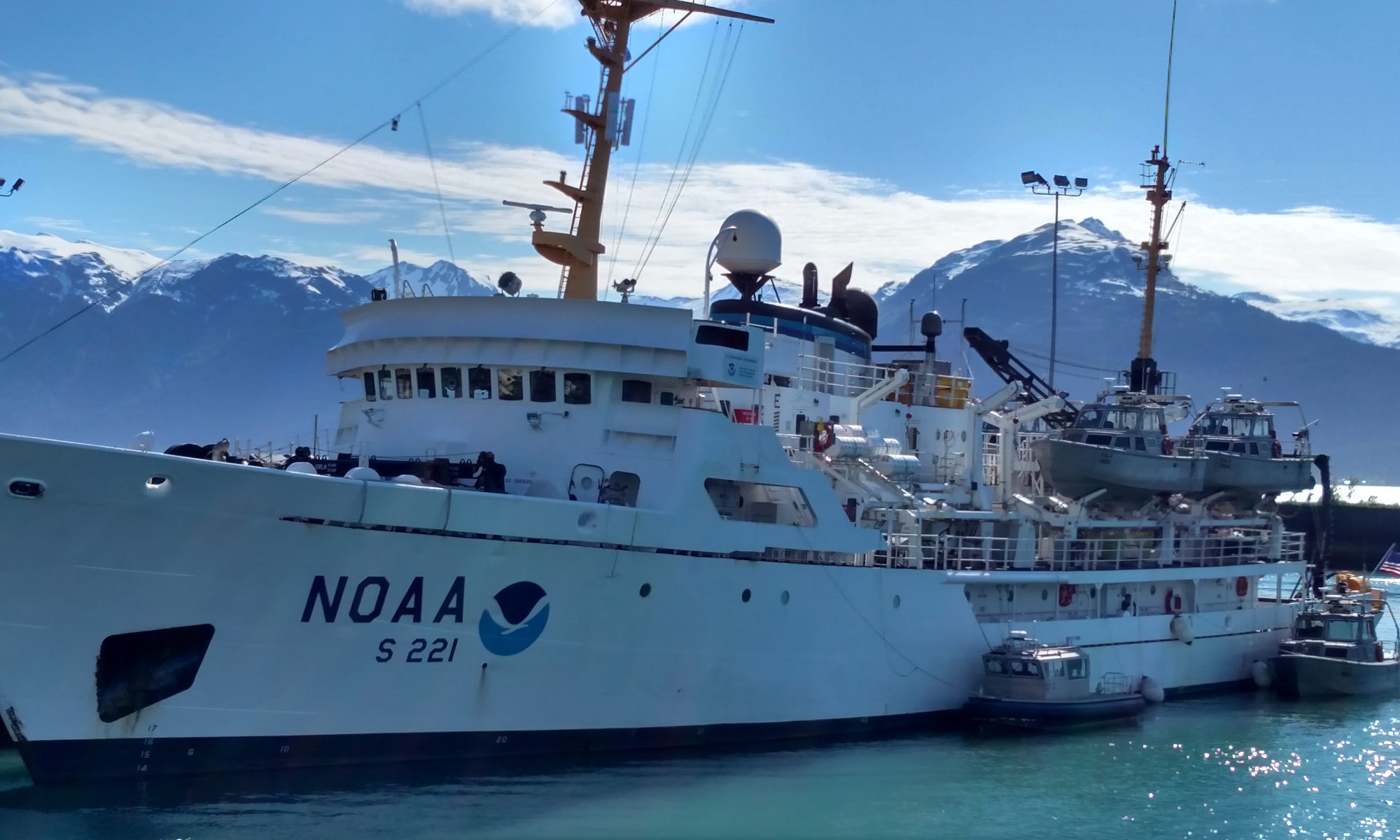
Geographic Area of Cruise: Northeast Atlantic Ocean
Date: August 26, 2018
Weather Data from the Bridge
Latitude: 39.487 N
Longitude: 73.885 W
Water Temperature: 25.2◦C
Wind Speed: 13.1 knots
Wind Direction: WSW
Air Temperature: 26.1◦C
Atmospheric Pressure: 1017.28 millibars
Water depth: 30 meters
Science and Technology Log
As if catching plankton and sneaking a peak with the microscope wasn’t exciting enough (see the picture of the larval eel!), there’s a lot more data being collected on this ship. All of it helps scientists understand what’s going on in this part of the Ocean. And some of it I am able to help with, which is my favorite thing about this cruise (well, maybe that and the incredible views).
I was able to examine some of the plankton samples with a microscope. Do you see the larval eel in the tray next to the scope?The CTD rosette and niskin bottles
At some of our stations, we lower a big and important science tool (called a rosette) into the ocean that contains niskin bottles (bottles used for water sampling) and a Conductivity, Temperature, and Depth meter (CTD). As the rosette is lowered into the depths and raised back up, the scientists can remotely operate the open niskin bottles to snap shut at specific depths. This allows each bottle to come up to the surface with a sample of water from many different depths! Meanwhile, the CTD can take measurements of conductivity (which indicates the salinity of the water), temperature, and pressure, among other things. Scientists have thought of many ways to collect A LOT of data at one time.
Bringing the CTD up from the depths.
When the CTD comes back onto the ship, it’s time for us to use the samples for different purposes. We collect water from 3 different bottles (so 3 different depths) to test the amount of chlorophyll in the water. Do you know what the chlorophyll comes from? If you said plants, you’re right! What are some plant-like things that are drifting all over the ocean? You guessed it! Phytoplankton! So the amount of chlorophyll gives scientists evidence as to how much phytoplankton is in the water. But first, we need to extract (take out) the chlorophyll from the water. We run the water through special filters and soak the filters in a chemical that extracts the chlorophyll. Then we can put the sample through a special machine that uses light to sense the amount of chlorophyll. Wow. One thing I am learning on this trip is how important light is in understanding a water ecosystem.
Me extracting chlorophyll samples
Do you remember what a hypothesis is? It’s an educated guess that answers a scientific question. When scientists come up with a hypothesis, it gives them something to test in an investigation. If you were presented with the question, “At what depth is phytoplankton most abundant?”, what would be your hypothesis?
Another thing we do with the water samples is collect a bit from most of the bottles to preserve and send to the lab to test for the amount of nutrients. When you think of nutrients, you probably think of healthy vitamins for people. But nutrients for plants are actually made from broken down waste of animals. It’s important for ocean water to have a balanced amount of nutrients so that phytoplankton can be healthy. But too much nutrients can also cause algae and phytoplankton to overpopulate!
But that’s not all! The scientists also take samples from the niskin bottles to test for Dissolved Inorganic Carbon (DIC). That sounds fancy, I know. Doing this basically helps scientists understand the pH of the water and look for evidence of ocean acidification (a result of climate change).
Jessica and I taking nutrient samples from the niskin bottles
Can you believe how much scientists can learn from dropping a big science tool into the water?
Scientist Spotlight – Harvey Walsh
Harvey is our Chief Scientist on the mission, meaning he oversees all of the scientific work happening on the ship. He has been so kind as to answer all of my many questions, including these:
Me – If you could invent any tool to make your work more efficient, what would it be and why?
Harvey – I would like a tool that allows you to easily and quickly identify fish eggs and larvae. Currently, it is a time consuming process that involves sorting through samples and identifying them in the lab. There have been and continue to be efforts to use image analysis and genetics to speed up the process. An image analysis has progressed quicker for phyto- and zooplankton, but fish and fish eggs still lag behind.
Me – When did you know you wanted to pursue a career in ocean science?
Harvey – I always thought I would end up studying freshwater fisheries in Minnesota, where I grew up, but after the first two ocean cruises I participated in, I knew the ocean was more for me and the lakes had less of an appeal.
Me – How long has EcoMon (the ecosystem monitoring program we are using) been conducted and how was the protocol (the methods we use) created?
Harvey – EcoMon started in 1992 but it was modeled after a program that started in 1977. The bongo plankton sampling has not changed much since it started, but with new technology we have added the water chemistry
Harvey relaxing in the bridge deck
testing, optics, and other instruments.
To create the protocol, scientists from around the North Atlantic region got together to form the International Commission for the Northwest Atlantic Fisheries. This council had the job of looking at plankton sampling techniques and deciding the best way to monitor plankton communities.
Me – Can you share an example of a way that people have used EcoMon data to form and test a hypothesis?
Harvey – Our data helps scientists make connections between different species in a food web, for example. After people noticed that Atlantic herring (fish) populations were getting low, they used EcoMon data to come up with a hypothesis like this:
“Increasing haddock populations lead to a lower stable state of herring because haddock feed on herring eggs.”
If people want to know more about a certain species of fish and how it survives and thrives, they need to understand the whole ecosystem, including the food web!
Personal Log
This cruise continues to amaze me. Sometimes we’ll have several hours between stations when I love to learn from others, bring a pair of binoculars up to the fly bridge and join the seabird observers, or catch up on a good book. Being around the water all day is calming and serene. I feel that this is the opportunity of a lifetime.
Me and the NOAA Drifter Buoy decorated for Ocean Studies Charter School!
Another rare opportunity came yesterday when I was able to launch my drifter buoy as part of the NOAA drifter buoy program! First, I decorated the buoy with our school’s name and a symbol for each of the classes at our school – the Sharks class, the Rays class, the Dolphin class, and the Sea Star class. Then, after gaining permission from the ship command, we dropped the buoy overboard!
The buoy has a long canvas tube that extends out like a spring after you release it. This allows the buoy to have a long tail that reaches into the water so that it can catch the ocean currents and drift. If it was just the floating buoy, it would get moved by the wind instead of the currents.
Everyone runs to the bow when dolphins are riding the wake!
The buoy has a satellite tag that sends a signal to a satellite wherever it goes. This way, back home my students and I can track the buoy online and see where it ends up! Where do you think the buoy will go?
Everyone on board gets excited when we spot a pod of dolphins or a whale spout! I can’t wait to see what’s out there tomorrow!
Did You Know?
Great Shearwaters are sea birds that spend most of their lives out at sea and only come to land to nest. They can dive deep to catch fish but do not have to dry out their wings like some other birds. They are almost always found soaring by air currents and they prefer stormy and rough weather for stronger air patterns to lift them up.
A great shearwater in flight. Photo courtesy of NOAA.
Challenge Yourself
If a plankton sample with 5,000 individual plankton contains 60% salps, 10% hake larvae, 20% arrow worms, and 10% crab megalops, how many arrow worms are in the sample?
Here’s a picture of an arrow worm from under a microscope. They are about the size of the letter “I” on your keyboard. Photo courtesy of NOAA.
NOAA Teacher at Sea Susan Dee Aboard NOAA Ship Henry B. Bigelow May 23 – June 7, 2018
Mission: Spring Ecosystem Monitoring Survey
Geographic Area of Cruise: Northeastern Coast U.S.
Date: May 24, 2018
Weather Data from Bridge
Latitude: 40°32′
Longitude: 070°45′
Sea Wave Height: 1-2 feet
Wind Speed: 12 knots°
Wind Direction: west
Viability: unrestricted
Air Temperature: 13.5°C
Sky: Few clouds
Science and Technology Log
Tuesday, May 22, I arrived at Newport Naval Base and boarded NOAA Ship Henry B. Bigelow to begin my Teacher at Sea journey by staying overnight on a docked ship. Day 1 was filled with many new experiences as we headed out to sea. The Henry B. Bigelow is part of a fleet of vessels commissioned to conduct fishery surveys. To learn more about the Henry B. Bigelow, check out this website: Henry B. Bigelow. The objective of this cruise is to access the hydrographic, planktonic and pelagic components of North East U.S. continental shelf ecosystem. The majority of the surveys we will take involve the microbiotic parts of the sea – phytoplankton, zooplankton and mesoplankton. Plankton are small microscope organisms in the oceans that are extremely important to the entire Earth ecosystem. These organisms are the foundation of the entire ocean food web. By studying their populations. scientists can get an accurate picture of the state of larger ocean organism populations.
Henry B. BigelowLeaving Newport Harbor
Before leaving the dock, I met with Emily Peacock from Woods Hole Oceanographic Institute (WHOI) to learn how to run an Imaging Flow Cytobot instrument that uses video and flow cytometric technology to capture images of phytoplankton. The IFCB was developed by Dr Heidi Sosik and Rob Olsen (WHOI) to get a better understanding of coastal plankton communities. The IFCB runs 24 hours a day collecting sea water and continuously measuring phytoplankton abundance. Five milliliters of sea water are analyzed every 20 minutes and produces the images shown below.
Emily Peacock teaching the usage of the Imaging Flow CytoBot (IFCB)
Imaging Flow Cytobot (IFCB)Images of Phytoplankton taken by IFCB
The science party on board is made up of scientists from National Marine Fisheries Service (NMFS) part of NOAA Fisheries Division. The chief scientist, Jerry Prezioso, works out of Narragansett Lab and the lead scientist, Tamara Holzworth Davis, is from the Woods Hole Lab, both from the NOAA Northeast Fisheries Science Center. Other members of the Science Party are Seabird/Marine Mammal observers and a student from Maine Maritime Academy. The Crew and scientist group work together to coordinate sampling stations. The crew gets the ship to the site and aid the scientists in deploying instruments. The scientists collect the data and samples at each station. The Crew and scientists work together to find the best and most efficient sea route to each sampling site. Note all the stops for specimen collection on map below. There definitely has to be a plan!
Proposed Cruise Track and Survey Locations
Personal Log
Because research instrument deployment is done 24 hours a day, the NOAA Corps crew and scientists are divided into two shifts. I am on watch 1200 – 2400 hours, considered the day shift. This schedule is working good for me. I finish duty at midnight, go to sleep till 9:00 AM and rise to be back on duty at noon. Not a bad schedule. Due to clear weather and calm seas, the ship headed east out of Newport Harbor towards the continental shelf and started collecting samples at planned stops. I joined another group of scientists observing bird and marine mammal populations from the flying bridge of the ship. Humpback whales and basking sharks breached several times during the day
It has only been two days but I feel very acclimated to life at sea. I am not seasick, thanks to calm seas and the patch. Finding the way around the ship is getting easier- it is like a maze. Spotting a pod of humpback whales breaching and basking sharks was a highlight of the day. My Biology students back at May River High School scored great on End of Course Exam. Congratulations May River High School Sharks! Thinking of y’all.
We have not started fishing yet because we are heading to our first transect off the western coast of the Haida Gwaii archipelago. I thought this would be a perfect time to introduce another research project that is gathering data on the Shimada. One of my roommates, Lynne Scamman, is on-board researching Hazardous Algal Blooms (HABs).
Lynne Scamman running wet chemistry tests and identifying phytoplankton.
What are Hazardous Algal Blooms?
They are large numbers of phytoplankton, either diatoms or dinoflagellates, who produce toxins. Phytoplankton are essential to the ecosystem because they produce half of the global oxygen. However under certain circumstances these organisms reproduce rapidly, skyrocketing the population, this is a bloom. Some of these phytoplankton produce toxins. When the populations are low the toxins aren’t a big deal. However, when a bloom of phytoplankton that produce toxins occurs there can be health concerns for organisms exposed to the toxins. We have to consider the marine food chain and something called bioaccumulation. Phytoplankton along with zooplankton create the base of the marine food web. Organisms who eat toxin producing phytoplankton retain the toxin in their body. Then any organism who eats them will also hold that toxin. You can see how the toxin would accumulate along the food chain and potentially hold serious side effects for organisms with high levels of toxin.
Why is research being done on HABs?
HABs are becoming a problem for humans along the coasts and in the Great Lakes. Basically all of the factors that contribute to the increase in HABs are a product of human impact. Global climate change, increased nutrient pollution and global sea trade are all factors contributing to the rise in Hazardous Algal Blooms. We want to monitor so that eventually we will be able to predict when, where and why the HABs will occur.
Why are YOU studying HABs?
One day I walked into my college biology lab and met a guest instructor who specializes in all things phytoplankton related. I was blown away by the complexity that some of these single celled organisms held. The professor shared a few species names and I started investigating. The species that grabbed my attention is called Nematadinium armatum. This organism has a rudimentary eye called a melanosome and nematocysts for hunting, again this is pretty impressive for an organism made of one cell. Once I learned about the variety in this microscopic world and how influential they were to the health of the entire ocean, I knew that I wanted to learn more.
Personal Log
I am still figuratively pinching myself every few hours at just how amazing this experience is to participate in first hand. Yesterday we left the dock of Port Angeles at 10am and the boat hasn’t slowed down since. We did drills to ensure that all aboard knew where to go in case of fire and if we needed to abandon ship. Part of the abandon ship drill is to make sure that everyone has and can get into their Immersion Suit aka “Gumby Suit.” This suit is amazing! This portion of the Pacific is quite cold and the Immersion suit would keep you warm and buoyant until a rescue can occur.
Trying on the Immersion suit.
After our drills several of the science crew went up to the Flying Bridge to look for marine mammals. We were cruising between Cape Flattery, Washington and Vancouver Island, British Columbia with high hopes of seeing activity. WOW, we lucked out. We spotted 17 Humpback whales, 2 Harbor porpoise and 2 Dall’s porpoise. We are also seeing several types of sea birds but I am still brushing up with the Sibley to id birds from this area.
The Shimada under two flags as it enters Canadian waters.
Did You Know?
The island cluster that we are heading to had a name change at the end of 2009. What was formerly called Queen Charlotte Islands is now called Haida Gwaii. This name change came as part of a historic reconciliation between British Columbia and Haida nation. Haida Gwaii translated means “island of the people.”
Oscar Dyson moves across the Shelikof Straight to collect the Line 8 samples
Geographic area of cruise: Western Gulf of Alaska
Date: August 26, 2017
Weather Data: 13.2 C, cloudy with light rain
Latitude 57 36.6 N, Longitude 155 .008 N
Science and Technology Log
As part of this survey, the scientists onboard collect data from what is known as “Line 8”. This is a line of seven sampling stations, positioned only a few miles apart, near the southern opening of Shelikof Straight between Kodiak Island and the Alaskan Peninsula. Water samples are taken at different depths at each sampling station to measure several different properties of the water. This study is focused on profiling water temperature and salinity, and measuring the quantities of nutrients and phytoplankton in the water.
The CTD rosette is lowered into the water using a winch – as seen from above.
To collect this data, a conductivity and temperature at depth (CTD) instrument is lowered into the water. This instrument can take water samples at different depths, by using its eleven canisters, or Niskin bottles. The water collected in the Niskin bottles will be used to determine the nutrient quantities at each station. The rosette of Niskin bottles also has sensors on it that measure phytoplankton quantities, depth, temperature, and how conductive the water is. Scientists can use the readings from conductivity and temperature meters to determine the salinity of the water.
Each Niskin bottle has a stopper at the top and the bottom. The CTD goes into the water with both ends of each Niskin bottle in the open position. The CTD is then lowered to a determined depth, depending on how deep the water is at each station. There is a depth meter on the CTD that relays its position to computers on board the ship. The survey team communicates its position to the deck crew who operate the winch to raise and lower it.
Niskin bottles are lowered into the water with the stoppers at both ends open.
When the CTD is raised to the first sampling depth, the survey crew clicks a button on a monitor, which closes the stoppers on both ends of Niskin bottle #1, capturing a water sample inside. The CTD is then raised to the next sampling depth where Niskin bottle #2 is closed. This process continues until all the samples have been collected. A computer on board records the depth, conductivity and temperature of the water as the CTD changes position. A line appears across the graph of this data to show where each sample was taken. After the Niskin bottles on the CTD are filled, it is brought back onto the deck of the ship.
They let me take control of closing the Niskin bottles at the sampling depths!I used this screen to read the data coming back from the CTD and to hit the bottle to close each Niskin bottle. The purple horizontal lines on the graph on the right indicate where each one was closed.
Water is collected through a valve near the bottom of each Niskin bottle. A sample of water from each depth is placed in a labeled jar. This study is interested in measuring the quantity of nutrients in the water samples. To do this it is important to have samples without phytoplankton in them. Special syringes with filters are used to screen out any phytoplankton in the samples.
Syringes with special filters to screen out phytoplankton are used to collect water samples from the Niskin bottles.
The “Line 8” stations have been sampled for nutrient, plankton, and physical water properties for many years. The data from the samples we collected will be added to the larger data set maintained by the Ecosystems and Fisheries-Oceanography Coordinated Investigations (Eco-FOCI), Seattle, Washington. This NOAA Program has data on how the marine ecosystem in this area has changed over the last few decades. When data spans a long time frame, like this study does, scientists can identify trends that might be related to the seasons and to inter-annual variation in ocean conditions. The samples continue to be collected because proper nutrient levels are important to maintaining healthy phytoplankton populations, which are the basis of most marine food webs.
Collecting water samples from a Niskin bottle.
Personal Log
As we travel from one station to the next, I have some time to talk with other members of the science team and the crew. I have really enjoyed learning about places all over the world by listening to people’s stories. Most people aboard this ship travel many times a year for their work or have lived in remote places to conduct their scientific studies. Their stories inspire me to keep exploring the planet and to always search for new things to learn!
Did you know?
Niskin bottles must be lowered into the water with both ends open to avoid getting an air bubble trapped inside of them. Pressure increases as depth under water increases. Niskin bottles are often lowered down below 150 meters, where the pressure can be intense. If an air bubble were to get trapped inside, the pressure at these depths would cause air bubble to expand so much that it might damage the Niskin bottle!
NOAA Teacher at Sea Dieuwertje “DJ” Kast Aboard NOAA Ship Henry B. Bigelow May 19 – June 3, 2015
Mission: Ecosystem Monitoring Survey
Geographical area of cruise: Gulf of Maine Date: May 28, 2015, Day 11 of Voyage
Interview with Student Megan Switzer
Chief Scientist Jerry Prezioso and graduate oceanography student Megan Switzer
Megan Switzer is a Masters student at the University of Maine in Orono. She works in Dave Townsend’s lab in the oceanography department. Her research focuses on interannual nutrient dynamics in the Gulf of Maine. On this research cruise, she is collecting water samples from Gulf of Maine, as well as from Georges Bank, Southern New England (SNE), and the Mid Atlantic Bight (MAB). She is examining the relationship between dissolved nutrients (like nitrate and silicate) and phytoplankton blooms. This is Megan’s first research cruise!
In the generic ocean food chain, phytoplankton are the primary producers because they photosynthesize. They equate to plants on land. Zooplankton are the primary consumers because they eat the phytoplankton. There are so many of both kinds in the ocean. Megan is focusing on a particular phytoplankton called a diatom; it is the most common type of phytoplankton found in our oceans and is estimated to contribute up to 45% of the total oceanic primary production (Yool & Tyrrel 2003). Diatoms are unicellular for the most part, and a unique feature of diatom cells is that they are enclosed within a cell wall made of silica called a frustule.
Diatom Frustules. Photo by: Steve SchmeissnerDiatoms! Photo by: Micrographia
The frustules are almost bilaterally symmetrical which is why they are called di (2)-atoms. Diatoms are microscopic and they are approximately 2 microns to about 500 microns (0.5 mm) in length, or about the width of a human hair. The most common species of diatoms are: Pseudonitzchia, Chaetocerous, Rhizosolenia, Thalassiosira, Coschinodiscus and Navicula.
Pseudonitzchia. Photo by National Ocean ServiceThalassiosira. Photo by: Department of Energy Joint Genome InstitutePhoto of Coscinodiscus
Diatoms also have ranges and tolerances for environmental variables, including nutrient concentration, suspended sediment, and flow regime. As a result, diatoms are used extensively in environmental assessment and monitoring. Furthermore, because the silica cell walls are inorganic substances that take a long time to dissolve, diatoms in marine and lake sediments can be used to interpret conditions in the past.
In the Gulf of Maine, the seafloor sediment is constantly being re-suspended by tidal currents, bottom trawling, and storm events, and throughout most of the region there is a layer of re-suspended sediment at the bottom called the Bottom Nepheloid Layer. This layer is approximately 5-30 meters thick, and this can be identified with light attenuation and turbidity data. Megan uses a transmissometer, which is an instrument that tells her how clear the water is by measuring how much light can pass through it. Light attenuation, or the degree to which a beam of light is absorbed by stuff in the water, sharply increases within the bottom nepheloid layer since there are a lot more particles there to block the path of the light. She also takes a water sample from the Benthic Nepheloid Layer to take back to the lab.
Marine Silica Cycle by Sarmiento and Gruber 2006
Megan also uses a fluorometer to measure the turbidity at various depths. Turbidity is a measure of how cloudy the water is. The water gets cloudy when sediment gets stirred up into it. A fluorometer measures the degree to which light is reflected and scattered by suspended particles in the water. Taken together, the data from the fluorometer and the transmissometer will help Megan determine the amount of suspended particulate material at each station. She also takes a water sample from the Benthic Nepheloid layer to take back to the lab. There, she can analyze the suspended particles and determine how many of them are made out of the silica based frustules of sinking diatoms.
This instrument is a Fluorometer and is used to measure the turbidity at various depths. Photo by: DJ Kast
She collects water at depth on each of the CTD/ Rosette casts.
Rosette with the 12 Niskin Bottles and the CTD. Photo by DJ KastRosette with the 12 Niskin Bottles and the CTD. Photo by DJ KastUp close shot of the water sampling. Photo by DJ Kast
CTD, Rosette, and Niskin Bottle basics.
The CTD or (conductivity, temperature, and depth) is an instrument that contains a cluster of sensors, which measure conductivity, temperature, and pressure/ depth.
Here is a video of a CTD being retrieved.
Depth measurements are derived from measurement of hydrostatic pressure, and salinity is measured from electrical conductivity. Sensors are arranged inside a metal housing, the metal used for the housing determining the depth to which the CTD can be lowered. Other sensors may be added to the cluster, including some that measure chemical or biological parameters, such as dissolved oxygen and chlorophyll fluorescence. Chlorophyll fluorescence measures how many microscopic photosynthetic organisms (phytoplankton) are in the water. The most commonly used water sampler is known as a rosette. It is a framework with 12 to 36 sampling Niskin bottles (typically ranging from 1.7- to 30-liter capacity) clustered around a central cylinder, where a CTD or other sensor package can be attached. The Niskin bottle is actually a tube, which is usually plastic to minimize contamination of the sample, and open to the water at both ends. It has a vent knob that can be opened to drain the water sample from a spigot on the bottom of the tube to remove the water sample. The scientists all rinse their bottles three times and wear nitrile or nitrogen free gloves to prevent contamination to the samples.
On NOAA ship Henry B. Bigelow the rosette is deployed from the starboard deck, from a section called the side sampling station of this research vessel.
The instrument is lowered into the water with a winch operated by either Adrian (Chief Boatswain- in charge of deck department) or John (Lead Fishermen- second in command of deck department). When the CTD/Rosette is lowered into the water it is called the downcast and it will travel to a determined depth or to a few meters above the ocean floor. There is a conducting wire cable is attached to the CTD frame connecting the CTD to an on board computer in the dry lab, and it allows instantaneous uploading and real time visualization of the collected data on the computer screen.
CTD data on the computer screen. Photo by: DJ Kast
The water column profile of the downcast is used to determine the depths at which the rosette will be stopped on its way back to the surface (the upcast) to collect the water samples using the attached bottles.
Niskin Bottles:
Messenger- The manual way to trigger the bottle is with a weight called a messenger. This is sent down a wire to a bottle at depth and hits a trigger button. The trigger is connected to two lanyards attached to caps on both ends of the bottle. When the messenger hits the trigger, elastic tubing inside the bottle closes it at the specified depth.
Todd holding a messenger to trigger the manually operated Niskin Bottle. Photo by: DJ Kast
Todd with the manually operated Niskin Bottle. Photo by: DJ KastManual CTD fully cocked and ready to deploy. Photo by DJ Kast
Here is a video of how the manual niskin bottle closes: https://www.youtube.com/watch?v=qrqXWtbUc74
The other way to trigger Niskin bottles is electronically. The same mechanism is in place but an electronic signal is sent down the wire through insulated and conductive sea cables (to prevent salt from interfering with conductivity) to trigger the mechanism.
Here is a video of how it closes electronically: https://www.youtube.com/watch?v=YJF1QVe6AK8
Conductive Wire to CTD. Photo by DJ KastPhoto of the top of the CTD showing the trigger mechanism in the center. Photo by DJ KastTop of the Niskin Bottles shows how the lanyards are connected to the top. Photo by DJ KastThe pin on the bottom is activated when an electronic signal is sent through the conductive sea cables. Photo by DJ Kast
Using the Niskin bottles, Megan collects water samples at various depths. She then filters water samples for her small bottles with a syringe and a filter and the filter takes out the phytoplankton, zooplankton and any particulate matter. She does this so that there is nothing living in the water sample, because if there is there will be respiration and it will change the nutrient content of the water sample.
Filtering out only the water using a syringe filter. Photo by DJ KastSyringe with a filter on it. Photo by: DJ Kast
This is part of the reason why we freeze the sample in the -80 C fridge right after they have been processed so that bacteria decomposing can’t change the nutrient content either.
Diatoms dominate the spring phytoplankton bloom in the Gulf of Maine. They take up nitrate and silicate in roughly equal proportions, but both nutrients vary in concentrations from year to year. Silicate is almost always the limiting nutrient for diatom production in this region (Townsend et. al., 2010). Diatoms cannot grow without silicate, so when this nutrient is used up, diatom production comes to a halt. The deep offshore waters that supply the greatest source of dissolved nutrients to the Gulf of Maine are richer in nitrate than silicate, which means that silicate will be used up first by the diatoms with some nitrate left over. The amount of nitrate left over each year will affect the species composition of the other kinds of phytoplankton in the area (Townsend et. al., 2010).
The silica in the frustules of the diatom are hard to breakdown and consequently these structures are likely to sink out of the euphotic zone and down to the seafloor before dissolving. If they get buried on the seafloor, then the silicate is taken out of the system. If they dissolve, then the dissolved silicate here might be a source of silicate to new production if it fluxes back to the top of the water column where the phytoplankton grow.
Below are five images called depth slices. These indicate the silicate concentration (rainbow gradient) over a geographical area (Gulf of Maine) with depth (in meters) latitude and longitude on the x and y axis.
Depth slices of nitrate and silicate. Photo by: GOMTOX at the University of Maine This is the type of data Megan is hoping to process from this cruise.