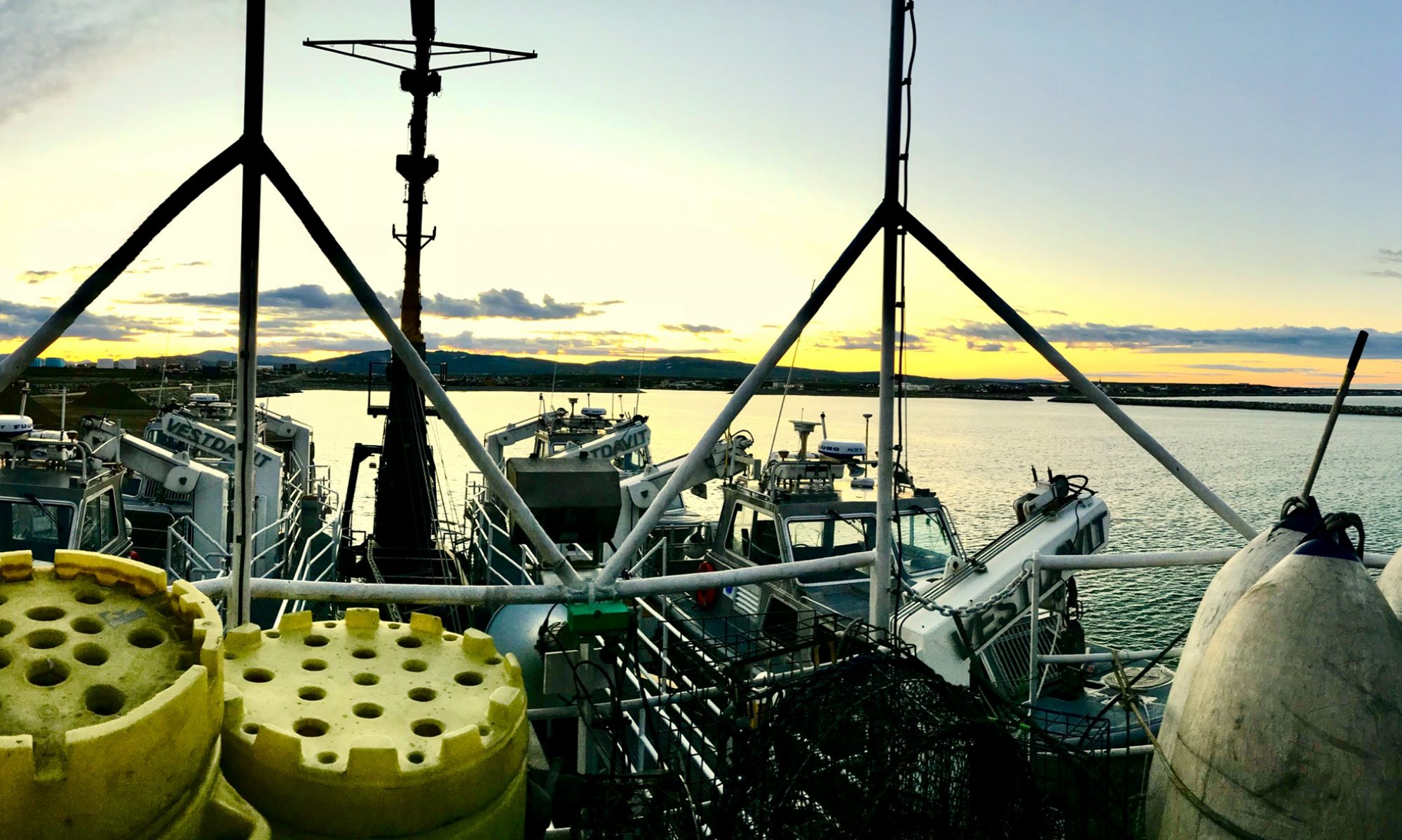
Mary Murrian: Working at Sea on the Oscar Dyson! July 11, 2014

NOAA Teacher at Sea

Mary Murrian

Aboard NOAA Ship Oscar Dyson

July 4 – 22, 2014

Mission: Annual Walleye Pollock Survey

Geographical Area of Cruise: Bering Sea North of Dutch Harbor

Date: Friday, July 11, 2014

Weather Data fro the Bridge:

Wind Speed: 17.02 kt

Air Temperature: 8.9 degrees Celsius

Barometric Pressure: 1004.3

Latitude: 5903.6745 N

Longitude: 17220..4880 W

noaa iphone pictures july 5 and 6 2014 1109
I’m sorting the jellyfish (Chrysaora Melanaster) from the pollock.

Science log:

I participated in my first live trawl, catch, sort and data collection survey. In my last blog, I talked about how we located and caught the pollock.  This blog will talk about what happens when the fish are unloaded into the wet lab and processed.  A wet lab is a science lab that is capable of handling excess water and houses the equipment need to to process the catch.

Fresh catch proceeding down the conveyor belt. Time to sort.

Once the crew off loads the fish, from the net to the short conveyor belt, into the wet lab or sometimes called the slime lab, (it really lives up to its name), I help the scientists sort the pollock from the other species caught in the net. A small sample of marine life, that is not a pollock, gets sorted, weighed and measured for data collection purposes. They are not the main target of our survey, however, they are interesting to see. Large quantities of jellyfish usually make the mix, but I have seen a variety of other animals, such as crabs, starfishes, clams, salmon, flatfishes, Pacific herring, Atka mackerel, and Yellow Irish Lord. The main character, the pollock, are weighed in batches and then placed on a small table to be sexed. In order to sex the fish, I had to cut across the side of the fish with a small scalpel. Next, I inserted my fingers into their guts and pulled out either the gonads (male) or ovaries (female). The gonads look like stringy romaine noodles and the ovaries look like whitish-pinkish oval sacs. Female pollock are placed in a bin labeled sheila’s and the male pollocks are placed in a bin labeled blokes. Sheila’s and blokes are Australian terms for female and male. Cute.

A female pollock full of eggs
Sexing the pollock.  This one is a female.  You can see it oval shaped ovaries.
Sexing the pollock. This one is a female. You can see it oval shaped ovaries.

Once sexed and sorted, the fish are measured for their length. Two very ingenious scientists (one who is working on my trip, Kresimir Williams, and Rick Towler), invented an electronic measuring device. The device allows us to measure quickly and accurately while at the same time automatically recording the measurement on the computer. It looks like a cutting board with a ruler embedded in the center. Of course, all measurements used are metric, the primary form of measurement for scientists across the world.  I to place the fish’s mouth at the beginning of the board and line the back tail of the fish along the ruler. Next, a special tool (a stylus) embedded with a magnet (it’s small, white,and the front looks like a plastic arrowhead) is placed arrow side forward on the end of the tail fin. Once the tool touches the board (it makes a noise which sounds similar to “ta-da” to let you know it captured its measurement), it automatically records the length in the data program, on the computer. I wish I had one for my classroom. Oh, the fun my students could have measuring!  The device streamlines the data collecting process allowing scientists more precise data collection and more time for other research.

I’m measuring the pollock on the electronic scale called the Ichthy Stick

That was a lot to absorb, but there is more. If you tend to get squeamish, you might want to scroll past the next paragraph.

Although, I did not work hands on with the next data collection, I closely observed and took pictures. I will try it before my trip ends. The next step is the aging process. Aging a pollock is a vital part of determining the health and welfare of the species. Aging a pollock is similar to the method of aging a tree.  The Russian scientist, Dr. Mikhail Stepanenko, who has been surveying pollock for over twenty years and is part of the NOAA science team, has it down to a science. First, he cuts the pollock’s head off exposing the ear bones called Otoliths (Oto–means ear; liths–means stone).  He removes the tiny ear bones (about the size and shape of a piece of a navy bean), rinses them, and places them in a small vial labeled with a serial-numbered bar code. The bar code gets scanned and the code is assigned to the specific fish in the computer data base, which also includes their sex, weight and length. Once back at the lab, located in Seattle, Washington, the otoliths can be observed under a microscope and aged based on the number of rings they have: pollock otoliths have one ring for every year of age.  Only twenty fish from each trawl have their otoliths extracted.

Looking inside the pollock.  The little white bones are the ear bones or otoliths.
Looking inside the pollock. The little white bones are the ear bones or otoliths.
Dr. Mikhail Stepanenko placing the otoliths (ear bones) in the vial to be sent to the lab.
Mikhail Stepanenko or we call him Meesha

Once all data are collected, there is still more work to be completed. All of the fish that we sampled, were thrown back into the ocean for the sea birds and other carnivores (meat-eaters) to enjoy. Who wouldn’t enjoy a free meal? Then the equipment and work space must be sprayed down to get rid of all the fish particles (slime). It’s important to clean up after yourself to ensure a safe and healthy environment for everyone. Besides, the smell would be horrible.  I also had to spray myself down, it gets very messy.  I had fish guts and jellyfish slime all over my lab gear (orange outer wear provided by NOAA). Unfortunately, the guts occasionally get splattered on my face and hair!  Yuck, talking about fish face.  Thankfully, a bathroom is nearby, where I can get cleaned up.

Starfish that fell from the net when being towed back on board.
Part of the snail family
Whelks (snails) and anemones

When all is clean, the scientists can upload and analyze the data. They will compare the data to past and current surveys. The data is a vital step to determining the health and abundance of pollock in our ecosystem. I am amazed at all the science, math, engineering, and technology that goes on during a fish survey. It takes many people and numerous skills to make the survey successful.

Brittle Sea Star

This is one of many experiences, I have had trawling and collecting data at sea aboard the Oscar Dyson.  The process will repeat several times over my three week trip.  As part of the science crew, I am responsible to help with all trawls during my shift.  I could have multiple experiences in one day.  I cannot wait!

Personal Log:

What’s it like to be on a NOAA ship out at sea? 

The deck hands, NOAA Corps, and the people I work closest with, the science team, are wonderful and welcoming. I’m super excited and I have to restrain myself from overdoing my questions. They have a job to do!

The weather is not what I expected.  It is usually foggy, overcast, and in the high 40’s and low 50’s.  Once in a while the sun tries to peek out through the clouds. The Bering Sea has been relatively calm. The heaviest article of clothing I wear is a sweatshirt.  It is still early, anything can happen.

On my first day at sea, we had a fire drill and an evacuation drill. Thankfully, I passed.  With help from Carwyn, I practiced donning (putting on) my survival suit.  I displayed a picture of me wearing it in my last blog.  It makes for a hilarious picture!   All kidding aside, NOAA takes safety seriously. The survival suit will keep me alive for several days in case of an evacuation in the middle of sea until someone can rescue me. It will protect me from the elements like water temperature, heat from sun, and it has a flashlight attached. Hopefully, I will not have to go through the experience of needing the suit; but I feel safer knowing it is available.

Carwyn Hammond

Besides the people, the best amenity aboard the Oscar Dyson is the food. Food is available around the clock. That is important because we work 12 hour shifts from 4:00 to 4:00. That means I work the morning 12-hour shift and my roommate, Emily Collins, works the night 12-hour shift. Hungry workers are grumpy workers. For breakfast, you can get your eggs cooked to order and choose from a variety of traditional breakfast food: French toast, grits, cereal, bacon, sausage, fresh fruit, etc…Hot meal options are served for lunch and dinner including a delicious dessert . Of course, ice cream is available always!  I hope I can at least maintain my weight while aboard.

The Galley
The Galley
Food Bar
Food Bar

If I get the urge, there is workout equipment including cardio machines and weights available to use. Other entertainment includes movies and playing games with the other crew members.  The Oscar Dyson also has a store where I can purchase sweatshirts, sweatpants, t-shirts, hats, and other miscellaneous souvenirs advertising the name of the ship. Who would have thought you could shop aboard a NOAA fishing vessel?  I am definitely going shopping.  One of my favorite things to do aboard the ship is to watch for marine life on the bridge, it is peaceful and relaxing.  For anyone that does not know, the bridge is where the Chief Commanding Officer, Chief Executive Officer, and crew navigate the ship.  It is the highest point in which to stand and watch safely out at sea and in my opinion, it has the best view on board.

Did you know?

Did you know when a marine animal such as a seal is close by during a trawl, the trawl process stops and is rerouted?   

The crew is very respectful of sea life and endeavors to complete their mission with the least negative impact on wildlife.  Also, while the ship is on its regular course, the officers on the bridge, sometimes with a deck hand who is available, keep an eye out for seals, sea lions, whales, and sharks, in order to maneuver around them and keep them safe.

NOAA Corps LT Greg Schweitzer, Executive Officer or XO
NOAA Corps Ensign Ben VanDine, Safety Officer


Did you know you can track the Oscar Dyson and its current location?

Check out this link: http://shiptracker.noaa.gov/

Make sure you find the Bering Sea and click on the yellow dot; it will tell you our coordinates!


Meet the Scientist:  Emily Collins

Emily holding a Yellow Irish Lord

Title: Fisheries Observer (4 years)

Education:  Bachelor’s Degree in Biology, Marine Science, Boston University

Job Responsibilities: As an observer, Emily works aboard numerous fishing vessels, including the Oscar Dyson.  She collects data to find out what is being caught so that we can send the information to NMFS (National Marine Fisheries Services), a division of NOAA.  They use the data she collects to complete a stock assessment about what type of fish are caught and how much.  She is helping, as part of the science team, survey the pollock for all three legs of the survey.  When I get back to port, she has a couple of days to rest up in Dutch Harbor and then she will complete the last leg of the trip.

Living Quarters:  As a full-time observer, her home is wherever the next assignment is located, mostly on the Bering Sea and the Gulf of Alaska.  She is from Dundee, New York, where her family currently resides.

What is cool about her work?

She loves working at sea  and working with the marine life.  She especially loves it when the nets catch a species of fish she has not seen before.  Getting to know new people and traveling is also a plus.

The weirdest and definitely not her favorite experience, while working on a smaller fisheries boats, was having to use a bucket for the toilet.

Emily had a wonderful opportunity her senior year in high school, the chance to go on a National Geographic Expedition with her mom and then later while in college while taking classes abroad. She went to the Galapagos Islands and Ecuador to study marine biology. These experiences and the fact that her mother is a veterinarian exposed Emily to the love of animals the ocean, and her career choice.


Nate is holding a snow crab.
A flat fish
Rock Sole (a type of flatfish)


Lots of crabs!
Lots of crabs!
Sorting through the bottom trawl
Korean Horsehair Crab
Kresimir Williams holding a crab
Alex De Robertis working in the wet lab.

Mary Murrian: My First Days in Dutch Harbor, July 6, 2014

NOAA Teacher at Sea 

Mary Murrian

Aboard NOAA Ship Oscar Dyson

July 4 – 22, 2014

Mission: Annual Walleye Pollock Survey

Geographical Area of Cruise: Bering Sea North of Dutch Harbor

Date: Sunday, July 6th, 2014

Weather Data from the Bridge:

Wind Speed: 6 kts

Air Temperature: 8.6 degrees Celsius

Weather conditions: Hazy

Barometric Pressure: 1009.9

Latitude: 5923.6198  N

Longitude: 17030.6395  W


Science and Technology Log

Part One of the Survey Trawl: Getting Ready to Fish

This is a picture of a pollock from our first trawl.

Today is my second day aboard the Oscar Dyson.  We are anxiously waiting for the echosounder (more information on echosounder follows) to send us a visual indication that a large abundance of fish is ready to be caught.  The point of the survey is to measure the abundance of Walleye Pollock throughout specific regions in the Bering Sea and manage the fisheries that harvest these fish for commercial use to process and sell across the world.  The Walleye Pollock are one of the largest populations of fish.  It is important to manage their populations due to over-fishing could cause a substantial decrease the species.  This would be detrimental to our ecosystem.  The food web [interconnecting food chains; i.e. Sun, plants or producers (algae), primary consumers, animals that eat plants (zooplankton), secondary consumers, animals that eat other animals (pollock), and decomposers, plants or animals that break down dead matter (bacteria)] could be altered and would cause a negative effect on other producers and consumers that depend on the pollock for food or maintain their population.

The main food source for young pollock is copepods, a very small marine animal (it looks like a grain of rice with handle bars).  They also eat zooplankton (animals in the plankton), crustaceans, and other bottom dwelling sea life.  On the weird side of the species, adult pollock are known to eat smaller pollock.  That’s right, they eat each other, otherwise known as cannibalism.  Pollock is one of the main food sources for young fur seal pups and other marine life in Alaskan waters.  Without the pollock, the food web would be greatly altered and not in a positive way.

How do we track the pollock?

Pollock
Pollock

Tracking begins in the acoustics lab.  Acoustics is the branch of science concerned with the properties of sound.  The acoustics lab on board the Oscar Dyson, is the main work room where scientists can monitor life in the ocean using an echosounder which measures how many fish there are with sound to track the walleye pollock’s location in the ocean.  They also use the ships’s GPS (Global Positioning System), a navigation system, to track the location of the NOAA vessel and trawl path.

Echo Sounder
Sonar Screen

What is sonar and how does it work? 

Sonar (sound ranging & navigation;  it’s a product of World War II) allows scientists to “see” things in the ocean using sound by measuring the amount of sound bouncing off of objects in the water.  On this survey, sonar images are displayed as colors on several computer monitors, which are used to see when fish are present and their abundance.  Strong echoes show up as red, and weak echoes are shown as white.  The greater the amount of sound reported by the sonar as red signals, the greater the amount of fish.

Echo Sonar Screen Showing the patterns of echos from the ocean.

How does it work?  There is a piece of equipment attached to the bottom of the ship called the echosounder.  It sends pings (sound pulses) to the bottom of the ocean and measures how much sound bounces back to track possible fish locations.   The echo from the ocean floor shows up as a very strong red signal.   When echoes appear before the sound hits the ocean floor, this represents the ping colliding with an object in the water such as a fish.

The scientists monitor the echosounder signal so they can convey to the ships’s bridge and commanding officer to release the nets so that they can identify the animals reflecting the sound.  The net catches anything in its path such as jellyfish, star fish, crabs, snails, clams, and a variety of other fish species. Years of experience allows the NOAA scientists the ability to distinguish between the colors represented on the computer monitor and determine which markings represent pollock versus krill or other sea life.  We also measure the echoes at different frequencies and can tell whether we have located fish such as pollock, or smaller aquatic life (zooplankton). The red color shown on the sonar screen is also an indicator of pollock, which form dense schools.  The greater amount of red color shown on the sonar monitor, the better opportunity to we have to catch a larger sample of pollock.

The Science Team Wonderful group of people.

Once we have located the pollock and the net is ready, it is time to fish.  It is not as easy as you think, although the deck hands and surveyors make it look simple.  In order to survey the pollock, we have to trawl the ocean.  Depending on the sonar location of the pollock, the trawl can gather fish from the bottom of floor, middle level and/or surface of the ocean covering preplanned locations or coordinates. Note: Not all the fish caught are pollock.

The preplanned survey path is called transect lines with head due north for a certain distance. When the path turns at a 90 degree angle west (called cross-transect lines) and turns around another 90 degree angle heading back south again.  This is repeated numerous times over the course of each leg in order to cover a greater area of the ocean floor.  In my case we are navigating the Bering Sea.  My voyage, on the Oscar Dyson is actually the second leg of the survey, in which, scientists are trawling for walleye pollock.  There are a total of three legs planned covering a distance of approximately 6,200nmi (nautical miles, that is).

Trawling is where we release a large net into the sea located on the stern (the back of the boat).  Trawling is similar to herding sheep.  The fish swim into the net as the boat continues to move forward, eventually moving to the smaller end of the net.  Once the sonar screen (located on a computer monitor) shows that we have collected a large enough sample of pollock, the deck hands reel the net back on board the boat.


The crew are beginning to release the trawl net.
This is the stern of the boat where the trawl net gets released into the ocean.

We have caught the fish, now what?  Stay tuned for my exciting experience in the wet lab handling the pollock and other marine wild life.  It is most certainly an opportunity of a lifetime.

Personal Log

What an adventure!

I was lucky enough to spend a day exploring Dutch Harbor, Alaska before departing on the pollock survey across the Bering Sea. It took me three plane rides, several short lay-overs and and a car ride to get here, a total of 16 hours. There is a four hour time difference between Dutch Harbor and Dover, Delaware. It takes some getting used to, but definitely worth it. The sun sets shortly after 12:00 midnight and appears again around 5:00 in the morning. Going to sleep when it’s still daylight can be tricky. Thank goodness I have a curtain surrounding my bed. Speaking of the bed, it is extremely comfortable. It is one of those soft pillow top beds. Getting in and out of the top bunk can be challenging. I haven’t fallen yet.

My bed is the top bunk.

During my tour through the small town of Dutch Harbor, I have encountered very friendly residents and fishermen from around the world.  I was fortunate to see the U.S. Coast Guard ship Healy docked at the harbor. What a beautiful vessel.  Dutch Harbor has one full grocery store (Safeway) just like we have in Delaware, with the exception of some of the local Alaska food products like Alaska BBQ potato chips. They have a merchant store that sells a variety of items ranging from food, souvenirs, clothing, and hardware. They have three local restaurants and a mom and pop fast food establishment. One of the restaurants is located in the only local Inn the Aleutian hotel, which also includes a gift shop. Dutch Harbor is home to several major fisheries. Dutch Harbor is rich in history and is home to the native Aleutian tribe. I took a tour of their local museum. It was filled with the history and journey of the Aleutian people. While driving through town, I got a chance to see their elementary and high school. They both looked relatively new. Dutch Harbor is also home to our nation’s first Russian Orthodox Church. Alaska is our 50th state and was purchased from Russia in 1867.

Me and the Oscar Dyson
Mary Murian in front of the Oscar Dyson
A very funny photo of me in my survival suit.

One of the coolest parts of my tour was walking around the area known as the “spit”. The “spit” is located directly behind the airport. I’m told it is called the “spit” because the land and water are spitting distance in length and width. We walked along the shoreline and discovered hundreds of small snails gathered around the rocks. We also found hermit crabs, starfish, sea anemones, jellyfish, and red algae. We saw red colored water, which is a bloom or a population explosion of tiny algae that get so thick that they change the color of the water.

One of numerous amazing views in Dutch Harbor
tas 2014 day 1 and perboarding july 2-4th 089
Starfish

Another animal in abundance in Dutch Harbor is the bald eagle. There is practically one on every light post or tall structure. Often the bald eagles are perched in small groups. Watch out: if you walk too close to a nesting mother, she will come after you. They are massive, regal animals. I never get tired of watching them.

We had to watch our step, the snails were everywhere along the shoreline of the Spit.
A bald eagle hoping to find some lunch.
Russian Orthodox Church in Dutch Harbor, AK

Did You Know?

Did you know that Alaska’s United States Coast Guard vessel has the ability to break through sea ice? 

This is especially helpful if you want to study northern areas, which are often ice covered, in the winter, and to assist a smaller boat if it gets trapped in the ice.

U.S. Coast Guard Ship Healy docked at the Spit.

Did you know that scientists set time to Greenwich Mean Time (GMT) which is the time in a place in England?

This reduces confusion (e.g. related to daylight savings, time zones) when the measurements are analyzed.

Key Vocabulary:

Carnivore

Primary Consumer

Secondary Consumer

Nautical Miles

Trawling

Stern

Acoustics

Decomposers

Echosounder

Meet the Scientist:

Alex De Biologist
Alex De Robertis Chief Scientist

Leg II Chief Scientist Dr. Alex De Robertis

Title: NOAA Research Fishery Biologist (10 years)

Education:  UCLA Biology Undergraduate Degree

Scripps Institute Oceanography San Diego, CA PhD.

Newport, Oregon Post Doctorate work

Living Quarters:

Born in Argentina and moved to England when one-year old.

Lived in Switzerland and moved to Los Angeles,CA at the age of 13.

Currently lives in Seattle, Washington, and he has two kids aged one and five.

Job Responsibilities:

Responsible for acoustic trawl surveying at Alaska Fisheries Science Center

Was able to help with the Gulf of Mexico oil spill clean-up using the same echo sonar used on trawl surveys.

What is cool about his work:

He enjoys his work, especially the chance to travel to different geographic locations and meet new people.  “You never know what you are going to encounter; there is always a surprise or curve ball, when that occurs you adjust and just go with it”.

In the near future, he would love to see or be part of the design for an autonomous ocean robot that will simplify the surveying process.

He has been interested in oceans and biology since a small boy.  He remembers seeing two divers emerge from the sea and was amazed it was possible.

Mary Murrian: Getting Ready to Fly to Alaska, July 1, 2014

NOAA Teacher at Sea

Mary Murrian

(Almost) Onboard NOAA Ship Oscar Dyson

July 19- July 22, 2014


Mission:  Annual Pollock Survey

Geographical area of cruise: Bering Sea and Gulf of Alaska

Date: July 1, 2014

Personal Log

Greetings from Dover, Delaware, the first state to ratify the United States Constitution!  My name is Mary Murrian and I teach math and science to a wonderful group of fifth grade students at William Henry Middle School.  My journey will begin early in the morning on Wednesday, July 2, 2014.  My son, Robert–an upcoming junior at the University of Delaware, is driving me to the Philadelphia airport at 3:00 am in the morning.  After transferring planes in Chicago, Illinois and then again in Anchorage, Alaska, I will finally make land at my final destination, Dutch Harbor, Alaska.

disney trip 2014 009

If you are a Deadliest Catch fan you will recognize Dutch Harbor as the home base for the popular television show on the Discovery Channel.  I will be aboard NOAA Ship Oscar Dyson, a NOAA (National Oceanic and Atmospheric Administration) ship.  I have the wonderful opportunity to work  with the crew and scientists aboard the Oscar Dyson to research and determine the abundance and health of walleye pollock, one of the largest fisheries in the world.  If you have ever eaten fish sticks or imitation seafood, most likely you have tried pollock!

Thanks to the NOAA Teacher at Sea program, I am afforded this wonderful opportunity to work hands-on, learning the science involved in research aboard a NOAA ship. I currently teach a unit on ecosystems, where my students learn about the ecosystem around them and the interrelationships between organisms in an environment focusing on food chains, food webs, and environmental factors that play a role in an ecosystem. This experience will enhance my knowledge of marine ecosystems and the important role the fish play in supporting a healthy and sustainable environment.  I look forward to learning and growing through my participation with experts in their field.  I want to gather as much information as possible, in order to bring it back to my classroom and share my real life experience with my students this upcoming school year and years to come.  What a wonderful way to bring real-life data and experiences to my students.

I have been asked numerous times if I am scared or nervous to be aboard a ship sailing on the Bering Sea.  My response, NO!  I am thrilled.  I cannot wait for my journey to begin.  I have cruised to Alaska before, however not as far north as the Dutch Harbor area and I was on a recreational cruise ship. It was beautiful and the scenery was amazing.  I never saw ice as blue as I did when we crossed Tracy Arm fjord.  A fjord is a typically long, narrow valley with steep sides that are created by advancing glaciers (http://oceanservice.noaa.gov/education/kits/estuaries/media/supp_estuar04_fjord.html).  The trip, although freezing, was amazing.  I also found out that glacial ice often appears blue because of years of compression gradually making the ice denser over time, forcing out the tiny air pockets between the crystals.  When glacier ice becomes extremely dense, the ice absorbs a small amount of red light, leaving a bluish tint in the reflected light (http://nsidc.org/cryosphere/glaciers/quickfacts.html).  Super cool!

Sawyer Glacier in Tracy Arm, showing the very blue ice.  Photo provided by personnel of the NOAA ship John N. Cobb
Sawyer Glacier in Tracy Arm, showing the very blue ice.
Photo provided by personnel of the NOAA ship John N. Cobb

I look forward to my upcoming experience, a trip of a lifetime.  There is more to come, I hope you will continue with me on my journey across the Gulf of Alaska and the Bering Sea!  Watch out Alaska, here I come!

Britta Culbertson: The Beat of the Bongo (Part 2) – Catching Zooplankton, September 12, 2013

NOAA Teacher at Sea
Britta Culbertson
Aboard NOAA Ship Oscar Dyson
September 4-19, 2013

Mission: Juvenile Walley Pollock and Forage Fish Survey
Geographical Area of Cruise: Gulf of Alaska
Date: Wednesday, September 12th, 2013

Weather Data from the Bridge (for Sept 12th, 2013 at 9:57 PM UTC):
Wind Speed: 23.05 kts
Air Temperature: 11.10 degrees C
Relative Humidity: 93%
Barometric Pressure: 1012.30 mb
Latitude: 58.73 N              Longitude: 151.13 W

Science and Technology Log

Humpback Whale
A humpback whale. (Photo credit: NOAA)

We have been seeing a lot of humpback whales lately on the cruise.  Humpback whales can weigh anywhere from 25-40 tons, are up to 60 feet in length, and consume tiny crustaceans, plankton, and small fish.  They can consume up to 3,000 pounds of these tiny creatures per day (Source: NOAA Fisheries).  Humpback whales are filter feeders and they filter these small organisms through baleen.  Baleen is made out of hard, flexible material and is rooted in the whale’s upper jaw.  The baleen is like a comb and allows the whale to filter plankton and small fish out of the water.

Baleen
This whale baleen is used for filter feeding. It’s like a small comb and helps to filter zooplankton out of the water. (Photo credit: NOAA)

I’ve always wondered how whales can eat that much plankton! Three thousand pounds is a lot of plankton.  I guess I felt that way because I had never seen plankton in real-life and I didn’t have a concept of how abundant plankton is in the ocean. Now that I’m exposed to zooplankton every day, I’m beginning to get a sense of the diversity and abundance of zooplantkon.

In my last blog entry I explained how we use the bongo nets to capture zooplankton.  In this entry, I’ll describe some of the species that we find when clean out the codends of the net.  As you will see, there are a wide variety of zooplankton and though the actual abundance of zooplankton will not be measured until later, it is interesting to see how much we capture with nets that have 20 cm and 60 cm mouths and are towed for only 5-10 minutes at each location.  Whales have much larger mouths and feed for much longer than 10 minutes a day!

Cleaning the codends is fairly simple; we spray them down with a saltwater hose in the wet lab and dump the contents through a sieve with the same mesh size as the bongo net where the codend was attached.  The only time that this proves challenging is if there is a lot of algae, which clogs up the mesh and makes it hard to rinse the sample.  Also, the crab larvae that we find tend to hook their little legs into the sieve and resist being washed out.  Below are two images of 500 micrometer sieves with zooplankton in them.

Zooplankton
A mix of zooplankton that we emptied out of the codend from the bongo.
Crab larvae
Crab larvae (megalopae) that we emptied out of the codend.

Some of the species of zooplankton we are finding include different types of:

  • Megalopae (crab larvae)
  • Amphipods
  • Euphausiid (krill)
  • Chaetognaths
  • Pteropods (shelled: Limasina and shell-less: Clione)
  • Copepods (Calanus spp., Neocalanus spp., and Metridea spp.)
  • Larval fish
  • Jellyfish
  • Ctenophores

The other day we had a sieve full of ctenophores, which are sometimes known as comb jellies because they possess rows of cilia down their sides.  The cilia are used to propel the ctenophores through the water.  Some ctenophores are bioluminescent.  Ctenophores are voracious predators, but lack stinging cells like jellyfish and corals. Instead they possess sticky cells that they use to trap predators (Source:  UC Berkeley).  Below is a picture of our 500 micrometer sieve full of ctenophores and below that is a close-up photo of a ctenophore.

Ctenophores
A sieve full of ctenophores or comb jellies.
Ctenophore
A type of ctenophore found in arctic waters. (Photo credit: Kevin Raskoff, MBARI, NOAA/OER)

It’s fun to compare what we find in the bongo nets to the type of organisms we find in the trawl at the same station.  We were curious about what some of the fish we were eating, so we dissected two of the Silver Salmon that we had found and in one of them, the stomach contents were entirely crab larvae! In another salmon that we dissected from a later haul, the stomach contents included a whole capelin fish.

Juvenile pollock are indiscriminate zooplanktivores.  That means that they will eat anything, but they prefer copepods and euphausiids, which have a high lipid (fat) content. Once the pollock get to be about 100 mm or greater in size, they switch from being zooplanktivores to being piscivorous. Piscivorous means “fish eater.”  I was surprised to hear that pollock sometimes eat each other.  Older pollock still eat zooplankton, but they are cannibalistic as well. Age one pollock will eat age zero pollock (those that haven’t had a first birthday yet), but the bigger threat to age zero pollock is the 2 year old and older cohorts of pollock.  Age zeros will eat small pollock larvae if they can find them.  Age zero pollock are also food for adult Pacific Cod and adult Arrowtooth Flounder.  Older pollock, Pacific Cod, and Arrowtooth Flounder are the most voracious predators of age 0 pollock.  Recently, in the Gulf of Alaska, Arrowtooth Flounder have increased in biomass (amount of biological material) and this has put a lot of pressure on the pollock population. Scientists are not yet sure why the biomass of Arrowtooth Flounder is increasing. (Source: Janet Duffy-Anderson – Chief Scientist aboard the Dyson and Alaska Fisheries Science Center).

The magnified images below, which I found online, are the same or similar to some of the species of zooplankton we have been catching in our bongo nets.  Click on the images for more details.

Personal Log (morning of September 14, 2013)

I’m thankful that last night we had calm seas and I was able to get a full eight hours of sleep without feeling like I was going to be thrown from my bed.  This morning we are headed toward the Kenai Peninsula, so I’m excited that we might get to see some amazing views of the Alaskan landscape.  The weather looks like it will improve and the winds have died down to about 14 knots this morning.  Last night’s shift caught an octopus in their trawl net; so hopefully, we will find something more interesting than just kelp and jellyfish in our trawls today.

Did You Know?

I mentioned that we had found some different types of pteropods in our bongo nets.  Pteropods are a main food source for North Pacific juvenile salmon and are eaten by many marine organisms from krill to whales.  There are two main varieties of pteropods; there are those with shells and those without.  Pteropods are sometimes called sea butterflies.

Pteropod
A close-up of Limacina helicina, a shelled pteropod or sea butterfly. (Photo credit: Russ Hopcroft/University of Alaska, Fairbanks)

Unfortunately, shelled pteropods are very susceptible to ocean acidification.  Scientists conducted an experiment in which they placed shelled pteropods in seawater with pH and carbonate levels that are projected for the year 2100.  In the image below, you can see that the shell dissolved slowly after 45 days.  If pteropods are at the bottom of the food chain, think of the implications of the loss of pteropods for the organisms that eat them!

Pteropods
Shelled pteropods after being exposed to sea water that has the anticipated carbonate and pH levels for the year 2100. Notice the degradation of the shell after 45 days. (Photo credit: David Liittschwager/National Geographic Stock)

Read more about ocean acidification on the NOAA’s Pacific Marine Environmental Laboratory (PMEL) website. Also, check out this press release from November 2012 by the British Antarctic Survey about the first evidence of ocean acidification affecting marine life in the Southern Ocean.

Teacher’s Corner

In my last blog entry on the bongo, I talked about using the “frying pan” or clinometer to measure wire angle.  If you’re interested in other applications of clinometers, there are instructions for making homemade clinometers here and there’s also a lesson plan from National Ocean Services Education about geographic positioning and the use of clinometers this website.

If you are interested in teaching your students about different types of plankton, here is a Plankton Wars lesson plan from NOAA and the Southeast Phytoplankton Monitoring Network, which helps students to understand how plankton stay afloat and how surface area plays a role in plankton survival.

If you would like to show your students time series visualizations of phytoplankton and zooplankton, go to NOAA’s COPEPODite website.

Zooplankton time series
Zooplankton time series visualization from the COPEPODite website.

For more plankton visualizations and data, check out NOAA’s National Marine Fisheries Service website.

If you are interested in having your students learn more about ocean acidification, there is a great ocean acidification module developed for the NOAA Ocean Data Education Project on the Data in the Classroom website.

Britta Culbertson: The Beat of the Bongo (Part 1): Catching Zooplankton, September 11, 2013

NOAA Teacher at Sea
Britta Culbertson
Aboard NOAA Ship Oscar Dyson
September 4-19, 2013

Mission: Juvenile Walley Pollock and Forage Fish Survey
Geographical Area of Cruise: Gulf of Alaska
Date: Wednesday, September 11th, 2013

Weather Data from the Bridge (for Sept 11th, 2013 at 10:57 PM UTC):
Wind Speed: 4.54 kts
Air Temperature: 10.50 degrees C
Relative Humidity: 83%
Barometric Pressure: 1009.60 mb
Latitude: 58.01 N              Longitude: 151.18 W

Science and Technology Log

What is a bongo net and why do we use it?

As I mentioned in a previous entry, one of the aspects of this cruise is a zooplankton survey, which happens at the same stations where we trawl for juvenile pollock.  The zooplankton are prey for the juvenile pollock.  There are many types of zooplankton including those that just float in the water, those that can swim a little bit on their own, and those that are actually the larval or young stage of much larger organisms like crab and shrimp.  We are interested in collecting the zooplankton at each station because because we are interested in several aspects of juvenile pollock ecology, including feeding ecology.  In order to catch zooplankton, we use a device called a bongo net.  The net gets its name because the frame resembles bongo drums.

20bon
Diagram of a 20 cm bongo net set-up. (Photo credit: NOAA – Alaska Fisheries Science Center)

The bongo net design we are using includes 2 small nets on a 20 cm frames with 153 micrometer nets attached to them and 2 large nets on 60 cm frames with 500 micrometer nets.  The 500 micrometer nets catch larger zooplankton and the 153 micrometer nets catch smaller zooplankton.  In the picture above, there are just two nets, but our device has 4 total nets.  At the top of the bongo net setup is a device called the Fastcat, which records information from the tow including the depth that bongo reaches and the salinity, conductivity, and temperature of the water.

Bongo in water
This is what the bongo looks like when it’s finally in the water (Photo credit: John Eiler)

What happens during a bongo net tow?

The process of collecting zooplankton involves many people with a variety of roles.  It usually takes three scientists, one survey tech, and a winch operator who will lower the bongo net into the water.  In addition, the officers on the bridge need to control the speed and direction of the boat.  All crew members are in radio contact with each other to assure that the operation runs smoothly.  Two scientists and a survey tech stand on the “hero deck” and work on getting the nets overboard safely.  Another scientist works in a data room at a computer which monitors the depth and angle of the bongo as it is lowered into the water.  It is important to maintain a 45 degree angle on the wire that tows the bongo to make sure that water is flowing directly into the mouth opening of the net.  One of the scientists on the hero deck will use a device that we lovingly call the “frying pan,” but more accurately it is called a clinometer or inclinometer. The flat side of the device gets lined up with the wire and an arrow dangles down on the plate and marks the angle.  The scientist calls out the angle every few seconds so that the bridge knows whether or not to increase or decrease the speed of the ship in order to maintain the 45 degree angle necessary.

Peter and the pan
Scientist Peter Proctor holds up the “frying pan” also known as a clinometer or inclinometer, which is used to measure the wire angle of the bongo when it’s in the water.

Meanwhile, back at the computer, we monitor how close the bongo gets to the bottom of the ocean.  We already know how deep the ocean is at our location because of the ship’s sonar.  The bongo operation involves a bit of simple triangle geometry.  We know the depth and we know the angles, so we just have to calculate the hypotenuse of the triangle that will be created when the bongo is pulled through the water to figure out how much wire to let out.  The survey tech uses a chart that helps him determine this quickly so he knows what to tell the winch operator in terms of wire to let out.  In the images below, you can see what we are watching as the bongo completes its tow.  The black line indicates the depth of the bongo, and the red, purple, and blue lines indicate temperature, conductivity, and salinity.

Good bongo tow
This is an example of a good bongo tow. The black line on the left of the graph shows a consistent tow angle both up and down. The key is that the black line should have a “v” shape on the graph if the tow is good.
Bad bongo
This graph shows what happens when a bongo gets caught in the current and stays at the same depth for a while. Look at how the black line isn’t smooth, but levels off for a bit. This happened with the bongo both when it was going down and coming back up to the surface.

When the bongo is within in 10 meters of the bottom, the survey tech radios the winch operator to start bringing the bongo back up.  It usually takes longer for it to come up as it does for it to go out, nevertheless, the 45 degree wire angle needs to be maintained.  When the survey tech sees the bongo at the surface of the water, the two scientists on the hero deck get ready to grab it.  This operation can be quite difficult when it’s windy and the seas are rough. If you look at the sequence of the photos below, pay attention to the horizon line where the water meets the sky and you can get a sense of the size of the swells that day.

When the bongo is safely back on deck, the person in the data room records the time of the net deployment, how long it takes to go down and up, how much wire gets let out, and the total depth at the station.  If anything goes wrong, this is also noted in the data sheet.

As the bongo reaches the surface, the scientists grab the net keep it from banging into the side of the ship.  When the net is on board, the next step is to read the flowmeters on the nets that indicate how much water has flowed through them.  Then we rinse the nets and wash all of the material down the nets and into the “codends” at the very end of the net.  These are little containers that can be detached and emptied to collect the samples.

Once the codends are detached, they are taken to the wet lab and rinsed.  Each of the four parts of the net has a codend where the zooplankton are caught. The zooplankton are rinsed out of the codends into a sieve and then collected in a jar and preserved with formalin.  The purpose of having two of each of the 20 cm and 60 cm bongo nets is to ensure that if one sample is bad or accidentally dumped, there is always a backup.  I have had to use the backup once or twice when there was a big jellyfish in the codend that kept me from getting all of the zooplankton out of the sample.

Codend
The codend from the 150 micrometer bongo net.
cleaning the codends and sieve
Britta rinsing the 500 micrometer sieve.

After we collect the zooplankton the samples are shipped to Seattle when we return to port. Back in the labs, the samples are sorted, the zooplankton are identified to species, and the catch is expressed at number per unit area.  This gives a quantitative estimate of the density of plankton in the water.  A high density of the right types of food means a good feeding spot for the juvenile walleye pollock!  This sorting process can take approximately one year.  I think it’s pretty amazing how much work goes into collecting the small samples we get at each station.  Just to think of all of the person hours and ship hours involved makes me realize how costly it is to study the ocean.

Colleen and zooplankton jar
Scientist Colleen Harpold holding up one of the preserved jars of zooplankton.
Colleen with zooplankton
Scientist Colleen Harpold holding up one of the preserved jars of zooplankton that has A LOT of algae in it too!

Personal Log

It is hard to believe that I’ve been on the ship a week now.  It feels strange that just 7 days ago I had never heard of a bongo net or an anchovy net.  Now I see them every day and I know how to identify several types of fish, jellyfish, and zooplankton.  I love working with the scientists and learning about the surveys we are doing.  Nearly every trawl reveals a special, new organism, like the Spiny Lumpsucker – go look that one up, I dare you!  We don’t have much down time and I’m trying to blog in between stations, but sometimes the time between stations after we finish our work can be 45 minutes and sometimes just 15 minutes.  So we are pretty much on the go for the whole 12-hour shift.  That’s where the fortitude part of Teacher at Sea comes in.  You definitely need to have fortitude to endure the long hours, occasional seasickness (I like to think of it as “sea discomfort”), and periodic bad weather.

By now though, it all seems routine and I’d like to think I’ve gotten used to being thrown around in my sleep a little now and again when we hit some rough seas.  This experience has been so worthwhile and even though I look forward to the comforts of home, I don’t really want it to end.  When I graduated from college, I worked with a herpetologist studying lizards in the desert south of Carlsbad, New Mexico.  I have fond memories of living in a tent for four months and collecting lizards all day to bring back to camp to measure and check for parasites.  I often miss doing scientific work, so Teacher at Sea has given me the opportunity to be a scientist again and to learn about a whole new world in the ocean.  What a treat! One of the reasons I chose to be a teacher was to be able to share my excitement about science with students and I feel so lucky that I get to share this experience too.

Did you know?

There are two species of Metridia, a type of copepod (zooplankton), that are found in the Gulf of Alaska/Bering Sea.  One of them is called Metridia lucens and the other one is Metridia oketensis.  These copepods are bioluminescent, which means that they glow when they are disturbed.  They sometimes glow when they are in the wake of the ship or on the crest of a wave.  Tonight when I was draining a codend into a sieve, my sieve looked like it had blue sparkles in it, but just for a second!  I asked our resident zooplankton expert, Colleen Harpold what they might be and she thought that my blue sparkles likely belonged to the genus Metridia.

If you are interested in reading a little more about Metridia, check out this blog from Scientific American on copepods in the Bering Sea!

Metridia longa
This is an image of Metridia longa. (Photo credit: NOAA/Hopcroft)
Glowing Metridia
This is a picture from Scientific American of Metridia spp. glowing while in a sieve. (Photo Credit: Chris Linder, Woods Hole Oceanographic Institute)

 Thanks for reading! Please leave me some comments or ask questions about any of the blog posts and feel free to ask other questions about the work we are doing or what it’s like at sea! I would love to be able to answer real-time while I am at sea.