Geographic Area of Cruise: West Coast Pacific Ocean
Date: July 24, 2026
Weather Data from Eugene, Oregon – Mahlon Sweet Field (KEUG)
Latitude: 44.13333° N Longitude: 123.21444° W Wind Speed: North at 8 mph Air Temperature: 28°C / 82°F
Introduction
Stacey
Hi! My name is Stacey Morris, Spanish & College/Career teacher at Churchill High School, in Eugene, Oregon. Tomorrow, I begin an incredible journey as a NOAA Teacher at Sea, and I couldn’t be more excited! This opportunity combines my love of education with the chance to experience science in action alongside NOAA scientists and crew members. I’ll be stepping aboard a research vessel to learn firsthand how ocean science is conducted and why it matters.
As an educator, I know that some of the best learning happens outside the classroom. My goal is to bring this experience back to my students in meaningful ways. I’ll be sharing what I learn about the many careers that make ocean research possible—not just the scientists, but also the officers, the engineers, deck crew, and others who keep a research mission running. I hope these stories will help my College Success students explore career pathways they may never have considered.
While I’m excited, I’m also nervous, as I know this adventure will push me outside my comfort zone, a lot! I’m looking forward to asking questions, learning from experts, making new friends, and experiencing life aboard a NOAA research vessel. Every day will bring new opportunities to discover something I can share with my students – I hope I can keep up with everything!
Stacey’s father
My father, who passed away just shy of 98 years old in March, was the one who inspired me to apply to NOAA. He was a high school biology teacher with a passion for marine science. We spent many vacations poking around in tide pools, and he was always curious about the creatures, critters, and plants surrounding us. He was so excited to hear that I was accepted, and I know that he is with me in spirit on this trip.
Throughout this voyage, I’ll post updates about the research we’re conducting, life aboard the ship, the people I’ll meet, and the amazing science happening at sea. Whether you’re one of my students, a fellow educator, family member, or simply curious about NOAA’s work, I invite you to follow along.
I just found out yesterday that I will be deploying three drifter buoys that we can track as they float and collect data. They will be decorated with CHS Lancer stickers, so even the fish will know our name. 🙂
Tomorrow the adventure begins, and I can’t wait to share the journey with all of you!
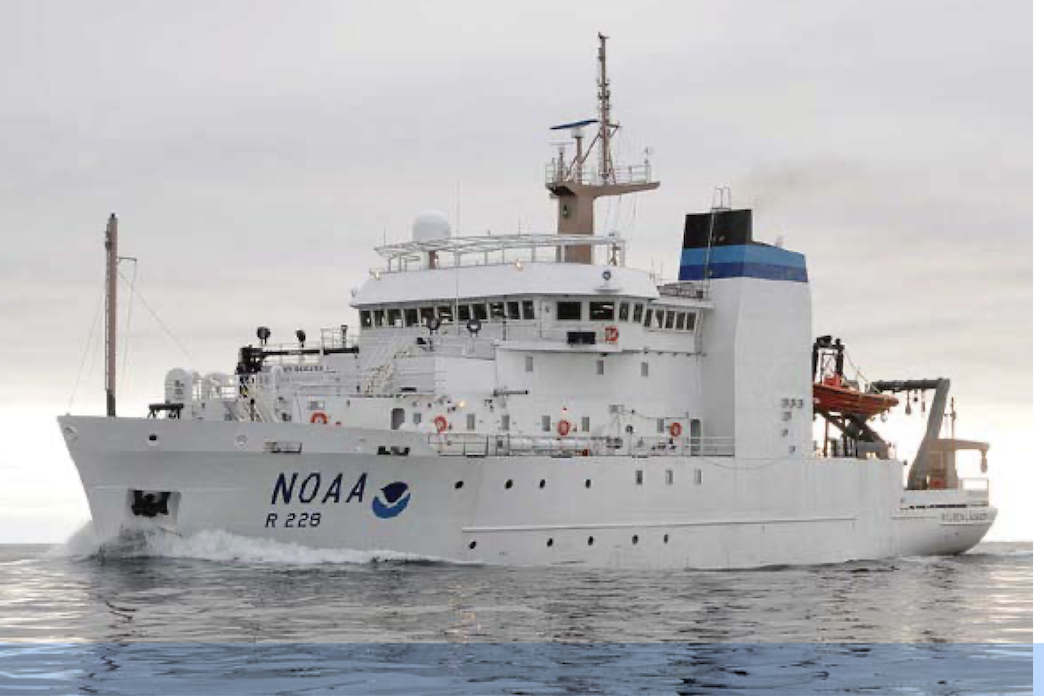
On Saturday, I will board NOAA Ship Reuben Lasker in San Francisco, a premier research ship equipped with cutting-edge technology for global fisheries study. I will be part of the Integrated West Coast Pelagics Survey, collecting data on Pacific hake and other fisheries through acoustic data, biosampling data, eDNA, and ecosystem data to understand the health of our fisheries with a changing ocean. I will soon find out what that data collection looks like and how it is done (and what some of those words even mean!).
Mission: Oceanographic and Biological Monitoring of Davidson Seamount
Geographic Area: Davidson Seamount/Monterey Bay National Marine Sanctuary
Date: July 26, 2025
Weather Data: 15°C/ 59°F in Berkeley, CA
Science and Technology Log:
Our mission ended and I disembarked in Alameda on Thursday morning. The Lasker is now headed back to its home port of San Diego. We accomplished the seven days of transects and had two additional days of data collection in which we did several more deep CTD drops (to 2400m) and two more full days of bird and mammal observations. Our total bird and mammal observations were 1333 with 986 birds and 347 mammals. Leach’s Storm Petrel and Red-necked Phalarope were the most common birds. Fur seals and whales (both unidentified) were the most common marine mammals with Fin whales coming in third. Besides these observations, we also observed 14 ocean sun fish (Mola mola), 12 sharks and 20 pieces of floating plastic and styrofoam. It was jarring and painful to see a plastic bottle floating by so far from land. This data will be added into the long term study of the Davidson Seamount which has been happening every few years since 2010. The past missions have been in 2010, 2015, 2018, 2022 and 2024. Thus, together with our work this year, we are building a story of the life above and below the seamount.
Overall, we surveyed over 500 miles and the ship traveled twice that- 1000 miles- since it doubled back in the night, collected more CTD samples, and then transited to the next line. Overall, we did 86 CTD casts and collected 81 eDNA samples which will give us a picture of the character and life of the ocean below the surface. This picture will complement our observations above the water and allows us to know how animals interact with their environment so we can work to conserve them. Given the fact that 95% of the ocean is unexplored, it feels amazing to be part of this effort and contributing to our understanding of the Monterey Bay National Sanctuary and specifically the Davidson Seamount.
In the down time between observation efforts on the flying bridge (highest deck on the Lasker), I had the chance to interview the two early career scientists- Kylie Marozsan and Melissa Ashley. Everyday Kylie and Melissa added so much enthusiasm and positivity to our work and I was inspired by how much they have accomplished in their lives so far. I believe they are great role models to my 5th grade students and the middle and high school students I mentor.
Melissa and Kylie holding ocean ‘shrinky dinks’ (projects compressed by adding them to the CTD drops)
—————————–
Kylie entering bird and mammal data
Early career scientist- Kylie Marozsan
Kylie is from Pennsylvania and is a rising senior at the University of Miami majoring in marine biology/ecology and minoring in microbiology/immunology. Beyond her studies, she is president of the marine mammal rescue team; a team of volunteers who are basic stranding certified so they can assist local officials with rescuing marine mammals. She is here as a NOAA Hollings Scholar.
What is a NOAA Hollings Scholar?
It is an eight-week program where students intern in NOAA between their junior and senior year of college. You fill out an application, write an essay and send in your resume. Then you have access to possible placements. I saw a post by Chad King, research ecologist for Monterey Bay National Marine Sanctuary, interviewed and did a site visit. While I have been at the Monterey Bay National Marine Sanctuary, I have worked on improving the sanctuary’s video database, assisted with microplastic field work on both the beach and the ocean, and participated in this 10 day research cruise aboard the Reuben Lasker. On July 29th, I will present my summer work at the NOAA Headquarters in Silver Spring, Maryland.
What do you enjoy about your experience?
I am enjoying the research with the Monterey Bay National Marine Sanctuary. The experience is well rounded with both field work and office work and being on a research crew.
What has been a challenge?
Moving to a new place, adjusting to a new climate with my first “adult” job and living on my own have all been challenges. Yet, the people and everyone have been so welcoming and kind.
Why is this work important?
We have been given a beautiful planet; we must do what we can to protect it and we can’t protect the people we love without protecting the place we love.
When did you know you wanted an ocean focused career?
Ever since the 6th grade I loved Shark Week on the Discovery Channel. Shark Week happens for a week every summer. I loved it so much I messaged the filmmaker that I wanted to do his job and he told me “live the life you dream”.
What is a book/ activity you recommend to someone who wants an ocean focused career?
I recommend the book Silent Spring by Rachael Carson. It is an eye-opening book about the chemicals in our world written by a woman. It made me more aware about products and their sustainability. Silent Spring discusses how pollution from land can accumulate and hurt all different levels of ecosystems including the ocean.
For activities- go snorkelling! You can learn a lot from what’s out there.
——————————-
Early career scientist- Melissa Ashley
Melissa collecting water for eDNA sampling
Melissa is from San Jose, California. She grew up going to northern California beaches and loved visiting the Monterey Bay Aquarium. In high school, she enjoyed marine biology so much that she led a marine biology club that did dissections, presentations and river clean-ups. She graduated from the University of San Diego in environmental and ocean sciences and then received her master’s degree from the Middlebury Institute of International Studies in Monterey. She focused on ocean and coastal management. Melissa now lives in Monterey and is a California Sea Grant Fellow.
What is a California Sea Grant Fellow?
It is a one year placement in a state agency focused on marine and coastal policy. I have been with Monterey Bay National Marine Sanctuary since February. Over the past ten years, we have seen a decline in bull and giant kelp throughout different parts of northern and central California believed to be attributed to a combination of marine heatwaves, sunflower sea star die-offs and a sea urchin population surge. Since we aren’t able to restore all of the kelp that has been lost, I am helping identify which kelp bed locations throughout the sanctuary are the most important to people who rely on them. One of the things I love most about being a fellow at a marine sanctuary is the chance to be involved in such a wide range of work. While I don’t typically work with seabirds or eDNA in the office, trips like this highlight the many different roles that go into managing a sanctuary.
Why is your work important?
My work is important because it helps bridge science and policy. Studying marine resources is incredibly important, but without strong policy, we can’t protect the resources that we study. Long term, I’d like my work to help protect the marine resources that we study, but also help the people that rely on these resources for their livelihoods.
What do you enjoy about your work?
On this mission, I love learning about so many new marine mammals and sea birds- like the Cook’s Petrel which you can only see offshore. It’s also been so fun getting to meet and spend time with such a dedicated and passionate team on board also enjoying getting to know everyone on board.
What is a challenge?
I’d say my biggest challenge right now is just adjusting to life at sea. It’s very comfortable here on the ship, but sometimes we’re stationary for long periods of time. As someone who likes being active, I have to make an effort to find different ways to stay active – whether that’s going to the ship’s gym in the evening or having impromptu dance parties during our breaks on the flying bridge!
When did you know you wanted an ocean focused career?
Ever since elementary school, I’ve loved both art and science, and I’ve always been curious about the natural world. As I watched documentaries online, I discovered that while the ocean is beautiful and inspiring, it also faces many threats. Studying environmental and ocean sciences in college felt like a natural path. It took some time, but I eventually found the policy space. Working in policy allows me to combine science, law, and policy-making it a perfect fit where I can draw on all my different interests.
What is a book/ activity you recommend to someone who wants an ocean focused career?
A couple of my favorite books I’ve read are California Against the Sea by Rosanna Xia and Seaweed Chronicles by Susan Hand Shetterly.
In terms of activities, try getting involved by volunteering to help with beach cleans up or starting a club of your own at school. If you’re in high school, community college courses and summer programs are a great way to explore topics of interest too. In high school, I participated in UC San Diego’s Academic Connections program where I lived on a college campus for three weeks and took a marine ecology class at Scripps Institute of Oceanography.
—————-
More Learning from the Science Team
Last sunset with the entire science team:
Front: Amity, Mike, Holly/ Back: Rudy, Chad, Mel, Kylie, Jim, Julie, Erica and Jacqueline
During the moments in which we were ‘off effort’- not observing birds and mammals- I was able to have in-depth conversations with each member of the science team. I learned so much during these exchanges and would like to share some excerpts from our conversations. Since Chad, Mike and Holly were featured in a previous blog, I will focus on Rudy, Erica, Jim, Amity and Julie.
Erica Burton (marine ecologist) :
My favorite movie is Incredible Mr. Limpet because he loved the ocean so much, he wished for it and fell into the ocean and became a fish. I also recommend the book Dove by Robin Graham about a boy who sails around the world.
Advice: Don’t be afraid to take courses to find out what you like and don’t like; you never know what will be of interest. Volunteer in your community to do community science with all your friends.
Jim Tietz (Point Blue Marine Scientist):
New learning: A ‘spark bird’ which is the bird that gets you interested in birding. For me, it was the American Kestrel, which is a very beautiful bird I found in my neighborhood while in college. It led me to get a book out and learn to identify birds in my yard. It is important to get out into nature and have people show you animals and plants where you live.
I recommend The Song of the Dodo by David Quammen because it describes how scientists have approached evolutionary problems.
Rudy Wallen (Point Blue Marine Scientist):
Story: I saw my spark bird when I was five at grandfather’s farm in Wisconsin. I was walking near the barn and kicking up insects with my steps. The bird swooped by and banked -stretching its wings and flaring its tail- and I saw a deep iridescent blue black color, a midnight steely blue, and then an orange rust color on the underside. I still have a snapshot of that moment; it is frozen in time for me.
Julie Howar (Point Blue Marine Scientist):
Advice: Go to the beach and look around. Focus on looking at little things- especially things you might think of as ‘gross’- something dead even. Look and really see what is there… on a rock, or under a rock. Also when an opportunity presents itself, take it if you can. (Julie speaks from experience as she travelled to Antarctica on the Polar Duke as part of a volunteer research team to study krill in 1994.)
Amity Wood (Education and Outreach Coordinator for Monterey Bay National Marine Sanctuary):
Advice: Explore nature! Get out to the tidepools, an estuary, a beach, and only take binoculars or a magnifying glass. Bird watch, take photos, and draw or paint what you see! It’s amazing what you’ll become excited about from opening your mind and senses to your natural surroundings. Humans are a part of nature and we should make connections daily.
Personal Log:
Last sunset over the Pacific Ocean. View from the bow of Reuben Lasker.
In these 10 days at sea, crossing 1000 miles of ocean, I spent days on end with no ship or land in sight. I was outdoors, invigorated by the fresh breeze, from early morning to after sunset. From the flying bridge, I looked out in full circle for miles into the horizon and watched the waters change as the skies changed – from cobalt to teal to silver and from glassy to rippled to white capped. With each rock and sway, the ocean spoke to us with her breath and reminded us that she is the one who sustains us.
As the project progressed, I learned that science takes time and patience. I honed my observation skills as I began to master my binoculars. With practice, I changed from my first days of missing every sighting, to being able to spot whale spouts on the horizon, a shark fin drifting by in the distance and to identifying birds- such as storm petrels and Red-necked Phalaropes- as they crossed our bow. As my patience grew, I became accustomed to the long days of observation and eagerly awaited each experience with the hope of new discoveries. Yet, we had days where there rarely was a bird or mammal in sight. We also had long waits- up to 1 hour 45 minutes- for the CTD rosette to descend and return from a 2400m drop. However, in these times, each scientist had so much to share to keep up the positive spirit. In the wet lab, Erica had a box of amusing finger fidgets, long lasting candies and a waterproof card game. On the flying bridge, people shared stories, favorite songs (click the link to listen), jokes and a range of crunchy snacks. There was always joy and laughter.
The story of science is also a story of the people who make it happen. We were 36 people alone on the ocean, on the Reuben Lasker, doing science as a team. The science couldn’t happen without the ship crew; our 11 member science team was supported by 25 crew. Each person aboard was unique and yet everyone was bound together by a desire to further understand our ocean and to protect it. For me, since I too love the ocean and science, being part of such a community was both fulfilling and awe-inspiring. I leave with a deep sense of hope that our work will have a lasting impact for the good of the ocean.
Now my mission continues at home, as I work to pass on this curiosity and joy of exploration to the next generation of sanctuary stewards. As my students and I study the 50 states (a 5th grade standard), we will also learn about the 18 national marine sanctuaries with a focus on the Monterey Bay National Marine Sanctuary and the work of this cruise. We will identify, study and monitor birds (‘being on effort’) right where we are- on our school grounds. Thus, I hope to empower my students as explorers of the natural world with the same joy and wonder I have experienced.
Did you know?
Red-necked Phalarope in front of the bow. Photo Credit: Jim Tietz
Red-necked Phalaropes breed in the Arctic tundra and winter at sea. They are only seven inches long. The females are brightly colored and fight fiercely over males. Yet, once they lay their eggs, they lose interest and the males incubate and raise the young. Meanwhile, the females seek out new males and lay a new clutch. On our cruise, the Red-necked Phalaropes and other birds were attracted to the night lights of the ship. After this was discovered, the ship turned its outside lights off at night to protect the birds.
Red-necked Phalarope. Photo Credit: eBird
Final Thanks …
I’d like to thank the Teacher at Sea program and specifically Emily Susko for offering me this special experience in my local Monterey Bay National Marine Sanctuary. I am also grateful to Chad King and the entire science team for allowing me to learn, sample, observe, appreciate and wonder with them. And finally, thank you to the entire crew of Reuben Lasker that transported us safely to the Davidson Seamount and back.
Mission: Oceanographic and Biological Monitoring of Davidson Seamount
Geographic Area: Davidson Seamount/Monterey Bay National Marine Sanctuary
Date: July 20, 2025
Weather Data from the Bridge
Latitude: 35° 36.65’ N
Longitude: 122° 47.97’ W
Wind Speed: 13 knots
Wave Height: 4-5’
Air Temperature: 15.3C/59F
Sky: Overcast
Science and Technology Log:
We have finished five transects with two left to go. Today (Saturday 7/19) we had the deepest drop to 2000 meters and collected eDNA samples for future processing by the Monterey Bay Aquarium Research Institute (MBARI). The work with eDNA (DNA shed from animals that have been in the area in the last 24-48 hours) compliments the first hand observations that the scientists on the deck are making. These samples are sent to MBARI and will be processed in 1-2 years. The time does seem long, yet the greatest challenge is getting the samples in the first place. So we are doing the essential work towards developing a deeper understanding of species distribution and how seamounts may be influencing the ocean’s biodiversity.
Once the CTD measurements and water sample collection is done at a station location, the ship moves again to the next CTD location on the transect. While the ship is moving along the transect, the seabird and mammal scientists are at work on the flying bridge (top deck of the ship) counting species seen within the observation zone (as detailed in previous post). So far, in five days of research, we have the following results.
Our effort is adding up and we now have 994 observations! The team is happy as we have been having good weather and calm seas to allow for good observational data collection.
Alongside the research that we are working on, we are also having some fun with ‘ocean shrinky dinks’. As you descend in the ocean, the pressure changes, increasing one atmosphere (14.7 pounds/ sq. inch) for every 10 meters below sea level. Animals adapt in many ways to this changing pressure; whales collapse their lungs when they dive deep and rely on the oxygen in their blood and muscles during this time. We can see the results of this change if we send a material like styrofoam down; the pressure squeezes the air out and the item shrinks. The deeper the object goes, the more the air is squeezed out and the smaller it gets.
We decorated styrofoam that are in the shape of cones, bears and birds – thanks to marine ecologist Erica Burton who brought all the materials and decorating pens. We then attached these items in laundry bags to the CTD rosette on deeper drops of 1620m, 1710m and 2000m (the blue dots on the transect map shared in the last post). Once we pulled up the CTD rosette–voila! our ‘shrinky dinks’ were ready, at a fraction of the original size! I am very excited to share these tangible projects with my students as they learn about the ocean.
Styrofoam cone before being sent downStyrofoam cone after being down 1710 meters below sea level
Styrofoam bears before and after 1620 meters immersion
Styrofoam hearts by Cassandra Dahl, survey tech after 2000 meters immersion.
Meet the Science Team!
I would like to introduce the team behind all this amazing science. Our chief scientist is Chad King, a research ecologist from Monterey Bay National Marine Sanctuary (MBNMS), also known for being the chief scientist on the 2018-2020 EV Nautilus expeditions with Ocean Exploration Trust that discovered the octopus garden along the flanks of Davidson Seamount at 3200 meters deep. A fun fact is that back in 2019, my class scored a virtual interaction with the Nautilus as it explored the deep ocean, with Chad as our ship-to-shore connection. Chad answered many of my students’ questions about studying the deep sea while actually on board the Nautilus. I never imagined that one day I would be able to join him on a research mission!
Assisting Chad with the CTD and eDNA work in the wet lab is Erica Burton, also a research ecologist from MBNMS. Erica specializes in ichthyology (study of fish), but has co-authored many research papers and the Davidson Seamount Taxonomic Guide, so she is known as a species expert.I am grateful to both of them for taking the time to explain the details of their work with me and for teaching me how to do eDNA sampling.
Erica Burton (research ecologist), Chad King (chief scientist) and myself in the wet lab.
Chad King (chief scientist) entering data in the wet lab.
Interview with Chad King:
Chad is a research ecologist with MBNMS who has a background in kelp forest ecology, GIS and he is an expedition diver and diver trainer with NOAA. He has been working with NOAA since 2008 and has been involved in various projects with the sanctuary including microplastic monitoring. He lives in Gilroy with his wife and two children Maya and Noah. Maya is studying at UC Berkeley and Noah is in high school.
Why is your work important?
Regular research, with our partners, is important for the sanctuary because we study priority or new issues such as kelp loss and microplastics, but we are also working on the ongoing characterization and exploration of the sanctuary. Exploration is so valuable because you don’t know what you will find.
What do you enjoy about your work? What is a challenge?
I enjoy the variety of work- I get to be a “jack of all trades”- and do different work week to week. It is fresh and engaging and I am exposed to more subjects related to the sanctuary. A challenge is having enough time to analyze the data since I am moving from project to project.
When did you know you wanted an ocean focused career?
As a child I feared the ocean, and over the years I learned that the best way to overcome fear was with knowledge. I watched a lot of ocean documentaries by Jacques Cousteau and visited the Monterey Bay Aquarium. By middle school, I knew I wanted to be a marine biologist. After high school, I went to UC Santa Cruz and majored in marine biology. After trying out working in real estate for 4 years, I returned to marine biology for a master’s degree from Moss Landing Marine Lab.
What book/activity do you recommend to a young person interested in an ocean focused career?
Bully for Brontosaurus: Reflections in Natural History is an engaging book that focuses on science and critical thinking skills. Reading it turned me on to science. I also recommend trying snorkeling as early as you can. Also, if it is possible, become a certified SCUBA diver. You can do so as early as age 10.
The Bird and Mammal Team
While Erica and Chad work in the wet lab, on the flying bridge are the bird and mammal specialists from Point Blue Conservation Science. Point Blue is a group of “160 scientists who work to reduce the impacts of climate change, habitat loss, and other environmental threats while developing nature-based solutions to benefit both wildlife and people.”
On our mission we have biologists Jim Tietz, Rudy Wallen, Julie Howar and Mike Johns from Point Blue. We also have Holly Lohuis, a marine life naturalist from Island Packers; Melissa Ashley, a CA Sea Grant Fellow; and NOAA Hollings Scholar Kylie Marozsan.
Bird and Mammal Team:
Kylie Marozsan, Julie Howar, Mike Johns, Rudy Wallen, Holly Lohuis, and Jim Tietz on the flying bridge.
Julie Howar Point Blue Marine ScientistRudy Wallen Point Blue Marine ScientistJim Tietz Point Blue Marine Scientist
Mike Johns, Point Blue Marine Scientist
Interview with Marine Ecologist Mike Johns
Mike Johns is a senior marine ecologist on our team. He works for Point Blue Conservation Science which is based in Petaluma. His focus is seabird studies and the Farallon Islands. He lives in Tacoma, Washington with his husband and his dog Noosa.
Why is your work important?
My work brings an understanding of how seabirds and the ecosystem depend on one another and respond to changes in our planet. I’m documenting how our actions impact the organisms we share our planet with.
What do you enjoy about your work?
I enjoy collecting data in the field through hands-on studies of birds, and once back at the office, revealing hidden patterns with long term data sets and creating engaging graphics – like animations of plots – that the general public can learn from.
What is a challenge?
Navigating the politics of work and staying funded are challenges. Working remotely is hard because you have no friends to bounce ideas off of.
When did you know you wanted an ocean focused career?
I’ve always loved camping in the Sierra Nevada as a kid, and surfing – once I discovered the ocean. Right after high school, at the age of 18, I worked as a deck hand on a whale watching boat in Monterey. The whales were cool, but I was captivated by the sea birds and how they can be the tiny size of a sparrow and spend their whole life at sea.
What was your path to becoming a marine ecologist ?
I attended CSU Monterey Bay and majored in environmental science. After graduating, in the summer of 2012- from March to August- I did the Farallon Seabird Internship. I lived in an 1850’s lighthouse keeper’s house with 4-8 others and was immersed in wildlife and the ocean. Whenever you went outside the Western Gulls were attacking us! On the Farallones, I learned about observation, banding and other elements of field research. This experience gave me the background to get other projects. I have worked on various sea bird projects in the Bering Sea (Alaska), Hawaii and Tasmania.
What books and activities do you recommend to someone who is interested in an ocean focused career?
Carl Safina has written many books on the ocean. I recommend Song for the Blue OceanandEye of the Albatross. For activities, I recommend tidepooling, bird and whale watching and …. looking at a droplet of water under a microscope.
Holly Lohuis, Island Packers Naturalist
Interview with Naturalist Holly Lohuis
Holly is a naturalist with Island Packers, the boat concession to Channel Islands National Park and marine educator with the Santa Barbara Maritime Museum. She also is the co-director of the newly designated Santa Barbara Channel Whale Heritage Area and has been an expedition diver and marine biologist with Jean-Michel Cousteau (son of Jacques Cousteau) and his marine conservation organization, Ocean Futures Society since 2002. She lives in Carpinteria with her partner Chuck and son, Gavin.
Why is your work important?
The ocean covers over 70% of our planet and contains over 90% of the living space. Yet, there are many unknowns about the ocean, especially in the deep sea and the rich diversity of marine life around seamounts. That’s why long-term monitoring by the Monterey Bay National Marine Sanctuary (MBNMS) is vital for informing decisions about preserving these unique ecosystems.
What do you enjoy about your work here at Davidson Seamount?
I love being part of a team where the crew and scientists all share a deep passion for ocean conservation. Every day, I’m learning something new—especially about seabird species—thanks to the expertise of our seabird biologists.
What is a challenge?
It is a challenge to be away from home but my work for decades has taken me away from home, traveling around the world with Jean-Michel Cousteau and his expedition team. But I still miss Chuck, Gavin, my friends, family and my cat Avalon.
When did you know you wanted an ocean focused career?
In 5th grade, my teacher Ms. Brown asked us to do a report on who we wanted to be when we grew up. I chose Sylvia Earle because I was fascinated by her deep-sea dives and ocean exploration. I also loved watching the Undersea World of Jacques Cousteau and like many people, I dreamed of being a silver suited diver on Cousteau’s team. Growing up landlocked in Sacramento, I knew I’d eventually want to live by the ocean.
What was your path to becoming a naturalist?
I went to UC Santa Barbara and majored in aquatic biology. In my last year of college, I interned at the Marine Mammal Rescue Center in Santa Barbara. After graduating, I worked at a local dive center in Santa Barbara and then with Island Packers. I also connected with Jean-Michel Cousteau and was hired as a diver and marine biologist at his small eco-resort in Fiji. My experiences both aboard Island Packers’ boats and while working in Fiji deepened my passion for educating others about the incredible diversity and delicate nature of both kelp forests and coral reefs, and how each of us can make a meaningful difference in protecting our ocean.
What books and activities and advice do you have to someone who is interested in an ocean focused career?
I recommend any books by Dr. Sylvia Earle like The World is Blue and Sea Change. I also love books by Carl Safina, Susan Casey and Cullum Roberts.
Take advantage of internship opportunities. Volunteer for local marine or coastal organizations and meet like-minded people who can be mentors and help with job opportunities.
Getting scuba certified can open up many opportunities in marine science and conservation work.
Go whale watching! Follow your curiosity. Learn the science. Spend time in, on, and near the ocean. And most of all—share what you love with others. Ocean careers need storytellers, scientists, educators, and advocates working together.
Personal Log:
I am getting into my routine of waking up and joining the observation crew on the flying bridge. It is such a beautiful gift to be out on the Pacific learning to do bird and mammal observations. I am gaining observation skills and have been seeing so many more animals. I know now how to spot groups of whales far out on the horizon. I have observed minke and blue whales and marveled as Laysan Albatross and Black-footed Albatrosses gently glide over the surface of the water. I am so happy to learn about these types of albatrosses in Monterey Bay National Marine Sanctuary. My students and I have been studying albatrosses in the context of Antarctic animals and now I have the knowledge to teach about these local species.
The animal observations on the flying bridge last approximately 45 minutes to one hour and then there is a break during CTD rosette deployment stops. Some scientists go for coffee and snacks; others -like Holly- go to the gym and run a mile on the treadmill. Holly has been an inspiration and I am also going down to the gym to work out once a day (Holly goes 3 times a day to run over 3 miles!). I am quite proud of myself for being able to do cycling and the elliptical machine with all the rocking of the boat. The waves are getting a bit stronger these days and I am adapting.
Gym on the Reuben Lasker
I have also been getting to know many of the people on board that are supporting the work of the scientists- both NOAA Corps and the crew. I have been interviewing some of them to prepare for future posts. Our meals continue to be amazing; tonight for Sunday dinner we had steak and lobster as an option. On every cruise, there is a special meal night and tonight was that night. There’s always a vegetarian option as well as a large salad bar at every meal. Tonight’s special desert was the ice cream sundae which is appropriate since it was World Ice Cream Day!
Sunday night dinnerIce cream sundae (Sunday dinner)
We are also building community aboard the ship as time passes. It is a bit like being in a dorm in college; however, we are even more tightly together since the ship is our only place to go. Yet, it is wonderful to share a space so closely with people that have a passion for science, the ocean and its conservation. With shipboard life, they also have the time and interest to share their knowledge. I am learning so much from every person I meet. I am also amazed that so many people – especially on the crew- have worked in Antarctica.
We are also having fun. On Saturday, we had a barbeque with a cooking challenge. The crew set up a cornhole game on the lower deck. In the evenings, after dinner and after our 8 o’clock science meeting, we play card games. Amity, my roommate, leads these with a treasure chest of games she has brought on board. I have learned several new and wonderful card games – like Skyjo and Exploding Kittens- to share with my class.
Cornhole at sea
Card games – our nightly pastime
Did you know?
Black-footed Albatross nest in the Hawaiian Islands and 98% of the species lives there. They mate for life, lay one egg per clutch and are very long lived; the oldest recorded was a male at nearly 61 years old. They have a keen sense of smell and can detect their favorite food as they glide over the vast ocean. Their wingspan averages 6’9”. Like other seabirds, the albatross can drink saltwater because it has special glands above the eyes that excrete the salt out of their tubenose bill. Black-footed Albatross are on the threatened species list and are threatened by plastic pollution, oil spills and long line fishing.
Black-footed Albatross flying in the sanctuary Photo Credit: Jim Tietz
Mission: Oceanographic and Biological Monitoring of Davidson Seamount
Geographic Area: Davidson Seamount/Monterey Bay National Marine Sanctuary
Date: July 16, 2025
Weather Data from the Bridge
Latitude: 35° 42.48’ N
Longitude: 122° 22.29’ W
Wind Speed: 3.1 knots
Wave Height: 3-4 ft.
Air Temperature: 16.2°C/ 61°F
Sky: Overcast
Science and Technology Log:
After a day of transit, we reached our location in Monterey Bay National Marine Sanctuary, the Davidson Seamount, an undersea mountain habitat 80 miles southwest of Monterey. At 7,480 feet tall and with its summit still 4,101 feet below the ocean surface, Davidson Seamount is one of the largest known seamounts in U.S. waters. It hosts a large number of deep-sea species-like coral forests, sponge fields, crabs, shrimps and deep-sea fish-as well as a great diversity of marine mammals and sea birds. While the deep-sea habitat of the seamount has been well studied, the area above the top of the seamount has not. Thus, this environment is the focus of our research. We are working to observe marine mammal and bird life and to measure water conductivity (salinity), temperature, and depth (also known as CTD), and to collect environmental DNA (or eDNA, the genetic material shed by organisms in the water) data to give a more complete picture of the rich and interdependent food web above the seamount.
At the moment, we have completed our first day of observations and collections. The scientists work in two groups. One group is on the flying bridge (highest deck) and is observing and recording birds and mammals over a set distance with the ship traveling at the same speed (10 knots) each time.. The other group, in the wet lab, is managing the CTD data and eDNA collection. The chart below shows our CTD data collection stops on the transects over the seamount. We started at 24W and progressed to 24E on day one. Now as I write on day two, we are on 20M.
Map of planned transects around Davidson Seamount. Image Credit: Chad King/MBNMS
What is a CTD?
A CTD rosette is an instrument used to measure conductivity, temperature and depth. Conductivity readings tell us how salty the water is because salinity affects how electricity moves through water. The device is a large cylindrical instrument, with a circle of 12 Niskin bottles, that is lifted by a very large winch and pulley system into the ocean. The caps to the bottles are open as the CTD rosette descends into the ocean. The device itself electronically collects CTD data along the round trip to 1000 meters and will do so at every location on the transect both in the day and in the night. For the water samples which capture the eDNA, the scientists close the caps on the bottles remotely to capture water at the depth of choice. For our eDNA samples at the yellow dots, we are collecting at 500 meters and the surface (0 meters) as the CTD rosette travels up. For the blue dots, we will collect eDNA at 0m, 500m and 1500-1700m. We are working hard to collect as much data as we can above the Davidson Seamount to better understand the relationship between oceanographic variables and the lives of marine organisms.
Raising the CTD back up to the LaskerCTD reaches deck
Landing the CTD on deck
Science in the Wet Lab:
Once the CTD rosette returns, the scientists collect sterile samples in small vials. First (image 1), 500ml of water is slowly run through a tube that forces the water through a very fine filter (imagine something like a disk shaped coffee filter). The filter (image 2), captures the eDNA which is then put into a small 2 ml vial with a preservative. This vial (image 3) will be processed by MBARI (Monterey Bay Aquarium Research Institute) which is dedicated to the study of our ever-changing ocean. The eDNA samples will allow scientists to identify species which have been in the area, although we have not physically seen them, by analyzing the genetic materials the organisms have shed. Thus, when combined with the actual physical observations, we will have a more complete picture of the ecosystem at Davidson Seamount.
(1) Filtering the water samples
(2) Preserving the filter
(3) Labels and datasheets
Science on the Flying Bridge:
The flying bridge, the highest deck on the ship (about 50 ft. above sea level), is where the mammal and bird scientists work. They divide the areas of observation into two 90 degree quadrants facing the direction of travel. Observations are recorded at specific time intervals from 7:30 am to 5 pm and only happen when the ship is traveling. As the observers call out, a recorder enters the data. There is a special order in which behaviors and details are entered. For birds the order of details recorded is: species, number, distance from ship (100m, 200m etc.), behavior (sitting on water, eating etc.) and direction of flight. For marine mammals, the order is: how first seen, what method (eye, binoculars), direction from ship, reticule (distance taken from binocular lines), animal’s activity, age/sex, species, number and any other comments. Since there are 4 observers calling out, taking turns is necessary. Also spotting a mammal takes precedence over birds- so mammal observers are allowed to interrupt and share their observations. All of this data is compiled daily. On our first day, we noted 331 sightings of which 284 were birds and 47 mammals. Today, Wednesday, we had 303 observations with 274 birds and 29 mammals. Most of the birds today were Red-necked Phalaropes and the mammals were fur seals. Red-necked Phalaropes, of which we saw 107 individuals, breed in the Arctic and then migrate to winter in South America.
The Flying Bridge
Mammal and bird scientists
All of this research is possible through excellent teamwork. Just as in our school, Oxford Elementary, we have a team of the principal, a secretary, teachers, instructional assistants, specialists, afterschool staff, maintenance and food service, our work on Rueben Lasker requires a team of the scientists, the ship crew and the NOAA Corps officers. I am part of the science team which is led by chief scientist Chad King from Monterey Bay National Marine Sanctuary and has four scientists from the sanctuary and four from Point Blue, a conservation organization that works both on land and sea. In future blogs, I will be spotlighting members of both the science team and the ship team to share their work.
Personal Log:
My first days on the ship have been wonderful. The entire community is so welcoming and are always checking in and willing to share their work. I have learned a great deal of new vocabulary that is important to get around the ship. My room is called “a stateroom,” the bathroom “a head,” and each floor is a “deck.” We eat in the dining room called the “ mess” and the food is made in the “galley” (kitchen). The front of the ship is “bow” and the back “stern,” while the right side is “starboard” and the left is “port.” I am learning my way around the ship- it is a bit of a maze of doors and levels. The first day, I spent an hour going up and down and around trying to find the acoustic lab to join the card games without luck. Now my orientation is better, and I know where the acoustic lab is; each day, though, I continue to notice more special doors or sections of the ship that I have never seen before.
I feel incredibly safe at sea due to the great teamwork. Chad, our chief scientist, meets with NOAA Corps and the crew twice a day- at sunrise and sunset- to discuss operations and gain feedback on the day. Our science team also meets at 8 pm daily to discuss both science and general well-being. On our second day at sea, the entire ship had both a fire drill and an abandon ship drill. For the fire drill, we had to go to our muster station- indicated on our bunk card – and wait for the ship crew to do their practice. This experience is much like fire drills at school where we make sure everyone is accounted for. For the abandoned ship drill, we had to put on the red survival suit. We were lucky we got to practice in the mess. It is a bit like struggling into the most awkward Elmo costume. Once you get your hands in, you lose dexterity and yet you still need to zip up your suit and pull up the head covering all on your own. With coaching by NOAA Corps officer, Lt. Mike Fuller, I made it! This suit will give you insulation and buoyancy to prevent hypothermia and drowning in case of the need to abandon ship.
Emergency Bunk Card
Immersion Suit Practice with coach Lt. Fuller.Success! Photo Credit: Holly Lohuis
Life aboard Rueben Lasker is quite comfortable. I share a stateroom with Amity Wood, who works with Monterey Bay National Marine Sanctuary in education and communication. She kindly let me have the bottom bunk. We have our own bathroom and shower and lockers to store our clothes in. Now, a few nights in, I am getting used to sleeping with the constant rocking. Overall, life aboard the ship is like being forever in a fun house. Everything moves- the hallways, the doors, the decks and the ladder like stairs. As you walk, you learn to keep your steadiness and constantly adjust despite it all. Metaphorically, this skill of always adjusting and adapting yourself to stay balanced no matter what happens is a great life skill.
StateroomHallway
The highlight of my experience so far is being able to spend my day 50 ft above sea level on the flying bridge surrounded by the deep blues to silver greys of the ever-changing Pacific Ocean. We began with amazing views of the Bay Bridge and the Golden Gate Bridge after we left our port of Alameda. Though I know the San Francisco Bay well, the chance to see it with the birds’ eye view was a special gift. I could see details I’d never seen before- such as the inside of a container loader’s cabin and the underside of both bridges.
Oakland Bay BridgeGolden Gate BridgeGolden Gate BridgeScience Team
Once we left the Bay, heading toward Monterey Bay National Marine Sanctuary, we sailed past several humpback whales, brown pelicans and cormorants. Each day, I learn more about scientific animal observation. I now know how to first spot an animal with your eye and then bring your binocular up to your face at the line of vision. You must not look down ever in the process or you will lose the animal you are focusing on. I am fairly new to birding- even though I started birding with my class this year. We gave ourselves the challenge to learn 6 local Berkeley birds and experienced birding at the Berkeley Marina, where most children saw their first ‘lifer’ – the Great Blue Heron. I’d love my students to see me now– as I am seeing ‘lifers’ every hour of the day! (A ‘lifer’ is the first time a bird species is seen by an observer.)
Observing on the Flying Bridge
Animal observation takes time and patience and precision. At first, every time I spotted an animal, by the time I lifted the binoculars, it was gone. With practice, I’ve gotten better and each day is filled with wonder. I have a goal to personally see at least one new species a day. On Monday it was a Black-footed Albatross. On Tuesday, after missing out time after time…. I actually saw -– a Mola mola!
Did you know?
The Mola mola, also known as Ocean Sunfish, is the heaviest bony fish in the world. They can be up to 14 feet long and weigh 4,400 pounds. They average at 550-2200 pounds. Mola mola are silvery grey with a tiny mouth, big eyes, a flattened body and no tail. Because they spend much of their time near the surface, they are very sensitive to entanglement and plastic pollution. In my sighting, I saw the dorsal fin first and then the giant body through the water. You can see Mola mola at the Monterey Bay Aquarium.
Mission: Oceanographic and Biological Monitoring of Davidson Seamount Geographic Area of Cruise: Monterey Bay National Marine Sanctuary Departure Port: Alameda, CA Arrival Port: Alameda, CA
Date: July 9, 2025
Yes, I am back for a second chance! Last year, after a wonderful orientation at the Coral Lab in Galveston, I unexpectedly came down with Covid just days before my cruise on Thomas Jefferson. Thanks to the Teacher at Sea Program and specifically the support of Emily Susko, I was placed on a new cruise on Reuben Lasker in the Monterey Bay National Marine Sanctuary. I am so grateful for this chance to sail and learn in my local marine sanctuary. Easier yet, the port of departure- Alameda- is just a 20 minute drive from my home in Berkeley!
In this cruise, the Monterey Bay National Marine Sanctuary (MBNMS) will be working with Point Blue Conservation Science and the Monterey Bay Aquarium Research Institute to study the Davidson Seamount. The Davidson Seamount is an undersea mountain that rises 8,000 feet above the sea floor and hosts a unique ecosystem due to the nutrient rich waters that are pushed to the surface. It is located 50 miles offshore of central California. I am very excited to learn more about seamounts!
In our survey, we will sample the water above and adjacent to the seamount. We will also be surveying marine mammals and seabirds and their prey and collecting environmental DNA (eDNA) to understand animals that we are not able to observe. This data will help give a more complete picture of oceanography and biology of the entire seamount from its base to the ocean surface and help us to understand connections between climate, ocean conditions and marine life. One goal is to use this data to inform the shipping industry so that ships crossing the Davidson Seamount lower their speed to avoid hitting whales. This work is of great importance to me as I have been saddened by the many whale strikes in the Bay over the recent months. All of our work will be done on board Reuben Lasker, a 208 ft research vessel equipped for both fishery and oceanographic research.
NOAA Ship Reuben Lasker, Photo courtesy of NOAA
While I shared my background in my introductory blog last summer, there have been some new developments. First is the great news that after 9 years of leading student activism to end single use plastics in school meals, we began reusable dishware for school lunch. The change is not just for my school, but will be rolled out in all schools across the district, impacting 9,000 students daily and vastly reducing the plastic waste our schools generate. I am really happy that students will be able to experience more sustainable meals at school — since lunch is school too.
Traditional single-use disposable materialsNew reusable lunch dishes
This school year, I also had the opportunity to travel for 12 days to Antarctica as a Grosvenor Teacher Fellow with National Geographic on the polar expedition ship Endurance. This life-changing experience of exploring the Southern Ocean deeply impacted both myself and my class. We spent the school year diving into a study of Antarctica, interacting with polar scientists and learning of the critical role Antarctica has for the health of our water planet. We discovered how our local actions impact the environment and affect places as far away as Antarctica.
Though I couldn’t take my students on the voyage with me, I did instill in them the curiosity and joy I experienced exploring. Thus, my class became explorers of our local environment — the Berkeley Marina and the San Francisco Bay. In a series of 10 field trips, we learned to identify local birds, trawled and studied plankton and charted and sailed a course on the schooner Pegasus, engaged in multiple beach clean-ups (with data sheets) and camped on the cliffs in Marin overlooking the Pacific Ocean. I hope that through these joyful experiences of learning in nature, my students will be inspired to continue to grow their connection, curiosity and sense of caring for our planet — and especially for our ocean.
The following photos are included courtesy of Oxford Elementary.
Bay scientist studies Trawling as Bay Scientists Beach Clean / Waste Audit Birding at the Berkeley Marina
Sailing on Pegasus (a youth sailing project)
Charting a course to Angel IslandSailing our course to Angel Island
Finally, I am especially excited for my Teacher at Sea experience because Monterey Bay is close to my heart. In 2019, my students and I participated in the Monterey Bay Aquarium’s Ocean Plastic Pollution Summit; it was a life changing 2-day experience where we explored the aquarium at night, slept next to the tanks, listened to inspirational youth ocean activists and connected with students from all over California who were also working to solve the plastic pollution crisis. Many of the students pictured below are still active in working to protect our ocean by volunteering at the Marine Mammal Rescue Center or serving as youth representatives on our city’s Climate Commission.
Ocean Plastic Pollution Youth Summit. Photo courtesy of Monterey Bay Aquarium
As I embark on this voyage of discovery, learning and adventure, these words of the great oceanographer and ocean activist Sylvia Earle, whom I deeply admire, come to mind:
“The ocean is the cornerstone of Earth’s life support system, it shapes climate and weather. It holds most of life on Earth. 97% of Earth’s water is there. It’s the blue heart of the planet — we should take care of our heart. It’s what makes life possible for us.”
With Sylvia Earle and my students (not pictured) in Alameda, CA
Thank you to the scientists and crew of Reuben Lasker for the opportunity to join you in this most important work!