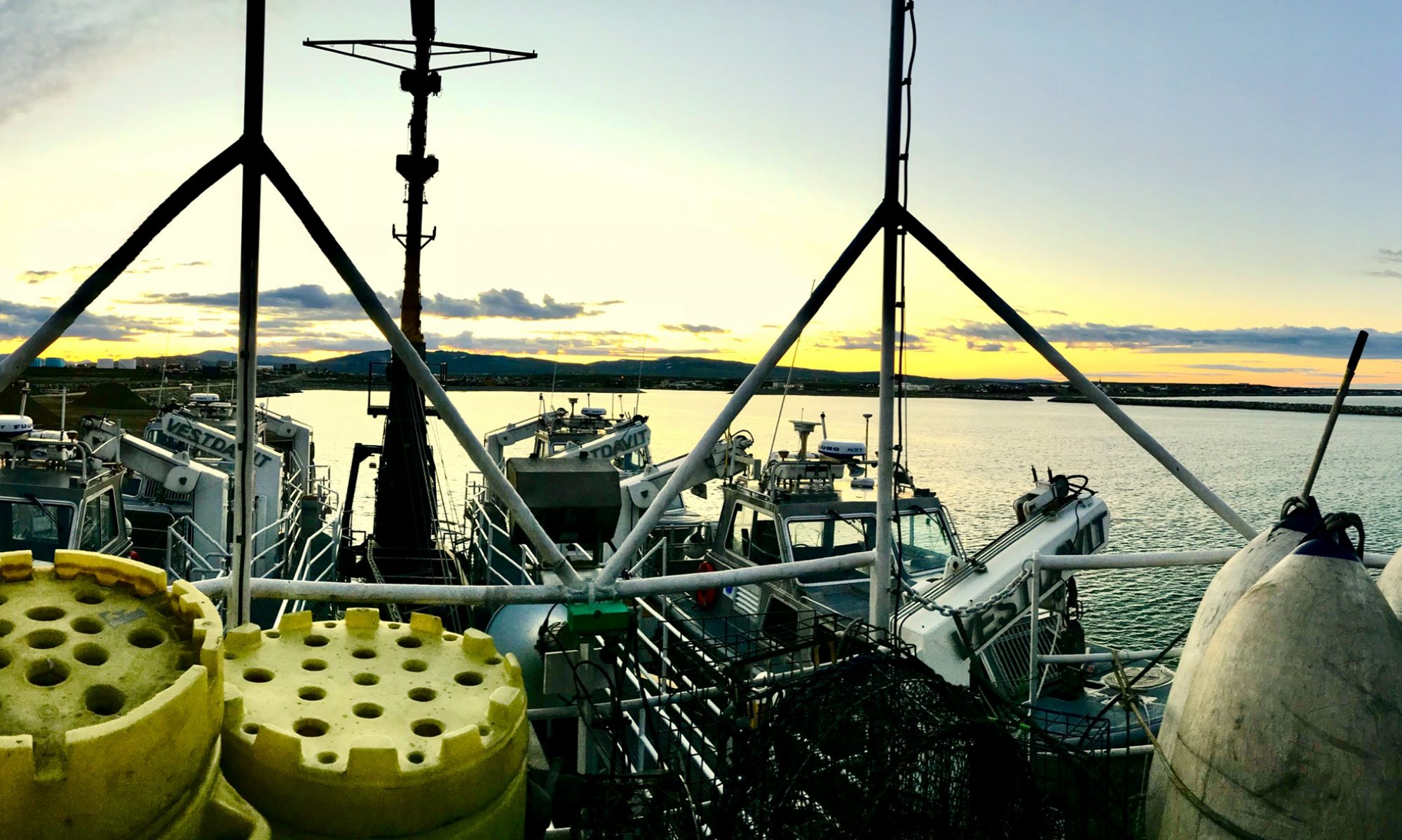
Mission: Pelagic Juvenile Rockfish Recruitment and Ecosystem Assessment Survey
Geographic Area of Cruise: Pacific Ocean off the California Coast
Date: June 4, 2017
Science and Technology Log
All of the work for the Juvenile Rockfish Survey is completed at night – we probably will not even get going most nights until after 9 PM. Wonder why so late? Any guesses?
This is a night time operation because we are focused on collecting prey species – we are not catching full grown rockfish, only juveniles which are less than a years old (YOY = Young of the Year). As Keith Sakuma, the Chief Scientist for the Reuben Lasker, explained – this survey gathers information about the juvenile rockfish so that NOAA can pass information onto the states in order to establish a sustainable fishery. This could lead to changes in fishing regulations based on the abundance of the juvenile stocks, which would be adults down the road. They trawl at night for two main reasons- during the day time, the rockfish would simply see the net and swim away. Also, many of the other creatures being catalogued are prey species that hide in the depths during the day to avoid predators, rising to the surface as the night moves on.
The night shift includes the science personnel and the crew of the boat. The boat crew not only operates the ship, but the fisherman also send out the trawl net and bring it back in. While the boat crew rotates on a specified schedule, the night-time science group keeps going until the work is done. However, these two groups are very much in sync and really work well together. This blog entry will be my introduction into the procedures and initial results of our work from the first couple nights. I will provide much more detail in later posts.
The science personnel for this leg of the voyage includes myself and Chief Scientist Sakuma as well as Cherisa and Ryan, who are members of the NOAA Corps; Thomas, an undergrad student from Humboldt State; Rachel, a PhD student at UC-Santa Cruz; and Maya, a Hollings undergraduate scholar from UNC-Wilmington.
The Night Crew at work separating species during the shrimp haul. Photo by Keith Sakuma.
The Juvenile Rockfish Survey, boiled to its simplest terms, consists of a midwater trawling net behind the ship, meaning it does not float and it never touches the bottom. Anything caught will be sorted and analyzed by the science crew. In reality, it is a bit more complicated.
First of all, net operations take place at specified stations that the ship revisits periodically and have been used for some time. The stations for a night run on the same latitude line, running west away from the coast.
Before sending the net out, we need to run a Marine Mammal Watch from the bridge for 30 minutes. If a marine mammal, such as a sea lion, dolphin or whale, is spotted, then they make efforts to avoid getting them tangled in their nets, or alter their behavior in any way. Sometimes the trawl for that station has to be abandoned due to wildlife activity, although we have not seen any marine mammals during our investigation so far.
Getting ready for my shift on the Marine Mammal Watch
Once the ship arrives at a station, the boat crew sends out the net. After it reaches the depth of 30m, they trawl for a 15 minute interval. A science crew member is also sent outside on deck to continue the marine mammal watch for the duration of the trawl. Finally, after the time is up, they bring in the net and empty its contents into buckets, which are then transferred to the science crew.
This is when our work began. While we are on the lookout for rockfish, we actually found very few of these. A majority of our catch consisted of pyrosomes and krill. The science crew employed a number of measures to estimate the numbers of these creatures, as counting them one-by-one would have taken a long, long time to do. We did volume approximations and analysis of representative samples for these creatures. When we found fish or other species of note, we would pull the individuals out, classify them and record their lengths. Samples were frozen for use by researchers working at other locations on the West Coast.
Measuring the mantle of a Market Squid. Photo by Rachel Zuercher.
Some examples of the species we collected:
Juvenile Rockfish collected off the “Lost Coast”Sample of other species collected and catalogued, including: Medusa Fish, Gonatus Squid, Thetys and California Headlight Fish
We worked solid through four stations on the first night, wrapping up just before 6 AM. We will be at it again, if weather permits, every night of the voyage.
Personal Log
Thursday, June 1st
This was a very long day. I left my house in Syracuse, NY at 6 AM, flying out of the airport around 8 AM. After a quick transfer in Chicago, I flew in a Boeing 737 all the way to San Francisco. I then made it to Eureka, California around 4 PM (West Coast time) for an overnight stay. Fortunately, I met up a few of the science personnel for dinner who were also headed to the Reuben Lasker in the morning. Eureka was beautiful, surrounded by oceans and redwoods.
Sunset in Eureka, CA
Friday, June 2nd
In the morning, we caught a transfer boat at the public marina out to the Reuben Lasker, anchored a few miles away off the coast. Once the passage was done, we settled in and met some of the crew. I even shared a coffee with the CO- or Commanding Officer. Everyone onboard has been so open and welcoming – you can tell they enjoy their work.
Transfer boat that to us to the Reuben Lasker
After dinner, we finally got down to sciencing. (That’s my word – I’m sticking to it.) I was impressed by how different the catch was from each station, even though they are only a few miles apart. You can try to start telling a story right there. That’s kind of the point to this whole survey. To try to tell a story about the overall health of the pelagic ecosystem based on representative samples. Piece by piece, year by year, data points can turn into meaning when connections are made. I think it is science in the purest form -gathering data for the sake of having information. By having a long-term data base of information about all of the other creatures collected, not just the rockfish, we can decipher meaning by analyzing population trends and collating them with other phenomena, such as weather, fishing or pollution.
Saturday,June 3rd
I am getting adjusted to the day/night pattern of the Night Shift. I got to sleep around 6:30 AM and woke up close to 2 PM. I was able to grab a quick cereal from the Galley and then started in on some work. Dinner was served at 5 PM – filet mignon with crab legs? The cooks, or stewards, Kathy & Patrick do an amazing job. They also save meals for people running the late schedule. For the next week and change, lunch is served around midnight and breakfast will be close to 6 AM, before we head to sleep.
Today, the wind picked up and the waves kicked up with it. We cruised around the “Lost Coast” and ran two stations at night. We were scheduled for more, but the waves got larger the further the ship is off the coast. Today’s word is shrimp – we hauled in more shrimp than you could count. We also found a number of rockfish in one of the stations, although there were very few found in our second trawl.
NOAA Teacher at Sea
David Amidon
Aboard NOAA Ship Reuben Lasker
June 2 – June 13, 2017
Mission: Pelagic Juvenile Rockfish Recruitment and Ecosystem Assessment Survey
Geographic Area of Cruise: Pacific Ocean -Off the California Coast
Date: May 25, 2017
Weather Data from the Bridge
Since I am still in Central New York, that is not an easy answer. This week – 60s and rain. Last week it was 85, hot & muggy; the week before saw a Frost Advisory. CNY meteorologists certainly earn their keep.
I will be traveling off the coast of California, which I have heard is nice. I expect 50’s to 60’s during the day, warming as we move south.
Science and Technology Log
Not much to report yet as I am still landlocked, but I am looking forward to seeing how the scientists work!
For some background, I pulled some information about the Rockfish Survey from the NOAA Fisheries website, and the official NOAA website of the Reuben Lasker (as well as the Facebook and Wikipedia entries for the vessel).
From the NOAA Office of Marine and Aviation Operations:
Built in Wisconsin by Marinette Marine Corporation and commissioned in 2014, the ship is named after Dr. Reuben Lasker (1929-1988), who served as the director of SWFSC’s Coastal Fisheries Division and as adjunct professor at Scripps Institution of Oceanography, U.C. San Diego. Dr. Lasker built a renowned research group that focused on the recruitment of young fish to the adult population — a topic with implications for fisheries management throughout the world. Reuben Lasker is homeported in San Diego, California.
The Juvenile Rockfish Survey dates back to 1983. Since that time, NOAA has expanded the range of coastline studied and added a great deal in terms of information gathered and instruments utilized. The Reuben Lasker is a very recent addition to the fleet, being commissioned in 2014, and has state of the art instrumentation. Oceanographic data collected includes conductivity, temperature, depth, chlorophyll and light levels as well as turbidity and dissolved oxygen concentration.
I will have to brush up on my rockfish (Sebastes spp.), as there 16 species that can be caught off the California coast, according to the California Department of Fish and Wildlife. There are many other species that are documented during the survey, including juvenile and adult Pacific whiting (Merluccius productus), juvenile lingcod (Ophiodon elongatus), northern anchovy (Engraulis mordax), Pacific sardine (Sardinops sagax), market squid (Loligo opalescens), Humboldt squid (Dosidicus gigas), krill (Euphausiacea). Data gathered includes the number and size of individuals collected. Rockfish will also have genetic tissue samples and otoliths (used for daily aging) taken. Finally, the crew conducts a seabird and marine mammal count as well.
I would like to start this section by stating how deeply honored I am to be selected for the Teacher @ Sea program and I want to thank NOAA for giving me this chance to further stretch my horizons. I have always seen science as more than just a class trapped in a four wall classroom, and I have been fortunate enough to take advantage of a few very exciting opportunities. Every time, I add to my repertoire, my knowledge base and my network. I can not tell you how excited I am to be able to take advantage of this opportunity from NOAA. Although I have been teaching science for almost 20 years, I have not done much in terms of field work. It is one thing to promote the exciting work being done in the world of STEM, but I feel it is another to actually talk from experience. I aim to bring as much of the field work from the Reuben Lasker to my classes as I can – and I am already thinking about how I might do that.
I am definitely stepping out of my comfort zone on this trip. Not only do I not blog on a regular basis (or ever), but I can not tell you how many times I have been asked “So do you get seasick?” I don’t really know! I have taken a couple cruises and my dad took me fishing on the Great Lakes as a kid, but this voyage will be very different. I’m going with the meds. I hope people find my writing to be informative and entertaining, and that I can be an asset for the program moving forward.
Did You Know?
Otoliths are bony structures behind the brains in fish. They make annual layers and can be counted to determine the age of a fish, like tree rings.
Video excerpt from “Microworlds: How Old is A Fish?” produced by NOAA’s Alaska Fisheries Science Center, available for download here.
Geographic Area of Cruise: Pacific Ocean from San Diego, CA to San Francisco, CA
Date: April 8, 2017
Science and Technology Log
“Water, Water, Everywhere. Nor any drop to drink.”
Sunrise somewhere over the Pacific Ocean
If you think about a famous quote about the ocean, this one might be one of the first you would think of.It is from “The Rime of the Ancient Mariner” by Samuel Taylor Coleridge. I don’t know the first time I heard that quote, but it gave me a view of the ocean as a foreboding place. People like to use quotes to capture a thought or a feeling or an idea that someone else said near perfect. It is a way of remembering ideas of others and being remembered. It is also a way to communicate a deep truth in a memorable fashion. If said well, the quote rings in someone’s head.
The greatest technology a scientist has is their ability to communicate to the public their science. All the measurements in the world, the most exacting procedures, and the best control of variables die on the hard drive if they are not effectively communicated and shared with others. Said well, it will ring in the head of the recipient.
Scientist Profile:
“We are what we do repeatedly. Excellence therefore, is not an act, but a habit.”
Aristotle * see footnote
If you have a career or are retired, you can think back to the path that took you to one of the most important aspect of your life. The people, opportunities, experiences, dreams, or something else that inspired you to take the career you chose. If you are in school, you are being exposed to influential people, ideas, and values that will shape your life. I have to say, the best aspect of this fisheries expedition has been the amazing and inspirational people I have met along the way. The group of people that were on the Reuben Lasker cover a large span of skill sets that are critical to run a long term research trip. From the NOAA Corps, to the ship operations, to maintaining the complex systems of the ship, to deploying the scientific equipment from the deck, to the planning, conducting, and evaluating the results of the science, everyone brings to the table their invaluable contributions. I have not thus far been associated with such an endeavor and I thank everyone for sharing their expertise with me. I asked the scientists I worked with three simple questions to get an understanding of the events that took them down the path to their career with NOAA. I’m sure you can relate to these stories and have stories of your own that have brought you to your career. If you still have many big decisions ahead of you, maybe you can use this as a sign post to reflect upon as you move along your path. Below is a picture of the scientists I had the privilege to learn from, work with, and share an amazing experience.
Figure 1:
Scientist (left to right) Dave Griffith, Kevin Stierhoff, Bev, Lenora, Bill Watson, Sue Manion, Chris Tait (Teacher at Sea) & Megan Human
Dave Griffith
How did you become a NOAA scientist?
I was working at Hubbs Marine Research as a laboratory manager prior to coming to NOAA. A group of us had started what turned out to be a long term project combining aquaculture and natural population enhancement known as OREHAP. One of the aspects of the OREHAP project was describing the micro-habitats of Mission Bay and San Diego Bay. Many days were spent in the field sampling the various habitats of each bay. One of the scientists that would join us on occasion was Sharon Kramer. At the time Sharon was working on her PhD from Scripps and was also an employee of NOAA’s Southwest Fisheries Science Center. Sharon alerted me of an opening at the center working for the Coastal Fisheries Resources Division headed up by Rich Charter, one of the best supervisors she had known, and I agree. The rest is history. I’ve now been with NOAA for 27 years; most of them spent at sea and have experienced sights that many people may only read about. No regrets whatsoever.
What do you like best about your career?
This is probably one of the easier questions. What I like and cherish most about my career is the people I have had the privilege to know and work with. Not only some of the best scientists in the world but just good people. The world of marine science, especially fishery science, is a relatively small community. They become your family. Throw into the mix that I also get to do something that I have wanted to do since high school and I realize that it wasn’t a bad choice.
What advice would you give to a student who would like to follow a similar career path?
In your early academic life, keep an open mind. There are so many aspects to science that you may not realize until you begin your formal education. Take a look at everything. I spent a short time at a city college exploring various avenues before making my commitment to a four year university. If you can, volunteer. It is definitely not time wasted. For a career in science, earn the highest degree or degrees you possibly can. And lastly, a major component of a career in science is being able to communicate. Learn to write well. I have found that an excellent way to improve your writing is to read. Read everything. Read novels, magazines, journals, newspapers, whatever you can get your hands on and never stop.
Lanora
How did you become a NOAA scientist?
Growing up, I loved mysteries and figuring out why things worked the way they did. I was also fascinated by the marine environment. Having learned about NOAA and its missions from relatives, I participated in a co-op program while in college where I worked at a NOAA Fisheries lab. That work experience helped me realize that this was a field I would like to make a career.
What do you like best about your career?
I would definitely have to say the challenge of the work. The marine environment is so dynamic and ever changing and evolving. Working with so many amazing scientists to better understand this environment and the organisms in it is very fulfilling.
What advice would you give to a student who would like to follow a similar career path?
If this is a career path a student is interested in, I recommend looking into volunteer and internship positions. These experiences help get an understanding of the work in this career and if it’s a right fit for you. It also helps to build your experience and make contacts in this field.
Sue Manion
How did you become a NOAA scientist?
I graduated from Michigan State University with a BS in Fisheries Biology. After graduation, I joined Peace Corps and worked for 3 years on the aquaculture program in the Dominican Republic. Upon my return to the states, I applied for and was accepted as a sea-going technician for NOAA at the Southwest Fisheries Science Center in San Diego. I have been an employee here since 1989.
What do you like best about your career?
What I like best about my job is the variety of tasks I perform. I was looking for a career where my job was outdoors and physical. I spend 1/3 of the year working on fisheries research vessels. I process trawl catches and assist in oceanographic sampling. In the past, I have been a marine mammal observer on a tuna boat, and have tagged sharks.
The rest of the time I work in an office processing data and prepping gear for our next research survey.
What advice would you give to a student who would like to follow a similar career path?
My advice for someone who would like to follow a similar career path would be to go beyond a BS and get a Master’s. I recommend taking all the math classes, computer classes and writing classes that are available to supplement whatever field of Science one chooses.
Bill Watson
How did you become a NOAA scientist?
After receiving undergraduate degrees in oceanography and zoology from the University of Washington I went to the University of Hawaii to do a master’s degree working on distributional ecology of fish eggs and larvae. While at UH I visited the larval fish laboratory at the NMFS Southwest Fisheries Center in La Jolla, California, to meet the staff and learn what I could to improve my skill in identifying fish eggs and larvae. I subsequently stayed in touch with the SWC larval fish lab while working first at UH, then for North Carolina State University doing biological monitoring studies at a coastal nuclear power plant as well as ecological studies of fish and shrimp larvae in an estuary and adjacent salt marshes, and then in southern California for a consulting company doing a wide variety of mainly coastal biological studies. While at the consulting company I received a call from the supervisor of the SWC larval fish group letting me know that a vacancy was coming up in the group and to keep an eye out for the job announcement if I was interested. When the announcement came out I applied, and got the job. Interestingly, the person I replaced was the person I started my larval fish career with in Hawaii 20 years earlier.
What do you like best about your career?
I like fish larvae, so having the opportunity to go to sea to collect samples, and being able to spend part of my time in the laboratory looking at fish eggs and larvae through a microscope often are as much entertainment as work. In addition to the routine sample processing that we do in support of biomass estimations for commercially important fishes, we regularly conduct analyses to look at how the California Current ecosystem functions from a fish perspective. We can do this because most fish species in our area have planktonic larval stages, so with one set of samples we can look at fish assemblages ranging from deep-sea meso- and bathypelagic fishes to rocky reef and shorefishes. In recent years we have added genetic tools to improve our taxonomic resolution, and have added squids to our repertoire. Most of the studies done in my lab are group efforts, in many cases in cooperation with universities and other NOAA Fisheries labs.
What advice would you give to a student who would like to follow a similar career path?
I always tell student interns in our lab that if they plan to be scientists, they need to pay attention in English classes. Research isn’t really done until it’s published, and if a manuscript is poorly written the likelihood is that it will be rejected by scientific journals. Writing is actually one of the more important skills to develop for someone interested in a career in science. Beyond paying attention in English classes, a postgraduate degree is almost a requirement these days to have any chance at doing independent research. Getting some real world work experience between undergrad and graduate school can be useful to help in setting a career course that you will be happy with, for example when I graduated from UW I planned to specialize in algology, but during a postgraduate internship working on the effects of tritium exposure on early development of rainbow trout, I discovered that I liked fish better and have been doing that ever since.
Megan Human
How did you become a NOAA scientist?
My career path with NOAA began during my junior year in college. I had been volunteering at the Seattle Aquarium for several years and decided to apply for an internship opportunity that was collaboration between the University of Washington and the NWFSC working with phytoplankton. I wasn’t sure if I wanted to work with plankton, but I ended up loving it and was offered a contracting position when my internship was up. In 2014 I ended up moving to San Diego, and thanks to some connections I had from the NWFSC I was referred to a position working with ichthyoplankton (larval stage of fishes).
What do you like best about your career?
I love getting to work with fish and see all the diversity the ocean has to offer. I‘ve also had the opportunity to conduct an egg rearing experiment where I get to raise fish eggs to larvae at sea and in the lab. While it presents many challenges, it is such a great feeling to be able to do hands research in the field. Once you start working on one question, you realize there are so many unknowns out there and it is exciting to get to be a part of a team that is trying to find the answers.
What advice would you give to a student who would like to follow a similar career path?
The best advice I could give to someone who wants to get into a career with marine sciences is to volunteer. There are usually many opportunities associated with local aquariums, NOAA or University vessels, and research laboratories. These are a great way to experience the different avenues of marine science and provide a lot of valuable experiences and connections with individuals in the field. It is also a great way to find what areas you are most passionate about as well as discovering what fields aren’t the best fits.
Contemplating a successful fishing voyage as we sail under the Golden Gate Bridge.
Personal Log
As the boat motors under the Golden Gate Bridge and into the port of San Francisco, I think about how this experience will impact me. How can I take what I have learned and effectively communicate to my students the importance of researching how our planet functions? How will the planet change in the face of growing stressors from impacts of human population growth? How can I motivate others around me to be mindful of our impacts and to work towards a more sustainable future? Well, with any great study, you generally end up with more questions than answers. I thank my friends from the Reuben Lasker for helping me communicate to others about the ocean, their science careers, and marine sciences in general.
Arrival to port at the Exploratorium in San Francisco!
For hope and encouragement I turned to my students for quotes of their own.
What quote would you use to describe your perspective on the world as you finish up school?
“For me, this class helped me decide to go into environmental studies. I always cared about the environment, but I realized that the more I know, the more empowered I will be to make a difference.” Abi Brown NFHS ‘17
“I am going into the heath field so it was very interesting knowing about all of the toxins that are having consequences on our health.” Ashley Parkinson NFHS ‘17
“This class really opened my eyes to the environmental issues I wasn’t all that aware of. I knew that climate change was occurring but I didn’t know all the contributing factors in my daily life could build up and add to global warming. Just being aware has made me change my lifestyle drastically.” Courtney Surovy NFHS ‘17
“Taking this class taught me how large of an impact humans have on the environment. It is hard to believe that just one person can make a change, but the more you know, the more you can take action to save the environment.” Emily Glueck NFHS ‘17
“After taking this class, I found myself constantly going home and sharing with my family what I learned. I wanted them to become as passionate as I became. This class has sparked my interest and motivated me to be more conscious of my actions and look at how all possible results can impact the Earth.” Maya Scocozza NFHS ‘17
“This class has given me a newfound love for the world that I live in, inspiring me to help improve the quality of the environment for current and future generations by doing even simple things such as recycling.” Olivia Hanisch NFHS ‘17
“As an incoming freshman to UConn’s MEM program, a dual business and engineering major, this class will forever impact my actions in the product design industry. Every step I take in my career will include consideration on how to engineer a product that is both marketable as well as environmentally sustainable.” Hailey Altobelli NFHS ‘17
“Taking AP Environmental Science allowed me to evaluate the destructive choices humans, including myself, make on a daily basis and how it amounts to significant impacts on our global climate and the surrounding ecosystems. Even something as little as leaving your lights on in an empty room or leaving water running while brushing your teeth can cause negative impacts on the environment. When individuals refuse to change their smaller habits on smaller issues, it becomes difficult for widespread change to occur. The class opened my eyes to how little changes make a big impact.” Matt Trewartha NFHS ‘17
“I will be pursuing a Mechanical Engineering degree via Rensselaer. A successful career to me will be one in which I have assisted in progressing the world environmentally and technologically.” Matt Sousa NFHS ‘17
“By taking this class, I have realized how much everything impacts the environment. From the cosmetics we use to the food we purchase, we greatly impact the earth’s land and its resources. By working on making sustainable choices, we can make a big impact on the earth.” Hadley Starr NFHS ‘18
“When environmentally friendly energy options become economically beneficial to large corporations and industry, global sustainability will become a tangible goal.” Kyle Van Vlack NFHS ‘17
“One thing I learned from this class is that little thing you do has an effect. Every bottle you throw out and every shower you take does affects the environment.” Leah Anderson NFHS ’17
“As someone who is interested in the field of policy making, this class greatly informed me regarding the hidden dangers in our treatment of the planet. I feel like I am much better educated about the harmful consequences of climate change, pollution, and many other topics.” Matt Rossi NFHS ‘17
“By taking AP Environmental Science, I have become more aware of the destructive effect humanity has on the planet, and thus the necessity of advocating for sustainability. If we wish to preserve the environment, we all must educate ourselves about the severity of climate change and do whatever we can to minimize the negative impact of our lifestyle; even the actions of one person can help make a difference. By becoming catalysts for positive change, we as a society will be one step closer to achieving harmony between humans and the environment.” Nicole Cennamo ‘17
“This class has helped me develop an understanding of the natural world which we live in, and as I move towards studying Biology in college, I believe I have the resources necessary to be successful and have an impact in the world.” Josh Sproule NFHS ‘17
“As a future Political Science major, learning about the massive environmental destruction caused by humans has taught me that fixing the environment should not be politicized, and we should all be committed to doing what is right for the environment.” Mike DaSilva NFHS ‘17
“After this class, I have grown to be able to be more conscientious about my actions and how I affect the world. I care more for the animals and their environment and now have a passion for protecting them as much as I can.” Emily O’Toole NFHS ‘17
“This class has encouraged me to take responsibility in helping to save our planet. I learned that everyday things such as long, hot showers or leaving the lights on actually contribute to the global problems we see today. Taking this class this year has definitely inspired me to take action in helping our planet survive.” – Jackson Lathrop NFHS ’17
“I have gained a lot of knowledge through this class that has helped me to fully understand the impact humans have on the environment, and how to prevent further harm to our world. As I plan to become a business major, this knowledge I now have will impact the choices I will make and influence how I live and go about my daily life, always keeping in mind my environmental footprint.” – Noah Alviti NFHS ’17
*footnote: This quote is actually a misquote of Aristotle. It was used by Matt Light of the New England Patriots at his retirement speech. Will Durant deserves the actual quote from his book “Ethics and the Nature of Happiness” where he paraphrased Aristotle’s words from “Nicomachaen Ethics.”
I returned last week from my trip on the Reuben Lasker and just wanted to take a moment to summarize what I learned and experienced onboard. As the trip ended, I sat down and talked with some of the science team to understand what the purpose of this research.
What is the purpose of the research? Our purpose was to take a survey of the organisms that live off the coast of California. The research was focusing on sardines and anchovies, but on my leg we didn’t find anchovies and found only 4 sardines. Although I was disappointed in the lack of fish, we learn something from this data. Currently, the population of sardines are down off the coast of California. This is part of a natural of sardine populations going up and down. Currently, researchers don’t know why these populations oscillate at these irregular intervals. Because of the low population numbers, there is currently a moratorium on commercial sardine fishing in this part of the Pacific Ocean. The numbers collected on this survey help to inform the individuals who make fishing policies. Sardines play an important role in the ocean ecosystem and food web. Low numbers in these populations affect the other organisms that live in this ecosystem. NOAA serves as an important bridge between environmental groups and commercial fisheries. Many commercial fisherman say that sardine populations are higher closer to shore, but the larger NOAA research vessels (like the Reuben Lasker) can only get so close to shore. Hopefully, the drone is able to help with some of that research.
So you didn’t see many sardines, what animals did you see?
We didn’t see a large number of fish on leg 2 of the Coastal Pelagic Species survey, but we did see some interesting animals. Below are some pictures of the animals that we found on our survey.
This slideshow requires JavaScript.
Personal Log:
I have been home for a little over a week and it is nice to return to my family and my classroom (although I am trying to catch up on my sleep and get back to my normal schedule). I am so thankful of the crew and science team on the Reuben Lasker. They were so welcoming and I learned so much from them. They didn’t mind my many questions or proofreading my blogs. I am appreciative for the NOAA Teacher at Sea Program. It was a great opportunity for me to see and experience careers in oceanography and marine biology. So many students are interested in marine biology and I now can give them an accurate picture of some of the careers available. I hope my students learned from my experiences as well from reading my blogs and interacting with me on our Google Classroom. Thank you for following along and I hope you enjoyed reading my blogs. It was a great experience and I hope other teachers will take advantage of this opportunity – it is an experience of a lifetime.
Did you know?
The National Oceanographic and Atmospheric Administration (NOAA) was official formed in 1970, but its roots go much further back in time. It is the combination of United States Coast and Geodetic Survey (formed in 1807), the Weather Bureau (formed in 1870) and the Bureau of Commercial Fisheries (formed in 1871). NOAA’s mission is to understand and predict changes in climate, weather, oceans, and coasts, to share that knowledge and information with others, and to conserve and manage coastal and marine ecosystems.
Mission: Spring Coastal Pelagic Species (Anchovy/Sardine) Survey
Geographic Area of Cruise: Pacific Ocean
Date: April 21, 2017
Weather Data from the Bridge:
Lat: 38o 2.4’N Long: 123o 6.2’W
Air Temperature: 13.9oC (57oF)
Water Temperature: 12.9oC (55oF)
Wind speed: 12 knots (13.8 mph)
Barometer: 1014.97 mbar
Conditions: Clear skies and the seas are pretty smooth
Scientific and Technology Log:
The Acoustics room on the Reuben Lasker
Today, I decided to learn more about the other key research part of the Coastal Pelagic Survey. As the trawling is happening at night and the egg and larval collections during the day, acousticians are listening to what is below us. Using this information, research scientists can assess the population of coastal pelagic species (CPS). The acoustics room is full of stacks of computers, servers, monitors and organized wires. NOAA researchers collect enormous amounts of data as we move down the 80 mile transects across the Pacific Ocean. On this leg, we have not found many large schools of sardines or anchovies, but the data from acoustic-sampling did lead us to some jack mackerel. I am going to try to explain some of the technology they use on the Reuben Lasker.
Simrad EK60 and EK80: These are two sonar systems that use multiple frequencies to listen to the ocean right below the ship. In the diagram, it is seen in green. The EK80 is newer and is being tested on the Reuben Lasker. It collects enormous amounts of data and acousticians are looking at how best to use that data.
Simrad ME70: This multibeam sonar (seen in orange in the diagram) listens to the water below and around the ship. It would almost look like a fan. This does not only tell us what is below, but what is beside the ship as well.
The Simrad ME70
Simrad SX90: This is a long-range sonar (shown in gray) that looks at the surface for a good distance around the ship. When I was there, they were analyzing 450 meter radius around the ship. This is where the UAS would come in to use. If a school of sardines or anchovies are seen on this sonar, they could possibly deploy the drone to fly over the school and take photographs. Researchers could then analyze those photographs and collect appropriate data. Researchers can also potentially use this system to see how the ship moving through the water effects the behavior of the school.
The Simrad SX90
Simrad MS70: The MS70 is a multibeam sonar that also analyzes the water off the side of the ship. It almost fills in the imaging gap left by the ME70.
The Simrad MS70K-SYNC
All of these sonars are linked together by a program called K-SYNC. This program makes sure that the sonars don’t “ping” at the same time and cause interference with all of the systems. The Reuben Lasker also a very quiet propulsion system to limit the interference of the sound of the ship moving through the water. The ship also has 3 hydrophones that can be used to listen to marine mammals.
Together these five sonar systems give the Reuben Lasker an incredible view of what is in the water under and around the ship. This informs the trawls at night and together gives a good picture of the CPS in the waters of coastal California.
Personal Log:
So what do we do during the time we are not working? The ship is full of movies, an exercise room, and snacks are available all day. I have been able to read a couple books, watch a few movies with the science team, work on my blog and talk to crewmembers, and even watch some TV (including seeing the Penguins play a couple hockey games). When you are on shift, there will be some downtime and then a bunch of activity as the net is pulled in. I have also tried to soak in the clean ocean air and take moments just to enjoy the experience. My Teacher At Sea voyage has been enjoyable, but I am looking forward to arriving back in San Francisco on April 22nd and flying home that night to be with my family.
Did you know?
Sonar, an acronym for SOund Navigation And Ranging, is a technique that uses sound to navigate, communicate, or detect objects on or under the surface of the water. American naval architect, Lewis Nixon, invented the first sonar-like device in 1906. Because of the demands of WWI, Paul Langevin constructed the first sonar set to detect submarines in 1915.