Linda Kurtz: Bathymetry – Who Knew? August 20, 2019

NOAA Teacher at Sea

Linda Kurtz

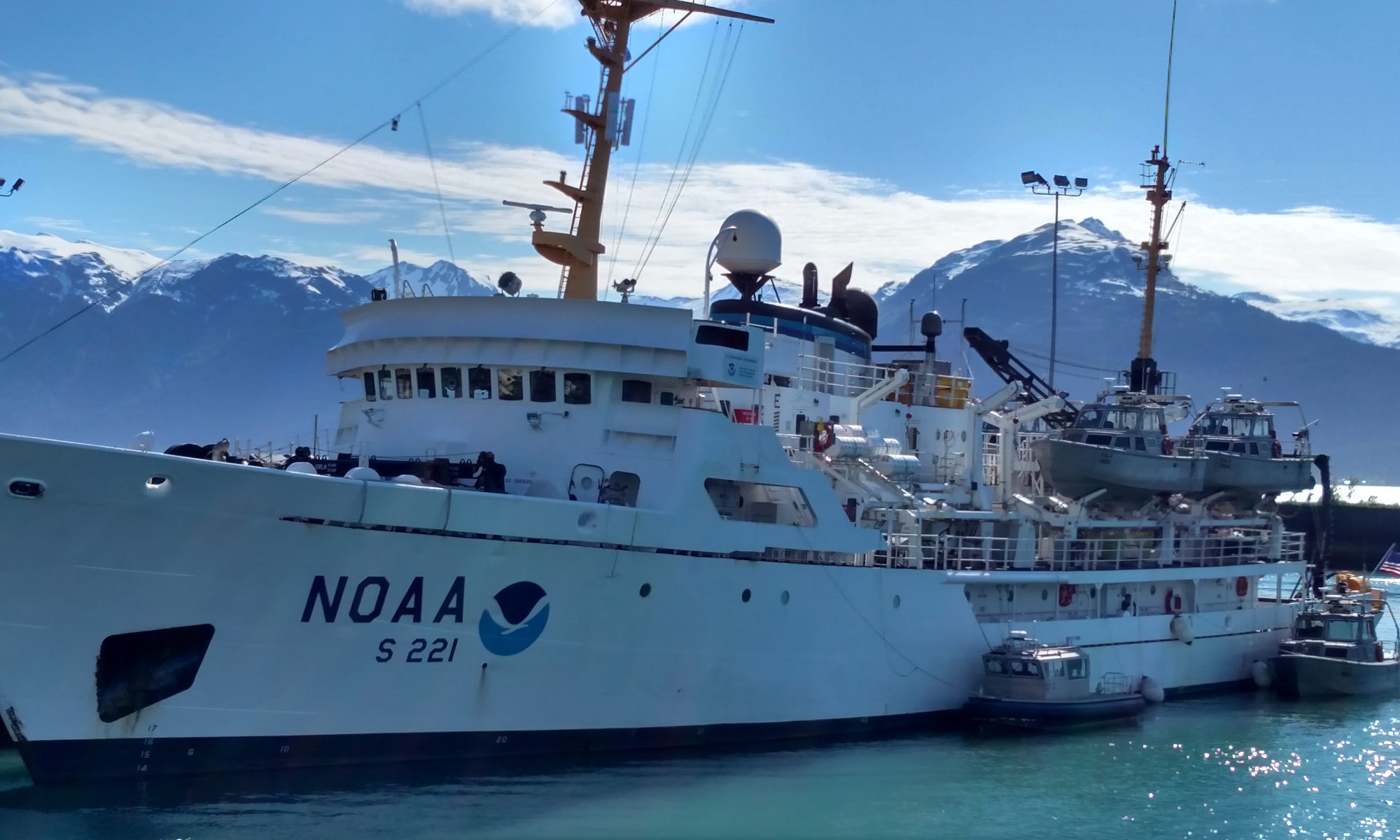
Aboard NOAA Ship Fairweather

August 12-23, 2019


Mission: Cascadia Mapping Project

Geographic Area of Cruise: Pacific Northwest (Off the coast of California)

Date: 8/20/2019

Weather Data from the Bridge:

Latitude: 41°04 N
Longitude:  124° 37 W
Sky Conditions:  Scattered Clouds
Present Weather:  Foggy
Visibility: 3 Nautical Miles
Windspeed: 2 knots
Sea Wave Height:  0
Swell Height: 2 feet
Temperature:  60° Fahrenheit


Bathymetry

What is Bathymetry and why is it important?  Bathymetry is the foundation of the science of hydrography, which measures the physical features of a water body. 

We covered Hydrography in the last blog post so we know it includes not only bathymetry, but also the shape and features of the shoreline and more.

Bathymetry is defined as “the study of the “beds” or “floors” of water bodies, including the ocean, rivers, streams, and lakes.” 

The term “bathymetry” originally referred to the ocean’s depth relative to sea level, although it has come to mean “submarine topography,” or the depths and shapes of underwater terrain.  In the same way that topographic maps represent the three-dimensional features of land, bathymetric maps illustrate the land that lies underwater.  Variations in sea-floor relief may be depicted by color and contour lines called depth contours or isobaths.  (Click here for source credit and more information from NOAA)

A bathymetric map looks like this (thanks Sam!):

bathymetric map
Latest bathymetric maps! Can you see the newly discovered undersea canyon?
(Southern coverage)
bathymetric map - north
Latest bathymetric maps! Can you see the newly discovered mud volcano?
(Northern Coverage)

Above are the first views of this part of the seafloor with a bathymetric map!  (Color coded for depth – see the chart on the left)


Science and Technology Log:

Among the NOAA officers Navigating the ship, Hydrographic Technicians, and wage mariners aboard Fairweather, and the Teacher at Sea, there are also two guest USGS scientists:  James Conrad, a research Geologist and Perter Dartnell, a physical scientist.  USGS stands for United States Geographical Survey.  The USGS was created by an act of Congress in 1879 and is the sole science agency for the Department of the Interior. 

As a Teacher at Sea, I had time to talk with these USGS scientists and learn more about Bathymetry and why it is important not only to scientists, but also how this information can be used to keep us safe. 

Discussion with James Conrad research Geologist who is utilizing the science of Bathymetry among others to map the Cascadia Region of the Pacific seafloor. The USGS scientists’ focus is mapping the Cascadia Subduction Zone where the Juan de Fuca tectonic plate is “diving” below the North American tectonic plate. Areas of particular interest to these scientists are finding new faults, faults that are known but we have little information about, mud volcanoes and subsequent “seeps,” and the overall goal is to understand the behavior of the mega thrusts in the Cascadia Region. 

map of tectonic plates
Image Credit: USGS scientists Peter Dartnell and James Conrad

About the visiting scientists:

James Conrad has a bachelor’s degree from U.C. Berkley and a master’s degree from San Jose State and has been at the USGS for 38 years.

A conversation with Research Geologist James Conrad:

What do you want students to know about Geology?

Geology is a field where there is still so much to discover, especially if you are doing hazards research work-like earthquakes, tsunamis, landslides, coastal change, and climate change issues

Were you always interested in geology?

Not as a child, but I became a geology major because I had taken an introductory course – and was guided to geology by the university.

I met you on a ship-where do most of your work?

Office is in Santa Cruz, but we go out in the field 1-4 times a year for a week up to 3 weeks. 

Geology is a very young science, the fact that continents move wasn’t proven until 1963.  There is very little known about the earth, and there is so much more to discover.

Peter Dartnell:

Peter Dartnell has Bachelor of Science in Oceanography from Humboldt State University and a Masters of Geography from San Francisco State and has been with the USGS for 28 years.

A conversation with Physical Scientist Peter Dartnell:

What does a physical scientist study?

Physical Science is a combination of the studies earth and computer sciences using computers & technology to study earth.

Physical Science allows you to do everything along the scientific “study train” from data collection, interpretation, to publications.

What are your publications used for? 

Scientific publications from the USGS (which is the science agency of the government) are used widely to inform about potential geohazards and changes in the earth.  We don’t make policy, but the information we provide may be used drive policies, especially safety.

Anything you want an aspiring physical scientist to know? 

Even though you are studying earth sciences in school, you’ll truly enjoy once you get out and start applying what you’ve learned in the field with hands on science. 

We’ve met on a ship, where is it you do most of your work?

I spend 75% of my time in the office and 25% in meetings or traveling to study

What is your favorite part of being a Physical Scientist?

Seeing part of the ocean that nobody has ever seen for the first time. We are the first ones to see these recently mapped parts of the sea floor. 

What types of technology you use in physical science?

We use specialized software to acquire data and analyze the data we collect.

We also use Multibeam sonar software – bathymetry and acoustic backscatter

GIS geographic information systems

Overlay/Compare and Contrast data

What do you think are some misconceptions about physical science?

Because we are working off shore and water covers 71% of the earth, marine geology is in its infancy — we really need to have a complete map of the sea floor which is vitally important to understand the geology of the earth. When we don’t have all of these details, we are essentially operating blind.  That’s why the work that NOAA is doing is so important and the research partnerships with USGS are so valuable.

Much of the geography of the seafloor is driven by the oil industry which is required to release their acquired data every 25 years.  A lot of the deep penetration data is all from oil surveys.  Sea floor mapping is limited for pure research purposes due to limited resources.

Interested in learning more from the USGS? 

Check out these resources for students and teachers:

Escape the POD challenge for grades 6-12

K-2 Resources

3-5 Resources

More about bathymetry and the NOAA and USGS mission:

I was lucky enough to attend a “Science Talk” by these USGS scientists which was titled the Subduction Zone Coastal & Marine Geohazards Project. The USGS scientists are guests aboard Fairweather like me. 

The focus of the USGS research is along the 700-mile Cascadia Subduction Zone:                                                                                                                                  

study area
Map of Study Area. Image Credit: USGS scientists Peter Dartnell and James Conrad

This area is where the Juan de Fuca plate dives below the North American Plate at an approximate rate of 1.6 inches per year.

Subduction Zone
Subduction Zone Image Credit: USGS scientists Peter Dartnell and James Conrad

Why is this subduction zone so important and why is NOAA Ship Fairweather out surveying the ocean floor in this area?  That’s because the world’s largest and most destructive earthquakes occur along subduction zones.  If we know the potential hazards, we can prepare people and potentially save lives.

To properly prepare, we need the following details:

slide preparing for earthquakes
What We Need to Prepare for Future Earthquakes
Image Credit: USGS scientists Peter Dartnell and James Conrad

This is why the bathymetric maps of the sea floor are important, they can help predict the area and amount of shaking that may occur during an earthquake and predict the tsunami danger zones.  Then we can make decisions for building codes, infrastructure (like strength of bridges), and escape routes for Tsunamis.  I took the pictures below when I arrived in Newport, little did I know how the research the Fairweather is conducting and the science of hydrography and bathymetric maps play a part in warnings like these! (See below)

Through the hydrographic surveying being conducted aboard Fairweather, the NOAA crew and USGS scientists are creating bathymetric maps which have reveled exciting new finds, such as: new seafloor faults, mapping known faults in greater detail, discovering mud volcanoes and submarine landslides, and using the water column data to discover the “seeps” which are most likely releasing methane gas.  See below.

(Image Credits: USGS scientists Peter Dartnell and James Conrad)

When I first heard the term BATHYMETRY I had no idea how these detailed maps of the seafloor could hold so much critical information!  It’s fascinating to watch this science happen right here and see the discoveries in real time. 


Personal Log

This post begins the last week aboard Fairweather.  I’m surprised about how quickly the ship has begun to feel “normal” to me.  I know my way around backwards (aft) and forwards (bow) and enjoyed getting to know everyone better.  Sean the IT specialist makes an amazing pot of French press coffee around 10:00 am and is kind enough to share with all.  Bekah, Sam, Joe, and Michelle in Hydrography patiently answer dozens of questions and allow me to participate when possible.  And the officers on the bridge answer all the questions and are very welcoming and generous with sharing information and their amazing views!  Carrie and the kitchen crew make 3 amazing meals a day, and I’ve made some new workout buddies to try to stay healthy with all this wonderful food!  The visiting scientists have been very nice about answering all my questions about bathymetry and geology.  It’s great when you are writing and studying about geology to be able to turn around and ask a geologist a question!  

I can’t believe how well I sleep on a ship!  The ship is constantly rocking and for this teacher at sea, and for me, that means some seriously deep sleep.  One thing I learned is to make sure all my belongings are secure before I go to bed.  If you leave something unsecured, chances are they will be banging around in the middle of the night or get tossed off a shelf (not the best middle of the night surprise!).  My room is very dark at night and I really don’t hear anything beyond the noise of the engines.  You can barely hear the foghorn from my area towards the back of the ship which is lucky since those sleeping in the front of the ship could hear it all night!  (Those friends look a little weary today.)  I have to set an alarm, or I will just keep sleeping with the constant rocking motion that is so relaxing!  Only 3 more nights of good ship sleep for me!

Linda Kurtz
The fog horn sounds every 2 minutes when the conditions are, you know, foggy!

Following the excellent tutelage of the NOAA officers, hydrographers, and USGS scientists, it’s exciting to look at the screen in the hydrography lab and start a conversation about features of the sea floor that we are seeing (or seeing in detail) for the first time.  On this mission, there have been new faults, mud volcanoes, and underwater canyons discovered.  The science is so fascinating and so little is known about the research being conducted aboard Fairweather.  I honestly had to “Google” the terms I am now so familiar with like Hydrographic survey, multi beam echo sounders, bathymetry, water column data, just to name a few. 

That’s the thing about science that has been reinforced being a Teacher at Sea, no matter how much you think you know about the earth, you learn just how much we don’t know yet, and we’re just beginning to realize the vast amount that is left to discover. 

Did You Know?

-The ocean covers 71% of the earth’s surface, but we actually know more about the surface Mars than the Earth’s ocean floor- (Credit-Peter Dartnell)

-The Juan de Fuca Plate is part of the famous Ring of Fire, a zone responsible for volcanic activity, mountainous regions, and earthquake activity.

Question of the Day:

Do you know how many tectonic plates there are?  Did you know they are all constantly moving? 

Challenge Yourself

Can you name the Earth’s major tectonic plates?  Can you find on a map the Pacific and Juan de Fuca plates that we are surveying right now?

Animals Seen Today:

Northern Fur Seal

Linda Kurtz: Hydrographic Surveys – Not your Mama’s Maps! August 17, 2019

NOAA Teacher at Sea

Linda Kurtz

Aboard NOAA Ship Fairweather

August 12-23, 2019


Mission: Cascadia Mapping Project

Geographic Area of Cruise: Northwest Pacific

Date: 8/17/2019

Weather Data from the Bridge

August 17th 2019

Latitude & Longitude: 43◦ 53.055’ N 124◦ 47.003’W
Windspeed: 13 knots
Geographic Area: @10-15 miles off of the Oregon/California coast
Cruise Speed:  12 knots
Sea Temperature 20◦Celsius
Air Temperature 68◦Fahrenheit

Future hydrographer button
Is this you?

Navigation is how Fairweather knows its position and how the crew plans and follows a safe route.  (Remember navigation from the last post?)  But what “drives” where the ship goes is Hydrographic survey mission.  There is a stunning amount of sea floor that remains unmapped, as well as seafloor that has not been mapped following a major geological event like an earthquake of underwater volcano.

Why is Hydrography important?  As we talked about in the previous post, the data is used for nautical safety, creating detailed maps of the ocean floor,  setting aside areas are likely abundant undersea wildlife as conservation areas, looking at the sea floor to determine if areas are good for wind turbine placement, and most importantly to the residents off the Pacific coast, locating fault lines — especially subduction zones which can generate the largest earthquakes and cause dangerous tsunamis.

In addition to generating the data needed to update nautical charts, hydrographic surveys support a variety of activities such as port and harbor maintenance (dredging), coastal engineering (beach erosion and replenishment studies), coastal zone management, and offshore resource development. Detailed depth information and seafloor characterization is also useful in determining fisheries habitat and understanding marine geologic processes.

The history of hydrographic surveys dates back to the days of Thomas Jefferson, who ordered a survey of our young nation’s coast.   This began the practice and accompanying sciences of the coastal surveys.  The practice of surveys birthed the science of Hydrography (which we are actively conducting now) and the accompanying science of Bathymetry (which we will go into on the next post.)  This practice continues of providing nautical charts to the maritime community to ensure safe passage into American ports and safe marine travels along the 95,000 miles of U.S. Coastline. 

Want to learn more about Hydrographic Survey history?  Click on THIS LINK for the full history by the NOAA.

Scientists have tools or equipment that they use to successfully carry out their research.  Let’s take a look at a few of the tools hydrographic survey techs use:

Want to learn more about the science of SONAR? Watch the video below.

ps://www.youtube.com/watch?v=8ijaPa-9MDs

On board Fairweather (actually underneath it) is the survey tool call a TRANSDUCER which sends out the sonar pulses.

Multibeam sonar illustration

The transducer on Fairweather is an EM 710- multibeam echo sounder which you can learn more about HERE

The Transducer is located on the bottom of the ship and sends out 256 sonar beams at a time to the bottom of the ocean.  The frequency of the 256 beams is determined by the depth from roughly 50 pings per second to 1 ping every 10 seconds.  The active elements of the EM 710 transducers are based upon composite ceramics, a design which has several advantages, which include increased bandwidth and more precise measurements. The transducers are fully watertight units which should give many years of trouble-free operation.  This comes in handy since the device in on the bottom of Fairweather’s hull!

Here is the transducer on one of the launches:

transducer
View of transducer on a survey launch

The 256 sonar beams are sent out by the transducer simultaneously to the ocean floor, and the rate of return is how the depth of the ocean floor is determined.  The rate of pulses and width of the “swath” or sonar beam array is affected by the depth of the water.  The deeper the water, the larger the “swath” or array of sonar beams because they travel a greater distance.  The shallower the water, the “swath” or array of sonar beams becomes narrower due to lesser distance traveled by the sonar beams.

The minimum depth that this transducer can map the sea floor is less than 3 meters and the maximum depth is approximately 2000 meters (which is somewhat dependent upon array size).  Across track coverage (swath width) is up to 5.5 times water depth, to a maximum of more than 2000 meters. This echo sounder is capable of reaching deeper depths because of the lower frequency array of beams. 

The transmission beams from the EM 710 multibeam echo sonar are electronically stabilized for roll, pitch and yaw, while they receive beams are stabilized for movements. (The movement of the ship) What is roll, pitch, and yaw? See below – these are ways the Fairweather is constantly moving!

Roll, Pitch, and Yaw

Since the sonar is sent through water, the variable of the water that the sonar beams are sent through must be taken into account in the data. 

Some of the variables of salt water include: conductivity (or salinity) temperature, depth, and density.

Hydrographic scientists must use tools to measure these factors in sea water, other tools are built into the hydrographic survey computer programs. 

One of the tools used by the hydrographic techs is the XBT or Expendable Bathy Thermograph that takes a measurement of temperature and depth.  The salinity of the area being tested is retrieved from the World Ocean Atlas which is data base of world oceanographic data. All of this data is transmitted back to a laptop for the hydrographers.  The XBT is an external device that is launched off of the ship to take immediate readings of the water. 

Launching the XBT:  There is a launcher which has electrodes on it, then you plug the XBT probe to the launcher and then XBT is launched into the ocean off of the back of the ship.  The electrodes transmit data through the probe via the 750-meter copper wire.  The information then passes through the copper wire, through the electrodes, along the black wire, straight to the computer where the data is collected.  This data is then loaded onto a USB then taken and loaded into the Hydrographic data processing software.  Then the data collected by the XBT is used to generate the sound speed profile, which is sent to the sonar to correct for the sound speed changes through the water column that the sonar pulses are sent through.  The water column is all of the water between the surface and seafloor. Hydrographers must understand how the sound moves through the water columns which may have different densities that will bend the sound waves.  By taking the casts, you are getting a cross section “view” of the water column on how sound waves will behave at different densities, the REFRACTION (or bending of the sound waves) effects the data.

See how the XBT is launched and data is collected below!

Videos coming soon!

The other tool is the MVP or moving vessel profiler which takes measurements of conductivity, temperature, and depth.  These are all calculated to determine the density of the water.  This is a constant fixture on the aft deck (the back of the ship) and is towed behind the Fairweather and constantly transmits data to determine the speed of sound through water.  (Since sonar waves are sound waves.)

MVP and launching wench
MVP (left) and the launching wench (right)

The sonar software uses this data to adjust the calculation of the depth, correcting for the speed of sound through water due to the changes in the density of the ocean.  The final product?  A detailed 3d model of the seafloor!

current survey area
Our current survey area! (Thanks Charles for the image!)

All of this data is run through the survey software.  See screen shots below of all the screens the hydrographers utilize in the course of their work with explanations.  (Thanks Sam!)  It’s a lot of information to take in, but hydrographic survey techs get it done 24 hours a day while we are at sea.  Amazing!  See below:

ACQ software screenshot
Hydrographic Survey “Mission Control”
HYPACK Acquisition Software
Real time coverage map

Did You Know?  An interesting fact about sonar:  When the depth is deeper, a lower frequency of sonar is utilized.  In shallower depths, a higher sonar frequency. (Up to 900 meters, then this rule changes.)

Question of the Day:  Interested in becoming a hydrographic survey tech?  See the job description HERE.

Challenge yourself — see if you can learn and apply the new terms and phrases below and add new terms from this blog or from your research to the list!

New Terms/Phrases:

Multibeam sonar

Sound speed

Conductivity

Salinity

Sonar

Sound waves

Refraction

Water column

Roll, Pitch, and Yaw

Animals seen today:

Humpback Whale

Bathymetry and USGS friends coming soon!

Plot room
Hydro-technician Sam Candio (right) collaborating with USGS Research Geologist James Conrad and Physical Scientist Peter Dartnell.

Linda Kurtz: Navigating Fair Winds and Following Seas – Fairweather Edition, August 13, 2019

NOAA Teacher at Sea

Linda Kurtz

Aboard NOAA Ship Fairweather

August 12-23, 2019


Mission: Cascadia Mapping Project

Geographic Area of Cruise: Northwest Pacific

Date: 8/13/2019

Weather Data from the Bridge

August 12th
Latitude & Longitude: 43 50.134N, 124◦49.472 W
Windspeed: 19mph
Geographic Area:  Northwest Pacific Ocean
Cruise Speed:  12 knots
Sea Temperature 20◦Celcius
Air Temperature 70◦Fahrenheit


Science and Technology Log

Yesterday, we embarked on this Hydrographic Survey Project, leaving Newport and heading out to the Pacific Ocean.  The 231-foot Fairweather is manned by 35 people and they are all essential to making this research run smoothly, keeping the ship on course, maintaining the ship, and feeding all of us!  Why is this Hydrographic survey mission important?  We’ll take a “deep dive” into hydrographic surveys in an upcoming blog, but there are several overlapping reasons why this research is important.  On previous hydrographic maps of the sea floor, there are “gaps” in data, not giving scientists and mariners a complete picture of this area.  The data is used for nautical safety, setting aside areas where there are likely abundant undersea wildlife as conservation areas, looking at the sea floor to determine if areas are good for wind turbine placement, and most importantly to the residents off the Pacific coast, locating fault lines –especially subduction zones, which can generate the largest earthquakes and cause dangerous tsunamis.  More about this and the science of Hydrography in a later post.  For now, we’ll focus on Navigation.


Science Word of the day:  NAVIGATION

The word NAVIGATION is a noun, defined: the process or activity of accurately ascertaining one’s position and planning and following a route.

synonyms: helmsmanship, steersmanship, seamanship, map-reading, chart-reading, wayfinding. “Cooper learned the skills of navigation.”


Time to leave port: 12:30 pm August 12th

As we were pulling away from the dock and headed out of Newport, someone was navigating this very large ship through narrow spaces, avoiding other boats, crab traps, and other hazards, and I began wondering… who is driving this ship and what tools do they have to help them navigate and keep us safe?  Navigation is the science of “finding your way to a specific destination.”  So, I made way to the bridge to find out. There was so much to learn, and the bridge crew was very patient taking me through who worked on the bridge as well as the various tools and technological resources they used to guide the Fairweather exactly where it needed to be.  First the humans who run the ship, then the tools!

On the bridge you have 3 key members in charge of navigation and steering the boat.  These are not to be confused with the CO or Commanding Officer who always oversees the ship but may always not always be present on the bridge (or deck). The CO is kind of like a principal in a school (if the school were floating and had to avoid other buildings and large mammals of course.) 

 1st in charge of the bridge watch is the OOD or Officer of the Deck.   The OOD is responsible for making all the safety decisions on the deck, giving commands on how to avoid other vessels and wildlife such as whales!  The OOD oversees the deck and reports regularly to the CO as needed. 

2nd in charge of the bridge watch is the JOOD or Junior Officer of the Deck.  The Junior Officer is responsible to the CO and OOD and uses both technology driven location data and plot mapping with paper to locate the position of the ship and use that location to plan the course for the ship.

The 3rd member of the bridge team is the helmsman.  The helmsman is the person who is actually driving the ship while following the commands of the OOD and JOOD.  Tools the helmsman uses include magnetic compasses on deck and electronic heading readouts to adjust course to stay on a particular heading (or direction of travel.)  The helmsman has another duty as lookout.  The lookout watches the ocean in front of the ship for land objects (we saw a lighthouse today), ocean mammals such as whales (we’ve seen 3 so far) or debris in the ocean so Fairweather can navigate around them.

Kevin Tennyson
Officer of the Deck (OOD): Kevin Tennyson
Calderon and Ostermyer
Junior Officer of the Deck (JOOD) Jeff Calderon and Helmsman Terry Ostermyer


There are so many devices on the bridge, I’ll share a few of them and their functions.  This blog post would take DAYS to read if we went over them all!

Let’s explore: what tools does the crew aboard Fairweather use for NAVIGATION?

Radar is a system that uses waves of energy to sense objects. These waves are in the form of high frequency radio waves which can find a faraway object and tell how fast it is moving. 

Radar is very useful because it can sense objects even at night and through thick clouds.   Radar helps the Fairweather navigate by detecting objects and vessels in the immediate area.  On Fairweather, you can see the objects that are near or could be in the determined path of travel.

RADAR
RADAR showing other watercraft and objects that could come into contact with Fairweather, for safe NAVIGATION.
Close up of RADAR
Close up of RADAR screen showing blue lines (indicative of speed) trailing other detected objects

While the picture above shows where the objects and vessels are, the “blue trail” shows how far they have traveled in 6 minutes.  A longer blue trail means a faster moving vessel and a shorter or no tail means little or no movement.  This tool also helps the Fairweather crew determine the path of travel of the other vessels so they can either navigate around or warn the other vessel of the Fairweather’s heading. 

Fairweather bridge crew also must follow what STEM students call the 4C’s: Communication, Collaboration, Critical Thinking, & Creativity.

To communicate while at sea, the crew must communicate via radio.

radio
Communication is essential for safe navigation.

Notice the abbreviations for the MF/HF or Medium Frequency/High Frequency, which has the longest range and you can communicate via voice or text. VHF or Very High Frequency are voice radios only.  Marine VHF radios work on a line-of-sight basis. That is, they can transmit and receive to and from another antenna as long as that antenna is above the horizon. How far is that? Standing on the bridge of a ship, the distance to the horizon is usually about 10-12 miles.  So, if there is a vessel within that 10-12 mile or so range, the Fairweather crew can communicate with them via the VHF radio.


Weather Tools:

It is crucial to gather weather data and analyze the information from various weather instruments onboard to keep the Fairweather safe. Sopecreek Elementary has a Weather Station too!  As you look through the photos below, see if you can find what weather instruments (and readings) Fairweather uses and compare and contrast with Sopecreek’s WEATHER STEM station!  What type of instruments do you think are the same, and which are different?

Weather Data
Data from the bridge on Day 2
Weather Data Time Series
weather data updates
Weather data updates – the ship can NAVIGATE to avoid dangerous weather


With all of tools discussed above, the Fairweather is approaching the Cascadia Margin that needs to be surveyed using science of Hydrography and Bathymetry (more about those concepts coming soon!)

The area to be survey has already been identified, now the ship must approach the area (the red polygon in the middle of the screenshot below).  Now the crew must plot a course to cover the area in horizontal “swaths” to aid in accurate mapping.  The bridge and the hydrographic survey team collaborate and communicate about speed, distance between horizontal lines, and timing of turns. 

See the initial area to mapped and the progress made in the first two days in the pictures below!

Cascadia Margin chart
Cascadia Margin: 1st Region the Fairweather is mapping
mapping progress
Progress mapping – navigation the survey area – colored lines indicate where the ship has been


Personal Log

It’s been a great start to this Teacher at Sea adventure!  There is so much to take in and share with my students (I miss you so much!) and my fellow teachers from across the country!  Today, we went from sunny skies and calm 2-4 foot seas, to foggy conditions and 6-8 foot seas!  The ship is definitely moving today!  I keep thinking about STEM activities to secure items and then testing against the varying degree of pitch on the ship!  For safety, the entire crew is tying up any loose items and securing all things on board, we’ll have to think of STEM challenges to simulate this for sure! 


Did You Know?

When steering a ship, an unwritten rule is you don’t want the speed of the ship (in KNOTS) and the degree of the turn of the rudder (in DEGREES) to exceed the number 30! 


Question of the Day: 

How many possible combinations of KNOTS and DEGREES are there? Can you draw or plot out what that would look like?


New Terms/Phrases:

Thermosalinigraph:  Measures the temperature and salinity of the water.

Challenge yourself: see if you can learn and apply the terms below and add new terms from this blog or from your research to the list!

ECDIS:  Electronic chart display information system

Longitude and Latitude

True North

Magnetic North


Animals Seen Today:

Dall’s Porpoise

Humpback Whale

Curious about STEM Careers with NOAA?  All the officers on deck had a background in some type of science but none were the same.  Everyone on board comes from different backgrounds but are united by the OJT (On the Job Training) and the common purpose of the hydrographic survey mission.   Learn more here:  https://www.noaa.gov/education

Linda Kurtz: STEM Teacher AWAY! August 6, 2019

NOAA Teacher at Sea

Linda Kurtz

Aboard NOAA Ship Fairweather

August 12-23, 2019


Mission:  Cascadia Margin Ocean Mapping Project

Geographic Area: Coastal Oregon and northern California

Date: August 6, 2019


Introduction

I am thrilled to be a NOAA Teacher at Sea aboard the NOAA Ship Fairweather

I will be embarking August 12 and sailing through August 23 on a Hydrographic Survey mission from Newport, Oregon. Hydrographic Survey missions focus on mapping the seafloor in detail.  I will be sharing more about that soon!  To all my students (past and present), colleagues, fellow STEM enthusiasts, and friends, I hope you will follow along via these blog posts as I share this teacher adventure at sea and learn with me about the important work of NOAA. NOAA stands for National Oceanic and Atmospheric Administration.  The mission of NOAA is “to understand and predict changes in climate, weather, oceans, and coasts, to share that knowledge and information with others, and to conserve and manage coastal and marine ecosystems and resources.” 

Most of my time teaching is spent within the walls of the classroom, trying to prepare students for STEM careers that they (or I) have never seen.  Now, as a Teacher at Sea, the dynamic will be flipped!  I will learn with actual scientists about STEM careers that support NOAA’s mission and bring those experiences back to the classroom myself! I am so grateful for this opportunity to expand my own knowledge and for my students who will get a front row seat to STEM careers in action.                                

My “classroom” for the next two weeks:

Classroom for Fairweather
My “classroom” for the next two weeks


About Me:

I was born in New Hampshire and moved around quite a bit growing up.  My “hometown” was Chattanooga, Tennessee, but I grew up in many places including South Africa.  I currently live on a “pocket farm” in Powder Springs, Georgia with my husband, 3 children, 3 dogs, and 2 cats.  My family and I love to travel as well as camp in state and national parks.

Kurtz Family Photo Collage

I have always enjoyed a bit of adventure, learning rock climbing, downhill mountain biking, bungee jumping, and skydiving.  My favorite adventure came at the age of 13 when I learned how to scuba dive.  A new underwater world was revealed to me and I developed a deep love and respect for the ocean.  I have tried to teach my children and my students the joys of outdoor adventure and the importance of stewardship.  Powder Springs is about 20 miles away from the Georgia’s capitol of Atlanta.  We love going to NFL Falcons’ games and MLB Braves’ games when we are not out camping!

Family Game Time
Family Game Time

My greatest adventure now is being a STEM teacher.  STEM stands for Science, Technology, Engineering, and Mathematics.  I have been a STEM teacher for my entire teaching career and love it!  I see STEM everywhere and believe our students are going to do great things for the world with a strong background in STEM education.  I particularly enjoy teaching Coding and 3D printing to students as well as how to use technology to create solutions to problems instead of being passive users of technology

My undergraduate work was focused in Early Childhood education, and my graduate degree in Integration of Technology into Instruction.  I now teach at Sope Creek Elementary and love my 1,000+ students in our evolving STEM school.  We follow the steps of the EDP or Engineering Design Process every day to solve real world problems.  We especially like to integrate problem solving with technology.  This practice is what drew me to the hydrographic survey projects conducted by NOAA.  I am excited to learn how technology is utilized to create detailed maps of the ocean floor, and learn about the science of Bathymetry, which is the study of the “beds” of “floors” of water bodies including oceans, lakes, rivers, and streams. 

Finally, it was the mission of the NOAA Teacher at Sea Program is what drew me to apply for this program:  The mission of the National Oceanic and Atmospheric Administration’s (NOAA) Teacher at Sea Program is to provide teachers hands-on, real-world research experience working at sea with world-renowned NOAA scientists, thereby giving them unique insight into oceanic and atmospheric research crucial to the nation. The program provides a unique opportunity for kindergarten through college-level teachers to sail aboard NOAA research ships to work under the tutelage of scientists and crew.   As a life-long learner it is difficult to access professional development. In this program, I will gain real world experience as a scientist as sea while also having an adventure at sea!  I can’t wait to share this experience with all of you!   Now I’m off to get my dose of vitamin sea!  More soon. 


Questions and Resources:

Teachers:  Please reach out with questions from teachers or students and keep an eye out for resources I will be sharing in the comments section of this blog.  Check out these K-12 resources available through NOAA!

Students:  Have a teacher or please post your questions.  Here are the answers from questions so far:

Question 1:  Do you think you will end up like the Titanic

Answer:  No way!  The NOAA Ship Fairweather has been conducting missions since 1967 (the ship is older than ME!).  This is a 231 foot working vessel with a strengthened ice welded hull.  I don’t plan on seeing any icebergs off the coast of Oregon in Pacific Ocean, so don’t worry!  NOAA Ship Fairweather’s crew have some of the best professionals in the world to run their fleet, so I will be safe!

Question 2:  Are you coming back?  And will you have to sleep outside like a pirate?

Answer:  Yes, I will be coming back!  I will be away for 2 weeks and will be back in the STEM-Kurtz lab on August 26th-so you can come see me when I get back.  As for your 2nd question, I will get to sleep inside in a “berth” and will have a bed and everything else I need.  I do not have to sleep outside, but you know when I’m home I like to sleep outside in my hammock! 

Student focus of the week:  Hey 5th Grade students!  You are going to be learning about constructive and destructive processes of the earth over time.  Check out this document about the Subduction Zone Marine Geohazards Project Plans.  My mission will link directly to what you are learning in class!

Meg Stewart: What the Bathymetry Looks Like at Cape Newenham, Alaska: Flat and a Little Wavy, July 23, 2019

sand waves

NOAA Teacher at Sea

Meg Stewart

Aboard NOAA Ship Fairweather

July 8 – 19, 2019


Mission: Cape Newenham Hydrographic Survey

Geographic Area of Cruise: Bering Sea and Bristol Bay, Alaska

Date: July 23, 2019

Weather Data from Home
Latitude: 41°42’25.35″N
Longitude: 73°56’17.30″W
Wind: 2 knots NE
Barometer: 1011.5 mb
Visibility: 10 miles
Temperature: 77° F or 25° C
Weather: Cloudy

Science and Technology Log

As you can tell from 1) the date of my research cruise and 2) my latitude and longitude, I am no longer in Alaska and I am now home. For my final NOAA Teacher at Sea post, I am pleased to show you the results of the hydrographic survey during the Cape Newenham project. The bathymetric coverage (remember that bathymetry means the topography underwater or depth to the bottom of oceans, seas and lakes) is not final as there is one more leg, but it is pretty close. Then the hard part of “cleaning up” the data begins and having many layers of NOAA hydrographers review the results before ever being placed on a nautical chart for Cape Newenham and Bristol Bay. But that day will come!

project location
Fig 1. First, here is a reminder of the location area for the project in Alaska, in the Bering Sea and Bristol Bay (circled in red).
coverage graphic
Fig 2. Here is the entire coverage of the project area to date. Notice that some of the coverage is complete and some is in spaced line segments. The red areas on the map are shallow and vessels should avoid those. The dark blue to purple zone is the deepest shown on the map and that is where ships should navigate and mariners will know that by looking on the future navigational chart. During the project, the Chief Hydrographer began to notice that the sea bed was nearly flat and gently sloping. The decision was made to use set line spacing for the rest of the project. (Hint: Click on the image to see more detail)
Cape Newenham
Fig 3. Going in a little more closely, I’ll show you the Cape Newenham area, shown in the dashed line region. You may recall that this is the nautical chart from three blog posts ago.
Cape Newenham surveyed
Fig 4. Now, we’ve zoomed in one of the cool parts of the bathymetric map. As I said above in Fig 2, most of the Cape Newenham sea floor surface is gently sloping. There are no obvious obstructions such as large boulders or shipwrecks; if there were, those would show up in the hydrographic survey. I’ll talk more about the red (or shallower) part of the map in the next figure.
sand waves
Fig 5. This is a 3D side view of the upper part of Fig 4. The red that you see is 5 meters or about 16 feet below the ocean surface. The light blue area is about 36 or so meters deep which is about 120 feet deep. What the hydrographers noticed were sand waves, which they found interesting but non-threatening to navigation unless the crests neared the ocean surface. Sand waves can migrate or move around and they can also grow larger and possibly become a navigational hazard in the future. As a geologist, I think the sand waves are excellent. These waves (sometimes they are called ripples) of sediment form as a result of ocean currents and show the direction of flow. See the next figure for a profile view (cross section view) along the light blue line on this map.
profile of sand waves
Fig 6. This is 2D profile view along the surface of the light blue line shown in Fig 5. This is the top of the sand waves. I’ve pointed to a couple of sand wave crests; there are five crests shown in this profile length. Notice that there is a gently sloping face of the wave and a steeper face. The ocean current direction is moving from the gentle face towards the steep face in this location on Cape Newenham which is from north to south. The hydrographers told me that, though the ocean flow may be north to south here now, it is possible that in the winter, the current reverses. There is also a tidal influence on the current here, too.


Part II – Careers at Sea Log, or
Check Out the Engine Room and Meet an Engineer

engineer Klay Strand
Photo 1. Klay Strand, 2AE, showing us around the Fairweather engine room.

This is Klay Strand who is 2nd Engineer on the Ship Fairweather. He’s been on the ship for about a year and a half and he graciously and enthusiastically showed three of us visiting folk around the engine room towards the end of our leg. It was truly eye-opening. And ear-popping.

Before I get to the tour, a little bit about what Engineering Department does and how one becomes an engineer. There are currently nine engineers on the Ship Fairweather and they basically keep the engines running right. They need to check fluid levels for the engine (like oil, water and fuel) but also keep tabs on the other tanks on the ship, like wastewater and freshwater. The engine is on the lower level of the ship.

Klay Strand’s path to engineering was to go to a two-year trade school in Oregon through the JobCorps program. Strand then worked for the Alaskan highway department on the ferry system and then he started accruing sea days. To become a licensed engineer, one needs 1,080 days on a boat. Strand also needed advanced firefighting training and medical care provider training for his license. There are other pathways to an engineering license like a four-year degree in which you earn a license and a bachelor’s degree. For more information on becoming a ship’s engineer, you can go to the MEBA union, of which Strand is a member. On Strand’s days off the ship, he likes to spend time with his niece and nephews, go skydiving, hike, and go to the gun range.

The following photos are some of the cool things that Klay showed us in the engine room.

ship's engines
Photo 2. There are two engines that power the ship. Ear protection is a must. Standing between the two engines felt like standing inside a running car engine if you were a tiny mouse. I didn’t get a shot of us standing there, so I drew an approximate line for reference.
engine room
Photo 3. The ceiling in the engine room is very low. There are A LOT of moving parts. And wires, cords, pipes, valves, enormous tools, tanks, meters and things I’ve never seen before. This part in the foreground, with the yellow painted on the cylinder, is akin to a car’s driveshaft.
waste water levels
Photo 4. This shows how much black water and gray water the ship currently has in the tanks. Those tanks are located in the engine area and the engineers keep a close eye on that information. Gray water is wastewater from washing dishes, clothes washers, and the showers. Black water is from the toilets, I mean ship’s heads. Black water is treated through a chlorination process. Both wastewaters are released at sea, where permissible.
desalination
Photo 5. Recall in my last “Did You Know?” that I said the ship makes its own freshwater from sea water. This is the reverse osmosis monitor showing how much freshwater is being produced. Yes, the engineers keep an eye on that, too.


Personal Log

Dutch Harbor panorama
Before I boarded the small plane that took off from Dutch Harbor to take me to Anchorage, AK, I looked out over the harbor. It was so lovely in Alaska. There’s so much space and untouched landscape. The green, pointed hill on the right side of the image is called Mount Ballyhoo, which I hear was named by Jack London on a swing through Dutch Harbor in the late 1800s.

Now that I’ve been home for a few days, I’ve had a chance to reflect on my time on NOAA Ship Fairweather. When I tell people about the experience, what comes out the most is how warm and open the crew were to me. Every question I had was answered. No one was impatient with my presence. All freely shared their stories, if asked. I learned so much from all of them, the crew of the Fairweather.  They respected me as a teacher and wondered about my path to that position. I wondered, too, about their path to a life at sea.

My first week on the ship, I spent a lot of time looking out at the ocean, scanning for whales and marveling at the seemingly endlessness of the water. Living on the water seemed fun and bold. As time went by, I could tell that I may not be cut out for a life at sea at this stage of my life, but I sure would have considered it in my younger days. Now that I know a little bit more about these careers on ships, I have the opportunity to tell my students about living and working on the ocean. I can also tell my educator colleagues about the NOAA Teacher at Sea Program.

Though I loved my time on the Ship Fairweather, I do look forward to seeing my West Bronx Academy students again in September. I am so grateful for all I learned during my time at sea.

Did You Know?

Marine Protected Area map
Using the interactive Marine Protected Area map, I zoomed in on the Cape Newenham area. Though there is a Walrus Protection Area there, we did not see any on our leg.

If you are interested in finding out about areas of the ocean that are protected from certain types of human activity because of concerns based on habitat protection, species conservation and ecosystem-based marine management, here are some links to information about Marine Protected Areas. Marine Protected Areas are defined as “…any area of the marine environment that has been reserved by federal, state, territorial, tribal, or local laws or regulations to provide lasting protection for part or all of the natural and cultural resources therein.”  Did you know that there are over 11,000 designated MPAs around the world?

NOAA Marine Protected Areas – this is information about MPAs in the U.S.

Atlas of Marine Protection is an interactive map that shows all the MPAs around the globe. 

National Geographic – Marine Protected Areas – a good teaching resource. Here is a NG lesson looking at MPAs.

Partnership for Interdisciplinary Studies of Coastal Oceans (PISCO) – the science of marine reserves.

Quote of the Day

“All of us have in our veins the exact same percentage of salt in our blood that exists in the ocean, and, therefore, we have salt in our blood, in our sweat, in our tears. We are tied to the ocean. And when we go back to the sea – whether it is to sail or to watch it – we are going back from whence we came.” – John F. Kennedy