
Victoria Cavanaugh: Patch Tests in Puget Sound, April 20, 2018

NOAA Teacher at Sea
Victoria Cavanaugh
Aboard NOAA Ship Fairweather
April 16-27, 2018

MissionSoutheast Alaska Hydrographic Survey

Geographic Area of Cruise: Southeast Alaska

Date: April 20, 2018

Weather Data from the Bridge

Latitude: 47° 44.116′ N
Longitude: 122° 32.070′ W
Sea Wave Height: 1 foot or less
Wind Speed: 5-8 knots in the AM, then less than 5 knots in PM
Wind Direction: SSE, variable
Visibility: 16.1 km
Air Temperature: 8oC  
Sky:  Scattered Clouds

Science and Technology Log

For the past two days, NOAA Ship Fairweather has been anchored in Port Madison,  part of Puget Sound off the coast of Seattle, Washington.  The crew is currently stopped for a few days in Puget Sound before heading north to Alaska in order to complete the yearly Hydrographic Systems Readiness Review (HSRR).  During HSRR, the survey techs test all of the hydrographic survey equipment that will be used during the field season.  It’s essential to test and calibrate the equipment at the start of the season in order to ensure the data accuracy for upcoming projects.

The first part of HSRR began Thursday morning. Because NOAA Ship Fairweather spent winter at dock in Yaquina Bay, barnacles and algae were able to grow plentifully on the ship’s bottom, making it their home.  The dive team deployed to check the Fairweathers hull and clean off the sonar transducers, removing any biofouling (sea life that had built up on the ship’s bottom) from the winter in port.


On Thursday afternoon and Friday, the next phase of HSRR began.  On Friday, I was able to spend most of the day on the survey launches as a few of the survey techs conducted patch testing (a process for precisely determining an orientation of the launch’s sonar).  NOAA Ship Fairweather has four 28-foot launches, and I spent the morning on 2808, and then the afternoon on 2806.  When working on projects in relatively shallow waters, the Fairweather deploys these launches to collect data more efficiently as four launches can work on a project simultaneously.

Safety Meeting Before Launches Deploy
One of the Launches is Lowered from F Deck (the 6th Deck Up)
One of the Launches Being Lowered into Puget Sound
A Launch Begins Patch Tests

The launches are driven by a coxswain, often a NOAA officer or deck hand, while a Hydrographer-in-Charge (HIC) plans track lines for the vessel to run.  Sometimes, a coxswain-in-training or HIC-in training will also join the launch.  As part of HSRR, the HIC chose a few track lines for the launch to run, and the coxswain, drove the launch back and forth on the lines at various speeds.  While we ran the track lines, the HIC was able to gather data by sending an acoustic ping from the sonar which reflects off the seafloor and is then recorded when it returns to the sonar.  The two-way travel time of the pin is measured, which (when coupled with the speed of sound through the water) can be used to calculate the water depth.

The Coxswain Helps Deploy the CTD
The Coxswain's Seat
The Coxswain’s Seat
The HIC Readies the Launch as We Pull Away from NOAA Ship Fairweather
The HIC and HIC-in-Training Prepare the CTD
The HIC Checks Data Being Collected as the Launch Runs Patch Tests

While in Port Madison, the crew will send all four of the Fairweatherlaunches out to run the same track lines and to ensure the data collected by each launch matches.  At night, after the HIC’s have gathered data, the survey techs spend hours in the plot room, looking at the day’s data and checking for any discrepancies.  The survey techs correct any errors in the data and the saved changes are sent back to each launch’s computing system.  This is known as calibrating.  By running patch tests and calibrating the launches to one another, survey techs are able to guarantee that data collected throughout the season is precise, no matter which launch is used for a given area.

The CTD Up Close: The Powerful Little Machine that Measures the Speed of Sound!

Data Being Collected from the CTD on the Launch Monitor: Conductivity (Salinity), Temperature, and Depth (Pressure)

The CTD Stands Ready to Be Deployed on the Launch's Deck
The CTD Stands Ready to Be Deployed on the Launch’s Deck

Before and after running the patch tests, the crew deploys a CTD  The CTD measures the conductivity, temperature, and depth of the water.  The survey techs are interested in the CTD readings because this information helps them assess the speed of sound (or the sonar waves) in a given body of water.  In turn, knowing the speed of sound and the amount of time the CTD takes to reach the ocean floor, allows survey techs to calculate ocean depths.  (The classic distance equation, d=rt!)

Data Being Collected from the CDT on the Launch Monitor

Conductivity refers to the ability of the given water sample to pass an electrical current.  Survey techs are interested in the conductivity, because the conductivity is another way to gauge the salinity (or “saltiness” of the water).  The more salt in a sample of ocean water, the greater the ocean water’s conductivity and the faster the sound waves travel.  Next is temperature.  Water closer to the surface is warmer, and thus, sound will travel faster closer to the surface.  Conversely, the cooler the temperature, the slower the sound waves travel.  The final measurement is depth, or pressure.  The deeper the water, the greater the pressure.  Greater depths increase the speed of the sonar waves.  The average speed of sound in the water is 1,500 m/s.  By comparison, the average speed of sound in air is about 340m/s.

Night Processing of Data in the Plot Room

After dinner, survey techs are assigned to night data processing.  I joined one of the survey techs, Ali, who was kind enough to explain how the launch data is analyzed.  One interesting note is the red light in the plot room.  The red light is used because the plot room is next to the bridge, where the officers and deck crew keep watch.  The red lights help the crew keep their eyes ready for night watch, so those processing data also work under red lights.

A "Painting" of Collected Data: Different Colors Represent Differing Depths
A “Painting” of Collected Data: Different Colors Represent Differing Depths

In the above photograph, notice the various colors representing the differing ocean depths.  In this case, red is shallower and purple is deeper.  Notice that as the survey tech, hovers over a datapoint with her mouse, the data collected by Fairweather launch 2807 is shown as a coordinate with a depth of 168.3 meters.  Creating a color “painting” of the data points is helpful because the changing colors help the survey techs understand the slope of the ocean floor; closer together colors mean a steeper slope or a sharp increase in depth, whereas larger swatches of the same color mean a flatter seafloor.

The green lines in the picture represent the “lines” that the launch ran, meaning the area where the coxswain drove back and forth in the boat at varying speeds.  Notice that there are two lines as the launches always run two lines to ensure accuracy.  As the launch is driven back and forth in the water, the transducers on the bottom of the launch emits multi-beam sonar, and sound waves ping off the ocean floor several times per second, sending sound waves back to the launch which are translated into millions of data points by the survey techs.

The survey techs use various computer programs and imaging software to analyze the data.  Above, the survey techs can look at a 3D cross-section of the data, which essentially looks like a virtual map of the sea floor.  In the bottom right corner, the survey tech compares two lines for accuracy, one with data points colored red, the other green.  When the lines line up exactly, precision is ensured.  The survey techs analyze the data to make sure the rocking of the boat in any direction (front/back, side-to-side, etc.) won’t interfere with mapping accuracy later in the season.  Finally, survey techs compare their work with each other to ensure precise calibration.

Personal Log

One of my favorite things about being onboard NOAA Ship Fairweather are the tremendous views every time I look outside.  Sunrises and sunsets are spectacular.  We’ve had some really great weather over the last few days, and though it has been a bit chilly, the skies have been fairly clear.

Sunset in Port Madison
Mount Rainier at Sunset
Pulling Up the Anchor in Port Madison Shortly After Sunrise
Brainbridge Island, Washington
Two of the Crew Checking the Anchor Line Angle During Anchor Recovery
Puget Sound
Puget Sound
Mount Olympia National Park


Did You Know?

On nautical charts (or maps), units of measurement vary.  Ocean depths can be marked in feet, meters, or fathoms. Fathoms, like knots, is another term steeped in nautical history.  When sailors used to measure ocean depths by hanging rope over the side of a vessel, they would pull in the line, looping the rope from hand to hand.  The distance of the rope from one outstretched hand to another (a sailor’s wingspan) became known as a fathom.

Challenge #2  – Devotion 7th Graders: Measure your wingspan, the distance from one outstretched hand to another.  Then measure four other friends, classmates, or family members’ wingspans.  What is the median wingspan for you and your friends?  What is the mean wingspan for you and your friends?  What is the mean absolute deviation for your collective wingspans?  One fathom is equal to 1.8288 meters or 6 feet.  If one fathom is the average sailor’s wingspan, how do your wingspans compare?  Present your findings on a 8.5x11inch paper as a mini-poster.  Include illustrations and calculations.


————————————————————————————————————————————–

Victoria Cavanaugh: Newport, Oregon to Port Madison, Washington, April 17, 2018

NOAA Teacher at Sea
Victoria Cavanaugh
Aboard NOAA Ship Fairweather
April 16-27, 2018

MissionSoutheast Alaska Hydrographic Survey

Geographic Area of Cruise: Southeast Alaska

Date: April 17, 2018

Weather Data from the Bridge

Latitude: 44.64°N
Longitude: 124.04°W
Sea Wave Height: SW 3 ft at 5 seconds. NW swell 9 feet at 10 seconds.
Wind Speed: 11 to 14 kt. Gusts to 20kt.
Wind Direction: SSW
Visibility: 15 kilometers
Air Temperature: 7.8oC  
Sky:  AM showers, scattered clouds in PM.

Science and Technology Log

Though we were originally set to sail on Monday afternoon, predicted 10-15 foot swells for Monday evening delayed our departure from Newport, Oregon until Tuesday afternoon.  The extra time in Newport allowed me to spend some time in the Plotting Room aboard NOAA Ship Fairweather.  The Plotting Room is one of the main work areas for the hydrographers, the NOAA technicians who both plan the missions and then process data collected after each launch.


One of the friendly surveyors, Bekah, gave me an overview of the upcoming project which will focus on the area west of Prince of Wales Island.  The hydrographic survey technicians first receive an assignment, known as a project, from NOAA.  Next, technicians, break each project into “sheets,” or smaller sections, which are assigned to each technician or NOAA officer.  From there, the technicians further break down the sheets into “polygons.”  The polygons are like mini-sections of a given area of the map, and are sized depending on a number of factors including the amount and distance from the shoreline as well as the depth.  The polygons are assigned one-by-one to the survey launches to complete.

img_20180418_1151321.jpg
A Sheet from the Project
IMG_20180418_115152
A Sheet Sectioned into Polygons (in Blue).  Notice the Topographical Markings on the Islands.

One of NOAA’s primary goals with hydrographic surveying and updating the charts is to obtain more accurate data on the Pacific seafloor and its features in order to promote safe marine navigation.  NOAA is part of the US Department of Commerce, and so updating navigational charts will help improve safe passage of all ships, especially commercial cargo ships.  As commercial ships grow larger and heavier and global trade continues to increase, improved navigational charts allow for increased shipping drafts (how deep the vessel extends below the water, which is a function of how much cargo they can load), which in turn creates a positive economic impact for the national economy.

Today, NOAA Ship Fairweather uses sonar to measure seafloor depths.  Previously, hydrographers used lead lines.  Essentially, lead lines were dropped over the ship’s rail and lowered until they rested on the seafloor.  While lead lines are occasionally still used today in very shallow areas close to shore, creating new seafloor maps with sonar allows for much greater precision, are much less labor intensive, and allow for continually measuring the depth.

IMG_20180419_103240
ENS Linda Junge Holding a Lead Line

Personal Log

On Tuesday afternoon, at 14:00 (2pm), we set sail from Newport, Oregon and began making our way north to Port Madison, near Seattle Washington.  After spending a few days at dock in Newport, I was eager to get underway, and the rest of the crew, many of whom had been in Newport for much of the winter, also seemed eager to begin the season.  While the views leaving Oregon were spectacular, the wide open seas proved a bit of a challenge.  I quickly learned that heading to the open deck on the back of the ship, the fantail, was an ideal place to catch some respite from feeling seasick.  Later in the evening, the waves subsided a bit, and by morning the seas felt much calmer.

IMG_20180416_120612
On the Dock in Newport, OR
IMG_20180416_202433
A Beautiful Last Night in Newport
IMG_20180417_141802
Passing Under the 982 meter long Yaquina Bay Bridge as We Leave Newport
IMG_20180417_142159
Heading Out to the Pacific
IMG_20180417_142331
Leaving Yaquina Bay
IMG_20180417_162826
Some Really High Waves Crashing on the Fantail!
IMG_20180416_122629
A Map Showing Our Departure Port (Newport) and Arrival (near Seattle)
IMG_20180417_134549
On the Flying Bridge of the NOAA Ship Fairweather as We Depart Newport

Each day, the POD (Plan of the Day) is updated with important meetings, mealtimes, and general updates.  Emergency responsibilities are also posted, and one of the first things we did once we were underway at sea was practice drills for a fire and abandon ship.  As part of the abandon ship drill, I had to practice putting on the “survival suit.”

Most aboard NOAA Ship Fairweather work several four hour shifts or “watches” each day, and some may also work a few additional hours of overtime.  Perhaps for this reason, meal times seem a bit early with breakfast at 7am and lunch at 11am.  Dinner, when in port is at 4pm, and at sea, it’s at 5pm.   Meals are prepared in the ship’s galley (or kitchen), and served buffet style.  The crew eats together in the mess (or main dining area).  In addition to meals, snacks such as cereal, fruit, and icecream are available 24/7 and some additional options are available for those on night watches who may eat “night lunch.”  Meals are a great time to meet the many aboard Fairweather and better understand how the different teams–the wardoom, the engineers, the survery technicians, the deck, the stewards, the ET, and the visiting scientists–all work together.

Did You Know?

NOAA Ship Fairweather is celebrating its 50th birthday this year!  Fairweather was designed by the US Deparment of Commerce Maritime Administration and built in Jacksonville, Florida by Aerojet-General Shipyards.  Fairweather was commissioned in October 1968 and is homeported in Ketchikan, Alaska.  Fairweather’s sister ship is NOAA Ship Rainier which is also part of NOAA’s Pacific Fleet.

NOAA Ship Fairweather has a field season of about 220 days per year.  At 231 feet long, it can house roughly 57 crew and weighs 1591 tons!  While cruising, Fairweather averages 13 knots, and while surveying, the ship travels 6 to 10 knots.

By the way, you might be wondering what exactly is a knot.  As the story goes, ancient mariners used to tell how fast their ship was moving by throwing a piece of wood tied to a rope overboard and measuring how much time it would take the wood to travel from the bow (front) to the stern (back) of the ship.  According to historian Elizabeth Nix, by the 16th century, this method was updated to include knots tied at certain intervals in the rope that was thrown overboard.  Sailors began to count the knots to determine a ship’s speed, and eventually a “knot” became a nautical mile per hour.

Nautical miles, by the way, refer to the Earth’s circumference, and are different from “land miles” which reflect the distance it takes to walk 1,000 steps (according to the Romans) or 5,280 feet (according to Queen Elizabeth).  Today, one nautical mile is understood as 1,852 meters or 1.1508 miles.  Or, more practically, it is one minute of latitude (where 60 minutes of latitude = 1 degree).

A knot, then, is a measure of speed used by ships and planes.  A rate of one knot refers to covering a distance of one nautical mile in one hour.

Challenge Question #1:  Devotion 7th Graders — Can you convert the speed of your favorite land animal, your favorite sea animal, your favorite bird,  your favorite car/plane/boat, and this year’s Boston Marathon winner (male or female) to knots?  Show the work to justify your conversions and then create an illustration comparing your choices.


————————————————————————————————————————————–

Cindy Byers: Off to Alaska! April 15, 2018

NOAA Teacher at Sea
Cindy Byers
Aboard NOAA Ship Fairweather
April 29 – May 13, 2018
Mission: Southeast Alaska Hydrographic Survey

Geographic Area of Cruise: Southeast, Alaska

Date: April 15, 2018

Introduction

In two weeks I will be embarking on my first ocean science experience aboard NOAA Ship Fairweather.  After having several friends become “Teachers at Sea,” I just knew that I wanted to have this experience so I could become a better ocean educator and bring this knowledge back to my students.

I am a seventh and eighth grade teacher from Rosholt Middle School, a small school district in rural Wisconsin.  Our pre-Kindergarten through 12 grade building has 650 students.  As a middle school teacher my duties include earth science, health, language and reading.  I also work with small groups of gifted students two hours a day.  It makes me flexibility and a “jack of all trades” as they say.

My real passion is science and environmental education, and I have found ways to teach my other subjects often using these as topics.

My students would tell you I like boats and working with scientists!  I have spent time working with Sea Grant on the Great Lakes.  Sea Grant is a network that is a partnership between 33 university-based programs and NOAA.  They are in every coastal and Great Lakes state.  I have attended and taught workshops for teachers through Sea Grant. In 2011, at the invitation of Sea Grant, I spent 9 days on Lake Superior with 16 other teachers and 3 scientists aboard the Environmental Protection Agency’s R/V Lake Guardian studying near and offshore environments.

In 2016, I was aboard Wisconsin’s Flagship, Denis Sullivan , with Sea Grant and a group of teachers on a six day journey up Lake Michigan and across Lake Superior.  This is the same tall ship that my seventh grade students sail on each fall.


I am so excited to be working on an ocean vessel.  I have always dreamed of going to Alaska, and I can not think of a better way to do it.

I will be on a hydrographic survey to collect data that will be used to produce maps for safe navigation. The instruments onboard include multibeam echosounders and side sonar that work to image the ocean floor.  Four small boats are also used to set up tide measuring stations. The data is also used for other scientific and environmental prediction purposes such as tsunami displacement measurements and mapping of fish habitat.

NOAA Ship Fairweather
NOAA Ship Fairweather (Courtesy of NOAA)

I am very excited to share how all of the science equipment is used and how the data is organized.  I would like to find a way to have my students be involved in science labs that use some of the techniques and data used by the scientists on the ship.  I would also like to learn more about careers in NOAA that some of my students may be interested in pursuing!


Did you know?

NOAA’s mission is: Science, Service and Stewardship

1. To understand and predict changes in climate, weather, oceans and coasts;

2. To share that knowledge and information with others; and

3. To conserve and manage coastal and marine ecosystems and resources.


Lisa Battig: DRs, The Survey Team and A Goodbye in Kodiak, September 8, 2017

NOAA Teacher At Sea

Lisa Battig

Aboard NOAA Ship Fairweather

August 28 – September 8, 2017


Mission: Alaskan Hydrographic Survey

Geographic Location: Kodiak and Anchorage Airports and back home

Date: September 8, 2017


map of route to kodiak
A map of the long transit south from the through the Aleutians and then northeast to Kodiak (the dark green line was the Tuesday evening through Friday morning transit from the Yukon River delta)

The last three and a half days of the experience were the transit back to Kodiak. This gave me a lot of time up on the bridge and in the surveyors’ work areas.

So many things impressed me about the crew on this trip.  I think most of all, seeing that a group of young scientists between 22 and 38 (I believe) were ultimately responsible for all of the ship operations and were doing a phenomenal job! Fairweather has the largest number of junior officers on board and the atmosphere is of constant training. I kept thinking about the ages of most of the junior officers and how my own students could be in this position in a few years. The opportunity to grow as a member of a uniformed service and receive all of the training while still being able to pursue the sciences is incredible to me and I intend to make sure that my students know about the opportunity. I can’t tell you how many times I thought, “If I had just known this existed when I graduated college…”


On the long trip back, we were traveling through dense fog, narrow rocky passes in the middle of the night, and areas of high and sometimes unpredictable currents. We even managed a rendezvous with another NOAA vessel in order to pass of some medical supplies. Throughout all of it, I watched the NOAA Commissioned Corps officers handle everything with tremendous grace under pressure. But on Fairweather, I found out their work does not stop with the ship operations. Each of the officers are also directly involved with the hydrographic science, and have responsibility for a specific survey area.

The Survey team are also responsible for specific survey areas.

Drew & Bekah
Survey techs Bekah and Drew at their computers. If they’re not eating, sleeping, working out, or on a survey boat – this is probably what they’re doing!

For each area owner, this culminates in a final report (called a Division Report, or DR) giving details of the survey and talking through all anomalies. Survey work does not stop. These folks are working 7 days a week and often 14+ hour days when they are out at sea.

In some cases the owner of a survey area will have very intimate knowledge of a survey area because they had the opportunity to be out on the survey boats. But in many cases, this will not be true. Ultimately their responsibility is making absolutely certain that every piece of necessary information has been gathered and that the data is clean. I was told that in most cases, writing the final report will take a couple months.

These reports will eventually become mapped data that is accessible to anyone through the National Centers for Environmental Information (NCEI). But it will also be sent in various forms to be housed for shipping navigation and other industries.

Sleepy Surveyors
If you’re working long hours 7 days a week, you learn to take advantage of any opportunity you get to rest. A couple members of the survey team, catching a nap on the transit back from the Yukon Delta to Fairweather.

With all of the work they do at sea, ports can become very welcome places. The Fairweather crew had gone into port at Nome, Alaska several time through July and August and were excited to pull into Kodiak. Even on our transit south, I watched the crew get more excited as they left the desolation of the tundra and we began to see cliffs and trees again.

I am so glad that I saw the tundra finally, and that I will now be able to explain it more fully to my students, but I can also completely understand how the sheer vastness of the northern parts of Alaska could make you long for more varied terrain.

Kodiak harbor
Harbors in Southern California don’t look like this!! Coast Guard Base harbor in Kodiak, AK

I only got to spend one day in Kodiak, but it is a breathtaking place. I didn’t get to do any serious hiking, but I did see the salmon running and ended up on an old nature trail. And the best part was that I got to see a bunch of amazing people relax and enjoy their time away from work.

Would I do this again if I had the opportunity? Unequivocally YES!! I would jump at the chance!

Would I recommend this to other teachers? Absolutely! It is an amazing experience. Granted, I think I had the best ship with the best crew…


Lisa Battig: The Interview Issue, September 8, 2017

NOAA TAS Lisa Battig

Aboard Fairweather Alaskan Hydrographic Survey Ship

September 8, 2017

Location: Coast Guard Base, Kodiak Alaska

Weather from the bridge: 48o F, 1-2 knot wind from, Completely overcast,


XO Gonsalves
Executive Officer Michael Gonsalves in his overwhelming (because of all the things he does) office.

An Interview with XO (Executive Officer) Michael Gonsalves

How long have you been with NOAA?

I’ve been here for 13 years…I’ve been on the ship for about 6 months.

What brought you into NOAA?

Certainly I’ve always had an interest in the ocean and in the environment. One of my undergraduate degrees was in oceanography. So I think that’s what steered me towards NOAA. My other undergraduate degree was in math, so I liked the idea of being able to apply math in an environmental setting.

As a side note, XO Gonsalves also has a MS in Applied Math and a PhD in Marine Science

What is it that you do – what is the job of an executive officer?

The Executive Officer position is second in command. So if anything should happen to the CO (commanding officer) I would assume command. Though that is a contingency; that is not my actual job… All administrative work goes through me. For example, the budget, payroll, travel, performance, disciplinary actions, scheduling, arranging all port logistics, …getting augmenters to come out to the ship to fill in… I do everything to allow everyone else to do their job. My job is not the mission. My job is keeping the ship safe and logistically ready to execute the mission.

This is typically a step on the path to becoming a CO, is that correct?

Typically, that’s right. Usually the average NOAA Corps officer will have four sea assignments. Basically every five years, give or take, they will be going back to sea. The first will be as a junior officer, an Ensign. The second is as an Operations Officer who will be coordinating the mission [of that ship]. On the hydro ships that means coordinating the hydrographic science. The third sea tour will be as an Executive Officer and the fourth, around year 15, will be as a Commanding Officer.

I know that NOAA Corp officers spend roughly two years at sea and then three at a land billet. So what has your path been thus far?

I lingered in nearly all of my assignments by a little bit. My first assignment was here, on Fairweather, just after she was reactivated. It was a very skeletal crew. I had opportunities to be trained quickly. We only had two launches at the time. There were so few boats, there were so few people trained in doing things, it was in the crew’s best interest to qualify me because very few people were qualified to do anything.

My first land assignment was at the University of Southern Mississippi. It was a double billet. Number one, it was full-time university training. There was also working with an inter-agency group, The Naval Oceanographic Office and the Army Corps of Engineers, both also conduct survey operations. It’s a nice inter-agency group with similar issues and problems and we can share best practices and things like that. Their particular niche is airborne laser bathymetry, so they are working from an airplane.

Back to University of Southern Mississippi, what was the degree you were pursuing?

Initially it was a master’s degree as a one year program. As it happened, there was a project that I could work on of suitable interest to the joint LIDAR center. We all agreed that I could continue to work on it. The university felt that it was dissertation worthy. So I received my Ph.D.

What was your second tour at sea?

My second tour was as an Operations Officer on Fairweather’s sister ship, Ranier. All three of my assignments thus far have been on hydro ships. There is something to be said for that. It’s a little bit tricky to bring someone in from the outside. It’s a steep learning curve.

My second land assignment was working for the NOAA Operations Branch in Washington D.C. This is a part of the Hydrographic Surveys Division. They govern the field units on the large scale. So I was making the big decisions for what the hydro ships would be responsible for during that particular season. We determined what type of coverage would be needed in each area. That is then the information that the Operations Officer on the ship is working from.

What made NOAA so attractive to you?

Giving service to the US government was a big part. I happily pay my taxes. I appreciate having a police force and knowing that my meat is safe. So that was definitely a big part of it. But NOAA also has a unique mission that I found attractive. And the variety is important to me – just knowing that every couple of years the assignment will change.

And what is it that keeps you going while you’re out here at sea? Is there anything you miss or are looking forward to when this sea tour is complete?

People are tricky and a lot of my job involves personnel. The whole job keeps me going, really. I do miss Washington, D.C. – the public transport, the museums and the shows. There are so many things to do and see. There are a lot of jobs in D.C. and I am making clear that is a desire for the next land billet.


ENS Calderon

ENS Carroll
Junior officers, ENS Calderon and ENS Carroll on the bridge working on the computer navigation system. Both also are intimately involved with the surveying program.

A quick one question survey for the junior officers on the ship… Why did you choose a hydrographic survey ship? A collection of the answers I received are below:

  • To have the opportunity to be much more deeply involved with the science
  • My background is math or math/mapping
  • To be in Alaska
  • This is a route to pursue flying with NOAA Corps
  • Didn’t want the technical skills developed in prior work to go to waste
  • Had already worked on fisheries ships with Department of Fish and Wildlife

As with all officers in our uniformed services; NOAA Corps officers have had degrees conferred prior to service. Most of the degrees are math and science. The hydrographic survey ships tend to attract the math, physics, and geological science degrees for obvious reasons. Many then go on to pursue advanced degrees as did LCDR Gonsalves, the focus of my interview.


An interview with Kathy Brandts and Tyrone Baker; Ships Stewards

How long have you been cooking for NOAA Ships and what were you doing prior?

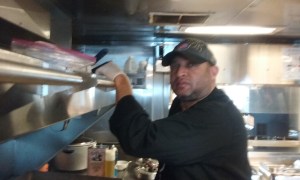
Chief cook Tyrone in the kitchen
Chief Cook Tyrone Baker, master of the grill

T: I cooked for the Navy for 20 years out of school. When I finished, I went to work for a casino for a while – still cooking. Then NOAA called me up (he had put in an application a while before and forgotten about it) and here I am! That was back in 2005.

K: I started out in the Coast Guard…I wanted to be a bosun [boatswain] mate, which is what everyone wants to do. But it was going to take a long time to make grade, and hardly anyone wants to be a cook because it’s a lot of work. I decided to go through their school, which was two months. That was when it started, in ’94. My first ship assignment was the Polar Star, which was an ice breaker.

Chief steward Kathy B and me
Kathy Brandts, Queen of the kitchen – also known as the Chief Steward. This is the day she let me cook a bit with her.

Kathy, why did you get out of the Coast Guard and what finally got you to NOAA?

K:  All of the land assignments were being contracted out to [private companies]. So I was never going to get a chance to cook on land. So I decided that wasn’t for me. I got out after my four and a half years. I landed in Seattle, and that’s where NOAA was based. I had heard about them when I was in the Coast Guard. I knew they were hiring, talked with somebody, and essentially got hired on the spot. And I was in Alaska! I started out in the augmentation pool, I worked on Discovery and then on Ranier. Then a permanent position came up and I jumped at it. I didn’t really get along with the Chief Steward, though – so I left NOAA and worked for Keystone Ski Resorts in Colorado at their stables. [She spent several years on land at that point.]

The Chief Steward on Ranier tracked me down [in Colorado] and asked me to come back. There was talk of Fairweather coming back online and I wanted the Chief Steward job. I didn’t have the experience at that point, so I took a year off and went to Culinary School. I applied for the Chief Steward job on Fairweather and got it. I was on Fairweather from 2004-2013. [She is now the Chief Steward on Ruben Lasker, another NOAA ship, but is helping out on this leg]

Why be a ship cook?

T: I’ve been so many places and seen so many things I wouldn’t have otherwise seen. I’ve really been all around the world. I’ve been in almost every port of the world. How many people can say that? I wouldn’t trade it.

K: I was a restaurant cook for a while. I hated it. You’re either going 9 million miles an hour or there’s nothing. There’s a lot of alcoholism and drug use in that industry and they live a different life. The service industry… (laughs). And people are either sailors or they’re not. I think, much to my chagrin, I found it out after I quit the Coast Guard.

T: Yes, I agree. I’m a sailor. It was why I joined the Navy.

What are the best and most rewarding things about what you do?

T: I just really like it. I enjoy the cooking. I enjoy the work.

K: I like good food and I like when people are appreciative of what I do. And we’re all stuck out here together, why not make it the best that it can be. Meal time is what you look forward to when you’re on a ship.

David GVA and me
GVA Dave – he just joined Fairweather and was actually helping out the stewards on this leg, but now he’s where he’s supposed to be in the deck department.

Crew member of the Day: Electronic Technician (ET) Charlie Goertzen 

Charlie and me
Charlie Goertzen, tech guy extraordinaire!

So today as we pulled into Kodiak, the news came in that the long awaited new televisions were here. Immediately, Charlie was notified. And he will work hours to make sure that each crew member has a working television in their room.

He is the guy that keeps the connectivity going in pretty difficult conditions. He has to spend a lot of time keeping various computer components talking to each other. He has to content with all of the complaints about lack of bandwidth, slowness of applications, slowness of wireless – and he does his best to keep things optimized and clean and efficient all the time. Two of the things he loves the most are the ocean and working with electronic components. He gets both of them all the time!