Barney Peterson: What Are We Catching? August 28, 2016

NOAA Teacher at Sea

Barney Peterson

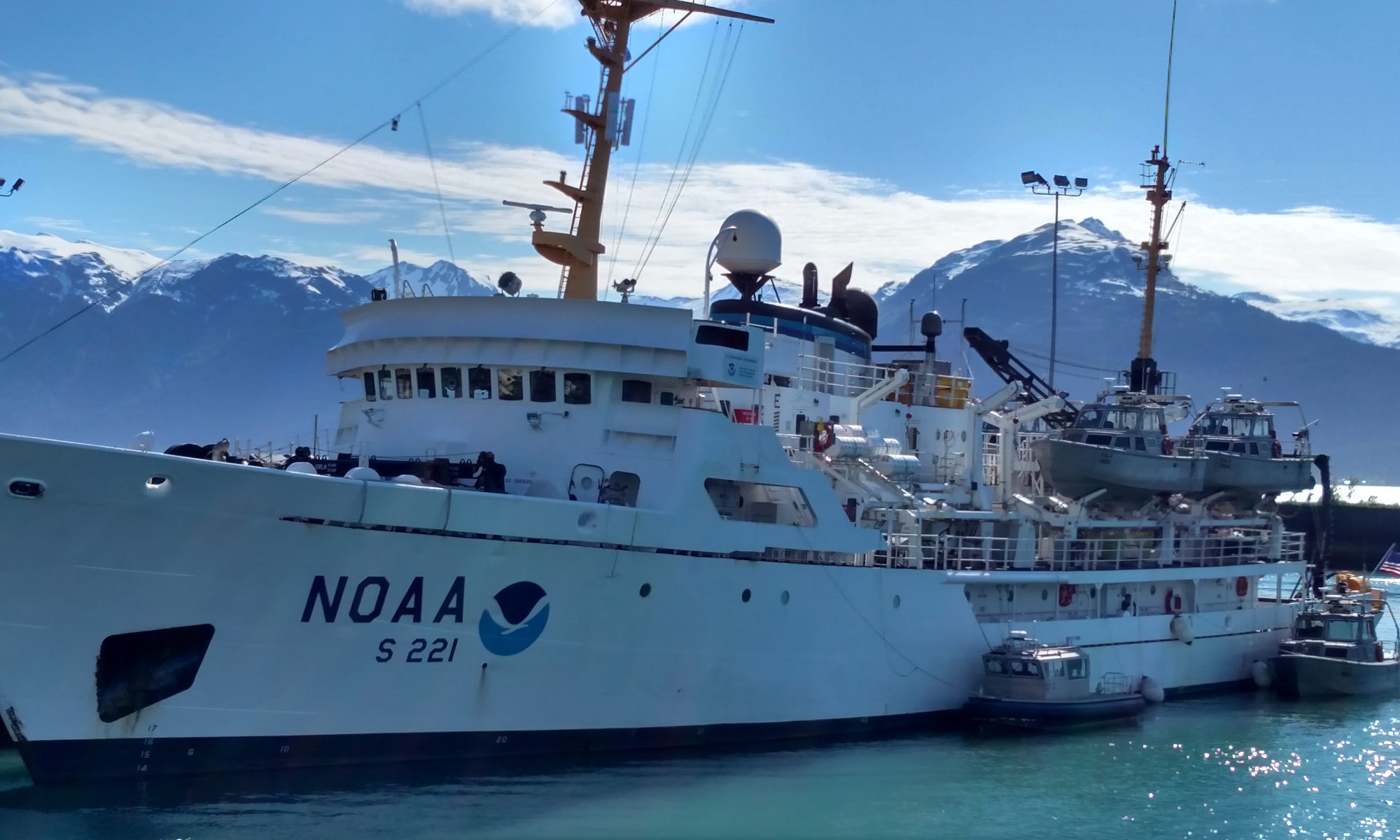
Aboard NOAA Ship Oregon II

August 13 – 28, 2016

Mission: Long Line Survey

Geographic Area: Gulf of Mexico

Date: Sunday, August 28, 2016

Weather Data is not available for this post because I am writing from the Biloxi/Gulfport Airport.

WHAT ARE WE CATCHING?

This is a long-line survey.  That means we go to an assigned GPS point, deploy hi-flyer buoys, add weights to hold the line down, add 100 baited hooks, leave it in place for an hour, and retrieve everything.

mackerel-bait-fish
Mackerel is used to bait the hooks.

As the equipment is pulled in we identify, measure and record everything we catch.  Sometimes, like in the case of a really large, feisty shark that struggles enough to straighten or break a hook or the lines, we try to identify and record the one that got away.  We tag each shark so that it can be identified if it is ever caught again.  We tally each hook as it is deployed and retrieved, and the computer records a GPS position for each retrieval so scientists can form a picture of how the catch was distributed along the section we were fishing.  The target catch for this particular survey was listed as sharks and red snapper.  The reality is that we caught a much wider variety of marine life.

We list our catch in two categories: Bony fish, and Sharks.  The major difference is in the skeletons.  Bony fish have just that: a skeleton made of hard bone like a salmon or halibut.  Sharks, on the other hand, have a cartilaginous skeleton, rigid fins, and 5 to 7 gill openings on each side.  Sharks have multiple rows of sharp teeth arranged around both upper and lower jaws.  Since they have no bones, those teeth are embedded in the gums and are easily dislodged.  This is not a problem because they are easily replaced as well.  There are other wonderful differences that separate sharks from bony fish.

Bony Fish we caught:

The most common of the bony fish that we caught were Red Groupers (Epinephelus morio), distinguished by of their brownish to red-orange color, large eyes and very large mouths.  Their dorsal fins, especially, have pointed spikes.

chrissy-with-enormous-grouper
Chrissy holding an enormous grouper

We also caught Black Sea Bass (Centropristus striata) which resemble the groupers in that they also have large mouths and prominent eyes.

sea-bass
Black Sea Bass

A third fish that resembles these two is the Speckled Hind (Epinephelus drummondhayi).  It has a broad body, large mouth and undershot jaw giving the face a different look.  Yes, we did catch several Red Snapper (Lutjanus campechanus), although not as many as I expected.  Snappers are a brighter color than the Red Groupers, and have a more triangular shaped head, large mouth and prominent canine teeth.

red-snapper
Red Snapper

The most exciting bony fish we caught was barracuda (Sphyraena barracuda).  We caught several of these and each time I was impressed with their sleek shape and very sharp teeth!

barracuda
TAS Barney Peterson with a barracuda

Most of the bony fish we caught were in fairly deep water.


Sharks:

We were fortunate to catch a variety of sharks ranging from fairly small to impressively big!

The most commonly caught were Sandbar Sharks (Carcharhinus plumbeus): large, dark-gray to brown on top and white on the bottom.

sandbar-shark
Sandbar Shark

Unless you really know your sharks, it is difficult for the amateur to distinguish between some of the various types.  Experts look at color, nose shape, fin shape and placement, and distinguishing characteristics like the hammer-shaped head of the Great Hammerhead (Sphyrna mokarran) and Scalloped Hammerhead (Sphyrna lewini) sharks that were caught on this trip.

great-hammerhead
Great Hammerhead Shark

The beautifully patterned coloring of the Tiger Shark (Galeocerdo cuvier) is fairly easy to recognize and so is the yellowish cast to the sides of the Lemon Shark (Negaprion brevirostris).

Other sharks we caught were Black-nose (Carcharhinus acrontus), Atlantic Sharp-nosed (Rhizoprionodon terraenovae), Nurse Shark (Ginglymostoma cirratum), Blacktip (Carcharhinus limbatus) and Bull Sharks (Carcharhinus leucus).

Several of the sharks we caught were large, very close to 3 meters long, very heavy and very strong!  Small sharks and bony fish were brought aboard on the hooks to be measured against a scaled board on the deck then weighed by holding them up on a spring scale before tagging and releasing them.  Any shark larger than about 1.5 meters was usually heavy and strong enough that it was guided into a net cradle that was lifted by crane to deck level where it could be measured, weighed and tagged with the least possibility of harm to either the shark or the crew members.  Large powerful sharks do not feel the force of gravity when in the water, but once out of it, the power of their weight works against them so getting them back into the water quickly is important.  Large powerful sharks are also pretty upset about being caught and use their strength to thrash around trying to escape.  The power in a swat from a shark tail or the abrasion from their rough skin can be painful and unpleasant for those handling them.

PERSONAL LOG

The Night Sky

I am standing alone on the well deck; my head is buzzing with the melodies of the Eagles and England Dan.  A warm breeze brushes over me as I tune out the hum of the ship’s engines and focus on the rhythm of the bow waves rushing past below me.  It is dark! Dark enough and clear enough that I can see stars above me from horizon to horizon: the soft cloudy glow of the Milky Way, the distinctive patterns of familiar favorites like the Big Dipper and the Little Dipper with its signature bright point, the North Star.  Cassiopeia appears as a huge “W” and even the tiny cluster of the “Seven Sisters” is distinct in the black bowl of the night sky over the Gulf of Mexico.  The longer I look the more stars I see.

This is one of the first really cloudless nights of this cruise so far.  Mike Conway, a member of the deck crew came looking for me to be sure I didn’t miss out on an opportunity to witness this amazingly beautiful show.  As I first exited the dry lab and stumbled toward the bow all I could pick out were three faint stars in the bowl of the Big Dipper.  The longer I looked, the more my eyes grew accustomed to the dark, and the more spectacular the show became.  Soon there were too many stars for me to pick out any but the most familiar constellations.

As a child I spent many summer nighttime hours on a blanket in our yard as my father patiently guided my eyes toward constellation after constellation, telling me the myths that explained each one. Many years have passed since then.  I have gotten busy seeing other sights and hearing other stories.  I had not thought about those long ago summer nights for many years.  Tonight, looking up in wonder, I felt very close to Pop again and to those great times we shared.


Barney Peterson:Welcome to OREGON II, August 14, 2016

NOAA Teacher at Sea
Barney Peterson

Aboard NOAA Ship OREGON II
August 13 – 28, 2016


Mission: Shark/Red Snapper Longline Survey

Geographic Area of Cruise: Gulf of Mexico

Date: August 14, 2016

Weather Data from the Bridge:

Latitude: 25 23.297 N

Longitude: 083 40 .794 W

Air temperature: 87.6 F

Pressure: 1017.04 Mb

Sea Surface Temperature: 30.6 C

Wind Speed: 16.6 Kt    East 86.74 degrees

Science Log:

We will set clocks tonight SHIP WIDE.  At 0100 it will become 0000.  Please plan accordingly.

What this translates to is that when we moved into the Gulf of Mexico we went to the Central Time Zone.  That means only a 2-hour difference between the ship and my home in the Pacific Northwest.  That also means I, who am on the noon-to-midnight shift, got one more hour to sleep (or whatever) Sunday night.

I am busy learning about schedules on the ship. The science group is split into 2 shifts.  We work days: noon to midnight; or nights: midnight to noon.  These hours rule our lives. Meals are served at 0630, 1100, and 1700.  You eat your first meal before you go on shift and your last at shift’s end.  During the 12 hours you are off shift your stateroom is yours and your roommate is expected to stay away and let you sleep.  The opposite is true for your time on: take everything you may need with you when you leave.  Showers, laundry and personal business are fit into your 12 hours off.  Shipboard courtesy requires that we keep voices low in the passageways and be careful not to let doors slam.  Somebody is always trying to sleep.  There is always a quiet spot somewhere to relax for a moment if you get the time: on the flying bridge, at the table on the stern, in the lounge or at a galley table.

Sunday, at 1230 hours, we had safety drills, required for all personnel within 24 hours of departure and once a week thereafter on every cruise.  Reporting stations for 3 different types of drills are posted in staterooms and throughout the ship.  Nobody is exempt from participation.

The signal sounds: a 10 second ringing of the bell: FIRE!  The PA announces a drill: “All hands report to assigned stations.”  Members of the science team quickly make their way to the stern.  By the galley stands a crew member with a sign reading: Fire ahead – detour.  After we arrive at our station, get checked off and, when all crew have been accounted for, return to our staterooms.

Next – 7 short and one long ring on the bell: ABANDON SHIP!  Announcement: “Drill.  All hands report to the bow with PFD’s and survival suits.”  We grab our life jackets and “Gumby suits” and head to the bow where we are checked off as we arrive.  We are required to don our “Gumbies” in 2 minutes or less – not impossible, but not simple either.  I’ve done it before.  The hardest part is getting the hood on and zipping up with your hands jammed into the lobster-claw gloves and your shoes and hat crammed into the suit with you…that’s when you discover just how much too long the arms and legs are.  It isn’t pretty, but if we actually end up in the water, those neoprene suits will be our best protection against the deadly, energy-sapping effects of hypothermia!

Just after we have stripped out of the “Gumby” suits, rolled them up and stowed them and our life jackets back in staterooms, we get the next signal.

3 long bells: “MAN OVERBOARD!” This drill is important too, but feels almost like an anti-climax.  It could mean the difference between life and death to a fellow crew member who falls into the water when the ship is moving.  Science team reports again to the stern and, in a real emergency, would receive instructions for participating in spotting or assisting in a rescue.  This time we stay and listen to a safety talk about our work with long lines, hooks, bait, and our possible catch which could include all kinds of fish and sharks.  There are very definite rules and procedures to ensure crew are safe and our catch is handled with care and respect.  If all goes well…our first lines will be set Monday night!

Personal Log:

Sitting on the flying bridge about 1900 Sunday evening, 3 of us spotted a small boat about ½ mile away that seemed to be drifting aimlessly.  There were two enormous cruise ships coming up behind us and they went around it on either side after cutting their engines to reduce their wake.  A crew member from the bridge watched from our deck as somebody on the boat fired a flare.  We were informed that radio contact was established: the boat was adrift, out of fuel, and we would stand by until the Coast Guard arrived. The OREGON II cut speed and circled back to stay closer to the small boat.  One of the cruise ships was also standing by while the other went on its way.  After about 20 minutes the white and red Coast Guard ship appeared and, when it reached the small boat, we were released to go on our way.

Seeing this response to another vessel in need of help put emphasis upon the importance of participating fully in our drills and understanding the measures in place to keep us safe and aid other ships sharing this big ocean.

Did You Know?  What is the largest shark found in the Gulf of Mexico?

going aboard
Teacher at Sea Barney Peterson about to board NOAA ship OREGON II

Jeff Miller: Getting Ready to Sail, August 19, 2015

NOAA Teacher at Sea
Jeff Miller
(Almost) Aboard NOAA Ship Oregon II
August 31 – September 14, 2015

Mission: Shark Longline Survey
Geographical Area: Gulf of Mexico
Date: August 19, 2015

Personal Log

Hello from Phoenix, Arizona.  My name is Jeff Miller and I teach biology at Estrella Mountain Community College (EMCC) in Avondale, AZ.  EMCC is one of ten community colleges in the Maricopa Community College District, which is one of the largest college districts in the United States, serving more than 128,000 students each year.  I have been teaching at EMCC for eight years.  I currently teach two sections of a general biology course for non-majors (that is students who are majoring in subjects other than biology) and one section of a human anatomy and physiology course primarily taken by students entering healthcare-related fields.

Jeff Miller
A photo of me at Tuolomne Meadow in Yosemite National Park

EMCC is an outstanding place to teach because of all the truly wonderful students.  EMCC serves a diverse set of students from recent high school graduates to adults seeking a new career. EMCC students are also ethnically diverse. Thus, students bring a wide range of knowledge, ideas, and talents to our classrooms. Despite this diversity, one thing most students lack is real world experiences with marine organisms and environments. We are, after all, located in the heart of the Sonoran Desert.  Arizona does, however, possess many unique and amazing environments and when I’m not in the classroom, hiking and exploring nature with my family is one of my favorite things to do.

Cathedral Rock
Cathedral Rock in Sedona, AZ
Great Horned Owl
A Great Horned Owl perches on a log in the desert near Tucson, AZ
Saguaro
A saguaro cactus in the Sonoran desert near Tucson, AZ
White Mountains
Arizona is home to the largest unbroken Ponderosa Pine forest in the world. My wife (Weiru), daughter (Julia), and dog (Maya) in the White Mountains of Arizona

I applied to the Teacher at Sea program to deepen my knowledge of marine systems as part of my sabbatical.  A sabbatical is a period of time granted to teachers to study, travel, acquire new skills, and/or fulfill a personal dream. I have always loved the ocean and even worked with sea urchin embryos in graduate school.  However, my knowledge and experience of marine organisms and ecosystems is  limited.  Therefore, participation in the Teacher at Sea program will give me the opportunity to learn how marine biologists and oceanographers collect and analyze data and how their investigations can inform us about human impacts on marine ecosystems. I plan to use the knowledge and experiences I gain to develop curriculum materials for a marine biology course at EMCC that to helps my students gain fundamental knowledge of and appreciation for our world’s oceans. I hope to foster greater curiosity and excitement about marine science and the scientists who explore our oceans and help students see why it is so important to protect and conserve the oceans resources for future generations.

To help fulfill my dream of learning more about the oceans, I have the opportunity of a lifetime – to sail on the NOAA Ship Oregon II.  I will be working with the crew and scientists aboard the Oregon II to perform part of an annual longline shark survey.  The goal of the mission is to gather data about shark populations in the Gulf of Mexico and along the Atlantic coast.  Some of the data collected includes length, weight, and sex of each individual, collection of tissues samples for DNA analysis, and collection of environmental data.  Please visit the main mission page or the Oregon II Facebook page for more detailed information and images, videos, and stories from recent cruises.  Also check out a recent article from the Washington Post featuring Kristin Hannan, a fisheries biologist for the National Marine Fisheries Services describing the shark research being conducted aboard the Oregon II.

Longline Shark Survey Map
Map showing the region of the Gulf of Mexico where I will participate in the longline shark survey aboard the NOAA Ship Oregon II

Needless to say, I am extremely excited, though a bit nervous, about my upcoming cruise.  I have little experience sailing on the open ocean and have never been up close to a shark let alone actually handled one in person.  All that will change soon and I know that I will treasure the knowledge and experiences I gain aboard the Oregon II.  I am currently packing up my gear and preparing myself for the experience of a lifetime.

The next time you hear from me I will be in the Gulf of Mexico on my mission to learn more about sharks.

Kathleen Gibson, Wild Weather, August 2, 2015

NOAA Teacher at Sea
Kathleen Gibson
Aboard NOAA Ship Oregon II
July 25 – August 8, 2015

Photo taken from the highest point on the ship.
A Nurse Shark in the cradle
Photo taken from the highest point on the ship.

Mission: Shark Longline Survey
Geographic Area of the Cruise: Atlantic Ocean off the Florida and Carolina Coast
Date: Aug 2, 2015

Coordinates:
LAT   3428.300 N
LONG  07705.870 W 

Weather Data from the Bridge:
Wind speed (knots): 11.2
Sea Temp (deg C): 29.1
Air Temp (deg C):  25.7

Science and Technology Log: Shark Reproductive Strategies

Rough Seas and bad weather have delayed our sampling.  I’m getting use to walking sideways.

Bringing in gangions in the rain.

Today we reached the northernmost sampling station of our cruise, just off the North Carolina coast. The latest stations have been further off shore than those previous and we’ve caught fewer sharks. However, the sharks we have caught have been much larger. Our catch included Sandbar Sharks, Scalloped Hammerhead, Spinner, Nurse and Black Nose.

Sharks have a number of reproductive strategies ranging from egg laying to placental formation. Oviparous sharks produce and release egg cases made of a collagen (protein). The case surrounds the developing embryo and a large yolk with the vital nutrients required for shark development. This is called lecithotrophic (all nutrients from yolk). Oviparous sharks can take to 2 years to develop within the egg case.

Cat shark adult (Image courtesy of Ian Davenport)
Adult cat shark
(Image courtesy of Ian Davenport)
Cat Shark egg case. Photo Courtesy of Ian Davenport
Cat shark egg case. Photo Courtesy of Ian Davenport

Sharks that give birth to live young are considered Viviparous. Within this category there are two major types. Those that produce eggs with large yolks with all required nutrients, but remain in the uterus for gestation, are called yolk-sac vivipores (ovoviviparous, or aplacental viviparity). In some cases, offspring will consume other eggs (oophagy) in the uterus to gain additional nutrients. An advantage to this type of reproduction is that the young sharks are larger when they are born and have a higher survival rate.

Yolk-sac embryos (Image courtesy of Ian Davenport, Ph.D.)
Yolk-sac embryos (Image courtesy of Ian Davenport, Ph.D.) 

The last group, considered to be the most advanced, is the Placental Group. As with the other types, a yolk is produced that can initially provide some nutrients to the developing pup. However, in the uterus the yolk sac after it is depleted is modified into a placenta through which nutrients can pass from parent to offspring. While fewer offspring are produced at one time, they are typically more robust and have a higher survival rate. Most of the sharks we have caught on this cruise are placental vivipores.    

Placental Shark (Image courtesy of Ian Davenport)
Placental Shark
(Image courtesy of Ian Davenport)

Career Spotlight: Dr. Ian Davenport, Ph.D., Research Scientist

Dr. Ian Davenport, Ph.D., is a Developmental Biologist at Xavier University, New Orleans, and has been a volunteer on this cruise for 7 years.

Dr. Ian Davenport dissecting a female Sharpnose shark.

Ian hails from Manchester, England, and his path to becoming a scientist was quite unusual. Similar to others on board, he always had an interest in Marine Science, and sharks in particular, but school was not a priority early on. He spent time travelling and learned a trade as well. He finally decided to return to school, but being accepted was a challenge. Fortunately Ian’s academic ability was recognized and he was accepted to the University of Newcastle upon Tyne where he studied Marine Biology, but a course in Developmental Biology particularly resonated. He went on to earn his Ph.D. in shark developmental biology at Clemson University.

Ian’s research focus is in evolution of “live bearing.”  As noted above, shark species employ a number of reproductive strategies. Placentals are considered to be the most advanced. Ian is studying the eggs of placental sharks and the structure of the cells that surround the egg. His research has revealed some interesting cell features that may aid in nutrient delivery to the developing embryo. If a female shark is caught during the cruise and does not survive, Ian collects the eggs for later study.

Career Spotlight: Chuck Godwin, Deck Crew and Environmental Compliance officer

Chuck has a B.A. in History and has also studied Wildlife Management. Chuck spent 10 years in the Coast Guard and left in 2000, but he was recalled to active service on two occasions – after 9/11 and after Hurricane Katrina. In addition to his work as part of the deck crew, where he is involved in all deck operations, Chuck is also the Environmental Compliance Officer. As such, he manages hazardous waste compliance.

Chuck Godwin hauling in the Longline.

It’s apparent that Chuck enjoys his work. He is all business when he needs to be, but has a knack for adding a note of levity when appropriate. He keeps me laughing, even when the fish aren’t biting. Chuck notes that as a member of the Coast Guard, part of his job was to enforce U.S. fisheries laws. With NOAA he plays an important role in establishing those regulations and this makes the work that much more rewarding.

Personal Log

The weather has been poor since yesterday. Lightning caused a five-hour delay in setting the longline in the night; the ship traversed back and forth over the sampling area waiting for the worst of the storm to pass. Sleeping was a challenge – I think some of us were airborne a few times. Thank goodness for the patch and a few saltine crackers. I took the video below in my bunk as I was nodding off to sleep.

Today’s rough seas and high winds prevented us from using the cradle to bring sharks up to deck height. Ken’s dual laser device, mentioned in my last blog post, was put to good use to estimate the size of the large sharks before they were released.

I need to give shout out to the ship’s cook Walter Coghlan and the second cook O.C. (Otha) Hill. The food has been great and plentiful. ( Homemade Mac n’ Cheese – need I say more?)  Walter takes special care to set aside a plate for us if we are on duty during mealtime. The ice cream sandwiches are much appreciated too.

In the kitchen with Walter.

New species seen since last posting: Sharksucker (a type of Remora, Echeneis naucrates), Blacktip (Carcharhinus limbatus) 

Trying to get a Remora to stick to my arm. What a strange feeling. (Photo: Kristin Hannan)
Trying to get a Remora to stick to my arm. What a strange feeling. (Photo: Kristin Hanna
The view from the Bridge
The view from the bridge.


Still working on the hooks. (Photo: Ken Wilkinson)

Check out these interesting shark facts.

Kathleen Gibson, Sailing Away, July 27, 2015

NOAA Teacher at Sea
Kathleen Gibson
Aboard NOAA Ship Oregon II
July 25 – August 8, 2015

Mission: Shark/Red Snapper Longline Survey
Geographic Area of the Cruise: Atlantic Ocean off the Florida and Carolina Coasts
Date: July 27, 2015
Coordinates:  25o   30.755 N
                       O79o   55.736W

Weather Data from the Bridge:
Wind speed (knots): 9
Sea Temp (deg C): 31.3
Air Temp (deg C):  31.2

View from the Bow - Gulf of Mexico
View from the bow – Gulf of Mexico

Just before we left Pascagoula last Saturday, we learned that the V-Sat system was not operational and that in all likelihood we wouldn’t have internet access during the trip.  So far this prediction has been accurate.  I’ll continue to write these blogs as we go and post them all after we get to port if it doesn’t get fixed.

In my first post I wrote a bit about the area we would be surveying. I’ve since learned that during this cruise we will only be working in the Atlantic Ocean. Another change is that our final destination will be Cape Canaveral, FL rather than Jacksonville, FL.

Motoring through the Florida Keys

Since we aren’t doing any fishing in the Gulf, we are currently following a straight track from Pascagoula to the Florida Keys. We’ve been sailing for two days and are currently off the coast of Key Biscayne, FL.  There has been one rain event that went by quickly, and otherwise it has been fair weather. While land isn’t visible, there are a good number of recreational motorboats, so land must not be too far off.


Science and Technology

This cruise is the first of four legs of a long-term (longitudinal) study of the distribution and abundance of shark and red snapper populations. The study began in 1995 and the research area includes U.S. waters of the Atlantic Ocean and Gulf of Mexico. The Atlantic Ocean sampling stations on this first leg are positioned at various distances offshore from Miami, FL to Cape Hatteras, NC and at different depths. Later legs will complete the survey in the Gulf of Mexico.  While this type of study can be resource and labor intensive and also time consuming, a well-designed longitudinal study can provide valuable data that tracks trends and patterns over an extended period of time. As with any investigation, numerous potential variables must be controlled, including time of year sampling occurs, sampling equipment (line and hooks) and sampling locations.

We’ve prepared three barrels of gangions (50 hooks in each). When we start fishing we will bait the hooks with mackerel and hook them on the long line.

Kristin Hannan ( left) and science volunteers preparing gangions. These will be baited and attached to the main line.
Kristin Hannan ( left) and science volunteers preparing gangions.
These will be baited and attached to the main line.
The circular hooks are designed to minimize harm.

NOAA Careers

A successful cruise requires a significant amount of preparation as well as committed participants. Those aboard include NOAA scientists, NOAA Corps Officers, an experienced deck crew, engineers, stewards, and science team volunteers. From the moment I arrived on board it has been apparent that everyone is fully invested in this project.  They’ve been willing to share their stories of how they made their way on to this cruise of the Oregon II;  I’ll share some of their stories with you in this and future blog entries.

Career Spotlight: Kristin Hannan – Field Party Chief, NOAA Shark Unit

As Field Party Chief, Kristin is responsible for all of the scientific work done during the cruise.  She is also the watch leader for the day shift.  While Kristin was fascinated with marine science at an early age, she followed some sage academic advice for her undergraduate program: “focus on being a scientist first, include rigorous coursework, and then do marine work.”  She graduated from Virginia Tech with a degree in Biology and a minor in Chemistry and she remains a loyal Hokie fan.

Kristin Hannan taking measurements

She has been involved in a number of challenging marine-related projects all around the United States and has been open to unusual opportunities when they arose. One such opportunity, over 10 years ago,  was to be a volunteer with NOAA Fisheries in Pascagoula, MS.  She joined the Shark Longline cruise as a volunteer one summer, and returned in subsequent summers to participate. Kristin eventually joined NOAA permanently as a Field Biologist with the Shark Unit, and is now the Chief Scientist/Field Party Chief for this cruise–the very same one she volunteered for some years ago.

In addition to her work with NOAA, Kristin is pursuing a Master’s Degree from the University of South Alabama, where she is studying chimeras and methods used to determine their age.

Kristin’s advice to students looking to work in Marine Sciences –or any field- is to:

  1. Be open to unusual opportunities
  2. Try to make a good impression every day
  3. Work hard

Personal Log

Flying Fish Photo Credit: NOAA
Flying Fish
Photo Credit: NOAA

We’re still sailing to the sampling area, so there is plenty of free time to meet others on board, read and walk around the deck.  This will definitely change when sampling begins. Today I went out to the bow and saw flying fish for the first time and dolphins were swimming off the bow.

The science team is made up of 4 NOAA scientists and 7 volunteers with a variety of experience. Our volunteers include 2 university professors, one graduate student, three undergraduate students, and one Teacher at Sea!  The group is split into two 12-hour shifts.  I’m on the day shift which begins at noon each day and ends at midnight.  It’s likely that we will begin fishing tomorrow morning, and the night crew has begun adjusting their sleep pattern to be prepared.  I’m going to have to work at sleeping in.

Survival Suit - Perfect Fit  Photo Credit: Lecia Salerno
Survival Suit – Perfect Fit  Photo Credit: Lecia Salerno


The Executive Officer (XO) LT Lecia Salerno, has graciously allowed me to share her quarters, which includes her office. The cabin is on an upper level so I definitely get rocked to sleep.

A fire drill and abandon-ship drill were called on the first full day at sea.  Lecia helped me get into my survival suit and, more importantly, out of it as well.

Questions of the day for my students:

What additional variables do you think should be considered and kept constant in this study?

What is a nautical mile and how many nautical miles is it from Pascagoula, MS, to Miami, FL?

How do chimeras differ from sharks?

Tomorrow we fish!
Tomorrow we fish!

Up next… Time to Fish.