Denise Harrington: Polygon Planning, April 24, 2014

NOAA Teacher at Sea
Denise Harrington
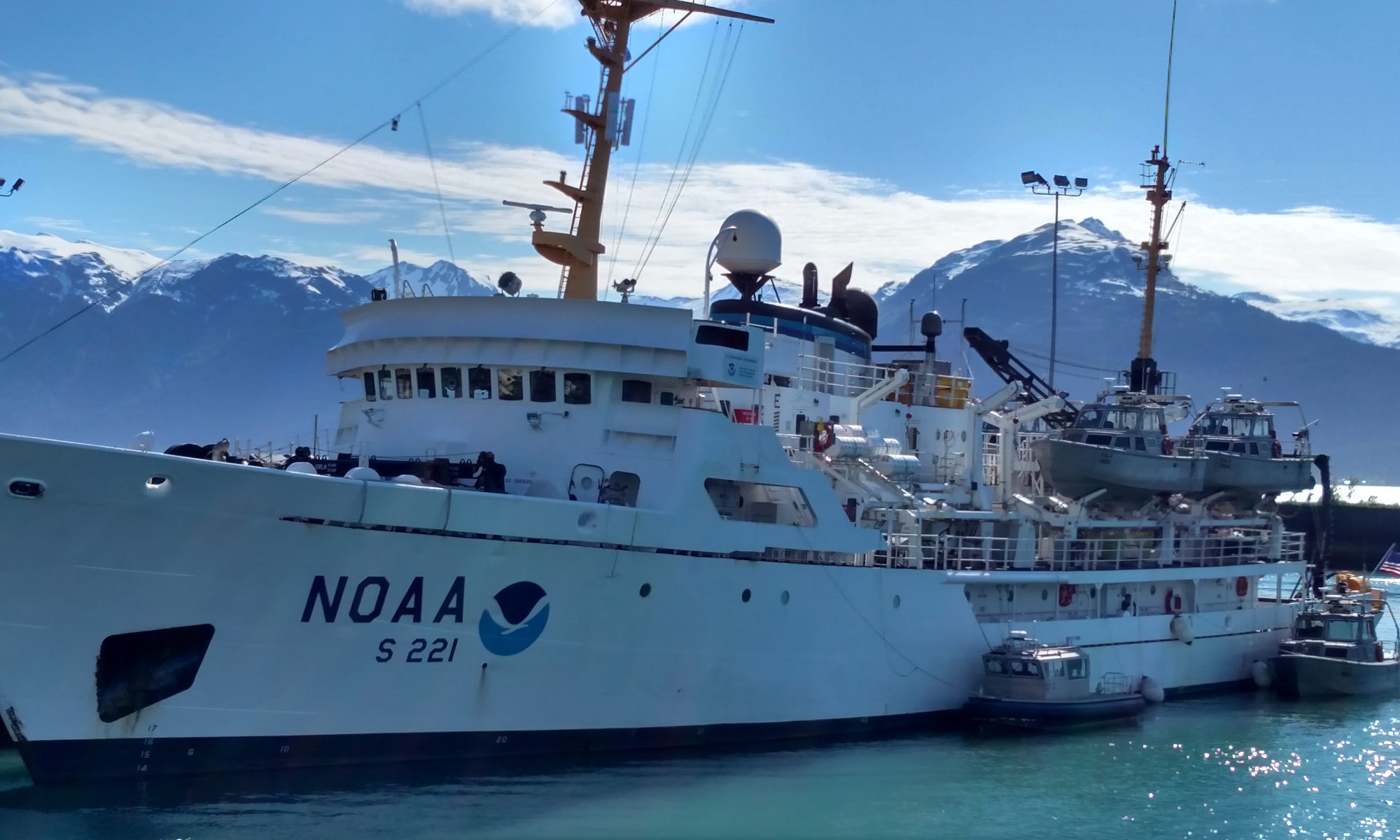
Aboard NOAA Ship Rainier
April 21 – May 2, 2014

Mission: Hydrographic Survey

Geographical Area of Cruise: North Coast Kodiak Island

Date:  April 24, 2014, 23:00

Location: 51 50.7’ N  127o 55.9’ W

Weather from the Bridge: 8.4C (dry bulb), Wind 9 knots @ 59o, overcast, light fog, 1-2′ swell.

Our current location and weather can also be seen at NOAA Shiptracker: http://shiptracker.noaa.gov/Home/Map

Science and Technology Log

Much like the the lab reports we do in class, hydrographers have a tremendous amount of work to do prior to going into the field.  As we make the transit from Rainier’s home port of Newport to our charting location of Kodiak Island, hydrographers are working long hours in the plotting room planning their season’s work. Today’s log is about a software program called CARIS that hydrographers use to plan their project and guide data collection through the season.  This morning, Ensign Micki Ream planned her season’s work in the Plot Room on CARIS.  This afternoon, she walked out the plot room door and onto the bridge where she navigated Rainier through the narrow Blackney Passage of the Inside Passage.   Prior to taking over the bridge, I watched as Ensign Ream as she plotted her project area for the season.  She has been assigned Cape Uganik, an area of North Kodiak Island in the vicinity of Raspberry Island.  The area was chosen to survey due to boat traffic and because the last survey completed was in 1908 by lead line.  Here you can see the original survey report and an image of how data was collect at that time (1908 Survey of Ensign Ream’s Survey Area). Ensign Micki Ream explained that the charts were called “sheets,” because originally, they were sheets of paper, sent out with the surveyor into the field.  While we still call them sheets, they are now in electronic form, just like the sheet below representing one of two project areas ENS Ream will most likely work on this summer.

Ensign Ream's task is to break this large polygon into smaller manageable parts.
Ensign Ream’s task is to break this large polygon into smaller manageable parts. Challenge:  print a copy of this map and come up with 30 smaller polygons to assign to your team to survey before you scroll down to see Ensign Ream’s plan.

Why make polygons instead of sending several launches out to your work area and tell them to start on opposite ends and meet in the middle? The polygons are a way for hydrographers to break a large amount of work into manageable tasks. Commander Rick Brennan, the Commanding Officer, explains “polygons are designed based upon the depth of the water, the time it will take to complete, and the oceanographic condition, particularly speed of sound through water.  Areas that are suspected to have a higher variability in sound speed will get smaller polygons to manage errors from sound speed.”

Also, imagine sending several launch boats out into a large area to work without telling them where to go. Polygons provide a plan for several boats to work safely in an area without running into each other.  It allows areas to be assigned to people based upon their skills.  The coxswains, boat drivers, with a lot of experience and skill, will take the near shore polygons, and the newer coxswains will take less hazardous, deeper water.

Another reason to break your sheet into polygons is to maintain team moral.  By breaking a large task into small assignments people feel a sense of accomplishment. As she divided her large polygon into 30 smaller polygons, Ensign Micki Ream kept in mind many variables. First, she considers the depth of the water.  The sonar produces a swath of data as the survey vessel proceeds along its course.  As the water gets deeper, the swath gets wider, so you can make a bigger polygon in deeper water. As she drew her polygons, she followed contour lines as much as possible while keeping lines straight.  The more like a quadrilateral a polygon is, the easier it is for a boat to cover the area, just like mowing a rectangular lawn. In her polygons, she cut out areas that are blue (shallow), rocky areas and kelp beds, because those areas are hazardous to boats.  While the hydrographer in charge and coxswain (boat driver), should use best practices and not survey these areas by boat, sometimes they rely on the polygon assignment.

Here is Ensign Ream's Proposal for how to complete this summer's work. How does it compare to your proposal?
Here is Ensign Ream’s Proposal for how to complete this summer’s work. How does it compare to your proposal?

Once she has drawn up her plan, Ensign Micki Ream roughly measures the average length and width of her polygons and puts that data into a Polygon Time Log form that a co-worker created on Rainier last season.  The form also takes into account the depth and gives an estimate of time it will take to complete the polygon.  This Time Log is just one of the many pieces of technology or equipment that crew invents to make their lives and jobs easier.

Polygon Time Logs estimate how long it will take to complete a sheet.

The fun part of this process is naming your polygons so that hydrographers in the field can report back to you their progress.  Traditional alphabetical and numerical labels are often used, but Ensign Micki Ream is naming some of her polygons after ’90s rock bands this year. Once the polygon is named, the sheet manager, Ensign Ream, develops a boat sheet for a hydrographer in charge (HIC):  this is their assignment for the day. Typically, they send out three to four people on a launch, including the HIC, coxswain and an extra hand. There are always new people aboard Rainier, so there are often other people in the launch being trained.  There are enough immersion suits for 4 people but ideally there are three people to help with launching the boat and completing the day’s work.  Communication between the HIC and coxswain is essential to get data for ocean depths in all areas of their polygon as they determine the direction to collect data in their work area.  Now, at least, the hydrographer and coxswain know where to start and stop, and are confident that their sheet manager has done her best to send them into a safe area to collect the data needed to make new charts.


Since Ensign Ream’s polygon plan is an estimate, the time to complete each polygon may be longer or shorter than estimated.  Variables such as the constantly changing depth of the ocean, weather, experience and equipment of the crew collecting data, and a myriad of other variables, known and unknown, make scheduling and completing surveys a constantly moving target.  There are two guarantees however:  flexibility is required to work on the crew and ultimately winter will force a pause to Rainier’s work.

Spotlight on a Scientist

Although I have been on Rainier for only several days, I am blown away by the incredible skills crew members acquire in short amounts of time.  Ensign Micki Ream is the perfect example:   In January, 2013, she joined the NOAA Corps which provides operational support for NOAA’s scientific missions.  During a six month officer training, she was trained in the basics of navigation. On June 2, 2013, she joined Rainier crew. In February, 2014 NOAA sent her to a one month Basic Hydrography School where she learned hydrography principles and how to use various software programs. Throughout her short time at NOAA, she has had significant and varied on the job training with scientific, managerial and navigational work.The rest of her skills are on the job training with an end goal of Officer of the Deck (similar to a mate in commercial sailing) and Hydrographer in Charge.

Here, Ensign Ream is modifying polygon names from 90's rock bands to the 12 Days of Christmas.  There is plenty of room for creativity here!
Here, Ensign Ream is modifying polygon names from 90’s rock bands to the 12 Days of Christmas. There is plenty of room for creativity!

Ensign Micki Ream does have a background in science which she is putting to use every day.  Originally from Seattle, she started her career with NOAA in June, 2009, after obtaining a Marine Biology degree at Stanford University.  Her first position was with the Office of National Marine Sanctuaries Program, which provided her with an internship and scholarship to acquire a Master’s Degree, also from Stanford, in Communicating Ocean Science. Just a little over one year after coming to NOAA Corps, she is a hydrographer in training and safely navigating a very impressive ship as part of a bridge team, including highly skilled navigational experts such as Ensign J.C. Clark and Commander Brennan.  Where else could you get training, experience and on the job support in so many diverse areas but with NOAA Hydro?

Ensign Ream consults with Lieutenant Russel Quintero, the Field Operations Officer, about the best way to navigate through a narrow passage during her upcoming bridge watch.

Personal Log

The food is absolutely amazing on board.  Tonight’s dinner options were roast prime beef, cut to order, au jus, creamy smoked salmon casserole, farro vegetable casserole, baked potatoes with fixings, asparagus and several different kinds of cake and fruit. In the evenings, snacks are also available.  My biggest challenge has been to pace myself with the the quantity of food I eat, particularly since taking long hikes after dinner is not an option. I feel very well cared for aboard Rainier. P1000587

This is the front door to the snack freezer.  For me, the answer is clearly "No."
This is the front door to the snack freezer. For me, the answer is clearly “No.”

Britta Culbertson: Hiding Out During Rough Seas, September 6, 2013

NOAA Teacher at Sea
Britta Culbertson
Aboard NOAA Ship Oscar Dyson
September 4-19, 2013

Mission: Juvenile Walley Pollock and Forage Fish Survey
Geographical Area of Cruise: Gulf of Alaska
Date: Friday, September 6th, 2013

Weather Data from the Bridge (for Sept 6th at 5:57 PM UTC):
Wind Speed: 42.65 knots
Air Temperature: 11.8 degrees C
Relative Humidity: 81%
Barometric Pressure: 987.4 mb
Latitude:57.67 N          Longitude: 153.87 W

Science and Technology Log

Weather Advsisory
The weather advisory for the Gulf of Alaska and around Kodiak Island (screen shot from NOAA Alaska Region Headquarters)
Spiridon Bay
Spiridon Bay (screenshot from Shiptracker.noaa.gov)

As you can see from my weather data section, the wind speed this morning was up to 42.65 knots.  We had waves near 18 feet and thus the Oscar Dyson ran for cover and tucked itself in an inlet on the North side of Kodiak Island called Spiridon Bay.  The Oscar Dyson’s location can be viewed in near real-time using NOAA’s Shiptracker website.   The screenshot above was taken from the Shiptracker website when we were hiding from the weather. The weather forecast from NOAA’s Alaska Region Headquarters shows that the winds should diminish over the next few days.  I’m thankful to hear that!

…GALE WARNING TONIGHT….TONIGHT…S WIND 45 KT DIMINISHING TO 35 KT TOWARDS MORNING. SEAS 23FT. PATCHY FOG..SAT…SW WIND 30 KT DIMINISHING TO 20 KT IN THE AFTERNOON. SEAS15 FT. PATCHY FOG..SAT NIGHT…W WIND 15 TO 25 KT. SEAS 8 FT. RAIN..SUN…SW WIND 20 KT. SEAS 8 FT..SUN NIGHT…S WIND 25 KT. SEAS 8 FT..MON…SE WIND 25 KT. SEAS 13 FT..TUE…S WIND 30 KT. SEAS 11 FT..WED…S WIND 25 KT. SEAS 9 FT.

Since the Dyson has been in safe harbor in Spiridon Bay for the last few hours, I have had some time to catch up on some blogging!  Let’s backtrack a few days to Wednesday, September 4th, when the Dyson left Kodiak to begin its journey in the Gulf of Alaska.  We headed out after 1PM to pick up where the last cruise left off in the research grid.  We reached our first station later in the afternoon and began work.  A station is a pre-determined location where we complete two of our surveys (see map below).  The circles on the map represent a station location in the survey grid.  The solid circles are from leg 1 of the cruise that took place in August and the hollow circles represent leg 2 of the cruise, which is the leg on which I am sailing.

The first step once we reach a station is to deploy a Bongo net to collect marine zooplankton and the second step is to begin trawling with an anchovy net to capture small, pelagic juvenile pollock and forage fishes that are part of the main study for this cruise. Pelagic fish live near the surface of the water or in the water column, but not near the bottom or close to the shore.  Zooplankton are “animal plankton”.  The generic definition of plankton is: small, floating or somewhat motile (able to move on their own) organisms that live in a body of water. Some zooplankton are the larval (beginning) stages of crabs, worms, or shellfish.  Other types of zooplankton stay in the planktonic stage for the entirety of their lives. In other words, they don’t “grow up” to become something like a shrimp or crab.

Station Map
Station map for leg 1 and leg 2 of the juvenile pollock survey. I am on leg 2 of the survey, which is represented with hollow circles on the map.

Before we reached the first station, we conducted a few safety drills.  The first was a fire drill and the second was an abandon ship drill.  The purpose of these drills is to make sure we understand where to go (muster) in case of an emergency.   For the abandon ship drill, we had to grab our survival suits and life preservers and muster on the back deck.  The life rafts are stored one deck above and would be lowered to the fantail (rear deck of the ship) in the event of an actual emergency.  After the drill I had to test out my survival suit to make sure I knew how to put it on correctly.

Life Jacket
Britta Mustering for Abandon Ship Drill on Oscar Dyson
survival suit
Britta models a survival suit – they even found a size SMALL for me!

On the way to our first station, we traveled through Whale Pass next to Whale Island, which lies off of the northern end of Kodiak Island.  While passing through this area, we saw a total of 4 whales spouting and so many sea otters, I lost track after I counted 20.  Unfortunately, none of my pictures really captured the moment.  The boat was moving too fast to get the sea otters before they flipped over or were out of sight.

Whale Island
A nautical chart map for Whale Island and Whale Passage

Personal Log

secure for sea!
Last night’s warning about high seas in the early morning of September 6th.

A lot of people have emailed to ask me if I have been getting seasick.  So far, things haven’t been that bad, but I figured out that I feel pretty fine when I’m working and moving about the ship.  However, when I sit and type at a computer and focus my attention on the screen that seems to be when the seasickness hits. For the most part, getting some fresh air and eating dried ginger has saved me from getting sick and fortunately, I knew about the threat of high winds last night, so I made sure to take some seasickness medication before going to bed.  After what we experienced this morning, I am sure glad I took some medication.

Everyone on board seems very friendly and always asks how I am doing.  It has been a real pleasure to meet the engineers, fisherman, NOAA Corps officers, scientists, and all others aboard the ship.  Since we have to work with the crew to get our research done, it’s wonderful to have a positive relationship with the various crew members.  Plus, I’m learning a lot about what kinds of careers one can have aboard a ship, in addition to being a scientist.

So far, I’ve worked two 12-hour shifts and even though I’m pretty tired after my long travel day and the adjustment from the Eastern Time Zone to the Alaskan Time Zone (a four hour difference), I’m having a great time!  I really enjoy getting my hands dirty (or fishy) and processing the fish that we bring in from the trawl net.  Processing the haul involves identifying, sorting, counting, measuring the length, and freezing some of the catch.  The catch is mainly composed of different types of fish like pollock and eulachon, but sometimes there are squid, shrimp, and jellyfish as well.

One of the hardest parts of the trip so far is getting used to starting work at noon and working until midnight.  We have predetermined lunch and dinner times, 11:30 AM and 5:00 PM respectively, so I basically eat lunch for breakfast and dinner for lunch and then I snack a little before I go to bed after my shift ends at midnight.  As the days go by, I’m sure I’ll get more used to the schedule.

Did You Know?

During one of our trawls, we found a lanternfish.  Lanternfish have rows of photophores along the length of their bodies.  Photophores produce bioluminescence and are used for signaling in deep, dark waters.  The fish can control the amount of light that the photophores produce.  Lanternfish belong to the Family Myctophidae and are “one of the most abundant and diverse of all oceanic fish families” (NOAA Ocean Explorer).

lanternfish
Lanternfish caught during a trawl. Note the dots along the bottom of the fish, these are photophores that emit bioluminescence.

Lanternfish
Photo of bioluminescing lanternfish (Photo Credit: BBC Animal Facts http://www.bbc.co.uk/nature/blueplanet/factfiles/fish/lanternfish_bg.shtml)


Avery Marvin: Brown bears, fish guts, WW2 bunkers and fossils, OH MY! Adventures in Kodiak, Alaska, August 6, 2013

NOAA Teacher at Sea
Avery Marvin
Aboard NOAA Ship Rainier
July 8 — 30, 2013 

Mission: Hydrographic Survey
Geographical Area of Cruise: Shumagin Islands, Alaska
Date: August 8, 2013

Current Location: 57° 47’ 35” N, 152° 23’ 39” W

Personal Log:

My Teacher at Sea experience ended on the island of Kodiak where the Rainier docked for a few days to stock up on supplies and give the crew a much-needed rest. They departed Kodiak 3 days later to begin the next 2-3 wk leg of their survey season. I had the good fortune of staying on the island for 4 days to explore its unique natural landscape and rich cultural history.

As I walked around downtown, perused the storefronts and enjoyed a latte at Harborside Coffee and Goods, one thing was very clear to me: this town is centered around fish, not tourists. Shelikolff drive is an entire street lined with fish processing plants. Trident Seafood, housed inside an old ship sprawls out on the other side of town.  The harbor itself is home to over 1000 fishing vessels, ranging from huge 125 foot crab boats to 18 foot set net skiffs.  Xtra Tuff fishing boots are the preferred footwear by all the locals and smelling of fish is a natural occurrence.

Kodiak fishing vessels
Crab pot parking spot!
Trident seafoods
Trident seafoods
Fish tackle
Fish tackle
Avery next to a recycled fish
Avery at the NOAA Kodiak Fisheries Research Center
Avery at the Alaska/NOAA Fisheries Research Center in Kodiak where a lot of important shellfish research is conducted.
Reindeer (Caribou) sausage sandwich
Reindeer (Caribou) sausage sandwich–The MOST delicious sauauge I have ever tasted!

When I was in the coffee shop, I noticed a young women in her late twenties with a toddler next to her, writing a letter to her husband who presumably was out at sea fishing. The letter had pictures of her son taped onto it and lots of hearts and colorful doodles–a gentle reminder that living in Kodiak is not for the faint-hearted. The life of a fisherman is physically demanding and maintaining relationships can be trying.

Kodiak has always been an industrious port and its people have always had a strong connection to the ocean.  The first people of Kodiak, the Aleut from Kamchatka, inhabited the island 10,000 years ago and lived off the nutrient-rich waters for 7,500 years.  They were true “nature engineers” using resources around them for fishing, clothing, dwellings and other needs. Nothing was wasted. Fishing with nets made of nettle fiber and sinew (tendon). Catching bottom dwellers with seaweed line and bone hooks. Using whalebone for door frames and sod for walls. Lighting the way with whale and seal oil lamps. Dressing in mammal skin and intestines.

I had the chance to see many original Aleut artifacts at the Baranov Museum in Kodiak. The most interesting piece was the Kayak splashguard made of mammal skin, the predecessor of the modern nylon kayak skirt used today. The translucent thin waterproof jackets made of mammal intestines also fascinated me. They looked very delicate but were actually strong and flexible when wet. Suspended from the museum ceiling, was an actual seal skin kayak or Bairdarka used by the Aleuts.  They wrapped seal skin around a wood frame, tied the seams with sinew and then added a layer of seal oil for waterproofing. Aleut craftsmanship at its finest!

Avery in front of the Baranov Museum
Avery in front of the Baranov Museum (I am waving in the back right.)
Bairdarka splashguard
Baidarka splashguard made of mammal skin
Aleut waterproof jacket made of mammal intestine
Aleut kayak or Bairdarka
Aleut kayak or Baidarka

The Aleuts clearly adapted well to their island home, making use of all that surrounded them but never exploiting these resources. Sadly in 1784, this peaceful existence was abruptly terminated by the Russians who, armed with muskets and cannons, took the island by force.  Having already decimated both the sea otter and native Aleut population around the Aleutian islands, the Russians under the command of Grigory Ivanovich Shelikhov established a permanent settlement in Three Saints Bay on Kodiak to capitalize on the remaining otter population in North Pacific waters.  Following the success of the fur trade industry on Kodiak, the Russians expanded their colonization on the Alaska mainland, establishing several subsequent fur trade centers.

Russian conquest was bittersweet. They brought with them diseases and modern necessities such as flour, tea, tobacco and sugar. They built several structures for their needs including fur warehouses, a school, a hospital, a stone quay, a saw mill and an ice making plant. They forced the Aleuts to be their skilled craftsmen and otter hunters. Between old world diseases, murder and abuse, many Aleuts lost their lives and those left standing witnessed the slow demise of their ancient seafarer culture.

The 126-year Russian occupation of Alaska finally came to an end when tired and poor from the Crimean war with France and England, they sold the territory to the U.S. for 7.2 million (2 cents per acre) in 1867.  With high-powered firearms, the Americans continued to slaughter the otters at an unsustainable rate. Teetering on the brink of extinction, an international treaty banning the killing of otters was signed in 1911. Post otter years, Americans tried their hand at other industries including trapping, whaling, clamming, cattle ranching, fox farming and gold mining.  Salmon fishing though proved to be the most reliable and profitable natural resource so the U.S. quickly established several salmon processing plants around Kodiak. Wooden dories replaced Baidarkas and by the end of the 19th century, Kodiak had transitioned from a fur-trading hub to a fishing mecca.

Things progressed unchanged until World War II, when Kodiak seen as a strategic waypoint between Asia and the North American west coast, was transformed into a military town.  The population went from 400 to several thousand in a short time. A huge self-sufficient navel base was built along with new roads around the island. In preparation for a Japanese attack, several concrete bunkers and underground bomb shelters were constructed. With all of this new infrastructure came indoor plumbing and electricity to the island. When Pearl Harbor was bombed on December 7, 1941 followed by Dutch Harbor on June 3, a Japanese attack on Kodiak seemed imminent but surprisingly the emerald isle went untouched.

Avery in WW2 bunker
Avery in WWII bunker

Today Kodiak remains an important fishing port with a wide variety of crab and fish species (salmon, cod, halibut, Pollack) caught and processed.  Modern fishing equipment and boats have replaced older, more natural gear but many of the fishing methods are still the same. Similarly, the factories along Sheikolf Drive have become more automated, with less human hands along each assembly line. Also, the fish industry as a whole on Kodiak has become much more regulated.

Kodiak is a fascinating place to explore because you can see several remnants of its past interspersed around the island: concrete WWII bunkers at Fort Abercrombie, Russian Orthodox church in downtown, old WWII ship anchors lying around, a 200 year old fur warehouse (now the Baranov Museum). Unfortunately, many historical landmarks were destroyed in the 1964 Alaska earthquake. The tsunami that followed the earthquake wreaked more havoc, killing 106 Alaskans and a family of 4 camping at Beverly Beach State Park near Newport, Oregon.

Besides a rich cultural history, Kodiak Island is full of natural beauty and an assortment of cool creatures.  Rosalind and I got the chance to explore fossil beach on the south-eastern side of Kodiak where we collected many unique fossils. My top finds were a snail fossil and a shale rock with encased petrified wood.

Avery finds a cool fossil at Fossil beach
Rosalind at Fossil Beach

After Rosalind left, I was blessed by another Teacher at Sea, Katie Sard, who spent the day with me on a spontaneous adventure around the island. We did all sorts of fun things like tide pooling, checking out WWII bunkers at Fort Abercrombie and eating Greek food at sunset at Monashka bay.

TAS's Avery and Katie Sard :)
TAS’s Avery and Katie Sard 🙂
Fly fisherman in Kodiak Bay

One of the highlights of my entire Alaska trip, was the float plane trip I took to the Kenai Peninsula on the mainland to see Brown bears.  These are the 2nd largest bears in the world (next to Polar Bears), living off a rich diet of berries and salmon. I had never been in a float plane before and was impressed by how soft the landing and take off were. The aerial views were also incredible. I spotted 2 Humpback whales on the way over to the peninsula from Kodiak and on the way back another passenger spotted a pod of about 45 Orca whales! The pilot was just as excited as we were, and circled around this giant pod for about 10 minutes giving us all good views of their movement and sheer numbers. Incredible!

Avery in the cockpit with the pilot
Bear tour seaplane
Bear tour seaplane
Wading over to the beach

We landed about a football field away from the peninsula, and waded in hip deep water to the beach. The scenery was beautiful with snow-covered mountains as a backdrop and wild flowers and meandering streams in the foreground. This was perfect bear country! Within about 3 hours we saw the Brown bear Trifecta: Brown bear trying to catch salmon, Brown bear mother with 2 cubs and to cap it all off, Brown bears mating. All of these sightings were of different bears and within a stones throw away.  I was surprised at how okay the bears were with our close presence. As I learned from my guide, human safety is ensured by the ability to read nonverbal bear clues which can be very subtle. For example, if a bear turns its back to you, it is saying “Please leave me alone.” You also never make eye contact with a bear or walk directly towards it. You want the bear to feel like he/she has plenty of surrounding space and an escape route if need be.  Jo, our guide said that in the 20 years of leading bear tours, she has only had to get out her bear spray 3 times. And one of these times involved a naïve group of students eating Subway sandwiches in front of the bears!

Mama and cubs crossing the river
Mama and cubs
Mama and cubs
Cub staring contest
Cub staring contest
Brown bear in search of salmon
Brown bears mating
Brown bears mating

The last day of my Kodiak stay was spent touring several fish factories where I got to experience the real backbones of this city. At all 3 factories, it was Pink salmon processing time which meant the machines were in full swing, with humans at various checkpoints along each assembly line.  The machines did everything from decapitating each salmon to cleaning out its guts to skinning it. Each factory processed about 200,000 pounds of Pink salmon per day.  In peak season with several different fish species being processed at once, the factories can see around ¾ million pounds of fish processed per day! At one factory, I learned that the big money comes from making surimi (ground fish) which is used as imitation crab all over the world. The most common fish used in surumi is the Alaska Pollock which is very plentiful in Kodiak waters. I am glad to hear that imitation crab is actually fish and not some other protein filler.

Check out these videos to see the factory process in action. It’s fascinating!!!

Avery gets her hands fishy!
Avery at the fish factory
Frozen salmon
Frozen salmon
Frozen aisle at fish factory

As you saw from the above videos, the most hands on section of the whole process is in the production of roe (salmon eggs).  This is because the roe must be gently handled and graded (1-3 scale) in preparation to be sold to Japan. At $50 per pound, roe is a delicacy in Japan and often eaten raw over rice or in sushi. Also Pink and Chum salmon produce the most desirable roe called ikura or red caviar. This roe is about the size of a pea and is sold as individual pieces. In contrast, the smaller eggs of Coho and Sockeye salmon produce sujiko, which is roe still connected in the sac. Throughout each of my fish processing plant tours, I was curious to know HOW the roe was graded. To my surprise, none of the factory managers could tell me how and I unfortunately could not communicate with the highly skilled Japanese roe technicians.

So I looked it up and it turns out roe is graded using the following criteria: size (larger is better), salt content (lower is better), drip (zero is best), firmness (firm is better but not so firm the egg breaks), color (bright, red-orange outer color with a center the color and consistency of honey), luster (eggs should be shiny and slightly transparent).

It was fitting to end my Kodiak stay with some down and dirty fish factory tours as this is the lifeblood of the city (and Alaska) and a good representation of the Kodiak spirit. These factories operate 24/7 with workers on their feet for 12 hour shifts. From the Aleuts to now, the Kodiak people have always been a hardy bunch with an incredible work ethic, and the ability to adapt to one of the most challenging environments in the world. This is the ring of fire: weather and natural disasters are unpredictable.  So why do people stay?  It’s the sea.  Beautiful. Vast. Mysterious. Full of life. She calls them back day after day, year after year. Welcome to Kodiak life.

Fun Factoid: The infamous Kodiak brown bear, the sole species of bear on the island of Kodiak, is a sub-species of the Alaskan mainland Brown bear population. Hunters come from all around the world to hunt this sub-species, paying thousands of dollars per expedition.

Melissa George: Yakutat or Bust, July 24, 2013

NOAA Teacher at Sea
Melissa George
Aboard NOAA Ship Oscar Dyson
July 22, – August 9, 2013

Mission:  Pollock Survey
Geographical Area of Cruise:  Gulf of Alaska
Date:  Wednesday, July 24, 2013

Current Data From Today’s Cruise

Weather Data from the Bridge (6:00 am Alaska Daylight Time)
Sky Condition: Scattered Clouds
Temperature: 12º C
Wind Speed: 12 knots
Barometric Pressure:  1017.2 mb
Humidity: 93%

Sun and Moon Data
Sunrise:  5:40 am
Sunset: 10:38 pm

Moonrise:  10:36 pm (July 23, 2013)
Moonset:  9:11 am

Sunrise on July 24, 2013

Geographic Coordinates  (6:00 am Alaska Daylight Time)
Latitude: 58º 30.5’ N   Longitude:  150º 53.9’ W

The ship’s position now can be found by clicking:

Oscar Dyson’s Geographical Position

Science and Technology Log

This blog is titled Yakutat or Bust because there is a great deal of hope to complete the survey around Yakutat, Alaska in the southeast.  On the map below, the green mark is our position in the water near Kodiak Island (the survey actually began a bit west near the islands of Four Mountains) and the red is our final destination of Yakutat Bay.  (Photo courtesy of GoogleEarth)

Gulf of Alaska Map
Gulf of Alaska Map

http://www.msc.org/track-a-fishery/fisheries-in-the-program/certified/pacific/gulf-of-alaska-pollock

The purpose of this cruise is to survey the walleye pollock (Theragra chalcogramma) in the Gulf of Alaska. Pollock is a significant fishery in the United States as well as the world.  Pollock, a certified sustainable fishery, is processed into fish sticks, fish patties and imitation crab.  Last year, about 3 million tons of pollock were caught in the North Pacific.  The scientists on board will collect data to determine the pollock biomass and age structure.  These data are used with results from other independent surveys to establish the total allowable pollock catch.

Our First Pollock Catch

According to the Alaska Fisheries Science Center, typically pollock grow to about 50 cm and weigh about .75 kg.  They live in the water column and feed on small krill, zooplankton, and small fish as they grow.  As they age they will eat other pollocks.  Sexual maturity is reached around age 4.  Spawning and fertilization occurs in the water column in early spring.  The eggs stay in the water column and once hatched are part of the zooplankton until they are free swimming.

The general process used to catch the pollock involves multiple parts.  I will break down those steps in a series of blogs.  But basically, acoustics are used to locate fish in the water column.  Once the scientists have located the fish along the transect (transects are the paths that the ship will travel on so the scientists can collect data), the Oscar Dyson sets out a trawl equipped with a camera.  The trawl is brought in and data from the catch is documented.  And then the ship continues on.

Bringing in the Aleutian Wing Trawling (AWT) Net

Trawling is usually completed only during daylight hours.  Fortunately the sun does not set here in Alaska right now until after 10 pm.  When it is dark, work aboard the Oscar Dyson continues.  For example, one of the scientists is documenting the sea floor with a drop camera.  She is looking at life that is there as well as potential threats to the trawl nets for the bottom trawl surveys.

Preparing the Drop Camera

Questions to Think About:

  • How do scientists use acoustics to locate pollock?
  • How are the transects locations determined?
  • How are pollock and the rest of the catch processed?
  • What information is retrieved from the trawl camera and other types of sensors?
  • What is a bottom trawl and how is it different from a mid-water trawl?
  • What types of careers are available on the Oscar Dyson?

Personal Log: 

Before we left Kodiak Island on July 22, I was able to spend a day exploring alone and with some of the members of the science team while the crew prepared the ship.  The town of Kodiak is one of seven communities on the island and the central location for all commercial transportation on and off the island either by airplane or ferry boat.  

Flying into the Kodiak Airport

Kodiak is the ancestral land of the Sugpiaq, native Alaskans of the Alutiq Nation, who subsisted by hunting, fishing, farming, and gathering.  Russian explorers were the first outsiders to visit the island, and under Grigory Shelikof, established a settlement in 1792 that became the center of Russian fur trading.  Following the 1867 Alaska Purchase from Russia, the island and the rest of Alaska became the 49th of the United States in 1959.  Russian influence is still apparent on Kodiak:  the Shelikof Strait separates Kodiak Island from mainland Alaska and the Holy Resurrection Russian Orthodox Cathedral holds a full house on Sunday mornings.

Holy Resurrection Russian Orthodox Church

Flora and fauna are abundant in this beautiful location.  On a short hike, I was able to sample the delicate salmonberries; fear the beautiful, yet invasive and poisonous hogweed; and watch a gorgeous sunset.

Delicate Salmonberries
Invasive Hogweed
Invasive Hogweed
Sunset on Kodiak Island

Did You Know?

The background of scientists on the Oscar Dyson varies; however, most have a strong affinity for the ocean and spent a lot of time outdoors exploring nature and playing with various critters as children. Kirsten, for example, is a post-doctoral researcher funded by the National Research Council.  She has a BS degree in Marine Biology from Roger Williams University in Rhode Island as well as MS and PhD degrees in Oceanography and Coastal Sciences with a concentration in Fishery Science from Louisiana State University in Baton Rouge.  She came aboard the ship to develop a time series of krill distribution in the Gulf of Alaska and to relate that to other species of importance such as pollock.

Kirsten's Krill Collection
Kirsten’s Krill Collection

Something to Think About: 

STEM (Science, Technology, Engineering, and Math) are not the only important subjects to know to work on the Oscar Dyson.  All three crews on the ship (NOAA Corp, Deck/Fishery Crew, and Scientists) use writing every day. Below are pictures of two log books: one records Weather Data by the NOAA Corp and the other Scientists’ notes.

NOAA Corp Weather Log
Scientists' Trawling Log
Scientists’ Trawling Log

Fun Fact:

Alaska’s official flag is based on a design by Benny Benson, a thirteen year old boy.  It was submitted in a territory-wide contest for schoolchildren sponsored by the American Legion in 1926.  Benny Benson chose the background color of the flag to represent both the blue sky and the forget-me-not. The Alaska legislature later named the forget-me-not as Alaska’s official state flower.  The flag inspired the state song, the lyrics of which are seen in the picture below.  Marie Drake wrote the lyrics, and Elinor Dusenbury composed the song.

A Popular Hang Out on Board

Melissa George: Contemplating Kodiak, July 20, 2013

NOAA Teacher at Sea
Melissa George
Aboard NOAA Ship Oscar Dyson
July 22–August 9, 2013

Mission:  Alaska Pollock Survey
Geographical Area of Cruise:  Gulf of Alaska
Date:  July 20, 2013

Introductory Blog

Greetings from Lafayette, Indiana, where I recently moved back after spending two years in Washington, D.C. as an Albert Einstein Distinguished Educator Fellow at the National Science Foundation in the Division of Environmental Biology.  In my recent position, I learned of many of the interesting research projects that ecosystem ecologists, population and community ecologists, systematic biologists, and evolutionary biologists are working on in various parts of the world. Beginning this fall, I will be returning to the Lafayette School Corporation to teach Biology and Zoology at Jefferson High School in Lafayette, Indiana.  I am excited to integrate aspects of the research I have learned about into my classroom.

Enhancing my understanding will be the authentic research experience in the  Gulf of Alaska as a  NOAA Teacher at Sea.  I will fly to Kodiak Island and board NOAA Ship Oscar Dyson, a support platform to study and monitor various aspects of the ocean:  environmental conditions,  habitat assessments, and marine mammal, fish, and bird populations.

Map of Kodiak Island

This particular mission will be surveying the population of a species of fish called Alaskan pollock or scientifically speaking, Theragra chalcogramma.   These fish belong to the cod family and are one of the United States’ most valuable fisheries; they are typically sold as fish sticks, fish patties, or imitation crab, scallops, or shrimp.  Pollock populations vary from year to year, thus fish surveys, help to enact management practices as well as monitor the effects of climate change.

Ways to Identify the Alaskan Pollock

This adventure is exciting to me for several reasons.  First, growing up on the Pacific Coast in Santa Cruz, California I fell in love with the ocean at a young age.  I realize the importance of respecting the ocean and the ecosystems within it and around it.  Having spent the second half of my life in the Midwest, I have missed its calming effect as well as the wealth of ecological wonders it holds.  I escape to the ocean whenever I have the chance.  Below is a picture of me resting on the beach at Halawa Bay on the east end of Molokai, one of the Hawaiian Islands.

On Beach at Halawa Falls

Second,  I hope to incorporate what I learn about how ocean scientists monitor various animal populations  into my high school classes.  There are so many aspects to this endeavor, I think my students will be excited to learn about many, if not all, of them.

Fun Fact:

I have four traveling companions.  They are in the photo below.  One of them will be accompanying me on the Teacher at Sea mission.  See if you can find pictures of this traveling companion in future posts and please comment when you do!

My Four Traveling Companions:  Manny, Molly, Mini Me, and Bust of Einstein
My Four Traveling Companions: Manny, Molly, Mini Me, and Bust of Einstein