Mission: Fisheries: Pacific Hake Survey (More info here)
Geographic Region: Pacific Ocean, off the coast of California
Date: July 3, 2023
Introduction and Background
Hello! My name is Lisa Carlson and I am an elementary school teacher in Virginia Beach, Virginia. I have taught third, fourth, and fifth grade general education with Special Education and English as a Second Language (ESL) inclusion. This coming fall I will be a second grade teacher, continuing with ESL inclusion! Although I was surprised to move down from fourth grade, I try to maintain the belief that everything happens for a reason, and the only constant in life is change.
For example, if I not missed out on previous opportunities to join NOAA as a Teacher at Sea due to the pandemic, a short career change, and other extenuating circumstances; I wouldn’t be writing this blog from a hotel room in San Francisco, California, anticipating boarding and seeing July 4th fireworks from the deck tomorrow.
– – ⚓ – –
My introduction to NOAA’s Teacher at Sea program began in the fall of 2017. After student teaching in the fall/winter of 2016 in a third grade class, and permanent subbing in a fifth grade in the winter/spring of 2017, I accepted a position for my own third grade classroom.
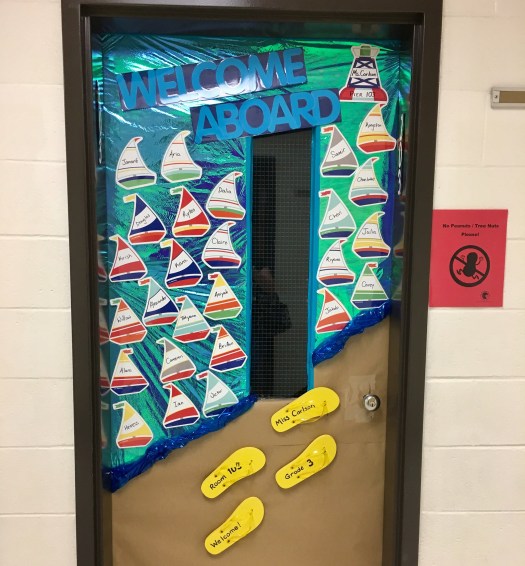
My classroom came together with a nautical theme, shades of blues and calm colors, nautical paintings by my Mom, lots of cleaning and moving by my Dad, sailboat name tags on the door, and our own 3D sailboat in my class library. It soon got around that my room was one to go see!
Door decorations for my first third grade classroom!
Classroom decor: life ring painting, handmade pilings, fish and life ring pillows, sea creature lights, and 3D sailboat
Our Technology Integration Specialist, a NOAA Teacher at Sea Alumnus, visited my room and explained the program to me. The application was due on my birthday, less than a month from when I learned about the opportunity.
– – ⚓ – –
So, I applied in November 2017, 2018, and 2019. One year I just wasn’t selected, one year administrative input was not turned in on time, and other hiccups along the way. Then, my 2019 application was accepted, and I was over the moon in January 2020 to learn that I was a finalist. Of course, we all know what happened that March; and the 2020 and subsequent 2021 sailing seasons were canceled. Slowly, a few teachers were able to sail in the summer of 2022, and I was able to read their blogs from afar with the belief of everything happening for a reason.
“For three decades, the Teacher at Sea program has helped teachers participate in annual NOAA research surveys conducted by our scientists. Teachers from around the country embark on a two to three week expedition at sea. They gain invaluable on-the-job experience and communicate their journey through a series of blogs and lesson plans.”
I am so excited for this opportunity and experience after five and a half years of anticipation. So follow along, wish us fair winds and following seas, and as many schools of Pacific Hake as possible to sample from and research!
– From my king sized bed hotel room, and last night ashore:
Temporarily reassigned teacher, and sailor at heart.
Mission: Hawaiian Islands Cetacean and Ecosystem Assessment Survey (HICEAS)
Geographic Area of Cruise: Hawaiian archipelago
Date: June 23, 2023
Introduction and Background
Gail Tang proudly showing off the NOAA SWAG
Hi Everyone! My name is Gail Tang and I am an Associate Professor of Mathematics at University of La Verne located in Southern California, about 35 miles east of East Los Angeles. I have been the Math program chair for 5 years. I teach mainly upper-level math classes for majors, but also really enjoy teaching the lower-level courses since it is in these classes where I can identify future math majors/minors. Shout out to those who added a math major/minor after one of these classes. You know who you are!
As I’ve been telling people about my summer plans, several questions have come up which I will answer below.
Where am I going?
In a few days, I am flying to Honolulu, Hawaii to start orientation for my Teacher at Sea (TAS) experience. TAS is a program of National Oceanic and Atmospheric Administration (NOAA) for any educators at any level teaching any subject! This could be YOU! Check out more here: https://www.fisheries.noaa.gov/topic/teacher-at-sea-program
What are the goals of Teacher at Sea with NOAA?
The TAS program has two main goals (TAS Online Training Documents, 2023):
To increase environmental literacy, outreach, and educational initiatives
To recruit and retain a highly adaptable technically competent and diverse workforce
Thus, during my time out at sea, I will be learning about NOAA research as related to ocean literacy principles, as well as education and training paths for NOAA-related careers. When I return home, I will work to create some math lessons using research methods, data collection, and data analysis learned aboard the ship. I will also create a lesson to highlight NOAA-related careers. I’m particularly excited about passing on career information to my students!
What kind of research do TAS participate in?
There are three types of cruises that TAS can get placed onto (TAS Online Training Documents, 2023):
Fisheries – conduct biological surveys and physical science studies “to protect, restore and manage use of living marine, coastal, and ocean resources through ecosystem-based management.”
Oceanographic – to increase the understanding of the world’s oceans and climate by measuring “ocean currents, ocean temperatures, atmospheric variables, surface salinity, carbon dioxide content, and sea-level atmospheric conditions.”
Hydrographic – chart the ocean floor using “multibeam sonar to collect depth measurements of the seafloor.”
Which type of cruise will I be joining?
I will partake in a fisheries cruise aboard NOAA Ship Oscar Elton Sette for a marine mammal survey near the Hawaiian Archipelago. The ship was originally built for the U.S. Navy and was formerly known as U.S. Naval Ship Adventurous. It is 224 ft, can go up to a speed of 10 knots, and has a range of 17487 nautical miles. Visit the ship’s website for more information: https://www.omao.noaa.gov/mo/ships/oscar-elton-sette
What type of research is involved in HICEAS?
HICEAS (pronounced High Seas) “will survey the Hawaiian archipelago with a focus on studying whales, dolphins, seabirds, and their ecosystem (i.e., oceanography sampling).” (Email correspondence with Emily Susko, March 1, 2023). The last time the survey was conducted was in 2017 and the 2023 survey will be the fourth HICEAS survey.
Through reading the blog posts about the 2017 survey, I learned that there are two teams: the visual team and the acoustic team. The visual team is trained to use 25-powered binoculars (nicknamed “big eyes”) to spot marine mammals. I am hoping I’ll learn to spot the difference between a white cap and a splash from a dolphin! The acoustic team will also keep track of the cetaceans (order of marine mammals, whale, dolphin, porpoise) under the surface using hydrophones and sonobouys.
Each surveyor privately records their estimates of the number of cetaceans they observed as not to influence others. Later all the estimates are calibrated. This reminds me of the mathematical concept called the “wisdom of crowds”. Basically, it says that a crowd’s prediction (or in this case estimate) is more accurate that the predictions (estimates) of any one individual’s. Truly an example of a group-worthy task, as we say in mathematics education! Watch this ~4-minute video of Dr. Talithia Williams, Associate Professor of Mathematics at Harvey Mudd, demonstrating the wisdom of crowds: https://ca.pbslearningmedia.org/resource/nvpn-sci-crowds/understanding-a-crowds-predictive-ability-prediction-by-the-numbers/
How did I find out about TAS?
Dr. Emily Cilli-Turner, Assistant Professor of Mathematics at University of San Diego, is a TAS alumna. In 2018, Dr. Cilli-Turner participated on a Pollock Acoustic-Trawl Survey aboard NOAA Ship Oscar Dyson for three weeks off the coast of Alaska. She told me about her experience and helped me apply. I actually applied twice, having been rejected the first time. Moral of the story: be persistent and use your failures as learning opportunities! To read about Dr. Cilli-Turner’s time at sea, visit her blog: https://noaateacheratsea.blog/category/2018/emily-cilli-turner/
How long will I be on board NOAA Ship Oscar Elton Sette and what will it be like?
Each HICEAS survey has been about 180 days across two ships. The 2023 survey has 5 legs aboard NOAA Ship Oscar Elton Sette (I am on the first leg for 4 weeks!) and 2 legs on NOAA Ship Reuben Lasker. TAS Staci DeSchryver joined the 2017 survey aboard NOAA Ship Oscar Elton Sette and filled me in on some of the day-to-day life experiences. Staci shared some of the incredible learning experience and didn’t want to tell me everything in order to keep some things a surprise. Some interesting things I learned through Staci as well as the blogs/materials:
Unless we are going onto one of the Fast Rescue Boats aboard the ship, we do not disembark from the ship for the entire 4 weeks.
I will eat the best fish I’ve ever eaten.
Fresh fruit and veggies run out at about week 3.
There was one room on the ship that many of the staff would get seasick.
There’s a movie room and a gym. There have been stationary bikes on deck in the past.
I will be sharing a “stateroom” or “bunkroom” with others.
I will be among 14 scientists (Marine Mammal Observers, Birders, Acousticians, Oceanographers) and about 22 crewmembers.
Personal Log
I first applied to the TAS in 2018 and then applied again in 2019. I was accepted as a TAS for the 2020 field season and was anticipating sailing Summer 2020. The COVID-19 pandemic delayed the sail to 2021, and then to 2022. Now in 2023 (about 4.5 years later!), I am scheduled for the HICEAS survey. To say I’m excited is an understatement. However, there are a number of reasons a cruise does not set sail so I am holding onto the excitement until I am on the ship! One characteristic the program really stresses is flexibility because there are so many factors that impact these research expeditions.
I am most looking forward to the learning opportunities aboard NOAA Ship Oscar Elton Sette. Though scary, uncertainty is thrilling, especially when it’s paired with prospects to view the world from a new and unimaginable perspective. As Michelle Obama says in her audiobook The Light We Carry:
“Go forth with a spoonful of fear, and return with a wagonful of competence.” (2:16:59)
Did You Know?
False killer whales (Pseudorca crassidens) are a priority of the HICEAS survey. Despite their name, they are actually a member of the dolphin family (the delphinids). Their name comes from the similarity of skull shape to the killer whale rather than visual appearance. This population has been on the endangered species list since 2012. Their biggest threat are interactions with fisheries; fishermen see them as competitors and the species are prone to net entanglement. (International Whaling Commission, Marine Mammal Commission)
The inner marine biologist in me is EXCITED. I shouldn’t say inner, as I do have a master’s degree in marine biology! But I definitely feel like a phony as I studied birds… on land… and never once needed to snorkel or SCUBA dive. I am embarrassed to admit it given my educational background and the fact that I grew up in a coastal town, but I cannot even swim. So sure, sign me up to live on a boat for two weeks!
One of the hundreds of dolphin statues that dot the Virginia Beach, VA landscape. Photo by Mechelle Hankerson.
If I were to trace back the threads to how I ended up in NOAA’s Teacher at Sea program, it would likely have started in 2007, when I was a junior in high school. Like other juniors, we were all feverishly searching College Board on universities to attend, majors to study, and regions to live in. Growing up in a coastal town and like many girls my age, I was obsessed with dolphins. To be fair, we literally have statues of dolphins all over my hometown, so how can you not be intrigued by them?! In Virginia at the time, there was only one university that offered a degree in marine biology: Old Dominion University. Unfortunately, ODU was only 15 minutes from where I grew up and I was ready to spread my wings and fly a little further from the nest. A great school I found for marine biology was the University of North Carolina Wilmington (UNCW), where I applied and was accepted, but the out-of-state tuition was too great for me to financially handle. After conducting more searches on College Board, I applied to Radford University, which is in the mountains of Virginia. Here, I settled into a degree program in Biology, with a concentration of Environmental Biology.
One of the requirements of the Environmental Biology concentration is to take a GIS course. GIS stands for geographic information systems and is a growing technology that has unlimited applications. The intro class I took focused on how to use ArcGIS, the software that is used in the industry. I elected to take an intermediate class where I got to practice my skills more and learn about the applications of the tool. I was the only biology major (and woman!) taking the intermediate course, which is surprising given how much GIS is used in the field now.
As my years at Radford came to an end, I knew that I wanted to teach. I had earned countless opportunities in various teaching or tutoring roles at the college and enjoyed every minute. Well, not every minute. I would get incredibly nervous before each class period and that… processed itself… in different ways… Anyway, if I wanted to pursue a career as a professor, I needed to at least get my master’s degree. With the help of my college professors, they reviewed my materials and shared the expectations of grad school, how to apply, and how to find a research mentor. Since funding was less of an issue as a graduate student, I was not worried about staying within the confines of Virginia. With this boundary lifted, I also set my eyes back on marine biology.
With my environmental background, I was able to shift my mindset away from dolphins to focusing on how humans impact marine organisms. I sent emails to over 50 different professors across 20+ schools and maybe only heard back from about half. I interviewed at 5 different schools, got a verbal offer to study sharks, but was rescinded when their funding fell through. One of the last people I emailed was Dr. Steve Emslie, whose lab at UNCW focused on mercury toxicology in marine birds. I had no interest in birds, and I think they are cheating at being considered a marine animal, but I was starting to realize I needed to expand my scope more because marine biology is a competitive field. And opportunities to study marine organisms larger than an oyster are even more competitive. Steve brought me on to his lab where I shifted my previous dolphin obsession to birds.
I definitely… terned…
Colony of Sandwich (foreground) and Royal Terns (background). Photo by Kiersten during graduate school research in the Cape Fear Estuary, North Carolina.
Picture of Kiersten holding a Brown Pelican that she just banded. Taken at Ferry Slip Island in the Cape Fear Estuary, NC.
While I could drone on and on about my research on Brown Pelicans and their mercury loads, we need to focus on the GIS, which is the thread that led me to NOAA. With my fundamental GIS background, I added a spatial variability component to my research to analyze how mercury concentration in Brown Pelican tissues in their breeding colonies varies over space. At UNCW, I took a higher level GIS course entitled Environmental GIS. In this course, I was able to learn about the ecological applications of GIS and about the exciting world of remote sensing. When you think of satellites, you likely think of sensors looking for alien life or GPS or Starlink. And while that is true, NASA has a series of satellites that point back at Earth that remotely sense various parameters, such as particulate matter in our atmosphere, the amount of chlorophyll a on a surface, water temperature, soil moisture, and so much more.
Near the end of the semester, a student in this course shared about an internship she completed and passed out flyers around the room. I took one, but it wasn’t related to teaching so I didn’t immediately jump on it. At this point, I was nearing graduation and was starting my search for a full-time faculty role. Looking back, it was quite ambitious to think I was just going to land a full-time faculty position directly out of my master’s degree. But I did try! I was able to get a couple interviews but was always outcompeted by someone with far more experience than me. Panicking that I need an income after I finished school, I applied for the internship.
Graphic of a subset of NASA’s Earth Observing Satellites. Created by NASA.
In the summer of 2014, I started my internship at NASA Goddard Space Flight Center in the DEVELOP program. This program utilizes Earth remote sensing to answer ecological questions for organizations around the world. The project that I had worked on that summer was using satellite imagery to measure forest fragmentation. We then compared it to bird presence data, which we collected from the Breeding Bird Survey, a yearly bird count through the U.S. Geological Survey. There were 7 other interns working together in a windowless office that was probably 150 sq ft in size. I would not be surprised if this was originally a storage room, given the wires, pipes, and electrical boxes found in the room.
Let’s do a quick speed run through parts that do not matter too much to this story: I worked at NASA Goddard for about 1.5 years before transitioning to teaching. I had been teaching part-time at a local community college for some of that time and received another part-time role, leading me to leave NASA. I worked at two institutions for a year, before getting the opportunity to move to China to teach the sciences at an international high school. I was there for 6 months before moving back in January 2017 to the United States after landing a full-time professorship at Montgomery College, a community college in Maryland. I have been with MC since then teaching ecology, evolution, and environmental biology.
Flash forward to 2019, and I see a post by one of my friends on social media. This friend was one of the other interns at NASA, whom I literally shared a desk with (it was a very small office space), who went on to work with the U.S. National Weather Service. And, if you did not already know, they are a part of NOAA! Jamie had shared about the Teacher at Sea program on his social media and after I read through the stories of educators on board, I knew I needed to apply. Add in four years while the world sorted itself, and here I am!
I am incredibly excited for this opportunity. The groundfish survey measures population size structures of the species caught and characterizes the water column at the sampling locations. I look forward to creating data driven lessons for my students to use statistics to measure diversity between stations and to compare that diversity with water quality samples. Our world is changing, and if we are to do something about it, we need to understand it.
Mission: 2023 Summer Acoustic-Trawl Survey of Walleye Pollock in the Gulf of Alaska
Geographic Area of Cruise: Islands of Four Mountains area, Western Gulf of Alaska Location (in port): 57o 47.0200′ N, 152o 25.5543′ W
Date: May 31, 2023
Not every educator has the amazing opportunity to volunteer with scientists on a NOAA ship. But in 2014, that opportunity became a reality for me when I joined NOAA Ship Thomas Jefferson for a hydrographic survey in the Atlantic Ocean. Now my journey at sea with NOAA continues in 2023 as I head out on NOAA Ship Oscar Dyson for an acoustic-trawl survey of walleye pollock populations in the Gulf of Alaska.
Ever since I was an undergraduate intern for two summers at NOAA Maine Operations Center – Atlantic in Norfolk, VA, I wanted to sail on a NOAA ship. The NOAA Teacher at Sea (TAS) program opened that door for me and has provided so much, from my own advancement of the science and technology used to map the ocean floor, to content and stories I share with students and at science outreach events for the public. Now as a TAS alumna, I can’t wait to see how much more I can learn, teach, and share from my latest ocean expedition with NOAA.
Offshore of Miami, Florida, where I went to graduate school (University of Miami – Rosenstiel School of Marine & Atmospheric Science)
I’m a college professor, teaching introductory-level earth science courses primarily for non-STEM majors at Penn State Brandywine in Media, Pennsylvania. I am dedicated to not only helping my students build their science literacy but also seeing the relevance of why and how science matters in their present and future lives. My research has involved using technology tools to enhance student learning of geoscience content, with my current work focusing on having students produce audio narratives (or “podcasts”).
RDML Gallaudet and I in his office in Washington DC
I also blog for the American Geophysical Union (AGU) about educational technology, pedagogy, and science communication on my blog GeoEd Trek. I’ve dedicated several posts on NOAA and its programs and resources . But it was my blog post A New Year’s resolution: help the public learn about NOAA (December 30, 2017) that caught the attention of RDML Tim Gallaudet, Assistant Secretary of Commerce for Oceans and Atmosphere and Acting Under Secretary of Commerce for Oceans and Atmosphere at that time. He was kind enough to invite me to his office in Washington DC to thank me for the post – and, naturally, I wrote up a blog post about the visit and our conversation! That visit has been “the” highlight of all my NOAA experiences! (*see A conversation about science communication with NOAA’s RDML Tim Gallaudet, Ph.D. (March 13, 2018))
Heading back out to sea with NOAA in 2023 is special for so many reasons. Life for all of us was disrupted in March 2020 – the COVID pandemic has been long and hard. My teaching and research has had so many twists and turns, and I still don’t know how everything will be moving forward. Getting out to sea on my first-ever fisheries expedition is not just exciting for me, but it has been heartwarming to see how many of my students and colleagues are sending me messages and looking forward to frequent updates! In a way, I’m taking so many people out to sea with me, and I’m going to work so hard to make this an informative and thrilling adventure for us all!
Cover photo of Macdougall’s book on the Challenger expedition
Last year (2022) was a notable year for the field of oceanography. It was the 150-year celebration of when the H.M.S. Challenger set sail to collect meteorological and oceanographic data ranging from deep sea soundings and temperatures to biological samples. Although there were several ships that went out on scientific expeditions prior to 1872, the Challenger expedition (from 1872-1876) is the one credited as giving rise to the field of oceanography – and it’s interesting that before 1872, the term “oceanography” didn’t even exist in any dictionaries! I read the book Endless Novelties of Extraordinary Interest: The Voyage of H.M.S. Challenger and the Birth of Modern Oceanography by Doug Macdougall, and I couldn’t help but make connections between the methods of oceanographic research back at the time of Challenger versus today. Keep a look out for many comparisons between the work and logistics of Challenger to my experiences on Oscar Dyson in my upcoming blog posts – no doubt I will be sharing some current items of “extraordinary interest!”
I’m also looking forward to continuing to explore the intersections of science and art (STEAM) can be used to engage audiences and to communicate science data. I like to crochet temperature data and use these temperature records created in yarn for teaching and outreach (it is similar to the amazing work of The Tempestry Project!). While on board Oscar Dyson, I’ll not only be exploring under the sea but looking up towards the sky as my atmospheric observations will inform my Stitch the Sky project! Stay tuned for a future blog post to follow along and/or to create your own data visualization for your location.
*If you are interested in reading about my first TAS experience on NOAA Ship Thomas Jefferson, here are direct links to those blog posts:
NOAA Ship Thomas Jefferson (at Marine Operations Center-Atlantic, 2014)
As I am writing this, I find it hard to believe that over three years have passed since I was first selected to start my journey as a Teacher at Sea (TAS) with the National Oceanic and Atmospheric Administration (NOAA). I am so grateful to continue to be a part of this amazing opportunity. In just a few days I will be on my way to join world-renowned scientists and to meet the crew of the ship.
I will be participating, April 22-May 5, 2023, in a Reef Fish Survey on the Gulf of Mexico on NOAA Ship Pisces. Here is the link to learn more about the ship I will call home for 14 days. The goal of this survey is to deploy baited cameras to gain video that allows us to count/measure the fish we see, categorize habitats, and ultimately provide information on overall fish populations. The measurement of water quality will be checked for environmental DNA analysis, which can provide information on what fish have been in the area. Another goal is to do seafloor mapping so that we can find new habitats worth sampling and provide higher quality maps. I will embark at the port in Galveston, Texas and disembarkation will take place in Pascagoula, Mississippi.
I am excited-nervous and the anticipation is at its highest right now. A part of me still has some disbelief that this is FINALLY going to happen. I am beyond ready and can’t wait to share this experience with my family, friends, and students.
NOAA Ship Pisces underway. Image courtesy of NOAA.
Introduction
Welcome to my Teacher at Sea Blog. My name is Julie Hayes and I am from Macon, Missouri. Macon is a small rural farming community in Northeast Missouri. I currently teach life science, ecology, and STEM at Macon R-1 Middle School, but I have taught grades 6-12 covering many science subjects. I would consider myself a life-long learner and am excited to see first- hand the data collection on this mission and how the use of technology has helped the scientists learn more about the ocean and ecosystems themselves.
I have been married for 24 years and have two grown kids. My son graduated last year with a degree in nuclear medicine and married his high school sweetheart. My daughter will soon be finishing up her first year of college. I am excited to share my experiences with my students. I was influenced by my science teacher growing up who allowed us to do hands on learning and this really peaked my interest to persuade young students to love all facets of science, too. I am excited to be taking this journey along with my students.
Family picture of my son’s wedding this past summer.
Why did I apply to NOAA Teacher at Sea?
Wow! Do I ever get asked this a lot from this midwestern town? Several people I know that have never ventured out further than the neighboring states of Iowa and Illinois, ask me, “why in the world I would want to go out into the ocean with a bunch of strangers and do a bunch of high tech science stuff that none of us have ever heard of?” Even my own children think I am crazy! I tell them it is exactly what I have dreamed of doing my whole life.
Growing up on a farm in a super small town, surrounded by nothing but cornfields and cows, created a sense of wanting to go out and see the world. My family cultivated most of our own vegetables and raised or harvested our own meat. Because of this, I was taught the importance of sustainability. I have always been drawn to nature (probably because it was all around me), but really became fond of all things water. I grew up swimming and observing all of the animals in rivers, creeks, ponds, and lakes. I spent countless hours trying to catch tadpoles, fish, frogs, and turtles just to put them back again. I developed an instant fascination with the ocean at a young age when I came across the scientific expeditions of Jacques Cousteau, that just happen to be on one of the 3 television channels that we could actually get.
I spent many years thinking I was going to go into marine biology, but due to being 1400 miles away from my college of choice for that, my plans took another turn. In fact, if any of my students still to this day ask me if I could be anything other than a teacher what would it be, I have always said a marine biologist. Because of my love for the ocean and the desire to continue to grow and learn more to influence my students, I started researching teacher opportunities over ten years ago.
That is when I found the National Oceanic and Atmospheric Administration’s Teacher at Sea Program. I knew that my plans of applying were several years away, because I wanted to wait until my kids were older. In 2019, I took the leap of faith and filled out the application and got the amazing news that I was chosen for the 2020 season. When the COVID pandemic hit, everything came to a stand still preventing me from going.
Student Impact
I currently teach over 100 middle school students. I want to encourage them and spark an interest to have a passion for science like I do. By having the opportunity to teach in this rural community, I would consider myself extremely lucky. I have many real-world examples students can relate to right at my fingertips. I put an emphasis on my students being able to relate to the environment around them. One way I do this is by using examples they come across in their everyday lives, especially discussing farming sustainability and ecological topics like symbiosis and food webs. Several educational specimens I bring into the classroom come from my own pond or land that I live on. I love encouraging them to just go outside and look around, including those students that tend to stay indoors more.
We are lucky to have a state park in our little town. When we discuss the importance of conservation, they can see first hand the effects of doing so and why it is so important. Since we are landlocked and far from the ocean, I try to bring the ocean to them. I use symbiotic relationships with ocean ecosystems as examples, and you can find many ocean organisms displayed throughout my classroom. Part of the application process to become a NOAA Teacher at Sea, was to include an original lesson plan. I wanted to create a lesson teaching the students that our practices here, whether it be in farming or the burning of fossil fuels, impact the oceans ecosystems. We discuss how our farming practices in the Midwest can filter through the watershed and end up in the Mighty Mississippi River that meets the Gulf of Mexico. Making them aware of the things we do in our own community, can still have an impact on the oceans ecosystems.
My hopes are that from this learning experience myself, I will become more educated on key topics from ocean careers, use of technology, and practices that will influence my students. Students in my class are often problem solving for solutions, collecting data, and then analyzing that data to come up with their answers. This opportunity involves all of these, in which I can’t wait to share with them.
Students collecting data. All student photos courtesy of Macon R-1 Middle School.
Student observations
Students collecting data.
Students collecting data.
Student observations
Student Involvement
Students and co-workers are excited to hear about my NOAA Teacher at Sea experience. Students wrote down questions they were curious to ask about the ship, mission, scientist, and crew. They also wrote me personal encouragement letters to take along with me while I am out to sea. I can’t wait to read them while I am away! My hopes are to maintain contact with the students while I am at sea, and plan to spend a few days a week checking in on them. I will miss all of them, but know that this experience will be well worth it.
Even Ms. Frizzle can’t wait for you to enjoy the blog!