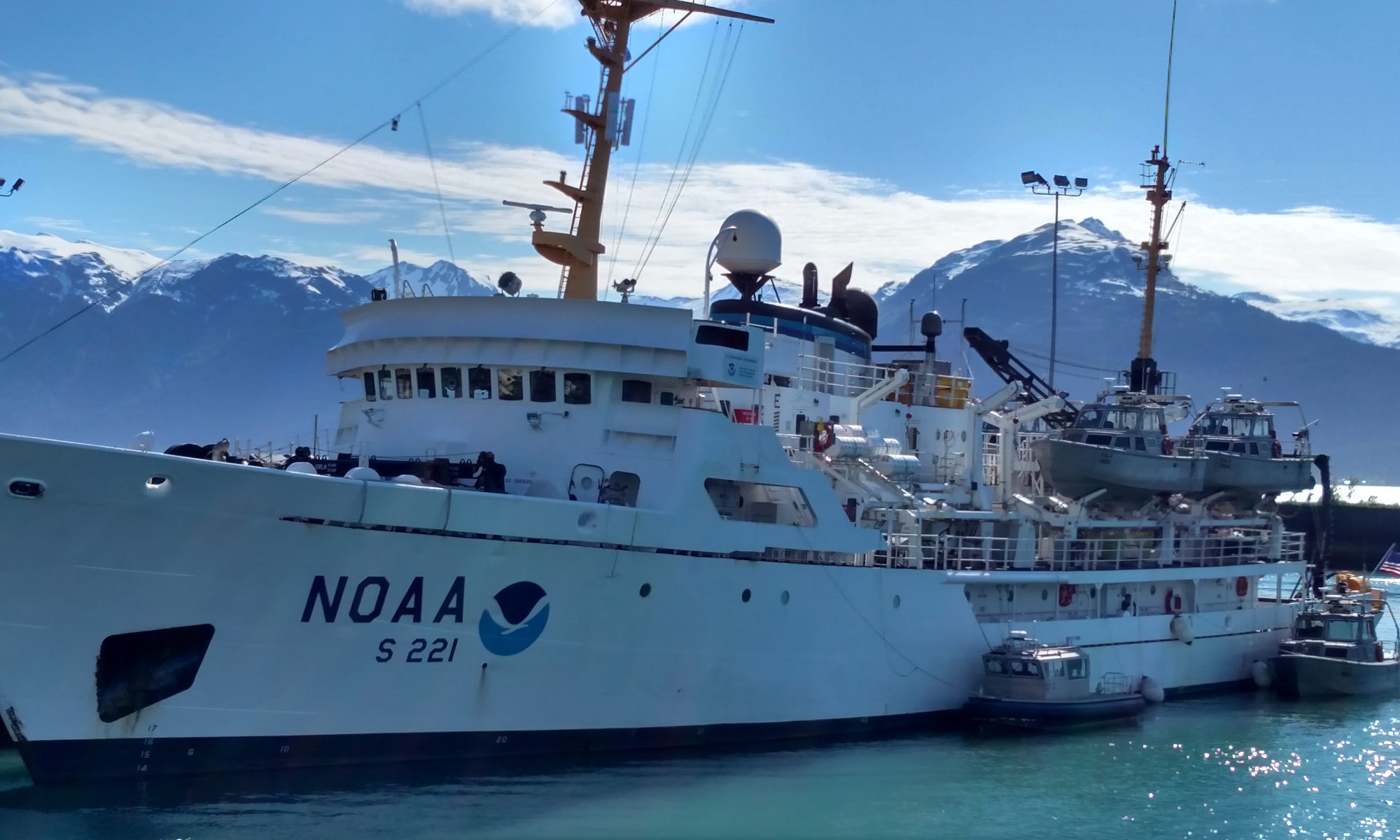
Bill Lindquist: Eager for the Journey, April 24, 2013

NOAA Teacher at Sea
Bill Lindquist
Aboard NOAA Ship Rainier
May 6-16, 2013

Mission: Hydrographic surveys between Ketchikan and Petersburg, Alaska
Date: April 24, 2013

Pre-cruise Log

I am absolutely thrilled at this truly unique opportunity to join a team of scientists aboard NOAA’s research vessel Rainier conducting hydrographic surveys through the Teacher at Sea program.

I am a teacher and have been for the last 34 years. It is a great career. My students have changed over time from my own fifth grade classroom in rural Minnesota, to a science specialist at Crossroads Elementary in the urban core of Saint Paul, to teaching graduate pre-service students at Hamline University. The unifying weave in my teaching fabric has been the creation of learning environments supportive of a collaborative, student-centered, community of learners. Woven into that professional cloth are the fibers of guiding high school kids on canoe trips into the Boundary Waters Canoe Area Wilderness, escorting my elementary students to a residential environmental learning center (Audubon Center of the North Woods), contributing authentic scientific data through GLOBE, visiting community schools in Ghana, flying our sixth grade students’ investigation in a microgravity environment through NASA’s Reduced Gravity Flight program, softening the reluctance of pre-service students to see themselves as teachers of science – exciting them to engage their students in the kind of science learning that strikes at the core of what makes us human, and all the myriad interactions with hundreds of young people as we have shared together in the joy of learning.

Something that has eluded me during my career has been the kind of extended immersion into the doing of science that I expect from this program. I applied six years ago without success. Being gifted this time with this Teacher at Sea opportunity is a realization of a multiple long-held visions, including:

  • Immersion into the doing of science. I am excited to be able to share with my students the first hand experience of being in the scientist role in the practice of doing science in the field – in a more real and felt way than the doing of science we experience in an elementary science lab.
  • Being at sea. I feel at home in a canoe and grew up with a love of being on the water. Seems the Rainier is bigger than my 16.5’ Old Town Penobscot. Minnesota is the land of 10,000 lakes, but a far, far way from the vast expanse of the ocean. With the increasing need to understand the vital impact the oceans play in the global climate systems directly impacting the day-to-day life on the Minnesota prairie, I am excited to bring home first hand experience.
  • Exploring Alaska – the grandeur of the Ketchikan Gateway is spectacularly breathtaking. I have little desire for a tourist cruise – seeing Alaska (albeit a small part) through the eyes of a researcher is thrilling. Though our focus will be viewing the bottom of the ocean – I will be deliberate in taking the time to look up to capture the grandeur of the surrounding landscape. I once had a fascinating conversation with Dan Barry, NASA astronaut, as we prepared for our reduced gravity flight. He told of many astronauts so intently focused on their work during a space walk that, once home, were unable to describe the incredible view impeded only by the visor of their space helmet. In response, he scripted into his program specific commands to look out and “make a memory”. I have little doubt I will not need a reminder to look up from the sonar data collections screen to make memories while cruising through the Gateway. I have my camera ready and fully expect my pictures to run beyond 1000.

I look forward to sharing this grand adventure. Specifically, I hope to share the story with my current class at Hamline. The semester ends while I am at sea, so facilitation of learning will happen while I am on board. They have patiently lived the experience of my acceptance as an alternate while anxiously waiting word of a cruise, to the excitement of successfully being placed aboard the Rainier. I will be working with a former colleague at Crossroads Elementary in Saint Paul, MN to vicariously take her class on an exploration of the ocean bottom off the coast of Alaska. I also hope to share the journey with my grandson, Logan’s class at Westwood Elementary in Traverse City, MI.

In a short week and a bit (May 4) I fly out of the Minneapolis-Saint Paul airport to begin this grand adventure. I can’t wait.

My family
So thankful for all the support of a loving family
Reduced Gravity
Had a chance to fly our sixth graders’ experiment in a reduced gravity environment
In love with the Boundary Waters Canoe Area Wilderness

Alicia Gillean: Introduction, April 29, 2012

NOAA Teacher at Sea
Alicia Gillean
Soon to be aboard R/V Hugh R. Sharp
June 27 — July 8, 2012

Mission:  Sea Scallop Survey
Geographical area of cruise: Northwest Atlantic Ocean
Date: Sunday, April 29, 2012

Personal Log

Alicia Gillean
Alicia Gillean, 2012 NOAA Teacher at Sea

Hello from Oklahoma!  My name is Alicia Gillean and I am ecstatic that I was selected as a 2012 NOAA (National Oceanic and Atmospheric Association) Teacher at Sea!  I am passionate about adventure, lifelong learning, and the ocean.  I can’t wait to merge these three passions together for twelve days at sea this summer and to share my learning with all of my students and coworkers back in Oklahoma. I will be blogging about my adventure and learning while aboard the ship and you are invited to follow my journey and get involved by asking questions and posting comments. I’ll start by telling you a little bit about myself, then I’ll fill you in on the details of my Teacher at Sea adventure.

A Bit About Me

When I’m not pursuing adventure on the high seas, I am the school librarian (also known as a library media specialist) at Jenks West Intermediate School, a school of about 600 5th and 6th graders in the Jenks Public Schools District, near Tulsa, Oklahoma.  I might be a bit biased, but I believe that I have the best job in the school and that I work with some of the finest teachers and students in the world.

You are probably wondering, “How did a librarian from Oklahoma become part of an ocean research cruise?”  I’m glad you asked.  It just so happens that this blog entry answers that very question.

I’ll admit it; I was born and raised a landlubber. There just aren’t many opportunities to visit the ocean when you grow up in the Midwest.  Rumor has it that I touched the ocean once when I was about 3, but I didn’t touch it again until I was 21. More on that later.

My passion for the ocean began in high school when I took a Marine Biology class where my mind was blown by the diversity and beauty of life in the sea and the complex network of factors that impact the health of an ocean environment.  I took Marine Biology 2 and 3 the following years where I set up and maintained aquariums in elementary schools and taught ocean-related lessons for elementary students.

Aquarium newspaper photo
Alicia showing a shark jaw to a three year old at the Oklahoma Aquarium

I started to become a little obsessed with marine life, went to college to become a teacher, and did a happy dance when I learned that an aquarium was going to open in Jenks, Oklahoma.  I landed a job as a summer intern in the education department of the Oklahoma Aquarium and was overjoyed to be a part of the team that opened it in 2003.  When I graduated from college, the aquarium hired me as an education specialist, where I worked with learners of all ages to promote our mission of “conservation through education” through classes, camps, fishing clinics, sleepovers, animal interactions, crafts… the list goes on and on. 

In 2006, I became a 6th grade teacher in Jenks Public Schools, then I earned my Masters degree and became the school librarian in 2010.  I love to work with all the kiddos in my school as they learn to develop as thinkers, scientists, and citizens who have the power to impact the world.  They are just the kind of advocates that the environment needs and I want to help prepare them for this important role any way possible.  My experiences as a Teacher at Sea will certainly help!

Let’s go back to my actual experiences with the ocean for a moment.  After graduating from college and marrying my high school sweetheart David, I hightailed it to an ocean as fast as possible.  We honeymooned in Hawaii where we snorkeled, explored tidepools, went on a whale watch, and temporarily filled the ocean-shaped void in my heart.

Alicia in ocean
Alicia on a Maui Beach

I’ve been back to the ocean several times and each time I am reminded of the delicate balance that must be maintained for the fascinating world under the waves to survive and thrive.  It is critical we protect the oceans and that people realize that their actions impact the oceans.  Even in the landlocked state of Oklahoma, our actions matter.

So, that’s why a school librarian from Oklahoma will spend the summer of 2012 on a ship in the Atlantic Ocean, counting sea scallops.  I can hardly wait for the adventure to begin!  Enough about me, let’s talk about the research cruise now.

Science and Technology Log

I’ll be participating in a sea scallop survey in the Atlantic Ocean, along the northeast coast of the United States, from Delaware to Massachusetts.  My adventure at sea will begin June 27, 2012 and end July 8, 2012.

What is a sea scallop?

A sea scallop is an animal that is in the same category as clams, oysters, and mussels. One way that sea scallops are different from other animals with two shells (bivalves) is that a sea scallop can move itself through the water by opening and closing its shells quickly.  How do you think this adaptation might help the sea scallop?  Watch these videos to see a sea scallop in action:


Importance of  Sea Scallops/Sea Scallop Survey

People like to eat scallops, so fishermen drag heavy-duty nets along the ocean floor (called dredging) to collect and sell them.  Most of them are harvested in the Atlantic Ocean along the northeastern coast of the United States. The United States sea scallop fishery is very important for the economy.

Sea Scallop Habitats
Map of sea scallop habitats from NOAA’s fishwatch.gov

The problem is that sometimes people can harvest too many scallops and the sea scallops can’t reproduce quickly enough before they are harvested again.  Eventually, this could lead to the depletion of the sea scallop population, which would be bad news for the ocean and for people.

This is where the NOAA Sea Scallop Survey comes in.  Every year, NOAA sends scientists out in a ship to count the number of Atlantic sea scallops (Placopecten magellanicus) in various parts of their habitat.  The sea scallops live in groups called beds on the ocean floor 100-300 feet deep, so scientists can’t just peer into the ocean and count them.  Instead, they have to dredge, just like the fisherman, to collect samples of scallops in numerous places.  The scientists record data about the number, size, and weight of sea scallops and other animals. Based on the data collected, decisions are made about what areas are okay for people to harvest scallops in and what areas need a break from harvesting for a while.  I’m considered a scientist on this cruise, so I’ll get to participate in this for 12 hours a day.  I hear it is messy, smelly, tiring, and fascinating.  Sounds like my type of adventure!  I think most good science is messy, don’t you?

The Ship

I’ll be sailing on the research vessel Hugh R Sharp. You can take a virtual tour of the ship here.  It was built in 2006, is 146 feet long (a little bit shorter than the width of a football field), and is used for lots of different scientific research expeditions. When I’m out at sea, you can see where I am on the journey and track the ship here.

RV Hugh R. Sharp
R/V Hugh R. Sharp; photo from NOAA Eastern Surveys Branch

What I hope to Learn

I’m very interested to experience what daily life is like on an ocean research vessel, how scientists use inquiry, data-collection, math, and other skills that we teach our students in a real-world setting.  Of course, I’m also hoping to see some fascinating ocean critters and get my hands dirty doing the work of a real scientist.

I’d love for you to join me on this adventure by following this blog and leaving your thoughts and questions in the comment section at the bottom of each blog entry.  Let’s make this a learning experience that we will all remember!

Pre-trip Pondering

 NOAA TEACHER AT SEA
CATHRINE PRENOT FOX
ONBOARD NOAA SHIP OSCAR DYSON
JULY 24 – AUGUST 14, 2011
 
Personal Log
I will be traveling in a few short weeks to join the crew of the NOAA ship the Oscar Dyson in the Gulf of Alaska.  During the voyage, I will be keeping this log up to date and documenting my “adventures” with a cartoon series as well.  
I hope that you will follow along, ask lots of questions, and travel with me digitally.  
Until our next adventure, Cat 

Beth Spear, July 20, 2010

My first blog

Welcome to my blog! This is my first attempt at blogging. I was accepted into the NOAA Teacher at Sea program this summer and thought a blog would be a good way to record my experiences.

My NOAA experience started this winter with my application. I had heard about the program in the summer of 2009 during a science leadership workshop at Pigeon Lake, WI. In March 2010 I was notified of my acceptance and signed on for a bottom long line survey. During April and May I worked on the online training. June was spent finishing up school and chaperoning a trip to New Zealand, Australia, and Hawaii.

Busy summer!

Now that July is here my departure date is approaching. I’ve been emailing with several NOAA employees to finalize my itinerary, submit all paperwork, and finalize details. My original ship (Oregon II) was needed for something else so I will now be aboard the Delaware II. I am scheduled to leave on July 29, and the ship leaves July 30.

I need to go start packing!