Kathy Schroeder: Sharks, Sharks, and More Sharks! September 23, 2019

NOAA Teacher at Sea

Kathy Schroeder

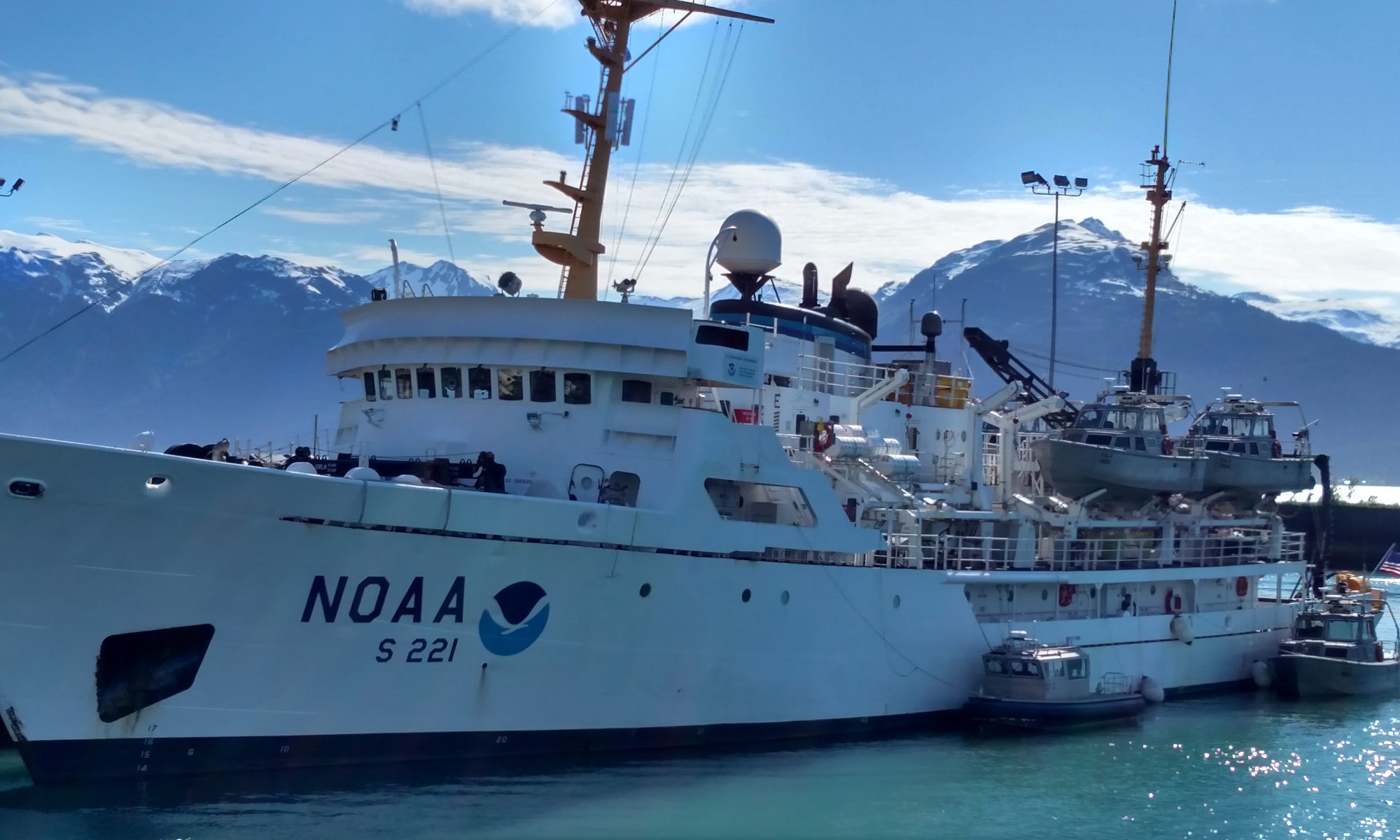
Aboard NOAA Ship Oregon II

September 15-October 2, 2019


Mission: Shark/Red Snapper Longline Survey

Geographic Area of Cruise: Gulf of Mexico

Date: 9/23/19

Weather Data from the Bridge (at beginning of log)

Latitude: 28.07
Longitude: 93.27.45
Temperature: 84°F
Wind Speeds: ESE 13 mph
large swells


Science and Technology Log

9/21/19-We left Galveston, TX late in the afternoon once the backup parts arrived.  After a few changes because of boat traffic near us, were able to get to station 1 around 21:00 (9:00 pm).  We baited the 100 hooks with Atlantic Mackerel.   Minutes later the computers were up and running logging information as the high flyer and the 100 hooks on 1 mile of 4mm 1000# test monofilament line were placed in the Gulf of Mexico for 60 minutes.  My job on this station was to enter the information from each hook into the computer when it was released and also when it was brought onboard.   When the hook is brought onboard they would let me know the status:  fish on hook, whole bait, damaged bait, or no bait.  Our first night was a huge success.  We had a total of 28 catches on our one deployed longline.                                                                                                                                       

Kathy and red snapper
NOAA TAS Kathy Schroeder with a red snapper caught on the Oregon II

We caught 1 bull shark (Carcharhinus leucas), 2 tiger sharks (Galeocerdo cuvier), 14 sharp nose sharks (Rhizoprionodon terraenovae), 2 black tip sharks (Carcharhinus limbatus), 7 black nose sharks (Carcharhinus acronotus), and 2 red snappers (Lutjanus campechanus).  There were also 3 shark suckers (remoras) that came along for the ride. 

sandbar shark
Sandbar shark – no tag. Oregon II

I was lucky to be asked by the Chief Scientist Kristin to tag the large tiger shark that was in the cradle.  It took me about 3 tries but it eventually went in right at the bottom of his dorsal fin.  He was on hook #79 and was 2300mm total length.  What a great way to start our first day of fishing.  After a nice warm, but “rolling” shower I made it to bed around 1:00 am.  The boat was really rocking and I could hear things rolling around in cabinets.  I think I finally fell asleep around 3:00.

9/22- The night shift works from midnight to noon doing exactly what we do during the day.  They were able to complete two stations last night.  They caught some tilefish (Lopholatilus chamaeleonticeps) and a couple sandbar sharks (Carcharhinus plumbeus).  My shift consists of Kristin, Christian, Taniya, and Ryan: we begin our daily shifts at noon and end around midnight.  The ship arrived at our next location right at noon so the night shift had already prepared our baits for us.  We didn’t have a lot on this station but we did get a Gulf smooth hound shark (Mustelus sinusmexicanus), 2 king snake eels (Ophichthus rex), and a red snapper that weighed 7.2 kg (15.87 lbs).  We completed a second station around 4:00 pm where our best catch was a sandbar shark.  Due to the swells, we couldn’t use the crane for the shark basket so Kristin tried to tag her from the starboard side of the ship. 

We were able to complete a third station tonight at 8:45 pm.  My job this time was in charge of data recording.  When a “fish  is on,” the following is written down: hook number, mortality status, genus and species, precaudal measurement, fork measurement, and total length measurement, weight, sex, stage, samples taken, and tag number/comments.  We had total of 13 Mustelus sinusmexicanus; common name Gulf smooth-hound shark.  The females are ovoviviparous, meaning the embryos feed solely on the yolk but still develop inside the mother, before being born.  The sharks caught tonight ranged in length from 765mm to 1291mm.  There were 10 females and 3 male, and all of the males were of mature status.  We took a small tissue sample from all but two of the sharks, which are used for genetic testing.  Three of the larger sharks were tagged with rototags.  (Those are the orange tags you see in the picture of the dorsal fin below).

measuring a shark
Taking the three measurements
king snake eel
King snake eel caught on a longline.


Personal Log

I spend most of my downtime between stations in the science dry lab.  I have my laptop to work on my blog and there are 5 computers and a TV with Direct TV. We were watching Top Gun as we were waiting for our first station.  I tried to watch the finale of Big Brother Sunday night but it was on just as we had to leave to pull in our longline.  So I still don’t know who won. 🙂 I slept good last night until something started beeping in my room around 4:00 am.  It finally stopped around 6:30.  They went and checked out my desk/safe where the sound was coming from and there was nothing.  Guess I’m hearing things 🙂 

Shout out! – Today’s shout out goes to the Sturgeon Family – Ben and Dillon I hope you are enjoying all the pictures – love Aunt Kathy

Hayden Roberts: What’s in a Name? July 18, 2019

NOAA Teacher at Sea

Hayden Roberts

Aboard NOAA Ship Oregon II

July 8-19, 2019


Mission: Leg III of SEAMAP Summer Groundfish Survey
Geographic Area of Cruise: Gulf of Mexico
Date: July 18, 2019

Weather Data from the Bridge
Latitude: 29.43° N
Longitude: 86.24° W
Wave Height: 1 foot
Wind Speed: 7 knots
Wind Direction: 220
Visibility: 10 nm
Air Temperature: 31°C
Barometric Pressure: 1017.5 mb
Sky: Few clouds


Science Log

Over the course of this research experience, I have realized that I was not entirely prepared to assist on this voyage. While I think I have pulled my weight in terms of manpower and eagerness, I quickly realized that not having a background in the biological sciences limits my capacity to identify species of fish. Not growing up in the Gulf region, I am already limited in my understanding and recognition of fish variety through their common names like shrimp, grouper, and snapper. Countless other varieties exist most of which have no commercial fishing value such as boxfish, sea robin, spadefish, and scorpionfish. Fortunately, the microbiology grad student paired with me during wet lab processing has been patient and the fishery biologists assigned to this research party have been informative showing me the basics to fish identification (or taxonomy).

Sorting fish species
Sorting fish species in the wet lab.
Measuring a stingray
Measuring and weighing a specimen in the wet lab.

The wet lab aboard Oregon II is the nexus of the research team’s work. While the aft deck and the computer lab adjacent to the wet lab are important for conducting research and collecting data, the wet lab is where species are sorted, identified, and entered into the computer. The lab has a faint smell of dead fish and briny water. While the lab is kept clean, it is hard to wash the salt off the surfaces of the lab entirely after every research station.

Alongside the buckets and processing equipment are textbooks, quick reference guides, and huge laminated charts of fish species. Most of the reference material has distinctive color photographs of each fish species with its scientific name listed as the caption. The books in this lab are focused on Gulf and Atlantic varieties as these are what are likely to be found during the surveys. Fishery biologists have a wealth of knowledge, and they pride themselves on knowing all the species that come through the lab. However, occasionally a variety comes through the lab they cannot identify. Some species are less common than others. Even the experts get stumped from time to time and have to rely on the books and charts for identification. To get experience in this process, the biologists have given me crustaceans to look up. I struggle to make matches against pictures, but I have gotten better at the process over the weeks.

Calappa flammea
Calappa flammea.

As I have learned more about the scientific names of each species we have caught, I have also learned that scientists use a two-name system called a Binomial Nomenclature. Scientists name animals and plants using the system that describes the genus and species of the organism (often based on Latin words and meaning. The first word is the genus and the second is the species. Some species have names that align close to the common name such as scorpionfish (Scorpaena brasiliensis). Others seem almost unrelated to their common name such as scrawled cowfish (Acanthostracion quadricornis).

scrawled cowfish
Acanthostracion quadricornis

Fortunately for those of us who do not identify fish for a living, technology has provided resources to aid in learning about and identifying species of fish we encounter. The FishVerify app, for example, can identify a species, bring up information on its habitat and edibility, and tell you its size and bag limits in area based on your phone’s Global Positioning System (GPS). The app is trained on over a thousand different species with the beta version of the app focused on 150 species caught in the waters of Florida. On our research cruise, we have encountered over 150 species so far.

Hayden and red grouper
Me and a large specimen of Epinephelus moiro.


Did You Know?

The naming system for plant and animal species was invented by the Swedish botanist Carl Linnaeus in the 1700s. It is based on the science of taxonomy, and uses a hierarchical system called binomial nomenclature. It started out as a naming system for plants but was adapted to animals over time. The Linnaean system has progressed to a system of modern biological classification based on the evolutionary relationships between organisms, both living and extinct.


Personal Log

Nearly two weeks into this experience and the end of my time with NOAA aboard Oregon II, I find that I have settled into a routine. Being assigned to the “dayshift,” I have seen several sunsets over my shoulder as I have helped deploy research equipment or managed the bounty of a recent trawls. I have missed nearly all the sunrises as the sun comes up five hours after I have gone to bed.

However, these two features along the horizon cannot match the view I have in the morning or late at night. After breakfast and a shower midmorning, I like to spend about 30 minutes gazing at the water from one of the upper decks. The clean light low along the water accentuates its blueish-green hue. In my mind, I roll through an old pack of crayons trying to figure out what color the water most closely represents. Then I realize it’s the Green-Blue one. It is not Blue-Green, which is a lighter, brighter color. The first part of the crayon color name is an adjective describing the second color name on the crayon. Green-blue is really blue with a touch of green, while blue-green is really green with some blue pigment in the crayon. Green-Blue in the crayon world is remarkably blue with a hint of green. The water I have admired on this cruise is that color.

Hayden on fore deck
View from fore deck of NOAA Ship Oregon II.

The Gulf in the east feels like an exotic place when cruising so far away from shore. While I have been to every Gulf state in the U.S. and visited their beaches, the blue waters off Florida seem like something more foreign than I am accustomed. When I think of beaches and seawater in the U.S., I think of algae and silt mixed with the sand creating water with a brown or greenish hue: sometimes opaque if the tide is rough such as the coast of Texas and sometimes clear like the tidal pools in Southern California. Neither place has blue water, which is okay. Each place in this world is distinct, but to experience an endless sea of blue is exotic to me.

Retrieving the trawling net
Retrieving the trawling net at night.

In contrast to vibrant colors of the morning, the late evening is its own special experience. Each night I have been surprised at how few stars I can see. Unfortunately, the tropic storm earlier in the week has produced sparse, lingering clouds and a slight haze. At night the horizon shows little distinction between the water and the sky. The moon has glided in and out of cover. However, the lights atop the ship’s cranes provide a halo around the ship as it cruises across the open water. What nature fails to illuminate, the ship provides. The water under this harsh, unnatural light is dark. It churns with the movement of the boat like thick goo. Yet that goo teems with life. Every so often a crab floats by along the ships current. Flying fish leap from the water and skip along the surface. Glimpses of larger inhabitants dancing on the edge of the ship’s ring: creatures that are much larger than we work up in the wet lab but illusive enough that it can be hard to determine if they are fish or mammal. (I am hopeful they are pods of dolphins and not a frenzy of sharks).

Hayden Roberts: Playing Hide and Seek with Sonar, July 16, 2019

NOAA Teacher at Sea

Hayden Roberts

Aboard NOAA Ship Oregon II

July 8-19, 2019


Mission: Leg III of SEAMAP Summer Groundfish Survey
Geographic Area of Cruise: Gulf of Mexico
Date: July 16, 2019

Weather Data from the Bridge
Latitude: 28.51° N
Longitude: 84.40° W
Wave Height: 1 foot
Wind Speed: 6 knots
Wind Direction: 115
Visibility: 10 nm
Air Temperature: 30.8°C
Barometric Pressure: 1021 mb
Sky: Clear


Science Log

In my previous blog, I mentioned the challenges of doing survey work on the eastern side of the Gulf near Florida. I also mentioned the use of a probe to scan the sea floor in advance of trawling for fish samples. That probe is called the EdgeTech 4125 Side Scan Sonar. Since it plays a major role in the scientific research we have completed, I wanted to focus on it a bit more in this blog. Using a scanner such as this for a groundfish survey in the Gulf by NOAA is not typical. This system was added as a precaution in advance of trawling due to the uneven nature of the Gulf floor off the Florida Coast, which is not as much of a problem the further west one goes in the Gulf. Scanners such as these have been useful on other NOAA and marine conservation research cruises especially working to map and assess reefs in the Gulf.

deploying side scan
Preparing to put the side scan over board.

Having seen the side scanner used at a dozen different research stations on this cruise, I wanted to learn more about capabilities of this scientific instrument. From the manufacturer’s information, I have learned that it was designed for search and recovery and shallow water surveys. The side scanner provides higher resolution imagery. While the imagining sent to our computer monitors have been mostly sand and rock, one researcher in our crew said he has seen tanks, washing machines, and other junk clearly on the monitors during other research cruises.

This means that the side scanner provides fast survey results, but the accuracy of the results becomes the challenge. While EdgeTech praises the accuracy of its own technology, we have learned that accurate readings of data on the monitor can be more taxing. Certainly, the side scanner is great for defining large items or structures on the sea floor, but in areas where the contour of the floor is more subtle, picking out distinctions on the monitor can be harder to discern. On some scans, we have found the surface of the sea floor to be generally sandy and suitable for trawling, but then on another scan with similar data results, chunks of coral and rock have impeded our trawls and damaged the net.

Side scan readout
Sample scan from monitor in the computer lab. The light areas are sandy bottom. The dark is either seaweed or other plant material or rocks. The challenge is telling the difference.


Did You Know?

In 1906, American naval architect Lewis Nixon invented the first sonar-like listening device to detect icebergs. During World War I, a need to detect submarines increased interest in sonar. French physicist Paul Langévin constructed the first sonar set to detect submarines in 1915. Today, sonar has evolved into more sophisticated forms of digital imaging multibeam technology and side scan sonar (see https://oceanexplorer.noaa.gov/explorations/lewis_clark01/background/seafloormapping/seafloormapping.html for more information).


Personal Log

When I first arrived aboard Oregon II, the new environment was striking. I have never spent a significant amount of time on a trawling vessel or a research ship. Looking around, I took many pictures of the various features with an eye on the architectural elements of the ship. One of the most common fixtures throughout the vessel are posted signs. Lamented signs and stickers can be found all over the ship. At first, I was amused at the volume and redundancy, but then I realized that this ship is a communal space. Throughout the year, various individuals work and dwell on this vessel. The signs serve to direct and try to create consistency in the overall operation of the ship and the experience people have aboard it. Some call the ship “home” for extended periods of time such as most of the operational crew. Others, mostly those who are part of the science party, use the vessel for weeks at a time intermittently. Before I was allowed join the science party, I was required to complete an orientation. That orientation aligns with policies of NOAA and the expectation aboard Oregon II of its crew. From the training, I primarily learned that the most important policy is safety, which interestingly is emblazoned on the front of the ship just below the bridge.

Safety First!
Safety First!

The signs seem to be reflective of past experiences on the ship. Signs are not only reminders of important policies and protocols, but also remembrances of challenges confronted during past cruises. Like the additional equipment that has been added to Oregon II since its commission in 1967, the added signs illustrate the history the vessel has endured through hundreds of excursions.

Oregon II 1967
Bureau of Commercial Fisheries Ship Oregon II (1967), which was later transferred to NOAA when the administration was formed in 1970.
Oregon II 2017
NOAA Ship Oregon II in 2017 on its 50th Anniversary.

Examples of that history is latent in the location and wording of signs. Posted across from me in the computer lab are three instructional signs: “Do not mark or alter hard hats,” “Keep clear of sightglass do not secure gear to sightglass” (a sightglass is an oil gauge), and “(Notice) scientist are to clear freezers out after every survey.”

signs collage
A collage of four signs around NOAA Ship Oregon II
more signs
Another collage of four signs around NOAA Ship Oregon II
even more signs
Another collage of signs around NOAA Ship Oregon II

Author and journalist Daniel Pink talks about the importance of signs in our daily lives. His most recent work has focused on the emotional intelligence associated with signs. Emotional intelligence refers to the way we handle interpersonal relationships judiciously and empathetically. He is all about the way signs are crafted and displayed, but signs should also be thought of in relation to how informative and symbolic they can be within the environment we exist. While the information is usually direct, the symbolism comes from the way we interpret the overall context of the signs in relation to or role they play in that environment.

Hayden Roberts: Wait-and-See (or Is It Sea?) July 8, 2019

NOAA Teacher at Sea

Hayden Roberts

Aboard NOAA Oregon II

July 8-19, 2019


Mission: Leg III of SEAMAP Summer Groundfish Survey

Geographic Area of Cruise: Gulf of Mexico

Date: July 8, 2019

Weather Data from the Bridge

Latitude: 30.35° N 
Longitude: 88.6° W
Wave Height: 1-2 feet
Wind Speed: 10 knots
Wind Direction: Northwest
Visibility: 10 nm
Air Temperature: 33°C 
Barometric Pressure: 1012 mb
Sky: Few clouds


Science Log

Day one of my trip and we are delayed leaving. Growing up in Oklahoma, you think you know weather until one of the NOAA fishery biologists assigned to the ship provides you a lengthy explanation about the challenges of weather on setting sail. As he put it, the jet stream is throwing off the weather. This is true. Studies have suggested that for a few years the polar jet stream has been fluctuating more than normal as it passes over parts of the Northern Hemisphere. The jet stream is like a river of wind that circles the Northern Hemisphere continuously. That river meanders north and south along the way. When those meanders occur over the Atlantic and the Pacific Oceans, it can alter pressure systems and wind patterns at lower latitudes and that affects how warm or raining it is across North America and Europe. 

This spring in Oklahoma, it has led to record-breaking rains that have flooded low lying areas across the Great Plains and parts of the southeastern United States. Thunderstorms have generally been concentrated in the southern and middle section of the US as the jet stream dips down. The NOAA biologist also indicated that the delay in our departure could be blamed on the El Niño effect. 

El Niño is a natural climate pattern where sea water in the central and eastern tropical Pacific Ocean is warmer than average. This leads to greater precipitation originating from the ocean. According to NOAA scientists, El Niño is calculated by averaging the sea-surface temperature each month, then averaging it with the previous and following months. That number is compared to average temperatures for the same three-month period between 1986 and 2015, called the Oceanic Niño index. When the index hits 0.5 degrees Celsius warmer or more, such as right now, it’s classified as an El Niño. When it’s 0.5 degrees Celsius cooler or more, it’s a La Niña. During an El Niño, the southern part of the U.S. typically experiences wetter than average conditions, while the northern part is less stormy and milder than usual. During a La Niña, it flips, with colder and stormier conditions to the north and warmer, less stormy conditions across the south. However, the El Niño this year has been classified as weak, which means typically the wetter conditions do not push into the Gulf of Mexico region, but exceptions can occur. With the fluctuating jet stream, the El Nino has vacillated between the Plains region and the upper South and regions closer to the Gulf. Thus, the storm causing our delayed departure comes from a weather condition that has been pushed further south by the jet stream.

While these may be causes for the delayed departure, the actual sailing conditions at the time of our voyage are the main concerns. Looking at the NOAA Marine Forecast webpage (https://www.nws.noaa.gov/om/marine/zone/off/offnt4mz.htm), the decision for our delay is based on a storm producing significant wave heights, which are the average height of the highest 1/3 of the waves. Individual waves may be more than twice the average wave heights. In addition, weak high pressure appears to dominate the western Gulf and will likely last mid-week. Fortunately, we are set sail into the eastern Gulf off the coast of Florida. We should be able to sail behind the storm as it moves west. We do have to watch the surface low forming along a trough over the northeast Gulf later in the week. The National Hurricane Center in Miami (which provided weather data in the Atlantic and the Gulf for NOAA) predicts that all of this will intensify through Friday (July 12) as it drifts westward. This will produce strong to near gale force winds and building seas for the north central Gulf. Hopefully by then we will be sailing south of it. 

Gulf of Mexico weather forecasts
Digital interface map for regions of the Gulf of Mexico and its weather forecasts (National Weather Service, NOAA)


Did You Know?

The weather terms El Niño and La Niña can be translated from Spanish to English as boy and girl, respectively. El Niño originally applied to an annual weak warm ocean current that ran southwards along the coast of Peru and Ecuador around Christmas time before it was linked to a global phenomenon now referred to as El Niño–Southern Oscillation. La Niña is sometimes called El Viejo, anti-El Niño, or simply “a cold event.” El Niño events have been occurring for thousands of years with at least 26 occurring since 1900.


Personal Log

I boarded NOAA’s Oregon II yesterday when the ship was virtually empty. It was Sunday, and we were not set to leave until mid-afternoon the following day (and now Tuesday, July 9). Spending the night on the ship was more comfortable than I had expected. While the stateroom was cramped (I share it with one other crew member), the space is surprisingly efficient. I had plenty of space to store my gear. The bunkbed was more cozy than restricted.

NOAA Pascagoula Lab
Even though it was Sunday and everything was closed, I had to stop for a selfie.
NOAA Ship Oregon II
My first look at NOAA Ship Oregon II.

My first day in Pascagoula, MS was spent learning about the town. Pascagoula is a port city with a historic shipyard. Pascagoula is home to the state’s largest employer, Ingalls Shipbuilding, the largest Chevron refinery in the world, and Signal International, an oil platform builder. Prior to World War II, the town was a small fishing community, but the population jumped with war-driven shipbuilding. The city’s population peak in the late 1970s, but today, there are less than 25,000 in the area. Pascagoula continues to be an industrial center surrounded by the growing tourism industry across the Gulf region to the east and west of the port. The population also declined when Naval Station Pascagoula was decommissioned in 2006. The old naval base is located on manmade strip of land called Singing River Island and is in the middle of the port. The port still maintains a large Coast Guard contingent as well as serving as the home portfor the NOAA Ships Gordon GunterOregon II, and Pisces. The NOAA port is actually called the Gulf Marine Support Facility and is located a block from NOAA’s National Marine Fisheries Service Mississippi Laboratory.

Betsy Petrick: Career Choice – Marine Archaeology, July 1, 2019

NOAA Teacher at Sea

Betsy Petrick

Aboard R/V Point Sur

June 24 – July 3, 2019


Mission:
 Microbial Stowaways: Exploring Shipwreck Microbiomes in the deep Gulf of Mexico

Geographic Area: Gulf of Mexico

Date: July 1, 2019

Interview with Scientist Melanie Damour

Melanie Damour is the Co-Principal Investigator and Co-Chief Scientist on the expedition.  She is responsible for directing all archaeological aspects of the investigation. We talked about her path to her career, and her advice for young people who might want to pursue ocean science.

Melaine Damour
Melanie Damour, Marine Archaeologist

When I asked her what sea creature she would choose to be, she immediately answered  “A mermaid. Mermaids have the agility of fish, but they are smart.” Melanie may not be a mermaid, but she is agile as a fish and smart.  

Melanie knew from early childhood what she wanted to be when she grew up.  Her father was a fire and rescue diver, and Melanie sometimes got to see him at work.  She was fascinated by scuba diving. With her father’s support, she learned to scuba dive when she was only eight years old.  The second event that shaped her career was a visit to the USS Constitution in Boston Harbor. This historic sailing ship is open to the public and played an important role in the war for independence from Britain. When Melanie visited this ship, she was awed by the ship and its history, and decided that somehow she was going to marry her two favorite things – diving and maritime history – for her career.  

She got her scuba diving certification when she was 14 years old, and studied history in high school.  She went to Florida State University to study anthropology. She took classes in archaeology, cultural and physical anthropology, and linguistics, all the disciplines within Anthropology.  She was offered a teaching assistantship which allowed her to get into a graduate program and study submerged paleoindian sites in Florida.  The offer was too good to refuse, so she began her graduate work at Florida State right away. Now she works for the federal Bureau of Ocean Energy Management (BOEM) as a marine archaeologist. 

Melanie reflected on what makes a good scientist.  Her first response was that good scientists are always asking questions; being curious is what leads to new understandings.   It’s also important to be open-minded. Scientists can’t expect things to turn out a certain way as this would blind them to what is actually happening.  A scientist has to be persistent in the face of problems and always be looking for different ways and better ways to attack a problem. The ability to work well in a team is key.  Each member of a good team contributes to the end goal. Taking into account different perspectives leads to a more accurate and complete picture.  

Melanie has worked on projects in the Gulf of Mexico, the Atlantic and the Pacific.  Her personal research interests led her to Guatemala, where she worked in Lake Petén Itzá  on a submerged Mayan port site.  She went to Panama to map a Spanish merchant ship that sank off the coast in 1681.  This is her favorite shipwreck so far. It is well preserved by the river sediments that poured into the Gulf there. The ship contains hundreds of wooden boxes full of supplies that Spain had sent to the colonies. The boxes contain nails and scissors, and some yet to be opened my contain books that are still preserved.  After this expedition, Melanie is heading to Mexico to dive with her husband on a site that may turn out to be her new favorite. They will be looking for the wreck of one of the ships belonging to Hernán Cortés, the Spanish explorer.  In 1519, Cortés sank his own ships to prevent his crew from leaving and returning to Cuba. This set the course for the conquest of the Aztecs. Last summer, Melanie and her husband found an anchor and wood that dated to the early 1500s. The wood was determined to be from Spain. This puts the anchor in the right time frame to be one of Cortés’ sunken ships.

Melanie pointed out that it isn’t easy to get a job as a marine archaeologist because it is a small field and there are not many permanent jobs.  But she also encourages anyone who wants to pursue this as a career to be persistent and not give up. “It’s not always a straight line from A to B,” she says; in fact, you may discover that when your plan isn’t working out, you actually prefer the new track your life takes – that Plan B option that you may not have known existed when you began your career. 

“The greatest threat to our oceans today is humans,” Melanie said.  “Our lack of consideration for the consequences of our actions is the greatest threat we face.”  

Marine archaeology is one of many subdisciplines in ocean sciences, and the future of our oceans depends on many scientists working together to reverse the trajectory of degradation we are on.   

Sunset on the Gulf of Mexico