
Caitlin Fine: Chemistry Is All Around Us, August 4, 2011

NOAA Teacher at Sea
Caitlin Fine
Aboard University of Miami Ship R/V Walton Smith
August 2 – 6, 2011

Mission: South Florida Bimonthly Regional Survey
Geographical Area: South Florida Coast and Gulf of Mexico
Date: August 4, 2011

Weather Data from the Bridge
Time: 10:32pm
Air Temperature: 30°C
Water Temperature: 30.8°C
Wind Direction: Southeast
Wind Speed:  7.7knots
Seawave Height: calm
Visibility: good/unlimited
Clouds: clear
Barometer: 1012 nb
Relative Humidity: 65%

Science and Technology Log

As I said yesterday, the oceanographic work on the boat basically falls into three categories: physical, chemical and biological. Today I will talk a bit more about the chemistry component of the work on the R/V Walton Smith. The information that the scientists are gathering from the ocean water is related to everything that we learn in science at Key – water, weather, ecosystems, habitats, the age of the water on Earth, erosion, pollution, etc.

First of all, we are using a CTD (a special oceanographic instrument) to measure salinity, temperature, light, chlorophyll, and depth of the water. The instrument on this boat is very large (it weights about 1,000 lbs!) so we use a hydraulic system to raise it, place it in the water, and lower it down into the water.

CTD
Lindsey takes a CO2 sample from the CTD

The CTD is surrounded by special niskin bottles that we can close at different depths in the water in order to get a pure sample of water from different specific depths. Nelson usually closes several bottles at the bottom of the ocean and at the surface and sometimes he closes others in the middle of the ocean if he is interested in getting specific information. For each layer, he closes at least 2 bottles in case one of them does not work properly. The Capitan lowers the CTD from a control booth on 01deck (the top deck of the boat), and two people wearing a hard hat and a life vest have to help guide the CTD into and out of the water. Safety first!

Once the CTD is back on the boat, the chemistry team (on the day shift, Lindsey and I are the chemistry team!) fills plastic bottles with water from each depth and takes them to the wet lab for processing. Throughout the entire process, it is very important to keep good records of the longitude and latitude, station #, depth of each sample, time, etc, and most importantly, which sample corresponds to which depth and station.

We are taking samples for 6 different types of analyses on this cruise: nutrient analysis, chlorophyll analysis, carbon analysis, microbiology analysis, water mass tracers analysis and CDOM analysis.

The nutrient analysis is to understand how much of each nutrient is in the water. This tells us about the availability of nutrients for phytoplankton. Phytoplankton need water, CO2, light and nutrients in order to live. The more nutrients there are in the water, the more phytoplankton can live in the water. This is important, because as I wrote yesterday – phytoplankton are the base of the food chain – they turn the sun’s energy into food.

Carbon
Sampling dissolved inorganic carbon

That said, too many nutrients can cause a sudden rise in phytoplankton. If this occurs, two things can happen: one is called a harmful algal bloom.  Too much phytoplankton (algae) can release toxins into the water, harming fish and shellfish, and sometimes humans who are swimming when this occurs.  Another consequence is that this large amount of plankton die and fall to the seafloor where bacteria decompose the dead phytoplankton.  Bacteria need oxygen to survive so they use up all of the available oxygen in the water. Lack of oxygen causes the fish and other animals to either die or move to a different area. The zone then becomes a “dead zone” that cannot support life. There is a very large dead zone at the mouth of the Mississippi River. So we want to find a good balance of nutrients – not too many and not too few.

The chlorophyll analysis serves a similar purpose. In the wet lab, we filter the phytoplankton onto a filter.

chlorophyll
I am running a chlorophyll analysis of one of the water samples

Each phytoplankton has chloroplasts that contain chlorophyll. Do you remember from 4th grade science that plants use chlorophyll in order to undergo photosynthesis to make their own food? If scientists know the amount of chlorophyll in the ocean, they can estimate the amount of phytoplankton in the ocean.

Carbon can be found in the form of carbon dioxide (CO2) or in the cells of organisms. Do you remember from 2nd and 4th grade science that plants use CO2 in order to grow? Phytoplankton also need CO2 in order to grow. The carbon dioxide analysis is useful because it tells us the amount of CO2 in the ocean so we can understand if there is enough CO2 to support phytoplankton, algae and other plant life. The carbon analysis can tell us about the carbon cycle – the circulation of CO2 between the ocean and the air and this has an impact on climate change.

The microbiology analysis looks for DNA (the building-blocks of all living organisms – kind of like a recipe or a blueprint). All living things are created with different patterns or codes of DNA. This analysis tells us whose DNA is present in the ocean water – which specific types of fish, bacteria, zooplankton, etc.

The water mass tracers analysis (on this boat we are testing N15 – an isotope of Nitrogen, and also Tritium – a radioactive isotope of Hydrogen) helps scientists understand where the water here came from. These analyses will help us verify if the Mississippi River water is running through the Florida Coast right now. From a global viewpoint, this type of test is important because it helps us understand about the circulation of ocean water around the world. If the ocean water drastically changes its current “conveyor belt” circulation patterns, there could be real impact on the global climate. (Remember from 2nd and 3rd grade that the water cycle and oceans control the climate of Earth.) For example, Europe could become a lot colder and parts of the United States could become much hotter.
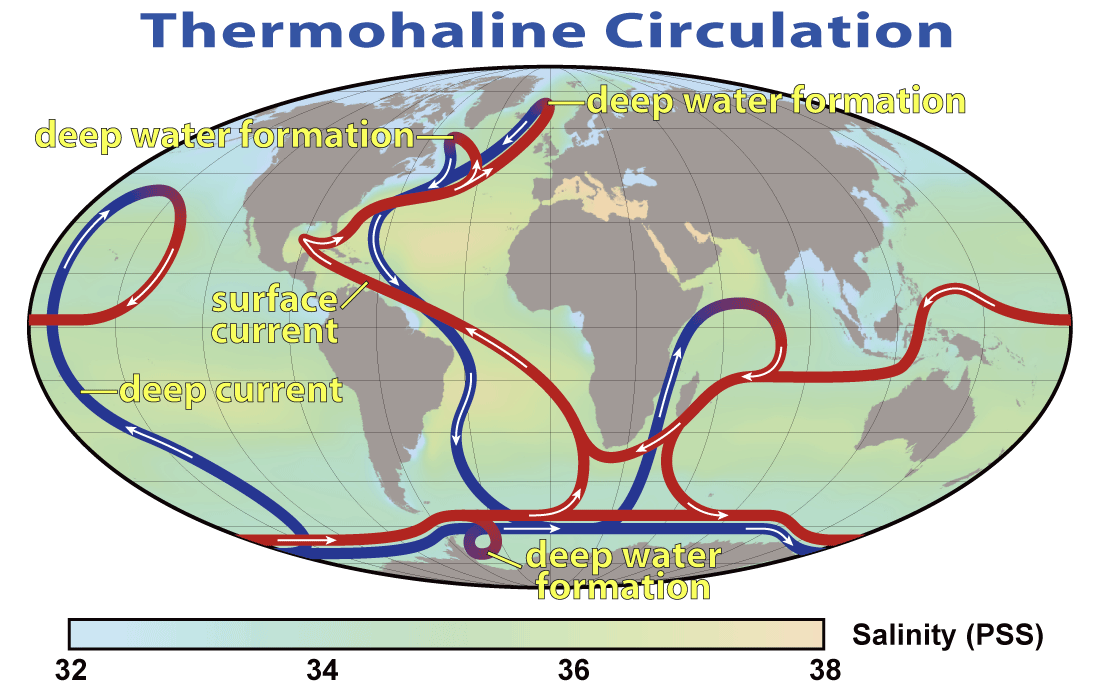
This is an image of the conveyor belt movement of ocean currents

The last type of analysis we prepared for was the CDOM (colored dissolved organic matter) analysis. This is important because like the water mass tracers, it tells us where this water came from. For example, did the water come from the Caribbean Sea, or did it come from freshwater rivers?

I am coming to understand that the main mission of this NOAA bimonthly survey cruise on the R/V Walton Smith is to monitor the waters of the Florida Coast and Florida Bay for changes in water chemistry. The Florida Bay has been receiving less fresh water runoff from the Everglades because many new housing developments have been built and fresh water is being sent along pipes to peoples’ houses. Because of this, the salinity of the Bay is getting higher and sea grass, fish, and other organisms are dying or leaving because they cannot live in such salty water. The Bay is very important for the marine ecosystem here because it provides a safe place for small fish and sea turtles to have babies and grow-up before heading out to the open ocean.

Personal Log

This cruise has provided me great opportunities to see real science in action. It really reinforces everything I tell my students about being a scientist: teamwork, flexibility, patience, listening and critical thinking skills are all very important. It is also important to always keep your lab space clean and organized. It is important to keep accurate records of everything that you do on the correct data sheet. It can be easy to get excited about a fish or algae discovery and forget to keep a record of it, but that is not practicing good science.

It is important to keep organized records

It is also important to stay safe – every time we are outside on the deck with the safety lines down, we must wear a life vest and if we are working with something that is overhead, we must wear a helmet.

I have been interviewing the scientists and crew aboard the ship and I cannot wait to return to Arlington and begin to edit the video clips. I really want to help my students understand the variety of science/engineering and technology jobs and skills that are related to marine science, oceanography, and ships. I have also been capturing videos of the ship and scientists in action so students can take a virtual fieldtrip on the R/V Walton Smith. I have been taking so many photos and videos, that the scientists and crew almost run away from me when they see me pick up my cameras!

Captain Shawn Lake mans the winch

The food continues to be wonderful, the sunsets spectacular, and my fellow shipmates entertaining. Tomorrow I hope to see dolphins swimming alongside the ship at sunrise! I will keep you posted!!

Did you know?

The scientists and crew are working 12-hour shifts. I am lucky to have the “day shift” which is from 8am to 8pm. But some unlucky people are working the “night shift” from 8pm to 8am. They wake-up just as the sun is setting and go to sleep right when it rises again.

Animals seen today…

zooplankton under the dissecting microscope

–       Many jellyfish

–       Two small crabs

–       Lots of plankton

A sampling of zooplankton

–       Flying fish flying across the ocean at sunset

–       A very small larval sportfish (some sort of bluerunner or jack fish)

Some moon jellyfish that we collected in the tow net

Heather Haberman: Science and Life at Sea, July 16, 2011 (post #5)

  • NOAA Teacher at Sea
    Heather Haberman

    Onboard NOAA Ship Oregon II
    July 5 — 17, 2011

Mission:  Groundfish Survey
Geographical Location:  Northern Gulf of Mexico
Date:  Saturday, July 16, 2011

Weather Data from  NOAA Ship Tracker
Air Temperature: 28.5 C   (83 F)
Water Temperature: 27.2 C  (81 F)
Relative Humidity: 82%
Wind Speed: 9.58 knots

Preface:  Scroll down the page if you would like to read my blog in chronological order.  If you have any questions leave them for me at the end of the post.

Science and Technology Log

Question of the day:  When I view your travels aboard the Oregon II on NOAA’s Ship Tracker website it looks as though you go as far as the continental shelf and then turn back towards the shore again.  Why don’t you go into the deep water?

Our groundfish survey course.

Answer:  If you were studying animals in the rainforest you would want to make sure to stay in that specific area.  You wouldn’t want to include Arctic animals in your report which are from a completely different biome.  The same goes for ocean life.  As depth, temperature, and amount of light change in the ocean so do the habitats and the animals that live in them.  On this groundfish survey we are focusing on offshore species that live in “shallow” waters up to 60 fathoms (361 feet).  If we were to go out into the deep water then our reports wouldn’t be as accurate.

Topic of the Day:  Science

What is science?  Can you come up with a good definition?  Difficult isn’t it.  There are many definitions that refer to science as the study of the natural world, systematic knowledge, etc. but something that’s often left out of the definition is that it can be used to make predictions.

We have all been conducting scientific experiments since we were old enough to formulate questions about our environment: “Will this ball bounce?”,  “Can I get it to bounce higher?”,  “Will ball #1 bounce higher than ball #2?”  The knowledge we have collected from these experiments allow us to make accurate predictions.  “I think ball #2 would be better for playing tennis than ball #1.”  Now keep in mind, the more we know about a subject, the better our predictions will be.

The more information we have the better our predictions become. Image: http://www.exploratorium.edu/baseball/bouncing_balls.html

Did you know that the ocean covers over 70% of the Earth’s surface but more than 95% of it remains unexplored.  This means we have a lot to learn if we want to accurately predict the relationships between the ocean, the atmosphere and the living things on our planet. To address these gaps in our knowledge, thousands of people working for the government, universities and private industries, are trying to collect the information we need to make the most accurate predictions possible.  Perhaps by expanding our knowledge we will be better equipped to formulate some solutions to the problems we have created in the seas such as  pollution (particularly plastics), climate change and overfishing.  These issues are drastically changing oceanic ecosystems which in turn affect the life on our planet.

The beautiful Pacific Ocean. Image: Universe Today
A new venture into deep ocean exploration. Image: ZD Net

One thing that sets science apart from other arenas is that is it based on verifiable evidence.  We are not talking about video footage of bigfoot or pictures of UFO’s here, we are talking about evidence that is easily confirmed by further examination or research.  I don’t think many people consider all of the expertise that goes into collecting this kind of scientific data–it’s not just scientists.

Not all evidence is verifiable.

Onboard the Oregon II there are engineers that make sure the ship and all its parts are functional, skilled fishermen that operate the cranes and trawling equipment, officers from the NOAA Corps that navigate and assist the captain in commanding the ship, cooks that feed a hungry crew and the scientists.  Conducting scientific research is a team effort that requires a variety of skilled personnel.

NOAA Corps member Ensign Brian Adornado with a nautical chart that's used for navigating our ships course.

Too often people underestimate the amount of time and labor that actually goes into collecting the information we have about our planet and its inhabitants.  In fact, many people dismiss scientific evidence as unimportant and trivial when in actuality it is based on the most technologically advanced methods that are available.  Scientific data, and conclusions derived from the data, are peer-reviewed (looked at by others in the field) before it is published or presented to the general public.

This is why it is so important to take heed to the reports about the changes taking place in the ocean’s waters. Without the data from NASA’s satellites in the sky,  NOAA’s ships on the sea and other sources too numerous to mention, we wouldn’t know the extent of the damage that’s being done to the ocean.

Chlorophyll concentrations in the ocean. Image: NASA satellite SeaWIFS

NOAA’s Teacher at Sea program has clearly demonstrated how good science is done.  I experienced first hand the importance of random sampling, scientific classification of organisms, repeating trials to ensure the accuracy of results, team work, safety, publishing data for the public to review and always having backup equipment.  I’m looking forward to sharing these experiences with my students.  Thank you NOAA!

Personal log:

My time aboard the Oregon II is coming to an end.  We have finished up our last stations and cleaned up the workrooms.  Now its back to Pascagoula, Mississippi.  It has been a wonderful experience!  For those of you that are wondering what I did each day on the ship it was pretty routine.

9:00 AM : Go to the galley for some juice and coffee.  Hot breakfast ends at 8:00 AM but they always have cereal and fresh fruit to eat.  In the galley there are two tables that each seat six people.  At the end of each table is a small TV so we can watch the news, our anything else that happens to be on DirectTV.

This is a picture of my room. I have the bottom bunk and my roommate sleeps on the top. The curtains are very nice for privacy since we work different shifts.
There is a bathroom (head) that my roommate and I share with our two neighbors. Each room has its own entry door to the bathroom.
This is the galley where all of our meals are served. It's also stocked with lots of yummy snacks and drinks!

9:30 AM:  After some coffee, juice and conversation I head upstairs to the lounge so I can check my e-mail and work on my blog.  The lounge has some comfortable seats, a big TV, lots of 8mm movies, two computers for the fishermen, and an internet cord for laptops.  Usually David, the ornithologist (bird scientist), is here working when I arrive so we usually chat for a while.

This is the lounge.

11:00 AM:  Lunch time!  everyday the chefs make amazing food for us to eat.  They’ve served bbq ribs, prime rib, turkey, quail, crab cakes, shrimp, mahi-mahi, ham, crab legs, pork loin, steaks and lots of other amazing side dishes and desserts.  Both chefs are retired from the Navy where they were also cooks.

12:00 noon: Head to the dry lab to start my shift.  At the start of every shift Brittany, our team leader, writes down all of the stations we will be going to as well as how many miles it takes to get there.

This is the "dry lab" where we spend our time waiting for the next trawl or plankton station. In this room there are computers dedicated to navigation, depth imagery and fisheries data.

5:00 PM:  Supper time!  Back to the galley for some more excellent food!

12:00 midnight:  Night crew comes in to relieve us from our 12 hour shift.  I quietly enter my room so I don’t wake up my roommate and hit the shower.  Then it’s to the rack (my bunk bed) with some ear plugs to block out the sounds of the engine.  The slow rocking of the waves makes a person fall asleep quickly after a long day at work.

Jacob Tanenbaum, October 15, 2008

NOAA Teacher at Sea
Jacob Tanenbaum
Onboard NOAA Ship Henry Bigelow
October 5 – 16, 2008

Mission: Survey
Geographic Region: Northeast U.S.
Date: October 15, 2008

Using the sextant
Using the sextant

Science Log

Our study of creatures on the bottom of the sea has been done every year for 45 years. In fact, it is the longest series of data for fish, in the world. Why is this important? I asked Dr. Michael Fogarty, head of the Ecosystems Assessment Program, at the Northeast Fisheries Sciences Center in Woods Hole, MA.

Mr. T: This is the longest uninterrupted time series of a trawl survey anywhere in the world. Is that important?

Dr. Fogarty: Really important because the changes that we are observing occur over long periods of time due to fishing and climate and other factors, so we need to track these changes to see how individual fish species are doing and to see how the ecosystem itself is responding to these changes.

Mr. T: What have you found?

Processing samples
Processing samples

We have found overall in the 45 years that we have been doing this survey, the number of fish has remained the same, but the types of fish have changed. In Georges bank, we would have mostly cod, flounder in the past, now we have small sharks, skates, which are relative of the rays.

Mr. T: What does that mean in terms of the ecosystem?

Dr. Fogarty: It has changed the entire food web because, for example, these small sharks we are seeing are ferocious predators. Because these dog-fish prey on other species, they keep the fish we usually like to eat down in number

Mr. T: Why is that happening?

Dr. Fogarty: Our hypotheseis is that because the some fish have been hurt by too much fishing, the other fish have come in to take their place.

IMG_7042-735252I thought about that for a while. It means this ecosystem has been effected by something called Overfishing and something called climate change. I started wondering about all the different factors that might have effected the environment we are studying. There are so many! Let’s look at some of the may things that human beings have done that have changed this ecosystem in the 45 years we have been doing this study. Dr. Fogarty and I talked about this and then we created talked about this mini website for you. Click each problem area to learn more.

Remember the other day when I tried to use a sextant to fix our position? I could not even get close, so today, I took a lesson with one of the NOAA Corps officers on board, Lieutenant Junior Grade Andrew Seaman. Click here to come along.

IMG_6866-762848Elsewhere on the ship, Snuggy and Zee paid a visit to the dive locker on the ship. This is the area on the ship where SCUBA gear is stored. We are not using SCUBA on this trip, but it was fun to visit the locker and see all the gear. Snuggy and Zee learned that the crew can actually fill up the air bottles they need right on the ship. They have all the equipment they need to do work underwater right here on the ship.

We had a fire drill yesterday. I know you are all familiar with fire drills, because we have them at school. When we do them at school, we often practice evacuating the building and calling the fire department. Well, at sea, things work a little differently. We have to get away from danger, but then, we have to practice putting out the fire as well. After all, there is no fire department to call way out here! Click here for a video.

Finally, so many of you asked about dangerous creatures that we have caught. This torpedo ray does have an electrical charge to it. The ray can zap you if you are not careful. I used rubber gloves to keep from getting hurt. The hardest part was holding the thing while we took the picture. I kept dropping it becuase it was so slimy!

————————–

AT: I have not been frightened by anything on the ship or in the sea that we have seen. The hag-fish did seem gross. Very gross. Other than that, no.

Hi SP, I enjoy Korean food very much and have eaten lots of crab roe. It does not gross me out at all. Thanks for writing.

NV, Zee and Snuggy are just fine. Thanks for asking.

Mrs. B’s Class: I’m glad you liked the blog. We found the dead whale 100 miles or so off of Cape Cod. There are no sea snakes here. The water is too cold. I’m kind of glad about that!

Hello Mrs. Graham’s Class. I am staying nice and warm. Even working on deck, it is not too cold. We could stay out for several more weeks without a problem. Do you know what we use to make electricity? See if you can figure that out. We have to go back to port before we run out of that.

Mrs. Christie Blick’s Class: Very interesting. Our chief Scientists says that they can tell the whales don’t like barnicles because whales without them don’t behave in quite the same way.
This particular fish, which we call a monk fish or a goose fish has all the adaptations you mentioned. You did very well thinking those up. The Chief Scientist, Phil Politis and I are both impressed. He says that the fish hides in the mud (that is why it is brown), which keeps it hidden from predators. It has another adaptation, the illicium which we are calling a fishing rod. This adaptation lures smaller fish to the monkfish. Since it does not move around as much as many other fish, it can stay safer from predators.

Hello to Mrs. Coughlin’s Class, Mrs. Berubi’s Class. I’m glad you like the blog.

NN, I’ll be back next week. Because the crew and I, as well as a few birds are the only land-creatures we have seen out this far! Thanks for writing.

Hi Jennnifer. Thanks for your kind words and thanks for checking in on the blog.

Tamil Maldonado, July 26, 2005

NOAA Teacher at Sea
Tamil Maldonado
Onboard NOAA Ship Fairweather
July 18 – 28, 2005

Mission: Hydrographic/FOCI Survey
Geographical Area: North Pacific
Date: July 26, 2005

Science and Technology Log

We are underway in the Gulf of Alaska, Southeast of Sitkinak Island.  This is our last day of doing FOCI survey. We used the Bongo Tow and CTD throughout day.

At 5:00 p.m. we were done with survey and transiting to Dutch Harbor, AK

At night I interviewed Chief Scientist, Janet Duffy-Anderson, one more time.  We talked about how to know fish ages and how fast they are growing.  It is because of their rings— the number of rings a larvae has will give the days they are alive.  Also, you can know their age by how far apart those rings are, which gives you the information of how fast they are growing.

Furthermore we talked about atmospheric changes and how this is affecting the ecosystem.  The target of FOCI is to get biological as well as physical data on the changes in the ocean and how those changes interact with the biota.  They wanted to do this research in Alaska because you can see changes more rapidly at the poles of the planet. We have seen phenomena like El Nino, La Nina and others increasing in frequency and duration. The rate between phenomena is increasing—they are happening  more frequently for the last decade.

I will be able to get fisheries raw data in time series done by FOCI and will continue doing some research back home in this area.

At night we did an acoustic hydrographic survey, and by changing depth target we got different data, all related. Changing the depth target changes how deep the beams go through the water and come back.  We worked with Hips & Sips Computer Software.  This program also corrects in real time the error estimates for each contributing sensor.  These entries are necessary for the computation of the Total Propagated Error.  The Vessel Configuration File (VCF) contains information about the different sensors installed on the survey vessel and their relationship to each other.  The information in the file is applied to logged, converted data files, and when the final sounding positions are calculated, the data is merged.  The entries in the VCF are time tagged and multiple time tags can be defined for each sensor.  This allows the user to update sensor information during the course of a survey.  This may occur if a piece of equipment has been moved.

In order to define the new fields in the VCF it is essential to understand standard deviation. The standard deviation is a statistic that explains how tightly various examples are clustered around the mean in a set of data.  When the data is tightly bunched together the bell-shaped curve is steep and the standard deviation is small.  When the data is spread apart, the bell curve is relatively flat indicating a larger standard deviation.

The vessel information will be displayed in the Vessel Editor.  The sensor positions are represented by colored dots. The VCF can be updated if a sensor changes position, and a unique time stamp ensures that the correct offsets are applied to data recorded at a certain time.  Each time the sensor information is changed, the drop down list above the 3-D vessel model will be updated to include the new time stamps.  The data grid below the 3D vessel contains all the offset information for the vessel.

Tomorrow… we will talk about the stability of the ship, and how its is done (so we do not sink!).

Kirk Beckendorf, July 15, 2004

NOAA Teacher at Sea
Kirk Beckendorf
Onboard NOAA Ship Ronald H. Brown

July 4 – 23, 2004

Mission: New England Air Quality Study (NEAQS)
Geographical Area:
Northwest Atlantic Ocean
Date:
July 15, 2004

Weather Data from the Bridge
Time 8:00 AM ET
Latitude- 45 53.18 N
Longitude- 70 36.48 W
Air Temperature 14 degrees C
Air Pressure 1000 Millibars
Wind Direction at surface Northeast
Wind Speed at surface 3 MPH

Daily Log

Yeah!!! The sun is trying to come out, the rains have stopped and the sea has calmed down. No I didn’t get sea sick, but it is hard to sleep when your bed is swaying back and forth and up and down. The winds have shifted and the scientists are hoping that the winds may be blowing some pollution our way. Seems like a strange thing to hope for, but of course they are here to study pollution and the wind has been blowing it away from us.

Why should anybody care if we add microscopic particles to the air?

Yesterday, I discussed one of the techniques used to study the microscopic particles that are in the atmosphere. But so what, why does anyone care about these tiny specks? Air pollution made by automobiles, power plants, factories and ships all contain both gases and particles. To be able to predict the changes resulting from air pollution, we have to learn all we can about the gases and the particles being released.

When the pollution is released into the atmosphere, the gases and particles start traveling with the air. (Just like pouring a quart of motor oil into a river.) Gradually the gases and particles spread out into the surrounding atmosphere. The gases can recombine and may start changing into other chemicals, but that’s another story I will get to soon.

The particles are not all the same. They come in different sizes and are made of a variety of chemicals. There are two main concerns about these little chunks floating along in the sea of gas; health hazards and climate change. If you take a breath, not only do you inhale the gas, but also all of the particles floating in the gas. Some of these particles may have a negative effect on a person’s health.

The main interest in the particles here on the BROWN is the effect they have on climate change. The Earth is of course warmed by the energy (light) coming from the sun. The more energy (light) the Earth gets and keeps, the warmer our temperatures. The less energy (light) the Earth gets and keeps, the cooler the temperatures. Pretty simple stuff? Not at all.

When sunlight shines down through the atmosphere and hits a particle the sunlight can either bounce off of the particle or be absorbed into the particle. If the light bounces back out of the atmosphere the Earth does not keep the light’s energy and there is a cooling effect. When light is absorbed into the particle, the energy (heat) will now be in the atmosphere and so there is a heating effect. Some particles absorb more light than others, so some have a cooling effect on the Earth’s atmosphere and others have a heating effect. One of the questions being asked is, overall do the particles cool the atmosphere or heat the atmosphere? This is not as simple of a question as it sounds, because there are also a lot of indirect effects that are not yet understood.

These microscopic chunks also affect clouds and cloud formation, but how much of an effect is not completely understood. The particles may cause clouds to be less likely to rain or at least, not rain as often. These microscopic particles in air pollution could have an effect on where and when it rains. So the scientists, here on the BROWN, are gathering data to help them try and understand the impact that particles will play in changing the Earth’s climate. Part of their task, is to determine where the particles are from, the numbers, sizes, and chemistry of the particles.

If I lost you in all of that, maybe it will help to put it all in a nutshell. These scientists are studying the type and number of particles in air pollution, to try and understand what effect these little chunks may be having on the Earth’s temperature and water cycle.

As Tim Bates said, we are trying to put together a large jigsaw puzzle and we don’t know what picture is on the puzzle. First we have to find all of the pieces. Then we have to put together the puzzle. We are now at the point that we think we have found most of the pieces and now we are trying to put them together. As you can see from the picture I sent in today there is some relaxation time, in the middle of all the data analysis.

Questions of the Day

The smaller particles are measured in nanometers how much of a meter is 1 nanometer?

If the wind is blowing 5 meters/second and we are 50 miles from Boston how long will it take Boston’s pollution to reach us?

Typical unpolluted air will have about 1000 particles in every cubic centimeter of air. What is something that has a volume of about 1 cubic centimeter?