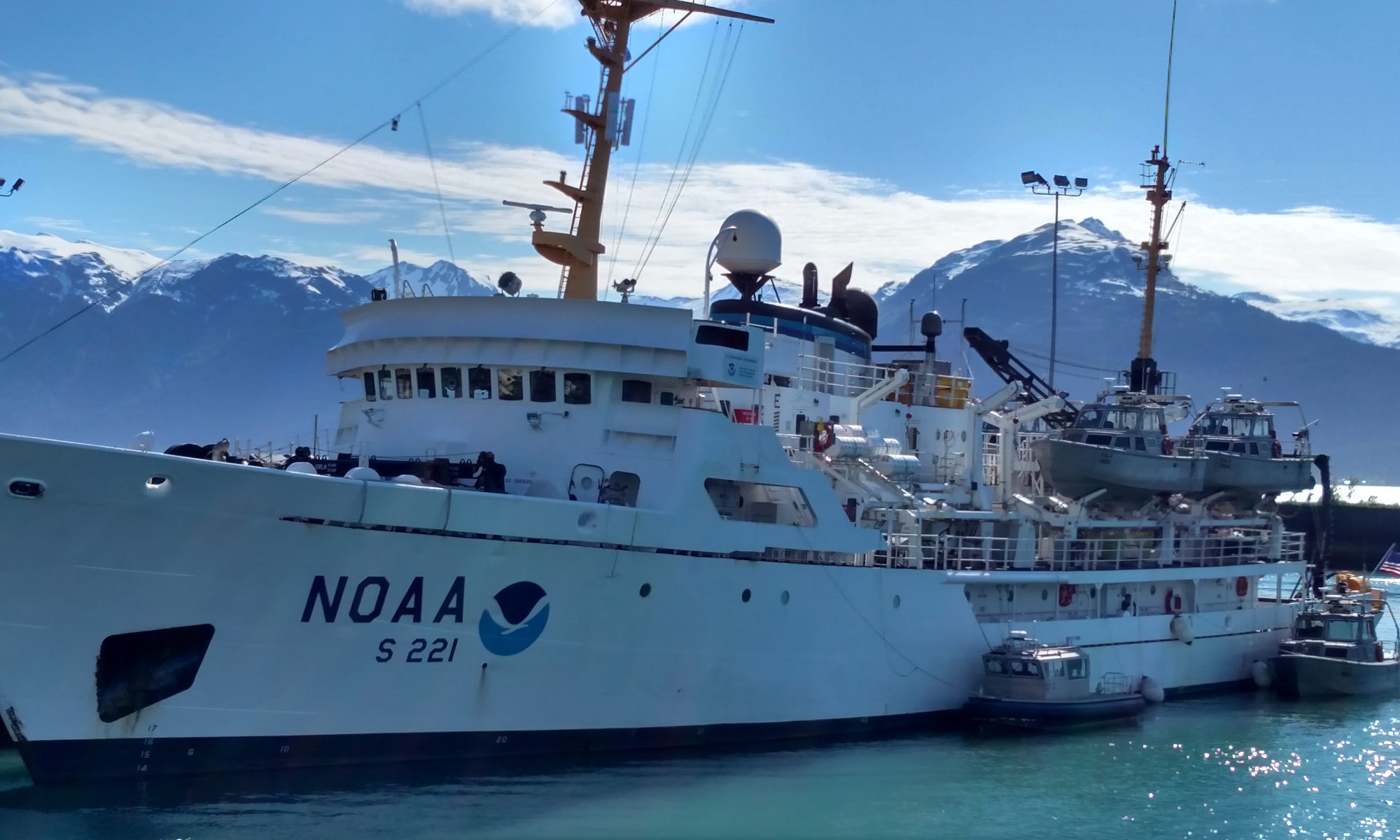
Geographic Area of Cruise: Bering Sea and Bristol Bay, Alaska
Date: July 23, 2019
Weather Data from Home Latitude: 41°42’25.35″N Longitude: 73°56’17.30″W Wind: 2 knots NE Barometer: 1011.5 mb Visibility: 10 miles Temperature: 77° F or 25° C Weather: Cloudy
Science and Technology Log
As you can tell from 1) the date of my research cruise and 2) my latitude and longitude, I am no longer in Alaska and I am now home. For my final NOAA Teacher at Sea post, I am pleased to show you the results of the hydrographic survey during the Cape Newenham project. The bathymetric coverage (remember that bathymetry means the topography underwater or depth to the bottom of oceans, seas and lakes) is not final as there is one more leg, but it is pretty close. Then the hard part of “cleaning up” the data begins and having many layers of NOAA hydrographers review the results before ever being placed on a nautical chart for Cape Newenham and Bristol Bay. But that day will come!
Fig 1. First, here is a reminder of the location area for the project in Alaska, in the Bering Sea and Bristol Bay (circled in red).
Fig 2. Here is the entire coverage of the project area to date. Notice that some of the coverage is complete and some is in spaced line segments. The red areas on the map are shallow and vessels should avoid those. The dark blue to purple zone is the deepest shown on the map and that is where ships should navigate and mariners will know that by looking on the future navigational chart. During the project, the Chief Hydrographer began to notice that the sea bed was nearly flat and gently sloping. The decision was made to use set line spacing for the rest of the project. (Hint: Click on the image to see more detail)
Fig 3. Going in a little more closely, I’ll show you the Cape Newenham area, shown in the dashed line region. You may recall that this is the nautical chart from three blog posts ago.
Fig 4. Now, we’ve zoomed in one of the cool parts of the bathymetric map. As I said above in Fig 2, most of the Cape Newenham sea floor surface is gently sloping. There are no obvious obstructions such as large boulders or shipwrecks; if there were, those would show up in the hydrographic survey. I’ll talk more about the red (or shallower) part of the map in the next figure.
Fig 5. This is a 3D side view of the upper part of Fig 4. The red that you see is 5 meters or about 16 feet below the ocean surface. The light blue area is about 36 or so meters deep which is about 120 feet deep. What the hydrographers noticed were sand waves, which they found interesting but non-threatening to navigation unless the crests neared the ocean surface. Sand waves can migrate or move around and they can also grow larger and possibly become a navigational hazard in the future. As a geologist, I think the sand waves are excellent. These waves (sometimes they are called ripples) of sediment form as a result of ocean currents and show the direction of flow. See the next figure for a profile view (cross section view) along the light blue line on this map.
Fig 6. This is 2D profile view along the surface of the light blue line shown in Fig 5. This is the top of the sand waves. I’ve pointed to a couple of sand wave crests; there are five crests shown in this profile length. Notice that there is a gently sloping face of the wave and a steeper face. The ocean current direction is moving from the gentle face towards the steep face in this location on Cape Newenham which is from north to south. The hydrographers told me that, though the ocean flow may be north to south here now, it is possible that in the winter, the current reverses. There is also a tidal influence on the current here, too.
Part II – Careers at Sea Log, or Check Out the Engine Room and Meet an Engineer
Photo 1. Klay Strand, 2AE, showing us around the Fairweather engine room.
This is Klay Strand who is 2nd Engineer on the Ship Fairweather. He’s been on the ship for about a year and a half and he graciously and enthusiastically showed three of us visiting folk around the engine room towards the end of our leg. It was truly eye-opening. And ear-popping.
Before I get to the tour, a little bit about what Engineering Department does and how one becomes an engineer. There are currently nine engineers on the Ship Fairweather and they basically keep the engines running right. They need to check fluid levels for the engine (like oil, water and fuel) but also keep tabs on the other tanks on the ship, like wastewater and freshwater. The engine is on the lower level of the ship.
Klay Strand’s path to engineering was to go to a two-year trade school in Oregon through the JobCorps program. Strand then worked for the Alaskan highway department on the ferry system and then he started accruing sea days. To become a licensed engineer, one needs 1,080 days on a boat. Strand also needed advanced firefighting training and medical care provider training for his license. There are other pathways to an engineering license like a four-year degree in which you earn a license and a bachelor’s degree. For more information on becoming a ship’s engineer, you can go to the MEBA union, of which Strand is a member. On Strand’s days off the ship, he likes to spend time with his niece and nephews, go skydiving, hike, and go to the gun range.
The following photos are some of the cool things that Klay showed us in the engine room.
Photo 2. There are two engines that power the ship. Ear protection is a must. Standing between the two engines felt like standing inside a running car engine if you were a tiny mouse. I didn’t get a shot of us standing there, so I drew an approximate line for reference.
Photo 3. The ceiling in the engine room is very low. There are A LOT of moving parts. And wires, cords, pipes, valves, enormous tools, tanks, meters and things I’ve never seen before. This part in the foreground, with the yellow painted on the cylinder, is akin to a car’s driveshaft.
Photo 4. This shows how much black water and gray water the ship currently has in the tanks. Those tanks are located in the engine area and the engineers keep a close eye on that information. Gray water is wastewater from washing dishes, clothes washers, and the showers. Black water is from the toilets, I mean ship’s heads. Black water is treated through a chlorination process. Both wastewaters are released at sea, where permissible.
Photo 5. Recall in my last “Did You Know?” that I said the ship makes its own freshwater from sea water. This is the reverse osmosis monitor showing how much freshwater is being produced. Yes, the engineers keep an eye on that, too.
Personal Log
Before I boarded the small plane that took off from Dutch Harbor to take me to Anchorage, AK, I looked out over the harbor. It was so lovely in Alaska. There’s so much space and untouched landscape. The green, pointed hill on the right side of the image is called Mount Ballyhoo, which I hear was named by Jack London on a swing through Dutch Harbor in the late 1800s.
Now that I’ve been home for a few days, I’ve had a chance to reflect on my time on NOAA Ship Fairweather. When I tell people about the experience, what comes out the most is how warm and open the crew were to me. Every question I had was answered. No one was impatient with my presence. All freely shared their stories, if asked. I learned so much from all of them, the crew of the Fairweather. They respected me as a teacher and wondered about my path to that position. I wondered, too, about their path to a life at sea.
My first week on the ship, I spent a lot of time looking out at the ocean, scanning for whales and marveling at the seemingly endlessness of the water. Living on the water seemed fun and bold. As time went by, I could tell that I may not be cut out for a life at sea at this stage of my life, but I sure would have considered it in my younger days. Now that I know a little bit more about these careers on ships, I have the opportunity to tell my students about living and working on the ocean. I can also tell my educator colleagues about the NOAA Teacher at Sea Program.
Though I loved my time on the Ship Fairweather, I do look forward to seeing my West Bronx Academy students again in September. I am so grateful for all I learned during my time at sea.
Did You Know?
Using the interactive Marine Protected Area map, I zoomed in on the Cape Newenham area. Though there is a Walrus Protection Area there, we did not see any on our leg.
If you are interested in finding out about areas of the ocean that are protected from certain types of human activity because of concerns based on habitat protection, species conservation and ecosystem-based marine management, here are some links to information about Marine Protected Areas. Marine Protected Areas are defined as “…any area of the marine environment that has been reserved by federal, state, territorial, tribal, or local laws or regulations to provide lasting protection for part or all of the natural and cultural resources therein.” Did you know that there are over 11,000 designated MPAs around the world?
“All of us have in our veins the exact same percentage of salt in our blood that exists in the ocean, and, therefore, we have salt in our blood, in our sweat, in our tears. We are tied to the ocean. And when we go back to the sea – whether it is to sail or to watch it – we are going back from whence we came.” – John F. Kennedy
Geographic Area of Cruise: Gulf of Alaska (Kodiak to Prince William Sound)
Date: Saturday, July 20th, 2019
Weather Data from Kodiak, AK: 4:00am Lat: 57.79° N Lon: 152.4072° W Temp: 56 degrees F.
Personal Log
Good morning! It is currently 4:30am on Saturday, July 20th and I have just woken up for my first shift on the boat. So far, I have met scientists Abigail McCarthy and Troy Buckley, who will be working the day shift with me. I also met Ruth, an intern from the University of Washington and my bunkmate. It will be nice to have someone else on board who is also new to the experience!
From left to right: Myself, Ruth, Abigail and Darin exploring Spruce Cape. Photo Credit: Troy Buckley
Before talking about work, I’d like to share what we got up to in Kodiak before departing on the cruise. One thing to note – Chief Scientist Darin Jones explained that because this is the 3rd leg of the survey and the scientists are taking over from the previous group, we do not have any set up or calibration of equipment to do. If this had been leg 1 of the survey, the free days in port would have been spent doing those jobs. Lucky us!
After unpacking everything in our state rooms (bunks), we quickly set out to explore Kodiak. In two and a half days, were able to see a lot! Wednesday night, some friends of mine in town took us for a stroll on Near Island, followed by a yummy dinner at Noodle Bar.
Walking with friends on Near Island, just across the bridge from Kodiak. Photo by Ruth Drinkwater
Thursday morning, team building began with a run to Safeway and Walmart for all last minute necessities. The teacher in me couldn’t resist a fresh pack of sharpie markers and colored pencils. 🙂 In the afternoon, we walked along Spruce Cape where we picked a TON of blueberries and found the largest barnacle I have ever seen.
Check out this Giant Acorn Barnacle!
After a short recoup back on the boat, Darin and Abigail were ready for an evening surf session at Fossil Beach. This beach is the farthest south you can access by road in Kodiak and the drive was BEAUTIFUL. Prior to the trip, I hadn’t looked up any pictures of Kodiak and so the treeless green mountains, cliffy coastlines and herds of cows were exciting to see. Once at the beach, we jumped in the ocean, watched a successful surf session and finished our team building with a fire and dinner on the beach.
Fossil Beach: We hiked up the cliffs in the background to check out old WWII bunkers.
Happily grazing cows on the drive back from Fossil Beach.
Science and Technology Log:
In just a few days of being here, I have already learned a lot about the workings of the ship and what we will be busy doing for the next three weeks. Here is a preview.
To begin, science shifts run from 4am – 4pm and 4pm – 4am. Throughout this entire time, acoustic data is being collected and read. Acoustic data is gathered by sending out sound waves from a transducer box attached to the bottom of a centerboard underneath the boat. The sound waves reverberate out and bounce off of anything with a different density than water. In the picture below, you can see a bold line on the screen with smaller dots above. Take a look and see if you can identify what the line and dots might represent.
Chief Scientist Darin Jones looking at the morning acoustic data. This room is called “The Cave” because it is the only lab without windows.
If you thought the big bold lines on each screen were the seafloor, you were correct! Most of the little dots that appear above the sea floor are fish. Fish are identified from the sound waves bouncing off of their swim bladders. Swim bladders are the “bags” of air inside fish that inflate and deflate to allow the fish to raise and lower itself in the water column. Air has a different density compared to water and therefore shows up in the acoustics data.
Close up view of the acoustic data screen.
What is this acoustic data used for? There are 2 primary parts. The first is to identify where schools of fish are located and therefore areas well suited for collecting fish samples. The second is to calculate the total biomass of pollock in the water column by combining acoustics data with the actual measurements of fish caught in that same area. More specifics to come as I take part in the process throughout the survey.
Did You Know?
On this survey, scientists do not catch/survey fish at night (when it is dark). The reason? At night, bottom dwelling species come up off the seafloor at night to feed. During the day they settle back down on the seafloor. The scientists are primarily interested in catching pollock, a mid water species, so they fish during daylight hours.
View from the upper deck of the trawl net being hauled in.
Updates to come later in the week. It is time for me to join the scientists and get ready process our first catch!
Weather Data from the Bridge Latitude: 54° 09.9 N Longitude: 161° 46.3 W Wind: 22 knots NW Barometer: 1014.2 mb Visibility: 10 nautical miles Temperature: 55.6° F or 13.1° C Weather: Partly cloudy, no precipitation
Careers at Sea Log, or Meet the ….
Life at sea on the Ship Fairweather, this past week and a half, with some 42 crew members, has been something I have never experienced. The closest thing that I can think of was when I was in undergraduate geology field camp, living in close quarters for weeks on end, with the same people, working together towards a goal. But I knew all of those field camp students; we were in college together. This is different. Everyone works here on the Fairweather and this is their job and their home. We’re all adults and no one knows anyone when they first come aboard. So, if you are friendly, open to people and welcoming, you can get to know some folks quickly. If you’re shy or try to ease in slowly, it may be a harder adjustment, living on a 231-foot heaving, rolling, pitching and yawing, ice-strengthened, welded steel hydrographic survey vessel. It’s a unique environment. And there are a lot of different but interesting jobs that people do here on the Fairweather. Here are but a few of the mariners on the ship.
NOAA Corps – The first group of ship crew that I’ll talk about are NOAA Corps officers. NOAA Commissioned Officer Corps (or NOAA Corps) is one of the nation’s seven uniformed services and they are an integral part of the National Oceanic and Atmospheric Administration (NOAA). NOAA Corps support nearly all of NOAA’s programs and missions.
XO Sam Greenaway, the Executive Officer on NOAA Ship Fairweather
Commander Greenaway is the Executive Officer onboard Fairweather and that work entails a variety of tasks that all function under the heading “administering the ships business.” Greenaway’s number one job is as the ship’s Safety Officer and he has additional tasks that include purchase requests from the departments, lining up contractors, making sure everyone has their training up-to-date, handling human resource issues, and accounting of the ship’s finances. On the Fairweather, Greenaway is second in command. He loves being at sea and has always liked sailing, which is one of his hobbies when not on the ship. What Greenaway least expected to be doing as a NOAA Corps officer was managing people but he finds that he loves that part of the job. Greenaway has a bachelors of science degree in Physics from Brown University and a masters degree in Ocean Engineering from University in New Hampshire.
*************************
ENS Jeffery Calderon, Junior Officer
Ensign Jeffrey Calderon is a NOAA Corps Junior Officer and has been on Ship Fairweather for two years. Calderon was previously with the Air Force for eight years and also with the National Guard for about four years. His duties on the ship include driving small boats, doing hydrographic surveys, bridge duty on the ship, and he’s the medical officer on board. Calderon enjoys the challenges he gets with NOAA Corps and likes to manage small teams and decide priorities. He learned about NOAA Corps from his college advisor at the University of Maryland, where he earned a bachelor’s degree in Physics.
*************************
ENS Iris Ekmanis, Junior Officer
Ensign Iris Ekmanis is also a Junior Officer who recently completed her basic training for the NOAA Corps. She has been on Ship Fairweather for about a month and a half. She chose NOAA Corps because she wanted to utilize her degree in Marine Science (from University of Hawaii, Hilo) and had worked on boats for six years. She likes that she has been learning new things everyday, like how to pilot the ship from the bridge, learning to coxswain a launch, and learning to use the hydrographic software to collect bathymetric data. In fact, when we left the dock in Dutch Harbor at the beginning of the leg, Ekmanis had the conn, which means she maneuvered the ship through her orders to the helm (although she had plenty of people around her in case she needed assistance.)
Survey team – The hydrographic survey team is involved in all aspects of collecting the data and generating the bathymetric surfaces that will be used to make updated nautical charts. They don’t drive the boats and ships, they run the software, take the casts that determine water salinity and temperature, tell the coxswain where to motor to next and then process the data back on Ship Fairweather. There are six members on the survey team; here are two of them.
Ali Johnson, Hydrographic Senior Survey Technician
Ali Johnson has been a hydrographer on the Ship Fairweather for two and a half years. She told me she always knew she wanted to work in ocean science in some capacity so she earned a degree in Environmental Studies at Eckerd College in St. Petersburg, Florida. With this job, Johnson enjoys going to places that most people don’t ever get to see and one of the highlights was surveying while dodging icebergs and seeing the interesting bathymetry as a result of glacial deposits, another was seeing an advancing glacier up close. She is the hydrographer who showed me most of the ropes on the ship, the launch surveys and in the plot room.
Michelle Wiegert has been with NOAA Ship Fairweather since last September. Although she did not lay eyes on the ocean until she was nineteen, she always knew she would do some ocean-based work. Wiegert earned a double major in Biology and Spanish from Metropolitan State University of Denver in Colorado and studied Applied Science Marine Technology at Cape Fear Community College in Wilmington, NC. As a Survey team member, she loves that she is working at sea and the fact that every day is different and she is always learning new things.
Ship Stewards – The stewards are the crew members who make the three square meals a day. The food on Ship Fairweather has been outstanding and every meal seems like two or even three meals in one because the stewards offer so much variety, including vegetarian and vegan options. There are four stewards on the Fairweather and they are all as nice as can be. Here is one of them.
Carrie Mortell, Acting Chief Cook
Carrie Mortell has been a steward with the Fairweather for two years and with NOAA for fifteen. She has ten years of commercial fisheries experience in southeast Alaska and she loves the ocean. Mortell told me she feels more comfortable at sea than on land. She likes to keep busy in her downtime by reading, writing letters, crocheting, cooking & baking and drawing.
Deck Department – The Fairweather’s Deck Department takes care of general ship maintenance, cleaning decks, painting, operating cranes, helming the ship, and coxswaining the launches. There are currently eight members of the Deck Department and I interviewed one for this post.
Eric Chandler, Able Seaman
Eric Chandler has been an Able Seaman with NOAA for one and a half years. He has driven the launches, taught coxswains-in-training, been a ship medic, moved launches with a davit, repaired jammed grab samplers, and many other tasks. Chandler started working on boats in 2016 when he was a deckhand, educator and naturalist on tour boats out of Seward, AK. He has also been a professional photographer and an auto mechanic. Chandler likes being on a ship because he sees remote places, gets to learn new skills all the time, and likes the feeling of being self-sufficient.
Visitors to NOAA Ship Fairweather – I am a visitor to Ship Fairweather but I am not the only temporary person onboard. Here are two of the four of us who are “just passing through.”
Fernando Ortiz, Physical Scientist at NOAA
Fernando Ortiz has been a Physical Scientist with NOAA since 2008 and works out of Western Regional Center in Seattle, WA. He was visiting the Fairweather on the same leg is mine. NOAA Physical Scientists normally work in the office but will go on a NOAA ship at least once a year to support field operations. Ortiz will possibly do the quality control check on the data for the Cape Newenham project in the future. Ortiz has a bachelor’s degree in Geography from the University of Washington, Seattle WA. His advice for people looking for a similar career is to take science classes and he emphasized having Geographic Information Systems (GIS) and programming experience.
*************************
Christine Burns, Knauss Fellow through NOAA Sea Grant
Christine Burns is visiting from Washington, DC, where she is a Knauss Fellow through NOAA Sea Grant. She is on a one-year post-graduate marine policy fellowship with NOAA’s Office of Coast Survey. She wanted to see what the hydrographic research going on so came out to Dutch Harbor as part of her fellowship. Burns has a bachelor’s degree in Environmental Science from Dickinson College in Carlisle, PA, and a masters in Marine Science from the University of Georgia in Savannah, GA. As she was visiting like I was and we were both very much observers, Burns filled me in on some scholarship and internship ideas she has for high school students and those students thinking of careers and college after high school graduation. By the way, once you’re nearing the end of college or have graduated already, don’t forget that there is usually career advisory office and your alumni network at your institution. You can make connections, seek advice, ask about positions, among other important functions those offices and groups do for you. Hollings Scholars – for current college sophomores, this is an undergraduate scholarship and internship through NOAA EPP/MSI Undergraduate Scholarship Program – this is the Hollings Scholarship for students attending HBCU or Minority Serving Institutions Student Conservation Association – a good place to get work and volunteer experiences or a gap year opportunity, for people 18-35 interested in land management. Youth Conservation Corps – a summer youth employment program that engages young people in meaningful work experiences on national parks, forests, and so on. USAJobs – this link has summer internships for college students or recent graduates. Rotary Clubs can help students find scholarships and volunteer opportunities Unions – you can find paid internships or educational opportunities through unions for skills such as pipefitters, electrical, plumbing, etc.
Next post: the Engineering Department of the Ship Fairweather
Personal Log
I am impressed and awed by the people who have chosen living and working on a ship. When I first came aboard the Fairweather, I felt everything was a little cramped and the space was confined. I couldn’t figure out how to get around very well. Now, I don’t get lost as often. It isn’t easy to live and work on a ship, but there are plenty of folks on the Fairweather who happily chose it.
On the flying bridge near Cape Newenham
I’ve enjoyed looking out at sea as we are underway. I try to spot whales and other flying and leaping sea critters. We have one more long transit before arriving back to Dutch Harbor so I am going to head up to the flying bridge and see what I can see.
Did You Know?
The Fairweather makes its own potable water. When I was shown the engine room, I was also shown the reverse osmosis water making machine that turns sea water into fresh water. The ship never runs out!
Quote of the Day
“It is not that life ashore is distasteful to me. But life at sea is better.” – Sir Francis Drake
Geographic Area of Cruise: Gulf of Alaska (Kodiak to Aleutian Islands)
Date: Monday, July 15th, 2019
Weather Data from Juneau, AK: 8:50am Lat: 58.35° N Lon: 134.58° W
Personal Log
Hello everyone. In just a few days I will be swapping out halibut fishing in Juneau, AK for surveying walleye pollock in the Gulf of Alaska (GOA)…and I can’t wait! Our cruise on NOAA Ship Oscar Dyson will depart from Kodiak Island and sail out along the Aleutian Islands, a place I have yet to see or experience since moving to Alaska.
Fishing for Halibut near Holkham Bay. This photo was taken just after the fillet had slipped out of my hands and onto the boat deck…guess I’ll benefit from fish handling practice on the cruise!
Photo Credit: Laura Maruhashi
Three years ago, I left a curriculum consulting job in Portland, OR to begin teaching in Juneau. Prior to Oregon, I was living overseas in Australia, where I completed my Masters in Education and spent time with the Australian side of my family. I am incredibly excited to now call Juneau my home and be in the classroom as both an educator and a learner. Alaska is such a unique and special place – sometimes I still can’t believe I live here!
Currently, I work as a 7th grade Life Science teacher at Floyd Dryden Middle School. Not only is middle school my favorite age of kids to teach (yes, you heard that right), but I also love the curriculum we get to share with them. One main focus during the school year is to teach about ecosystems. Two years ago I developed a unit, along with NOAA Scientist Elizabeth Siddon, that focuses on how commercial fisheries quotas are set in Alaska. The lessons range from data collection and stakeholder input to presenting recommendations to the North Pacific Fisheries Management Council. Alaska takes several different aspects of the ecosystem into consideration when setting quotas and I think it is a great way for students to see how the science they learn in school can be applied to real life careers.
Students in my 7th grade life science class presenting ecosystem risk table recommendations to a panel of scientists for sablefish quotas in the Gulf of Alaska.
I myself have never had the chance to work as a scientist. That is why I am so excited for the opportunity to participate in data collection and analysis alongside a research team right here in Alaska. It will be fantastic to bring what I learn back to my students and be able to give them an even better understanding what being a scientist can entail.
Lastly, outside of teaching, I try to enjoy all of the outdoor activities Juneau has to offer. With the recent streak of unusually warm and sunny weather, my friends and I have been boating, swimming, and hiking as much as possible. While it will be hard to leave those things behind, I am looking forward to this next adventure!
Midway through a hike from Granite Creek Basin to Mount Juneau.
Photo Credit: Laura Maruhashi
Science and Technology Log:
The research team on NOAA Ship Oscar Dyson is conducting an acoustic-trawl (AT) survey to collect data, primarily on walleye pollock, to be used in stock assessment models for determining commercial fisheries quotas. When collecting data, scientists will work in 12 hour shifts and be looking to determine things such as species composition, age, length distribution etc.
NOAA Ship Oscar Dyson. Photo Credit: NOAA
Trawl fishing, for those of you unfamiliar, is a method of fishing when a net of particular size is pulled through the water behind a boat. Oscar Dyson is a 64 meter stern trawler that contains acoustic and oceanographic instruments to collect the necessary data. After researching online, I learned that the main instrument used is a Simrad EK60 split-beam echosounder system. Look for more information about what this instrument is (and others) in future blog posts!
Did You Know?
Alaska pollock is one of the largest commercial fisheries in the world!
Thank you for reading and I am looking forward to sharing more about life out at sea!
Geographic Area of Cruise: Bering Sea and Bristol Bay, Alaska
Date: July 11, 2019
Weather Data from the Bridge Latitude: 58° 36.7 N Longitude: 162° 02.5 W Wind: 1 knot N Barometer: 1011.0 mb Visibility: 10 nautical miles Temperature: 58° F or 14° C Weather: Partly cloudy, no precipitation
“Red sky at night, sailors’ delight. Red sky in morning, sailors take warning.” This old mariner’s adage did NOT prove to be true when I saw this sunrise viewed from NOAA Ship Fairweather at 5:21am yesterday. It turned out to be a perfect delight for a surveying day!
What is NOAA and the Teacher at Sea program?
You may be wondering what, exactly, am I doing going “to sea” with NOAA. First off, NOAA stands for the National Oceanic and Atmospheric Administration and originates back to 1807 with Thomas Jefferson founding the U.S. Coast and Geodetic Survey (as the Survey of the Coast) with a mission to provide nautical charts to the maritime community for safe passage into American ports. Over time, the Weather Bureau was added and then the U.S. Commission of Fish and Fisheries was developed. In 1970, these three agencies were combined under one umbrella organization and named NOAA, an agency that supports accuracy and precision of physical and atmospheric sciences, protection of life and property, and stewardship of natural resources. NOAA is within the Department of Commerce.
I am standing on the flying bridge of the Fairweather where you get a fantastic 360° view.
NOAA’s Teacher at Sea (TAS) program has existed since 1990, sending over 800 teachers on NOAA research cruises. The TAS mission is “to give teachers a clearer insight into our ocean planet, a greater understanding of maritime work and studies, and to increase their level of environmental literacy by fostering an interdisciplinary research experience.” There is usually just one teacher sent per leg of a mission, that way the TAS gets full exposure to the research process and attention from the crew, scientists and staff on the ship. And it is true, everyone onboard has been friendly, helpful, welcoming, and willing to answer any question I might have, like, where is C deck? (That’s where my stateroom is located).
Science and Technology Log
Now that you understand NOAA’s mission, it should not surprise you that I am on a research cruise that is mapping a part of the seafloor that has not had detailed soundings. “Soundings” means the action or process of measuring the depth of the sea or other body of water. See the map below as that is where I am right now, in Bristol Bay. By the way, NOAA nautical charts are available for free at this NOAA site.
The NOAA nautical chart of Bristol Bay, Cape Newenham and Hagemeister Strait. Note that where there are small numbers in the white and blue sections of the chart (that is all water), you can see the sounding depths to surface shown in fathoms. The red polygon is drawn on by me. We are working in the upper, northwest part of that “poorly mapped” section. Notice that there are essentially no soundings in that region.
When I’ve told friends, family and students that I was chosen to be on a NOAA research vessel that was compiling a detailed map of the sea floor off of Alaska, it was met with great surprise. “The ocean floor hasn’t been mapped before? How could that be?” In fact, more than 80 percent of the ocean bottom has not been mapped using modern, highly precise technologies. But we do have a very coarse ocean floor – or bathymetric – map, created in the early 1950s by Marie Tharp using sounding data collected by the U.S. military and her collaborator Bruce Heezen. Tharp’s early map of the sea floor beautifully revealed the Mid-Atlantic Ridge and added another piece of evidence in support of the theories of continental drift plate tectonics. There’s a terrific Cosmos: A Spacetime Odyssey episode featuring Tharp.
This is the Tharp and Heezen (1977) colorized ocean floor map. This map is used under the Creative Commons license.
Why we need a more detailed bathymetry map than the one created by Tharp and Heezen can be explained by the original mission of the early version of NOAA. Jefferson wanted to build a “…survey to be taken of the coasts of the United States…” in order to provide safe passage of ships to ports within the navigable waters of the U.S. As the Bristol Bay chart above shows, there are still coastal areas that have limited to no data. Without detailed charts, mariners cannot know where the shallower waters are (called shoals), or rock obstructions, shifted underwater sand bars, shipwrecks, or other hindrances that cause safety concerns to the movement of boats.
The hydrographic Survey Team on the NOAA Ship Fairweather use several 30 foot boats, called launches, with a multibeam echosounder attached to the hull (the bottom of the ship). The multibeam echosounder uses sonar and is a device useful for both shallow and deep water. In a nutshell, depth measurements are collected by calculating the time it takes for each of the sound pulses to travel from the echosounder through the sea water to the ocean floor and back again. The distance from the instrument to the seafloor is calculated by multiplying the travel time by the speed of sound through seawater, which is about 1,500 meters/second or 4,921 feet/second. Right before a hydrographic survey is started, the team collects information on the conductivity, temperature and depth of the sea water, as temperature and salinity will modify the density and change the travel time of the sonar pulses. The video below can explain the process further.
This NOAA video explains multibeam sounding and hydrographic operations.
A launch on a lift right before going out to survey. The multibeam echosounder is permanently fixed to the bottom of the hull. It’s a square, rigid box that sits flat against the hull in front of the keel.
This is Ali Johnson in the cabin of a launch. She is a hydrographic survey technician and is analyzing the multibeam echosounder data as it is being collected. The length of a launch is 32 feet, and all the technology needed for the hydrographic surveys are directly on boats in the cabin. Post-processing, or stitching the completed surveys into one comprehensive product, is done “back in the office” on Ship Fairweather.
The software used to collect the soundings is created by the multibeam echosounder manufacturer, so the collection of millions of points on a transect is seamless. Data collection runs are taken over multiple days and several “legs” or extended periods of time when the crew are all out at the same time on the Fairweather. Following collection transects, the data are then post-processed using Caris HIPS and SIPS, which is the software that the Fairweather hydrographers use for data processing.
A close-up of one of the monitors that shows what the sounding data look like. By looking at these data returns, the hydrographers can tell immediately if something is not right with the equipment. The two windows that show maps colored red to yellow to blue (top right and bottom left) show the bathymetry. The red areas are shallow depths and the blue are deeper depths, relatively speaking. Also notice the window at the bottom right with a triangle and circle within the triangle; that is showing the fan-shape of the echosoundings.
Personal Log
We’ve motored to a new location, Cape Newenham, which is the name of this mission, so we will be here for about a week. When we got underway, the ship got to really rocking and my stomach could not handle it. I had one bad night but I am now fine and ship shape!
Cape Newenham is at latitude 58°N so we are up close to the Arctic Circle (66.5°N). At this time of year, there are about 5 hours of darkness per night here in Alaska, which is really cool. Compare that what we have in New York…
For July 11, 2019, the number of daylight hours in Anchorage, AK (closest large city to where I am now) is 18 hours and 41 minutes. Times of sunrise and sunset are also given….the sun sets at 11:25pm today! And in NYC, NY (where my school is located), you are getting four fewer daylight hours, or about 15 hours of light. Again, times of sunrise and sunset are shown. Source for both: https://www.timeanddate.com/sun/usa
Launches waiting to get underway. All boats going out for surveys stay close to the Fairweather until everyone is securely in their boat, just in case of MOB (man overboard).
This is where Ship Fairweather is anchored for the next few days, as the survey crews transect the project area. We are on the southern side of Cape Newenham. Again, the terrain is tree-less, though we are now adjacent the mainland of Alaska. I’ve seen so many types of sea birds, but the puffins are the best because they seem to not have figured out how to fly. I hear there are walrus in the area, but I haven’t spotted one as yet.
Did You Know?
You probably know that Charles Darwin was the naturalist on board the HMS Beagle which set sail on December 27,1831. Over the nearly five years the Beagle was at sea, Darwin developed his ideas on natural selection and evolution of species. But what you might not know is that the captain of the Beagle, Robert FitzRoy, was an officer in the Royal Navy, a meteorologist and hydrographer. In fact, the primary mission of the Beagle was to survey the coastline of South America and, in particular, the Strait of Magellan, at the southernmost tip. Better, more accurate charts were needed by the British government, to navigate the treacherous, rough waters of the channels. In addition, FitzRoy was a protégé of Francis Beaufort (who developed the Wind Force Scale which is still used to help explain wind speed) and both worked together to create the science of weather forecasting.
Quote of the Day
“In every outthrust headland, in every curving beach, in every grain of sand there is the story of the earth.” – Rachel Carson