Chris Harvey, June 17, 2006

NOAA Teacher at Sea
Chris Harvey
Onboard NOAA Ship Oscar Elton Sette
June 5 – July 4, 2006

Mission: Lobster Survey
Geographical Area: Central Pacific Ocean, Hawaii
Date: June 17, 2006

Science and Technology Log  

I just woke up from a wonderful 2-hour nap, reminding myself of something I have meant to write about for days but have forgotten. Since the swells have come along, the ship bounces around quiet a bit at night, making sleep difficult if not entirely impossible at times. So I have modified my sleeping patterns somewhat to adjust to the situation.

I take a short nap immediately after work, whether at 1:30 or at 6:30 (short to me is anywhere between 1-3 hours). This is the only sleep that I can guarantee myself that day, so I cherish the fact that my stateroom has no windows and thus can become completely dark and the fact that after work I know I will be entirely exhausted. (I think back now to how excited I was on my first night into Honolulu when Bob told me I would be working, not observing. What a fool I was!) I usually wake up just in time for a quick bite for dinner and then I make my way outside to enjoy the last remaining hours of daylight. Once the sun has set, I either take my laptop up to the bridge and sit out on the side deck where there is no obstruction to the star-filled sky, or I return inside and write if the clouds cover up the stars. Either way, I have been spending a good but of my time in writing inspired by the scenery around me. I write until I am once again completely exhausted (the only guarantee for sleep), which is usually around 11:30 or midnight, and I head back to bed for a few hours until it is time to get up for work again.

Having just awakened from my nap, I have a whole new day in front of me- one that requires no work from me! So I will begin this new day by telling you about a book I have just finished reading upon the recommendation of Huntley, a well-read traveler. I do this because nothing much happened today worth describing- although it has been confirmed that the NWHI are now the largest marine sanctuary in the United States, and that our mission is not so much invalidated, but will be used for other purposes. NOAA will still be in charge of the area on the federal level, so our data on lobster catch will take on meaning in a different way. Also, Amee said, “please” today for the first time on the cruise. So my inferences are correct, she is not of royal English ancestry. Go figure!

Back to “The Little Prince.” If you can read French, buy the book in French. I am sure that a lot of meaning is “lost in translation” (which is also a good movie by the way). But if you are like me, an English-only reader, then you can still enjoy the book for its simplicity. The author, Antoine de Saint- Exupery, speaks to us as an adult who encourages us to keep a child’s perspective in life for all of the naiveté and simplicity doing so would retain. It would not surprise many of you to know this is a chief goal of mine (inherited through my Peter Pan of a father, to the chagrin of my mother! Thanks Dad!), though I often try to imitate the wisdom of the sage- making a wonderful fool of myself in the long run. By the end of the story I was left with moistened eyes (tears fall infrequently from my eyes), and the feeling that it was time to create Something Beautiful.

So I am in attempts now to create the first of (hopefully) many Beautiful things in my life. I have an idea for a children’s story that came to me suddenly, with such great passion that I probably irritated Bob by my slowness in work today. I tried clinging to each new thought I had, as if it were my last, in hopes that each thought that came my way was some integral piece of that Something Beautiful (Incidentally, the story has a working title of “Something Beautiful.”) As it turns out, in looking back after a refreshing nap, the thoughts I have recorded do not seem as full of potential as they did before. But maybe that is because the stars are still waiting for someone to turn out the light tonight, so they can have their way with my heart. On the surface, I am still a scientist/resident Teacher At Sea with scientific obligations to achieve. But in my heart, I am a man on a journey to become the artist he believes himself to be, willing to take in every experience as a piece of the story that will mean the most to him- the Story of His Life.

“It is only with the heart that one can see rightly; what is essential is invisible to the eye.”

– The Fox from “The Little Prince”

Jacob Tanenbaum, June 17, 2006

NOAA Teacher at Sea
Jacob Tanenbaum
Onboard NOAA Ship Miller Freeman
June 1 – 30, 2006

Mission: Bering Sea Fisheries Research
Geographic Region: Bering Sea
Date: June 17, 2006

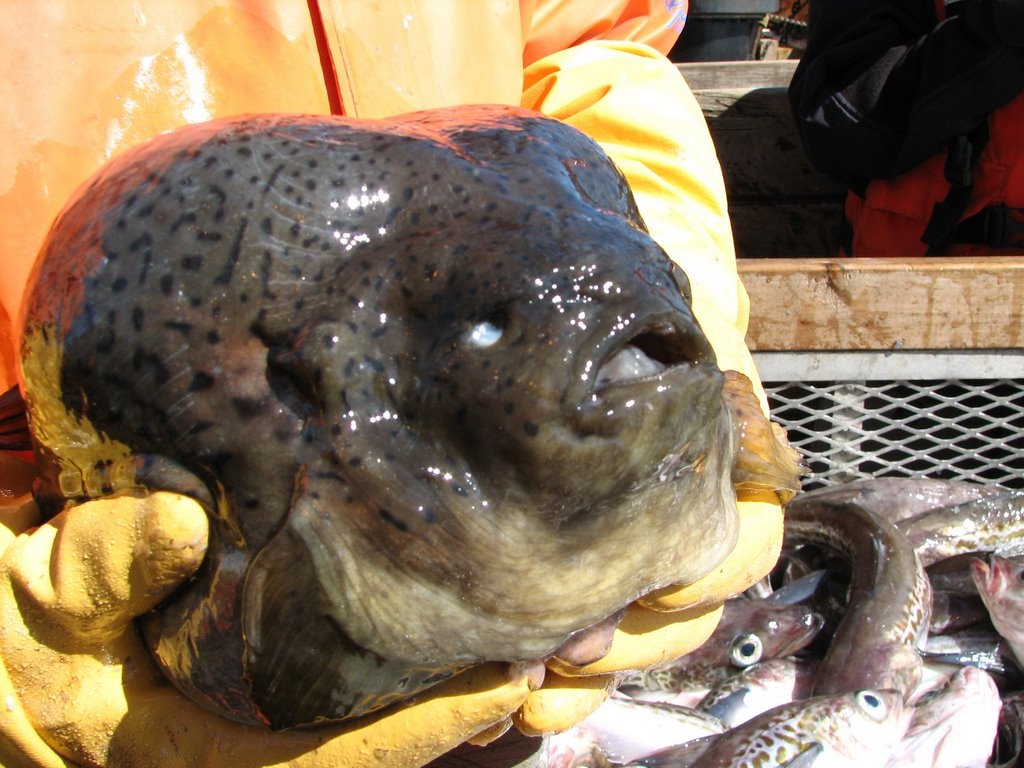
Smooth Lumpsucker fish.

Weather Data from the Bridge

Visibility: 14 miles
Wind Speed: 25 miles per hour
Sea Wave Height 7: feet
Water Temperature: 44.06 degrees
Air Temperature: 44.96 degrees
Pressure: 1009 Millibars

Personal Log

NOTE: We will arrive in the port of Dutch Harbor, Alaska on June 20. As the project draws to a close, I would like to evaluate how effective it was. There is a link to an electronic survey. I would like to ask students, teachers, parents, and other visitors to the site to take a few moments to let me know what you think of this idea. The survey is all electronic and only takes a minute or two to complete. Thank you in advance for your time. Click here to access the survey.

Well, we had pea soup for lunch today, also called storm soup by sailors. Legend is that when you serve pea soup, the weather will turn stormy, and sure enough, a gale is blowing nearby and the waves are picking up. The soup was great, though. As the ship rocks and rolls to the rhythm of the waves, lets take a closer look at how it moves. Sailors have lots of different terms for ships movement:

Pitch – refers to the up and down movement of the front, and back, or bow and stern of the ship

Yaw — when the ship spins from side to side.

Heave — When the entire ship moves up and down.

Roll — When the ship rocks from side to side.

Surge – When the ship jumps forward or backward.

Sway – When the ship jumps sideways.

Happy Father’s Day to all. A special hello to my own father, Elias, and my two son’s Nicky and Simon. I miss you, guys.

Science Log

Our trawl nets picked up the smooth lumpsucker fish near the bottom last night. This fish tends to say near the bottom and can inflate itself with water as a defense against predators. A good defense, I would say. Would you want to eat it?

Our survey continues. We brought in two hauls of fish this morning. Tamara is having less time on the bridge looking for birds in the last day or so. Her time is limited because we are fishing more and a large group of birds following a fishing net is not considered a natural occurrence, so she does not count them in her study. If the waves are too high, she cannot see the small birds in the troughs of the waves, so she can’t count during heavy seas, and right now, the seas are fairly heavy.

Question of the Day:

Look at the movements of the ship described above. When the ship drives into the wind and waves, sailors call it a corkscrew motion. Can you think why?

Answer to Yesterday’s Question

It is about 8:00 AM on Saturday morning. If the ship uses 2100 gallons of fuel a day, how many gallons of fuel will we need to get to Dutch Harbor on Tuesday Morning at about 8:00 AM?

It will take 3 days to reach Dutch Harbor. Since the ship uses 2100 gallons of fuel a day, we have to multiply 2100 x 3 which equals 6300 gallons of fuel. Enough for my car to drive 157500 miles. Wow.

Answers to Your Questions

Hello to James H from yesterday.

Thanks for writing

Lisa Kercher, June 17, 2006

NOAA Teacher at Sea
Lisa Kercher
Onboard NOAA Ship Fairweather
June 11 – 24, 2006

Assistant Survey Technician Stephanie Mills and Physical Scientist Megan Palmer prepare the CTD for deployment
Assistant Survey Technician Stephanie Mills and Scientist Megan Palmer prepare the CTD for deployment

Mission: Hydrographic and Fish Habitat Survey
Geographic Area: Alaska
Date: June 17, 2006

Science and Technology Log 

Today was an intense day of hydrography survey work! I received an introductory course to all the survey research that is done on the ship. The morning began with computer system problems – something that took teamwork and troubleshooting to fix. The system that logs data as the ship moves through the water was unable to track the ships movements. It was a team effort to get the system up and working again, but they were eventually successful.  As the ship moved through the Gorman Strait collecting data using a transducer that send multiple beams to the ocean floor the technicians were able to show me how they read and interpret that data. It is a complex process with many computer screens and complicated programs.

I assist in sending the CTD line to the bottom of the ocean

I am glad I was not in charge! Every few passes through the Gorman Strait we were also required to take a sample of the conditions of the ocean floor. A machine called an MVP (moving vessel profiler) is used to do that. Unfortunately this piece of equipment would not cooperate with us either and we were forced to use the manual version of the MVP called a CTD (conductivity, temperature, depth) device. Each instrument does the same thing in sampling the conditions on the ocean floor, but the benefit of the MVP is that the ship is not required to stop to collect data when using it, hence the name moving vessel profiler. The CTD on the other hand cannot be trusted to give accurate data while the ship is in motion. It is also operated manually; therefore several people need to be on hand to assist in its deployment into the water. I was able to help in this task. By the end of the day we had nearly finished surveying the Gorman Strait and completed several CTD deployments leaving us with a lot of data that needed to be processed later that evening.

Megan and I bring the CTD safely back to the ship.

Personal Log 

It was very interesting and fun to be part of the scientific research that went on today by surveying the Gorman Strait. I truly felt like I was accomplishing something of value, something that Alaskan fisherman and the cruise line industry will be able to use for years to come. It was great to be part of a team, working together to complete a task, just the way science students work in the laboratory to complete lab activities.

Question of the Day 

After acquiring the data from the CTD (conductivity, temperature, depth) device, we were able to produce a graph comparing the sound velocity (the speed at which sound travels) and the depth of the water. We found that as we lowered the CTD further into the water (increased the depth) the sound velocity decreased.  What type of relationship does sound velocity have to depth?  What would you expect to happen to the sound velocity as you raise the CTD out of the water (decrease depth)?

In the O-Lab, Stephanie and Megan begin to process the data that we collected.

Susan Just, June 16, 2006

NOAA Teacher at Sea
Susan Just
Onboard NOAA Ship Oregon II
June 15 – 30, 2006

Mission: Summer Groundfish Survey
Geographical Area: Gulf of Mexico
Date: June 16, 2006

Weather Data from Bridge 
Visibility: nautical miles  8-10 (nm)
Wind direction: 205.5 ◦
Wind speed: 11.3
Sea wave height: 0-1
Sea swell height: 1-2
Seawater temperature: 28.7
Sea level pressure: 1016.6
Cloud cover: 5/8 Altostratus and cirus

Science and Technology Log 

Tonight we began with a Neuston. Now I know that a Neuston is a rectangular frame to which has been attached a “sock” style net with a round portion at the bottom known as the “cod end.” The Neuston drags at the surface and catches sargassum (sea weed) and also plankton. Why? I’ll need to find out.

Next we pulled in the Bongos. These are round shaped “sock” nets with cod ends. In the cod ends, plankton and other sea life are collected from either the bottom or a maximum depth of 200 feet. The “catch” from both the Neustons and the Bongos are placed into jars with formaldehyde as a preservative. Forty-eight (48) hours later they are transferred to alcohol. They are then shipped out for processing.

The CTD was performed to capture water samples and hydrological data. All of the information is assembled and accompanies the samples to the lab for processing. Finally, we weighed and sorted the catch. Each species is identified by its scientific nomenclature which means we hear a great deal of latin in the wet lab.

Personal Log 

OK, I’m not quite as confused now. I had a great night’s sleep. I am beginning to learn some of the scientific names and I have gotten my fingers onto the computers that record the data regarding the organisms we classify. I’ve started having intelligent conversations with people and I am beginning to make sense of the activities aboard the ship.

Question of the Day 

What is the purpose of collecting the organisms in the Neuston and the Bongos? Answer: Plankton data is part of a long-term study regarding trends in fish populations.

Chris Harvey, June 16, 2006

NOAA Teacher at Sea
Chris Harvey
Onboard NOAA Ship Oscar Elton Sette
June 5 – July 4, 2006

Mission: Lobster Survey
Geographical Area: Central Pacific Ocean, Hawaii
Date: June 16, 2006

Science and Technology Log 

There is talk today that the President has made the Northwest Hawaiian Islands (NWHI) a national monument, whatever that means.  Bob informed me this morning and I am inclined to think he is the resident expert on the matter since he has the most riding on the line (i.e., his job is on the line). From my understanding, the NWHI would become like Rocky Mountain National Park or Yosemite National Park, and would be completely off limits to commercial fishing.  This would have a HUGE impact on the fishing industry out here, since many companies are awaiting Bob’s findings about whether or not the NWHI can sustain commercial lobster fishing or not.

Regardless of the rumor, we continued work today as normal.  So did the trade winds. So too did the swells. I was in a great position as a stacker to watch my fellow scientists cracking the traps against the threat of one breaking wave after another.  At one point I thought we would lose Aris, the little one, to a swell that must have been about 15-20 feet from trough to crest.  I was relieved to see that he was still cracking away after the water had subsided, and could only laugh at the great luck I had not to be a cracker today!  (That said, I think I can sense my waxen wings beginning to melt.)

We finished late again today. And other than fighting the rough seas, nothing much happened. I have taken to watching the swells- as my old man taught me- but from the surfer’s point of view instead of the scientist’s point of view.  I anticipate great waves in the distance while everyone else is “ooo-ing” and “awww-ing” at the ones near the ship. And it is always these distant waves that turn out to be trouble.  I see the swells in sets, unpredictable of when, except that I know that they will come.  And when I see a large face of a wave, I think to myself, its time to start paddling or else I’m going to miss it.  But I catch myself, sadly, when I remember that I am on a ship in the middle of the Pacific Ocean where I would not have a chance of catching a wave anyway–there is no bottom for the swells to catch.  One hope for me is that someone will catch the waves, when they touch ground and build into beautiful things.  Some surfer on the North Shore is doing exactly what I am doing, watching the set and waiting, because the swells I see today will be the surf he rides tomorrow.