Jacob Tanenbaum, June 16, 2006

NOAA Teacher at Sea
Jacob Tanenbaum
Onboard NOAA Ship Miller Freeman
June 1 – 30, 2006

Waves washing over the bow of NOAA Ship MILLER FREEMAN

Mission: Bering Sea Fisheries Research
Geographic Region: Bering Sea
Date: June 16, 2006

Weather Data from the Bridge

Visibility: 14 miles
Wind Speed: 27 miles per hour
Sea Wave Height: 7 feet
Water Temperature: 41.7 degrees
Air Temperature: 42.4 degrees
Pressure: 1013.8 Millibars

Plotting longitude and latitude

Personal Log

NOTE: We will arrive in the port of Dutch Harbor, Alaska on June 20. As the project draws to a close, I would like to evaluate how effective it was. There is a link to an electronic survey. I would like to ask students, teachers, parents, and other visitors to the site to take a few moments to let me know what you think of this idea. The survey is all electronic and only takes a minute or two to complete. Thank you in advance for your time. Click here to access the survey.  How do you find your way around when you can’t see any land? I spent some time with Ensign Lindsey Vandenberg, on NOAA Ship MILLER FREEMAN.

Plotting longitude and latitude

Every 30 minutes or so, the bridge officers take a “fix” on their position. How do they do it? When they are out at sea, they take the latitude and longitude from the GPS and plot their exact position on a chart. A GPS is a machine that uses satellites to display the exact longitude and Latitude on a screen. The charts also have the latitude and longitudes written on them, but there is a problem. The longitude and latitudes scales on the chart are on the side and bottom of the chart, not where the ship is located. Every so often, there is a line across the entire chart. The navigator must use a tool, like the same compass you might use in math class, to mark the distance to the exact point on a scale from a line on the chart. She can then use the same tool to mark the distance in the part of the chart where we actually are. This must be done for both the longitude and latitude of the ship.

Ploting the bearing on a map

When we are near land, we can use Terrestrial Navigation. This means we can use the distance to an object on the shore, such as a lighthouse, to find out wherewe are. With a large ship close to shore, it is very important that we know exactly where we are so that we don’t wind up in shallow water. Ensign Vandenberg uses a tool called an alidade to help her. She puts the alidade over a large compass outside of the ship. The instrument reflects the compass into the viewer so she can see both the object on shore and the exact compass heading. If she takes a few bearings to objects on shore, she can use tools to chart her exact position on the chart.

Science Log: 
I’ve been asking many of the people on the ship what becomes of the data that we are collecting. This survey will be used to set quotas for one of the most important fisheries in the world. Here is how it works. If too many fish are caught in an area, there will not be enough fish left for the species to come back the next year. That is bad for the fish, and bad for the fisherman. To prevent this “overfishing,”. A quota, or limit to the number of fish that can be safely caught, is established. Methods are put in place to make sure that all fishing boats in the area respect the quotas. Do you want to learn more? Take a look at this short video on the subject.

Question of the Day:
It is about 8:00 AM on Saturday morning. If the ship uses 2100 gallons of fuel a day, how many gallons of fuel will we need to get to Dutch Harbor on Tuesday Morning at about 8:00 AM?

Answers to Yesterday’s Question:
If our ship wants to do a trawl 50 meters below the surface, how much wire would it need.

The ship must put out two feet of wire for every one foot of depth. So you have to multiply 50 x 2 which gives 100 meters of wire. Each net has, not one, but three wires holding it to the ship. So you would need 3 wires. All three are 100 meters in length. That gives us 300 meters of wire to do our trawl.

Answers to Your Questions:
Hello to all who wrote today.

Colin, no seawater on the equipment yet. They have a couple of computers in the lab where we process fish that can be drenched with water and will still work. Maybe I need one of those.

Mrs. Z. Click here to see the route we have taken so far. I do not think it will give you exact miles, but you can get a good idea of our total.

Thanks for writing.

Susan Just, June 15, 2006

NOAA Teacher at Sea
Susan Just
Onboard NOAA Ship Oregon II
June 15 – 30, 2006

Mission: Summer Groundfish Survey
Geographical Area: Gulf of Mexico
Date: June 15, 2006

Weather Data from Bridge 
Visibility: 8-10 nautical miles (nm)
Wind direction: 147◦
Wind speed: 0.1
Sea wave height: 0
Swell wave height: 1
Seawater temperature: 28.6◦
Sea level pressure: 1015.9
Cloud cover: Light Haze

Science and Technology Log 

Our watch began at midnight.  When we arrived in the lab there were fish awaiting processing. All commercial quality shrimp were separated from the catch and a representative sample of the whole was reserved for sorting. The sort included many species which were identified, counted, and weighed.  Individual members of each species were measured and counted, up to twenty (20) per species.  Finally, Two hundred (200) brown shrimp were counted out, separated according to sex and then measured and weighed, individually. Bongo, Neuston and CTD samples were drawn but I was occupied with the fish catches. These catches were repeated constantly throughout the watch until noon at which time we were relieved. Bongo, Neuston and CTD samples were drawn but I was occupied with the fish catches.

Personal Log 

What have I gotten myself into?  I am on the night watch.  This means that my sleeping hours have changed, literally overnight, to between noon and midnight.  Dinnertime has disappeared. Lunch has become the big meal of the day.  I can best describe myself as confused.

So far my impression is that all members of the ship’s crew and the scientific party are professional, helpful and “nice.”  It is easy to recognize the ship’s officers because they are dressed in uniforms.  Everyone else is arrayed in their personal gear and, generally, there is a state of designed “disarray.”

Question of the Day 

What is the most important skill to be learned before becoming a field scientist? Common courtesy/etiquette (be polite!).

Chris Harvey, June 15, 2006

NOAA Teacher at Sea
Chris Harvey
Onboard NOAA Ship Oscar Elton Sette
June 5 – July 4, 2006

Mission: Lobster Survey
Geographical Area: Central Pacific Ocean, Hawaii
Date: June 15, 2006

Science and Technology Log 

I have lost track of time out here, both the date and the day of week, and am only reminded that it is the middle of June by the changing of the date on each of my new journal entries. It is kind of nice to forget about time for a while.  All I know of time is that I wake up each morning and go about the routine of hauling the traps in the morning and setting the traps in the evening. It has truly become Groundhog Day out here.  Regardless of what day it is, there is one thing I know I will be doing: waking and working. At least the scenery is nice!

The trade winds have continued to blow at a consistent 20 knots from the east, bringing with them long, deep swells and choppy surface waves.  It was much rougher today, and is still much rougher tonight, than it was on any other day.  So long, quiet Pacific.  As I stood on the bow of the ship to watch the sunset I thought about the fact that these trade winds have already come across my little Honduran island and have long since left.  The same winds, at some point, helped carry tropical storm Alberto across the Atlantic Ocean and towards my home in Jacksonville.  Of course, the energy and direction of the winds have fluctuated indefinitely over the time it takes them to wrap around the world, but they are essentially still the same. And I go back to my island in the Caribbean and think of how wonderful the trade winds are for keeping the mosquitoes and sand flies away during the summer time.  And how they inspired me to do anything and everything.  And now they make me sit outside long into the night to keep fresh air in my lungs and brain, and to keep a horizon of sorts on level ground for the sanity of my inner ear.

Many of the scientists have already given up the fight and have retired long before dinner. I, a fighter of nearly everything, have continued the battle against seasickness and am waiting for the trade winds to clear the clouds from the evening sky so that I might take in their beauty once again.  I am yet to miss a sunset on the ship, or a moment of utter awe at the night sky above me. And I doubt I will miss either the rest of the trip, even if I am ailing from the increased swells that can be anticipated from strong wind across a large section of water over a long time.  The view out here is definitely not something I get to see every day back home.

Work today was difficult with the waves splashing over the side of the ship.  I was a stacker today and found, at times, that stacking traps on the fantail was like climbing a mountain and dragging the traps behind. I would watch and wait for the ship to tilt bow up, so I could pull the traps “downhill” across the fantail in the rear of the ship.  Sometimes there was no “downhill” or “uphill” for that matter.  Sometimes we just bounced back and forth and rocked in almost every direction at the same time.  I guess my offerings of respect and love for the Pacific were not accepted.

In addition to having difficult trap drags on the deck, it took us much longer to move from the site where we hauled the traps to where we set them than it normally does.  (That sentence took a long time to write, not only because it seems grammatically deficient, but also because I had to sit and watch the mouse slide back and forth across the desk, dragging the curser on the screen along with it!  Talk about entertainment onboard a rocking ship!) In short, I ate a small dinner before I set the traps tonight.  So we were not done working until around 6:45 or so.  Long day. Plus I managed to get a nice sunburn.

I am again envious of our resident albatross.  I watched him soar back and forth and up and down, along the tips of the crests of waves up to the outline of the bottoms of clouds, without moving his wings once.  It was truly remarkable to watch him soar so freely without expending energy. A friend has informed me that only information can break the laws of physics. I think this albatross has come pretty darn close today.

Also, I will attach the “biographies” of two of the ship’s crew who have become good friends of mine. In an attempt to “practice” my creative writing and character development of stories, I am interviewing as many of the crewmen as possible and then writing a “fun” biography for the ships records.  Knowing how well I am at starting projects, and how poor I am at finishing them, these will probably be the only two I complete during the cruise.  But I am going to try to get everyone done before July 4, when we pull back into Honolulu. I make reference to many different people in my journal entries, and I have not done an adequate job of describing them.  I will try to fill you in on their characters and personalities, but no promises that you will be able to relate to my experiences out here any more or less as a result.

As you will read, Sarah is a junior officer on the ship and a peer of mine through age and life experience. She has taught me many things about the bridge and how the boat functions, as well as how the ship acquires weather data that it sends back to the National Weather Service every few hours, and of course, the Beauty of the evening sky and the many constellations that occupy its space.  We have a similar background that makes conversation easy and, as always, this conversation carries meaning for me because it constantly stretches my mind and perspective on how things in the world operate.

Bruce is the first of the crew that I met, and immediately struck a note with.  He is native Hawaiian, born in the house in the Oahu hills that his parent’s still live in today.  He has a wonderful laugh that makes me laugh every time I hear it, even if I do not hear the punch line of the joke or story he has just told.  He is about the happiest-go-lucky person I have ever met, with an outlook on life that is enviable.  I have been told that he can be mean at times.  But I haven’t seen that part of him.  And those times are so few and far between that his demeanor is positive in an almost excessive amount.  (When has positive attitude and behavior ever been excessive?  Certainly not in this world!)  He is one of those people who you can’t help but to hope that everything good happens to him in life- just because he is not expecting it to, and he is not demanding that it does.  I am learning a lot on this cruise from Bruce.

All quiet other than that. I thought of school today and made myself sick with worry.  So I stood up and walked to the very rear of the ship and watched the “screws” (props) churn up sky-blue water. I don’t like thinking of school.  There are so many things that I know I will have to do- so many things to worry about.  This is the last time I will mention it.  Worry is not for me.  Especially not here.

ENS Sarah Harris 

Junior Officer/Scientist

Sarah always wanted to be a professional clown when she grew up, but her feet were not large enough to fit into the shoes of a clown, and so she was turned down from the National Clown Academy upon her completion of high school.  Instead, she attended Long Island University in South Hampton, New York and earned a degree in marine biology. Upon completion of her degree, Sarah had a difficult time finding a job as a marine biologist.  Instead, she spent the better part of the two years after college working “stupid jobs” in order to make ends meet.

One day, working as a server in a Moroccan restaurant and as a bodyguard in a girls’ home, Sarah had an epiphany of sorts.  Memories of a Marine Ecology class came to mind.  She had used NOAA data in one of her class projects and had the sudden revelation that she should apply to become a NOAA officer. Sidestepping pressure to join the Air Force or Navy, she attended courses through the Merchant Marine Academy and within three months was qualified to begin work with NOAA onboard several ships.

In an interview for placement aboard a NOAA ship, Sarah commented that she would prefer to be on a Hawaii-based ship. She knew that the OSCAR ELTON SETTE had the best crew, and by far the best meals of any NOAA vessel.  As fortune revealed itself to Sarah, none of the other NOAA officers applied for Pacific ships, and she was given a position aboard the SETTE, based out of Honolulu, Hawaii.

Here she is at twenty-four years of age driving the SETTE through the waters of the Northwest Hawaiian Islands. Her unofficial capacity as an officer aboard the SETTE is to “drive the dang boat.” (As it would be, you can put a boat on a ship, but you CANNOT put a ship on a boat!). However, her official job description is to “help coordinate scientists and crew to accomplish the ship’s mission.”  (Proper use of the term “ship,” and might I add as an objective interviewer, very well stated!)

Sarah focuses daily on her short-term goal, which is to not jump overboard during the shark feeding frenzy that takes place on lobster cruises each afternoon.  In the long run, she hopes to use the GI Bill to help her earn her masters degree in the coming years.  She also aspires to become a treasure hunter and, if that does not work out, a pirate!

In her spare time, Sarah enjoys riding her beach cruiser.  Of course she cannot do that while at sea, so she also takes up the wonderfully entertaining hobby of reading.  Her fondest memory aboard the SETTE was the first day setting sail in January of 2006, when she earned the affectionate nickname of “Princess Spew Wog” for putting on a wonderful demonstration of what a hangover will do when mixed with Pacific swells and a moving ship.

Sarah carries a line with her everywhere she goes, whether out to sea or on land:

“Desire is Desire wherever you go. The Sun with not bleach it, or the Tides wash it away.”

Bruce Mokiao 

“Decky”

“Always look for the good in people.”

If there is a friendly face to know aboard the SETTE, and the warmest laughter to accompany a welcoming smile, it belongs to Bruce.  He has been a decky aboard the SETTE since it was commissioned on January 23, 2003.  Before that, he worked in the same capacity aboard the recently decommissioned NOAA vessel, the TOWNSEND CROMWELL.  Even further back than that, one might recognize Bruce’s voice in the song “Wipe Out.”  The royalties for the song have since run out, so Bruce takes to the sea to do what he has come to do very well.

Spending much of his time before NOAA as a commercial long-line tuna and marlin fishermen, he stumbled into his current position almost by accident.  A friend of his working on the Townsend Cromwell had given him an application many years back, which he held onto for two years before finally submitting it to NOAA.  Like many of us, he only knew NOAA for the National Weather Service, and not for its marine research.

On June 11, 2006 Bruce passed his five-year mark with NOAA, an accomplishment that he is very proud of. He has no real plans of leaving the ship any time soon, although he is finishing up testing with the Coast Guard when the ship is at port.  As long as tuna are being caught in the trolling lines and he has first dibs on a freshly beating tuna heart, Bruce will always be found aboard the SETTE.

Some of Bruce’s hobbies on the ship include making fun of the Teacher at Sea, and storytelling, both of which he does with such clear evidence of god-given talent it is amazing!  While the ship is not as sea, Bruce heads back to his parents home to spend time with them.  He has great love and respect for his mother and father, who make frequent appearances in his stories, and he strives to model their example in his own life for his daughter (21 years old) and his son (19 years old).  Bruce was recently married in January 2006 and takes great pride in his wife as well.

Some of the best advice that Bruce has to offer surrounds him, much like the quotes at the top and bottom of this page.

“I like to be happy every day.”
Jacob Tanenbaum, June 15 2006

NOAA Teacher at Sea
Jacob Tanenbaum
Onboard NOAA Ship Miller Freeman
June 1 – 30, 2006

Mission: Bering Sea Fisheries Research
Geographic Region: Bering Sea
Date: June 15, 2006

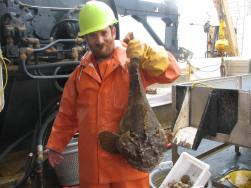
Jacob holds a monkfish
Holding up the catch

Weather Data from the Bridge

Visibility: 14 miles
Wind Speed:19.5 miles per hour
Sea Wave Height: 4 foot
Water Temperature: 44.4 degrees
Air Temperature: 44.2 degrees
Pressure: 1018.8 Millibars

Personal Log

main_engine-702351I got to thinking the other day that the engines on this ship have been running since we left port almost two weeks ago now. I started to wonder how they could stay running for so long and so I decided to ask Chief Engineer Steve Bus to tell me more about them. So put on your ear protection, and lets go to the engine room. The engine room on NOAA Ship MILLER FREEMAN is like a small city below the deck. In addition to the 2100 horsepower diesel engine that moves the ship forward, there are generators sufficient to power a small town. A research vessel, after all, needs a lot of electricity to run all the electronics we need. In addition, the engine room has equipment to make it’s own drinking water out of sea water. We cannot drink sea water because it has too much salt for our bodies to handle. The machines in the engine room take the salt out of the water and, clean it, and make it possible for us to drink it.

sewage-793154There are boilers to heat water and make steam to keep the ship warm. There are also machines that process waste water. Finally, there is shaft alley. This is the part of the engine room where a long metal shaft connects the diesel engine to the propeller. Take a look at this video to see shaft alley. The ship burns 2100 to 2200 gallons of fuel on an average day. Who keeps it all running? Chief Engineer Steve Bus and his crew. They are responsible for the ship from bow to stern.
How do you prepare for an emergency at sea? The same way you do in school. By drilling over and over. Today, we had a fire drill where the some of the crew got into firefighting gear and practiced what they would do in an actual emergency. Want to come along? Click here for a video.

water-737525Science Log

We had some interesting returns on the echosounder this morning. Take a look at the screen. You can clearly see the top and bottom of the water column. You can clearly see the different groups of fish. The echosounders can tell us so much information. When we put the nets down near the surface, we knew exactly what to expect. We did a trawl along the bottom of the sea floor last night and brought up some of the most interesting creatures I’ve ever seen. Here are a few.

This is a basket star, a kind of sea star. Its branches are hard and are divided into many different branches. The basket star uses all of these to catch plankton. In the center is the mouth.

This is a basket star, a kind of sea star. Its branches are hard and are divided into many different branches. The basket star uses all of these to catch plankton. In the center is the mouth.

crab-726932 Next, we have a lyre crab. Have you ever seen a hermit crab without a shell? This one lost his on the way up from the bottom.

bottom-777997

This next photo includes a huge sea star, a sea urchin, a hermit crab without its shell, a tanner crab and several fish called poachers. These fish have scales that are hard, almost like bone or a shell.
h-crab-706029 This last one is my personal favorite. The fish at the top of the screen is called a big mouthed sculpin. It has the biggest mouth of any fish I’ve ever seen. This fish stays on the bottom waiting for smaller fish to come by, and then… watch out! When it came up in the net, it had a smaller fish in its mouth.

Finally, we brought up a creature called a brittle star. It is a kind of sea star with soft tentacles. It moves very fast for a sea star. The arms can break easily, but don’t worry, they grow back. That’s why they call it a brittle star. Here is a video of a brittle star moving across the lab table.

Later on the same day, our ship was visited by some dall’s porpoises. Click here for a video

Question of the Day

Look at the answer to yesterday’s question. Let’s try another one. If our ship wants to do a trawl 50 meters below the surface, how much wire would it need.

Answer to Yesterday’s Question

How much wire would the ship need to let out if it wanted to put the nets 200 feet below the surface? Make sure to watch the video on nets before you try to answer the question.

The ship must put out two feet of wire for every one foot of depth. So you have to multiply 200 x 2 which gives 400 feet of wire. Wait, we are not finished yet. Each net has, not one, but three wires holding it to the ship. So you would need 3 wires. All three are 400 feet in length. That gives us 1200 feet of wire to do our trawl.

Answers to Your Questions

Hello to all who wrote today.

The MILLER FREEMAN does seem like home to me now. I have gotten used to the constant rocking of the ship and the routines of the day. I really enjoy being at sea. By the way, they had pizza for lunch, but I asked the cook to make me some fresh pollock that we caught and filleted last night.

Do people eat jellyfish? I asked our chief cook, Mr. Van Dyke. He told me many species of jellyfish are poisonous. Even those that are safe to touch with your hands. So, no, we don’t’ eat them here, but in some countries they do. We have caught many tons of fish, but more importantly, we have seen many fish without catching them using our echosounder. This device allows us to survey fish without capturing so many.

There are 34 people on board with us for this cruise. That will change next week when we get to port.

The squid felt slimy, but not much more slimy than most fish seem. I don’t recall it spraying anything.

Lisa Kercher, June 15, 2006

NOAA Teacher at Sea
Lisa Kercher
Onboard NOAA Ship Fairweather
June 11 – 24, 2006

Back in beautiful Homer, AK, boats are  constantly coming and going
Back in beautiful Homer, AK, boats are constantly coming and going

Mission: Hydrographic and Fish Habitat Survey
Geographic Area: Alaska
Date: June 15, 2006

Science and Technology Log 

Last night we spent time in port back in Homer, AK. I had to opportunity to explore the small town but unfortunately did not take my camera with me. What was I thinking!?! This morning we left port and began our journey towards the Shumagin Islands where we will be conducting hydrography studies. The greatest part of today’s leg so far was the amazing volcano that I got to see. We passed by the St. Augustine volcano before noon. This area is known for its volcanoes and small earthquakes.

A view from under the pier

The Saint Augustine volcano! Notice the steam coming out of the top and the deep trenches down the side of the mountain.

kercher_log5c

Question(s) of the Day 

  1.  Of the three types of geologic plate boundaries: convergent, divergent, and transform fault; deduce what type(s) of boundary must be near the St. Augustine volcano and this area of Alaska?
  2.  When was the last time that the St. Augustine volcano erupted?