Welcome to my Teacher at Sea blog! My name is Kate Schafer, and I am a teacher at the Upper School at the Harker School in San Jose, California, right in the middle of Silicon Valley. I teach biology, marine biology and food science to mostly juniors and seniors. This may seem like an odd mix of courses, but I am so fortunate to be able to teach students about all my favorite topics. I have heard that the food is delicious on the Oregon II, and I’m interested in learning more about the challenges of keeping a crew fed when you can’t pop down to the corner grocery store when you realize that you forgot to order that crucial ingredient. I have spent many hours on the ocean, and spent six years studying coral reefs in Belize, Central America, but I’ve never been to sea on a research vessel. I’m thrilled to have that opportunity and to share it with my students.
My husband, daughter and I ready to tour the Atlantis in Woods Hole, MA this summer
Weather Data
The weather has been a big topic of conversation of late here in San Jose. Two weekends ago set all-time record high temperatures throughout the Bay Area, even along the coast. Living in close proximity to the ocean, we expect relief from that rare hot day to come rather quickly, but the heat lingered for days. We’re back to normal fall weather as I head off, though. This morning is cool and seasonable. I know from growing up in Atlanta, Georgia, that I’m heading to warm and humid conditions on the other end of my travels.
Science and Technology Log
On this research cruise, we will be conducting long line surveys, looking at shark and red snapper populations in the Gulf of Mexico. I will report more on where we are going and what we’re studying once the leg of the survey begins. There are multiple legs to the survey, and I’ll be joining in for the fourth and final leg. It has been a tumultuous time in the Gulf over the past few weeks, and it will be interesting to learn about how this has impacted the coastal waters in the area we will be surveying.
Personal Log
I am sitting in the airport in San Jose, ready to board my flight to Dallas, en route to Gulfport and my final destination of Pascagoula, Mississippi. Wow! It’s been a frantic week of getting all sorts of last minute pieces put together to allow things to, hopefully, run smoothly in my absence. It’s early morning, so I’m still in a bit of a groggy cloud, making the fact that I’m actually heading off on this adventure all the more unreal.
Even the grogginess cannot stifle my excitement, though, as I head off for two weeks of working with scientists and collecting data. As I was packing last night, I couldn’t help but be reminded of all the previous trips I packed for more than 15 years ago to conduct field research on coral reefs in Belize. I was studying a type of crustacean called the stomatopod and learning about the role that they play in coral reef ecosystems, how they interact with other species like pygmy octopus and crabs, their main source of prey.
I am thrilled to be heading out on this research trip and feel so fortunate for the opportunity. I look forward to questions from you about what we are doing and learning on our voyage. Check in frequently for updated blog posts once the trip commences.
Did You Know?
That the Oregon II has been part of the NOAA fleet since 1977?
Mission: Juvenile Pollock Survey Geographic Area of Cruise: Gulf of Alaska Date: September 13, 2017
Weather Data from the Bridge
Latitude: 55 06.6N
Longitude:158 39.5W
Winds: 20 S
Temperature: 11 degrees Celsius (51.8 degrees Fahrenheit)
Up. Down. Up. Down. Left. Right….no I’m not in an aerobics class. High winds and seas cause my chair to slide across the floor as I type.
Thus far we’ve been working 12 hour shifts, 24 hours a day. Today we’re sitting about twirling our thumbs as 12 feet seas toss us about. It’s not too bad actually, but it is bad enough to make operations unsafe for both crew and equipment. I’ve been impressed with the safety first culture on-board the Oscar Dyson. Hopefully, it’ll calm down soon, and we can start operations again.
Science and Technology Log
Ship support systems for power, water, sewage treatment, and heating/cooling are all several levels below the main deck, which makes ship engineers a bit like vessel moles. These hard working guys ensure important life support systems work smoothly. Highlights from my time with them include a lesson on the evaporator and engines.
The evaporator, which for some reason I keep calling the vaporizer, produces the fresh water drinking supply. The evaporator works by drawing in cold seawater and then uses excess engine heat to evaporate, or separate, the freshwater from the seawater. The remaining salt is discarded as waste. On average, the evaporator produces approximately 1,400 gallons of water per day.
*Side note: the chief engineer decided vaporizer sounds a lot more interesting than evaporator. Personally, I feel like vaporizer is what Star Trek-y people would have called the system on their ships.
The evaporator in action.
The Oscar Dyson has 4 generators on board, two large, and two small. The generators are coupled with the engines. Combined they produce the electricity for the ship’s motors and onboard electrical needs, such as lights, computers, scientific equipment, etc.
I even got to see the prop shaft.
Personal Log
This week I also spent time in the Galley with Ava and Adam. (For those of you who know me, it’s no surprise that I befriended those in charge of food.) Read on for a summary of Ava’s life at sea story.
Me: How did you get your start as a galley cook?
Ava: When I was about 30 years old, a friend talked me into applying to be a deck hand.
Me: Wait. A deck hand?
Ava: That’s right. I was hired on to a ship and was about to set out for the first time when both the chief steward and 2nd cook on a different ship quit. My CO asked if I cook to which I replied “for my kids,” which was good enough for him. They immediately flew me out to the other ship where I became the 2nd cook. 12 years later I’m now a Chief Steward.
Me: Wow! Going from cooking for your kids to cooking for about forty crew members must have been a huge change. How did that go?
Ava: To be honest, I made a lot phone calls to my mom that first year. She helped me out a lot by giving me recipes and helping me figure out how to increase the serving sizes. Over the years I’ve paid attention to other galley cooks so I now have a lot of recipes that are my own and also borrowed.
Me: What exactly does a Chief Steward do?
Ava: The Chief Steward oversees the running of the galley, orders food and supplies, plans menus, and supervises the 2nd Cook. I’m a little different in that I also get in there to cook, clean, and wash dishes alongside my 2nd Cook. I feel like I can’t ask him to do something that I’m not willing to do too.
Me: So you didn’t actually go to school to be a chef. Did you have to get any certifications along the way?
Ava: When I first started out, certifications weren’t required. Now they are, and I have certifications in food safety and handling.
There are schools for vessel cooking though. My daughter just recently graduated from seafarers school. The school is totally free, except for the cost of your certification at the very end. For people interested in cooking as a career, it’s a great alternative to other, more expensive college/culinary school options. Now she’s traveling the world, doing a job she loves, and putting a lot of money into her savings.
Me: Talking with crew members on this ship, the one thing they all say is how hard it is to be away from family for long stretches of time. A lot of them are on the ship for ten months out of the year, and they do that for years and years. It’s interesting that your daughter decided to follow in your footsteps after experiencing that separation firsthand.
Ava: I was surprised too. Being away from friends and family is very hard on ship crew. Luckily for me, my husband is also part of the NOAA crew system so we get to work and travel together. Nowadays I’m part of the augment program so I get to set my own schedule. It gives me more flexibility to stay home and be a grandma!
Did You Know?
Nautical miles are based on the circumference of the earth and is 1 minute of latitude. 1 nautical mile equals 1.1508 statue miles.
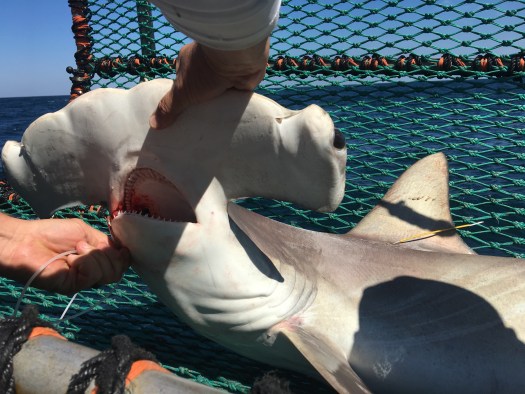
We have been sampling along the coast of Florida, Alabama, Mississippi, Louisiana, and Texas at varying depths – “A” stations ( 5- 30 fathoms), “B” stations (30 -100 fathoms) and “C” stations (100 – 200 fathoms). A fathom is six feet or approximately 2 meters. The longlines are baited the same – mackerel on 100 hooks spread out across one nautical mile and then set on the bottom of the ocean. As we reel in the long line, the click and whine of the line as it’s being spooled, we wait in anticipation of what it may bring. Each station yields something different and you never know what you are going to get. Below is a list of some of the animals we have encountered.
baby hammerhead
Shark species: blacktip, sharpnose, blacknose, scalloped hammerhead, great hammerhead, bull, tiger, spinner and bonnet head (to learn more about each of these species, select it for a NOAA fact sheet).
Scallop Hammerhead in cradle
Other animals: southern ray, cownose ray, roughtail stingray, red snapper, black drum, sharksuckers, catfish, red drum, yellowedge grouper, king snake eels and even some blue crabs.
southern stingray
catfish
So why survey sharks? Did you know that people are one of only a few species that prey on sharks — killer whales and other sharks are the others– killing over a hundred million per year?* Sharks are apex or top predators in an ocean food web and play a vital role in keeping this food web in balance. With the hunting of sharks as well as over fishing the prey that sharks eat we are disturbing the natural balance. This survey is used determine the number of sharks and other species that are present in the Atlantic Ocean including the Caribbean Sea and the Gulf of Mexico. With these numbers, the National Marine Fisheries Service (NOAA Fisheries) regulate how many sharks, swordfish and tuna can be harvested without impacting the total population. In the Pacific Ocean, NOAA fisheries work with fisheries in developing how to best manage sharks.
red snapper
Apex predators in any ecosystem are vital to the health of that ecosystem. These top predators keep numbers down on the more abundant prey species and keep their numbers in check. Here is a simplified illustration of what happens when we lose apex (top) predators in an ocean ecosystem.
If the number of sharks goes down then the food the sharks eat goes up (forage fish) because they are not being eaten by the sharks. With more of those forage fish around their need for food – the zooplankton – increase. With more forage fish eating the zooplankton there are less zooplankton and their numbers begin to decrease. If there are less zooplankton then the phytoplankton numbers increase because the zooplankton aren’t around the eat them. Removing top predators from any ecosystem can have an impact on the entire food web and this phenomena is called a trophic cascade.
Removing Hook
Personal Log
When people think of sharks, they think of the movie Jaws. Unfortunately this has given sharks a bad reputation and has vilified these animals that are essential to the ocean food webs. Sure, there have been shark attacks, but did you know that more people are killed each year by electrocution by Christmas tree lights than by shark attacks? When people imagine sharks, they think of enormous sharks that eat everything in sight. The reality is that sharks come in all sizes and shapes. A mature Atlantic sharpnose shark will only get to be 3.5 feet long with the world’s smallest shark being the dwarf lantern shark that can fit in the palm of your hand. The largest shark is the harmless-to-human whale sharks that feeds primarily on plankton and can grow up to 60 feet!
Smooth-hound (Mustelus Sinusmexicalis)
Did You Know?
Scientists can tell the age of a shark by counting the rings on its vertebrae (similar to how they can tell how old a tree is by counting its rings!)
Question of the day:
What is an example of a terrestrial (land) apex predator that has been over hunted impacting the entire ecosystem?
Now that I am back home, I have some time to think about the variety of animals I saw on the cruise and do a little more research about them. Many of the animals we caught in our net have the ability to light up. This adaptation is known as bioluminescence. Different species use bioluminescence in different ways to help them survive.
Myctophids are a type of fish also known as a lantern fish. These small fish can occupy the same habitat as juvenile pollock, and we caught several of them at our sampling stations. I got a chance to look at them closely and I could see small spots, called photophores, along the sides of their bodies. In dark waters, these spots have bioluminescent properties. Lantern fish can control when to light them up and how bright the spots will glow.
There are many different species of lantern fish. Scientists have learned that each species has a unique pattern of bioluminescent photophores along the sides of their bodies. For this reason, it is believed that lantern fish use their bioluminescent properties to help them find a mate.
The photophores can be seen as white spots on this lantern fish. Image courtesy of NOAA.
Lantern fish also have bioluminescent areas on the underside of their bodies. This adaptation helps them achieve what is known as counter-illumination. In the ocean, a predator can be lurking in the dark waters below its prey. Since many things feed on lantern fish, it is important for them to have a way to camouflage into the environment. When a predator looks up, during the day, a fish that is lit up on the bottom will blend in with the lighter waters above it, making it hard to see.
The camouflaging effect of counter-illumination can be seen when this bioluminescent fish lights up its underside. Image courtesy of the Smithsonian.
Lots of animals use this technique to help them hide from predators, including squid. We pulled in many small squid in with our samples that had patterns of photophores on them. Depending on the species, squid also use bioluminescence to attract mates and to confuse predators.
The pattern of lighted photophores can be seen on this squid. Image courtesy of NOAA.
In addition to fish and crustaceans, we also pulled in a variety of jellyfish. Jellyfish also have bioluminescence characteristics. Many jellyfish use light as a way to protect themselves from predators. When a jellyfish is threatened by a predator, it flashes in a rapid pattern. This signals other fish nearby that it is being hunted. This can alert larger predators, who may be hunting the predator of the jellyfish. The larger predator will then swoop in after the jellyfish’s predator, allowing the jellyfish to escape!
Many jellyfish use bioluminescence to protect themselves from predators. Image courtesy of NOAA.
Personal log
I have been home for over a week and I think I finally have my land legs back again. Looking back on the experience, there were so many little surprises that came with living onboard a ship. One thing I noticed is that I got much better at walking around the longer I was there. I learned to always have one hand available to grab a railing or brace myself during any sudden movements. However, I never quite mastered getting a decent workout in on the treadmill! Another surprise is how relaxing the rocking of the ship could be when I laid down. I thought the movement would be distracting, but it actually helped me drift off to sleep!
Did you know?
There are many superstitions surrounding life on a ship. It is considered bad luck to have bananas on board and whistling is discouraged. Whistling onboard a ship is thought to bring on wind and storms!
Weather from the bridge: 48o F, 1-2 knot wind from, Completely overcast,
Executive Officer Michael Gonsalves in his overwhelming (because of all the things he does) office.
An Interview with XO (Executive Officer) Michael Gonsalves
How long have you been with NOAA?
I’ve been here for 13 years…I’ve been on the ship for about 6 months.
What brought you into NOAA?
Certainly I’ve always had an interest in the ocean and in the environment. One of my undergraduate degrees was in oceanography. So I think that’s what steered me towards NOAA. My other undergraduate degree was in math, so I liked the idea of being able to apply math in an environmental setting.
As a side note, XO Gonsalves also has a MS in Applied Math and a PhD in Marine Science
What is it that you do – what is the job of an executive officer?
The Executive Officer position is second in command. So if anything should happen to the CO (commanding officer) I would assume command. Though that is a contingency; that is not my actual job… All administrative work goes through me. For example, the budget, payroll, travel, performance, disciplinary actions, scheduling, arranging all port logistics, …getting augmenters to come out to the ship to fill in… I do everything to allow everyone else to do their job. My job is not the mission. My job is keeping the ship safe and logistically ready to execute the mission.
This is typically a step on the path to becoming a CO, is that correct?
Typically, that’s right. Usually the average NOAA Corps officer will have four sea assignments. Basically every five years, give or take, they will be going back to sea. The first will be as a junior officer, an Ensign. The second is as an Operations Officer who will be coordinating the mission [of that ship]. On the hydro ships that means coordinating the hydrographic science. The third sea tour will be as an Executive Officer and the fourth, around year 15, will be as a Commanding Officer.
I know that NOAA Corp officers spend roughly two years at sea and then three at a land billet. So what has your path been thus far?
I lingered in nearly all of my assignments by a little bit. My first assignment was here, on Fairweather, just after she was reactivated. It was a very skeletal crew. I had opportunities to be trained quickly. We only had two launches at the time. There were so few boats, there were so few people trained in doing things, it was in the crew’s best interest to qualify me because very few people were qualified to do anything.
My first land assignment was at the University of Southern Mississippi. It was a double billet. Number one, it was full-time university training. There was also working with an inter-agency group, The Naval Oceanographic Office and the Army Corps of Engineers, both also conduct survey operations. It’s a nice inter-agency group with similar issues and problems and we can share best practices and things like that. Their particular niche is airborne laser bathymetry, so they are working from an airplane.
Back to University of Southern Mississippi, what was the degree you were pursuing?
Initially it was a master’s degree as a one year program. As it happened, there was a project that I could work on of suitable interest to the joint LIDAR center. We all agreed that I could continue to work on it. The university felt that it was dissertation worthy. So I received my Ph.D.
What was your second tour at sea?
My second tour was as an Operations Officer on Fairweather’s sister ship, Ranier. All three of my assignments thus far have been on hydro ships. There is something to be said for that. It’s a little bit tricky to bring someone in from the outside. It’s a steep learning curve.
My second land assignment was working for the NOAA Operations Branch in Washington D.C. This is a part of the Hydrographic Surveys Division. They govern the field units on the large scale. So I was making the big decisions for what the hydro ships would be responsible for during that particular season. We determined what type of coverage would be needed in each area. That is then the information that the Operations Officer on the ship is working from.
What made NOAA so attractive to you?
Giving service to the US government was a big part. I happily pay my taxes. I appreciate having a police force and knowing that my meat is safe. So that was definitely a big part of it. But NOAA also has a unique mission that I found attractive. And the variety is important to me – just knowing that every couple of years the assignment will change.
And what is it that keeps you going while you’re out here at sea? Is there anything you miss or are looking forward to when this sea tour is complete?
People are tricky and a lot of my job involves personnel. The whole job keeps me going, really. I do miss Washington, D.C. – the public transport, the museums and the shows. There are so many things to do and see. There are a lot of jobs in D.C. and I am making clear that is a desire for the next land billet.
Junior officers, ENS Calderon and ENS Carroll on the bridge working on the computer navigation system. Both also are intimately involved with the surveying program.
A quick one question survey for the junior officers on the ship… Why did you choose a hydrographic survey ship? A collection of the answers I received are below:
To have the opportunity to be much more deeply involved with the science
My background is math or math/mapping
To be in Alaska
This is a route to pursue flying with NOAA Corps
Didn’t want the technical skills developed in prior work to go to waste
Had already worked on fisheries ships with Department of Fish and Wildlife
As with all officers in our uniformed services; NOAA Corps officers have had degrees conferred prior to service. Most of the degrees are math and science. The hydrographic survey ships tend to attract the math, physics, and geological science degrees for obvious reasons. Many then go on to pursue advanced degrees as did LCDR Gonsalves, the focus of my interview.
An interview with Kathy Brandts and Tyrone Baker; Ships Stewards
How long have you been cooking for NOAA Ships and what were you doing prior?
Chief Cook Tyrone Baker, master of the grill
T: I cooked for the Navy for 20 years out of school. When I finished, I went to work for a casino for a while – still cooking. Then NOAA called me up (he had put in an application a while before and forgotten about it) and here I am! That was back in 2005.
K: I started out in the Coast Guard…I wanted to be a bosun [boatswain] mate, which is what everyone wants to do. But it was going to take a long time to make grade, and hardly anyone wants to be a cook because it’s a lot of work. I decided to go through their school, which was two months. That was when it started, in ’94. My first ship assignment was the Polar Star, which was an ice breaker.
Kathy Brandts, Queen of the kitchen – also known as the Chief Steward. This is the day she let me cook a bit with her.
Kathy, why did you get out of the Coast Guard and what finally got you to NOAA?
K: All of the land assignments were being contracted out to [private companies]. So I was never going to get a chance to cook on land. So I decided that wasn’t for me. I got out after my four and a half years. I landed in Seattle, and that’s where NOAA was based. I had heard about them when I was in the Coast Guard. I knew they were hiring, talked with somebody, and essentially got hired on the spot. And I was in Alaska! I started out in the augmentation pool, I worked on Discovery and then on Ranier. Then a permanent position came up and I jumped at it. I didn’t really get along with the Chief Steward, though – so I left NOAA and worked for Keystone Ski Resorts in Colorado at their stables. [She spent several years on land at that point.]
The Chief Steward on Ranier tracked me down [in Colorado] and asked me to come back. There was talk of Fairweather coming back online and I wanted the Chief Steward job. I didn’t have the experience at that point, so I took a year off and went to Culinary School. I applied for the Chief Steward job on Fairweather and got it. I was on Fairweather from 2004-2013. [She is now the Chief Steward on Ruben Lasker, another NOAA ship, but is helping out on this leg]
Why be a ship cook?
T: I’ve been so many places and seen so many things I wouldn’t have otherwise seen. I’ve really been all around the world. I’ve been in almost every port of the world. How many people can say that? I wouldn’t trade it.
K: I was a restaurant cook for a while. I hated it. You’re either going 9 million miles an hour or there’s nothing. There’s a lot of alcoholism and drug use in that industry and they live a different life. The service industry… (laughs). And people are either sailors or they’re not. I think, much to my chagrin, I found it out after I quit the Coast Guard.
T: Yes, I agree. I’m a sailor. It was why I joined the Navy.
What are the best and most rewarding things about what you do?
T: I just really like it. I enjoy the cooking. I enjoy the work.
K: I like good food and I like when people are appreciative of what I do. And we’re all stuck out here together, why not make it the best that it can be. Meal time is what you look forward to when you’re on a ship.
GVA Dave – he just joined Fairweather and was actually helping out the stewards on this leg, but now he’s where he’s supposed to be in the deck department.
Crew member of the Day: Electronic Technician (ET) Charlie Goertzen
Charlie Goertzen, tech guy extraordinaire!
So today as we pulled into Kodiak, the news came in that the long awaited new televisions were here. Immediately, Charlie was notified. And he will work hours to make sure that each crew member has a working television in their room.
He is the guy that keeps the connectivity going in pretty difficult conditions. He has to spend a lot of time keeping various computer components talking to each other. He has to content with all of the complaints about lack of bandwidth, slowness of applications, slowness of wireless – and he does his best to keep things optimized and clean and efficient all the time. Two of the things he loves the most are the ocean and working with electronic components. He gets both of them all the time!