Jacob Tanenbaum, The Survey Continues, May 25, 2007

NOAA Teacher At Sea: Jacob Tanenbaum
NOAA Ship MILLER FREEMAN
Mission: Fisheries Oceanography Coordinated Investigations
Day 7: May 25, 2007
Weather Data from the Bridge:
Visibility: 8 Miles
Wind Speed 11 Kts:Sea Wave Height 4 Feet:
Water Temperature: 5.1 Degrees Celsius
Air Temperature: 6.0 Degrees Celsius
Pressure: 1004.2 Mbs
Personal Log:
The low pressure system over our heads just will not let up. The seas are a little flatter today and I could sleep last night without feeling like I was going to wind up on the floor. In any ship, the sections at either end, the bow (front) or stern (back) move up and down the most with the heavy seas. I’m way up in the bow. My cabin really moves. What does a cabin look like on a research ship? Well here is mine. Tomorrow we will take a tour of the entire ship.

IMG_8561-799324

Stateroom
Stateroom

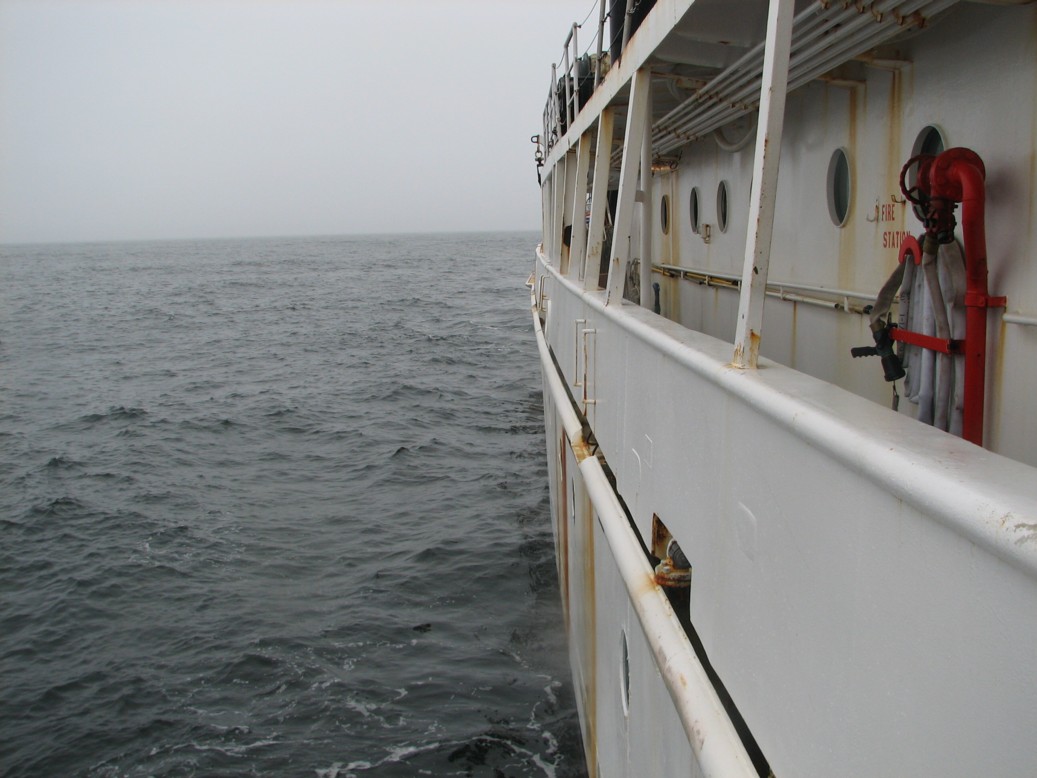
I am also including some unique views of the ship while out at sea. As you can see from the photos, the weather just does not want change.

Science Log:

The work on the survey continues. The ship is moving in a kind of search pattern around the northern section of the Gulf of Alaska. We are looking for Pollock larvae and we are finding many. We are also finding lots of other cool creatures in our nets. Here are a few:

We are still waiting to hear more data from Excalibur, though it has returned some. Keep watching the drifter site for more information. In the mean time, here are some intersting creatures from today’s catch. You can double click the photos to make them larger.

Segmented Worm
Segmented Worm
Segmented Worm
Segmented Worm

This segmented worm usually stays near the bottom. When it is ready to lay eggs, it swims up into the water and scatters its eggs in the water as it goes. We must have caught this one as it moved up off the bottom to lay eggs. Can you see the eggs in the photos?

Crab Zoea
Crab Zoea

These are crab zoea. They will become like the crabs we think of later in their lives. The long spines may prevent preditors from eating them.


A smiling face
A smiling face
Copepod
Copepod

This little copepod hasn’t been eating crabbie paddies! You can see its dinner both before and after it has been eaten in this photo.

Thecosomate Pteropods.


The shell fish here are called thecosomate pteropods. Theco means shell and somate means body. ptero means wing and pod means foot. So they look like
shelled winged feet when they move. They eat phytoplankton (tiny plants).

larvaceans
larvaceans


The long white creatures are larvaceans. They move their tails to make a current that moves food into their bodies. Look how many different kinds of
creatures there are in these samples we are bringing up!

Question of the Day
I gave you the water temperature and air temperature in Celsius. Can you find them in Fahrenheit?Answers to your Questions

The ship was pointed at 51 degrees and moving at 355 degrees because the wind was blowing against the side of the ship.

Yes, Morgan, we do experiments 24 hours a day, 7 days a week. Work continues today as always. Toby, I’ll be back next week.

Marty. Great to hear from you. I will say hello to all. Thanks for the great information.

Hello to Mrs. Bolte’s Class, Amanda and Ms. Stern’s Class. Great to hear from you all.

Mrs. Freeley’s Class, we catch only baby fish, but have seen many other kinds besides Pollock. The scientists, however, are mainly interested in Pollock.
We eat lots of different kinds of fish. Last night, we had halibut. Tonight, we are having shrimp. And I’m hungry.

We do take showers, but you have to hang on when the ship moves or you wind up leaving the shower a little before you planed on it.

How do we sleep? In a “rack,” which is ship-talk for a bed. It is kind of fun in high seas to lay flat on your rack and look at your feet going way up
above your head as the ship rolls over the waves. It takes a little getting used to. There is a picture of my cabin on the blog today for you. There are no
animals on the ship this year.

Thanks to all for writing.

Jacob Tanenbaum, What are we seeing?, May 24, 2007

NOAA Teacher At Sea: Jacob Tanenbaum
NOAA Ship MILLER FREEMAN
Mission: Fisheries Oceanography Coordinated Investigations
Day 6: May 24, 2007
Weather Data from the Bridge:
Visibility: 3 Miles
Wind Speed: 23 Kts.Sea Wave Height: 6 Feet
Water Temperature: 4.2 Degrees Celsius
Air Temperature: 6.6 Degrees Celsius
Pressure: MbsScience LogLast night around 2:00 AM Alaska Time, we reached the point in the cruise where we were in the right position to deploy our drifter buoy. We stood
on the back deck and gently lowered it over the side of the ship and watched it disappear into the Alaska night. Bon Voyage, Excalibur! Click here for the video. We heard from the buoy several times overnight
and now are having trouble reaching the website. I will download data as soon as I can.

It was wonderful to see Excalibur in the water. I’m proud of each and every student in Mrs. O’Brien’s Class who worked so hard to put this buoy
together. I can’t wait to get back and see the data from the buoy with you.

Another gale has blown in and we are again facing winds above 30 kts. And heavy seas. The work has been tough but we have been able to continue.
Well, you have seen how the nets work, you have seen how the lab works. Today I would like to show you some of the incredible creatures that have
come up in our tiny nets. The little bowl of reddish liquid you see here holds an incredible array of creatures which make up the plankton
community in the Gulf of Alaska. Lets meet a few. We will need a microscope to do it. All of the pictures you see here were taken with a camera
mounted to a microscope. But first, will the real Sheldon Plankton from Sponge Bob, please stand up…

Sheldon Plankton
Sheldon Plankton
This is what Sheldon Plankton really looks like. He is a copepod. And he eats phytoplankton (plants), not crabby patties.
Baby Crab
Baby Crab

This is a baby crab. The female carries the eggs. When they hatch, the float around for a few weeks eating phytoplankton. They go through 3 major
stages. This is the last one. At this stage, the crab settles to the bottom and starts to begin life as a bottom dweller. At each stage, these
creatures shed a shell, swell with water, form a new shell and then expel the water they absorbed before they grew the new shell. They use the extra
space to for real grow before they have to shed again.

Pollock larvae
Pollock larvae

This is a pollock larvae. That may be the yolk sack from the egg under its mouth! It absorbs the yolk and then must begin to look for food on its own. You
are seeing this pollocks first real meal.

Baby Sculpin
Baby Sculpin
This is a baby Sculpin. At this stage, the fish begin to settle to the bottom. It now begins to have the colors it needs to hide from predators above.
The don’t have fins quite yet. They are not really able to swim against the current. Right now, since it is too young to swim, it is considered
plankton. Look how large they eyes are. Why do you think they need such large eyes?

Hatched Shrimp
Hatched Shrimp

This is what shrimp look like, when they first hatch. Shrimp like this look red to us, but in deeper water, where there is less sunlight, the red looks
black, not red. What great camouflage!

Pollock larvae
Pollock larvae

Another pollock larvae. You can clearly see the eye and mouth. This pollock does not have a yolk sack, so it has been eating on its own. Do you see the
food in its stomach? I wonder what it has been eating. Take a guess and write a comment. There are no real fins at all on this fish, yet. See how small the
stomach is? These fish have to find food and find it fast. They cannot store energy in their bodies yet.

Zooplankton and Phytoplankton
hyperiid amphipod
hyperiid amphipod

Several different types of zooplankton gather around some phytoplankton. Here is the beginning of the food web. The algae in this photo serve as food for
many little creatures in the sea. The copepods and other small creatures eat the tiny phytoplankton, and in turn are eaten by small fish.

This is a a creature called a hyperiid amphipod. It is related to a sand flea. They live in plankton. These particular ones will borrow into the surface of
jellyfish and ride around on them. They are tiny hitchhikers. They have plates on their abdomen are where the babies stay when they are young.

Personal Log

The storm is really raging now and the seas are getting bigger. I am NOT seasick! That is because of Lt. Sean. He gave me some medicine which seems to
be working. Now it is kind of fun to be out her since the waves don’t’ bother me any more. I kind of enjoy the ride now. We are REALLY moving up and
down.Question of the DayThis is a complex one, but an important concept if you ever sail. The ship was facing 51 degrees (North East) when we let off the buoy, but the ship
was moving 355 degrees (almost true north). Why would the ship face one way and travel a slightly different way?

HINT: Think about how the storm affects the ship

Answers to your Questions

The answer to yesterday’s question was 12.5 x 24 or 300 kts. or about 345 miles. Congratulations all who got this one correct. Of course, we stop a lot
here to take measurements, so we do not go that far in a day.

Many of you asked how much we are finding. I’ll tell you about that in a day or so when the scientists have a better idea of what the data is showing.

We have not seen any sharks. That’s OK with me.

Was it scary to be at sea in a storm? Not really. You get used to the waves after a while. They are really rolling along right now. But people here are
used to it and go about their lives as people do.

What was the deepest ocean we have sailed over so far? 240 meters. We will sail over deeper water in the days to come.

Josh, I’m not getting sea-sick anymore, and there are not many people on deck right now because of the storm. Most of us are inside unless we have to
work.

Amanda, good question. I don’t really feel the tides, but I know they are there. They just move us around a little, but what I really feel are the
waves from the storm.

Hello as well to Lt. Sean’s family. Thanks so much for writing. I’m glad you are enjoying the blog.

Hello to Nazilla and Earnest in Seattle. Thanks for writing.

Jacob Tanenbaum, June 20, 2006

NOAA Teacher at Sea
Jacob Tanenbaum
Onboard NOAA Ship Miller Freeman
June 1 – 30, 2006

eagle-727518Mission: Bering Sea Fisheries Research
Geographic Region: Bering Sea
Date: June 20, 2006

Personal Log 

Click here if you would like to look at the results from the Pollock Study.

This will be my last blog entry for the trip. As the project draws to a close, I would like to evaluate how effective it was. There is a link to an electronic survey. I would like to ask students, teachers, parents, and other visitors to the site to take a few moments to let me know what you think of this idea. The survey is all electronic and only takes a minute or two to complete. Thank you in advance for your time. Click here to access the survey.

Wild horses
Wild horses

Today we arrived in the port of Dutch Harbor, Alaska early this morning. Dutch Harbor is a fishing village full of interesting sites to see and people to meet. It is also where the fishing vessels featured in the TV show “Deadliest Catch” are based, so a lot of you may have heard of it. The highlights of an incredible included a herd of wild horses. Their ancestors were released here by US soldiers stationed here after World War 2. We couldn’t figure out what they ate until… 🙂

Climbing in mountains full of wildflowers.
Standing on the glacier

An incredible end to an incredible journey. Thanks all of you for sharing it with me.

Final Thoughts:

I would like to express my profound appreciation to everyone on board NOAA Ship MILLER FREEMAN. Every single person on board the ship welcomed me and helped me in every possible way with this project. The scientists and ships personnel answered every one of mine and your thousands of questions and opened the entire ship up to us all. Many of the people on board shared the blog with their families back home, and the notes I have gotten back from them touched me deeply.

To Commander Gallagher, Lieutenant Commander Boland, Dr. Paul Walline and the everyone on board, thank you for making this project possible and for all you have done to welcome me on board the ship these past weeks.

Thank you as well to the Jennifer Hammond, Elizabeth McMahon and everyone at the Teacher At Sea program for creating this wonderful opportunity and for all of your support before and during the project.

Thank you as well to all of you back home for taking part in this experiment. Teaching and learning with you from the Bering Sea has been one of the most rewarding experiences of my 19 years as an educator.

Have a great summer vacation everyone.

Jacob Tanenbaum, June 19, 2006

NOAA Teacher at Sea
Jacob Tanenbaum
Onboard NOAA Ship Miller Freeman
June 1 – 30, 2006

Mission: Bering Sea Fisheries Research
Geographic Region: Bering Sea
Date: June 19, 2006

Mountains in the clouds

Weather Data from the Bridge

Visibility: Less than 1 mile
Wind Speed: 14 miles per hour
Sea Wave Height: 2 feet
Water Temperature: 44.06 degrees
Air Temperature: 41.36 degrees
Pressure: 1018 Millibars

Personal Log

NOTE: We will arrive in the port of Dutch Harbor, Alaska on June 20. As the project draws to a close, I would like to evaluate how effective it was. There is a link to an electronic survey. I would like to ask students, teachers, parents, and other visitors to the site to take a few moments to let me know what you think of this idea. The survey is all electronic and only takes a minute or two to complete. Thank you in advance for your time. Click here to access the survey. I should be able to send one more blog tomorrow from Dutch Harbor. Check back and I will let you know what being on land again feels like. Dutch Harbor should be an interesting place.

Large sea stars from the bottom trawl

We passed the Pribilof Islands. Home to one of the largest worlds largest gatherings of marine mammals in the summer time. I got up to see the islands at midnight and again when we passed a second one at 4:00 AM. We were covered in fog both times, so we will have to come back another day. At midnight, the sun had not yet set. Our sun set last night at about 12:15 and it took a long time to grow dark after that. The sky began to grow light at about 5:00 and it came up a little after 6. A short night.

Science Log

Last night we had another bottom trawl. This one had some of the largest sea stars I have ever seen. One was close to a foot long.  In addition, there is a coral here called sea raspberry. It is common along the Bering Sea Shelf. I thought coral was only in tropical seas, but here it is in the Bering Sea. Since it is our last day at sea, I spoke to our Chief Scientist Dr. Paul Walline from the Alaska Fisheries Science Center in Seattle Washington about what we have learned so far.

Coral called a sea raspberry

What does the data tell you so far? 

What do you expect to see in the next legs?

What will happen to the data at the end of the cruise? 

Finally, we were testing a platform today that can open nets at different depths. We lowered the platform to about 390 feet before a technical problem forced us to raise it back up to the surface. As an experiment of my own, I tied a bag of Styrofoam cups to the platform to see what the pressure at that depth would do to them. Want to see more? Click here for a video

Question of the Day:

What was your favorite part about participating in this project. Please write and let me know.

Jacob Tanenbaum, June 18, 2006

NOAA Teacher at Sea
Jacob Tanenbaum
Onboard NOAA Ship Miller Freeman
June 1 – 30, 2006

Mission: Bering Sea Fisheries Research
Geographic Region: Bering Sea
Date: June 18, 2006

mike-781281Weather Data from the Bridge

Visibility: 10 miles
Wind Speed: 9 miles per hour
Sea Wave Height:2 feet
Water Temperature:41 degrees
Air Temperature:40.8 degrees
Pressure: 1013 Millibars

Personal Log

NOTE: We will arrive in the port of Dutch Harbor, Alaska on June 20. As the project draws to a close, I would like to evaluate how effective it was. There is a link to an electronic survey. I would like to ask students, teachers, parents, and other visitors to the site to take a few moments to let me know what you think of this idea. The survey is all electronic and only takes a minute or two to complete. Thank you in advance for your time. Click here to access the survey.

Sea cucumbers
Sea cucumbers

By now, you have met many of the interesting people aboard NOAA ship MILLER FREEMAN. There are three groups of people aboard these ships. The officers on the ship are part of the NOAA Corps. This is a uniformed service of the United States consisting of about 300 officers who complete rigorous training and hold ranks, like ensign, or commander. They are in charge of ships operations and stand watch on the bridge. The scientists aboard are mostly from NOAA research labs, like the Alaska Fisheries Science Center in Seattle. Many of the other members of the crew are civilian wage mariners. These are professional sailors who handle many of the day to day operations of the ship. Some, such as Chief Engineer Bus, have made their home on this ship for close to 30 years. Other sailors are contract workers who come aboard for a few months, go home and take a break, then join the crew of another ship for a different sort of cruise. Sometimes they are on research vessels, sometimes they are on freighters, sometimes they are on tankers. Today, lets meet able-bodied seaman, or AB Michael O’Neal. Click each question to listen to the answer.

Mud star
Mud star

What do you do on board the NOAA Ship MILLER FREEMAN?

Tell us about what you have done and where you have gone on some of the other ships you have been on.

Where are some of the other jobs you have had at sea?

What does it take to be an able-bodied seaman?

Science Log:

Smile! Here are big mouth sculpins. Once close up and one in the hands of Dr. Mikhail Stepanenko.
Smile! This is a big mouth sculpin.

We had another in a series of amazing bottom trawls last night. When the nets trawl along the bottom out here, some of the most interesting creatures of all get swept into our nets. Creatures that live on the bottom are often stranger looking for a few reasons. They are adapted to blend into the bottom so that predators cannot see them. They often wind up looking like rocks or plants as a kind of defense. They are also adapted to an environment with higher pressure and less light than the surface. Some of their adaptations can also make them look very different from other fish. Since they don’t have to worry about predators below them, these fish may be flat and have both their eyes sticking up. These creatures often do not need to be fast swimmers, since their defense is to blend into the environment rather than swim away when predators approach. The basket of sea cucumbers was one of the strangest things I’ve seen so far. These sticky blobs are not plants. They are sea creatures that live on the bottom of the sea and sift through the sand or water to find food. There are several different kinds of sea cucumbers in this basket. Can you see the different types? Mud stars, on the other hand, are soft and sticky, not like the sea stars we have at home. It may be called a mud star, but I think looks like Patrick from Sponge Bob.

Here is another kind of sculpin with large fins that look like the wings of a butterfly, called a Butterfly sculpin.
Another kind of sculpin with large fins that look like the wings of a butterfly, called a Butterfly sculpin.

Question of the Day

Now that you have seen some of the different jobs aboard NOAA Ship MILLER FREEMAN, if you were on a ship, which job would you prefer? Write me a comment on the blog and let me know!

Answer to Yesterday’s Question

Look at the movements of the ship described above. When the ship drives into the wind and waves, sailors call it a corkscrew motion. Can you think why?

A corkscrew motion occurs when the ship is struck by waves in such a way that it moves in several motions at once. In other words, it may pitch, roll, surge, and sway all at the same time. I’m getting a funny feeling in my stomach just thinking about it!

Answers to Your Questions

Sorry that I left off the link from Friday where you can see the position of the ship. Here it is. Fair warning, the site was down for most of today, so if it does not work, just try again later.

http://info.nmao.noaa.gov/shiptracker/Ship.aspx?ship=Miller%20Freeman

After we put in to port, I’ll have a day or two in Dutch Harbor to look around, before I can get a flight in to Anchorage. After that, I’ll be visiting some friends and family out west before I head back east. Thanks for writing.