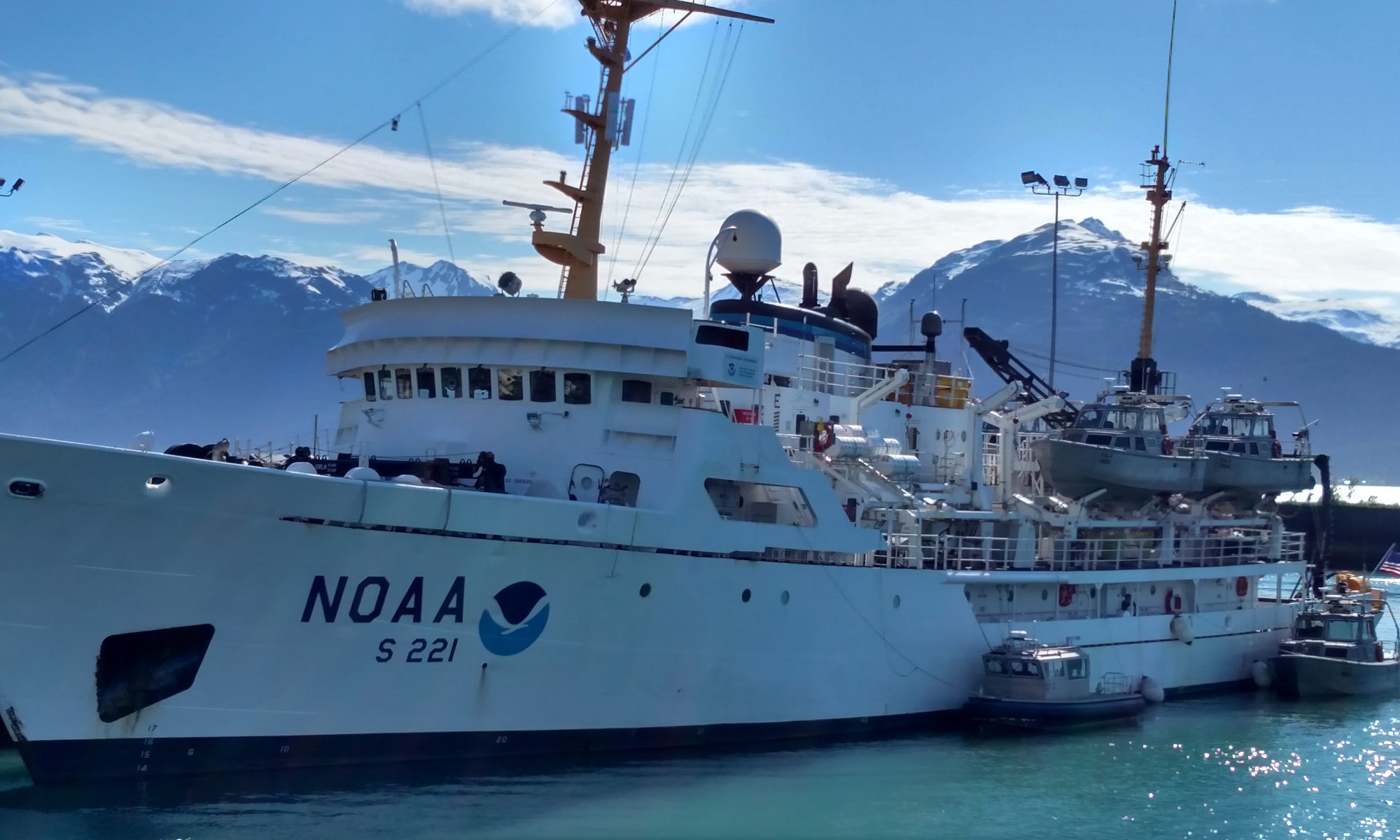
Denise Harrington: Spotlight on a Blacktip Shark, September 24, 2016

NOAA Teacher at Sea

Denise Harrington

Aboard NOAA Ship Oregon II

September 16-30, 2016

Mission: Longline Survey

Geographic Area: Gulf of Mexico

Date: Saturday, September 24, 2016

Yesterday, I was in the crew lounge, working on my next blog, when Eric Hoffmayer, Research Fishery Biologist, called me out to the fantail to see a large deceased female blacktip shark (Carcharhinus limbatus) brought in that morning.

countershade-2
(deceased) female blacktip shark

The contrast between the gray and white skin caught my eye. The countershading, a dark grey color on top, had a light bronze hue that sparkled in the light. A white band starting at its pectoral fins widened until it merged with the belly at the anal fin.

If there is a mortality, the science team uses the opportunity to dissect the fish, collecting additional information otherwise unavailable.  When we catch a shark, we release it as quickly as possible. The urgency of getting shark back in the water keeps me from carefully studying its detailed characteristics.

While I understand the loss of this particular shark touches many of us on board, understanding the species better through the loss is a practical, necessary approach to  managing the marine environment.  Without an in depth understanding of sharks, their populations, life cycle, and reproduction, there is no way we can sustainably manage fish populations.  Some may find dissection unappealing, and for those folks you may want to skip this blog, but not without first thanking the biologists who do this work compassionately. They keep our fisheries sustainable.

I rubbed my hand from the head to the tail.  It was smooth. Rubbing from the tail to the head felt just the opposite, rough like sandpaper.  Tiny dermal denticles allow sharks to move quickly through the water, an adaptation so amazing, it was put to use by designers of swimsuits in the Olympics and engineers of Navy ships.

Eric, Adam, and Chrissy, placed the shark on the table.  Eric cut the shark and pulled out a long sack that looked like empty sausage casing. At the end of the casing was a tiny shark pup. Trey joined the crew as they took data on each of the six pups.  The shark was pregnant.

The golden colored egg casing is still about six times the size of the pup, giving it plenty of room to grow.
The golden colored egg envelope is still about six times the size of the pup, giving it plenty of room to grow.


Here, Trey stretches out the casing demonstrating the significant amount of room left for the pup to grow,
Here, Fisheries Biologist Eric Hoffmayer stretches out the egg envelope demonstrating the significant amount of room left for the pup to grow. In the background you can see the egg envelop of another pup stretching across the table.

From the number of pups in a brood, to the possibility of immaculate shark conception, the reproduction of blacktip sharks is of interest to fishery biologists.  Without knowing all about shark reproduction, how many, and where sharks reproduce, we cannot sustainably manage this species, or fisheries in general.

Trey takes me through each stage of reproduction. The blacktip shark is viviparous, like humans. They are born alive, “vivi,” and develop within the mother getting nutrients through a placenta.

life-cycle-diagram


Egg

The shark life cycle begins in the female shark’s ovary with an egg.   Trey hands me an ovary that holds the eggs.  It is a large sack of many small red pinpoint size spheres with about 6 larger marble like balls from the high in the body cavity. These eggs wait to mature until the conditions are ideal for reproduction. At that time, the follicle ruptures, and the egg comes out.

Shark eggs are fertilized inside the female’s body.  The male fills his siphon sacs with seawater, and then flexes his abdomen to shoot the seawater and semen into the female shark through his clasper.

p1090186
Now I understand why we spin the clasper of a male shark to determine its maturity.  I was able to rotate this male Gulf smoothhound shark (Mustellus sinusmexicanus) clasper 180 degrees and reported it as an adult male.

Embryo/Pup

The male blacktip shark is often ready to mate in April to May but the females are often not ready to reproduce until June or July.  With many sharks, blacktip sharks included, the sperm can remain inside the female until she is ready to reproduce.  When that moment arrives, the egg slips through the ostium, down the anterior oviduct, and into the oviducal gland where it is fertilized by the sperm. For the blacktip shark, usually 4-6 eggs will be fertilized and develop into shark pups.  Females usually reproduce every other year.


large-yolk-little-shark
Note that different sharks have different modes of reproduction.  For example, Cuban dogfish (Squalus cubensis) reproduce through aplacental viviparity or ovoviviparity. The tiny pups you see here nourish themselves with the yolk “ovo” and have no placental connection to their mother.  They are born live “vivi,” and able to feed and protect themselves. Some sharks are oviparous, which means they lay eggs  that hatch later.

Initially,  the blacktip shark embryo uses the nutrients from a yolk sac for about 10-11 weeks. For the remaining time inside the mother, the pup increasingly gets nutrients from the mother through a placenta.  They are viviparous and remain inside the mother for approximately 10 months until they can survive on their own.  I held a pup, still connected to its mother by the umbilical cord. The similarities between human reproduction and blacktip shark reproduction surprised me so much I began to question the classification of viviparous sharks as fish.


holding-pup
I held a pup, still connected to its mother by the umbilical cord.

Immature Shark/Juvenile

For approximately two months after it is born, the immature shark has an umbilicus (like a bellybutton) that is still open.  During this phase of the life cycle it is called a neonate, or newborn.  It is otherwise just like a miniature adult blacktip shark.  It can hunt and hide from predators (including its mother).

immature-blacktip
Here, Eric and Evan Pettis, Texas Parks and Wildlife Fisheries Biologist, tag, measure, and release an immature blacktip shark.

 Mature Shark/Adult

Individual sharks even within a species mature at different rates, just like humans.  Generally, a male blacktip shark matures between 4-5 years of age, and females between 7-8 years.

p1080498
This 1385 mm male mature blacktip shark was brought in our second day of the survey.

How does the shark’s life cycle affect fisheries?

Evolutionarily speaking, placental viviparity gave the blacktip shark and others like it an advantage; the shark is born able to survive independently.  But this adaptation has also has a downside:  the females only produce a small brood, unlike other fish that use broadcast fertilization.

During gestation, the female shark we caught most likely migrated to our current location just off the coast of the Mississippi from deeper waters.  Called the Fertile Fisheries Crescent, the Mississippi Sound is one the most productive seafood areas in the nation.  Another risk to this species is pollution and over-fishing in the fragile estuarine habitat, the juvenile shark’s nursery.

There is demand for the high quality blacktip shark meat, the fins, and even the carcasses for fishmeal. The work NOAA Fisheries does to collect information about shark populations over time and over a wide geographic area not only helps keep blacktip shark populations sustainable, it also gives us valuable information about the ocean’s health in general.


Personal Log

Today I reached the half way point in my time on the longline crew.  I finally feel like I am getting into the groove, finding my way around the ship, and meeting people beyond my fishing buddies.  Valerie  McCaskill, Chief Steward, and her cousin, Ava Speights cook amazing seafood, grilled veggies, and au gratin everything. Ava showed me a great piece of exercise equipment, Jacob’s Ladder, to allow me to enjoy the great food guilt free.

Each station, each day, a new adventure.

Denise Harrington: First Day Jitters, September 21, 2016

NOAA Teacher at Sea

Denise Harrington

Aboard NOAA Ship Oregon II

September 16-30, 2016

Mission: Longline Survey

Geographic Area: Gulf of Mexico

Date: Wednesday, September 21, 2016

My first day on the longline cruise seems so long ago with three days of work under my belt. The night before my first shift, just like when school starts, I couldn’t sleep. Trying to prepare was futile. I was lost, lost in the wet lab, lost in my stateroom, lost in the mess. I needed to get some gloves on and get to work, learning the best way I know how: by doing.

At noon, I stepped out the fantail, life vest, gloves, hard hat, and sunscreen on, nervous, but ready to work. The Gulf of Mexico horizon was dotted with oil rigs, like a prairie full of farmhouses. Heat waves rose from the black deck.

Fifteen minutes before arriving at our first station, our science team, Field Party Chief Dr. Trey Driggers, Field Biologist Paul Felts, Research Biologist Kevin Rademacher, NOAA Science Writer Matt Ellis, and I began to prepare for our first station by baiting the hooks with mackerel (Scomber scombrus). I learned quickly that boots and grubby clothes are ideal for this task.

p1080831
Once all the hooks were baited, Chief Boatswain Tim Martin and Paul release a high flyer, a large pole with a buoy at the bottom and a reflective metal flag on top.

The buoy, connected to the boat by the longline, bobbed off toward the horizon.

p1080429

Tim attached the first of three weights to anchor the line to the sea floor.

p1080443

As the longline stretched across the sea, Kevin attached a numbered tag to the baited hook held by Paul.

p1080326

Paul passed the baited, tagged hook to Tim, who attached 100 hooks, evenly spaced, to the one mile longline.

p1080838
On another station, Paul attached numbers to the gangion (clip, short line, and baited hook) held by Trey.  Each station we change roles, which I appreciate.

Setting the longline is rather predictable, so with Rush and Van Halen salting the air, we talked about our kids, dogs, riots in the news, and science, of course. The tags will help us track the fish we catch. After a fish is released or processed, the data is entered in the computer and shared with the scientific community. Maybe one of these tagged fish will end up in one of the many scientific papers Trey publishes on sharks each year.

The line soaked for an hour waiting for snapper, tilefish, eels, sharks, and other fish to bite. While the line soaked, Mike Conway, skilled fisherman, and I lowered the CTD, a piece of equipment that measures conductivity (salinity), temperature, and depth, into the water.  Once the biologists know how salty, cold, and deep the water is, they can make better predictions about the species of fish we will find.

We attached a bag holding a few Styrofoam cups to see how the weight of the water above it would affect the cup.  Just imagine the adaptations creatures of the deep must have developed to respond to this pressure!

The ship circled back to hook #1 to give each hook equal time in the water. After an hour, we all walked up to the well deck, toward the bow or front of the ship. We pulled in the first highflyer and weight.  We pulled in the hooks, some with bait, and some without.  After 50 hooks, the middle weight came up. We still didn’t have a fish.  I began to wonder if we’d catch anything at all.  No data is still data, I thought. “Fish on eighty three!” I heard someone yell.   I wake from my reverie, and get my gloves on.

p1080432

It was a blacknose shark (Carcharhinus acronotus), “pound for pound, the meanest shark in the water,” says Trey. He would know, he’s the shark expert. It came up fighting, but was no match for Kevin who carefully managed to get length, weight, and sex data before releasing it back into sea.

With one shark to process, the three scientists were able to analyze the sexual maturity of the male blacknose together. I learned that an adult male shark’s claspers are hard and rotate 180˚, allowing them to penetrate a female shark. An immature shark’s claspers are soft and do not rotate. For each male shark, we need to collect this data about its sex stage.

p1080172
Here, you can see Trey rotating the clasper 180 degrees.

Later, Paul talked about moments like these, where the field biologists work side by side with research biologists from all different units in the lab.  Some research biologists, he notes, never get into the field.  But Kevin, Trey, and others like them have a much more well-rounded understanding of the data collected and how it is done because of the time they spend in the field.

Fortunately, the transition from inexperienced to novice was gradual. The second line was just as easy as the first, we only brought in two fish, one shark and one red snapper (Lutjanus campechanus).

For the red snapper, we removed the otoliths, which people often call ear bones, to determine age, and gonads to determine reproductive status.  I say “we” but really the scientists accomplished this difficult feat. I just learned how to process the samples they collected and record the data as they dissected the fish.

We set the longline a third time. The highflyer bobbed toward the orange sun, low on the horizon. The ship turned around, and after an hour of soaking, we went to the well deck toward the front of the ship to pull in the longline.  The sky was dark, the stars spread out above us.

“One!” “Three!” “Seven!” “Nine!”  The numbers of tags with fish on the line were being called out faster than we could manage.  It seemed like every other hook had a shark on it.  Two hours later we had collected twenty-eight Atlantic sharpnose (Rhizoprionodon terraenovae) sharks and had one snapper to process. Too busy working to take pictures, I have nothing to document my transition from inexperienced to novice except this data sheet.  Guess who took all this data? Me!

p1080265

Personal Log

NOAA Ship Oregon II is small, every bunk is filled.  I share a stateroom with the second in command, Executive Officer (XO) Lecia Salerno, and am thankful she is such a flexible roommate, making a place for me where space is hard to come by.

Last night, as I lay in my bunk above XO Salerno and her office, I felt like Garth on Wayne’s World, the thought that “I’m not worthy” entering my head.  All members of the crew are talented, experienced, and hard-working, from the bridge, to the galley, to the engine room, and out on the deck where we work. I’ve made a few mistakes.   I took the nasty thought and threw it overboard, like the slimy king snake eels (Ophichthus rex) we pull from the deep.

o-rex
King Snake Eel (Ophichthus rex)

In the morning I grabbed a cup of coffee, facing the risk of being the least experienced, slowest crew member to learn, with curiosity and perseverance.  First day jitters gone, I’m learning by doing.

Denise Harrington: Joining the Longline Crew, September 17, 2016


NOAA Teacher at Sea

Denise Harrington

Aboard NOAA Ship Oregon II

September 16-30, 2016

Mission: Longline Survey

Geographic Area: Gulf of Mexico

Date: Saturday, September 17, 2016

Location: 29 2.113’ N  93o 24.5’ W

Weather from the Bridge: 28.9C (dry bulb), Wind 6 knots @ 250o, overcast, 2-3′ SE swell.

Science Log

The muggy afternoon air did not dampen my excitement as we left Galveston, Texas, aboard the National Oceanic and Atmospheric Administration (NOAA) Ship Oregon II.  I am a NOAA Teacher at Sea, participating in a  longline survey in the Gulf of Mexico, surveying sharks and bony fish.

p1080113
Fellow volunteers Leah Rucker and Evan Pettis and I bid farewell to Galveston. Evidence of human influence, such as development, oil rigs, barges, and ships, is not hard to spot. Photo: Matt Ellis, NOAA

When I tell people about the Teacher at Sea program, they assume I teach high school or college, not second grade in rural Tillamook, Oregon.  Yet spend a few moments with any seven or eight year old and you will find they demonstrate significant potential as scientists through their questions, observations, and predictions. Listen to them in action, documented by Oregon Public Broadcasting, at their annual Day at the Bay field trip.

Just as with language acquisition, exposing the young mind to the process of scientific inquiry ensures we will have a greater pool of scientists to manage our natural resources as we age.  By inviting elementary teachers to participate in the Teacher at Sea program, NOAA makes it clear that the earlier we get kids out in the field, the better.

dsc_0447
Each year, my students develop a science or engineering project based upon their interests.  Here, South Prairie Elementary students survey invertebrates along a line transect as part of a watershed program with partners at Sam Case Elementary School in Newport, Oregon.

The NOAA Teacher at Sea program will connect my students with scientists Dr. Trey Driggers, Paul Felts, Dr. Eric Hoffmayer, Adam Pollock, Kevin Rademacher, and Chrissy Stepongzi, as they catch sharks, snapper, and other fish that inhabit the Gulf of Mexico. The data they collect is part of the Red Snapper/Shark Bottom Longline Survey that began in 1995. The survey, broken into four legs or parts each year, provides life cycle and population information about many marine species over a greater geographic distance and longer period of time than any other study of its kind.

Leg IV is the last leg of the survey.  After a long season of data collection, scientists, sailors, and fishermen will be able to return to their families.

My twelve hour shift begins tomorrow, September 17, at noon, and will continue each day from noon until midnight until the most eastern station near Panama City, Florida, is surveyed.  Imagine working 12 hour shifts, daily, for two weeks straight!  The crew is working through the day and night, sleeping when they can, so shutting the heavy metal doors gently and refraining from talking in the passageways is essential.  I got lucky on the day shift:  my hours are closer to those of a teacher and the transition back to the classroom will be smoother than if I were on the night shift.

Approximately 200 stations, or geographic points, are surveyed in four legs. Assume we divide the stations equally among the legs, and the first three legs met their goal. Leg IV is twelve days in duration. How many stations do we need to survey each day (on average) to complete the data collection process?  This math problem might be a bit challenging for my second graders, but it is on my mind.

p1080124
Mulling over the enormity of our task, Skilled Fisherman Chuck Godwin and I discuss which 49 year old fisherman will end up with more wrinkles at the end of the survey. Currently, I am in the lead, but I bet he’s hiding some behind those shades. Photo: Mike Conway

I wonder what kind of sharks we will catch.  Looking back at the results of the 2015 cruise report, I learned that there was one big winner.  More than half of the sharks caught were Atlantic sharpnose (Rhizoprionodon terraenovae) sharks. Other significant populations of sharks were the blacktip (Carcharhinus limbatus) shark, the sandbar (Carcharhinus plumbeus) shark, and the blacknose (Carcharhinus acronotus) shark.

My fellow Teacher at Sea, Barney Peterson, participated in Leg II of the 2016 survey, and by reading her blog I learned that the shark they caught the most was the sandbar shark.

p1080106
In this sample data sheet from the end of Leg III, all but one of the sharks caught were the blacknose sharks.  Notice the condition of two of the fish caught: “heads only.”  Imagine what happened to them!


Personal Log

My first memory of a shark was when my brother, an avid lifetime fisherman, took several buses across the San Francisco Bay area to go fishing.  That afternoon, he came home on the bus with a huge shark he’d caught.  I was mesmerized. We were poor at the time and food was hard to come by, but mom or dad insisted sharks were not edible, and Greg was told to bury the shark in the yard.  Our dog, Pumpkin, would not comply, and dug that shark up for days after, the overpowering smell reminding us of our poor choice. I don’t have many regrets, but looking back on that day, I wish we had done something differently with the shark.

Since then, I’ve learned that shark is a popular source of protein in the diets of people around the world, and is growing in popularity in the United States.  In our survey area, Fisheries Biologist Eric Hoffmayer tells me that blacktip and sandbar sharks are the two most commercially important species. Our survey is a multispecies survey, with benefits beyond these two species and far beyond our imagination. As demand increases, so too does the need for careful management to keep fisheries sustainable. I am honored to be part of a crew working to ensure that we understand, value, and respect our one world ocean and the animals that inhabit it.

Barney Peterson: Who Works on NOAA Ship OREGON II? Part 3

NOAA Teacher a Sea

Barney Peterson

Aboard NOAA Ship Oregon II

August 13 – 28, 2016

Mission: Long Line Survey

Geographic Area: Gulf of Mexico

Date: Sunday, August 28, 2016

Weather Data is not available for this post because I am writing from the Biloxi/Gulfport Airport.

DECK CREW

Tim Martin, Chief Boatswain, aboard the OREGON II, left his home near the Missouri River in Missouri for a life at sea and has never looked back.  Like many young people from the Central United States, he joined the Navy as a way to travel and see the rest of the world.  He was stationed on Whidbey Island in Washington State and when he left the Navy he became a commercial fisherman working out of Seattle to fish the in Bering Sea from Dutch Harbor, Alaska.

Tim left the west coast and the world of commercial fishing to join NOAA and worked for several years on ships out of NOAA Woods Hole Station in Massachusetts.   Eventually, through connections he made on the job, he was able to transfer to the Southeastern Fisheries group.  He has worked on several ships, but has been on the OREGON II for 12 years.  Tim likes his job for the variety and activity it provides, as well as opportunities to apply his mind to ways to make things work better or more smoothly.  He attributes much of the good working atmosphere on the ship to the stability of many crew members who have worked together for years.   As a long-time civilian mariner with NOAA he appreciates the importance of believing in what you are doing and being committed to being successful.

But, Tim Martin is not so one dimensional that you can know him as just a mariner.  Talking with him I learned that he is a voracious reader with very eclectic tastes in literature.  He devours everything from travel accounts to true adventure, biographies, and historical accounts of exploration and settlement of the world.  He has traveled broadly and uses his reading time to continue to learn about the places he has visited.  He is a licensed diver and enjoys the underwater world as much as sailing on the surface of the sea.   I was fascinated to learn that he has dived to authentic pirate wrecks…quite a change from his underwater beginnings in the dark and brackish Pascagoula River.  Tim is a great example of someone who recognizes that his only limits are the ones he sets for himself.  That is a great legacy to leave for his family.

Chris Nichols, Lead Fisherman, got into marine work for the adventures.  Growing up he read classics like “Captains Courageous” and “20,000 Leagues Under the Sea.” His years as a Boy Scout helped empower him with a can-do attitude that kept him from quitting when things got difficult.  After a mediocre high school career and his childhood years in West Palm Beach, Florida, hanging around the docks and fishing, his quest for travel and adventure led him first to commercial fishing and then to join the Navy.

After six years in the service, including training in water rescue, Chris left the Navy and started classes for work in the merchant marine industry.  As he worked toward earning his 100 ton master rating he discovered that using math, which had seemed unimportant and boring in high school, was critical for navigation.  Applying the things he was studying to real world problems made learning important.  The life-style structure of his military years helped him move fairly seamlessly into the shift work that became his routine aboard merchant ships.  The travel fed his sense of exploration and adventure.

Now, after 20 years working either on NOAA ships or for companies that contracted with NOAA, Chris still loves his job and his life style.  His experience in the merchant marine gave him the background to understand working on ships from the viewpoint of the wheel house and the deck.  He patiently explained to me that the job titles of people working on the deck crew are just positions for which eligible Able Bodied Seamen were hired.  They are not classification by skill or experience; they are job descriptions.  Each survey watch requires 3 crew members on deck to work equipment and support the scientists in deployment and retrieval of lines. Cooperation and communication are the most critical skills needed by everyone on the ship for success in carrying out their mission.

“NOAA has recently been experiencing a lack of interested, qualified applicants,” Chris told me.  “I think many young people lack the sense of adventure that makes life at sea attractive.”  He certainly demonstrates that desire for adventure: his eyes light up and an infectious grin spreads across his face as he talks about the places he’s been and the places he still wants to go.

The whole deck crew, including Chris Rawley, Mike Conway, Chuck Godwin, and James Rhue, are a lively, hard-working bunch.  They do their jobs, they have some fun doing them sometimes, and they like what they are doing.  Every time I was around them I could hear John Fogarty’s song “Rambunctious Boy” playing in my head and I ended up smiling and humming along!

the-deck-crew-chris-nichols-mike-conway-tim-martin-james-rhue-and-chris-rawley
The Deck Crew – Chris Nichols, Mike Conway, Tim Martin, James Rhue, and Chris Rawley

ENGINEERS

Thirty-six years ago Rich Brooks took the advice of his high school math and history teachers and enrolled at the Massachusetts Maritime Academy.  The strict structure of the Academy helped him develop his study habits and learn the discipline needed to raise from a low C student a B+ student who took pride in his work.  He graduated with a degree in Marine Engineering, but spent time as a substitute teacher while deciding where he wanted to go with his career.  Currently he holds 3 chief engineer licenses: steam, motor and gasoline and is qualified to operate any watercraft.

richard-brooks
Richard Brooks

Eventually he started working on ships, spending a number of years in the Merchant Marine.   He worked on merchant transport ships contracted to our government to support Operation Desert Storm and Operation Iraqi Freedom in the Persian Gulf. For 10 years he worked on independent oil tankers on the West Coast, transporting oil and gasoline to and from various ports. He has been a 1st Engineer for NOAA for 2 years.

Rich enjoys the travel and adventure that are part of his career.  He likes visiting different cities and has been through both the Suez and Panama Canals in his travels.  It has been a long journey around the world from his childhood home in Haverhill, Massachusetts to Mobile, Alabama where he made his home base for the last 25 years.  He is proud that his work as an engineer has influenced his son to pursue a career in engineering, following his father’s example of hard work and sacrifice as the way to get ahead in life. Rich hopes to see more young people turn to careers in engineering, knowing as he does that the average age of marine engineers in this country is 58 years which means there will be openings for young people as they complete their training.  As for him, when he retires several years in the future he looks forward to moving closer to his father in Florida, going fishing and playing golf.


THE PEOPLE I MISSED INTERVIEWING:

My roommate, Chrissy Stepongzi, is a marine biologist and the person of whom I saw the least on this cruise.  She knows her job and was always eager to answer questions.  We just did not see each other often to talk because of being on opposite shifts and sharing the room.  She slept while I worked and visa-versa.  I appreciated her quick smile and well-developed sense of humor and wish we had been able to get better acquainted.

night-crew-before-shift-change-trey-chrissy-lydia-and-toni
The Night Crew before a shift change – Trey, Chrissy, Lydia, and Toni

Fisherman Mike Conway has been working on ships for a long time.  He loves the ocean and loves the travel.  His willingness to make sure I learned and got opportunity to see things was really helpful and made me feel welcome.  Mike was always willing to grab my iPad and take pictures so I could be in them and he was the one that made sure I got to see the sky at night and appreciate the beauty of being on the ocean in one more way.

Fisherman Chris Rawley, quick to grin, but slow to talk, took some effort to get to know.  Chris was a fisherman on our shift and helped with everything from running the crane to pulling lines to wrestling sharks.  He was “born under a wandering star,” and loves to travel.  He’s a gypsy at heart.

James Rhue is another fisherman working on the deck crew.  He too was with the night shift so we didn’t cross paths often.  When we did talk he could always answer my questions and made me feel welcome.

Mike, Chris, and James are pictured in the Deck Crew photo above.

Mary Stratford was filling in on the deck crew this cruise.  She lives in Puerto Rico where she is a ceramic artist, but much of her life has been spent working in jobs that allow her to see the world.  Mary was helpful and friendly and always interesting to talk to.

2nd Engineer Darnell Doe, the quiet, friendly guy I ate breakfast with most mornings.  We shared a little conversation and watch the news over a quick bite to eat and a cup of coffee.  I never turned out into a formal interview and didn’t take notes on our casual conversations.

darnelle-doe
2nd Engineer Darnell Doe

3rd Engineer Sam Bessey was filling in a temporary vacancy.  He is a recent graduate of an academy in Maine and worked the opposite shift of mine so we had a few chances to talk a little, but not enough to call an interview.  I do know he wants to head for Hawaii and try to find work there after this cruise, but will head home to Maine to see family first.  Good luck in your new career Sam.

Roy Tolliver was our tech person.  I most often saw him walking from place to place on the decks, checking on electronic equipment and trying to troubleshoot computer problems when they arose.  Roy has worked on ships for many years and has been many places around the world.

roy-tolliver-and-sam-on-the-flying-bridge-as-we-moved-into-the-harbor-at-gulfport-mississippi
Roy Tolliver and Sam Bessey on the flying bridge as we moved into the harbor at Gulfport

O C Hill, Listed on the staff roster as a “wiper” was another one of the people who kept the ship running.  Our interactions were limited to friendly smiles and greetings.  When folks work in the engine room it is hard to find a time to talk with them, especially if shifts don’t match.

wiper-otha-hill
Otha (O.C.) Hill

Valerie McCaskill, our cook and one of the most important people on the ship.  I know she has a daughter she was eager to get home to see.  I know she had very little warning that the previous cook would not be on this voyage so she had to step in in a hurry.  I know that she has a beautiful smile and makes legendary macaroni and cheese!  She kept us very happy!

Chuck Godwin would normally be working on this ship as a skilled fisherman on the deck crew, but he worked in the kitchen with Valerie this trip to fill an important empty spot and keep us all well-fed.  His irrepressible sense of fun and lively conversation kept us all hopping.  His career has spanned time in the Coast Guard as well as years with NOAA.  His is a proud new grandpa.

valerie-mccaskill-and-chuck-godwin-in-the-galley-of-noaa-ship-oregon-ii
Valerie McCaskill and Chuck Godwin in the galley of NOAA Ship OREGON II

That I did not get to know everyone on the ship is my loss.  Everyone that I met was friendly and helpful.  It was a true pleasure to meet and work with these great people.

Barney Peterson: Who Works on NOAA Ship OREGON II? Part 2

NOAA Teacher a Sea

Barney Peterson

Aboard NOAA Ship Oregon II

August 13 – 28, 2016

Mission: Long Line Survey

Geographic Area: Gulf of Mexico

Date: Sunday, August 28, 2016

Weather Data is not available for this post because I am writing from the Biloxi/Gulfport Airport.

WHO WORKS ON THE OREGON II?  Part 2: THE SCIENTISTS

Meet Lisa Jones, a career marine scientist who came to her present position as a Research Fisheries Biologist for NOAA from a life of working with animals.  Born in Memphis and raised in the mountains of east Tennessee, she did her undergraduate work at Emory University, and then earned her Master of Science at East Tennessee State.

Lisa has lived and worked in Colorado where she trained horses for a while.  She moved to California and worked for the Department of Fish and Game to earn money for grad school and eventually ended up in at the National Marine Fisheries lab in Pascagoula, Mississippi.  She started there as a student intern and 19 years later is working as a research scientist for NOAA.  Her schedule of being out on the water during the summer and home during the winter months suits her well.

Ten years ago Lisa got interested in doing agility training with a rescue dog she kept, an Australian Shepherd.  Since then she has acquired 3 more Aussies through rescue and adoption (one dog left homeless by Hurricane Katrina.)  Lisa’s interest in dog training and agility trial competition helps her recharge her energy and enthusiasm each winter so she is ready to go back to sea in the spring.  Her big goal is to make it to the national agility dog competition trial with her Aussies.

Lisa’s advice for students interested in a marine science career is to do well in math and science, but do not neglect developing good research and communication skills: reading, writing and speaking.  In a science career you will need to be able to work as a team member, report on your work and develop applications for grant funding.  While you are young, get out and volunteer to get experience.  Take internships, volunteer at an aquarium, a science camp or as a field work helper.  Getting good field work experience is important even if you don’t plan a research career.  It is hard to run support for researchers and set policy for others if you don’t have a fairly deep understanding of their jobs.  “Always ask questions.  Demonstrate your interest.  The only stupid question is the one you don’t ask.”

Lisa has been my go-to person for everything I needed to know about living and working on the OREGON II.  From making sure I met everyone, to teaching me to use and care for our equipment, to teaching me to cut mackerel and bait hooks, she has been right there.  The success of this experience for me has been mostly due to having good teachers and being with a group of people willing to share their experience and expertise.

Kevin Rademacher, Fisheries Research Biologist, started out riding dolphins at Marine Life in Gulfport, Mississippi!  He spent several years doing dive shows and working with performing marine mammals before he got into research work.  Kevin was graduated from University of Southern Mississippi with major emphasis in biology and fisheries science and a minor in chemistry.  After graduation he worked restoring antiques with his father while he applied for jobs in the marine science industry.

Kevin started out on NOAA Ship CHAPMAN, a 127’ stern trawler.  In 1988 he spent 240 days at sea as a survey technician while earning certifications with survey equipment, deck equipment, as a diver, an EMT, worked the helm watch and corrected charts.  Then he moved into the lab working with the marine mammal group, ground fish and reef surveys.  He has chosen to continue working on reef fish surveys because it gives him the opportunity to work with cutting edge equipment like underwater cameras as they have evolved from simple video to using sophisticated arrays of four sets of camera groups, each cluster including a stereo black and white set and one color camera to give the fullest possible depth and detail 360⁰ images.  Underwater work is Kevin’s main interest, but there are only so many research biologists so his job assignments have been varied.  It was fortunate for me that he was assigned to work on the long-line survey this trip so I could learn from him.

During my time on the OREGON II Kevin has been a willing source of any information I request about the marine life we are seeing.  He has a copious memory for facts and an encyclopedic knowledge of the appearance, habits, and names of the animals in the ocean.  No matter what we brought up on our hooks, bony fish, sharks, algae, coral or shellfish, he knew them by common and scientific name and provided interesting facts to help me remember them.  Kevin’s passion for his job is obvious in the way he attends to details and shares his knowledge.  His irrepressible sense of humor made the afternoons baiting hooks with smelly fish in the hot sun an adventure instead of a chore.

the-day-shift-science-crew-kevin-rademacher-teacher-at-sea-barney-peterson-lisa-jones-mike-cyrana-and-kasea-price
The Day Shift Science Crew – Kevin Rademacher, TAS Barney Peterson, Lisa Jones, Mike Cyrana, and Kasea Price

Trey Driggers, Research Fisheries Biologist, first got interested in aquatic animals because of alligators.  Growing up on a lake in Florida he was constantly warned to stay away from the water because there were alligators…the kind of warning guaranteed to intrigue any curious youngster.  About then, the movie “Jaws” was released and the media blitz that accompanied it drew his imagination toward an even scarier predator.  His interest grew and he remembers two books in particular that kept it alive: “The Dictionary of Sharks” and “Shark Attack.”  From that point on his career path seemed to point straight toward marine biology.

Trey put in four years studying a basic liberal arts program at Clemson University.  He remembers a Smithsonian presentation called “Shark in Question,” which had a chapter addressing the question “How can people become shark experts.”  He entered the University of South Carolina and spent 2 years taking nothing but science courses to get enough credits and background knowledge to enter a Master’s program in Marine Science. He began working as a volunteer in labs and on commercial fishing boats to gain experience.   Trey completed his thesis on yellowfin tuna and was ready to move on.  Advisors warned him away from focusing on charismatic marine fauna, but his father had taught him to push back against barriers and pursue his goals.  He began working as a volunteer in labs and on commercial fishing boats to gain experience.  He spent 3 years earning his Ph.D. and worked in a post-doctoral position while looking for a research job.  His previous volunteer work on surveys gathering information on blacknose sharks helped him get a foot in the door to get a contract position at the NOAA Fisheries Research Lab in Pascagoula.  He continues research to add to our understanding of sharks and enjoys his job because he loves the challenge of not knowing all the answers.

Trey’s advice to young people is to get involved in volunteering in a variety of ways so you can discover where your interests lie.  That volunteer experience can demonstrate interest that will set you apart from other applicants when it comes to applying for the limited number of positions that may be available in your chosen field.

trey-driggers-head-of-the-night-shift-science-team-working-in-the-dry-lab
Trey Driggers, head of the Night Shift Science Team, working in the dry lab

VOLUNTEERS

There were six unpaid volunteers aboard the ship this cruise.  They provide important manpower to get the research done while gaining knowledge and experience to transfer to other areas of their lives.  Most often they are students who are gathering data to use for research projects, working toward advanced degrees.  Sometimes there will be a volunteer like me, a very lucky Teacher at Sea who has been chosen by NOAA…….. to participate in the cruise to learn about the work and careers in NOAA to take that knowledge back and share it with our students and the general public.

Mike Cyrana is a Post-Doctoral Student at Tulane University, working toward his PhD in Marine Biology.  This is the second year he has worked with fisheries crews in the Gulf as he compiles data for his research.  Mike was on my watch so we worked together 12 hours each day and got to swap stories and share information.  He shows a passion for his work that lets you know he has chosen a career he loves.  Mike is to blame for introducing me to chocolate tacos….my newest vice!

mike-showing-off-the-catch
Mike showing off the catch

Lydia Crawford is also a Post-Doctoral Student at Tulane University.  She is doing research about sharks for her PhD in Ecology and Evolutionary Biology.  Lydia was on the midnight to noon shift so our paths crossed very seldom.  She is knowledgeable and willingly shared what she knows to help make our jobs easier.  She also has been out on research cruises as a volunteer before and helped us newbies learn the ropes.

night-crew-before-shift-change-trey-chrissy-lydia-and-toni
The Night Shift at work – Trey, Chrissy, Lydia, and Toni

Kasea Price, working for her MS at University of Southern Mississippi was on day shift with me and helped me wrangle sharks, dissect for otoliths and collect any number of specimens to bring home to my class.  On one of our last days working together she found out that she has been hired to work for one of her professors at school, a job that will make it possible for her to complete her degree without piling up huge loans.  We all celebrated for Kasea.

kasea-price-showing-off-a-large-red-grouper
Kasea Price showing off a large Red Grouper

Toni Mancinelli is the youngest of the volunteers.  She is an undergraduate, just starting her junior year at The University of Tampa.  She felt very fortunate to be accepted for this cruise and worked hard to learn and contribute while she participated.  Her happy attitude and willingness to help made her a pleasure to know and work with.