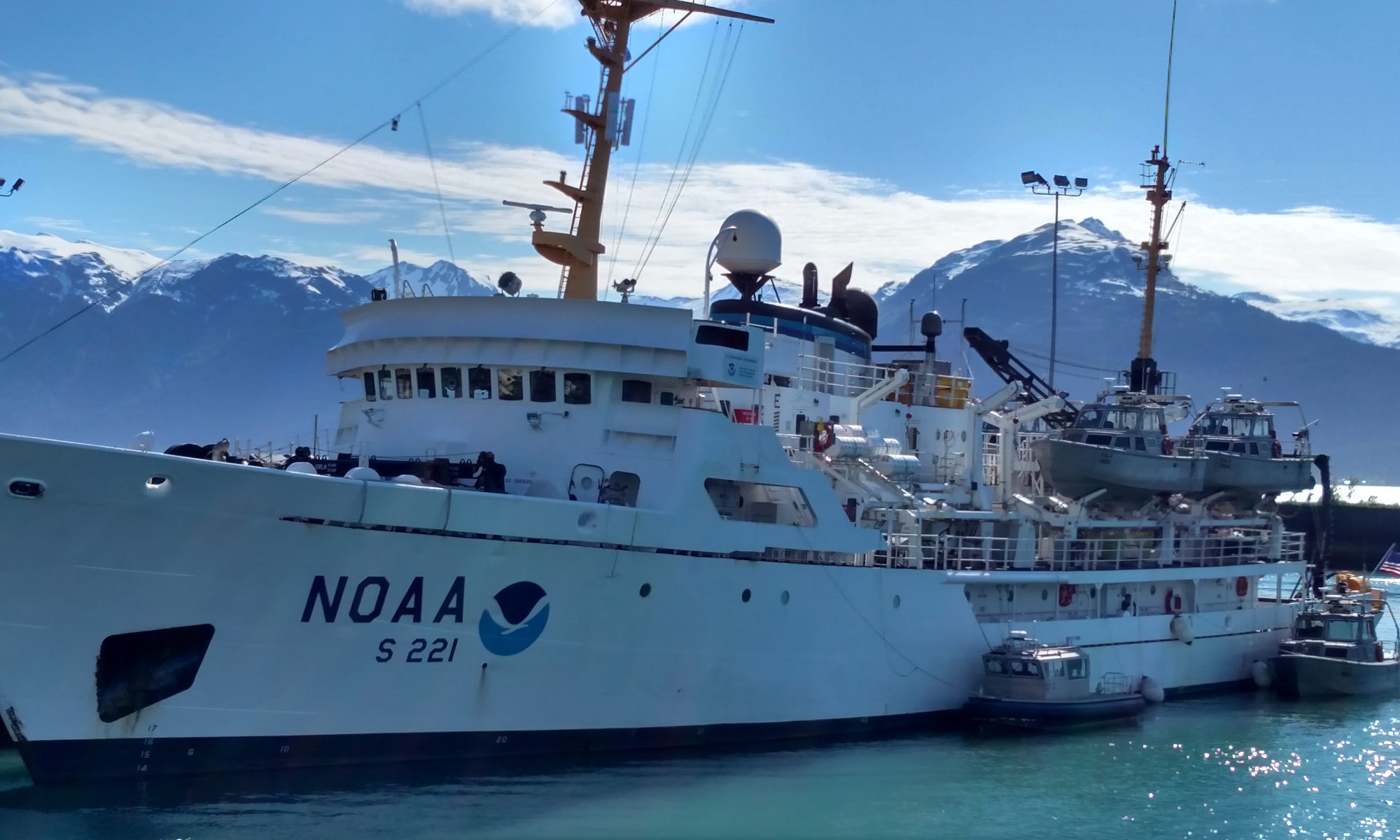
Lisa Hjelm, July 29, 2008

NOAA Teacher at Sea
Lisa Hjelm
Onboard NOAA Ship Rainier
July 28 – 15, 2008

Mission: Hydrographic Survey
Geographical area of cruise: Pavlov Islands, Alaska
Date: July 29, 2008

As soon as we pulled away from the pier the incredible beauty of Alaska began to unfold all around us.

Science and Technology Log 

We set sail at precisely 1300, in bright sunshine. Once we were underway everyone was busy. The gangplank and onshore equipment were stowed away. Survival suits, hardhats and lots of instructions were handed out to the newcomers. Before I knew it I had been in and out of a survival suit and knew my job and location in case of fire or any other possible emergency. I made sure I knew where my lifeboat was as well (#7). This is after all my first adventure at sea. As soon as possible I stationed myself on the Bridge where I spent most of my time during the transit from Kodiak to our work site at the Pavlof Islands. I was very interested in learning about the navigation of the RAINIER, but initially I was distracted by the islands, volcanoes and wildlife to be seen in every direction. Puffins, with their funny orange feet, were everywhere and in one of the narrow passages I saw at least ten sea otters. As we moved beyond Kodiak Island we frequently saw the spouts of whales. Our transit time was 32 hours at 13 knots, so I did get to spend time observing the Bridge in full operation.

Scenery in transit
Scenery in transit

There were always at least three people at work on the Bridge, usually more. Everyone worked a four hour shift, and they were alert, attentive, observant, and busy every minute of that time. The ship’s position was updated on a nautical chart every 15 minutes as was the weather log. I noticed there was a NOAA cloud identification chart posted on the wall, the same one I use in my classroom. Two Ensigns were responsible for directing the ship, monitoring radar, speed, weather, our exact location, updating the chart and using binoculars to scan the horizon in all directions. A member of the Deck Crew was at the helm steering the boat and providing a third set of eyes scanning the horizon in all directions.  There was constant communication amongst the three of them about what they were seeing and doing. We saw and monitored the progress of many fishing trawlers, an occasional log and whales. Whales were most easily spotted by their spouts and the RAINIER shifted course slightly whenever necessary to avoid them.

The Captain was on the Bridge whenever we went through narrow passages, and she was called when fishing boats got within a certain distance of the RAINIER. It was exciting to see people collecting data and using all of the skills taught in science. I was seeing science in action. It was absolutely clear that everyone knew his or her job and did it well. As a result, my first night at sea, I slept like a baby, rocked by the waves.

View of the Bridge, in transit from Kodiak to Pavlof Islands, AK

Personal Log 

When I arrived in Kodiak it was cool and drizzly. Patches of snow were visible on the tops of nearby hills and lilacs were just beginning to bloom, very different from NH weather in late July. Our lilacs bloom on Memorial Day. A van from the ship picked me up and Ensign Anna-Liza Villard-Howe showed me to my bunk and gave me a quick tour of the ship. After practicing climbing into and out of an upper bunk and stowing my stuff, I spent some time investigating on my own. My first impression was that NOAA Ship RAINIER was similar to Hogwarts, lots of narrow passageways and staircases that moved around when I wasn’t looking. Now that I’ve been aboard for a couple of days, I know it’s only the ship that moves, not the staircases, and I’ve learned the way to my favorite place so far, the Bridge.

Ensign updating the chart
NOAA Teacher at Sea, Lisa Hjelm, learns the ropes

Jillian Worssam, July 29, 2008

NOAA Teacher at Sea
Jillian Worssam
Onboard U.S. Coast Guard Vessel Healy
July 1 – 30, 2008

Mission: Bering Sea Ecosystem Survey
Geographic Region: Bering Sea, Alaska
Date: July 29, 2008

was told yesterday that if you want too much, or have expectations too high you will be disappointed.  Well I disagree.  I believe in going full tilt into everything I do, and well, I want to do pretty much everything.

We have two more full days at sea and still I am learning.  Yesterday was busy for me, a 22 hour busy day.  The funny thing is, I slept in until 8:30 am, but didn’t go to bed until 6:30 this morning.

MK2 Jeffrey Coombe covered in grease after he emerges from the depths of the engine.

It all started with the Webinar and ended with three successive MOCNESS as Alexei tried unsuccessfully to catch pregnant Krill.  But I digress.  Yes the science is winding down, but there is still so much to do.  After the webinar I went to the engine room to watch the successful removal of a piston cylinder liner in one of the four main engines.  Salt water is used to cool fresh water to cool, I think, jacket water that cools the engine.  This is not a typical repair while at sea, but the engineering team in charge knew exactly what they were doing and proceeded with care and skill.

That is actually MKC John Brogan in the Engine.

After the engine room, and dinner I joined FN Angela Ford as she did her TOW rounds.  The TOW (technician of the Watch) is responsible for walking the ship from stern to bow, covering all engineering spaces.  The TOWs are looking for water leaks, electrical concerns, fire, pretty much everything and anything out of place or potentially hazardous.  Even though I had already taken a tour of the vessel this trip was predominantly focused on safety and I was able to see new spaces I had not previously ventured into.

There is a right and wrong way to open, enter and leave all hatches aboard an ocean going vessel.

We even managed to find a crew member I had not previously met, Oscar.  This poor headless fellow is used in man overboard drills as well as other casualty drills during the voyage.  Oscar is also no light weight, weighing in at over 50 lbs he is a great way to practice and for crew members to realize what it would be like to actually work on an injured individual.

Oscar is also the designation of the flag flown when there is a man overboard.

But the day is not over yet, we still had THREE MOCNESS drills to complete.  Alexei wants to find pregnant krill so that he can develop a baseline for aging.  Unfortunately after over four and a half hours of work all we had to show for our labors were some shrimp and krill that were not pregnant, bummer.

This could be a scientist, or a crew member, all we know is that the past 29 days have worked them to exhaustion!

Quote of the Day: The “Control of nature” is a phrase conceived in arrogance, born of the Neanderthal age of biology and philosophy, when it was supposed that nature exists for the convenience of man.      Rachel Carson

FOR MY STUDENTS: Please find three authors who predominantly write about knowledge and preservation of the earth’s ecosystems and the species within.

Jillian Worssam, July 28, 2008

NOAA Teacher at Sea
Jillian Worssam
Onboard U.S. Coast Guard Vessel Healy
July 1 – 30, 2008

Mission: Bering Sea Ecosystem Survey
Geographic Region: Bering Sea, Alaska
Date: July 28, 2008

Today will be the last installment of my meet the crew Monday.  There are so many people that I would love to interview and share in this forum, but there is just not enough time in the day.

To start today we have MK1 Allan Whiting, and an amazing list of responsibilities he and his department have on board.  MK stands for machinery technician, and is within the engineering division. Allan’s “A gang” is responsible for EVERYTHING that doesn’t move the ship, thus auxiliary equipment, refrigeration, cranes, hydraulics, water (can make up to 8000 gallons of drinking water a day), winches, therefor a lot of responsibility.

Working on refrigeration is only one part of his job!

I think I have previously talked about the scientists as being a web of different fields that drive a bigger picture of how this entire Bering Sea Shelf Ecosystem is changing and adapting with global climate differences.  Well the vessel is not too dissimilar.  Each person, each division is a vital link to the effective and smooth running of the ship, and if the vessel didn’t work, neither would the scientists.

Another responsibility for the “A gang” is the transfer of the starting 1.3 million gallons of fuel from storage tanks while we are underway.  These “A Gang” members are the “FOWK’s” of the vessel; Fuel, Oil, Water, Kings,” and out technical gurus should any fuel casualty occur.  So as you can tell a lot of responsibility with this department.

Where Allan is a lead with the “A Gang,” EM1 Hans Shaffer works with all things wires.  Yes, he is one of our electrical specialists and if it generates, or uses power Hans is part of the team that is responsible for making sure it works.  From all monitoring systems, to the propulsion and even lighting systems, without the electricians the ship wouldn’t move.

While working on the cyclo-converter I stood way back!

Hans also works with the cyclo-converters, and I must be honest, I know that they take 1444 volts at 60 hrtz and convert it to usable power, but that is about all.  This technology is one that I have never studied.  It is a shocking shame I am not more wired in on the intricacies of electricity.  All I know is this electricity is directly proportional to the speed of the propellers and for a vessel, propeller speed is very important.

I usually do only two people on my meet the Crew Mondays, but today I would like to add two more individuals into the mix.  There is camaraderie on this vessel that is amazing, it really is a family.  And a family that exponentially doubles every thirty days or so with the advent of the scientists, yet still all are welcome.  Smiles abound and I have not once felt unwelcome.

FN Angela Ford learning how to operate the winches with excellent guidance from MST1 Chuck Bartlett.

FN Angela Ford is one of those people who always has a smile, and who appears to always be learning new skills.  Angela started out in the deck department, and then transferred to engineering (which I have heard is a bit difficult to do).  Angela is also studying to get rated as an YN3, Yeoman third class.  If you see Angela she is either studying, doing rounds with engineering or learning new components of the vessel.  Yesterday while in Aft-Con Angela was supported by the MST crew and took a hand at running the winch to deploy and retrieve the CTD, it was great to watch.  Under the guidance of MST1 Chuck Bartlett, Angela jumped right in, ready to learn something new.  As an educator I was not only impressed with her desire to learn, but Chuck’s patience in teaching.  The whole experience was an educational gift!

XO Commander Bateman teaching me how to make a delicious pie.

Unfortunately I could not stay too long, because I had my own educational experience waiting for me.  The XO, Commander Dale Bateman was preparing to give me a lesson in making a Chocolate French Silk Pie.  Ok, get that smile off your face, because, well, let me tell you, it was one of the tastiest lessons I have had in a while.

For those interested here is the recipe:

(multiply all ingredients times 3 for a standard pie crust)

½ cup butter

½ cup sugar

1 oz chocolate

1 egg

A smidgen of brown sugar

A splash of vanilla

To make this recipe, you first construct a pie crust, then in a mixer blend the butter and sugar.  According to the XO, you can never blend too much.  Add the chocolate and blend, add the eggs and blend some more.  To be precise once all the ingredients are in the bowl blend for at least 15 more minutes, you want this no bake wonder to be frothy and smooth.  Place in a refrigerator over night, and in two hours I will be able to get a piece of our masterpiece, and let you know how the finished product tastes.

Meet 1C Jennifer Peterson a senior at the Coast Guard Academy and MK3 Betty Brown, always smiling these two are.

I would like to add a special thanks to all those who participated in the webinar today.  It was wonderful to hear your voices, and even better to share with you this amazing adventure of discovery I have been fortunate enough to experience, thank you!

Quote of the Day:  Since water still flows, though we cut it with swords.  And sorrow returns, though we drown it with wine, since the world in no way answers to our craving, I will loosen my hair tomorrow and take to a fishing boat. – Li Po

FOR MY STUDENTS:  Are you prepared for school in two weeks?

Jillian Worssam, July 27, 2008

NOAA Teacher at Sea
Jillian Worssam
Onboard U.S. Coast Guard Vessel Healy
July 1 – 30, 2008

Mission: Bering Sea Ecosystem Survey
Geographic Region: Bering Sea, Alaska
Date: July 27, 2008

Today is Sunday, and there is change in the air. For one, we have left the sun and re-entered fog. We have also started the 70 meter line back to Dutch Harbor. A large portion of the scientists have completed their work, and each station is now predominantly the CTD, calvet, and optics. With three days left, the tenor of the vessel is mellow, the frenzy of departure just a warm memory. Three full days and then on the morning of the 31st we arrive in Dutch Harbor. I am not ready to leave; there is still much to learn, and this goodbye will be bittersweet. Needless to say I need to get busy; there are words to be written.

U.S. Coast Guard Healy

I recently received a blog asking questions about the vessel and yes, I have been lax about sharing information about the HEALY and what it is like to live on a four hundred and twenty foot cruising scientific ice breaking mobile command center that floats!

Here are the facts: –Four decks are dedicated to berthing –The Main deck is predominantly the Galley forward, the Engine space a mid ship and the science labs aft. –There are three more decks below the main deck and the bridge above the 04 deck. It is approximately 70 feet from the bridge to the water line. –There is a helicopter hanger and flight deck.

The flight deck without a helicopter is perfect for social functions.

Each deck has shared open space all with TV, computers and other lounge type equipment

With the permission of the room mates here is a corner of a crew room, quite large.

There is a weight room far forward and a cardio room off the flight deck aft.

With a tv and all this equipment, anyone would be happy here!

And the best of all, there are mapped out distances on the weather deck for those who wish to jog (stairs are part of the experience) –Don’t forget the ships store, they even have latte!

Hi Andy, any new merchandise today? hehehe

There it is the bare bones of the HEALY, plenty of places to go, lots of things to do. Bingo on the mess deck every Saturday, ping pong in the hanger. Not a moment passes when I am not trying something new.

Everything on a sea going vessel is always strapped down.

Even as the science of our cruise slows down my days are full. There is much still to learn and experience. This afternoon I was able to assist the XO in making a chocolate silk pie…tomorrow we eat!

I am in heaven licking the beaters, and chocolate, perfect!


Nautical Expression: “Square Meal” originally when ships were close enough of shore to get fresh vegetables and fruits, healthy fare. The meals were served hot on square plates., thus a healthy most nutritious meal was a square meal.

FOR MY STUDENTS: Think up an entire square meal based only on items you can eat from the sea?

Katie Turner, July 26, 2008

NOAA Teacher at Sea
Katie Turner
Onboard NOAA Ship Miller Freeman
July 10 – 31, 2008

Mission: Pollock Survey
Geographical Area: Eastern Bering Sea
Date: July 26, 2008

Rescue crew retrieves a dummy man overboard. It is a maritime custom to refer to the man overboard as “Oscar." This comes from an international regulation requiring the raising of the Oscar flag when a vessel is responding to a man overboard, warning other vessels to be on the lookout
Rescue crew retrieves a dummy man overboard. It is a maritime custom to refer to the man overboard as “Oscar.” This comes from an international regulation requiring the raising of the Oscar flag when a vessel is responding to a man overboard, warning other vessels to be on the lookout

Weather Data from the Bridge 
Visibility:  3 miles
Wind Direction:  050
Wind Speed:  8 knots
Sea Wave Height:  0-1 foot
Swell Wave Height:  2-3 feet
Seawater Temperature: 7.8˚ C.
Present Weather Conditions: cloudy

Science and Technology Log 

After leaving Captain’s Bay early Friday morning, the trip to the rendezvous point with OSCAR DYSON took nearly 20 hours. During that time we had our mandatory fire, abandon ship, and man overboard drills.  For our fire drill the Captain staged a mock fire, with smoke reported from the acoustics lab.  The fire fighting team had to respond, find the point of origin of the fire and figure out how to treat it. A debriefing was held afterward so that responders could discuss strategies and learn from the experience.

The rescue boat is brought back aboard the MILLER FREEMAN
The rescue boat is brought back aboard the MILLER FREEMAN

The abandon ship drill is regularly performed so all crew are ready to respond to a severe emergency by mustering at their assigned stations and getting into survival suits to be ready to board life rafts. It’s a good way for new crew members, such as me, to make sure they know where to go and what to bring. We made our rendezvous with OSCAR DYSON late Friday evening in the Bering Sea and immediately moved into position to run the first side by side transect. We are working on a comparison study to determine whether acoustic estimates of pollock (Theragra chalcogramma) abundance made by MILLER FREEMAN and OSCAR DYSON are comparable.  Pollock may have different behavioral responses to these vessels during surveys due to the differences in the amount of noise each vessel radiates into the sea from its propeller, engines, and other equipment.  These behaviors could affect the acoustic estimates of abundance.  OSCAR DYSON is taking over the task of acoustic pollock surveys in the Bering Sea and has been built under new specifications that require a lower level of radiated noise. MILLER FREEMAN has been doing the Bering Sea pollock surveys since 1977.  This study is important because it will ensure that future biomass estimates will be continuous with those done in the past. During this cruise the two ships will continuously collect acoustic backscatter data while traveling side by side along a transect line where pollock schools are known to occur. The distance between the two ships is maintained at 0.5 nautical miles (nm), while they travel at about 12 knots. Every 50 nm along the transect, the vessels switch sides.

OSCAR DYSON from the bridge of the MILLER FREEMAN in the Bering Sea

For this to happen one vessel will slow down and cross behind the stern of the other vessel, then catch back up on the other side. The beginning and end of each transect section must be carefully coordinated between the scientific team in the acoustics lab The remainder of our time on this cruise will be spent working with the OSCAR DYSON to cover as much of the study area as possible before returning to the port of Dutch Harbor.  After the study is complete, the acoustic data collected by each vessel will be carefully compared to see if there is any consistent difference between them. At the same time officers on the bridge are in constant communication to coordinate navigation and maneuvering of the ships.

The figure above shows the final transect path of MILLER FREEMAN in the Bering Sea as straight lines in red. The parallel lines running nearly north and south were traversed from the east to the farthest westerly point. The zigzag red line across the parallel lines represents the path taken as we head back to the southwest on our return. Other colored lines on the map are depth contour lines.  Red lines indicate depths from -75 to -100 meters, yellow to -130 meters, green to -155 meters, and blue greater than  -160 meters.

Ship transect
Ship transect

Personal Log 

During these few days at sea the scientists onboard have taught me a lot about acoustic studies. It’s a complex science that requires both an understanding of the physical science of acoustics and the technology involved, but also the biology, behavior, and ecology of pollock.

One of the opportunities I have especially enjoyed has been watching and photographing the seabirds. They are an important part of this ecosystem and one that can be observed without acoustics. We have seen mostly northern fulmar (Fulmaris glacialis) and black-legged kittiwake (Rissa tridactyla), but also an occasional long-tailed jaeger (Stercorarius longicaudus), and flocks of thick-billed murre (Uria lomvia). Northern fulmar (Fulmaris glacialis) exhibit a lot of variation in color from very light, to light, and dark versions, with gradations in between. These different color morphs all mate indiscriminately. They are gull sized birds with moderately long wings, a short, stout, pale bill, and a short rounded tail. A key characteristic is their dark eye smudge.  They are common in the Bering Sea but also in the northeast Atlantic.

Northern fulmar, light morph
Northern fulmar, dark morph

Fulmars are well known among commercial fisherman for scavenging waste thrown off fishing boats, which explains why they have been nearly constant companions to the MILLER FREEMAN on this cruise. Fulmars are members of the family Procellariiformes, also known as the “tube-nose” birds, along with albatrosses, petrels, and shearwaters. The term comes from the tubular nostril, a structure that looks like a tube on top of their beak.  Their beak, as you can see in the photo, is made up of many plates. This specialized nostril is an adaptation that enhances their sense of smell by increasing the surface area within to detect scent. They also have enlarged brain structures that help them process those scents. Learn more at the Cornell and U.S.G.S. websites.