Jill Carpenter, September 8, 2006

NOAA Teacher at Sea
Jill Carpenter
Onboard NOAA Ship Delaware II
September 5 – 15, 2006

Mission: Herring Hydroacoustic Survey
Geographical Area: North Atlantic
Date: September 8, 2006

Weather Data from Bridge
Docked in Woods Hole for calibration and Advanced Fisheries Towed Vehicle testing—no weather data.

Navigation Officer Mark Frydrych charting the route the ship will take.

Science and Technology Log 

Today was spent on last minute performance testing to verify that the ship’s instrumentation is working properly.  Crewmembers finished tying down equipment, the Advanced Fisheries Towed Vehicle was tested and adjusted with minor protective modifications, and the Scientific Computer System was finished being set up.  The DELAWARE II is scheduled to depart tomorrow at noon. I was also able to interview several of the crewmembers on board the ship.  Each person has such an interesting story and so much knowledge to share. The first person that I had a chance to interview was Navigation Officer Mark Frydrych.  He has many duties on board the ship.  As a navigation officer, he is responsible for all the charts used to navigate the ship. He starts the navigation process by creating a route on the computer, then transfers and double checks the route on the paper charts. Mark is on his first sea tour which has mostly been in the northern Atlantic Ocean.  His favorite part about his job is that he gets to draw on big pieces of paper and that he has the opportunity to see some wonderful sunsets. Navigation Officer Frydrych has additional duties on board the DELAWARE II as well. Another title he holds is Junior Officer where he inventories and periodically checks the safety equipment like the fire extinguishers and escape hatches.

TAS Jill Carpenter and Fisheries Biologist Karen Bolles with a subsample of herring collected from a midwater trawl.

For anyone interested in becoming an officer aboard a NOAA ship, Mark recommends pursuing a scientific or engineering degree.  He says that computer experience and math classes would also be helpful.  Mark would eventually like to be trained as a NOAA Corps pilot. The other person that I was able to speak with was fisheries biologist Karen Bolles.  Her research involves using morphometrics (analysis of shape) to examine body shape differences among Atlantic herring spawning groups in the northwest Atlantic Ocean (stock discrimination).  This will help improve the accuracy of our herring stock assessments and harvesting strategies. Using computer programs, Karen analyzes differences among groups of herring, using characteristics such as mouth length. Because herring spawning groups mix during non-spawning time, these findings can be used to determine proportions of different spawning stock herring that may constitute research and commercial catches.

Karen’s research has taken her from mid-Atlantic waters north to the Bay of Fundy in Canada. She has also been a scientific member on research vessels operating off Iceland and in the Great Barrier Reef region of Australia. Karen has survived some challenging voyages at sea, including a two-week cod survey trip around the island of Iceland that took place during extremely rough winter weather where nobody on board spoke English!

TAS Jill Carpenter working hard aboard NOAA ship DELAWARE II.

When talking with Ms. Bolles, it is very evident that she is passionate about her job. She says that she loves the feeling of helping to improve fisheries management and stock assessments.  She especially enjoys using digital image analysis systems to measure morphometric characteristics, but her main passion is working with fishermen to gain knowledge and to fine-tune her fish sampling designs.  One thing about the field of marine biology that was surprising to her in the beginning was the amount of math and statistics that is used to analyze biological data.  Karen’s advice for individuals pursuing experience in the marine science field is to get involved with volunteer opportunities, independent studies, and internships that come your way.  She stresses the importance of hands-on experience, understanding how to work with large data sets and spreadsheets, and good writing skills.

Personal Log

I am very excited to get out on the open water and begin to use the equipment to conduct surveys and take measurements.  I am also a little anxious to put to use all that I have been learning; I hope I can remember how to enter all the information accurately.  See, even teachers get worried before a test! I am enjoying talking with each of the crewmembers.  I feel fortunate to be on a cruise with such a good group of people!

Question of the Day

The fish that the DELAWARE II will be studying are classified as pelagic fish, which means that they live in the top layer of the ocean away from the seashores or ocean floor.  1. Why do you think that most of the oceans creatures live in the top layer of the ocean?  2. Research to find what percentage of sea life lives in this zone.

Jill Carpenter, September 7, 2006

NOAA Teacher at Sea
Jill Carpenter
Onboard NOAA Ship Delaware II
September 5 – 15, 2006

Mission: Herring Hydroacoustic Survey
Geographical Area: North Atlantic
Date: September 7, 2006

Weather Data from Bridge
Docked in Woods Hole for calibration and Advanced Fisheries Towed Vehicle testing—no weather data.

TAS Jill Carpenter in front of the AFTV.

Science and Technology Log 

Today was a very exciting day aboard the DELAWARE II. Scientists and crewmembers worked together to deploy the Advanced Fisheries Towed Vehicle (AFTV) into the water for the first time in order to complete initial testing.  The AFTV was delivered to the NOAA pier yesterday and loaded on the aft deck of the DELAWARE II.  Chief Scientist Bill Michaels explained to me how he designed the AFTV in collaboration with Deep Sea Systems International.  This new piece of scientific research equipment utilizes the latest underwater technology to improve measurements in support of NOAA’s strategic goals (e.g., Essential Fish Habitat, Stock Assessment Improvement Plan).  The AFTV is presently configured for verification of acoustic targets in the water column during NOAA’s Herring Acoustic Survey (RV DELAWARE II cruise DE200615). The AFTV provides a universal platform in which acoustical, optical and environmental sensors are integrated. The AFTV electronics convert these data to ethernet signals that are transmitted through the 2000 m of fiberoptic cable to a laptop providing network ready information.  For example, real-time underwater video images during cruise operations can be viewed from a computer on land provided satellite transmission.  The advantage of this towfish is that new technologies, such as newly developed sensors, can be readily plugged into the towbody’s ethernet-based electronics to accomplish various cruise objectives.  The AFTV can be reconfigured during future cruises for marine habitat classification (video mosaics and acoustic classification of the seafloor).

Intricate knot work is used to protect scientific equipment.

We also had the chance to learn how to use the Fisheries Scientific Computer System (FSCS). This computerized system is used for electronically recording data from the biological sampling that will be completed on board.  Nancy McHugh, a fisheries biologist and FSCS administrator from the Northeast Fisheries Science Center, showed us how to operate the system and record our information accurately.  In the past, data had to be hand-recorded, and errors were not caught until months later.  Nowadays, using the FSCS allows us to digitally record measurement data, such as lengths and weights, in real time and gives us the advantage of computer-audited data which flags the scientists for potential errors.

Afterwards, Dr. Jech explained the ship’s Scientific Computer System (SCS) located on the bridge of the ship. This PC-based system continuously collects information from more than a hundred sensors on board. Information about the ship’s location and route, weather conditions, ocean conditions and biological sampling is gathered, recorded and synchronized on these computers.  We also practiced entering data into computers using the SCS Event Log program which documents all operational events, such as each time the scientists lower sensors into the water or collect fish samples.

Jill Carpenter, Teacher at Sea, on the bow of the NOAA ship DELAWARE II.
Jill Carpenter, Teacher at Sea, on the bow

Personal Log

It was great to witness the experimental launching of a new piece of scientific equipment.  I think my fifth graders would be really excited to witness firsthand this underwater vehicle being placed in the water. It looks like a large yellow plastic box with metal pipes that make up the frame.  Attached to the back are “wings” that help to stabilize it, and in the front are spotlights and video equipment to take pictures of fish. It is controlled by joysticks and computers on board the ship. It is like an underwater robot.  Very cool! I think it is also an invaluable learning experience for me to see the process of scientific experimentation happening right here on board the ship. Between the calibrations, setting up the Scientific Computer System, and launching the AFTV, I have witnessed scientists and crewmembers informally using various scientific methods to find better solutions and problem solve when the unexpected arises.

Sailboats, Woods Hole, MA.

It is exciting to see science experiments happening every day, with real people in a real-life context, instead reading about it from a worksheet or having that intangible image in my mind of a mad scientist in a white lab coat stirring a beaker of something bubbling.  Science is accessible to everybody!  You don’t have to be in a fancy laboratory or have the latest equipment.  It can be done inside or out, on a boat or in your backyard. Science encompasses so many fields and is available to anyone with a curious mind.  I am excited to share this realization with my students and make science more real to them.

Question of the Day

Two words that I am using aboard the ship are “starboard” and “port”.  What do these two words mean?  Where do they come from, and why are they important to use when on board a ship? 

Jill Carpenter, September 6, 2006

NOAA Teacher at Sea
Jill Carpenter
Onboard NOAA Ship Delaware II
September 5 – 15, 2006

Mission: Herring Hydroacoustic Survey
Geographical Area: North Atlantic
Date: September 6, 2006

The Advanced Fisheries Towed Vehicle is a new submersible designed to use acoustic and optic sensors to verify sonar data and evaluate habitat.
The AFTV is a new submersible designed to use acoustic and optic sensors to verify sonar data and evaluate habitat.

Weather Data from Bridge
Docked in Woods Hole for calibration and Advanced Fisheries Towed Vehicle testing—no weather data.

Science and Technology Log

It has been a busy day aboard the DELAWARE II as we are preparing to get underway on Friday or Saturday. The uncertainty about our departure date is due to the set-up and system testing of the Advanced Fisheries Towed Vehicle (AFTV). The AFTV is a recently constructed submersible vehicle that is designed to use acoustical and optical sensors to verify sonar data and evaluate habitat.  Because the AFTV has not previously been set up on the ship, performance tests may require more than one day.  The ship will remain in Woods Hole until the AFTV system is ready.

This morning, we began with a continued effort to calibrate the hydroacoustic systems using the copper sphere attached to the downriggers with fishing line. We were successful in placing the copper sphere in the hydroacoustic beam, but again had to postpone our efforts due to seaweed interference.  We now plan on completing the calibrations in Cape Cod Bay. The remainder of the morning and afternoon was spent helping to load and organize additional supplies on board.  A lot of thought goes into securing items on the ship in order to prevent them from falling or rolling around when we are at sea.

Chief Scientist Bill Michaels and Commanding Officer Richard Wingrove aboard the NOAA ship DELAWARE II.

The more I see scientists and crewmembers securing equipment, the more concerned I become about maintaining my balance on board the ship. In the Northeast Fisheries Science Center’s “Manual for First-time Sailors,” the advice is to use your life preserver to “wedge” yourself against your bunk rail to avoid being tossed around when sleeping.  From the preparations I am witnessing aboard the ship, it looks like I will be taking this advice! My work day finished with helping Research Fisheries Biologist Dr. Mike Jech secure computer equipment to the ship. We did this by using wood boards, screws and tape to attach equipment to immobile objects.  I found it comical to tape down the computer keyboards.  This ship may be pitching more than I expect! I learned a bit of ship trivia that I found interesting.  A ship’s foghorn is used to communicate many messages.

The following are the meanings of some sound patterns of a ship’s foghorn: 1 prolonged blast = the ship is leaving the port; 1 prolonged blast every 2 minutes = the ship is steaming (traveling) through fog; 1 prolonged blast followed by 2 short blasts every 2 minutes = the ship is fishing in fog; 5 short blasts = danger, get out of the way! 1 prolonged blast followed by 3 short blasts = the ship is leaving the dock in reverse

Research Fisheries Biologist Dr. Mike Jech securing computer equipment to prepare for sailing on board the DELAWARE II.

Personal Log

It amazes me how much preparation and behind-the-scenes work goes into getting ready for a fisheries research trip.  Everyone is hurrying around the ship, completing last-minute duties and running tests on electronic equipment.  They have all been very friendly and patient with me; I am looking forward to getting to know and working with the entire crew of the DELAWARE II.

I spent the evening typing logs and adjusting the size of my digital pictures to fulfill space requirements on emails.  I find it challenging and somewhat time consuming to “translate” all of the scientific explanations into language that is more friendly to a room of elementary school students (and to myself as well!). I am grateful to several members of the crew for their input and suggestions on the wording of certain complex concepts. My evening ended with a walk into the village of Woods Hole.  I find Woods Hole such an interesting and charming little town.  Located on the southwest corner of Cape Cod, Woods Hole has developed into a world leader in marine and fisheries research.  This scientific community is the home of the world renowned Marine Biological Laboratory (MBL), the Woods Hole Oceanographic Institution (WHOI), and the Northeast Fisheries Science Center (NEFSC), each contributing great advances to the field of marine science research.

TAS Jill Carpenter holding a damage control plug used to plug a hole in the hull of a ship.

Don’t worry, Hutchison Farm Elementary, I haven’t forgotten about you! I am sure there is just as much hustle and bustle going on there during the first week of school!  I am anxious to see each one of you; I know I can expect a very mature and intelligent group of fifth graders.  Thanks so much for being on your best behavior for Mrs. Nelson! I have been sleeping like a rock on board the ship.  I am  appreciating these restful nights now because I don’t know if I can count on a peaceful night sleep once we are out to sea! The food is also very good, and I am becoming known for my big appetite. The chefs, Dennis and John, are excellent cooks.  I look forward to each meal they serve.  Looks like I won’t be losing any weight!

Question of the Day 

1. The NOAA scientists and crewmembers need to bring many materials on board with them when they go to sea. If they forget something, they will not be able to return to get it, and there are no stores in the middle of the ocean.

a. What would you bring to sea with you if you were going for a week?

b. What would you absolutely need to bring with you?

c. What if you could only bring 10 items?  What would they be?

d. What if you were only able to bring 5 items? What would they be?  Two items?

My stateroom, or bedroom, on board the DELAWARE II
My stateroom, or bedroom, on board 
Butterfly on NOAA pier, Woods Hole, MA

Jill Carpenter, September 5, 2006

NOAA Teacher at Sea
Jill Carpenter
Onboard NOAA Ship Delaware II
September 5 – 15, 2006

Mission: Herring Hydroacoustic Survey
Geographical Area: North Atlantic
Date: September 5, 2006

NOAA ship DELAWARE II.

Weather Data from Bridge
Weather data not collected while in port

Science and Technology Log

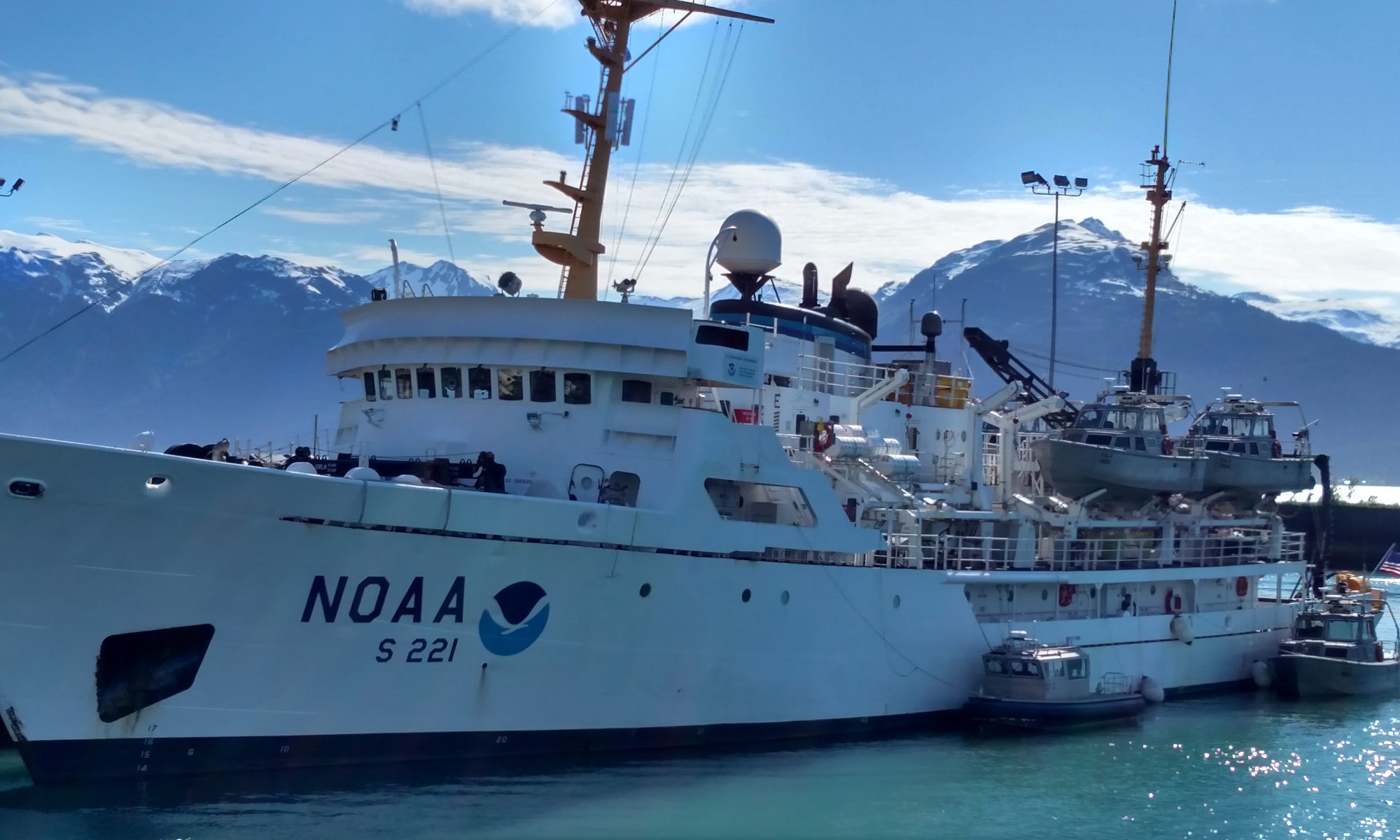
I arrived in Woods Hole, Massachusetts yesterday evening. After a short walk through town, I came upon the Northeast Fisheries Science Center building and NOAA pier where the DELAWARE II was docked.  For the next 10 days, this vessel will be completing part 1 of a 3-leg Hydroacoustic (water-sound) Survey, and I will be a part of it!  I will bring back the knowledge and experiences that I gain and share these with my classroom of fifth grade students in South Riding, Virginia. The DELAWARE II is a stern trawler ship, which means that it is designed to catch fish and other sea life in nets from the rear (stern) of the ship.  The ship was built in 1968, is 155 ft long, and displaces 600 tons of water.

Harbor scene in Woods Hole, MA, taken from aboard the DELAWARE II.

The purpose of this survey is to estimate the number of certain species of northwest Atlantic pelagic (mid-water) fish.  The ship will use technologies such as multifrequency and omni (all) directional sonar to provide information about the fish.  We will also take select samples of certain species for biological data, such as weight, length, age, and prey items (stomach contents). 

After breakfast, my roommate and I helped research fisheries biologist Dr.Mike Jech and herring biologist Karen Bolles load equipment needed for the trip.  Some of the supplies loaded were computer equipment, tool boxes, life vests, and equipment for collecting and measuring fish, such as large plastic baskets, measuring boards, and waterproof labels.

About mid-morning, we shifted piers from the NOAA pier to the neighboring Woods Hole Oceanographic Institution (WHOI) pier.  The first goal, before getting underway, was to calibrate the sonar systems on board.  We needed to calibrate to make sure the system is working properly and to maintain consistency and standardize this survey to all previous hydroacoustic surveys. This helps scientists to find the fish they are researching and obtain important information about them such as behavior and size of the schools.

Jill Carpenter aboard the Delaware II in port

The calibration is accomplished by lowering a copper sphere, which is about the size of an orange, below the hull of the ship so that it is in the hydroacoustic beams.  The acoustic beam is shaped like a flashlight beam. This process should be performed at slack tide (when the water is moving the least) so we have the most control of the sphere. The copper ball will bounce an echo back to the ship, and the scientists can translate that data into information that will make sense to them. It took patience to calibrate the sonar system.  First, Mike, Karen and I worked to position the copper sphere so that it was in the sonar beams.  This was done by using downriggers (which are like large fishing reels) and fishing line to lower and adjust the copper sphere below the hull. We eventually had to postpone the calibration because of the high amount of seaweed that interfered with the echo from the sphere. I also had the opportunity to receive a tour of the fore deck of the boat.  Navigation Officer Mark Frydrych showed me around the bow and explained some of the equipment to me, such as the hawse pipe (the tube where the anchor chain drops down) and the wildcat (the drive that lifts the anchor chain and anchor. Also, I learned that rope on board a ship is called “line”.

Lead fisherman Pete Langlois helping load cargo that will be used Leg 1 of a Hydroacoustic Survey.
Lead fisherman Pete Langlois helping load cargo that will be used Leg 1 of a Hydroacoustic Survey.

Personal Log

When I first caught sight of the DELAWARE II, my new home for the next 10 days, I was in awe. It looked to me like a ship that you would see on the Discovery Channel!  It has so much technical equipment on board, and the ship seems so large when you are standing next to it on the pier. It was a different story when I got on board!  The hallways are more narrow than I am used to, and my room is only about 7’ x 10’ but sleeps 4 people!  I have quickly become used to the size of the interior of the ship and have learned how to maneuver quickly around the passageways.

I am most fearful of becoming seasick while on board.  I keep my motion-sickness medicine and wristbands with me at all times.  I am still a little worried, though, since I can already feel the ship rocking and we haven’t even let the port yet!

Chief Scientist Bill Michaels (right) with his new Advanced Fisheries Towing Vehicle, used for the first time on this hydroacoustic survey. It uses fiberoptic cables to send real-time images to the ship’s computer.
Chief Scientist Bill Michaels (right) with his new Advanced Fisheries Towing Vehicle, used for the first time on this hydroacoustic survey. It uses fiberoptic cables to send real-time images to the ship’s computer.

I have been thinking of my students today and wondering how their first day of fifth-grade is going. I am looking forward to returning and getting to know each one of you!  I hope your year is off to a good start and I am eager to share my experience with all of you! Take care of Mrs. Nelson!

Question of the Day

1. How old is the DELAWARE II?

2. What does it mean to “displace” water?  Can you think of a time when you have displaced water?

3. I learned that lengths of chain are measured in “shots” instead of feet or meters.  A shot is 90 feet of chain. If 5 shots of chain are needed to be released in order for the anchor to touch bottom, how much chain will that be?

Sunset from the NOAA pier in Woods Hole, MA

Joan Raybourn, August 25, 2005

NOAA Teacher at Sea
Joan Raybourn
Onboard NOAA Ship Albatross IV
August 14 – 25, 2005

Mission: Ecosystem Productivity Survey
Geographical Area: Northeast U.S.
Date: August 25, 2005

Personal Log

Today was the last day of our two-week adventure at sea. At dawn this morning, we paused for a while before entering the north end of the Cape Cod Canal. While we have been within sight of land for a day or two, it was strange to see land on both sides of us. The canal was built in the 1930s, and using it to get back to Woods Hole saves at least half a day’s sailing time. Without it, we would have to sail all the way around the “arm” of Cape Cod. We slipped into the canal and eased our way south, back into civilization. We stood on the bow of the ship and watched fish playing in the water, seabirds hovering hopefully over them. People walked their dogs on the path beside the canal, and sailboats passed silently. All was quiet. When a siren split the air, we knew we were back.

The trip through the canal took about an hour and a half, and we were in Buzzards Bay. We made our way through the islands and back around to Woods Hole, to the pier where our trip began. We cleaned the labs and packed our gear and samples to go ashore. At the pier, a gangplank was attached to the ALBATROSS IV so that we could move “all ashore that was going ashore”. We lugged boxes and crates over it to the NOAA warehouse, the EPA truck, and the NOAA van that would take the samples back to the lab in Rhode Island. It was a strange feeling to be back on land. At the beginning of the trip, my body had to adapt to the motion of the ship, and for the first two days I staggered around until I got my sea legs. Back on land, my body had to adapt again; even though my brain knew I was on solid land, the sensation of motion persisted.

And then it was over. By 2:30, everyone who was leaving was gone, and our shipboard community was dissolved. Since my flight home is not until tomorrow, I will stay one more night aboard the ALBATROSS IV. It’s a little lonely now, with everyone gone and no work to do. But I’ve been up since midnight, when my last watch began, and an early bedtime tonight will be welcome. What an adventure this has been! I will never forget my days out on the wide blue sea, with nothing to see but sky and wind and ocean. Whenever city life hems me in, I’ll be able to go back in my mind’s eye, feeling the wind and the sunshine, and watching the endless play of the sea, all the way to forever.

14

15