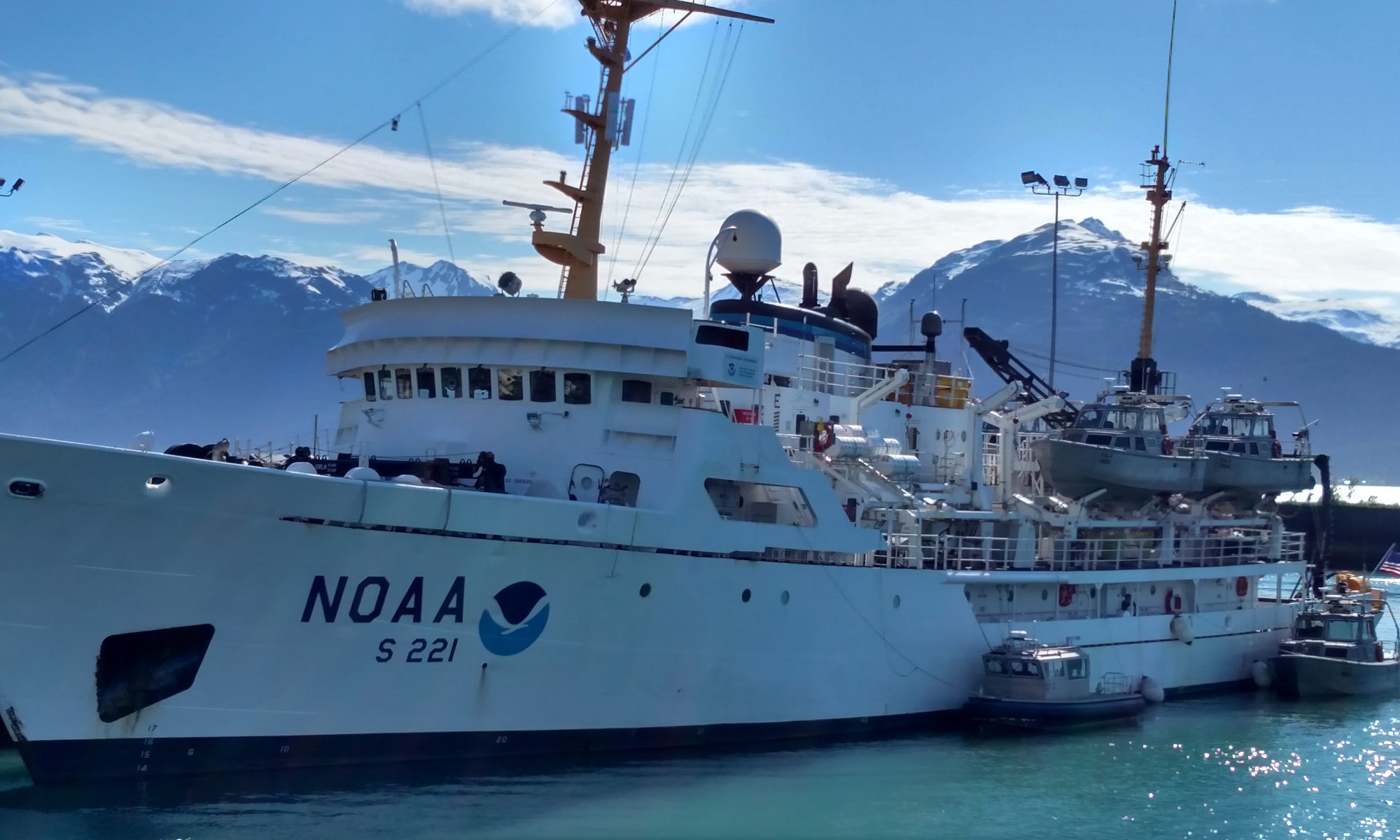
NOAA Teacher at Sea Anne Mortimer Onboard NOAA Ship Oscar Dyson July 4 — 22, 2011
Mission: Pollock Survey Geographical area of cruise: Gulf of Alaska Date: July 14, 2011
Weather Data from the Bridge Conditions: sunny and windy
Air Temperature: 10.1 ⁰C
Sea Temperature: 7.6 ⁰C
Wind direction: 237 ⁰C
Wind speed: 20 knots
Wave height: 2-3 ft.
Swell height: 5-6 ft.
Science and Technology Log
My last blog I said that I would talk more about the cam-trawl. This technology was created by scientists working on the pollock survey. The purpose behind the cam-trawl is to be able to put a net in the water with an open cod-end (basically a net with an opening at the end), and have images of the number, species, and size of fish that went through the net. Of course, sometimes some fish would have to be brought on deck so the otoliths and stomachs could be taken back to the lab in Seattle. Overall, this could eliminate taking so many research-based fish and/or invertebrate samples. When cam-trawl is used on acoustic-trawl surveys, the echograms can be matched up with the stereo-camera images which can provide more data about the distribution of fish or other marine organisms in the water.
How the cam-trawl works: it is a stereo-camera system that takes snapshots of whatever comes through the net. These images allow the research team (including me on this leg) to determine the approximate number, species (some, not all), and size of fish that go through the net.
This still image from the cam-trawl shows a salmon and pollock against a black “curtain.”
The pictures are taken at the same time, but because of the slight difference in camera position, they look similar but not identical. You can mimic this with your eyes by looking at an object with only your right eye, then switching to looking with only your left eye. Did you see the same object but from a slightly different perspective? This is called disparity, or parallax (astronomers often use parallax to estimate the distance of far-away stars or other celestial objects). The program that was written for the cam-trawl (also by this research team) can then calculate the approximate size of the fish based on their relative positions.
In this photo, I’m using the cam-trawl measuring program to measure a sample of fish.This screen shot shows the stereo-images and the yellow measurements that I’ve added. Using the lengths that I’ve chosen for the program, it calculates the approximate length (in meters) of the fish.
Personal Log
After several windy days with lots of swell, I’m happy to be in calmer waters. I’ve been working on the computer for some of the time which doesn’t go well with swell. I have also found it to be very tiring and tense on my body to be in constant motion and prepared to grab whatever I can to stay upright. I can’t tell you how hard it is to use a treadmill or take a shower in rough seas! BUT, for the time being, it’s calm and I just watched a great sunset over Kodiak island with a few humpback whale blows in the distance. If you are still wondering about the salmon in the picture above, it’s a chum!
NOAA Teacher at Sea Kathleen Harrison Aboard NOAA Ship Oscar Dyson July 4 — 22, 2011
Location: Gulf of Alaska Mission: Walleye Pollock Survey Date: July 15, 2011
Weather Data from the Bridge True Wind Speed: 34 knots, True Wind Direction: 284.43
Sea Temperature: 10.02° C, Air Temperature: 11.34° C
Air Pressure: 1014.97 mb
Latitude: 56.12° N, Longitude: 152.51° W
Sunny, Clear, Windy, 10 foot swells
Ship speed: 10 knots, Ship heading: 60°
Science and Technology Log
The Walleye Pollock is an important economic species for the state of Alaska. It is the fish used in fish sticks, fish patties, and other processed fish products. Every year, 1 million tons of Pollock are processed in Alaska, making it the largest fishery in the United States by volume. The gear used to catch Pollock is a mid-water trawl, which does not harm the ocean floor, and hauls are mostly Pollock, so there is very little bycatch.
A sample of pollock that the Oscar Dyson caught for scientific study. A "drop" in a very large "ocean" of pollock industry.
Although Pollock fishermen would like to make as much money as they can, they have to follow fishing regulations, called quotas, that are set each year by the North Pacific Fishery Management Council (NPFMC). The quotas tell the fishermen how many tons of pollock they can catch and sell, as well as the fish size, location, and season. The NOAA scientists on board NOAA Ship Oscar Dyson have an important role to play in helping the NPFMC determine what the quotas are, based on the biomass they calculate.
The quotas are set in order to prevent overfishing. Pollock reproduce and grow quickly, which makes them a little easier to manage. When fishing is uncontrolled, the number of fish becomes too low, and the population can’t sustain itself. Imagine being the lone human in the United States, and you are trying to find another human, located in Europe, only you don’t know if he is there, and all you have is your voice for communication, and your feet for traveling. This is what happens when fish numbers are very low– it is hard for them to find each other.
There are many situations where uncontrolled fishing has cost the fishermen their livelihood. For example, in the early 1900s, the Peruvian Anchovy was big business in the Southeast Pacific Ocean. Over 100 canneries were built, and hundreds of people were employed.
This graph shows how the Peruvian Anchovy catch rose to record heights in 1970, then collapsed in 1972. This could have been prevented by effective fishery management.
Scientists warned the fishermen in the 1960s that if they didn’t slow down, the anchovies would soon be gone. The industry was slow to catch on, and the anchovy industry crashed in 1972. The canneries closed, and many people lost their jobs. This was an important lesson to commercial fishermen everywhere.
The Walleye Pollock (Theragra chalchogramm) is a handsome fish, about 2 feet long, and greyish – brown. Most fishermen consider him the “dog” food of fish, since he pales in comparison to the mighty (and tasty) salmon. Nonetheless, Pollock are plentiful, easy to catch, and thousands of children the world over love their fish sticks.
Besides calculating biomass, there are 2 other studies going on with the Pollock and other fish in the catch. Scientists back at the Alaska Fisheries Science Center (AFSC) in Seattle are interested in how old the fish are, and this can be determined by examining the otoliths.
Here are 2 otoliths from a pollock. The one on the left shows the convex surface, the other shows the concave surface.
These are 2 bones in the head of a fish that help with hearing, as well as balance. Fish otoliths are enlarged each year with a new layer of calcium carbonate and gelatinous matrix, called annuli, and counting the annuli tells the scientists the age of the fish. Not only that, with sophisticated chemical techniques, migration pathways can be determined. Amazing, right? The otoliths are removed from the fish, and placed in a vial with preservative. The scientists in Seattle eagerly await the return of the Oscar Dyson, so that they can examine the new set of otoliths. By keeping track of the age of the fish, the scientists can see if the population has a healthy distribution of different ages, and are reproducing at a sustainable rate.
Another ongoing study concerning the Pollock, and any other species of fish that are caught during the Pollock Survey, deals with what the fish eat.
A pollock stomach is put into a fabric bag, which will be placed in preservative. Scientists at the Alaska Fisheries Science Center will study the contents to determine what the fish had for lunch.
Stomachs are removed from a random group of fish, and placed into fabric bags with an ID tag. These are placed into preservative, and taken to Seattle. There, scientists will examine the stomach contents, and determine what the fish had for lunch.
Personal Log
I learned about fishing boundaries, or territorial seas, today. In the United States, there is a 12-mile boundary from the shore marked on nautical charts. Inside this boundary, the state determines what the rules about fishing are. How many of each species can be kept, what months of the year fishing can occur, and what size fish has to be thrown back. Foreign ships are allowed innocent passage through the territorial seas, but they are not allowed to fish or look for resources. Outside of that is the Economic Exclusion Zone (EEZ) which is 200 miles off shore. The EEZ exists world-wide, with the understanding among all international ships, that permits are required for traveling or fishing through an EEZ that does not belong to the ship’s native country.
Everyone was tired at the end of the day, just walking across the deck requires a lot more energy when there are 10-foot swells. Check out this video for the rolling and pitching of the ship today.
NOAA Teacher at Sea Kathleen Harrison Aboard NOAA Ship Oscar Dyson July 4 — 22, 2011
Location: Gulf of Alaska Mission: Walleye Pollock Survey
Here I am with my IB Biology students, exploring a mud flat that is part of a barrier island of the Eastern Shore of Virginia.
Personal Log
In February, I found out that I was selected to be a Teacher at Sea. This was very exciting at the time, but it seemed a bit unreal. By the end of March, I completed the online training, had several more e-mails from the Teacher at Sea program, and was coming to the realization that I actually would be going to sea with NOAA.
Around the first of May, I learned that I would be participating in the Walleye Pollock Survey, in the Gulf of Alaska, for 3 weeks in July. Teaching in Hampton, and living in Virginia Beach, I am used to very hot summers, with plenty of sunshine. It took me a few days to get used to the idea of being cold in July. Now, one day before I fly to Kodiak, I am so excited, I doubt that I will sleep much tonight. I don’t care what the weather is. I am extremely grateful for this opportunity, and will gladly count every pollock that comes up in the net.
On July 3, I will board the NOAA ship Oscar Dyson in the port of Kodiak, Alaska. You can learn more about the Oscar Dyson here: http://www.moc.noaa.gov/od/ I am thrilled to have the chance to participate in real-world research with NOAA, and learn more about marine science careers. Already, I have been asked to share what I learn with a group of students at my school this fall. My International Baccalaureate (IB) Biology students will be reading these posts for their summer homework, and choosing an animal to research. I hope that you will continue to follow my exciting adventures over the next few weeks, as I figure out what a pollock looks like, and identify other Gulf of Alaska marine animals.
NOAA TEACHER AT SEA JASON MOELLER ONBOARD OSCAR DYSON JUNE 11-JUNE 30
NOAA Teacher at Sea: Jason Moeller
Ship: Oscar Dyson
Mission: Walleye Pollock Survey
Geographic Location: Kodiak Harbor
Date: June 29-30
Ship Data
Latitude: 57.78 N
Longitude: -152.42 W
Wind: 4.9 knots
Surface Water Temperature: 8.5 degrees C
Air Temperature: 9.1 degrees C
Relative Humidity: 69%
Depth: 18.99
Personal Log
For the last time, welcome aboard!
We are now back in Kodiak, and I fly out on Thursday, June 30th. We got in late on the 28th, and so that gave us some time to explore! Once again, it was back to the trail to try and look for some bears!
We had a nice start when this bald eagle flew right above our heads and landed on a light!Another photo of the eagle.
On June 29th, after stopping for some Mexican food, Paul, Jake, Jodi and I hopped in a car and drove out to Anton Larsen Bay in hopes of some great photo opportunities and wildlife. Below are some of the best photographs that I took of the trip.
The first place we stopped the car had this beautiful view of rolling hills and mountains in the background.The road we took to get here. In the middle of the image is a lake, and if you look hard enough we could see all the way to the ocean.Jodi has fun demonstrating a yoga pose!Our next stop was to explore the actual bay. This mountain overlooked the spot where the water ended and land began.An empty boat was randomly just drifting in the bay. It made for a nice photo though.After looking at the bay, we began to explore a trail that led into the woods. There was supposed to be a waterfall at the end of the trail, but the trail just ended with no falls in sight. Oh well! This stream ran alongside of the trail the entire way.Another photo of the stream.It was nice and sunny yesterday, making it the first time I had seen sun in Kodiak! It made for some picturesque moments while walking through the woods.In the end, once again, I didn't see a bear. However, as we were driving back, we did see this fox catch a mouse!
Science and Technology Log
As the survey is now over, there is no science and technology log.
Species Seen
Gulls
Arctic Tern
Bald Eagle
Red Fox
Mouse
Reader Question(s) of the Day!
There are no questions of the day for this last log. However, I would like to extend some thank yous!
First, I would like to thank the NOAA organization for allowing me the wonderful opportunity to travel aboard the Oscar Dyson for the past three weeks. I learned an incredible amount, and will be able to bring that back to my students. I had a great time!
Second, I would like to thank the crew of the ship for letting me come onboard and participate in the survey. Thanks for answering all of my questions, no matter how naive and silly, teaching me about how research aboard this vessel really works, editing these blogs, and for giving me the experience of a lifetime.
Third, I would like to thank Tammy, the other NOAA Teacher at Sea, for all of the help and effort that she put into working with me on the science and technology section of the blog. Tammy, I could not have done it without you!
Next, a huge thank you to the staff of Knoxville Zoo for their support of the trip and granting me the time off! A special thanks especially needs to go to Tina Rolen, who helped edit the blogs and worked with the media while I was at sea. She helped keep me from making a complete fool of myself to the press. Another special thanks goes out to Dr. John, who loaned me the computer that I used to post the first several logs.
Thanks also go out to Olivia, my wonderful and beautiful wife, for supplying the camera that I used for the first half of the trip.
Finally, I would like to thank everyone who read the log and sent comments! I received many positive comments on the photography in this blog, although I must confess that I laughed a bit at those. Paul, our chief scientist, is the expert photographer on board, and his photos expose me for the amateur that I actually am. I would like to end this blog by posting some of the incredible images he gave me at the end of the trip.
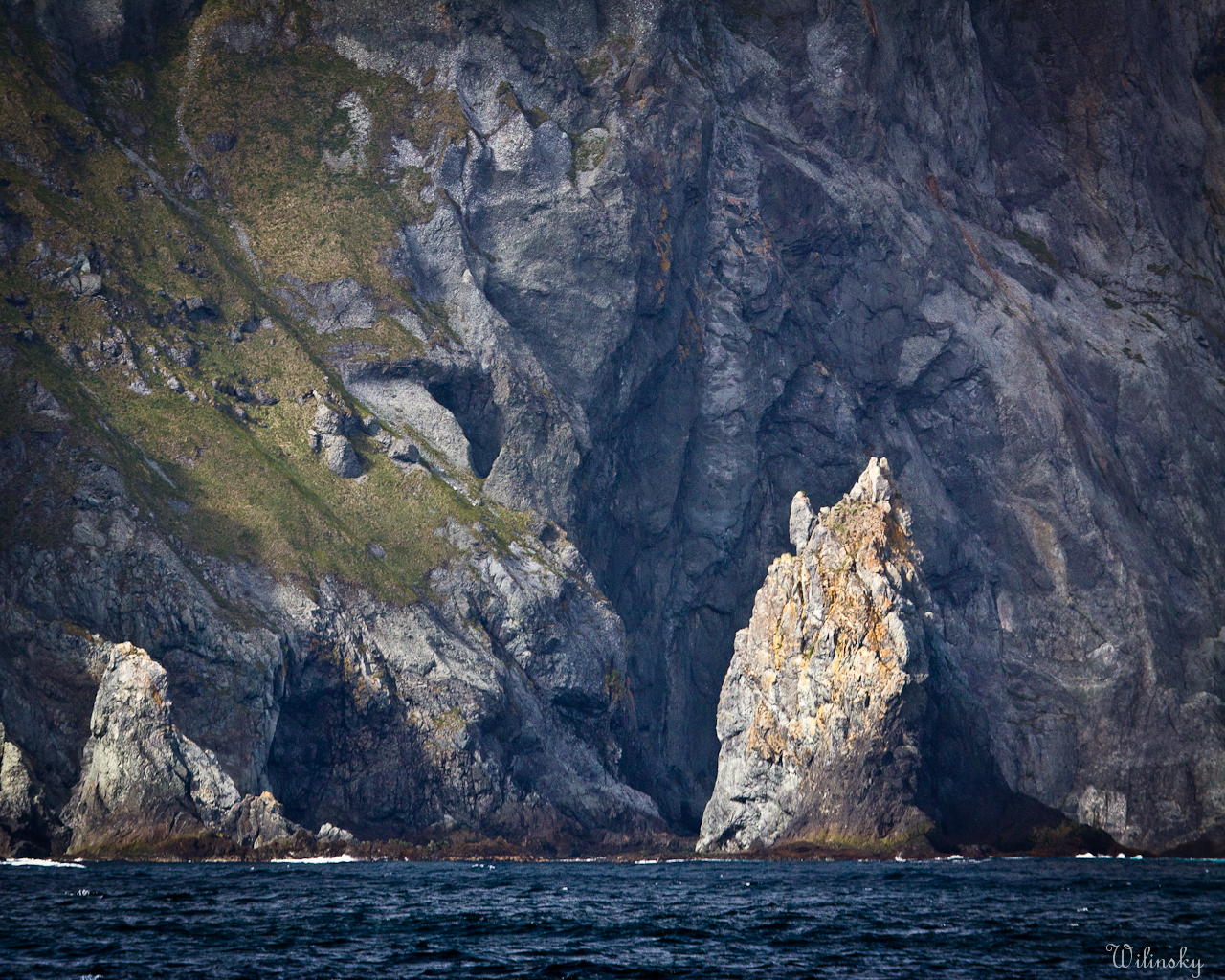
Cliffs rise sharply out of the ocean in the Gulf of AlaskaA waterfall plummets into the Gulf of AlaskaClouds cover the top of an island.
Fog rolls down the cliffs toward the ocean.
The Twin Pillars
A closeup of the cliffs that make up the Alaskan shoreline.
Since we saw so much of it, it seems appropriate to end this blog with a photo of fog over the Gulf of Alaska. Bye everyone, and thanks again!
Hi, my name is Anne Mortimer and I am very fortunate to be a 2011 Teacher at Sea on the NOAA ship Oscar Dyson. On this trip, I’ll be working with researchers on a Pollock fisheries survey. Pollock are mid-water fish that are a very important food resource. The research I will be participating in will help to manage the fish populations in the North Pacific and Bering Sea.
Currently, I live in Bellingham, WA and teach science at Mount Vernon High School. Next year, I will be teaching Biology, Sheltered Biology (for English-language learners), and Physical Science (a freshmen science course). I grew up in dry, sunny eastern Washington but have always loved everything about the ocean and coastal areas. I even worked on Catalina Island, CA for 3 years as a marine science instructor. This will be my first trip to Alaska, and hopefully not my last!
My dog Cedar.
I’m very excited to be a Teacher at Sea, living and working with a research team and the ship crew. So far, I’m most looking forward to seeing Alaska’s beautiful waters and the life found there, and bringing my new experiences to my students in Mount Vernon.