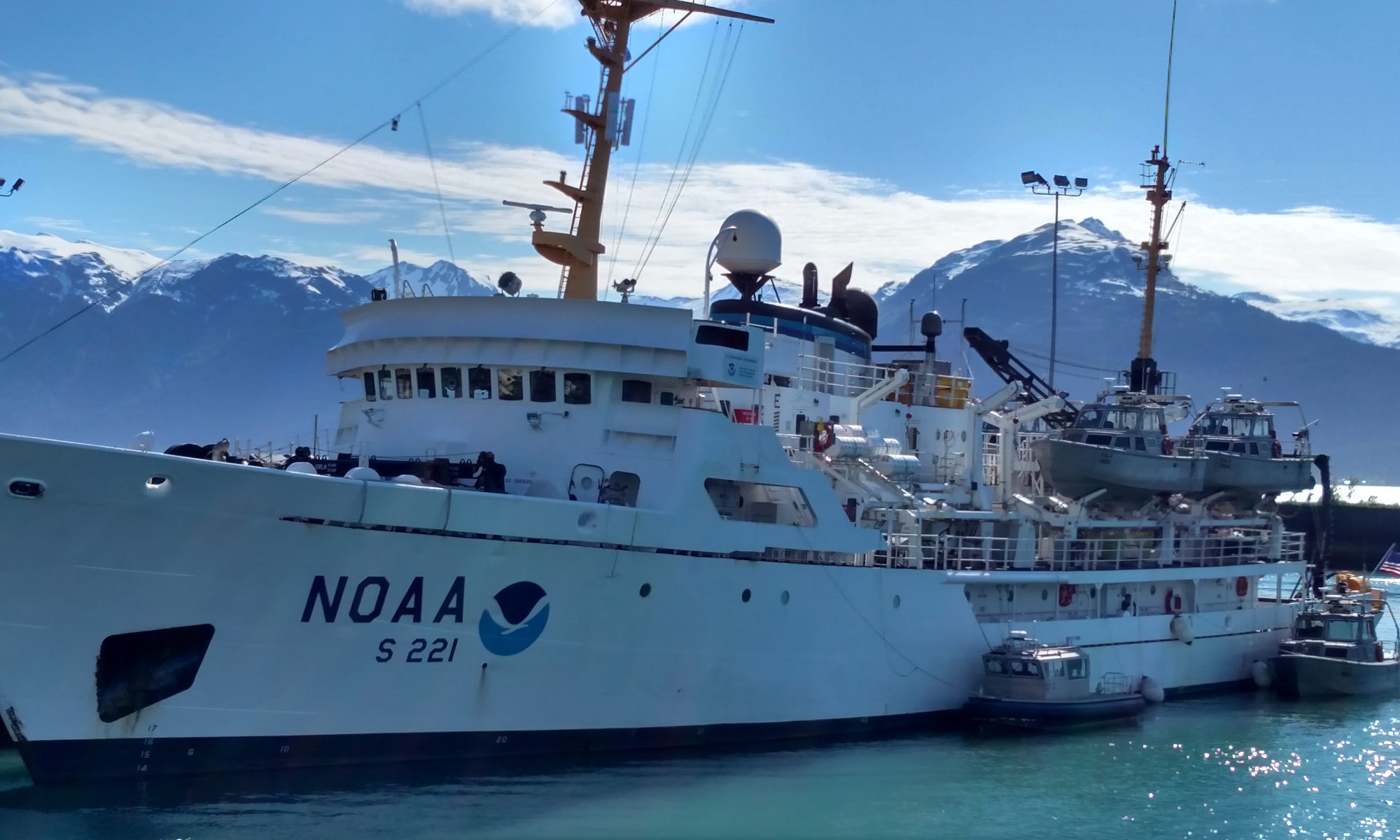
Tom Savage: Surveying the Coastline of Point Hope, Alaska, August 12, 2018

NOAA Teacher at Sea

Tom Savage

Aboard NOAA Ship Fairweather

August 6 – 23, 2018

Mission: Arctic Access Hydrographic Survey

Geographic Area of Cruise: Point Hope, northwest Alaska

Date: August 12, 2018

Weather data from the Bridge

Wind speed 8 knots
Visibility: 10 nautical miles
Barometer: 1010.5 mB
Temp:  8.5 C     47 F
Dry bulb 8   Wet bulb 6.5
Cloud Height: 5,000 ft
Type: Alto Stratus
Sea Height 2 feet

Science and Technology

Why is NOAA taking on this challenging task of mapping the ocean floor?  As mentioned in an earlier blog, the ocean temperatures worldwide are warming and thus the ice in the polar regions are melting. As the ice melts, it provides mariners with an option to sail north of Canada, avoiding the Panama Canal. The following sequence of maps illustrates a historical perspective of receding ice sheet off the coast of Alaska since August 1857.  The red reference point on the map indicates the Point Hope region of Alaska we are mapping.

This data was compiled by NOAA using 10 different sources. For further information as how this data was compiled visit https://oceanservice.noaa.gov/news/mar14/alaska-sea-ice.html. 

The light grey indicates  0-30% Open Water – Very Open Drift.  The medium grey indicates 30 – 90 % Open drift – Close Pack.  The black indicates 90 – 100% very close compact.

Sea Ice Concentration August 1857
Ice Concentration August 1957
Sea Ice Concentration August 2016

Ships that sail this region today rely on their own ships sonar for navigating around nautical hazards and this may not be as reliable especially if the ships sonar is not properly working (it’s also problematic because it only tells you how deep it is at the ship’s current location – a sonar won’t tell you if an uncharted hazard is just in front of the ship). Prior to mapping the ocean floor in any coastal region, it requires a year of planning in identifying the exact corridors to be mapped. Hydrographers plot areas to be mapped using reference polygons overlaid on existing nautical charts.  Nautical charts present a wealth of existing information such as ocean depth, measured in fathoms(one fathom is equal to six feet) and other known navigation hazards.

As mariners sail closer to the shorelines, the depth of the ocean becomes increasingly important.  Because of this uncertainty in the depth, the Fairweather herself cannot safely navigate safely (or survey) close to shore.  In order to capture this data, small boats called “launches” are used. There are a total of four launch boats that are housed on the boat deck of the Fairweather. Each boat can collect data for up to twelve hours with a crew of 2-5. Depending on the complexity of the area, each daily assignment will be adjusted to reasonably reflect what can be accomplished in one day by a single launch. Weather is a huge factor in the team’s ability to safely collect data. Prior to deployment, a mission and safety briefing is presented on the stern of the ship by the Operations Officer. During this time, each boat coxswain generates and reports back to the operations officer their GAR score (safety rating) based on weather, crew skills and mission complexity (GAR stands for Green-Amber-Red … green means low risk, so go ahead, amber means medium risk, proceed with caution; red means high risk, stop what you’re doing).  In addition, a mission briefing is discussed outlining the exact area in which data will be collected and identified goals.


Safety Briefing
Safety Briefing by LT Manda – photo by Tom Savage


Deploying a launch boat
Deploying a launch boat – photo by Tom Savage

The sonar equipment that transmits from the launch boats is called EM2040 multi beam sonar. A multi beam sonar is a device that transmits sound waves to determine the depth of the ocean. It is bolted to the hull that runs parallel to the boat, yet emits sound perpendicular to the orientation of the sonar. In the beginning of the season, hydrographers perform a patch test where they measure the offsets from the sonar to the boat’s GPS antenna, as well as calculating any angular misalignments in pitch, roll or yaw. These measurements are then entered in to software that automatically corrects for these offsets.

deploying CTD
TAS Tom Savage deploying the conductivity, temperature and density probe ~ photo by Megan Shapiro

The first measurement to collect is the ocean’s conductivity, temperature and depth. From this information, the scientists can determine the depths in which the density of the water changes. This data is used to calculate and correct for the change in speed of sound in a given water column and thus provide clean data. The boats travel in pre-defined set lines within a defined polygon showing the identified corridor to be collected. Just like mowing a lawn, the boat will travel back and forth traveling along these lines. The pilot of the boat called the Coxswain, uses a computer aided mapping in which they can see these set lines in real time while the boat moves. This is an extremely valuable piece of information while driving the boat especially when the seas are rough.

Coxswain
Coxswain Zucker – photo by Tom Savage

The coxswain will navigate the boat to the position where data collection will begin inside a defined polygon. Since the multibeam echosounder transmits sound waves to travel through a deep column of water, the area covered by the beam is wide and takes longer to collect. In such stretches of water, the boat is crawling forward to get the desired amount of pings from the bottom needed to produce quality hydrographic data. The reverse is true when the boat is traveling in shallow water. The beam is very narrow, and the boat is able to move at a relatively fast pace. The boat is constantly rolling and pitching as it travels along the area.


Hydrographer Megan analyzing the data

As the boat is moving and collecting data, the hydrographer checks the course and quality of the data in real time. The depth and soundings comes back in different colors indicating depth. There is at least four different software programs all talking to one another at the same time. If at any point one component stops working, the boat is stopped and the problem is corrected.  The technology driving this collection effort is truly state of the art and it all has to operate correctly, not an easy feat. Every day is different and provides different challenges making this line of work interesting.  Troubleshooting problems and the ability to work as a team is crucial for mission success!


Personal Log

I have found the work on the Fairweather to be extremely interesting. The crew onboard has been exceptional in offering their insights and knowledge regarding everything from ship operations to their responsibilities.  Today’s blog marks my first week aboard and everyday something new and different is occurring. I look forward in developing new lesson plans and activities for my elementary outreach program. Prior to arriving, I was expecting the weather to be mostly overcast and rainy most of the time. However, this has not been the case. Clear blue skies has prevailed most days; in fact I have seen more sun while on the Fairweather than back home in Hendersonville in the entire month of July!  For my earth science students, can you make a hypothesis as to why clear skies has prevailed here? Hint, what are the five lifting mechanisms that generate instability in the atmosphere and which one(s) are dominant in this region of Alaska?

Question of the day.  Can you calculate the relative humidity based on the dry and wet bulb readings above?      Data table below……    Answer in the next blog

What is the relative humidity?


Until next time, happy sailing !

Tom

Cindy Byers: Above the Queen Charlotte Fault, May 2, 2018

NOAA Teacher at Sea
Cindy Byers
Aboard NOAA Ship Fairweather
April 29 – May 13, 2018

Mission: Southeast Alaska Hydrographic Survey

Geographic Area of Cruise: Southeast Alaska

Date: May 2, 2018

Weather From the Bridge

Latitude: 54°41.2 N
Longitude: 134°15.3 W
Sea Wave Height: 5 feet
Wind Speed: 7 knots
Wind Direction: 330°
Visibility: 2 nautical miles
Air Temperature: 9.9°C  
Sky:  Complete Cloud Cover

Science and Technology Log

NOAA Ship Fairweather is now 46 miles off the southeast coast of Alaska, mapping the ocean floor over a fault. This a transform boundary, so it is a strike slip fault.  It is the boundary between the North American and Pacific plates.  The United States Geologic Survey (USGS) has hired NOAA to survey the ocean floor in this area called the Queen Charlotte fault. The entire section of the fault is called the Queen Charlotte – Fairweather fault (named for Mount Fairweather, just like the ship’s name.)  It runs for over 1,200 kilometers from Yakatat, Alaska to the north and British Columbia to the south. This is a part of a long fault along this plate boundary that is called the San Andreas fault when it is on land in California

The last time this particular area was surveyed was for the creation of navigational charts, between 1900 and 1938, but without accuracy or data density that the multibeam sonar being used today has.  Once this portion is surveyed, the entire fault will have been mapped.  The mapping has been done by the USGS, the Canadian Geologic Survey, and NOAA.

Queen Charlotte Fault
The Queen Charlotte Fault

The photo above shows the features of the sea floor.  It is set  on top of a navigational chart.  You can see the numbers on the old chart that represent depth reading.   The data collected today shows depth for the entire area mapped and the features on the sea floor.

Looking at what NOAA Ship Fairweather has already mapped, the fault is very distinct as are the channels that have been offset by past seismic activity.  These channels were created from runoff as the glaciers receded from this area 17,000 years ago.  Using the offset measurements and the time since the canals where formed, scientists have given a slip rate of 5.5 centimeters per year to this area of the fault. This makes it one of the fastest moving continental – ocean transform boundaries.

Mapping


NOAA ship Fairweather has sonar that was built for detecting hazards for surface navigation, but it is capable of surveying to several kilometers in depth. The survey team has figured out how map at these great depths up to 2,100 meters.  It involves going slowly over the area, and gathering richer data by going over part of the previous survey lines. This is much like painting a wall, where the painter overlaps their brushstrokes so there are not gaps in the coverage. The multibeam solar is also directed in a narrow band, at this depth, for more accurate data.

Bridge Computer
The blue squiggly lines show where mapping is happening. The other colors are where we have been.

Why do you think this information is wanted by geologists?

The fault has produced at least seven earthquakes with a magnitude greater than 7.  An 8.1 magnitude earthquake was generated from this fault near British Columbia in 1949.  To date, it is the largest Canadian earthquake recorded. In 1958, a magnitude 7.8 earthquake above Lituya, Alaska created a massive underwater landslide which produced a tsunami sending water 525 meters (1700 feet feet) up a mountainside.  More recently in 2012, a 7.5 magnitude earthquake was measured from this fault, and in 2013, Craig, Alaska was hit with a magnitude 7.5 earthquake.

Surveyors computer These five screens are used by the survey team when the multibeam sonar is in use.
These five screens are used by the survey team when the multibeam sonar is in use.

Scientists want to know more about this fault, which could cause further damage to areas of southeast, Alaska.  From the seabed mapping, geologists hope to better understand the slip rate and the intervals between earthquakes.

Personal Log

I have been so impressed with the people on NOAA Ship Fairweather.  Everyone has been so welcoming and kind.  This small group of people living in small quarters could be difficult for many people, but everyone here is so enthusiastic about the mission and their jobs.  They are very open to sharing what they know with me, including explaining the science and technology of the equipment and how the ship functions.

It has been really fun learning about this fault and the surrounding underwater topography.  Being able to see the sea bottom as we continue over it is amazing!

I am so happy I will get a chance to share this science with my students.  I hope they noticed, as they read this post,  the highlighted terms and concepts that we learned this year about faults and earthquakes.

Did you know?

I found a term that was new to me, tectonic geomorphology.  It is the study of the interaction between active plates and land process, and how these shape landscapes.


Information used in this post can partly from:

“A Closer Look at an Undersea Source of Alaskan Earthquakes.” Earth and Space Science, vol. 99, no. 2, 2018, pp. 1–6.


Victoria Cavanaugh: West of Prince of Wales Island, April 26, 2018

NOAA Teacher at Sea
Victoria Cavanaugh
Aboard NOAA Ship Fairweather
April 16-27, 2018

MissionSoutheast Alaska Hydrographic Survey

Geographic Area of Cruise: Southeast Alaska

Date: April 26, 2018

Weather Data from the Bridge

Latitude: 54° 40.914′ N
Longitude: 134° 05.229′ W
Sea Wave Height: 8-9feet
Wind Speed: 15 knots
Wind Direction: NNW
Visibility: 10 km
Air Temperature: 9.5oC  
Sky:  Partly Sunny in the AM, Cloudy in the PM

Science and Technology Log

Over the past two days, the crew of NOAA Ship Fairweather has been hard at work on the first major project of the season, charting the ocean floor along the Queen Charlotte-Fairweather Fault System.  The project itself will take seven days, though with two days at sea before heading to port in Ketchikan, the survey techs have been focusing on the first sheet, D00245, roughly 900 kilometers offshore in an area known as West of Prince of Wales Island.

Chart of survey area
The Survey Starts Here: Note Sheet D00245 to the Left in Blue

Fairweather is completing the survey in collaboration with the United States Geological Survey (USGS) which has spent the last three years researching and mapping the seafloor along the fault.  Geologists are particularly interested in this fault as little is known about the region and the seafloor here is largely unexplored.  Geologists believe that by studying the fault line and the geology of the ocean floor, they may be able to unlock secrets about the history of our oceans as well as develop new understanding of seismic activity that can keep communities safer when future earthquakes strike.

Plot room
The Plot Room: Survey Techs aboard Fairweather Can View the Data Being Collected in Real-Time

One of the reasons the USGS turned to NOAA to complete its charting efforts is because of the tremendous ocean depths.  The survey techs are using  Fairweather multibeam echosounders for the project which will take a total of seven days to complete.  Sonar pings from the ship’s transducer hit the ocean floor and bounce back to the ship, creating 2D and 3D charts of the ocean floor.  Additionally, survey techs can learn more information about the type of surface on the ocean floor (sandy, rocky, etc.)  based on the strength of the return of the sonar pings. Despite the seafloor in the area being some 15,000 years old, it has never been explored!   Thus, for the survey techs and geologists working on this project, there is a sense of pure excitement in being able to explore and discover a new frontier and help others sea what humans have never seen before.

Depth reading
1520 Meters Down: The Number at the Top Left of the Screen Shows We’re in Water Nearly a Mile Deep!

One of the geologists remarked that he was surprised to see that despite how old the ocean floor in the area is, little appears to have changed, geologically speaking in thousands of years.  Another surprise for geologists is how the fault appears to be one large, long crack.  Many other fault areas appear to be made up of lots of small, jagged, and complicated “cracks.”  Another question to explore!

Shallower depth reading
A Much More Shallow Area: Notice the Sonar Here Shows We’re Just 247 Meters Deep

Notice the colors which help survey techs see the changing depths quickly.  The green, mostly vertical lines, show the ship’s course.  To collect data, Fairweather  runs about 6 hours in one direction, before turning around to run 6 hours in the opposite direction.  This allows survey techs to gather more data about ocean depths with each turn.  In total, survey techs collected nearly 48 hours of data.  This meant survey techs working all night long to monitor and process all of the new information collected.

Bekah and CTD
Survey Tech Bekah Gossett Prepares to Launch a CTD off the Ship’s Stern

Just like on the launches during patch tests, survey techs deploy CTD’s to measure the water’s conductivity (salinity), temperature, and pressure.  This information is key in order to understand the speed of sound in a given area of water and ensure that the sonar readings are accurate.

Survey techs ready CTD
The Survey Techs Work in Rough Seas to Ready the CTD

Personal Log

View off bow
Nothing But Blue Skies in Every Direction!

In striking contrast to the beautiful coastlines that framed the Inside Passage, the last two days have provided endless blue skies mixing with infinite blue seas.  No land in sight!

Nautical chart
Finding the Survey Area West of Prince of Wales Island on a Chart
Radar
The Ship’s Radar Shows Just One Vessel Nine Miles Due East

The open ocean is challenging (huge waves make the entire ship sway constantly and gives new meaning to earning one’s “sea legs”), but far more inspiring.  I’m grateful for the glimpse into life at sea that NOAA has provided me.  There is deep sense of trust among the crew, in their collective hard work that keeps us all safe in the middle of the ocean.  There is also a wonderful sense of adventure, at being part of discovering something new.  Just as explorers have sought after new frontiers for hundreds of years, Fairweather today is charting areas still unknown to humankind.  There is something truly invigorating about watching the sonar reflect the ocean floor in a rainbow of colors, in watching as peaks and valleys slowly are painted across the monitors in the plot room and bit by bit, another sliver of science is added to the charts.  There is something particularly refreshing and exciting about seeing whales spray and play in the waves while standing on the ship’s bridge.  I’m truly grateful to all onboard Fairweather and NOAA’s Teacher at Sea Program for this remarkable opportunity, and I look forward to sharing what I’ve learned with students back at Devotion.

Wave heights
The View out a Port Window Shows Some of the More Extreme Wave Heights as Fairweather Rocks and Rolls

Did You Know?

Prince of Wales Island is one of the southernmost parts of Alaska.  Home to some 4,000 inhabitants, Prince of Wales Island is the 4th largest island in the US and the 97th largest island in the world.   Originally home to the indigenous Kaigani Haida people,  Spanish, British, and French explorers all passed by the island in the 1700 and 1800’s.  In the late 1800’s, miners came to the island looking for gold, copper, and other metals.  Today, most of the land is protected as the Tongass National Forest covers a great portion of the island.

Challenge Question #5: Devotion 7th Graders – Can you find the depths of the Charles River, the Boston Harbor, and 900 kilometers offshore the Massachusetts coast?  What sort of aquatic life exists in each area?  What does the river/seafloor look like in these areas?  Create a comic strip or cartoon showing your findings.

Donna Knutson: Last Leg of Leg III Atlantic Sea Scallop Survey 2016, June 24, 2016

NOAA Teacher at Sea Donna Knutson
Aboard the Research Vessel Sharp
June 8 – June 24, 2016

2016 Mission: Atlantic Scallop/Benthic Habitat Survey
Geographical Area of Cruise: Northeastern U.S. Atlantic Coast
Date: June 24, 2016

Last Leg of Leg III Atlantic Sea Scallop Survey 2016

Mission and Geographical Area: 

The University of Delaware’s ship, R/V Sharp, is on a NOAA mission to assess the abundance and age distribution of the Atlantic Sea Scallop along the Eastern U.S. coast from Mid Atlantic Bight to Georges Bank.  NOAA does this survey in accordance with Magnuson Stevens Act requirements.

Science and Technology:DSCN7770 (2)me best

Latitude:  41 29.84 N

Longitude:  070 38.54 W

Clouds:  partly cloudy

Visibility: 5-6 nautical miles

Wind: 3.58 knots

Wave Height: 6 in.

Water Temperature:  53  F

Air Temperature:  67 F

Sea Level Pressure:  30.0 in of Hg

Water Depth: 26 m


It has been an action packed two weeks.  The men and women who dedicate themselves to the scallop survey are extremely hard working scientists.  It is not an easy job.  The sorting of the dredged material is fast and furious, and it needs to be in order to document everything within the catch before the next one comes in.  The baskets are heavy and it takes a strong person to move them around so quickly.

DSCN8159 (2) dredge team
Han, Jill, Mike, Vic, Me and Ango

In small catches every scallop is measured.  In dredges with many baskets of scallops, a percentage is measured.  It is a random sampling system, taking some scallops from each of the baskets to get a general random sample of the whole.  Mike led an efficient team, he told us what to look for and oversaw the measuring.

DSCN7780 (2)mike and nicki
Mike and Nikki

He often set samples aside to show me later, when we were not as busy. A few examples were how to tell the difference between the red and silver hake or the difference between the Icelandic and Atlantic sea scallop.  He showed me how the little longhorn sculpin fish, “buzz bombs” known to fisherman, vibrate when you told it in your hand.

DSCN8008 (2)buzz
Longhorn sculpin

Mike even took the time to dissect some hake and to show me the differences in gonads, what they were feeding on by opening their stomach, and the otolith within the upper skull.  The otolith is a small bone in the inner ear that can be used to identify and age the fish when in a lab looking through a microscope.  Mike answered my many questions and was always eager to teach me more.

Another helpful team member was Vic.  Vic taught me how to run the HabCam.  He has been involved in the HabCam setup since it started being used four years ago.  There is a lot of work to do to set up the multiple monitors and computers with servers to store all the images collected by the HabCam.  Vic overlooks it all from the initial set-up to the take down.  I admire Vic’s work-ethic, he is always going 100% until the job is completed.  Sometimes I just needed to get out of his way, because I knew he was on a mission, and I didn’t want to slow him down.

DSCN8132 (2) monitors
Control center for Habcam and Dredging

When we weren’t dredging, but rather using the HabCam, there was a pilot and copilot watching the monitors.  The HabCam, when towed behind the ship, needs to be approximately 1.7 m off the ocean floor for good resolution of the pictures, and keeping it at that elevation can be a challenge with the sloping bottom or debris.  There is also sand waves to watch out for, which are like sand bars in a river, but not exposed to the surface.

When not driving HabCam there are millions of pictures taken by the HabCam to oversee.  When you view a picture of a scallop you annotate it by using a measuring bar.  Fish, skates and crabs are also annotated, but not measured.  It takes a person a while to adjust to the rolling seas and be able to look at monitors for a long period of time.  It is actually harder than anticipated.

DSCN7768 (2)skate
HabCam Picture of a skate.

Han was making sure the data was collected from the correct sites.  She works for the Population Dynamics branch of NOAA and was often checking the routes for the right dredges or the right time to use the HabCam.  Between the chief scientist Tasha and Han, they made sure the survey covered the entire area of the study as efficiently as possible.

DSCN7839 (2)tash han mike
Tasha, Han and Mike discussing the next move.

Dr. Scott Gallager was with us for the first week and taught me so much about his research which I mentioned in the previous blogs.  Kat was with us initially, but she left after the first week.  She was a bubbly, happy student who volunteered to be on the ship, just to learn more in hopes of joining the crew someday.  Both vacancies were replaced by “Ango” whose real name in Tien Chen, a grad student from Maine who is working on his doctoral thesis, and Jill who works in Age and Growth, part of the Population Biology branch of NOAA.  Both were fun to have around because of their interesting personalities.  They were always smiling and happy, with a quick laugh and easy conversation.

DSCN8131 (2)the three
Jill, Ango and Han after dredging.

The Chief Scientist, Tasha, was extremely helpful to me.  Not only does she need to take care of her crew and manage all the logistics of the trip, plus make the last minute decisions, because of weather or dredges etc, but she made me feel welcome and encouraged me to chat with those she felt would be a good resource for me.  On top of it all, she helped me make sure all my blogs were factual.  She was very professional and dedicated to her work, as expected from a lead scientist leading a scientific survey.

DSCN8146 (2)tash and jim
Evan, Tasha and Jimmy discussing route.

I spent as much time as possible getting to know the rest of the crew as well.  The Master, Captain James Warrington “Jimmy” always welcomed me on the bridge.  I enjoyed sitting up there with him and his mates.  He is quick witted and we passed the time with stories and many laughs.  He tolerated me using his binoculars and searching for whales and dolphins.  There were a few times we saw both.

He showed me how he can be leader, responsible for a ship, which is no small feat, but do so with a great sense of humor, which he credits he inherited from his grandmother.  The other captains, Chris and Evan, were just as friendly.  I am sure all who have been lucky enough to travel with them would agree that the RV Sharp is a good ship to on because of the friendly, helpful crew and staff.

DSCN7785 (2)KG
KG, oceanic specialist, helped with dredges.

Because this was my second experience on a survey, the first was a mammal survey, I have really come to appreciate the science behind the study.  It is called a survey, but in order to do a survey correctly, it takes months of planning and preparation before anyone actually gets on a ship.

There is always the studying of previous surveys to rely on to set the parameters for the new survey.  Looking for what is expected and finding, just that, or surprising results not predicted but no less valued, is all in a scientist’s daily job.  I admire the work of the scientist. It is not an easy one, and maybe that is why it is so much fun.  You never know exactly what will happen, and therein lies the mystery or maybe a discovery to acquire more information.

DSCN8127 (2)big goose
I had to hold the largest goose fish we caught!

It was a challenging two weeks, but a time I’m so glad I had the opportunity to have with the members of Leg III of the 2016 Atlantic Sea Scallop Survey.

Lynn Kurth: The Earth has One Big Ocean, June 22, 2016

NOAA Teacher at Sea

Lynn M. Kurth

Aboard NOAA Ship Rainier

June 20-July 1, 2016

Mission: Hydrographic Survey

Geographical area of cruise:  Latitude: N 57˚50 Longitude: W 153˚20  (North Coast of Kodiak Island)

Date:  June 23, 2016

Weather Data from the Bridge:
Sky: Clear
Visibility: 10 Nautical Miles
Wind Direction: 268
Wind Speed: 14 Knots
Sea Wave Height: 2-3 ft. on average
Sea Water Temperature: 12.2° C (54° F)
Dry Temperature: 16° C (60.8° F)
Barometric (Air) Pressure: 1023 mb


Science and Technology Log

I’m continually searching for ways to connect what I am learning to what is relevant to my students back home in the Midwest.  So, as we left Homer, AK for our survey mission in Kodiak Island’s Uganik Bay, I was already thinking of how I could relate our upcoming survey work to my students’ academic needs and personal interests.  As soon as the Rainier moved away from Homer and more of the ocean came into view, I stood in awe of how much of our planet is covered with water.  It’s fascinating to think of our world as having one big ocean with many basins, such as the North Pacific, South Pacific, North Atlantic, South Atlantic, Indian, Southern and Arctic.  The study of ocean and its basins is one of the most relevant topics that I can teach when considering the following:

  • the ocean covers approximately 70% of our planet’s surface
  • the ocean is connected to all of our major watersheds
  • the ocean plays a significant part in our planet’s water cycle
  • the ocean has a large impact on our weather and climate
  • the majority of my students have not had any firsthand experience with the ocean


IMG_1675
Earth’s One Big Ocean as seen from outside of Homer, AK


Each of the ocean basins is composed of the sea floor and all of its geological features which vary in size and shape.  The Rainier will be mapping the features of the sea floor of the Uganik Bay in order to produce detailed charts for use by mariners.  The last survey of Uganik Bay was completed in 1908 when surveyors simply deployed a lead weight on a string over the edge of a boat in order to measure the depth of the water.  However, one of the problems with the charts made using the lead line method, is that the lead line was only deployed approximately every 100 meters or more which left large gaps in the data.  Although not in the Uganik Bay, in the 1930s NOAA began using single beam sonar to measure the distance from a ship’s hull to the sea floor which made surveying faster but still left large gaps in the data. Fast forward from approximately 100 years ago when lead lines were being used for surveying to today and you will find the scientists on the Rainier using something called a multibeam sonar system.  A multibeam sonar system sends out sound waves in a fan shape from the bottom of the ship’s hull.  The amount of time it takes for the sound waves to bounce off the seabed and return to a receiver is used to determine water depth.  The multibeam sonar will allow our team on the Rainier to map 100% of the ocean’s floor in the survey area that we have been assigned.

nNTC_Hydro
Evolution of Survey Techniques (Illustration Credit: NOAA)


DSCN0006
NOAA Ship Rainier June 22, 2016 in Uganik Bay off of Kodiak Island

 All Aboard!

IMG_1814
NOAA Corps Junior Officer Shelley Devereaux

The folks I am working with are some of the most knowledgeable and fascinating people that I have met so far on this voyage and Shelley Devereaux from Virginia is one of those people.  Shelley serves as a junior officer in the NOAA  (National Oceanic and Atmospheric Administration) Corps and has been working aboard the Rainier for the past year.  The NOAA Commissioned Officer Corps is one of the seven uniformed services of the United States and trains officers to operate ships, fly aircraft, help with research, conduct dive operations, and serve in other staff positions throughout NOAA.

Here is what Shelley shared with me when I interviewed her one afternoon.

Tell us a little about yourself:  I’m originally from the rural mountains of Appalachia and moved to Washington DC after college.  I lived in DC for about seven years before I joined the NOAA Corps and while in DC I really enjoyed cycling, hiking, cooking, baking and beer brewing.

How did you discover NOAA Corps and what do you love most about your job in the NOAA Corps?

I went to Washington DC after I received my undergraduate degree in math and worked a lot of different jobs in a lot of different fields.  In time, I decided to change careers and went to graduate school for GIS (Geographic Information Systems) because I like the data management side of the degree and the versatility that the degree could offer me.  I was working as a GIS analyst when my Uncle met an officer in the NOAA Corps who talked with my Uncle about the NOAA Corps.  After that, my Uncle told me about NOAA Corps and the more I found out about NOAA Corps the more I liked it.  Especially the hydro side!  In the NOAA Corps each of your assignments really develops on your skill base and you get to be involved in a very hands on way.  Just this morning I was out on a skiff literally looking to determine what level a rock was in the water.  And, later in my career I can serve an operations officer.  So I loved the fact that I could join the NOAA Corps, be out on ship collecting data while getting my hands dirty (or at least wet!), and then progress on to other interesting things.  I love getting to be part of all the aspects of ship life and being a surveyor.   It’s a wonderful feeling knowing that what we do here has a tangible effect on the community and the public because we are making the water safer for the people who use it.

DSCN0011
NOAA Corps Junior Officer Shelley Devereaux manages her sheets during near shore work in Uganik Bay

What are your primary responsibilities when working on the ship?  

I am an ensign junior officer on a survey ship.  Survey ships operate differently than other ships in the NOAA fleet with half of my responsibilities falling on the junior officer side of ship operations which includes driving the ship when we are underway, working towards my officer of the deck certification, working as a medical officer, damage control officer and helping with emergency drills.  The other half of what I get to do is the survey side.  Right now I am in charge of a small section called a sheets and I am in charge of processing the data from the sheets in a descriptive report about the area surveyed.  So, about half science and half ship operations is what I do and that’s a really good mix for me.  As a junior officer we are very fortunate that we have the opportunity to and are expected to learn the entire science of hydrography.

IMG_1819
Junior Officer Shelley Devereaux checks the ship’s radar

What kind of education do you need to have this job and what advice do you have for young people interested in a career like yours?

You need a college degree with a lot of credits in science and/or math.  Knowing the science that is happening on the ship is important to help your understanding of the operations on the ship which helps you be a better ship operator. Realize that there are a lot of opportunities in the world that are not always obvious and you need to be aggressive in pursuing them.


Personal Log

You didn’t think I’d leave out the picture of Teacher at Sea in her “gumby suit” did you?  The immersion suit would be worn if we had to abandon ship and wait to be rescued.

IMG_1760
Teacher at Sea (TAS) Kurth Hi Mom!

 Happy Solstice!  Quirky but fun:  For the past six years I have celebrated the solstice by taking a “hand picture” with the folks I am with on the solstice.  I was thrilled to be aboard the Rainier for 2016’s summer solstice and include some of the folks that I’m with on the ship in my biannual solstice picture.

IMG_0989
Winter Solstice 2015 with Sisu (family pet) and my husband James
IMG_1820
All Hands on Deck! Summer Solstice 2016

Did You Know?

Glass floats or Japanese fishing floats are a popular collectors’ item.  The floats were used on Japanese fishing nets and have traveled hundreds and possibly thousands of miles via ocean currents to reach the Alaskan shoreline. The floats come in many colors and sizes and if you’re not lucky enough to find one while beach combing, authentic floats and/or reproductions can be found in gift shops along the Alaskan coast.

floats(2)
Japanese Fishing Floats