Erica Marlaine: Diving Down the pH Scale, July 13, 2019

NOAA Teacher at Sea

Erica Marlaine

Aboard NOAA Ship Oscar Dyson

June 22 โ€“ July 15, 2019


Mission: Pollock Acoustic-Trawl Survey

Geographic Area of Cruise: Gulf of Alaska

Date: July 13, 2019

Weather Data from the Bridge:

Latitude: 57ยบ 09.61 N
Longitude: 152ยบ 20.99W
Wind Speed: 15 knots
Wind Direction: 210 ยบ
Air Temperature:  12ยบ Celsius
Barometric Pressure: 1013 mb
Depth of water column 84 m
Surface Sea Temperature: 12ยบ Celsius


Science and Technology Log

Are you wondering what itโ€™s really like to live and work full-time on a NOAA research vessel? I asked Andrea Stoneman, the Senior Survey Technician on the NOAA Ship Oscar Dyson.

Andrea Stoneman
Senior Survey Technician Andrea Stoneman

Like everyone onboard the Oscar Dyson, Andrea is always working hard, but always has a smile on her face. Originally from Duluth, Minnesota, she has been employed by NOAA as a โ€œwage marinerโ€ for a year. A wage mariner means she is an at-sea civilian employee of NOAA. She began college at the University of Minnesota as a business major, but an internship as a freshwater mussel researcher changed her life and made her realize her true love: BIOLOGY! She earned a degree in Environmental Science, and then attended graduate school at Delaware State University, where NOAA funded her research on ocean acidification and its impact on fish.

Are you wondering what ocean acidification means?  

The amount of carbon in the ocean is rising due to an increase in the amount of carbon dioxide (CO2) in the air. Carbon dioxide acidifies the water, reducing its pH level.  The letters pH stands for the ‘potential of Hydrogen.โ€™ The pH scale was invented in 1909 by a biochemist names S.P. Sorenson. The scale uses numbers from 1 to 14, with 1 being the most acidic, 14 being the least acidic (or more alkaline) and 7 as the middle (neutral) point.

For the past 300 million years, the average pH of the ocean was approximately 8.2. It is now closer to 8.1, a drop of 0.1 pH units.  Remember, the numbers go โ€œin reverseโ€ so a drop in pH means it is MORE acidic.  You may be thinking, but itโ€™s only a drop of 0.1. That doesnโ€™t sound like a lot. However, a drop of 0.1 represents a 25-percent increase in acidity.  Thatโ€™s because the pH scale is a logarithmic scale, not a linear scale.  To understand a linear scale, think of a ruler. The difference between inches on a ruler stays constant. A 5-inch fish is one inch bigger than a 4-inch fish, and 2 inches bigger than a 3-inch fish. In contrast, the pH scale is a logarithmic scale in which two adjacent values increase or decrease by a factor of 10.  Therefore, a pH of 3 is ten times more acidic than a pH of 4, and 100 times more acidic than a pH of 5.

Studies indicate that many marine species may experience adverse effects on their health, growth, reproduction, and life span due to ocean acidification. That means fish could develop diseases, have fewer babies, or die younger.

You and I need calcium to build strong bones. We get calcium through milk, cheese, green leafy vegetables, and many other sources. Marine species also need calcium carbonate to build their bones or shells. Ocean acidification causes carbonate ions to be less abundant in the ocean, which makes it harder for marine species to build strong bones and shells. This is especially bad for oysters, clams, sea urchins, corals, and mussels, the very species that made Andrea fall in love with science!

After graduate school, Andrea worked as a fisheries observer on commercial fishing vessels. (I met quite a few people on-board the ship who are or were observers.) To a non-fisheries person, an โ€œobserverโ€ SOUNDS like someone who stands around watching others, but it is actually very hard work! Observers document compliance (making sure that things are being done the correct way). They take samples of the catch and collect data regarding the size of the catch and the species caught.  The data goes into the same service model that NOAA data does, which is vital for ensuring sustainable fishing for the future. 

Through her work as an observer in Alaska, Andrea met people at NOAA, took a tour of a NOAA ship, and decided to apply for a job with NOAA.  (Hmmmโ€ฆ When I interviewed Ensign Andonian for an earlier blog, she also mentioned visiting a NOAA ship as the thing that made her decide to choose a career with NOAA. That gives you an idea of just how amazing NOAA ships are!)

So what does a Senior Survey Technician do?

She runs and maintains all of the scientific sensors on the ship (including the meteorological and oceanographic sensors). She also runs the CTD, a device which measures the conductivity, temperature, depth, salinity, and other oceanographic parameters of the water. 

CTD
The CTD device

In addition, she is involved in setting and retrieving the fishing nets and is an expert at processing the catch in the fish lab. Andrea ensures that the data collected onboard is sound and accurate, and โ€œpackagesโ€ the data so that it is presentable and accessible to NOAA thus becoming accessible to the public whom NOAA serves.

Asked if she recommends a NOAA life, Andrea says itโ€™s great for college graduates who have an interest in science and a love of the ocean. Some perks (especially for new college graduates) include living rent-free onboard, having delicious meals cooked for you three times a day, and getting to see the world while being involved in interesting, and sometimes ground-breaking, scientific research. An added perk is that working for the federal government can โ€œeraseโ€ some of your student loans!

Andrea enjoys being the Senior Survey Technician onboard the NOAA Ship Oscar Dyson, and has fallen in love with Alaska, which she now considers her home.

Click below to watch a 2-minute video by NOAA about ocean acidification:


Personal Log

While I cannot describe what it is like to live full-time on a NOAA ship, I can tell you what itโ€™s like as a Teacher at Sea for 26 days. Like everyone onboard, I โ€œworkโ€ a 12-hour shift.  The science team works shifts starting at either 4 a.m. or 4 p.m.  I was assigned the 4 p.m. to 4 a.m. shift. That means I wake up most days between 2:30 and 3:00 in the afternoon.  On days that I am โ€œgoodโ€ I head down to the gym. On other days, I grab a light โ€œbreakfastโ€ before heading to the chem lab to start my shift.

Often we start our shift processing fish by 4:30. First I suit up in steel-toed boots, a waterproof jacket and overalls, and elbow-high rubber gloves. 

Erica ready for the fish lab
I am ready to work in the fish lab!

Then we process the haul, which means sorting approximately 1000 pounds of fish and jellyfish by species.

haul
An average-sized haul

We weigh them, measure them, and dissect some to collect otoliths (ear bones) or ovaries.  All of this can take 2-3 hours. Then we clean.  The fish lab gets COVERED in fish slime, scales, and jellyfish goo.

Jellyfish "goo"
Jellyfish “goo”

There are high-powered waters sprayers hanging from the ceiling, and we blast every surface in the room with saltwater for at least 10 minutes after every haul. Imagine cleaning your kitchen with a fire engine hose! Itโ€™s definitely the most fun I have ever had cleaning!  

cleaning the fish room
One of the many high power saltwater sprayers

At the end of the cruise, I will join Andrea the Survey Technician and the science team for 2-3 hours of meticulously scrubbing and spraying the fish lab so that it is clean and ready for the next group that comes aboard a few days after we leave.

Since the scientists onboard often want to do โ€œpair trawlsโ€ (fishing in the same area using the โ€œoldโ€ AWT net and the โ€œnewerโ€ LFS net in order to align the catch data with the acoustics data),  I am often back in the fish lab an hour later to process another haul, and again clean the fish lab.

After that, depending upon the time, I might have a snack, or do research and write blogs, or spend time in the chem lab with my co-workers, Matthew Phillips (the Fish Lab Lead) and volunteer biologist Nathan Battey, discussing the haul or what is coming up for the rest of the shift. At about 11 p.m., the sun sets, and sometimes it is spectacular, so I try to pop out onto the deck for a quick photo. 

The sun setting near Mitrofania

At midnight, we start getting ready to do the drop camera to determine which areas are trawlable. We usually do at least 4 camera drops, from approximately 1 p.m. to 4 p.m. This time of night often involves the science team consuming caffeine, ice cream, red vines, sour patch kids, or all of the above. At 4 a.m., the next shift starts, and my roommate, Jamie Giganti, comes into the chem lab. Jamie is a field coordinator for AIS. She works as an observer part of the time, but also provides support and training for new observers, and acts as a liaison between boat captains and observers.

Jamie Giganti
My roommate Jamie Giganti

Jamie’s arrival in the chem lab means it is my turn to go to โ€œourโ€ room.  Although we are roommates, we are never actually in the room at the same time. The goal is that you stay out of the room for the 12 hours your roommate is off-shift, allowing them to sleep or relax.  That means that every time I am on shift I need to make sure that I take everything I might need for the day.

The first few days onboard, I was in bed and asleep 15 minutes after my shift ended. Now that I am accustomed to the schedule, or perhaps due to the caffeine or sugar, I am often up until 5 or 5:30 a.m. That means I go to sleep just as the sun rises.

My stateroom has a bathroom and shower, a desk, a few shelves, lockers that act as a closet, and bunkbeds.  (I was so happy when Jamie asked if she could have the top bunk!)

My state room
My state room

The large window has both magnificent views of Alaska and also blackout curtains that block the sun so that people on my shift can sleep.

The shower area in the bathroom has a slightly raised border, but since the boat moves while you are showering, so does the shower curtain.

shower
Shower

Perhaps other people have figured out how to get the water to stay IN the shower.  I am still working on that. On the upside, the bathroom floor gets cleaned every day! (I am told that one trick is to use zip ties to โ€œlengthenโ€ the shower curtain.  (Next time?)

Processing a haul seems easy now, but it was overwhelming the first few days! As a non-scientist, I was unfamiliar with fish and jellyfish species, perplexed by the computer program used to enter data, and kept confusing which fish to measure, which fish to weigh, and which fish to measure and weigh.  I am so grateful for the patience of everyone around me!

Amazingly, I never got seasick. I wore a scopolamine patch for the first part of the trip, and then one day decided to take it off and learned that I had in fact โ€œgotten my sea legs.โ€ Now I barely feel the boat moving during the day and enjoy the light rocking at night.

I am writing this during my last few days onboard.  While we have occasionally been near land, during much of our time onboard, the view was the incredibly beautiful Gulf of Alaska.  Yesterday, when I saw land in the distance, I was sad to learn that it was Kodiak.  That means my time on the NOAA Ship Oscar Dyson is almost over. 


Catherine Fuller: Into the Copper River Plume, July 7, 2019

NOAA Teacher at Sea

Catherine Fuller

Aboard R/V Sikuliaq

June 28 โ€“ July 18, 2019

Mission: Northern Gulf of Alaska (NGA) Long-Term Ecological Research (LTER)

Geographic Area of Cruise: Northern Gulf of Alaska

Date: July 7, 2019

Weather Data from the Bridge

Latitude: 59ยฐ 40.065 N
Longitude: 146ยฐ 04.523 W
Wave Height: 2-3 ft
Wind Speed: 10.4 knots
Wind Direction: 254 degrees
Visibility:  100 m
Air Temperature: 12.0 ยฐC
Barometric Pressure: 1015.4 mb
Sky: Overcast, foggy


Science and Technology Log

Usually LTER cruises are more focused on monitoring the ecosystem, but in our case, the cruise will also focus on a process study of the Copper River plume.

Copper River plume
This is a satellite photo of the plume with an overlay of the salinity of the water along our course. The darker colors represent the lowest salinity.

This seasonal plume brings iron and fresh water into the marine ecosystem, where they are dispersed by weather and currents. Because our winds have been very light, the plume is retaining its coiled shape remarkably well.  Our sampling on the Middleton Line (prior to the plume study) will add information about how both the Copper River fresh water and iron are spread along the shelf and throughout the food web.  

Clay Mazur
Clay checking the fluorescence of a sample.

Clay Mazur has a particular interest in the iron-rich waters of the plume.  He is a graduate student from Western Washington University who is working under Dr. Suzanne Strom (also onboard). He is one of a few on board who are working on their own experiments as opposed to assisting others.  The overall goal of his work is to study how iron in phytoplankton is limited and how the sporadic addition of it can stimulate growth.  He has a gigantic on-deck incubation experiment in which he will take an iron-limited plankton community from offshore in the Gulf and introduce iron-rich water from the Copper River plume to see what happens.  Clay will measure chlorophyll โ€“ an indication of biomass โ€“ by which he can estimate the plankton population.  He will also be checking the physiology of plankton in different size classes, and taking samples to see the pigments that every cell produces and if they change over time with the addition of water from the Copper River plume. His hypothesis is that everything should change: phytoplankton species composition, cell size, photosynthetic โ€˜healthโ€™, and chlorophyll production. When phytoplankton are iron-limited, they cannot produce healthy photosynthetic structures. 

Clay measured the same indicators on every station of the MID (Middleton Island) line and will also measure the same on GAK line.  These samples will use the metrics described above to show environmental heterogeneity along the cross-shelf sampling lines. Samples from the MID and GAK line will also allow his iron experiment to be seen in context.  Does the iron-rich community that develops during the experiment match anything that we see on the shelf? How realistic is experiment within the Gulf of Alaska? Clay would also expect a diatom bloom with the introduction of iron into his sample population, but he says there are not a lot of cells greater than 20 microns out here and 5 days may not be enough for diatoms to grow up from this small seed population.

The Acrobat

One specialized instrument being deployed to gather information about the Copper River plume is the Acrobat.  Where the CTD is critical to give a site-specific profile of various indicators in the water column, the Acrobat can provide much of the same information along the path of the research ship, such as through the plume or across the shelf from deep regions to shallow.

CTD Screen
This is an example of the readout that comes from the CTD when it is deployed.

Lead scientist Dr. Seth Danielson from UAF, and Pete Shipton, a mooring technician from UAFโ€™s Seward Marine Center are using the Acrobat to record a number of parameters as it moves through the water column.  The Acrobat is lowered off the stern of the ship and towed behind us.

Acrobat on deck
Bern, the Marine Tech, and Paul, the Bosun, with the Acrobat on deck prior to launch

As it is towed, it dives and climbs in a repeated vertical zigzag pattern to sample the water column vertically along the length of our course, creating a โ€œcross-sectionโ€ of the ocean along our line.  The Acrobat measures water temperature, salinity, density, chlorophyll, particle concentrations and CDOM (colored dissolved organic matter). The CDOM indicator allows the Acrobat to distinguish between different water colorations.

The path of the Acrobat can be constrained by distance from the surface or seafloor, in which case it receives depth sounder readings from the ship itself to inform its โ€œflightโ€ behavior.  It can also be set to run a path of a set distance vertically, for example, within a 20m variation in depth.  When set to a maximum depth of 40 m, it can be towed at 7-8 kts, but someone must always be monitoring the โ€œflightโ€ of the Acrobat in relation to ship speed to ensure the best possible results. The operator provides a watchful eye for shallow regions and keeps an eye on the incoming data feed.  The Acrobat also has two sets of wings.  The larger set will allow the Acrobat to reach a maximum depth of 100m or carry a larger sensor payload.  The profile being created as we tow through strands of the plume indicates that there is a pronounced layer of fresh water at the surface.  A concentration of phytoplankton, indicated by high chlorophyll a fluorescence levels, lies just beneath the fresh water layer and as we exit the plume, we observe a subtle shift towards the surface.  The fresh water also contains a good deal of sediment from the river that settles to the bottom as the plume spreads out. As we cross through the plume, we see the sediment levels at the surface drop, while the temperature, salinity and density remain fairly constant, showing a continued flow of fresh water at the surface. 

The readout from the Acrobat appears as a series of bar graphs that record in real time and provide a clear picture of whatโ€™s happening in the water column as we move.

Acrobat screen
This is what the Acrobat readout looked like as we went through a portion of the plume.

Once the data from the Acrobat is gathered, Dr. Danielson is able to create three-dimensional representations of the water column along our path according to the individual indicators. One that is particularly interesting and important for the Gulf of Alaska is salinity, which exerts strong control on water column stratification and therefore the supply of nutrients into the ecosystem.

Acrobat salinity graph
Here is a 3-D representation of the salinity along our plume route.

The low-salinity waters of the Gulf of Alaska are influenced by the fresh water precipitation, snow melt and glacier melt in the coastal Alaska watershed, including the big rivers like the Copper River and the thousands of un-gauged small streams.  Some of the fresh water runoff eventually flows into the Bering Sea, the Arctic and the Atlantic Ocean, playing its role in the global hydrological cycle and the conveyor belt that circulates water through the worldโ€™s oceans.  Oceanographic monitoring has shown that the Gulf of Alaska water column is warming throughout and getting fresher at the surface, a consequence in part of glaciers melting along the rim of the Gulf of Alaska.


Personal Log

Finding my way around onboard was initially somewhat confusing.  I would exit the main lab and turn the wrong way to locate the stairway back up to my room, and it took a few days to figure it out.  Hereโ€™s an idea of the path I take in the mornings to get from my room to the lab:

Hereโ€™s what our stateroom looks likeโ€ฆyes, itโ€™s kind of messy!

One rule when you open a door, because the hallways are narrow and the doors are heavy, is to open slowly and check for people.

The stairs are steep with narrow treads and necessitate careful and constant use of the handrails.

From the main hall, I usually go into the wet lab.

From the wet lab I can either go into the main labโ€ฆ

Main lab
Main lab

… or into the Baltic Room.

Baltic Room
Baltic Room

There are six levels to the ship.  At the bottom are supply rooms, equipment, the engine room, workrooms and the gym.  On the main floor are the labs, workrooms, laundry areas and computer center.  On the first floor are science team quarters, a control room for the main deck winches, the mess hall and a lounge.  On the second floor are crew quarters.  The third floor has officer quarters, and the fourth level is the bridge.  There are also observation decks at the stern and bow on the third level.

I have a bit of a reprieve during the plume study, since Steffiโ€™s project does not focus on these waters.  Itโ€™s been a great opportunity to shadow other teams and learn about what theyโ€™re doing, as well as to explore more of the ship. Now that the first phase of the plume study is over, we are extending it farther out in the gulf to be able to examine a fresh water eddy that is showing up on satellite imagery.  After that, we will have about a 12-hour transit to the next line of stations, called the GAK (Seward) line, where Steffi (and I) will resume her testing. 


Did You Know?

Itโ€™s still foggy and the sea state is very calm compared to what everyone expected.  Itโ€™s great for the experiments, but doesnโ€™t help with wildlife sightings.  Weโ€™re under the influence of a high pressure system currently, which is expected to keep things quiet at least through Wednesday.  At some point next week, we may have a low-pressure system pass through, which would increase wind speed and wave height. 


What Do You Want Kids to Learn from Your Research?

**Note: Iโ€™m asking the various scientists on board the same question.  Clay took five days to formulate this and it really captures the essence of his passion for his research and the effects of climate change.  Itโ€™s worth the read!

Clay: Recently, I was asked by Cat, our Teacher at Sea for this cruise, what I want members of the general public to take away from my work studying iron limitation of phytoplankton. Though I can provide her a superficial answer to my research question immediately, the motivations for my work go much deeper than answering โ€œHow does a micronutrient affect phytoplankton growth?โ€

There are two main levels at which I want to answer Catโ€™s question:

1. Proximal: Though phytoplankton are microscopic, they have macroscopic impacts.

2. Philosophical: Why bother in the quest for such knowledge?

Level 1: The Macroscopic Impacts of a Microscopic Organism 

Both human societies and phytoplankton communities are impacted by global climate change. Globally, humans are realizing the need to combat carbon emissions and mediate the effects of increasing global temperatures. Consequences of global climate change for us include mass emigration as sea levels rise and increased frequency of extreme weather events (e.g. droughts, wildfires). As a result, humans are racing to bridge political divides between countries, develop sustainable energy, and manage natural disaster response.

Phytoplankton, too, must respond to global climate change. As sea surface temperatures rise, phytoplankton will have to adapt. CO2 that is dissolved in seawater removes the precious materials some diatoms use to make their โ€œshellsโ€ and takes away their protection. Dissolved CO2 can also alter the ability of micrograzers to swim and find food!

Melting glaciers are a double-edged sword. Glacial flour in freshwater runoff brings in vital nutrients (including iron) through the Copper River Plume and phytoplankton love their iron! But freshwater also works to trap phytoplankton in the surface layers. When all the nutrients are used up and youโ€™re a phytoplankton baking in the heat of the sun, being trapped at the surface is super stressful!

As global climate change accelerates in the polar regions, phytoplankton in the Northern Gulf of Alaska are in an evolutionary race against time to develop traits that make them resilient to their ever-changing environment. Phytoplankton crossing the finish line of this race is imperative for us humans, since phytoplankton help to mediate climate change by soaking up atmospheric CO2 during photosynthesis to produce ~ 50 % of the oxygen we breathe!

Phytoplankton also form the base of a complex oceanic food web. The fresh salmon in the fish markets of Pikeโ€™s Place (Seattle, WA), the gigantic gulp of a humpback whale in Prince William Sound (AK) and even entire colonies of kittiwakes on Middleton Island (AK) are dependent on large numbers of phytoplankton. When phytoplankton are iron limited, they cannot grow or multiply (via mitosis). In a process called bottom up regulation, the absence of phytoplankton reduces the growth of animals who eat phytoplankton, the animals who eat those animals, and so on up the entire food chain.

Let us consider โ€œThe Blobโ€, an area of elevated sea surface temperature in 2015 to illustrate this point. โ€œThe Blobโ€ limited phytoplankton growth and that of herbivorous fishes. As a result, the population of kittiwakes on Middleton Island crashed as the birds could not find enough fish to provide them the nutrients and energy to reproduce successfully. In this way, the kittiwake deaths were directly attributed to a lack of phytoplankton production.

Not only are phytoplankton ecologically important, they are commercially important. For consumers who love to fish (and for the huge commercial fisheries in the Northern Gulf of Alaska), the base of the food web should be of particular interest, as it is the harbinger of change. Fisheries managers currently use models of phytoplankton growth to monitor fish stocks and establish fisheries quotas. If sporadic input of iron from dust storms, glacial runoff, or upwelling stimulate phytoplankton to grow, fish stocks may also increase with the newfound food source. Because phytoplankton are inextricably linked to fish, whales, and seabirds, in years where nutrients are plentiful, you may well see more fish on kitchen tables across the U.S. and Native Alaskans may be able to harvest more seabird eggs.  

Level 2: The Nature of Science

As a supporter of place-based and experiential learning, I view myself as a student with a duel scientist-educator role. To succeed in these roles, I have to be able to combine reasoning with communication and explore questions like โ€œHow does science relate to society?โ€ and โ€œHow do we foster scientific literacy?โ€ What better way to think about these questions than embarking on a three-week cruise to the Pacific Subarctic?! Not only am I working with amazing Principal Investigators in an immersive research experience, I am able to collect data and think of creative ways to communicate my findings. These data can be used to build educational curricula (e.g. Project Eddy modules, R shiny apps, etc.) in an effort to merge the classroom with the Baltic room (where the CTD is deployed). But whatโ€™s the point of collecting data and sharing it?

Science is โ€œa collaborative enterprise, spanning the generationsโ€ (Bill Nye) and is โ€œthe best tool ever devised for understanding how our world worksโ€ (Richard Dawkins). The goal of communicating my results in a way that touches the lives of students is two-fold. One aim is to allow them to appreciate the philosophy of science – that it is iterative, self-correcting, and built upon measurable phenomena. It is the best way that we โ€œknowโ€ something.

The other aim is to allow students to engage in scientific discourse and build quantitative reasoning skills. As the renowned astrophysicist Neil DeGrasse Tyson has said, โ€œWhen youโ€™re scientifically literate the world looks very different to you and that understanding empowers you.โ€ Using phytoplankton to model the scientific process allows students to enter into the scientific enterprise in low-stakes experiments, to question how human actions influence ecosystems, and to realize the role science plays in society. Ultimately, I want students to use my data to learn the scientific process and build confidence to face the claims espoused by the U.S. government and seen on Facebook with a healthy amount of skepticism and an innate curiosity to search for the truth.

Ashley Cosme: All Aboard! – August 31, 2018

Sitting by Ship

NOAA Teacher at Sea

Ashley Cosme

Aboard NOAA Shipย Oregon II

Augustย 31 โ€“ September 14, 2018


Mission:ย Shark/Red Snapper Longline Survey

Geographic Area of Cruise: Gulf of Mexico

Date: August 31st, 2018

Weather Data from the Bridge:

NOAA Ship Tracker
Figure 1. Current location of NOAA Ship Oregon II (Photo courtesy of NOAA Ship Tracker)

  • Latitude: 28.378N
  • Longitude: 90.05717W
  • Wind speed: 10 Knots
  • Wind direction: South
  • Sky cover: Scattered
  • Visibility: 10 miles
  • Barometric pressure: 1014.2 atm
  • Sea wave height: 1-2 feet
  • Swell: 140 (2-3 feet)
  • Sea Water Temp: 30.3 ยฐC
  • Dry Bulb: 27.8 ยฐC
  • Wet Blub: 24.3 ยฐC


Science, Technology, and Career Log:

I arrived to NOAA Ship Oregon II on Thursday afternoon, August 30th, after traveling from Chicago.ย  The very first person I met aboard the ship was my stateroom roomie, Valerie McCaskill.ย  Valerie is a full time NOAA employee, as she holds the position as Chief Steward.ย  NOAA Ship Oregon II would not function daily if her position did not exist.

Valerie is from Naples, FL and attended the Art Institute of Atlanta where she studied culinary arts. She has been with NOAA for three years, and also has a cousin that works on a different NOAA vessel.ย  She stated that she is โ€œresponsible for the morale of the shipโ€.ย  Her daily duties include making sure everyone has fresh linens, grocery shopping while on shore, preparing all meals, and she even takes special meal request from her fellow crew members.

Her position on NOAA Ship Oregon II is crucial for all to run smoothly while out at sea.ย  Valerie truly is the heart and Mom of the ship.ย  She is constantly making sure all crew members are fed and remain steady emotionally.ย  It takes a special person to hold down the ship and Valerie does just that, while leaving behind her 9 year old son, Kain, for 8 months out the year.ย  She is also forced to get creative in the kitchen, as there is no stove.ย  All food is prepared on a grill, in the oven, or in a kettle.

As I am sitting here with Valerie writing this piece of my blog, she rushes out the door because we just heard dishes fall in the kitchen.ย  She takes care of all the little things aboard the ship, and most expeditions would not be successful without crew members like Valerie.

NOAA Cooks
Figure 2. Chief Steward Valerie McCaskill and 2nd Cook Arlene Beahm.


Personal Log:ย 

Today I went or 5 mile walk/run to explore the area around the port.ย  I have always been fascinated by lighthouses, and I was fortunate to come across the Round Island Lighthouse.ย  The original Round Island Lighthouse was built on Round Island in 1833, but it was relocated and renovated due to damage from Hurricane George in the 90โ€™s.ย  The lighthouse now sits inland on the western gateway into Pascagoula, Mississippi.

Round Island Lighthouse
Figure 3. Round Island Lighthouse by the gateway into Pascagoula, Mississippi.

We left the port in Pascagoula, Mississippi around 1400.ย  I made sure I put on my sea sickness patch last night to give the medicine time to get in my system.ย  I woke up with one dilated eye on the side that I placed the patch.ย  I much rather have a funny looking eye than get nauseous.

Sitting by Ship
Figure 4. Last time on land for two weeks. Getting ready to board NOAA Ship Oregon II.


Did You Know?:

There are numerous oil rigs throughout the Gulf of Mexico. ย Many bird species that are migrating across the Gulf will stop to rest on the oil rigs.ย  Unfortunately, most of these birds will not continue on and they will end up dying of exhaustion and dehydration.ย  A possible reason for the birds interrupting their flight is a change in the wind pattern.ย  If they are unable to cruise in the jet stream they will be forced to expend more energy to get where they are going.ย  Sometimes they donโ€™t have that extra energy to go against the wind and will stop their flight on an oil rig.


Animals Seen Today:

Two bottlenose dolphins (Tursiops truncates)

Many laughing gulls (Leucophaeus atricilla)

Tom Jenkins: A Day in the Life of a Teacher at Sea, April 15, 2018

NOAA Teacher at Sea
Tom Jenkins
Aboard NOAA Ship Henry B. Bigelow
April 10 โ€“ 27, 2018

Mission: Spring Bottom Trawl Survey
Geographic Area: Northeastern U.S. Coast
Date: April 15, 2018

Personal Log

Stairwell
A ladder well on Henry B. Bigelow

The ladder wells.ย  On the Henry B. Bigelow these sets of steps will take you everywhere that you need to go throughout the day.ย  Life on a ship is interesting in the fact you don’t ever leave while on your mission.ย  This is where you sleep, where you eat, where you work and where you hang out with your friends.

One of the most frequently received questions from my students back home is about life on the ship.ย  Since the past couple of days have been relatively slow in terms of fishing (due to inclement weather), I have decided to highlight the areas of the ship where I spend the most of my time.

My room (likely about the size of your own room at home) happens to be a quad which means I share my room with 3 other people.ย  In addition to two bunk beds, we have a work area (w/a small TV) and a compact bathroom.ย  While it is definitely a bit cramped, the 4 of us are split between the 2 shifts (My shift is 12am-12pm.).ย  ย The end result is that there are no more than 2 people in the room at any time, so it ends up working out quite well.ย ย Notice the handle in the shower.ย  This comes in handy when you are trying to clean up and not wipe out as sometimes the ship can move around quite a bit!ย  You may also notice the emergency billetย  on the door.ย  This tells each member of the crew where to go and also what to do during emergency situations.


The food on the ship has been amazing.ย  As students in my classroom will attest, I swore I was going to go on a diet during this cruise .ย  While that would be possible, given there are always tons of healthy options, it’s not everyday when there is a BBQ spare rib option for lunch!ย  Additionally, when you are working off and on over the course of your 12 hour shift, eating food is sometimes a good way to pass the time.ย  While I don’t think I have gained weight, I definitely do not think I will lose weight over the final 12 days of the cruise.


The labs where the scientists work are obviously where we spend a large part of our day (or my case, night).ย  The picture to the left is where many of the fish are cataloged and processed.ย  The photo in the top right are where some of the specimens are preserved for later examination in not only NOAA facilities, but also other other research facilities around the world.ย  The area in the bottom is a planning/observation space where the science team goes to gather, plan and share information related to their research mission.


Finally, there is the lounge and fitness area.ย  The lounge is really nice with large recliners which are a wonderful way to relax after a long shift.ย  There is Direct TV which is nice for both sports and news and the ship also has an impressive collection of movies for the crew to enjoy.ย  The fitness area in the bottom right is my favorite space on the ship.ย  While neither expansive nor pretty, it is a great place to go to burn off steam.ย  There is a TV and enough equipment to break a sweat.ย  Although I must admit, its extremely challenging to use an elliptical during a storm with rough seas.ย  Especially with low ceilings! ๐Ÿ™‚


Thank you for taking the time to read my blog.ย  As always, if you have any questions and/or comments, please feel free to post them below.

Helen Haskell: Life on a Ship, June 7, 2017

NOAA Teacher at Sea

Helen Haskell

Aboard NOAA Ship Fairweather

June 5 – 22, 2017

Mission: Hydrographic Survey

Geographic Area of Cruise: Southeast Alaska – West of Prince of Wales Islandย 

Date: June 7, 2017

Weather Data from the Bridge:

Latitude: 55 04.473 N

Longitude: 133 03.291 W

Wind: 9 knots from the east

Air temperature: 17C

Visibility: 10 miles

Barometer: 1004.2 hPa

Science and Technology Log

The mission of the Fairweather is to conduct hydrographic surveys for nautical charting. The Fairweather does this work in the waters off the United States Pacific coast, but principally in Alaskan coastal waters. The data is collected using sonar both by the Fairweather but also using a series of smaller boats that are launched as often as possible, each with a small crew of 3-4 people. These smaller boats are able to conduct the surveys much closer to the shoreline, and spend about 8-9 hours each day surveying a specific region. Many of the waters up here have had no recent data collected, and mariners are relying on charts that may have measurements taken in the 1800โ€™s or 1900โ€™s when technology was very different.

IMG_0282
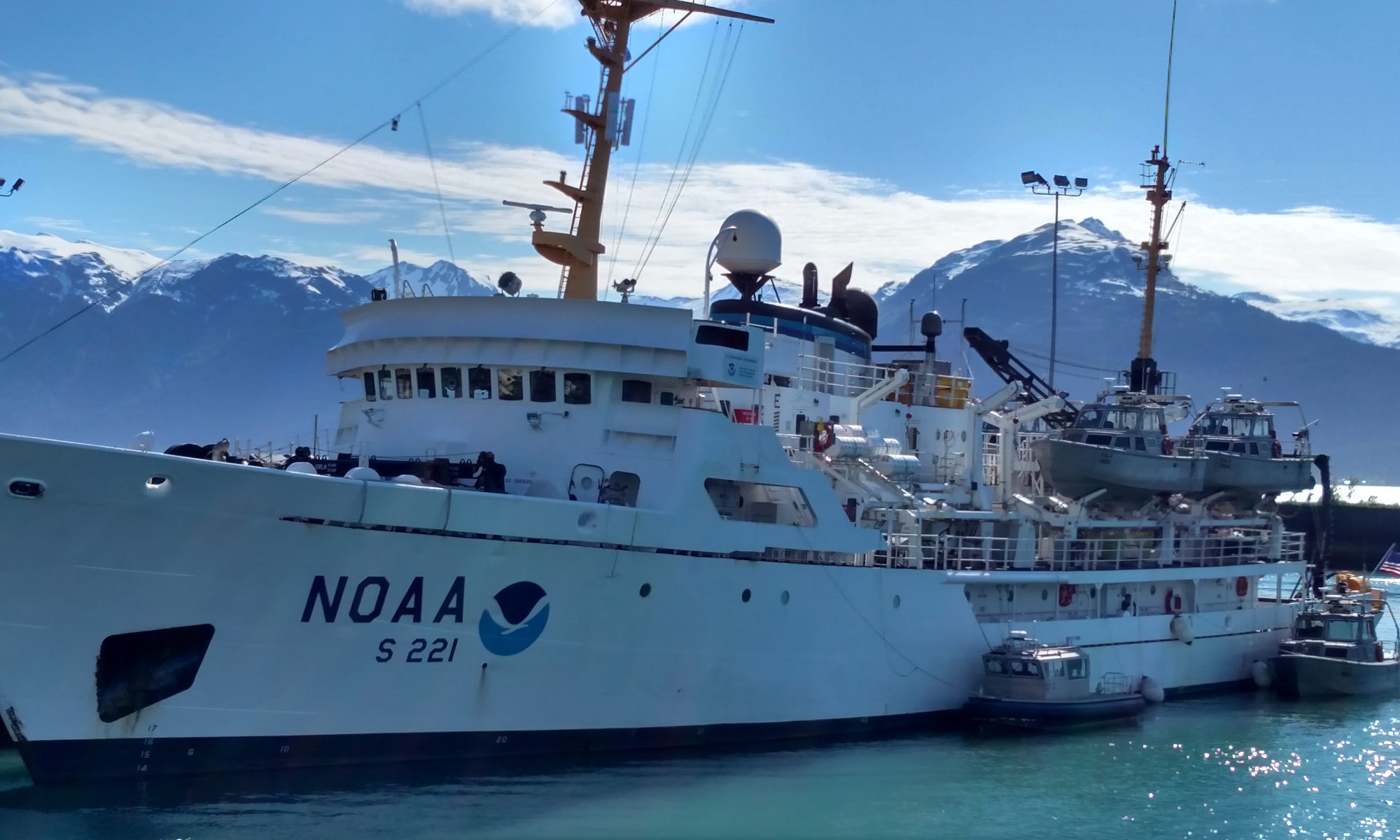
NOAA Ship Fairweather

During the field season, Fairweather spends about 210 days at sea. During the rest of the year, the Fairweather stays at her homeport, allowing the crew to work on maintenance issues, take leave, work on the data and outfit the boat for the following season. During the field season, the boat conducts different legs of the research, spending 12-20 days out at sea at a time before returning to a port to re-supply. There are six departments on the ship: Command, Deck, Electronics, Engineering, Steward and Survey. Each person on the ship is hired with specific duties and responsibilities.

As a government vessel, the Fairweather is also available for use during the time of war or in case of an emergency. In the event of something along these lines, the ship and the officers would be transferred to the Armed Forces of the United States.

The Fairweather is named after the tallest peak in the Fairweather range in Alaska. The ship served in Alaskan waters for over 20 years but was decommissioned in 1988. In 2004, due to increasing demand for modern surveys in Alaska, it was retrofitted and put back in to the research fleet. Previously staterooms housed up to 4 people, but after the retrofit a maximum of two people share a room. The boat can house 58 people in 24 single staterooms and 17 double staterooms. The boat itself is 231 feet in length and 42 feet wide. Its cruising speed is 13 knots, with a survey speed of 6-10 knots.ย ย  The Fairweather has 7 levels, A-G, each containing many rooms and areas essential to the mission of this ship. Wires and pipes run throughout the ship with sensors monitoring equipments, sensors ready to trigger if needed. Lower levels of the ship contain tanks, ballast and engines. Diesel, drinking water and grey water are stored in the tanks. The next three levels contain staterooms, lots of machinery and storage, the Mess, the Galley, laundry, labs, the sick bay and one deck with small boat storage. The last two levels contain the ships Navigation Bridge, the data processing center, electronics office, and lots more equipment.

Personal Log

A few days in to my journey with the ship, things are starting to make more sense. While there are still doors I havenโ€™t opened and rooms I am sure I have not been to, I feel that I am getting a better sense of the Fairweather and how it works, the roles that people play, and a slightly better understanding of what it means for home to be a ship.

There is a lot going on. Unlike many of the fisheries boats, where science staff works on a shift system, here on the Fairweather, much of the hydro data acquisition needs to be done on the small vessels during daylight. After the 8am meeting, boats are launched and the survey crew leave for the day. Meanwhile the rest of the scientists and survey crew works with the previously acquired data. Shift systems are in operation for most of the rest of the staff. There are always engineering projects and issues to sort out on a boat of this size, and engineers are always available and always problem solving. There are always NOAA Corps officers and deck crew on the bridge to monitor the ship and coordinate communication. From early in the morning there is always food to prepare, parts of the ship to be cleaned and decisions to be made, reviewed and modified. Somewhere around 4:30pm the survey boats return. Meal times and group meetings are places where most of the crew comes together to hear about how the day has gone and what is needed for the next day. After dinner, there is still work to be done. The dayโ€™s data needs to be processed in order for the plans for the next day to solidify. Small boats are checked after their day in the water, re-fueled and parts fixed if need be. After working hours the ship is patrolled hourly to make sure equipment is working and things are safe.


In between all these jobs, the crew does have down time. Those on a shift system hopefully manage to get some decent sleep, even if it is daytime. Laundry gets done. Personal emails are sent to communicate with families. Movies are watched in the lounge/conference room. Showers happen. People visit the exercise room. The ships store opens up for a while each night, allowing crew to splurge on a bag of chips or a candy bar. So, itโ€™s a busy place. Whether itโ€™s visible or not, there are always things going on.


In some very simple ways it is no different to your home or mine. There is food, shelter and water. In most other respects, it is very far removed from living on land. Most people donโ€™t have breakfast, lunch and dinner with their work colleagues. Here we do. Most people donโ€™t have bedrooms without windows in them. Here we do. Most people donโ€™t have the floor swaying beneath their feet due to wave action. Here we do. And for what itโ€™s worth, most people donโ€™t get to look over the deck and watch curious sea otters swim by, knowing that a whale may breach any minute. Here we do.


Fact of the day:

NOAA has nine key focus areas: Weather, Climate, Fisheries, Research, Satellites, Oceans and Coasts, Marine and Aviation, Charting and Sanctuaries. NOAA employs 12,000 people worldwide, of which 6,773 are scientists and engineers studying our planet. NOAAโ€™s roots began over 200 years ago with the establishment of the U.S. Coast and Geodetic Survey by President Thomas Jefferson. In 1870 the Weather Bureau was formed closely followed by the U.S. Commission of Fish and Fisheries. In 1970 these three organizations became the beginning of NOAA. For more information: http://www.noaa.gov/about-our-agency

Word of the day: Knot

Knot, in nautical terms is a unit of speed. ย One knot is the equivalent of going one nautical mile per hour.

What is this?

What do you think this is a picture of? (The answer will be in the next blog installment).

IMG_0269

(Previous answer: The picture is of a light and whistle that are attached to my PFD (personal flotation device).

ย Acronym of the Day

MPIC: Medical Person In Charge